An interview at High-End Vienna 2026 with AIDAS Cartridges of Kaunas, Lithuania, the boutique maker of handmade moving-coil cartridges in mammoth tusk, true-stone, and gold
The High-End show returned to Vienna this spring, and somewhere between the grand listening rooms and the low hum of electronics warming up, one of the smallest objects in the entire building was quietly doing some of the most remarkable work. A phono cartridge is barely larger than a thumbnail, yet inside it lives a hand-wound generator whose coils are finer than a human hair, riding a record groove with movements measured in millionths of a millimeter. Few people understand that delicate art as intimately as the team behind AIDAS Cartridges, the boutique Lithuanian manufacturer we sat down with in the AIDAS room.
The setting suited the subject. High-End, the most important European gathering of the year, had decamped from its long-time home to Vienna’s Austria Center, bringing with it the familiar ritual of darkened rooms, hushed conversation, and systems coaxed slowly up to temperature. Amid the towering loudspeakers and refrigerator-sized amplifiers, the AIDAS table was an exercise in restraint: a handful of jewel-like cartridges arranged under the lights, each representing hundreds of hours of work that would never be visible to the naked eye. It is easy to walk past a cartridge at a show like this. It is much harder, once you understand what goes into one, to forget it.
AIDAS Cartridges is the work of two men from Kaunas, Lithuania’s second city: master craftsman Aidas Svazas, who designs and builds every cartridge by hand, and Donatas Tamosiunas, who joined us to talk about the company, its lineup, and the philosophy that sets these cartridges apart. It is a genuinely small operation, “the two behind this company,” as Donatas puts it, and that intimacy is precisely the point. Everything is made in-house in their Kaunas laboratory, with the sole exception of the diamond and the cantilever, which are imported from the finest Japanese suppliers, Namiki and Ogura.
The story stretches back further than the brand itself. Lithuania was part of the Soviet Union until the early 1990s, and in those years, a curious young engineer had only a trickle of Western cartridges to learn from. Aidas Svazas got hold of a few, took them apart, and began to understand how these tiny transducers actually work. By the late 1990s, he was repairing and modifying cartridges for other people, and doing it so well that what customers received back often outperformed what they had sent in. That long apprenticeship in other makers’ designs became the foundation for his own. His first complete cartridge, the AS-1, appeared in 2010, carried a titanium cantilever, and found its way to the United States. The current line, the MK1 and MK2 generators, arrived in 2022 and remains in production today, the culmination, Donatas is happy to admit, of decades of patient refinement rather than restless reinvention.
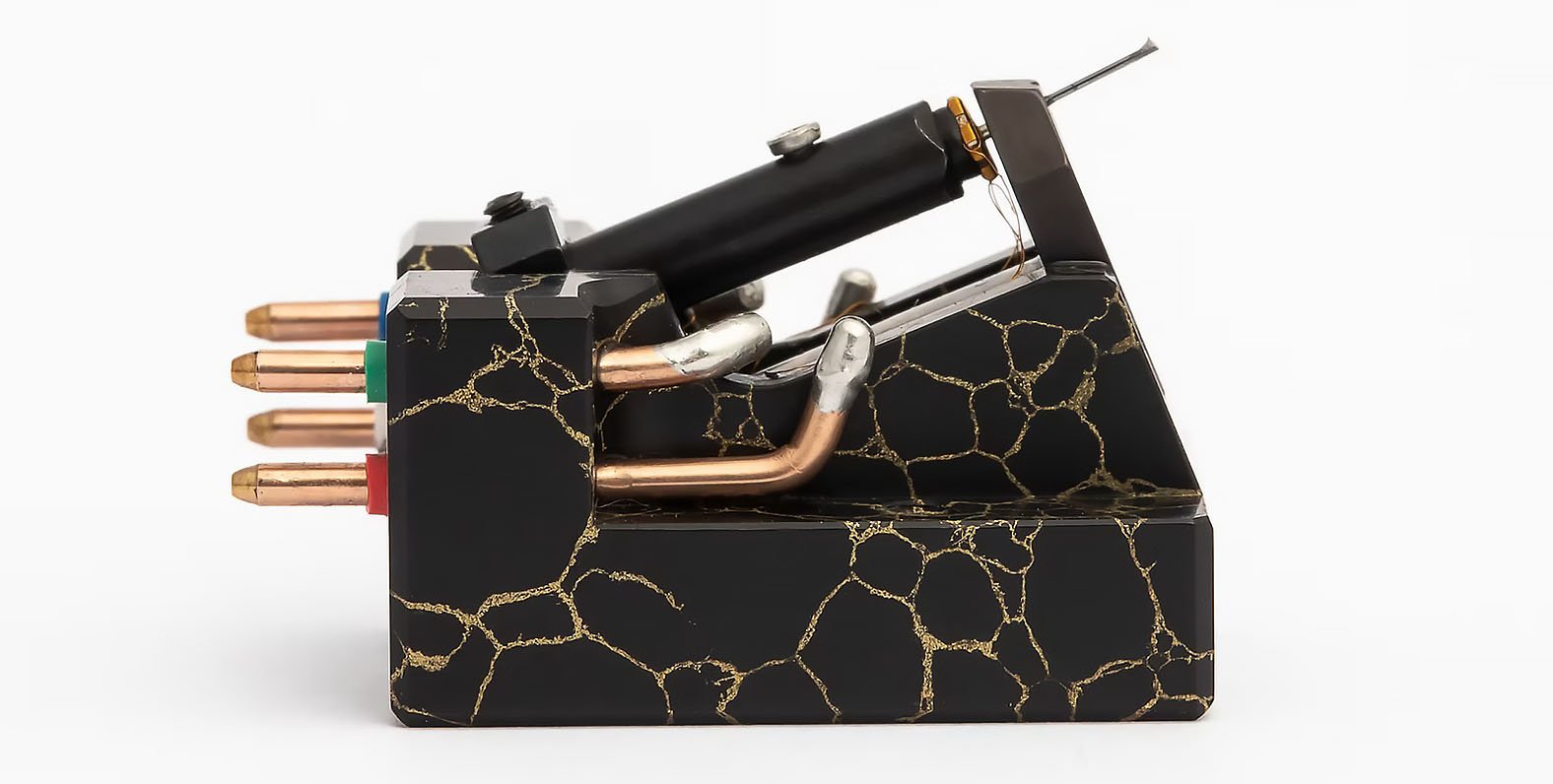
– Tru-Stone Gold Web (GOLD PL SERIES) –
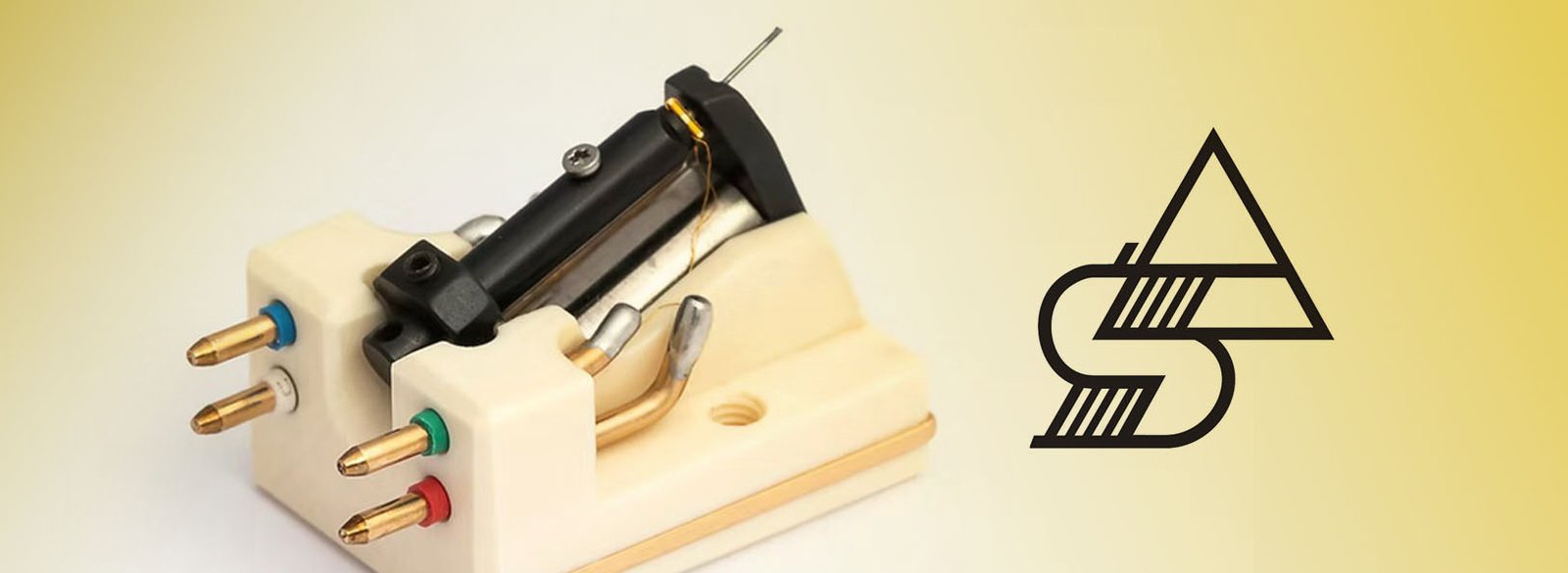
What emerges from that workshop is a family of moving-coil cartridges built around a shared philosophy and differentiated by two variables: the coil and the body.
There is a particular romance to where these cartridges come from. When Aidas Svazas began, Lithuania was still behind the Iron Curtain, and the Western moving-coil cartridges that audiophiles elsewhere took for granted were almost impossible to obtain. Scarcity bred ingenuity. With only a few precious examples to study, an engineer’s training and a great deal of patience, he learned to coax better performance out of cartridges than their original makers had managed, re-tipping, re-damping, and re-suspending them until they tracked more lightly and sang more sweetly. That repair work, carried out for clients across Europe and beyond, was the real apprenticeship; the AS-1 of 2010 was simply the diploma. The coils climb through four tiers, from copper to silver-plated and gold-plated copper and, at the summit, pure gold, each hand-wound and individually matched for inductance and impedance against the lab’s reference tools. The bodies are where the craft becomes almost sculptural: rare woods, a proprietary true-stone composite such as malachite, and, in the flagship Mammoth editions, genuine mammoth tusks that spent more than twenty thousand years frozen in the Siberian permafrost. Each of these materials does the same essential job, controlling and damping unwanted vibration, but each does it with a different voice.
That family is larger and more storied than its size suggests. Over the years, the workshop has produced an evocatively named catalog featuring the Malachite Silver, the multicolored Durawood and Rainbow models, and the sapphire-stylus Panzerholz, each built on the same unusual foundation: a distinctive generator architecture, a double-suspension system that eliminates the tensioning string most moving-coil designs rely on, and AlNiCo magnets chosen for their particular character. Reviewers have taken notice; at AXPONA 2024, an AIDAS cartridge helped earn one of the show’s most coveted rooms a Best of Show nod, and the brand now reaches listeners across Europe, the United States, and Asia. The flagship Mammoth editions, with their pure-gold coils and twenty-thousand-year-old tusk bodies, sit at the pinnacle of the range, while more attainable copper and silver models carry the same DNA down to earth.
To appreciate why those choices matter, it helps to remember what a moving-coil cartridge actually does. As the diamond traces the wall of the groove, it transmits its minuscule movements up a cantilever to a pair of coils suspended in a magnetic field; the motion generates a current measured in fractions of a millivolt, which, after a great deal of amplification, becomes the music. Everything in that chain is referred back to the body that holds it together, so the body’s rigidity and the way it dissipates stray energy are not cosmetic concerns; they are audible. The same is true of the coil: its material, its mass, even the insulation around the wire all leave a fingerprint on the sound. This is the territory Aidas Svazas has spent a quarter of a century mapping, by hand and by ear.
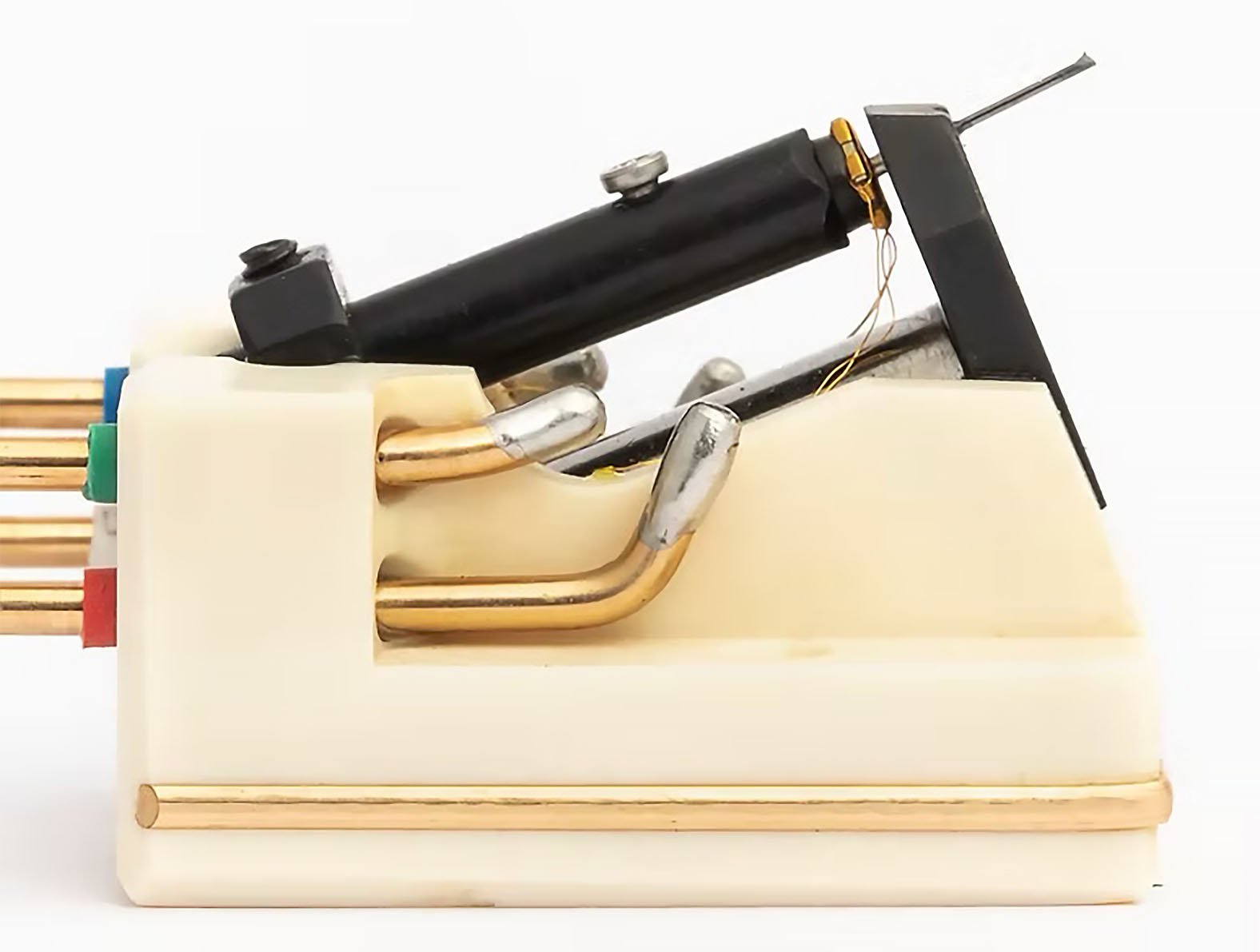
– Mammoth Gold (GOLD DESRIES) –
It is worth pausing on just how exacting this work is. A cartridge body must be stiff, dead, and dimensionally perfect, because everything the diamond reads in the groove is ultimately referred to it. The coils must be wound with absolute consistency, turn after microscopic turn, then matched as a pair so that the two stereo channels behave identically; a difference invisible to the eye is plainly audible as a wandering image or a tilted tonal balance. There is no automation to hide behind and no second chance once the assembly is complete. A single misplaced winding or a fraction of a gram of stray mass, and the piece begins again. This is craftsmanship in the truest sense, part engineering, part watchmaking, part listening, and it is exactly the sort of slow, human work that the high-end world exists to protect. We spoke with Donatas about all of it: the materials, the coils, the service philosophy, and the conviction, repeated almost as a mantra, that the final judge of any cartridge is the human ear.
None of this is inexpensive, and AIDAS makes no apology for it. The flagship Mammoth editions are limited, collector-grade objects priced accordingly, while the copper and silver models offer the same core engineering at an easier price point. The range is organized by coil rather than by body: at the time of writing, the entry-level copper series sits at around €4,500, the silver-plated and gold-plated copper models between roughly €5500-5900, and the pure-gold flagships, the Tru Stone Violet Gold 7000Eur, followed by the Mammoth Gold, start at about €9000, with figures varying a little by market and over time. And then there are the Limited Editions, such as Mammoth Gold LE, Baltic Amber Body Gold LE, and Mammoth Gold Mono. Servicing follows the same spirit: a re-tip and cantilever replacement costs only a few hundred euros, rather than anything close to the price of a new cartridge. What unites the line is a refusal to chase numbers for their own sake. AIDAS does not advertise record-breaking trackability or laboratory-perfect channel balance; it advertises a sound and trusts the listener’s ear to confirm it. In a hobby increasingly seduced by specifications, that is a quietly radical position, and, as our conversation made clear, a deeply held one.
Before turning to the interview, we want to thank Donatas Tamosiunas for his time and for the openness with which he shared details of a craft most makers keep behind closed doors. The conversation below preserves Donatas’s own words, lightly edited for clarity and readability.
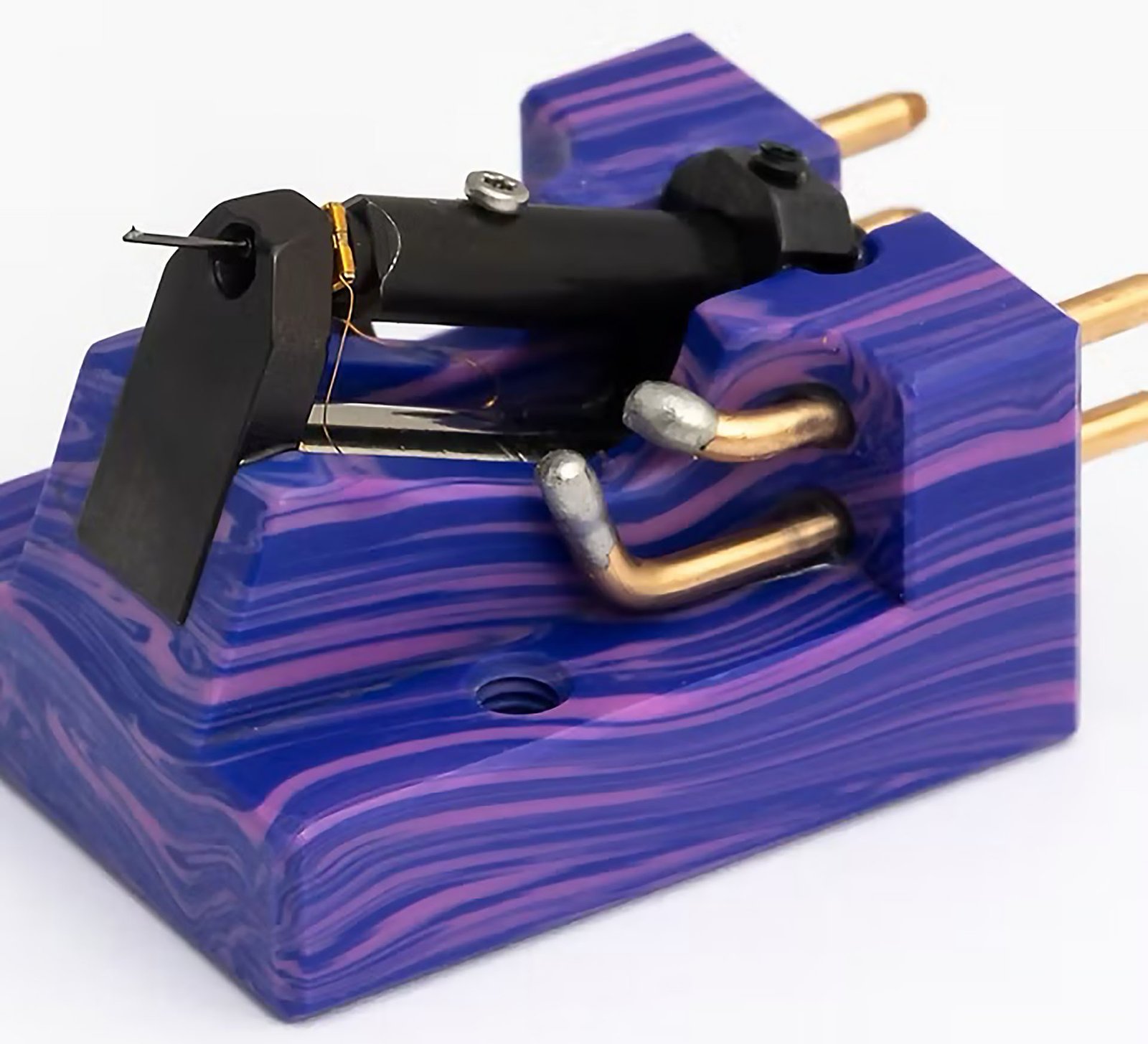
– Tru-Stone Violet Gold (GOLD SERIES) –
On the Company, the Craft, and the Lineup
Let’s start at the beginning. Who is Aidas Cartridges, and what makes your work unique?
My name is Donatas, and I’m from a company called AIDAS Cartridges. We are based in Kaunas, Lithuania, and Mr. Aidas and I are the two people behind this company. Aidas makes these beautiful handmade cartridges himself; everything is made in-house, except for the needle and the cantilever, which are imported from Japan, from suppliers such as Namiki or Ogura. Most of our cartridges use the Namiki micro-ridge stylus, while our limited-edition Mammoth Gold uses the Ogura PA microline, a slightly different stylus. It has slightly different edges where it meets the groove, and it draws a little more extraction from the groove at the very high frequencies. So, what is unique? We have unique bodies and four different types of coils in our lineup. We start with the copper coil; then, as we step up, we move to a silver-plated coil, a gold-plated coil, and finally the pure gold coil, as you can hear in the Mammoth Gold.
Let’s talk about those coils, especially the gold, which you almost never see in cartridge coils. Most makers treat their higher resistance as a liability. Why pursue it?
Aidas spent many years researching different wire types for the coils, and it is not all about the wire itself: the insulation is also very important. He found the best insulation, the one that sounded best with the gold material, and it’s a special Teflon insulation for the gold. The gold wire is quite rare in the audio business. The resistance of the gold wire is not very desirable compared with silver, but in a cartridge we use so very little wire that what we gain instead is a very rewarding sound, rich, but not too much; a very smooth tonal character that is still highly detailed, yet never glaring, never harsh. So we have a very, very beautiful sound, which is why we use this coil at the top of the line in the Mammoth Gold.
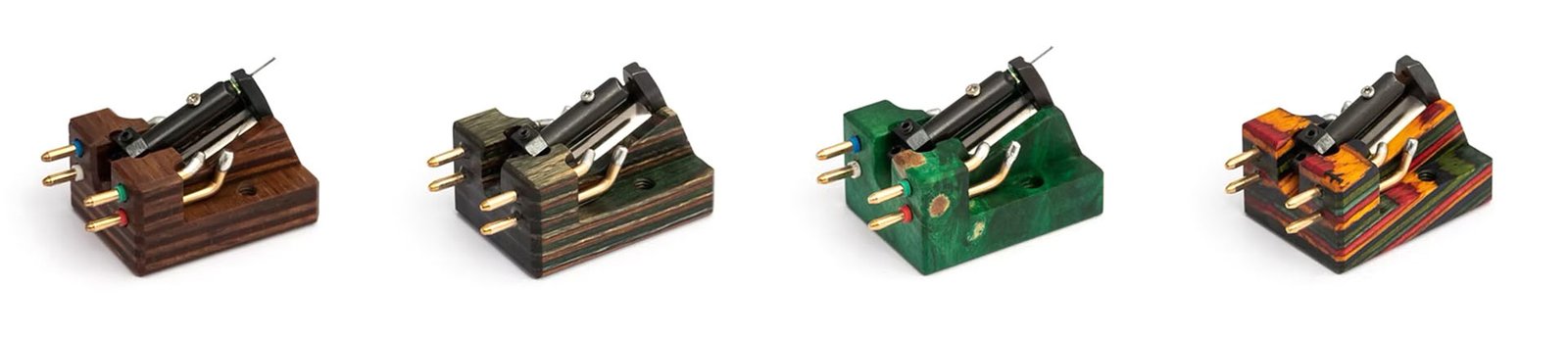
– COPPER SERIES: Panzerholz, Durawood, Wood Composite, Durawood Bee –
On Materials, the Mammoth Tusk, and Damping
If the coil is the cartridge’s voice, the body is its temperament, and it is here that Aidas has built much of its reputation. The flagship’s body may be the most unusual material in all of high-end audio.
The body of that flagship is a genuine mammoth tusk, a material with a story all its own. Tell us about it, and how you came to use it.
Apart from the coil, we use a very special material in our top-of-the-line cartridge: mammoth tusk, which is around 22,000 years old. This material is imported from Siberia, and it is completely legal. The same material is openly available in Germany, and we had it checked in a laboratory in the United States, where the age came back at roughly 21,000 years. The material has very special properties. It is not like bone or horn. In our limited editions, we have tried other types of horn, such as American buffalo horn and Tibetan yak horn, but those materials are softer. The tusk is very special: it sat in the ice for some 21,000 years, so it is stiff, dry, and dampens sound in a unique way. And so we have a great result.
Is anyone else doing this? It feels like territory you have largely to yourself.
I think someone tried, a Japanese company, many, many years ago, I was told, but it was a very, very long time ago. Today, other companies work with exclusive materials, such as stone. But we never use solid stone: stone is fragile and heavy, and it doesn’t dampen the vibrations we need to dampen. What we do use is a true-stone material, for example, our malachite, which combines stone dust with a special resin. It dampens vibrations well and is very good for the cartridge. So it’s a proprietary mixture, and a good thing for the cartridge. We also use wood materials in the copper series, which are likewise very desirable and good for the sound.
So across the range, you are really offering four different voices, all from the same foundation. How should a listener think about choosing between them?
Yes, we play with four different sounds in our series. As we move up from the copper series to the gold series, they all share the same good Aidas sound and fundamental character, with more flavor and detail as you climb. Whether you choose the copper or gold series, you will never be disappointed. It isn’t as though one is a completely different cartridge from another: it’s the same generator, the same good technology, the same R&D behind it, simply offered in a more widely available package. The sound is really good across the whole range.
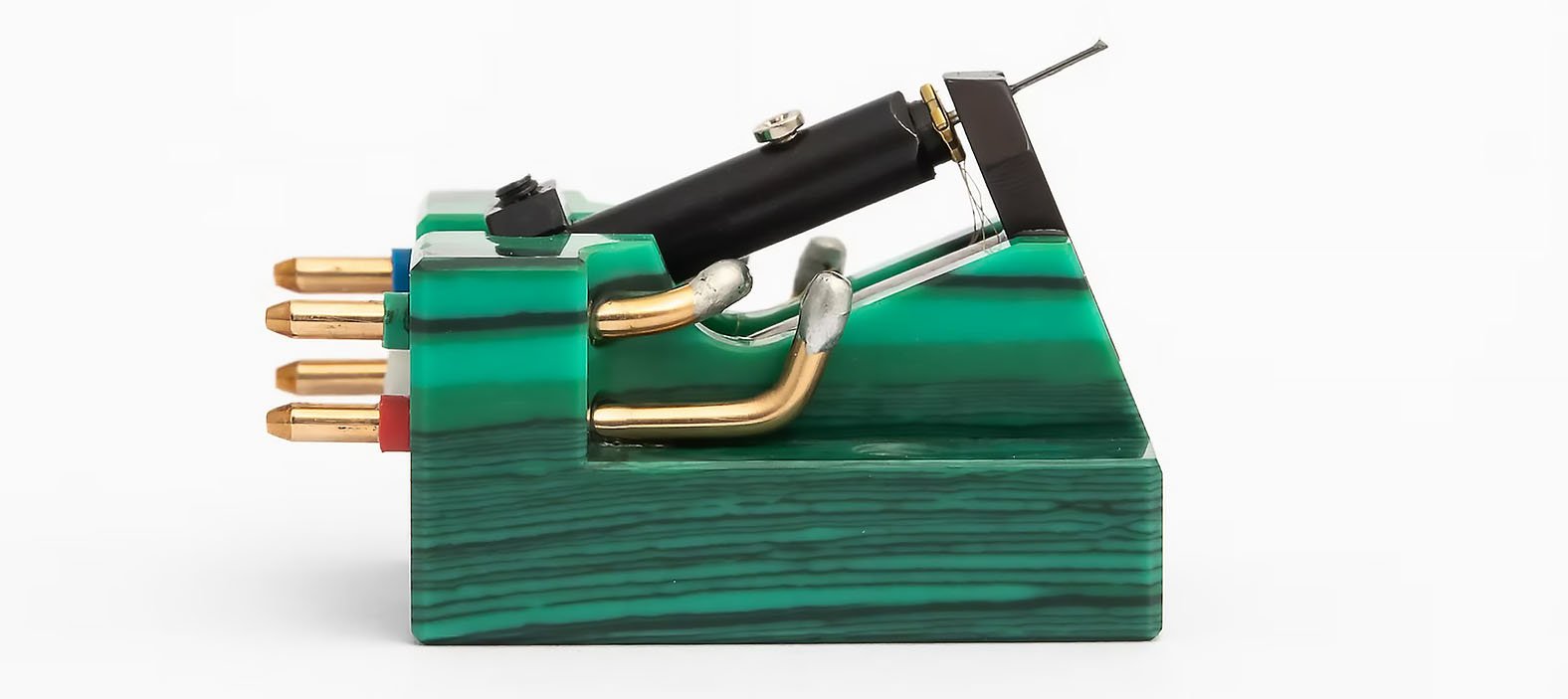
– SILVER PL SERIES: Malachite Silver –
On Craftsmanship, Service, and Origins
For all the romance of mammoth ivory and gold wire, what ultimately defines a boutique cartridge is the discipline of its making, and the question of what happens years later, when a beloved stylus finally wears.
How much of that consistency comes down to the way each cartridge is actually made, the part the customer never sees?
A great deal. One of the reasons we achieve such a balanced sound is a very, very strict process in the making, particularly in the making of the generators and the coil windings. The quality control is so strict. Each cartridge is made by hand; each coil is hand-wound and checked many, many times. The inductance and impedance of each coil are perfectly matched using our laboratory tools, and we can really feel it in the end results. So we are very glad that audiophiles enjoy our products.
You are also known for being unusually fair in servicing. For a cartridge at this level, that is not a small thing.
That’s right. Compared with much of the market, our approach to repair is unusual. This is a very limited-edition, very expensive piece of machinery, and customers naturally worry about what happens if it breaks or if the stylus simply wears out over time. We know that our customers want to keep it forever, so if it breaks, we can repair it; and if the stylus is worn, we can replace it together with the cantilever. The cost of that is very affordable compared with the rest of the market, very, very affordable. That is really important. Of course, we want our customers to be happy for many, many years.
Let’s go back to the very beginning. How and when did all of this start, in a country that for decades had almost no access to Western hi-fi?
It started a long time ago, twenty years or more, when Aidas first began to explore analog. You have to remember that Lithuania was part of the Soviet Union until the 1990s, so we had a very limited supply of Western cartridges, but he still managed to get hold of some. He has an engineering background, and with those cartridges, he began to explore the mechanics of everything and to make his own prototypes. After some years, he started repairing cartridges, and he did it very well, and from there he moved on to prototyping his own. Back in 2010, I think, he had his first model, the AS-1, which was really great and was available in the United States; it had a titanium cantilever on board. The latest models, the MK1 and MK2, came out in 2022, and we have been producing them ever since. In fact, there hasn’t been much change in over four years, because this is the best he can do at the moment; most of the improvements were made by that date. For many, many years, he explored many wire types, many rubber types for the suspensions, and everything else, always trying to balance the sound against the parameters, trackability, and the rest.
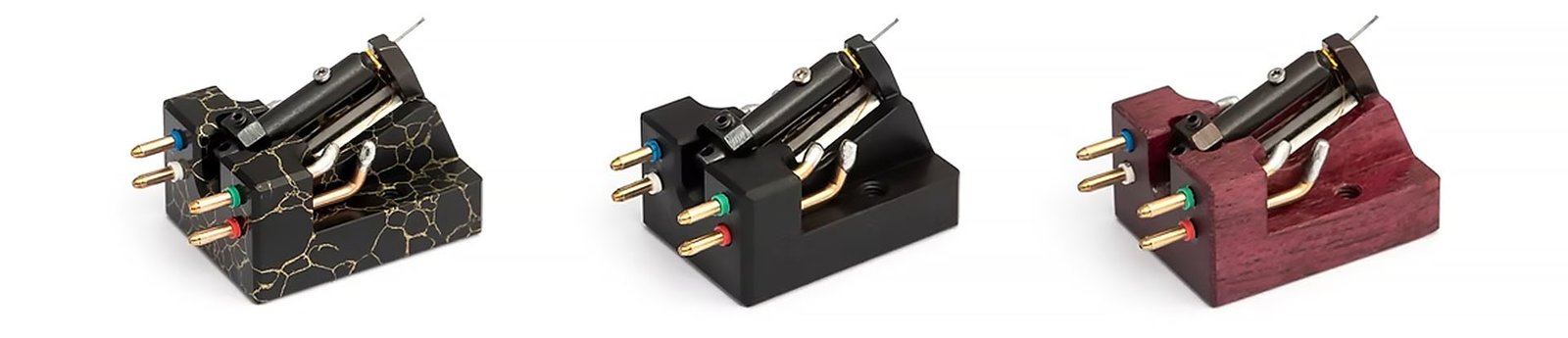
– GOLD PL SERIES: Tru-Stone Gold Web, African Blackwood, Brazilian Purpleheart Wood –
On Listening, Measurement, and Philosophy
We ended where every serious cartridge maker eventually does: with the question of how you actually know when a design is finished, and which instrument has the final word.
So you are not chasing the spec sheet. In an industry that loves to quote trackability and channel separation, that is almost a provocation.
No. We are not aiming for the best parameters, top-notch trackability, figures of 80 or 90, and so on. We are aiming for the best sound. You must always evaluate your results on the listening, on the listening, on the listening. Measuring helps you to find out what is wrong, or where you should go next, but the main tool for evaluation is your ears. Humans have the best measuring tools right here. Perhaps we lack the best words to describe what we hear, but the best tools for evaluation are our ears. For sure.
That feels like the heart of it. A lovely note to end on.
Yes. We are very excited that we have fans, and more and more of them each year. And we are grateful that we have fans in Romania; we hope to have many more there, too. Thank you all so very much.
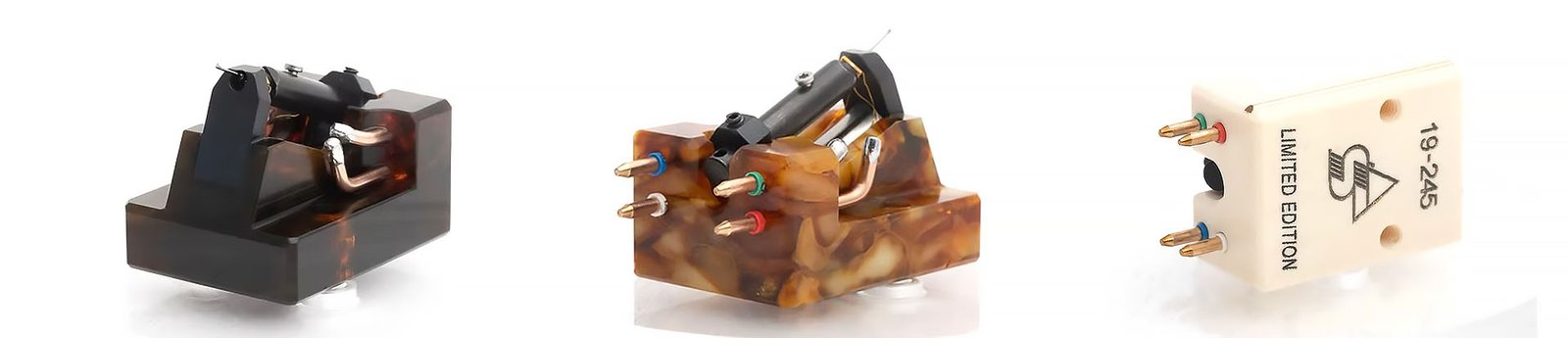
– LIMITED EDITIONS: Baltic Amber Gold LE, Mammoth Gold LE, Mmmoth Gold Mono –
It is a fitting place to leave it. In a building full of engineering superlatives and price tags to match, AIDAS Cartridges makes its case in a quieter register: two people in Kaunas, a workshop, a microscope, and a pair of trusted ears, turning ancient ivory and hair-thin gold into music. The whole enterprise rests on a conviction that the best instrument in any laboratory is the one nature already gave us, and that the only specification that finally matters is whether the record sounds alive.
As we wrapped up, Donatas returned more than once to the same two ideas: the fans and the gratitude. For a company this small, every listener who chooses an AIDAS cartridge is known almost personally, and that closeness is clearly something he and Aidas Svazas treasure as much as the sound itself. He was especially warm about the brand’s growing following here in Romania, and left us with an open invitation to anyone curious enough to come and listen. Judging by the steadily growing chorus of admirers, in Romania and far beyond, a good many already have. We thank Donatas and Aidas once again for their time, their candor, and their cartridges.
Interview conducted at High-End Vienna 2026 | Austria Center Vienna, the Aidas room
AIDAS CARTRIDGES, LITHUANIA
aidascartridges@gmail.com | www.aidascartridges.com