Let’s take a deep look at the story of Marantz because we believe that few brands in the entire existence of the high fidelity industry carry such a rich history, as emotionally charged, or as culturally consequential as this one. Learning where Marantz comes from is a beautiful way to understand what the Model 10 means, what it represents in our time and space, and why it creates such a big controversy.
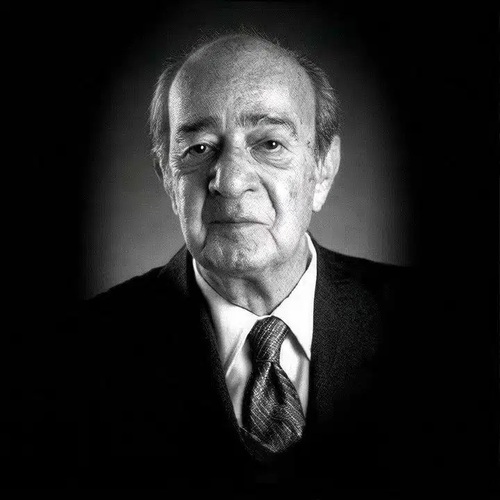
The story begins with Saul Bernard Marantz, born in 1911 in Brooklyn, New York. He was the son of Polish immigrants, a passionate music lover, an accomplished classical guitarist whose personal friendship with Andrés Segovia speaks quietly to the depth of his devotion to music, and a man constitutionally incapable of accepting mediocrity in sound reproduction of any kind. In the early 1950s, as the LP record was just beginning to reshape the landscape of home listening, Saul found himself genuinely frustrated. The equipment available to him simply did not do justice to the music he loved. And so, in the way that only the most driven and gifted people respond to such frustration, he decided to build something better himself.
What emerged from his kitchen table in 1952 was the Audio Consolette, a preamplifier of remarkable sophistication for its time. By 1953, demand had outgrown his kitchen entirely, and the Marantz Company was formally established in Woodside, Queens. The audio industry had just found one of its founding fathers, although none of them quite knew it yet.
Working alongside his trusted engineer Sidney Smith, Saul produced components that still carry the full weight of legend. The Model 7 preamplifier remained in production for eleven consecutive years. The Model 9 monaural power amplifier was so stable and authoritative that NASA chose a modified variant for use in tracking stations around the world as part of the Apollo space programme. A hi-fi amplifier built by a music-loving graphic artist from Brooklyn, deployed in the service of putting human beings on the moon, now that is something to be proud of!
By the mid-1960s, financial pressures led Saul to sell the company to Superscope, and by late 1967 he had walked away entirely, unwilling to compromise the vision he had built from nothing. He passed away in January of 1997, aged eighty-five, still curious, still listening.

And so, the Americanness of Marantz, so central to its founding identity, began its quiet erosion in 1964 with the company’s acquisition by Superscope, which and almost immediately moved its headquarters from New York to California. That relocation was only the first step. By 1966, Superscope, facing the commercial reality that American manufacturing costs were making it increasingly difficult to compete at accessible price points, struck a production agreement with Standard Radio Corporation, a Japanese manufacturer based in Sagamihara, near Tokyo. The arrangement was straightforward at first: design remained in America, assembly happened in Japan. But the centre of gravity was already shifting.
The consequences of that arrangement deepened steadily through the late 1960s and across the entire decade of the 1970s. The 2200 series receivers, the most commercially successful products Marantz ever produced and the components that introduced the brand to an entire generation of music lovers around the world, were Japanese-built. The engineers, the factory workers, and the quality control teams shaping what millions of people understood as the Marantz sound were Japanese. And in 1975, Standard Radio Corporation made the transformation explicit by changing its name to Marantz Japan Inc., formally cementing in the company’s own structure what had already become true in practice.
By 1980, Superscope sold the Marantz brand, its dealer network, and all overseas assets outside the United States and Canada to Philips Electronics of the Netherlands. Philips, in turn, acquired the remaining North American rights in 1992, briefly making a European conglomerate the formal owner of what had begun as a Brooklyn kitchen table project. But the actual engineering, the actual manufacturing, the actual human soul of the company, remained in Japan throughout. When Marantz Japan Inc. reacquired the brand from Philips in 2001 and then merged with Denon to form D&M Holdings in 2002, it was less a takeover and more a formal acknowledgement of something that had been true for decades.
Japan had built Marantz. Japan had sustained Marantz. And it was in Japan, specifically at the Shirakawa Audio Works facility that became Marantz’s manufacturing heart from 2002 onward, that the brand’s most enduring and most celebrated engineering work continued to take shape. The Model 10 is a Japanese product in every meaningful sense of the word, conceived, engineered, hand-tuned, and built at Shirakawa by a team carrying forward a lineage that has been Japanese in practice since 1966, regardless of what any corporate ownership document ever said.
All this history lesson tells us that the brand survived ownership changes, corporate restructurings, and the arrival of the digital age with its identity remarkably intact. The champagne faceplate, the symmetrical knob arrangement, the signature porthole display first seen in 1960, the HDAM circuitry pioneered in the late 1960s and still present in Marantz’s finest components today. These are statements of continuity from a company that understands its own lineage and chooses to honour it.

Perhaps no single figure better embodies that continuity than Ken Ishiwata, the engineer who would become Marantz’s Sound Master. It was Saul Marantz himself who, in his later years, reached out to Ishiwata with words that have since become part of the brand’s living mythology: that he had done as much as he could with mono and stereo LPs, and that now it was Ishiwata’s turn to do something with the compact disc. The KI Signature products that followed elevated Marantz to the status of a brand recognised as the bearer of a specific and deeply considered musical philosophy. Warmth and softness, resolute without any hint of sterility. A sonic character that draws the listener toward the true emotional heart of a recording.
After years of corporate transition and a gradual blurring of its identity within the D&M Holdings structure shared with Denon, Marantz made a clear and public commitment around 2020 to reimagine itself as a high-end focused brand. That process took five years of engineering work at Shirakawa Audio Works, conducted with a blank-page mentality and complete freedom from cost constraint. The engineers were asked a single question: what is the best integrated amplifier Marantz is capable of building? The price was determined only after the answer was found. What emerged from that process is the Model 10 Reference Integrated Amplifier, the most powerful and most ambitious single component the company has ever produced, the centrepiece of the new 10 Series Collection alongside the SACD 10 and the LINK 10n, and the clearest statement Marantz has made in decades about exactly who it is, where it stands, and where it intends to go. It carries seventy years of history in its chassis. And it is, as we shall discover, genuinely controversial in the best possible way.
The Model 10 Reference Integrated Amplifier – Exquisite Construction
The Model 10 arrived on a Friday morning, and the rest of that day’s plans quietly dissolved. We spent a long time with it before connecting a single cable, turning it around, studying every connector, running our hands along the side walls, peering through the mesh on top, and reading the rear panel like a map of engineering prowess. We kept discovering new details to look at, in the same way one absorbs a painting without finish. At some point, we realised we had been staring at the thing for ten minutes but enjoyed every second of it. So there was a lot to understand even before listening began.
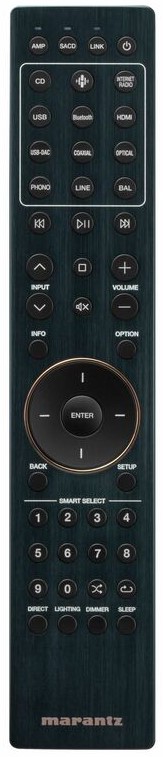
There is one thing we need to get off our chest before we move forward. The remote control. We are not sure what happened here, or who made this decision, but the remote control that ships with the Model 10 is genuinely bad. Not just slightly disappointing or a minor compromise, no. It’s utterly ugly and bad. It is dark green, a color that has nothing in common with the device, plasticky, covered in a plethora of useless tiny buttons with no backlighting, and it feels like it was pulled from a mid-range AV receiver from fifteen years ago. Holding it after seeing and moving the Model 10 around, feeling its aluminium knobs and copper-plated chassis, feels like a very bad joke. A $15,000 amplifier, built with this level of obsession and craftsmanship, paired with this remote? Marantz, why? This needs to change. At least give us the option to buy a properly thought-out one as an option, seeing as this one is shared between 3 devices.
Now that we have closed that chapter, we want to congratulate Marantz on a beautifully rendered presentation of the device on their official YouTube page. We will dissect and analyse each section further down the review, but please, be free to explore the video before, so you can have a general idea of the build.
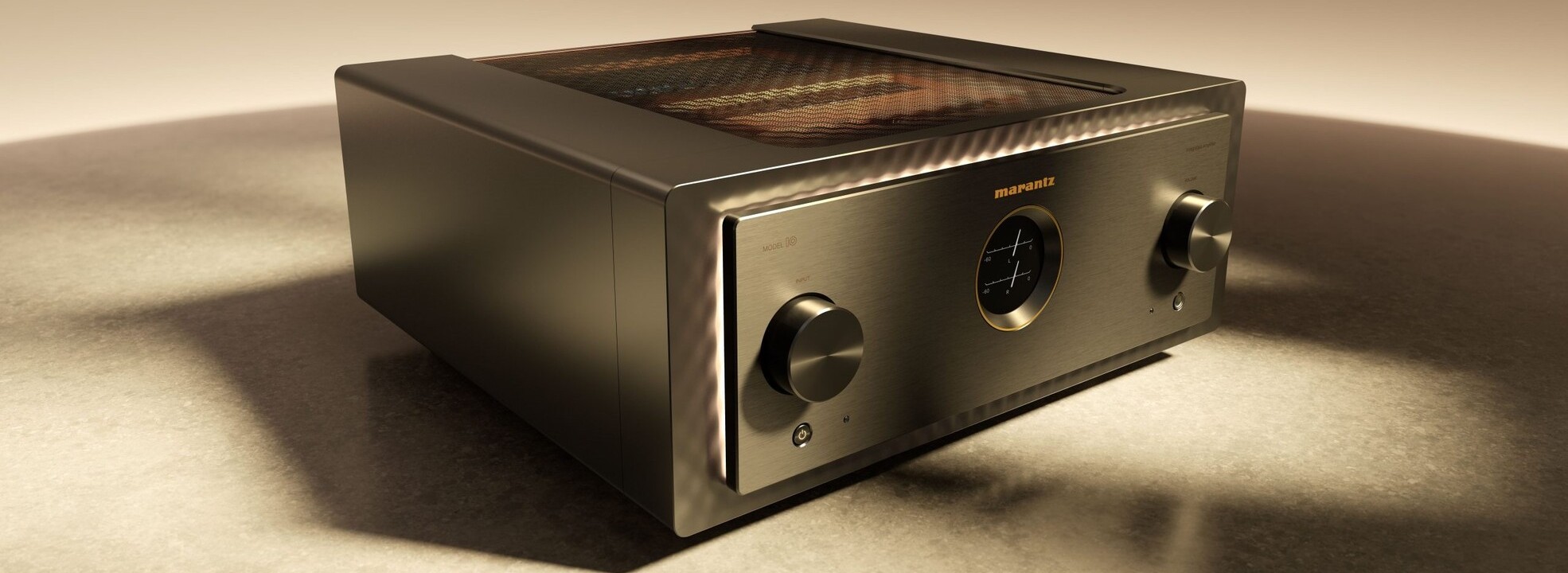
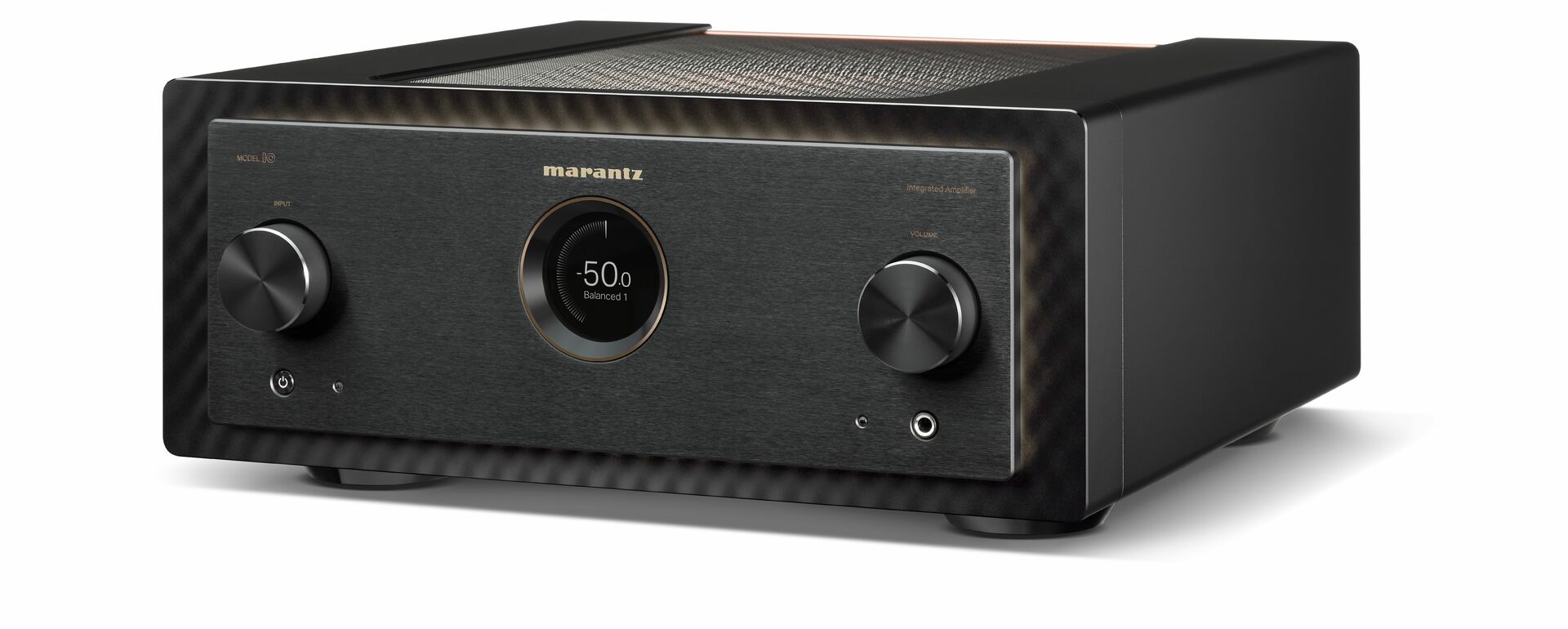
At the front, the Model 10 is dominated by three circles: the input selector on the left, the volume knob on the right, sitting on individual bearings that make them a pleasure to turn. Between them, the circular display showing volume level and selected input on a crisp OLED screen framed in dark metal. The same circular design has been present on Marantz amplifiers since 1960, and it still looks completely at home even in 2026, on the most powerful amplifier the company has ever made. The side panels carry a deep wave-cut texture that catches light differently depending on where you stand and creates a very nice visual effect. The floating centre panel glows behind the controls. Through the stainless mesh on top, you can already see the copper inside.
The front panel is machined aluminium at 4.5 millimetres of thickness, and the side covers at 15.8 millimetres, with a design that conceals every screw from the front and sides. Nothing interrupts the surfaces.
The rear panel is where the full ambition of the Model 10 becomes visible. Looking at it for the first time, your eyes need a moment to take everything in, because a lot is happening here, and all of it is done properly.
Starting from the left, a phono input covering both MC and MM, with a dedicated signal ground post. Below it, a recorder line out. Moving across, three sets of XLR balanced inputs, two sets of unbalanced RCA line inputs, power amp inputs, and preamp outputs in both balanced and unbalanced formats. That alone would satisfy most serious system builders. Then the speaker terminals, four pairs of Marantz’s own copper SPKT-100+ binding posts, arranged in two rows and built with the kind of solidity that makes you confident about the connection before you even tighten them. The F.C.B.S. Floating Control Bus System sits in its own dedicated section on the lower left, alongside the amp mode switch for stereo or bi-amp configuration, IR input and flasher, and remote control in and out. The AC inlet anchors the far right. There is also a dedicated ground terminal, which is why Marantz chose a two-pin IEC inlet and not the standard three-pin. The grounding is handled on their own terms, through their own circuit, avoiding the mains earth.
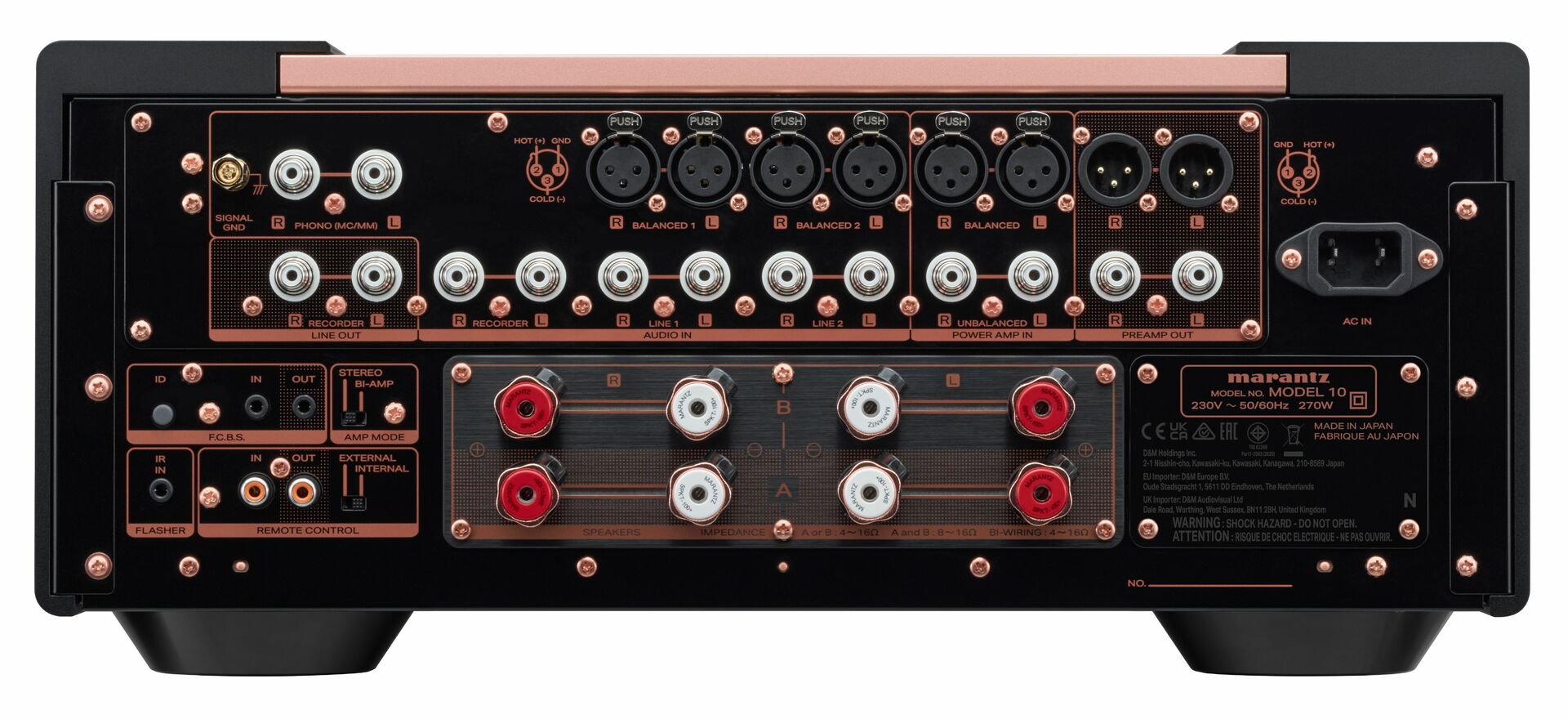
What the photograph also shows clearly, and what no specification sheet fully conveys, is the copper. The entire rear panel surround, the terminal labelling borders, the screw heads, everything here is real copper. Made in Japan, it says in the lower right corner. It does not need to say anything else.
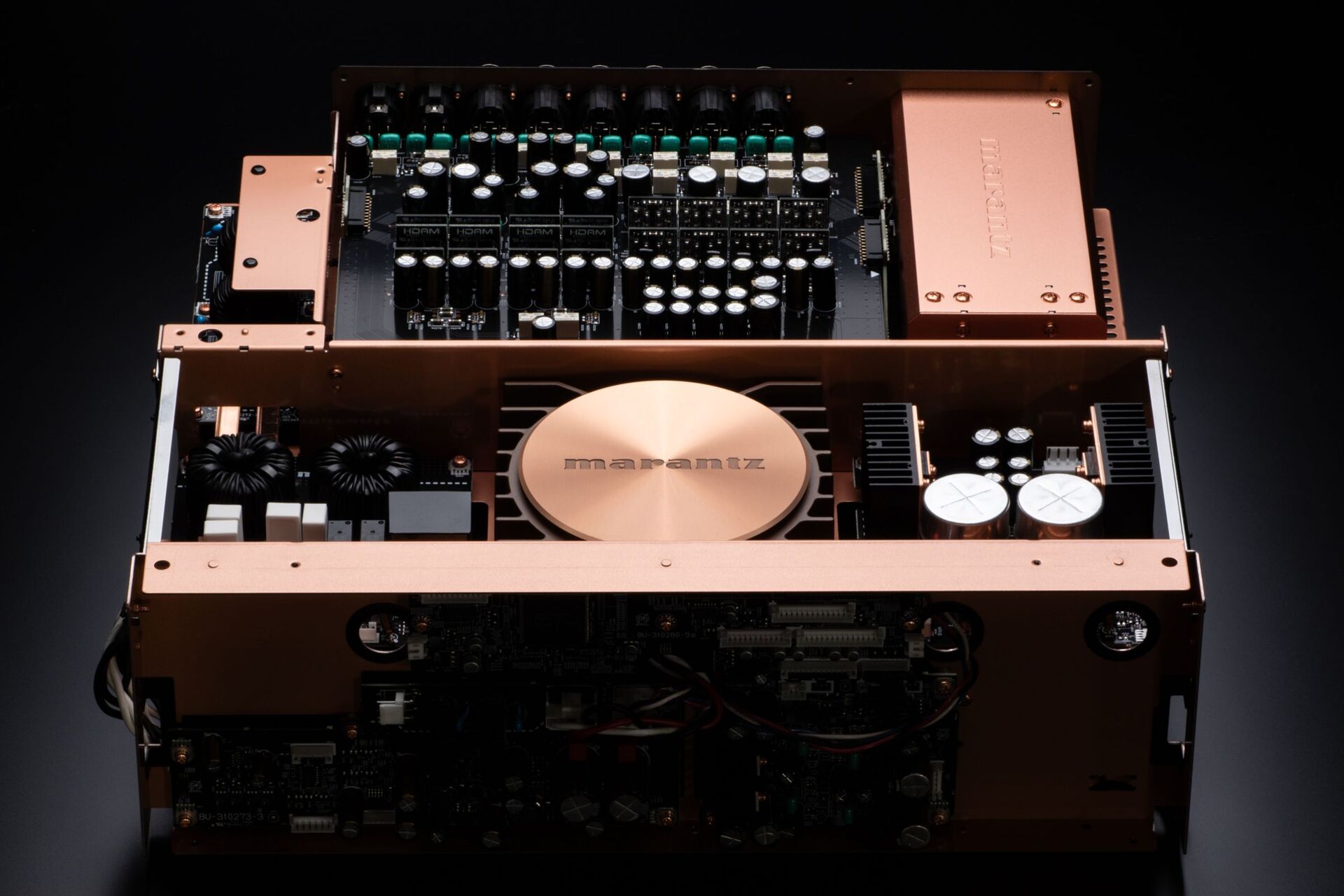
The upper layer is the preamplifier’s world. Starting from bottom left, we have the AC entry point, a line filter circuit that sits at the front of the signal chain, blocking high-frequency interference from travelling back into the power network and protecting the entire circuit from line disturbances and surges before anything else even begins. From there, a dedicated toroidal transformer serves exclusively the preamplifier section, wrapped in its own copper-plated shield plate, feeding an analogue power supply circuit built around a pair of 10,000 µF, 35v capacitors. That is a serious power supply by any measure, and it exists solely for the preamplifier, to keep the section as clean and stable, completely independent from the demands of the amplification happening below it.
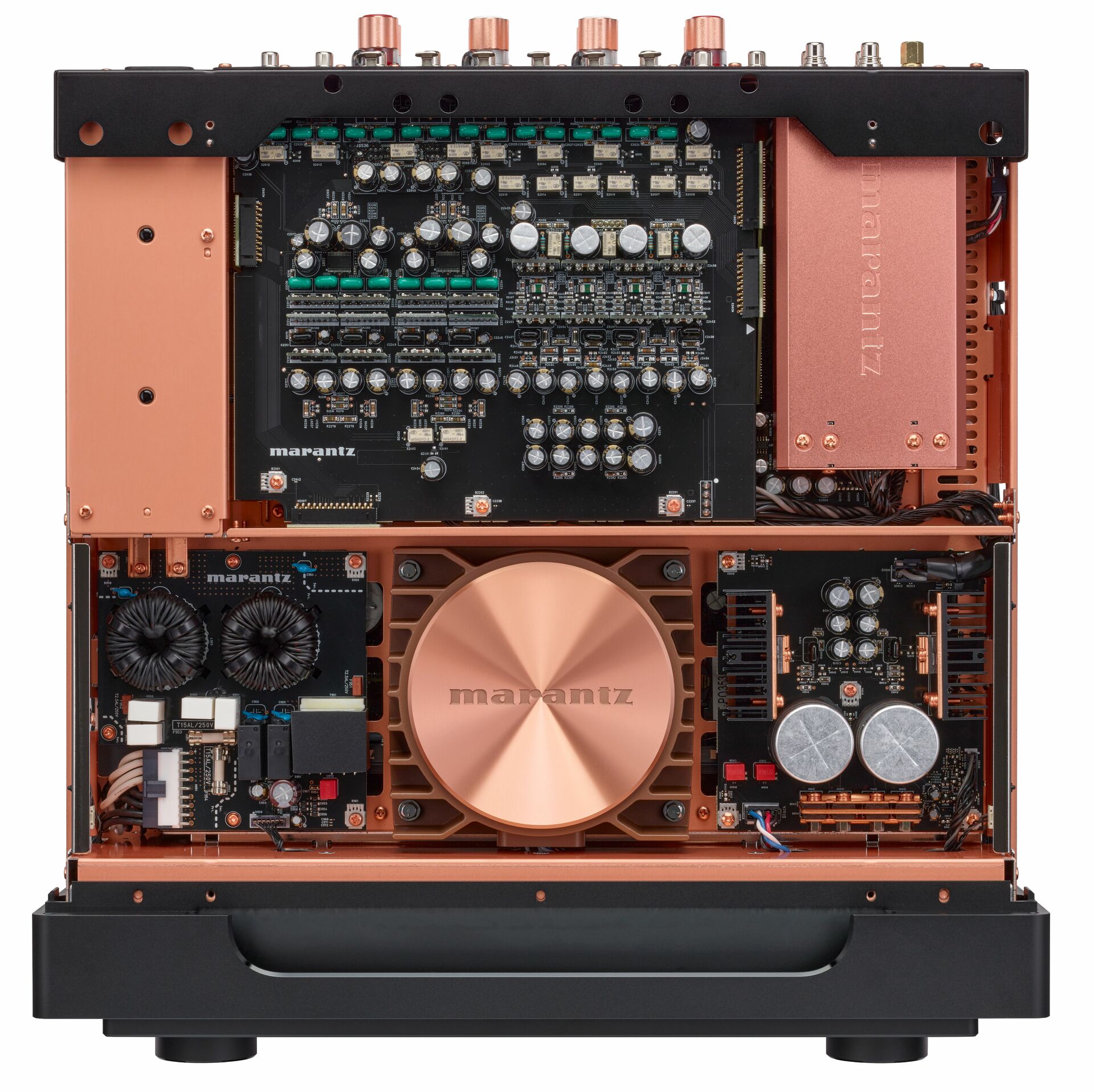
The phono stage has its own dedicated left and right equaliser boards, handling both MC and MM cartridges. In the middle, we can see the vertically mounted HDAM modules rising above the main PCB. The acronym stands for Hyper Dynamic Amplifier Module, and they are perhaps the most important piece of proprietary technology in the entire Marantz engineering vocabulary. The story behind them is worth reading.
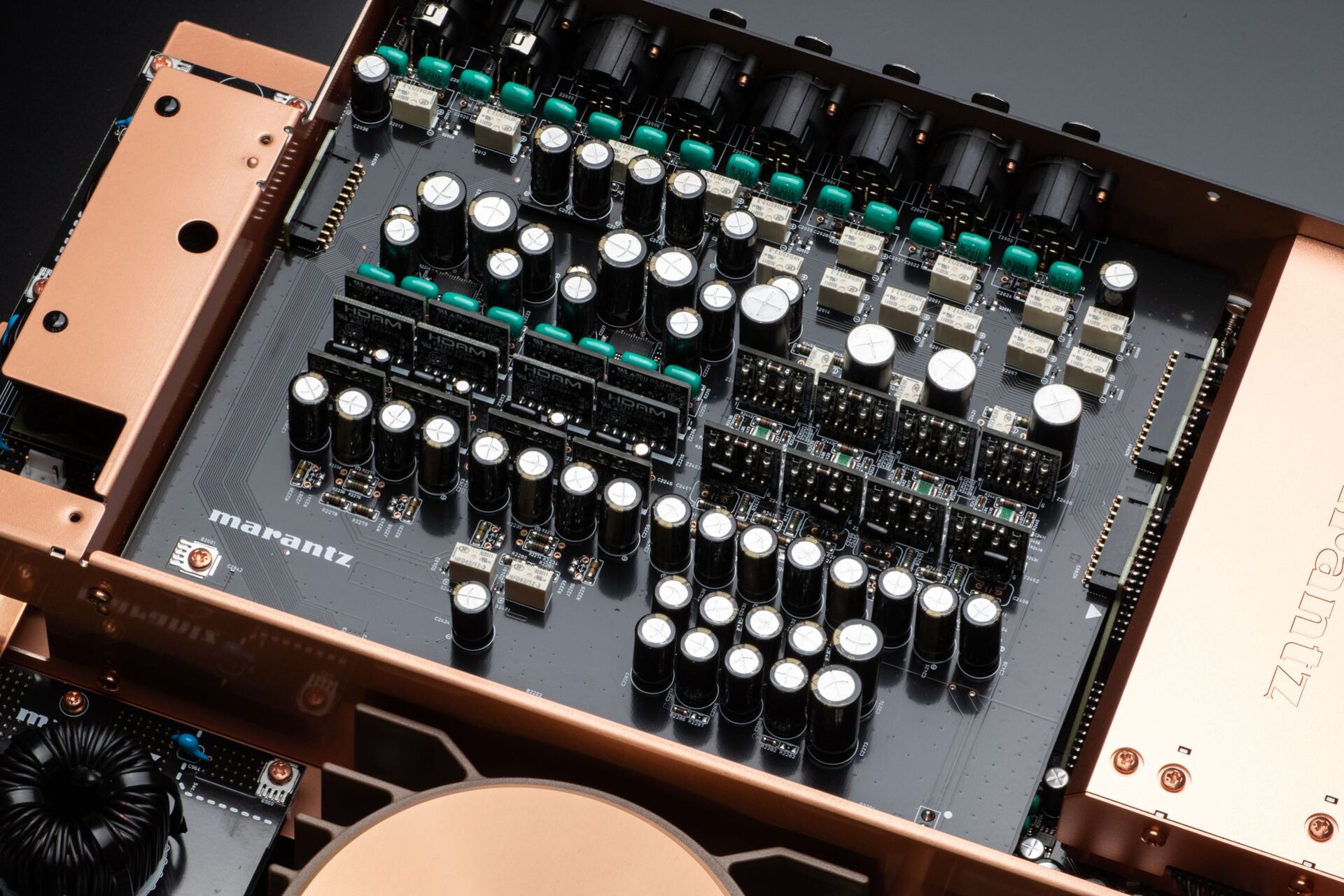
Standard operational amplifier chips, the IC op-amps found in the signal paths of most amplifiers at every price level, are convenient, consistent, and inexpensive. They are also a compromise. Their slew rate, which is the speed at which the circuit can respond to a changing signal, is limited by the nature of integrated circuit design, and that limitation has a direct and audible effect on dynamic transients, high-frequency resolution, and the sense of immediacy in the sound.
Marantz’s answer, first introduced in 1992 with the PM-99SE integrated amplifier, was to replace the IC op-amp entirely with a stamp-sized discrete circuit module built from individual transistors and resistors, hand-selected and assembled to a standard that no mass-produced chip can replicate. The original HDAM delivered approximately 70 decibels of raw gain with a slew rate of 70 to 80 volts per microsecond, figures that put it in a completely different performance category from anything a standard op-amp could offer. It was a genuinely radical decision at the time, and the sonic results made it one of the defining characteristics of the Marantz house sound from that point forward.
The module has been developed continuously across more than three decades since then. The New HDAM arrived in 1994 with improved slew rate and signal-to-noise ratio. The adjustable HDAM followed in 1997, adding the ability to fine-tune DC offset directly within the module itself, eliminating the need for DC servo circuits in the signal path, a change that was both technically cleaner and sonically beneficial. The HDAM-SA arrived in 2002 as a unity-gain buffer amplifier designed specifically for current feedback loop topologies, and the HDAM-SA2 and SA3 generations followed, each one refining the circuit further with additional transistors, tighter component matching, and lower noise floors.
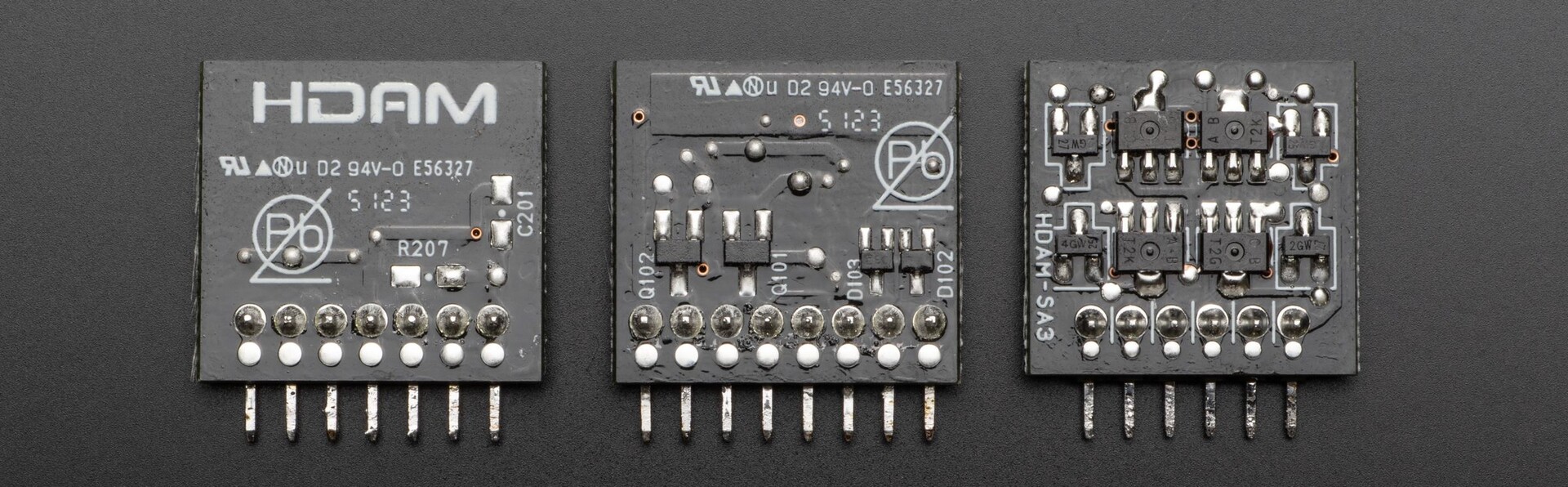
The modules in the Model 10 are the latest SA3 generation, and in this application, they serve the preamplifier and phono stages in a fully symmetrical dual-mono arrangement. The phono equaliser boards each carry their own dedicated HDAM module, and the main preamp board carries further SA3 modules at every critical point in the gain and buffering chain. When Marantz says the Model 10 uses their most advanced preamplifier section to date, the HDAM story is a large part of what they mean. These are the same modules that Ken Ishiwata spent decades refining, the same technology that has been at the heart of every serious Marantz component since 1992, now in their most developed form, inside the most powerful amplifier the company has ever built.
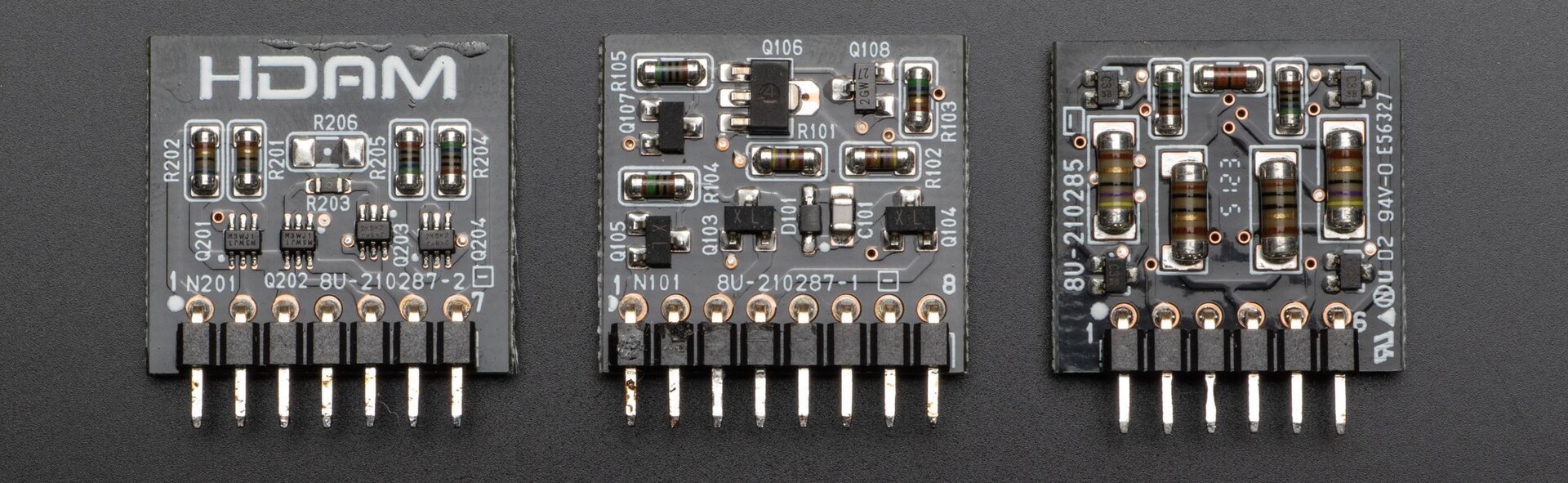
The volume control at the heart of the preamp section is handled by a MUSES 72323, one of the finest audio-grade volume control ICs available, chosen specifically because Marantz wanted the gain stage to be as transparent and as musically accurate as the rest of the circuit surrounding it.
Before we go further into how the Model 10’s amplifier section is built, we need to talk about Class D, because this is where the controversy begins, and it is a controversy worth understanding properly.
We are not strangers to Class D. Over the years, we have spent time with amplifiers built around ICEpower modules, Hypex UcD, Ncore and Nilai, Pascal, and Purifi implementations from various manufacturers. We have heard what these technologies do well, and we have heard exactly where they fall short. The ICEpower units we tested had a kind of grain to them, a hardness in the upper frequencies that made extended listening sessions tiring in a way that good amplification should never be. The older Hypex UcD designs carried the same characteristic Class D pallor, a slight thinning of body, and lack of warmth that made instruments sound slightly smaller and less present than they should. Even the Ncore generation, which was a genuine step forward and powered impressive amplifiers, still had moments where we became aware of the technology behind the music not just the music itself. Early Purifi implementations, heard through various manufacturers who used the modules with different input stages and power supplies, showed the enormous potential of the underlying technology but also revealed how much the surrounding circuit matters. The module alone is a small part of the entire story. We say all of this because we want to be clear about where we are coming from when we discuss the Model 10. We have no romantic attachment to Class D, and we have no reason to be generous toward it simply because it is new or technically impressive. What we heard through those modules, across the years, gave us a very specific and very honest reference point for what Class D harshness and pale reproduction actually sound like in practice. And that reference point is exactly what made our time with the Model 10 so unexpected. But before we get there, the technology itself deserves a proper explanation, because what Purifi and Marantz built together for the Model 10 is genuinely different from anything we have seen and heard before it.
It is also worth noting that the Model 10 is not Marantz’s first encounter with Class D, and the pattern of how they have deployed it across their lineup is interesting. The AMP 10 multi-channel amplifier uses ICEpower output stages, a competent and widely used solution that makes practical sense in a device requiring 16 channels of amplification, where cost per channel is a real part of the engineering design. The Model 30 integrated amplifier steps up to Hypex modules, a meaningfully better technology deployed in a more focused two-channel context. And the Model 10, their statement product, gets Purifi, the most advanced switching amplifier technology available anywhere today. The progression is deliberate and completely logical. Marantz appears to choose their Class D partner based on the performance ceiling each product requires, matching the technology to the ambition of the device instead of standardising across the range for convenience like so many companies do. Whether this reflects a broader strategy of evaluating the best available solutions at each price point, or whether Marantz is quietly building the knowledge and experience to one day develop their own switching amplifier architecture from scratch, only time will tell. What it tells us right now is that they understand Class D at a very high level, and that when the budget and the brief finally match, they will go straight to the top.
Just look at this beauty! Wonderful.
The core principle of class D is that the amplifying devices, the power transistors, operate as switches, not as linear amplifiers. They are either fully open or fully closed, switching at very high frequencies, and the audio signal is encoded in the width of those pulses. A low-pass filter at the output strips away the high-frequency switching noise and recovers the audio signal, now amplified. The efficiency of this approach is extraordinary compared to Class A or Class A/B, because a switch that is either fully on or fully off wastes almost no energy as heat. But the quality of that output filter, and the precision of the switching itself, determines everything about how it sounds.
For years, the problem was that early Class D designs used output filters with magnetic cores that exhibited hysteresis, introducing a form of distortion that was audible and very unpleasant, something so bad that standard feedback architectures could not fully correct. The sound that resulted was exactly what the audiophile community described: hard, grainy, and lacking the warmth and natural decay that music requires. We heard it ourselves, repeatedly, across different implementations and different price points.
When Bruno Putzeys and Lars Risbo founded Purifi Audio in Denmark the wanted to adress this essential problem. Putzeys had already transformed Class D once before, with his UcD and later Ncore topologies developed at Hypex, which set new performance benchmarks and powered a generation of highly regarded amplifiers. Purifi was his next chapter, and the Eigentakt technology it produced represented a further leap that the industry had not anticipated. Through a combination of patented feedback algorithms, self-oscillating circuit topologies, and a completely new approach to output filter design that addresses magnetic hysteresis directly without trying to correct it downstream, Eigentakt achieved distortion figures and load-invariant frequency response that were difficult to measure even with the best available test equipment. A loop gain exceeding 75 decibels across the entire audio band, a gain-bandwidth product of 110 megahertz, total harmonic distortion falling below 0.0002 percent, and a frequency response that remains ruler-flat from below 20 hertz to above 20 kilohertz regardless of what load is connected to the output. These are numbers that Class A and Class A/B amplifiers, regardless of price or pedigree, cannot match.
Marantz understood what Purifi had achieved, and chose not to license off-the-shelf Eigentakt modules the way some manufacturers do, they chose to do something more serious. They entered a direct engineering collaboration with Purifi, working together to develop a bespoke implementation of the Eigentakt technology built specifically for the Model 10, manufactured entirely at Shirakawa Audio Works in Japan. The modules inside the Model 10 are not standard Purifi products. They are Purifi technology adapted, tuned, and built to Marantz’s own specifications, with the circuit configured in a BTL, (Bridge Transformer Less) topology that uses a bridge circuit to drive the speaker load differentially, effectively doubling the voltage swing available to each channel.
We want to make a clear comparison between what Purifi sells to manufacturers and what Marantz did because it shows a very important distinction, and we want to make sure it lands properly.
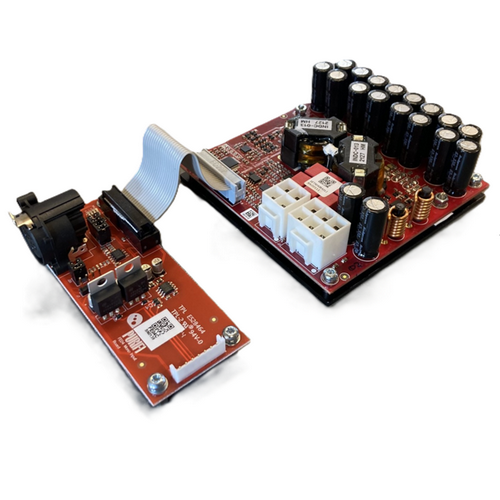
The image on the left shows the Purifi 1ET9040BA evaluation module as Purifi sells it to manufacturers. It is a red circuit board, compact and purposeful, carrying the essential Eigentakt amplification circuit in its raw, reference form. This is what a manufacturer receives when they decide to build a product around Purifi technology. Some use it almost exactly as it comes. Others do more with it.
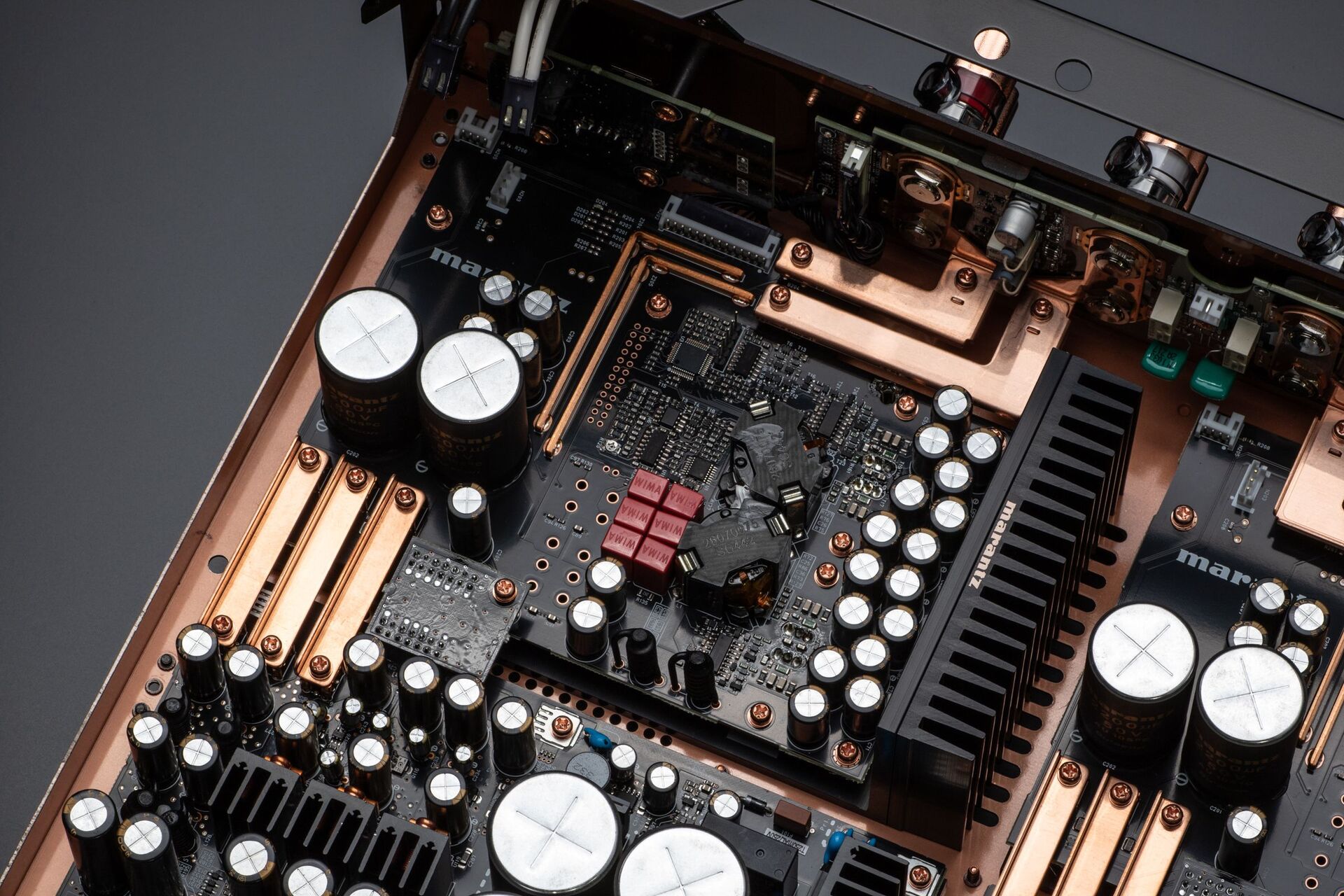
The bottom image shows what the Japanese masters did with it.
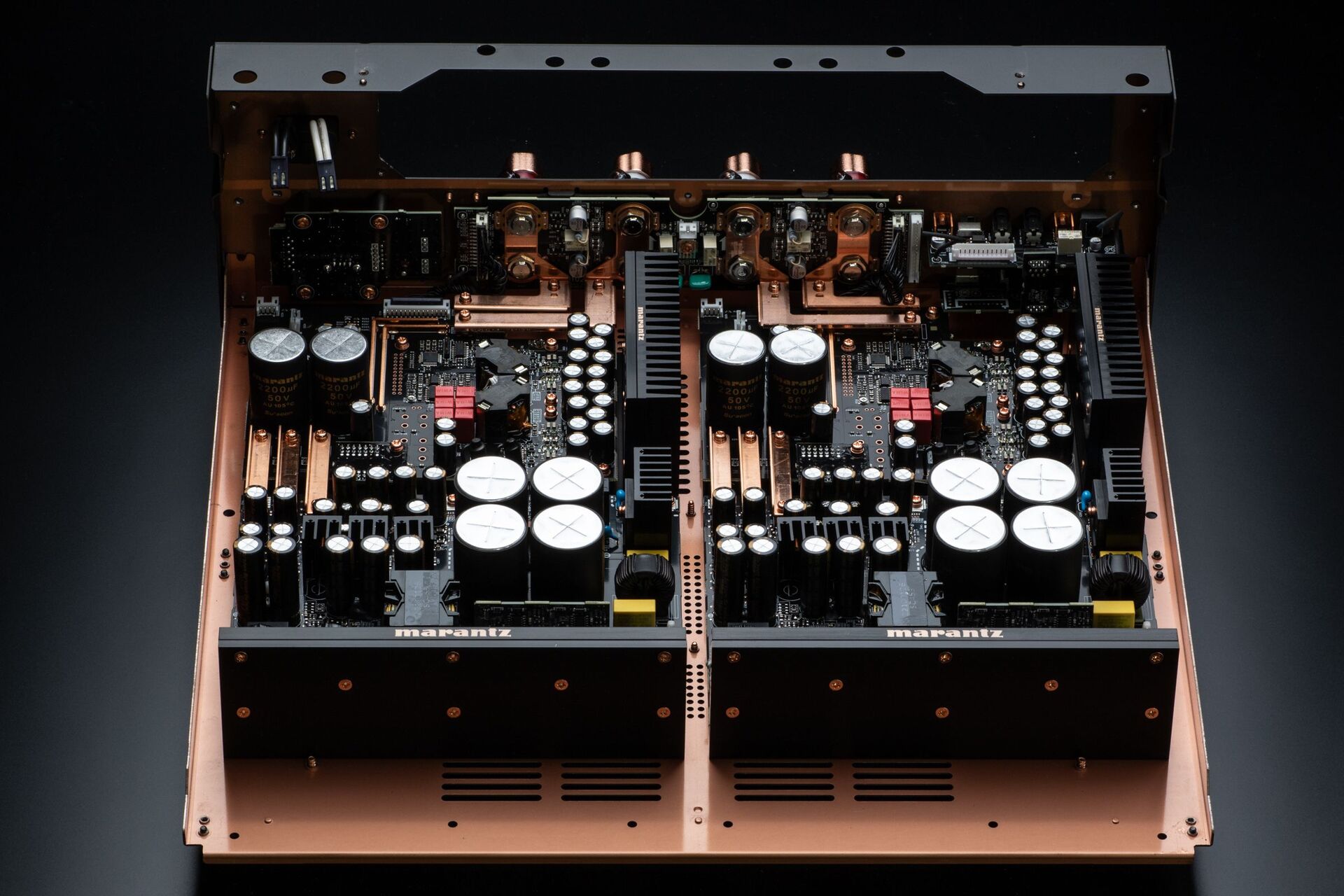
Look at the two photographs and notice the difference in scale and ambition. What Marantz built at Shirakawa is not a simple off-the-shelf module dropped into a chassis with supporting components around it. It is an almost entirely new amplification architecture that uses the Eigentakt technology as its foundation and then builds a different structure on top of it. The Marantz boards are larger, denser, and more complex than the Purifi reference design. The power delivery architecture is built around solid copper bus bars that run directly between the power supply section and the amplification circuit. And they do not stop at the amplification stage. Those same copper bars continue all the way to the speaker output terminals. The amplified signal travels from the output stage to the speaker binding posts through copper, and copper alone, with no connectors, no wire joints, and no transition points interrupting the path. Every metre of speaker cable you connect to the Model 10 begins its journey at a copper bar, not at a crimped terminal or a soldered wire end. There is no trace of wires, connectors, or ribbon cables. We are seeing thick, machined copper conductors that carry current with the absolute minimum of resistance and impedance between the supply and the speaker cable. In a high-current amplification circuit, every connection in the power path is a potential source of voltage drop, noise, and instability. Marantz eliminated those connections entirely. The copper bars are a direct, uninterrupted power highway from one end of the board to the other.
Removing all these connectors entirely is an engineering decision that costs more, takes more design effort, and produces a board that is harder to assemble. Marantz did it anyway. And we wish every amplifier manufacturer would do the same.
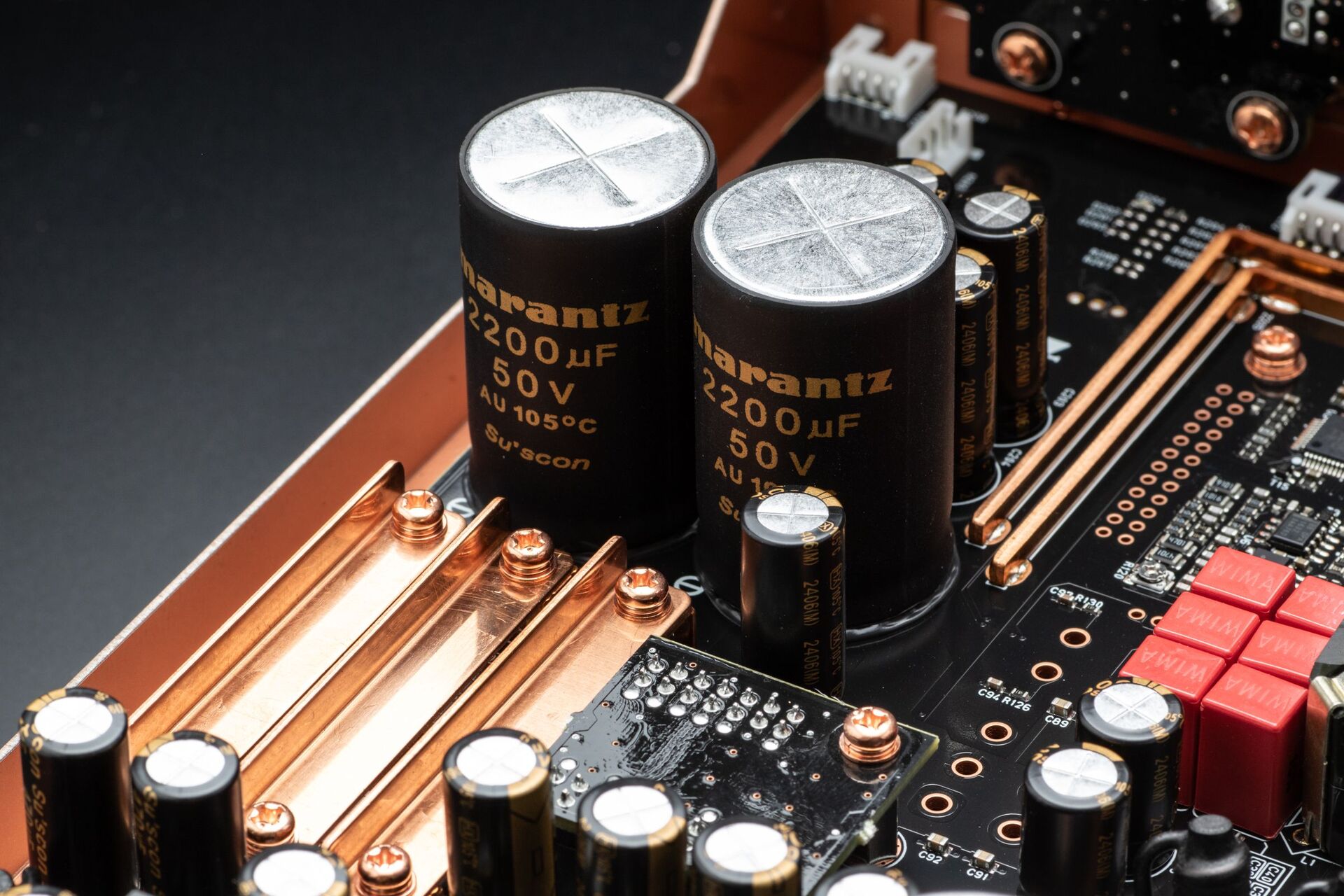
Then there is the added buffer stage. Sitting on the same PCB as the amplification circuit, between the power supply capacitors and the switching stage, is a local buffer built around two large dedicated capacitors positioned at the point of maximum necessity. The original Purifi reference design does not include these. It is a Marantz addition, and its purpose is to ensure that instantaneous current demands from the amplification circuit are met immediately, locally, without asking the main power supply to respond fast enough. When a musical transient demands a sudden surge of current, that buffer is already there, fully charged, ready to deliver it without the slightest hesitation. The two Marantz-branded 2,200 microfarad 50 volt capacitors you can see at the centre of each channel board are exactly those buffers, and the fact that Marantz had them custom-branded and manufactured to their own specifications from Su’scon, to specifically avoid using standard off-the-shelf parts shows just how high the level of attention is. Even the heatsinks running along the side of the amplification boards, flanking the capacitor arrays, are branded. Going through such lengths and detail is truly admirable.
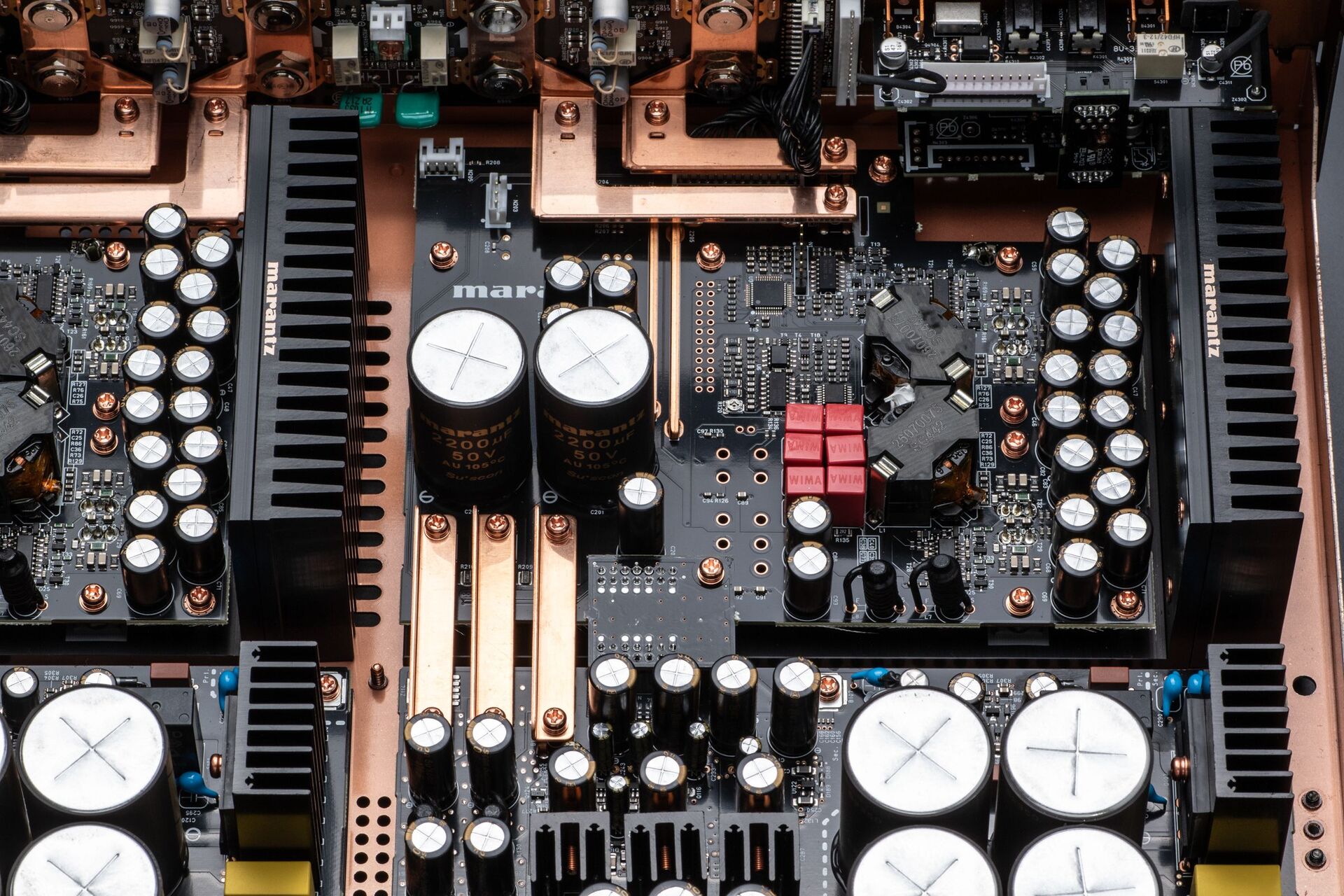
All of this together, the copper bars, the removed connectors, the local buffer capacitors, the WIMA signal path components, the custom-specified parts throughout, the exquisite layout, even the screws that are all made of copper. This is what five years of development at Shirakawa Audio Works actually looks like when you photograph it from above.
The standard Purifi module is an excellent piece of engineering, sold to whoever wants to build with it but what Marantz built here is a completely different proposition, conceived from scratch around the Eigentakt principle, manufactured in-house, and tuned by their Sound Master to behave the way a Marantz amplifier is expected to behave. The technology is shared. Everything else is their own work entirely.
This is why the collaboration matters, and why calling the Model 10 a Purifi amplifier is not quite accurate. Purifi gave Marantz the most advanced switching amplifier circuit available anywhere in the world today. But what Marantz brought to the table is something that cannot be licensed or purchased as a module. It is seventy years of knowing exactly what a musical amplifier should feel like, a culture of obsessive refinement that runs from Saul Marantz’s kitchen table through Ken Ishiwata’s listening room and into every decision made at Shirakawa. When that kind of pedigree and intention are applied to the best available technology, the gains are of a completely different order.
Listening
We unsealed the Model 10 package ourselves. We were the first ones to pull the packaging apart, lift the unit onto the rack, connect the Monitor Audio Platinum PL300 3G speakers with the Roboli HP8000 cables, run the Roboli XLR 2100 interconnects and the Roboli Power5200 power cables, and press play. We fully expected to spend the next four weeks listening to an amplifier trying to find itself, the way every serious amplifier we have ever reviewed needed time to open up, settle, and become what it was built to be.
This is the first amplifier that we heard, which sounded on day one the same way it sounded after one month. We double-checked this deliberately, going back to the same tracks, at the same volume levels, time and time apart, looking for the changes we were certain must have been there. They were not. No loosening of the bass, no opening of the midrange, no gradual smoothing of the top end. Just the same sound, fully formed, from the very first session.
We have thought about why this is, and the answer certainly lives in the architecture itself. A Class D amplifier built around a self-oscillating switching circuit has no output devices running in a linear region that need thermal stabilisation, no large toroidal output transformers building their magnetic character over time, no capacitors slowly reforming to their operating conditions. The Eigentakt circuit reaches its operating state almost instantly and stays there. What you hear on day one is what the amplifier actually is. There is something both impressive and slightly disorienting about that, coming from years of experience with amplifiers that reveal themselves gradually. The Model 10 simply presents itself completely, immediately, and without apology. But what about the pre-amplifier part, you ask?
That is an honest question and one we asked ourselves during those first weeks. The preamplifier section of the Model 10 is a fully discrete analogue circuit built around HDAM modules, a dedicated toroidal transformer, and a linear power supply with large capacitors. By every conventional understanding of high-end audio electronics, that section should have needed a burn-in time. Our only explanation is that we believe Marantz runs every single Model 10 through an extensive burn-in and measurement process at Shirakawa before it leaves the factory, and that the Sound Master tuning process itself happens on a unit that has already been operated for a significant period. The component selection, the matching of parts, and the final voicing are all done on a circuit that is already past the point where burn-in changes would be audible. And so, by the time the Model 10 reaches the customer, Shirakawa has already done that work on your behalf.

We begin our listening journey with Pernille Rosendahl’s Feet on the Ground, and we chose it deliberately. This track is a bass laboratory disguised as a song, and it has been part of our reference toolkit for long enough that we know every frequency layer in it by memory.
It opens with a 65Hz foundation modulated with 25Hz underneath it, two bass voices working together, already asking questions of the amplifier and the speakers. Then, at the 1:00 mark, a continuous 75Hz tone enters, modulated with 35Hz, floating above the original rhythm without replacing it. Two bass lines now, independent, simultaneous, each with its own character and weight. By the 2:20 mark, the track introduces tighter 90Hz content modulated with 40Hz, 75Hz with 40Hz, and 105Hz beginning to emerge from below. It becomes, there is no other word for it, a bass symphony. Layered, complex, each voice demanding its own space and its own timing. Reproducing it correctly, meaning with every layer audibly separate, tonally accurate, and rhythmically tight, is something that defeats most amplifiers and speakers at any price. Our reference for this track is a system built around full Wadax electronics driving a pair of Magico S5. We have sat in front of that system and heard this track from beginning to end at high levels, multiple times, until the experience was cemented in our memory as a benchmark. We carry that memory with us. When we played it through the Marantz the first time, we certainly did not expect what happened. The bass control was absolute. Every layer sat exactly where it belonged. The 65Hz and the 75Hz voices remained distinct and independent throughout, the modulations underneath them were fully resolved, and when the 105Hz content at 2:20 landed, it was with a physical authority that we have heard from very few amplifiers and from almost nothing in this price range. Our jaw dropped, and we are not using that expression lightly.
One last thing about this track. If Feet on the Ground does not sound spectacular on your system, the bass layers blur into each other, or the swirling effect stays flat against the speakers, Pernille’s voice loses its texture and presence, take it as a sign. You are not in high-end territory yet. This track will tell you exactly where you stand, without mercy, but to understand this, you need to trully hear it first.

Next up is Mandragora’s Center of the Universe in the Freedom Fighters Remix version, and if the Pernille track was about precision and control, this one is about pure, unrestrained joy.
This is a heavy track. Loads of synths are used throughout it, a lot of the notes sitting in a frequency range that, through most amplifiers at high levels, will eventually start to wear on you. There is an edge to them, a synthetic muddiness that lesser electronics will translate into listener fatigue within the first few minutes. We have heard this track become unpleasant. The fatigue is real, and it arrives fast.
Listening to the track on the Model 10 was a real joy. Across more than 40 track sessions from beginning to end, during our time with the amplifier, that’s how much we loved it. What the Model 10 did with those synths is take every smudged edge and replace it with nothing, because there was no muddyness or sharp edges to begin with. The extreme cleanliness of this amplifier, combined with a sweetness in the upper frequencies that we had not expected from a Class D design, turned what should have been a fatiguing experience into the opposite. We kept reaching for more volume. At times, we found ourselves at -10 on the dial, which for a 250 watt amplifier driving the Platinum PL300 G3s is a serious number, and the only feeling in the room was the need to go further.
The bass in this track is a two-handed thing. There is a chest-pounding note that arrives with physical force, and underneath it a lower, slower massaging frequency that you feel in your body before you consciously hear it with your ears. Together, they create a layered physical experience that becomes something close to addictive. Through the Model 10, everything arrived with complete authority, completely separated, each doing its own work without interference from the other.
Then the 2:07 mark arrives. And something happens that is very difficult to describe in language without sounding ridiculous. The track builds, and builds, and builds, and the Model 10 builds with it, effortlessly, without strain, or compression, or the slightest sense that anything is being held back. It just transports you somewhere else entirely. By the time the voice arrives at minute 4, telling you things that under normal circumstances you might consciously process and dismiss, you are already somewhere else entirely. Whatever the lady says lands differently when you are already that far up in Nirvana.
We listened to this track more than 40 times during our time with the Model 10. Every single time, it delivered the same result. Pure, uncomplicated, unapologetic, extremely fun pleasure.

Infected Mushroom have been part of our listening life for long enough that their early catalogue feels like old furniture, comfortable, familiar, dependable, always there. Dancing with Kadafi first appeared in 2001 on the B.P.Empire album, and if you were anywhere near the psychedelic trance scene in the early 2000s, this track shaped you, whether you realised it or not. The REBORN version is released in February 2024, takes that original architecture and rebuilds it with modern production tools and a low-end that the 2001 version could not have dreamed of. We like to think it is more of a reimagining, not a remaster, and the difference in bass weight and impact between the two versions tells you everything about how far music production has gone in 23 years.
Through the Model 10, the REBORN version is a physical event. The bass notes in this track are not subtle at all, they arrive precisely as Erez and Amit wanted, with mass, intention, low, physical, and layered in a way that asks the amplifier to track multiple things simultaneously at frequencies that most systems blur into a single indistinct wall of energy. The Model 10 separated them impeccably. Each note had its own shape, its own beginning and end, its own distinct identity in the room. The impact was maintained at chest level, at levels where the Platinum PL300s were moving serious amounts of air. We did not once feel the amplifier straining or compressing. It simply delivered, every time, as much as the track asked for.

From there, we moved through many more tracks from Infected Mushroom. One more we would like to talk about is Avratz. It was one of those that made us enter a completely different world. Released in 2003 as part of the double album Converting Vegetarians, Avratz runs for just over ten minutes at 123 BPM in A Major, and it is one of the most bass-dense recordings in the duo’s entire catalogue. Where Dancing with Kadafi hits you with impact and weight, Avratz works differently. The bass here is layered, complex, and constantly evolving, with multiple synthesised lines running simultaneously, each sitting in its own frequency pocket, each modulating independently of the others. It is a track that requires a system capable of true bass resolution and power, a system through which you have to hear the individual notes within a low-frequency texture.
The Model 10 resolved every layer. The lowest tones sat deep and completely controlled, with no bloom, no overhang, no smearing into the notes that surrounded them. The mid-bass lines above them were articulate and rhythmically precise, tracking the 123 BPM pulse without the slightest hesitation. And across all of it, the upper bass texture that gives Avratz its characteristic warmth and density came through with a body and presence that made the track feel genuinely alive in the room. Ten minutes passed very quickly. We listened again.

EBE by Captain Hook and Ace Ventura opens with a plethora of sparkling explosions, and that is where the Model 10 immediately tells you something important about itself. The notes are clean, precise, from the very first to the last. No smear, no slow rising edge. It is fast, it is exactly as it was intended to sound. Then it starts to rise. Slowly, deliberately, building layer by layer, each addition sitting in its own defined space in the soundstage, the whole construction gaining mass and tension with every passing second.
When the first explosion hits, it hits. There is no other way to describe it. The impact is physical and immediate, moving through your chest and arriving in your body before your brain has finished processing it as sound.
Then the voice arrives, and here the Model 10 shows another side of itself entirely. Clear, crisp, and completely separate from everything happening around it, sitting in its own defined pocket of the soundstage with a presence and intelligibility that made every word effortless to follow, even with the full weight of the production surrounding it. The contrast between the explosive low end and the delicacy of that vocal reproduction, handled simultaneously and without compromise in either direction, is one of the things the Model 10 does that genuinely surprised us.
The 1:25 mark is one of those moments in the track that you just know something is about to happen. Everything begins to pull back, the energy draws inward, and the room goes quiet in a way that feels locked and loaded. We felt it coming. And when the bass finally dropped in, low, massive, chest thumping and couch massaging in equal measure, relentless and unending, we stopped thinking. That is the only honest way to describe it. The psychedelic journey that Captain Hook built into this track arrived completely, and without reservation, through the Model 10, and at the levels we were listening, it was breathless from the first drop to the very last note.
We have heard this track before on other systems, but never like this. The only amplifiers capable of equaling this experience are the M8 monoblocks from Michi. Still, they do so in a completely different way: with more than 1 kW of power per channel on reserve. The sheer speed and authority with which the Model 10 delivered every moment of this experience was startling, and we sat there afterwards just absorbing what had happened.

Next up, an entire album: Seven Years by ATB. We grew up with this type of music. Even though our father was a full-on rocker, he respected our choice of music and let us listen to whatever we wanted, and for that, and many other things, he has our eternal gratitude. We fell in love with electronic dance music from ATB, Tiësto, Armin van Buuren, Paul van Dyk, Gareth Emmery, Ferry Corsten, Above & Beyond, Chicane, Dash Berlin, Markus Schulz, Paul Oakenfold, Cosmic Gate, Robert Miles, and so many others whose names alone are enough to send you somewhere specific in time. These were the artists that shaped how we understood music, how we understood feeling, how we understood what sound could do to a room full of people or to a single person sitting alone with a pair of speakers and nowhere else they needed to be. We grew up with this music, and it had the same depth of emotional investment and the same kind of formative imprinting that never fully left us, regardless of how many years passed or how many other musical worlds we explored afterwards.
Seven Years is an album that lives in that world. And playing it through the Marantz Model 10 at club levels brought back everything those years contained, as something present, arriving with enough physical authority to make the body respond before the mind has any say in the matter. The goosebumps arrived on their own accord. One moment, we were sitting on the couch, the next we were somewhere else entirely, teenagers again, in the club, in a time that most people believe is gone forever. It is never gone. You can return to any part of your life if the emotional connection is strong enough. Music is one of the keys that open the door to re-experiencing, and the Model 10 surprisingly handed it to us on a “copper” platter.
And the reason this happened is simple. The Marantz Model 10 got out of the way. Music was presented without any grain pulling our attention toward the quality, or better yet, the lack of. There was no distortion, reminding us we were listening to a poorly recorded master through speakers, because let’s be honest, this music was never recorded with audiophile intentions in mind. This style of music was made for clubs, for enormous sound systems, for dancefloors packed with people, mastered loud, hard, and in some cases mastered with audible clipping baked right into the file. Despite that, our attention was not drawn to the harshness at the top end, to the greyness, to the muddiness, making us unconsciously brace ourselves against the volume, at levels that should have been fatiguing. Our attention was nowhere to be found because everything was effortless and clean. The mind had nothing to fight against, nothing to compensate for, nothing to process. It was handed the experience of the music. And when that happens, when the last barrier between you and the recording is removed, the emotions that music was always carrying find their way through, completely and without interference. It was a beautiful listening session on a Sunday evening. Felt like being sixteen years old again.
After hours spent with EDM, at volumes that made conversation impossible and neighbours scratching their heads, we want to stop for a moment and say something simple. This amplifier is fun. Genuinely, irresponsibly, completely FUN. Every track we played at high levels, we listened to from beginning to end without once reaching for the volume knob to turn it down. That does not happen often. In fact, thinking back, the last time this happened was with the Michi M8 monoblock amplifiers, and those are two 60kg monoblock amplifiers. The Model 10 has a way of making you forget that you are evaluating something and just gives the feeling that you are listening to music, which is, when you think about it, the only thing that actually matters!

With Chris Stapleton’s Death Row, the Model 10 immediately shows why we kept raising the volume in each listening session. The opening guitar notes are filled with texture and density, floating inside a dark soundstage with strong layering and convincing dimensionality. Through this integrated amplifier, Stapleton’s voice was presented with excellent chest resonance and enough harmonic substance to preserve the rawness of his performance. At elevated listening levels, the amplifier gained tremendous authority. Bass tightened, outlines sharpened, and the entire presentation became highly physical and immersive.
This track can easily become thick and congested once the volume rises, especially on amplifiers that emphasize warmth. The Model 10 kept instrument separation extremely precise, even at excessive SPL. The kick drum remained articulate, vocal lines stayed holographic and well separated from the background instrumentation, and the soundstage preserved excellent focus even during dense passages. There was a sense of effortlessness to the presentation, as if the amplifier still had enormous reserves left untouched.
The character of the amplifier changed once the volume came down.
At quieter levels, Death Row gradually lost emotional tension. Stapleton’s voice stayed clean, intelligible, and highly focused, but the density behind the performance became lighter. Harmonic textures lost some saturation, bass presence stepped back, and the song no longer carried the same emotional pressure. The spaces between notes became very clean and technically organized, yet the performance itself felt restrained and behaviorally controlled.
This became one of the clearest examples of the Model 10’s personality.
The Purifi based output stage behaves with extreme linearity and control. At higher listening levels, this architecture becomes deeply impressive. Bass articulation improves, transient precision sharpens, separation increases, and the amplifier starts sounding massive, disciplined, and highly resolving. At lower listening levels, however, the human ear depends far more on harmonic density, bass fullness, and microdynamic shading to maintain emotional engagement. The Model 10 keeps its composure and technical precision intact, but emotional saturation drops more than expected. Daytime listening felt grand, immersive, and physically involving. Late-night listening shifted toward something cleaner, more normalized, and less emotionally loaded, as if the amplifier prioritized structural precision over emotional tension once the energy level inside the room decreased.

With Wherever I Go by Mark Knopfler and Ruth Moody, the Model 10 immediately shifted into a more intimate and atmospheric presentation. Ruth Moody’s voice floated delicately inside the soundstage, while Knopfler’s guitar lines showed something truly special: articulation of the highest order. Every pluck started with startling precision, stopped without blur, and decayed into silence with almost surgical cleanliness. This is among the finest guitar articulation we have heard from any amplifier.
At higher listening levels, the amplifier became deeply immersive. The soundstage expanded naturally, layering voices and instruments with strong positional precision and excellent focus. Bass stayed tight and disciplined, preserving rhythm without adding thickness. The Model 10 handled the track with unusual refinement, especially through the upper midrange and treble, where small string movements and vocal textures appeared from a very dark background.
Lowering the volume changed the emotional connection again.
The technical structure stayed intact, but the emotional intimacy softened. Ruth Moody’s voice remained clear and perfectly outlined, while part of the harmonic density and emotional pull stepped back. The presentation became cleaner, lighter, and more controlled, reducing the sense of immersion that made the track so captivating at higher levels.
There is also a technical angle behind this behavior. The Model 10 uses Purifi Eigentakt based Class D modules, a design known for extraordinary linearity, ultra-low distortion, and exceptional control. The presentation feels highly disciplined, behaviorally stable, and extremely organized, qualities that become deeply impressive once dynamic energy inside the room increases.
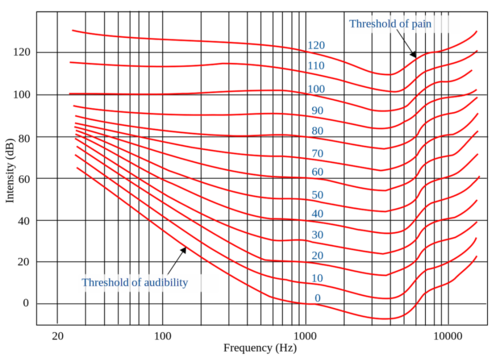
At higher listening levels, the Fletcher Munson effect gradually flattens perceived frequency balance, allowing bass weight, harmonic structure, and dynamic contrast to become more fully perceived by the ear. This is where the amplifier’s strengths dominate: bass articulation, separation, transient precision, cleanliness, and control.
At lower listening levels, however, the ear becomes far less sensitive to bass and treble extremes. Harmonic density and microdynamic shading become much more important for emotional immersion. Here, the ultra-controlled nature of the amplifier slightly reduces emotional saturation, especially on calmer and more delicate material. During daytime listening, when we can increase the volume to outstanding levels, the Model 10 sounds majestic, physical, and deeply involving.
Late-night sessions with quieter and more meditative music revealed a presentation that remained technically exceptional, but emotionally drained, compared to amplifiers that inject a stronger sense of harmonic saturation and low level intimacy into the music. This is where many tube amplifiers, MOSFET designs and large Class A amplifiers gain an advantage. Their richer low-order harmonic behavior, softer transient contours, and more fluid dynamic presentation naturally compensate for the ear’s reduced sensitivity to bass and treble at lower listening levels. Voices preserve more physicality, ambient textures feel psychoacoustically denser, and the emotional atmosphere surrounding the performance seems more continuous and immersive even if listening quietly.

With Michelle Shocked’s Quality of Mercy, the Model 10 delivered one of the strongest performances we experienced. The opening bass lines came forward with exceptional articulation, carrying tremendous grip, texture, and physical force while remaining incredibly organized. Kick drums hit with deep authority and explosive energy, energizing the room with a combination of mass, speed, and precision that very few amplifiers can achieve simultaneously.
The entire presentation felt highly coherent and beautifully integrated. Instruments occupied clearly defined positions inside the soundstage, while voices, percussion, and string textures flowed together naturally and convincingly. Complex passages remained effortless to follow, with every layer preserving its individuality without disrupting the overall musical structure.
Detail retrieval reached a truly exceptional level. Small reverberations, vocal inflections, and low-level ambient information emerged effortlessly from a very dark background. The amplifier presented enormous amounts of information with striking clarity and precision, giving the recording a highly resolved and almost holographic quality.
This track exposed one of the Model 10’s greatest strengths: immense bass authority combined with outstanding cleanliness and articulation. The track was delivered in a massive, fast, controlled, and deep sense. Among solid state amplifiers we have heard, this belongs among the very best performances in bass control, separation, and overall composure.

Armand Amar’s HOME ost. Here, the Model 10 approached the music with the same discipline, precision, and cleanliness that we had already grown accustomed to. The dark background we have spoken about repeatedly throughout this review revealed itself once again from the very first moments of the album. Silence between notes felt highly resolved and beautifully organized, allowing small ambient reverberations and distant vocal textures to emerge with striking precision. The soundstage itself felt spacious, layered, and extremely well focused, preserving even the faintest atmospheric cues with remarkable control.
And yet, it is our feeling that one particular track exposed one of the amplifier’s deepest personality traits more clearly than most.
Cum Dederit does not rely on impact, explosive dynamics, or spectacular bass energy. Its emotional force comes from softness, atmosphere, calmness, and gradual immersion. This type of music slowly pulls you inward emotionally, almost meditatively. As we have already been adamant about on several previous tracks, the Model 10 thrives once energy, dynamics, and physical intensity enter the picture. Here, the presentation remained technically exceptional, but emotionally devoid, unfortunately, more than we had hoped for.
At lower listening levels, especially, the track lost part of its sweet emotional gravity. Harmonic textures became lighter, the emotional weight behind voices softened, and the hypnotic atmosphere never fully materialized in the room. The amplifier continued sounding highly controlled and impressively precise, but the emotional immersion remained at a certain distance, never quite reaching us.
Increasing the volume improved scale, dimensionality, and bass presence, though Cum Dederit is not the kind of composition that transforms into a thrilling spectacle once played louder. Its beauty comes from intimacy, stillness, and emotional suspension, a tranquil presentation that comes to life through patience. The Model 10 illuminated every layer of the recording with remarkable precision and cleanliness, while the emotional core of the performance remained more intellectual and observational than deeply felt.
This became increasingly apparent during low-level playback and through chill, meditative, slower-paced tracks. The amplifier approached every track with exceptional control, clarity, and structural precision. But some recordings rely on emotional intimacy, the feeling that you get when you abandon completely, and become surrounded only by tonal and harmonic richness. In this case, these tracks were rendered with unnecessary sophistication. This breaks all sense of emotional immersion and human warmth. The same warmth and pleasure we often associate with a well-executed Class A or tube-driven designs.

With Vangelis’s 1492: Conquest of Paradise and several Oliver Shanti recordings, including Sacral Nirvana and Well Balanced Worlds, the Model 10 revealed both the brilliance and the limitations of its personality more clearly than almost any other music we played. These albums are built around atmosphere, calmness, and peace. This music’s strength is in emotional suspension, slow harmonic movement, and the feeling of being absorbed into a continuous meditative flow.
Technically, the Model 10 performed at an astonishing level.
The dark background we have spoken about repeatedly throughout this review became almost surreal on these recordings. Tiny ambient reverberations, distant textures, and trailing decays emerged from silence with exceptional clarity, speed, and precision. The soundstage expanded effortlessly, preserving strong layering and highly focused positioning. Oliver Shanti’s atmospheric instruments floated tridimensionally through the room with beautiful separation, while Vangelis’s massive orchestral swells carried enormous scale and authority once the volume increased.
And yet, it is our feeling that these albums exposed the amplifier’s emotional behavior more than any other material we tried.
At lower listening levels, the extreme precision, cleanliness, and articulation of the Model 10 started working against the emotional character of the music itself. Harmonic textures became lighter, the atmosphere lost density, and the hypnotic immersion these albums are capable of creating gradually weakened. The presentation stayed highly resolved and impressively organized, though the emotional calmness and meditative flow became less convincing than we expected.
Increasing the volume transformed the experience dramatically with 1492. The amplifier’s immense control, bass authority, and separation created a gigantic and cinematic presentation that felt deeply spectacular. Oliver Shanti remained more complicated. These recordings naturally invite quieter and more introspective listening sessions, while the Model 10 consistently reached its emotional peak once energy and physical scale inside the room increased.

We spent an evening with Vivaldi’s Four Seasons performed by the Royal Festival Orchestra. There are recordings that a sufficiently transparent and honest amplifier will expose for what they are. Through the Model 10, we believe that every decision made during the recording session and every choice made at the mastering desk arrived in our room with complete fidelity and without mercy. The string section, rendered with the full precision and speed this amplifier is capable of, lost the warmth and body that a more forgiving electronics chain might have lent it. The upper register of the violins, already forward in the recording, became something that asked a great deal of the listener as the minutes passed. There was detail everywhere, spatial information, individual bow strokes, the breath of the hall, all of it present and accounted for with remarkable precision. But clarity, in this case, was not kindness.
We lasted longer than we expected to, partly out of professional obligation and partly because there were moments, brief and scattered, where the Model 10 did something with the dynamics of the orchestra that impressed us. A sudden fortissimo passage arriving after a quiet section had real physical presence and scale. The sense of the hall, the distance between the front and the back of the ensemble, was rendered with a three-dimensional accuracy we rarely hear. The Model 10 was doing its job perfectly.
By the time we reached Summer, we had made our decision. We stopped the music, sat quietly for a moment, and thought about what we had just experienced. The Model 10 had revealed that some recordings, beloved as they are by many listeners, were made for systems that would soften their rougher edges. The Model 10 does not soften anything. It presents what is there, completely and without apology, and on this particular evening, what was there tested our patience more than our ears deserved.
We moved on to something else, turned the volume back up, and forgot about it within minutes, going through Schiller – Illuminate (full album), Argus – Architect of Time (full album), Easily Embarrassed – EE4B (full album), Morten Granau, Phaxe, Dhamika, Infected Mushroom, Smilk, Two Steps from Hell, Lab’s Cloud, Mike Dawes, Carbon Based Lifeforms, Metrik, Heilung, Jessee Cook, Alan Taylor, EMantra, The Midnight, Jean Michel Jarre, vangelis, Max Oazo, Hans Zimmer, and many, many others made our day brighter.
As we have already been adamant about throughout this review, the Model 10 thrives on structure, articulation, dynamics, and control. Calm and meditative recordings revealed a presentation of exceptional technical sophistication, clarity, and precision, but it seemed the emotional magic itself was closely tied to the listening volume.
Conclusion
As is often the case with every electronics component that passes through our room, time remained the ultimate teacher. And with time, the true voice of the Model 10 revealed itself. This is an amplifier that delivers precision, articulation, extreme separation, and control. Everything it does revolves around order, discipline, and an extreme level of structural refinement. And the bass performance shows this perfectly.
The Model 10 delivers the finest bass articulation we have yet heard from any amplifier, regardless of topology or price. Now this is a statement!
Bass notes start and stop with almost surreal precision. The kick carries enormous physical authority while remaining perfectly controlled. Complex bass passages never blur together, never thicken, and never lose shape even at maximum listening levels, close to hitting the amplifier’s maximum specified power. The amount of grip, separation, and transient control this amplifier exerts over low frequencies borders on unbelievable at times.
The harder we pushed the amplifier, the more alive it became. EDM sessions were dangerous in the best possible way. Hours disappeared, tracks kept playing, volume levels kept at or near the maximum. At the top levels, the dark background we have discussed throughout this review became another extraordinary feat. Small reverberations, distant textures, and low-level ambient information emerged from silence with remarkable transparency and speed. The amplifier consistently sounded highly resolved, highly separated, and exceptionally clean.
Guitar articulation on tracks like Wherever I Go reached a level that put this amplifier among the finest performances we have ever encountered.
At the same time, after weeks of listening, we also came to understand that the Model 10 asks for a certain type of listening energy to fully reveal its magic. Meditative and emotionally delicate recordings were approached with remarkable discipline and articulation, though without the warmth and emotional surrender that some listeners may seek. The difference was never dramatic or problematic, especially because the amplifier’s technical sophistication remained extraordinary at all times.
We believe Marantz understood exactly what they wanted the Model 10 to be. An amplifier that pursues resolution, discipline, control, and modern reference level precision with enormous conviction and, within that vision, the execution is exceptional.
The Model 10 ultimately feels like an amplifier designed for listeners who want to hear everything inside a recording while also preserving scale, physicality, and musical engagement. Once volume, dynamics, and energy enter the room, it transforms into something truly spectacular. The combination of immense bass authority, world-class articulation, exceptional cleanliness, and an almost limitless sense of power creates an experience that very few amplifiers currently on the market can replicate.
Pros and Cons
Pros
- Among the finest bass performances we have heard from any amplifier, regardless of price or topology
- Exceptional detail retrieval, transient precision, and instrument articulation without fatigue, especially at very high listening levels
- Among the most holographic, three-dimensional, and wide soundstage presentations we have experienced
- Extremely dark background with outstanding separation, transparency, and low-level resolution
- Exceptional treble refinement with absolutely no trace of sibilance, glare, or listening fatigue even during very long sessions at excessive listening levels
- The presentation consistently prioritizes articulation, precision, and structural control over warmth, tonal bloom, and romantic saturation
- Highly and dangerously addictive with energetic, dynamic, and physically engaging music
- Luxurious workmanship, exemplary construction both inside and out (except for that awful remote)
Cons
- Lower listening levels with calmer and more meditative music reduce part of the emotional immersion, harmonic density, and low-level intimacy
- The presentation consistently prioritizes articulation, precision, and structural control over warmth, tonal bloom, and romantic saturation
- The remote control feels completely disconnected from the amplifier itself. It is shockingly poor for a product at this level. In no way, shape or form does it match the superb craftsmanship, engineering ambition, and luxurious physical presence of the Model 10.
Associated Equipment:
- Digital Transport / Roon Server / DAC : Gustard R30
- Loudspeakers: Monitor Audio Platinum 300 3G
- Interconnects: Roboli XLR 2100
- Speaker cables: Roboli HP8000 2.5m
- Power Cables: Roboli Power5200
Scoring
Regarding the scoring below, keep in mind that what you see is the result of the matching made specifically for this review. Scores would change drastically if we changed the cabling or the source, which is why we tend to use the same reference cables and source when doing these types of reviews, for consistency purposes.