It is almost impossible to have a true audiophile listening room for most of us. We have families, kids, partners with their own taste in interior design, and a living room that needs to serve everyone equally. The ideal stereo setup requires speakers to be placed away from walls, a dedicated listening chair positioned in the middle of the room, and, of course, no subwoofer, because in the traditional two-channel world, subwoofers simply do not belong. The bass is the speakers’ responsibility, full stop. This is a belief most audiophiles have. We ourselves used to have it, but experience, measurement, and careful integration have shown us just how incomplete that view really is.
We are confronted with the situation where the living room needs to work as a family space first, then an audiophile listening room, and, why not, even a home cinema from time to time. The speakers must live where they look good. The sofa sits where it makes sense for everyone. This situation poses more problems than one needs, especially when trying to integrate an audiophile system and make it sound right. We want good soundstage, good three-dimensionality, bass that is both tight and subterranean, with no peaks or dips in the system’s response, no bloated low end that would ruin transparency, clarity, and micro-detail.
The question we get asked most often, and the one this entire review is built around, is a simple one: how does one solve all this?
Let’s find out what happens when two properly integrated subwoofers enter a constrained, real-world stereo system.
The room we are working with measures approximately 5.5 meters long by 4 meters wide, with a standard ceiling height of 2.6 meters. Due to previous constraints and because we wish to simulate a living space, we decided the speakers would sit along the longer wall, the sofa runs along the opposite end, and the listening position is a wife-friendly 50 cm from the back wall. The floor is hardwood, the walls are plastered over acoustic-grade drywall, and the wall cavities are filled with the highest-density rockwool available. A few sound-absorbing panels, painted to look like artwork, blend into the room without standing out. Aside from this largely invisible treatment, it is a completely normal living room, and precisely the kind of space that the vast majority of us actually live in.
Room modes and why they matter so much
Every room has room modes. These are the acoustic fingerprints of every enclosed space, and understanding them is the first step toward making any loudspeaker positioning or subwoofer integration work properly.
Room modes are standing waves that form when a bass frequency’s wavelength relates mathematically to one or more dimensions of the room. When that relationship aligns, the outgoing wave and its reflected wave reinforce each other, creating a stationary pressure pattern frozen in space. Some positions in the room receive too much energy at that frequency. Others receive almost none. This happens independently of how well the speakers measure in an anechoic chamber. It is purely a consequence of geometry.
There are three types of room modes, and each one behaves differently.
Axial modes are the simplest and strongest. They form between two parallel surfaces, meaning a pair of walls, the floor and ceiling, or the front and back wall.
Tangential modes involve four surfaces simultaneously, reflecting off two pairs of parallel walls, and carry roughly half the energy of axial modes.
Oblique modes involve all six surfaces at once and carry less energy still, but they are far more numerous and contribute to the overall modal density of the room.
In a typical domestic room, the axial modes are the ones that cause the most audible problems, particularly in the bass region below 300 Hz, a frequency range that acoustic engineers refer to as the Schroeder region, where modal behavior dominates, and the room’s geometry matters far more than any treatment applied to its surfaces.
The frequency at which an axial mode forms is straightforward to calculate. For any given room dimension, the fundamental axial mode frequency is simply the speed of sound, 343 meters per second at room temperature, divided by twice the length of that dimension. For our room’s 5.5 meter length, that gives us a fundamental axial mode at approximately 31-32 Hz. For the 4 meter width, it lands at approximately 43-44 Hz. For the 2.6 meter ceiling height, it sits at approximately 66-67 Hz. Each of these fundamentals also generates harmonics at whole number multiples of the fundamental frequency, so a room does not have just three axial modes, it has dozens, stacking up through the bass region and into the lower midrange.
This is precisely why bass behavior in a real room is so complex, and why simply placing a subwoofer in a corner and turning it up rarely ends in success.
To make all of this tangible, we modeled the pressure distribution of our room’s five most significant modal frequencies using Room EQ Wizard’s Room3D visualization.
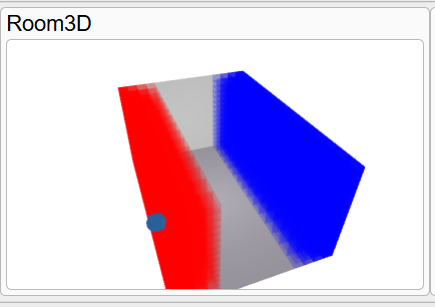
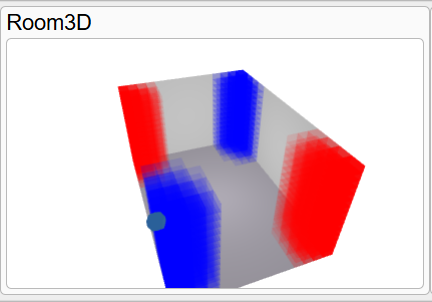
In each image, the color mapping is consistent: red represents a pressure maximum, a location where that frequency arrives with full, reinforced energy, and blue represents a pressure minimum, where that frequency is cancelled or heavily attenuated. These five frequencies are not arbitrary but correspond directly to the strongest modes our room produces, and they sit in the exact range where a subwoofer operates.
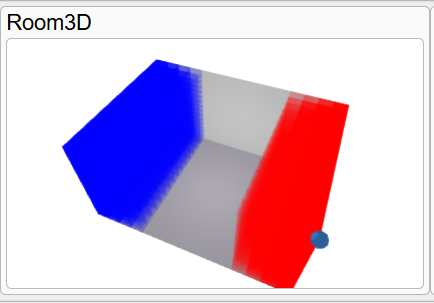
32 Hz — The first image shows a clean, powerful axial mode running along the full length of the room. The pressure maximum fills the listening area near the back wall, which is precisely where our sofa sits. At 32 Hz, anyone sitting on our sofa is in a reinforcement zone, receiving a significant boost at this frequency that no amount of volume adjustment can tame.
This is where our first problem becomes visible. The speakers sit near the front wall, deep in the colored blue zone, and aesthetic constraints mean they cannot move. The sofa sits near the back wall, also locked in position due to the various constraints we imposed earlier. We are essentially trapped between two pressure extremes, with no freedom to escape either of them through repositioning alone.
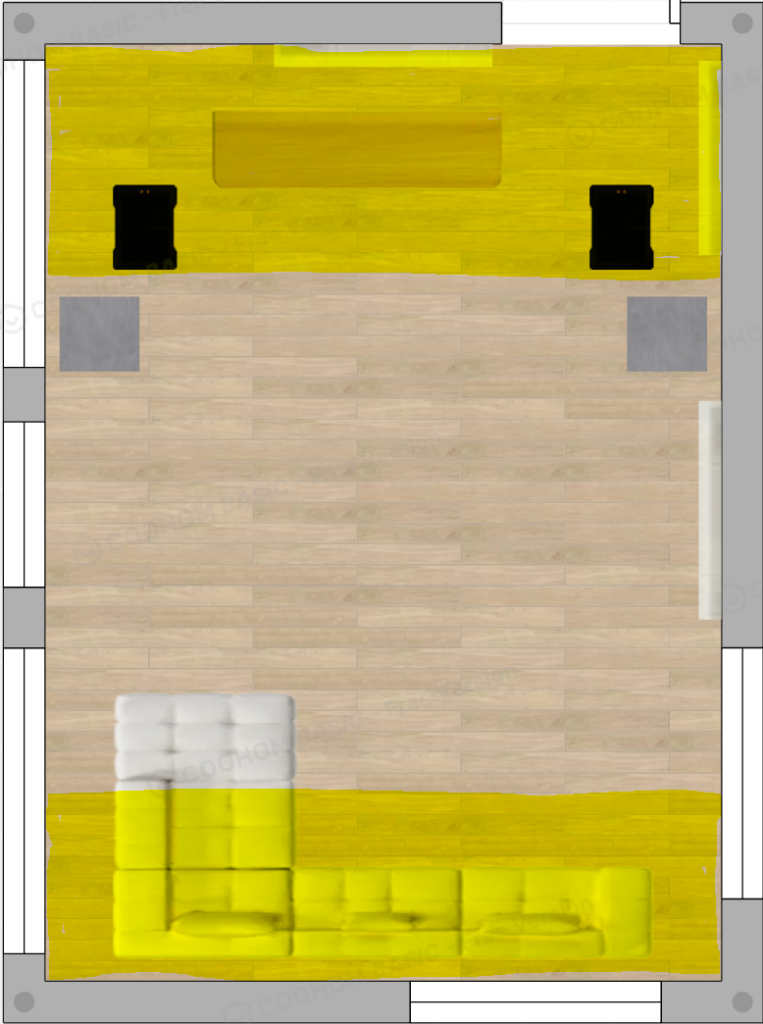
So what happens if we introduce a subwoofer placed outside these zones, in a position where the modal pressure at 32 Hz is neither at its maximum nor its minimum? The subwoofer would interact with this mode from a completely different point in the standing wave pattern, with the potential to partially cancel the excess energy at the listening position. This is one of the most powerful and least discussed arguments for adding a subwoofer to a stereo system: strategic placement for modal correction.
Before moving on to the other modes, we believe a quick measurement tells the story better than any simulation.
The graph below shows four scenarios in our room. The pink trace is our speakers alone, no subwoofer involved. Green adds only one subwoofer near the right speaker, cyan adds only one near the left. Blue is both subwoofers running together. We can clearly see the improvements in the modal problem zone with just a single subwoofer on either side. With two of them, the graph says everything we need it to say.
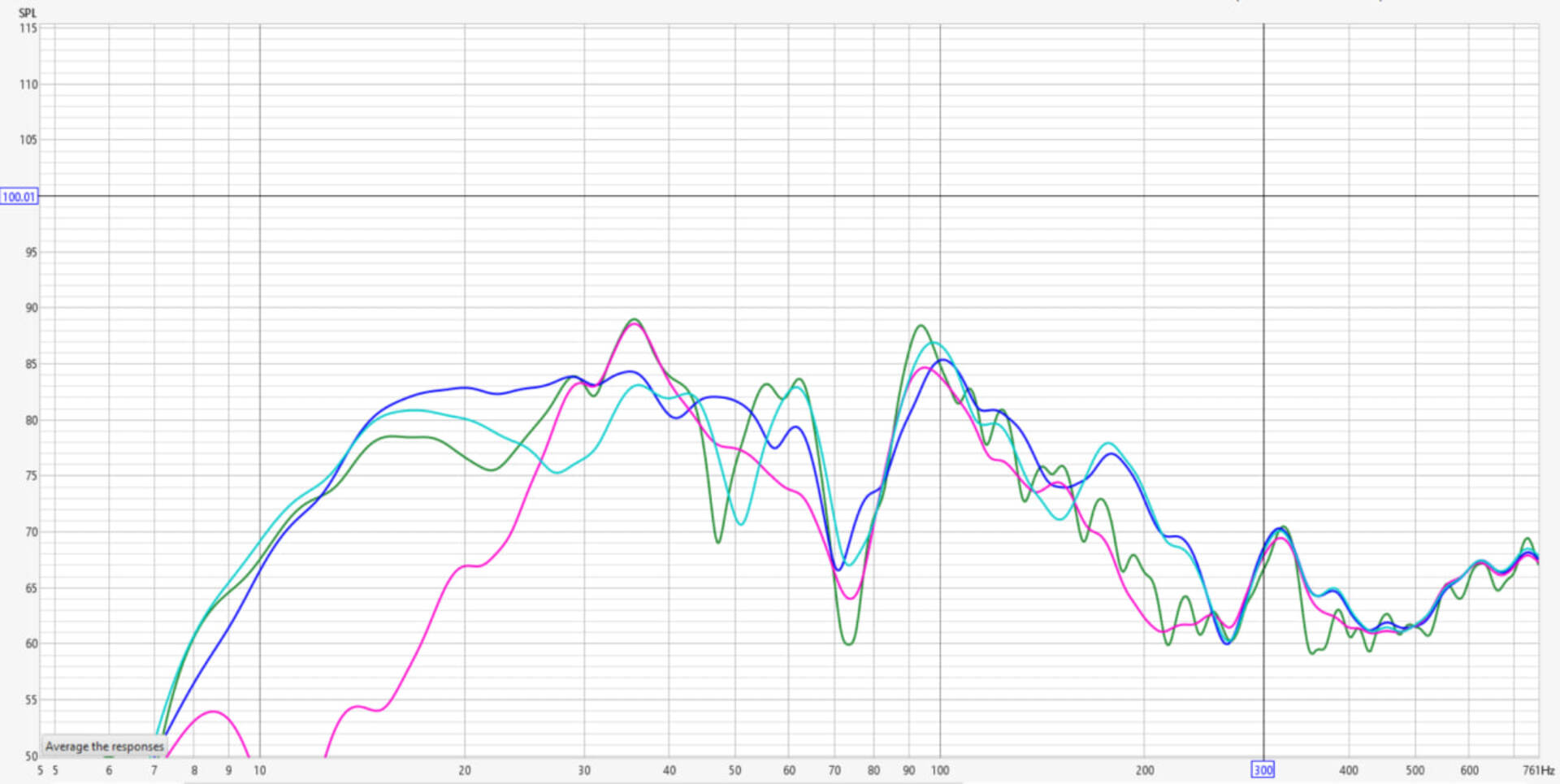
Pink – solo speakers | Green – right side subwoofer | Cyan – left side subwoofer | Blue – both subwoofers connected
What makes this even more remarkable is that these measurements were done completely plug-and-play. We have no EQ here, no volume calibration, no fine-tuning of any kind, just the subwoofer plugged in with its default settings, purely to simulate what a simple addition would do. With proper calibration and adjustment, the results can be taken considerably further.
44 Hz — The second image shows a lateral axial mode running across the width of the room. The pressure distribution has rotated: one side wall saturates in red, the opposite falls into blue. This lands in one of the most perceptually sensitive regions of the bass range, the zone where kick drums live, where electric bass lines define groove, and where any unevenness is heard immediately.
This is also where things get interesting. Looking back at our measurement graph, adding a single subwoofer on either side actually makes this mode worse at the listening position. The green trace and the cyan trace both show a more problematic response around 44 Hz compared to the pink trace of the speakers alone. A single subwoofer, regardless of which side it sits on, excites this lateral mode asymmetrically, reinforcing the pressure imbalance and making the response even worse.
Only when both subwoofers were placed symmetrically along the room’s width, did this mode begin to cancel properly. The blue-traced measurement makes this immediately clear. Two sources, mirror-positioned relative to the lateral standing wave, produce equal and opposite contributions that work together to smooth out exactly what a single unit cannot do. This is the most compelling technical argument for dual subwoofers in a domestic setting, and our example demonstrates it without any ambiguity.
55 Hz — The third mode we analyze introduces even greater complexity. The pressure maxima now appear at multiple corners simultaneously, while the centre of the room approaches a relative null. This is a tangential mode, reflecting off two pairs of surfaces rather than one. It is inherently harder to manage than a simple axial mode precisely because it involves more surfaces and creates a more complex pressure distribution throughout the room.
Corners become the most problematic positions here. Any source placed in a corner will excite this mode with near-maximum efficiency, producing an exaggerated and uneven response at 55 Hz that spills across the entire room. This is one of the main reasons why the classic advice of placing a subwoofer in a corner for maximum output is, acoustically speaking, one of the worst things one can do in a real room. Yes, output increases, but that’s all. Control will be lost. Bass bloat and bloom will become apparent and ruin everything, starting from transparency, cleanliness, microdetail, and every little nuance that bass articulation should emphasize.
Looking again at our measurements, the 55 Hz region shows clear peaks and dips depending on subwoofer placement. A single subwoofer, regardless of where it sits, will always excite this tangential mode unevenly.
Pink – solo speakers | Green – right side subwoofer | Cyan – left side subwoofer | Blue – both subwoofers connected
Two symmetrically placed subwoofers, each contributing from a mirrored position relative to the room’s width, distribute the excitation evenly across both sides of the pressure pattern, significantly reducing the modal contribution at the listening position.
At this point in the analysis, a pattern is emerging that we cannot ignore. Mode after mode, the data keeps pointing toward the same conclusion. Two (or more) subwoofers, placed symmetrically, are the only geometrically correct answer to what a real room does to bass.
64 Hz — The 4th mode we analyze shows a clear red band running across the full width of the room at its midpoint, with both the front and back walls sitting in blue minimum zones. The subwoofer, positioned near the back wall, sits deep in the cancellation zone, meaning it is generating output at 64 Hz from a point in the room where the standing wave pattern actively works against it.
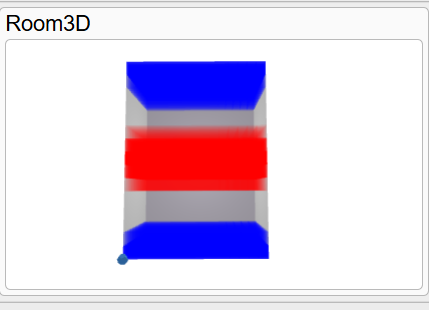
For the listener, this mode creates a very specific and recognizable problem where the midpoint of the room receives a significant pressure boost at 64 Hz, while both ends of it hear almost nothing at this frequency. Walking from the back wall toward the center of the room produces a gradual but dramatic increase in bass energy. This spatial inconsistency is one of the most common reasons why bass sounds completely different depending on where in the room you are standing versus where you are sitting.
At 64 Hz, we are just below C2, in a region where the cello reaches its lowest fundamentals, low brass and bass woodwinds begin to show real weight, and instruments such as double bass and piano gain much of their body, scale, and physical presence.
A strong modal peak here gives instruments an artificial weight and bloom that masks fine detail in their fundamental tone, reducing the sense of clarity and definition that we are looking for in a well-integrated system. Two symmetrically placed subwoofers, each positioned at mirrored points relative to this pressure band, give us the tools to address this in a way that a single unit cannot.
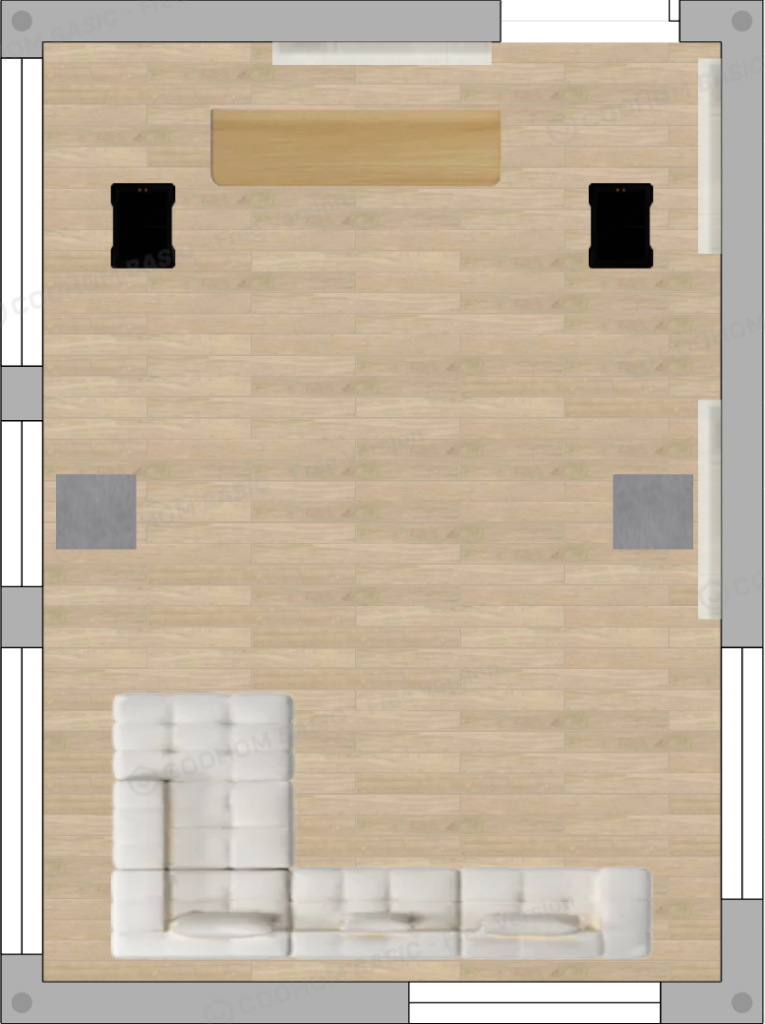
Looking at the pressure distribution for this mode, the subwoofers should be placed as close as possible to the red zone, the midpoint of the room along its length. Positioning them there means they are operating from the pressure maximum, giving them maximum influence over this mode. A subwoofer sitting in the blue zone at the front or back wall has almost no authority over this mode, regardless of how powerful it is or how aggressively it is equalized, because it is generating output from a point where this frequency is already cancelled by the room itself.
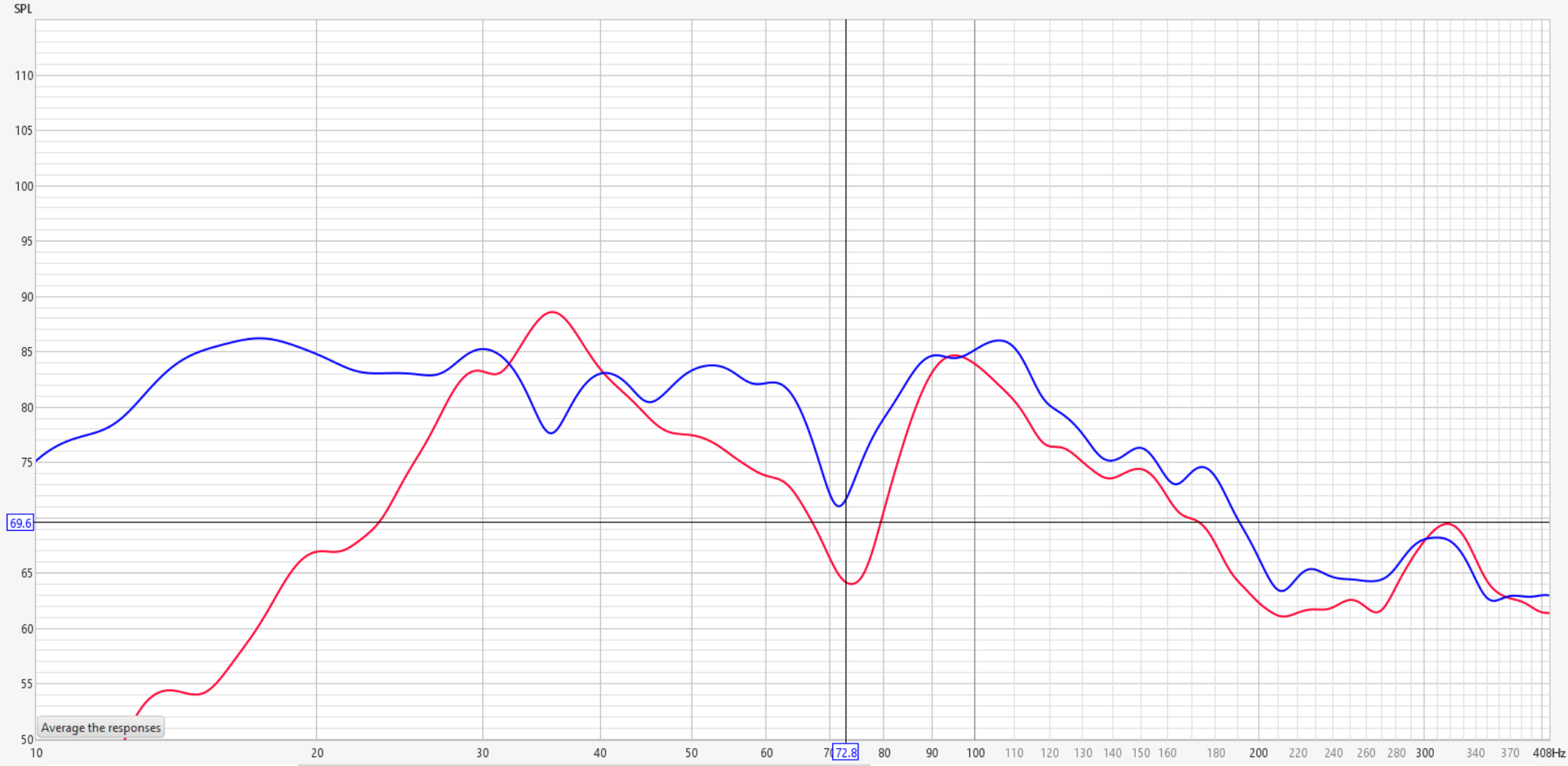
Red – solo speakers | Blue – both subwoofers connected
Before we move on to the 73 Hz mode, the measurements we took when repositioning the subwoofers in the middle of the room tell us something important that deserves its own discussion.
Below we will show 3 different waterfall plots in the same room under three different conditions.
The first waterfall, with speakers alone, shows two dominant modal peaks sitting at approximately 35 Hz and 70 Hz.
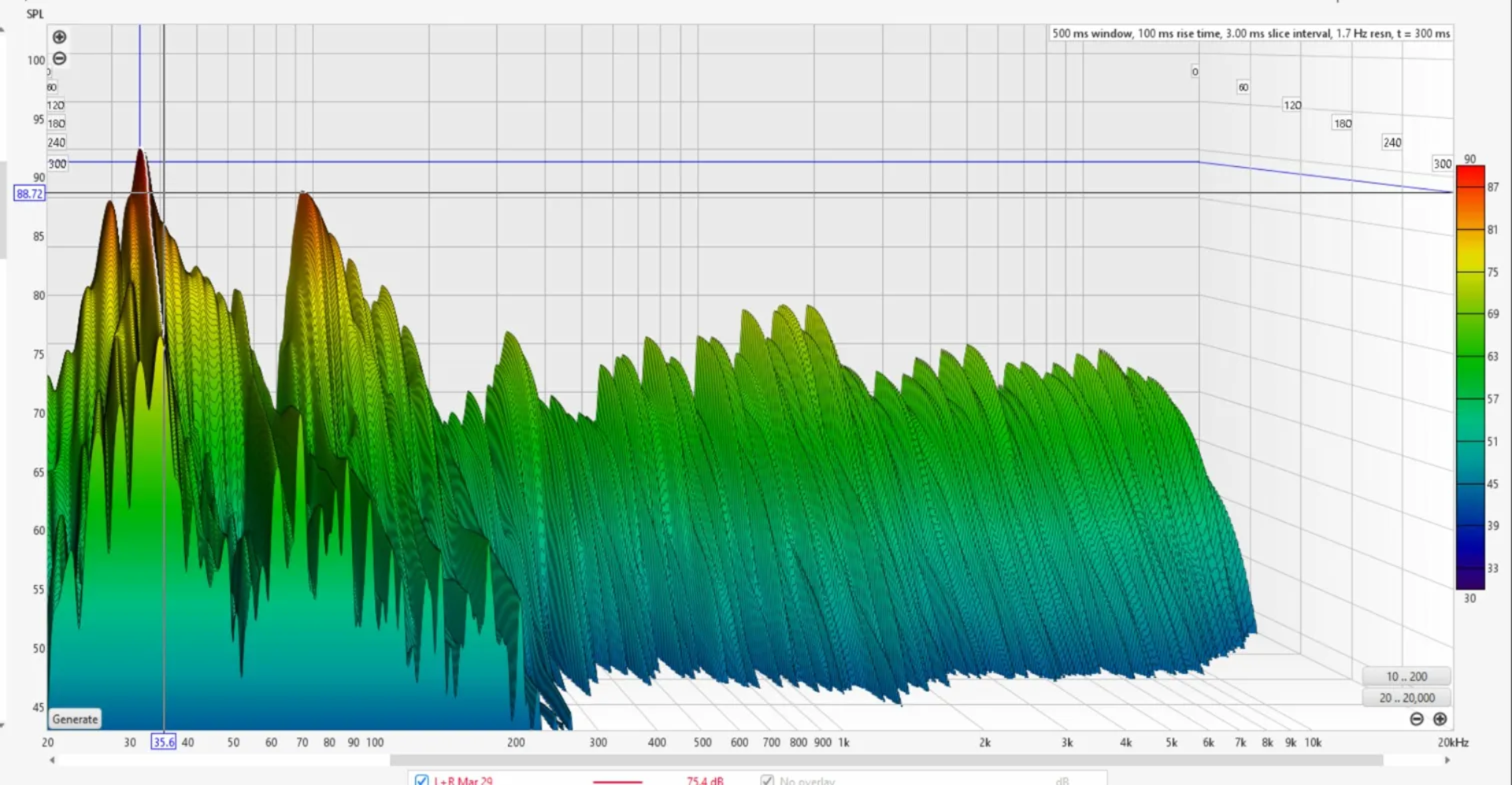
Waterfall 1 – solo speakers
Both peaks are tall, narrow, and red at their tips, indicating not just high output at those frequencies but a very slow decay, meaning the room rings at these frequencies long after the signal has stopped. This is the acoustic signature of an untreated modal problem.
The second waterfall shows how both subwoofers placed close to the speakers near the front wall react, helping reduce the decay across the entire bass region.
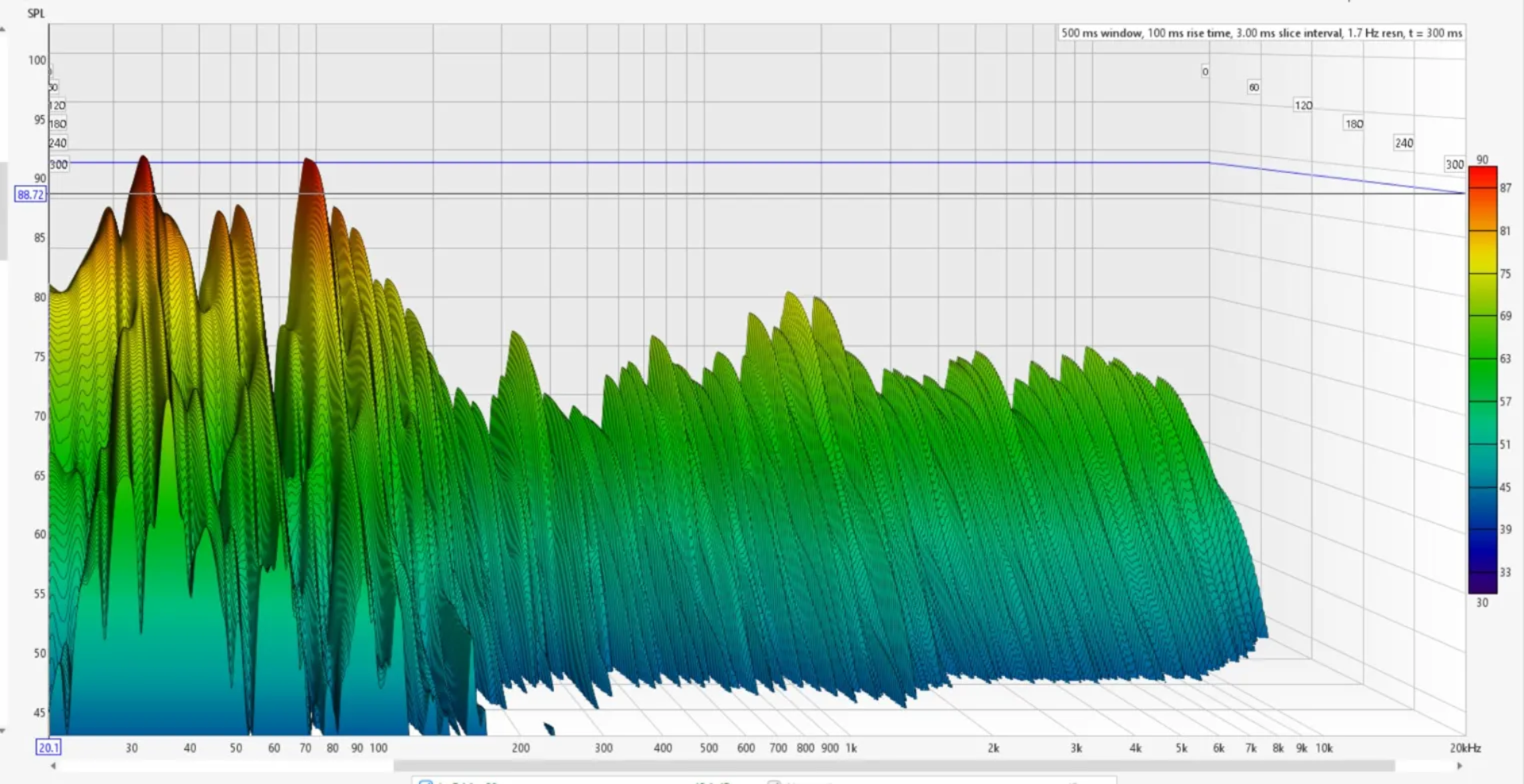
Waterfall 2 – both subwoofers connected close to the speakers
The peaks at 35 Hz and 70 Hz are still present, the room modes themselves never disappear, but they resolve more quickly, leaving the bass region cleaner and better controlled over time.
The third waterfall, with both subwoofers placed in the middle of the room as shown in the floor plan, shows a different picture.
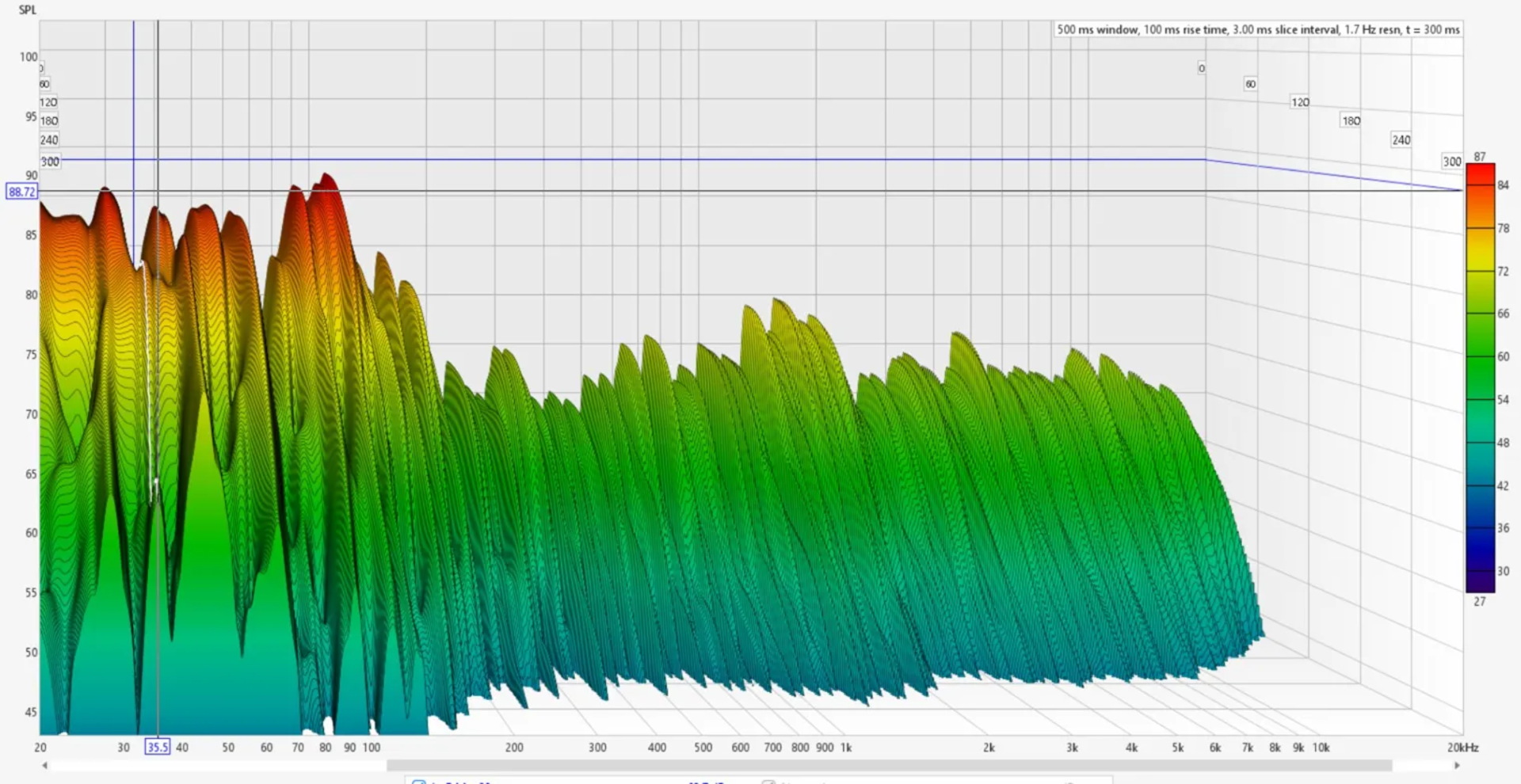
Waterfall 3 – both subwoofers connected and placed in the middle of the room
The modal peaks broaden, and the overall bass energy redistributes across a wider frequency range. However, the decay at the problematic frequencies remains slow, and new interactions appear between 40 and 80 Hz that were less visible before.
Moving the subwoofers to the middle of the room changes the modal excitation pattern significantly. The energy that was previously concentrated at the front wall now excites the room from its midpoint, which happens to coincide with the pressure maximum of several of our room’s axial modes. Placing a source at a pressure maximum means feeding energy directly into the mode at its strongest point, which causes the increased ringing we see in this third waterfall. The decay tails grow longer, the modal peaks become broader, and the overall low-frequency behavior becomes considerably harder to control.
This is where the time domain becomes just as important as the frequency domain, and from our experience, even more so for a true audiophile. A frequency response problem is visible on a graph and correctable via EQ. A ringing problem wreaks havoc across the entire audio band in ways that no equalizer can fully address. Slow modal decay adds smearing to every bass note, blurring the leading edge of kick drums, thickening the fundamental of a cello, and robbing the entire presentation of the speed, definition, and transparency that we are working so hard to achieve.
The bass becomes slower, less articulate, and less truthful to the original signal. Yes, we may have partially addressed the 64 Hz frequency response problem by moving the subwoofers to the middle of the room, but in doing so, we introduced a significantly worse problem, one that lives in time rather than frequency, and one that the listener feels as a constant, unavoidable heaviness sitting over everything the system tries to do.
The solution to the time domain problem is actually simpler than it might seem. Keeping the subwoofers as close as possible to the main speakers, as our second waterfall clearly demonstrates, produces the fastest and most controlled decay across the entire bass region. The subwoofers and the main speakers essentially become a single coherent source, exciting the room’s modes from almost the same point in space and allowing their combined energy to dissipate more quickly and more naturally. This is the position we recommend as a starting point for anyone integrating subwoofers into a real-world stereo system under similar aesthetic constraints.
73 Hz — the 5th mode we analyze is the most complex and the most difficult to address of everything we have seen so far.
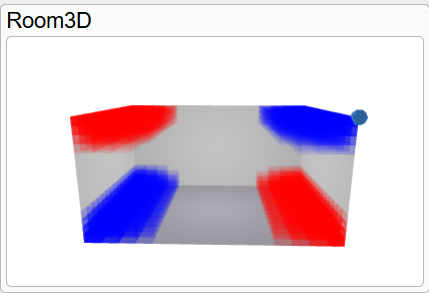
The pressure distribution shows an oblique mode with maxima appearing diagonally across the room, red zones bloom from two opposite corners, while the other two corners fall into deep blue cancellation zones. The subwoofer position near the front wall sits directly inside one of these blue minimum zones, meaning it has almost no authority over this mode regardless of output level or EQ applied.
What makes this mode particularly problematic is its diagonal nature. Every other mode we analyzed had a degree of symmetry that two correctly placed subwoofers could exploit. This one distributes its energy asymmetrically across all four corners simultaneously, making it resistant to correction from almost any practical domestic placement. Moving the subwoofers to the middle of the room produces no meaningful improvement here either, as the pressure pattern at 73 Hz simply does not offer a geometrically convenient position that two symmetrically placed sources can use to cancel or reduce it.
The listening position near the back wall falls into one of the red maximum zones, meaning the listener receives a significant boost at 73 Hz that sits right in the range of upper bass and lower midrange, the region where the body and warmth of instruments lives, and where any excess energy immediately translates into a thick, heavy, congested presentation that no amount of careful amplifier matching or cable selection will ever resolve. This is a room problem, and to fix it, we require a somewhat complex solution.
Solution based on given constraints
Taking everything we learned from analyzing these five modes, we applied phase correction as our first and most important integration tool. The right subwoofer received 32 degrees of phase correction, the left 7 degrees.
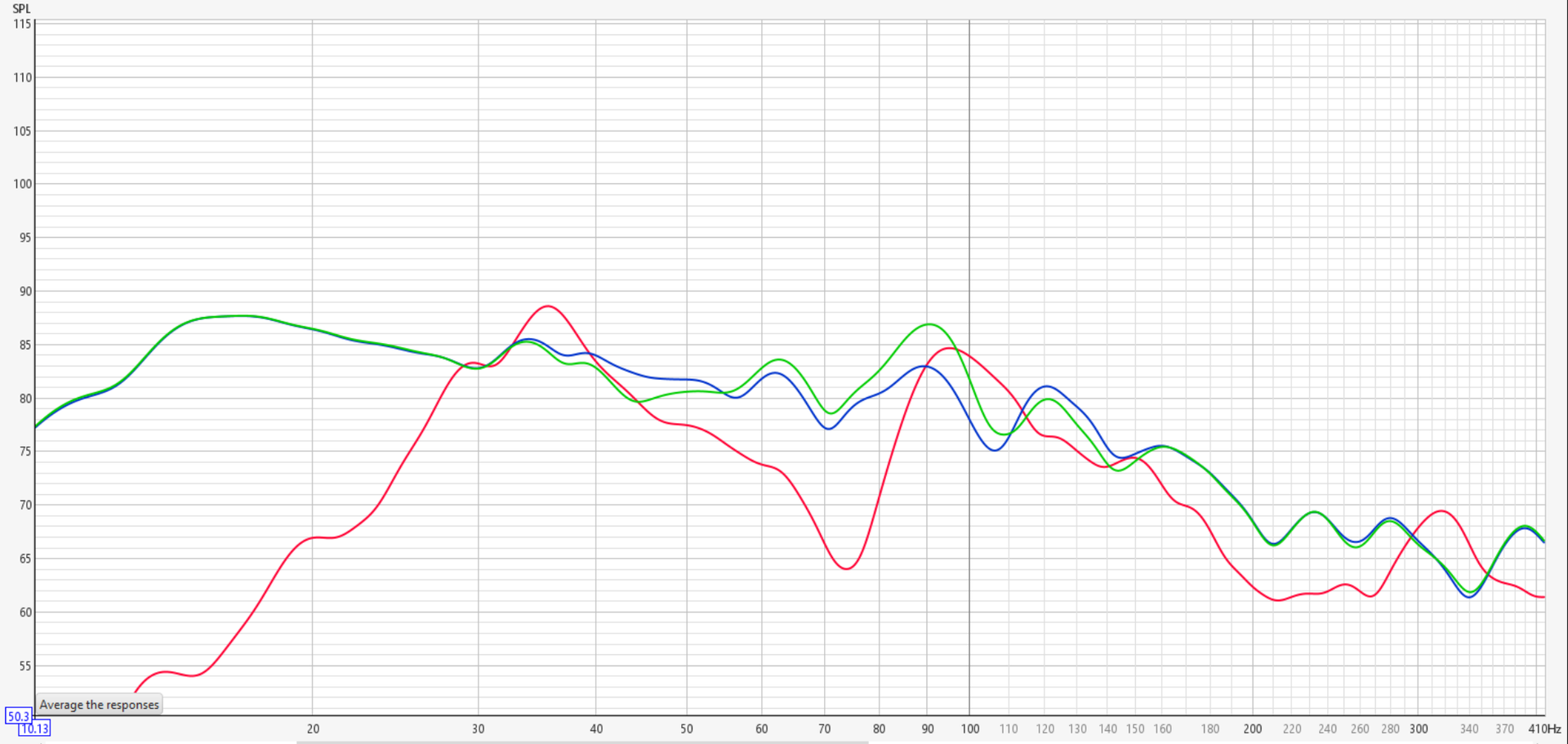
Red – no subwoofers | Green – subwoofers with EQ only | Blue – subwoofers with the same EQ but phase correction applied
The graph above separates our integration tools and shows what each one contributes independently. The red trace remains our reference, speakers alone, no subwoofers. The blue trace is dual subwoofers with phase correction and EQ applied. The green trace is dual subwoofers with EQ only, no phase correction.
We believe the comparison between blue and green is where this becomes genuinely instructive. Through the 30 to 60 Hz region, both traces perform similarly well, with EQ alone managing to reasonably correct the response in this range. The real difference emerges in the 60 to 90 Hz region, precisely where our most difficult and problematic modes live. Here, the green trace shows clear unevenness, with the deep cancellation around 73 Hz remaining largely unaddressed and the overall response losing consistency. The modal interactions that the EQ alone cannot resolve begin to yield when the subwoofers are first brought into proper phase alignment with the main speakers and with each other.
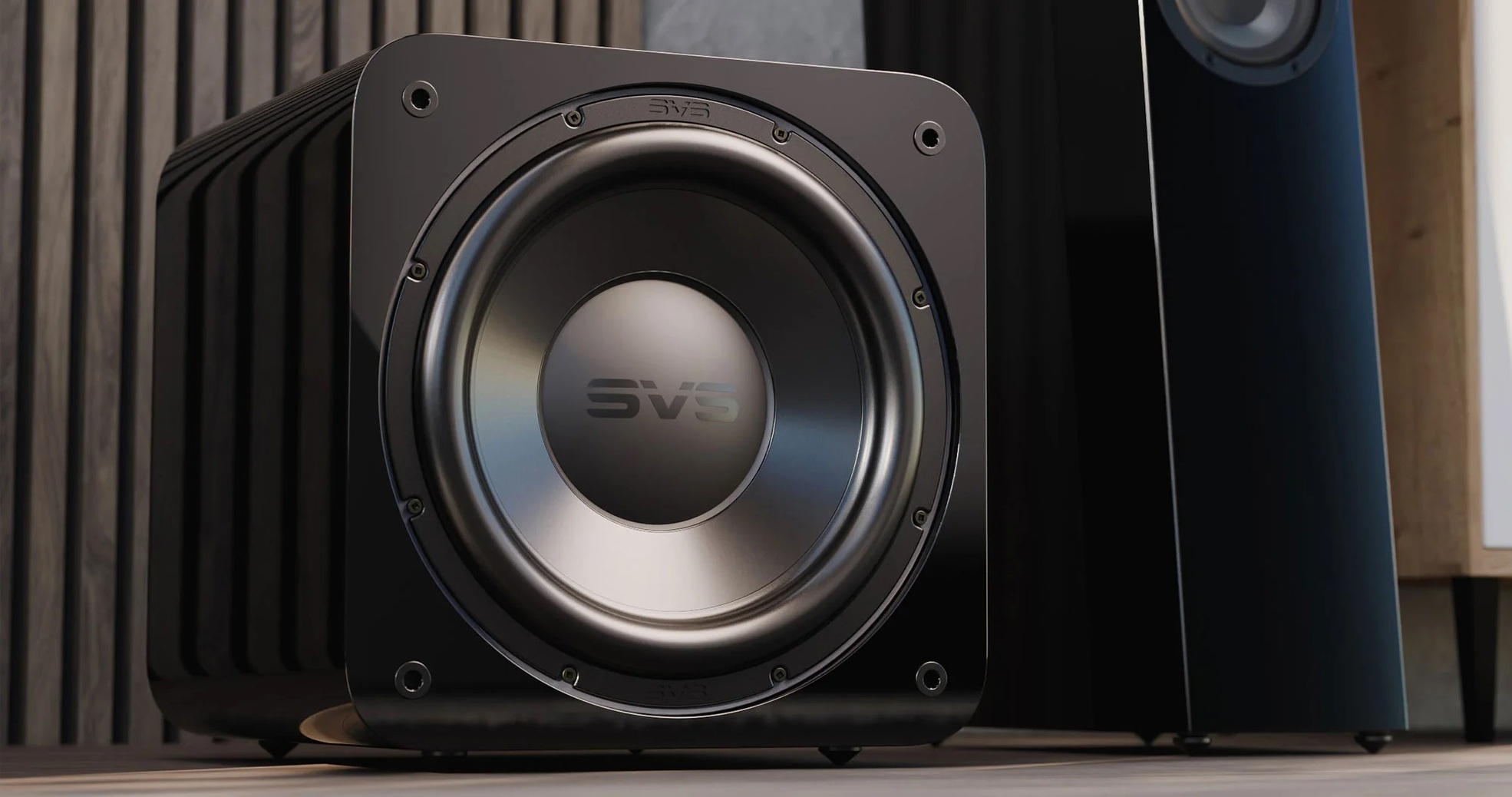
This is precisely where the fine-tuning of the phase produces audible and measurable differences in the real world. The difference between 32 degrees and 43 degrees, or between 7 degrees and 17 degrees, is significant in practice. Even a single degree of phase shift changes how the pressure contributions of each source add or cancel at the listening position across a crossover region already complicated by modal interactions. The SVS SB-3000 R|Evolution offers exactly this resolution through its app, and our measurements show directly what that precision is worth. Systems with coarser phase adjustment simply cannot arrive at the optimal alignment point. They can get close. Close is measurably and audibly different from correct.
What about time alignment?
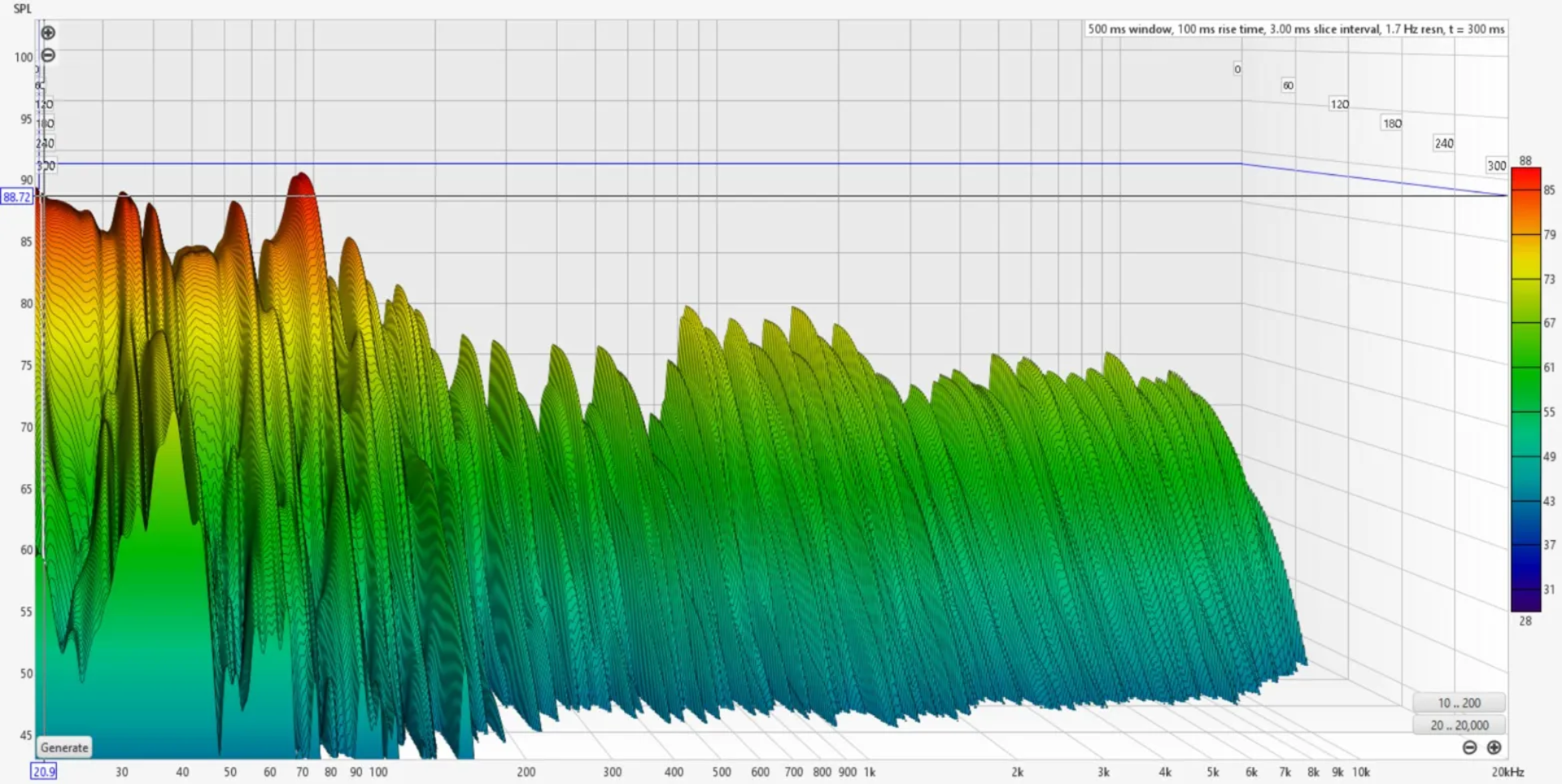
The two waterfalls we will analyze complete the argument that the frequency response graphs started. The first waterfall shows our system with EQ applied, but no phase correction.
Looking at this first waterfall, the modal peaks below 100 Hz show predominantly red and orange coloring, with decay tails that stretch well beyond 200 milliseconds at several frequencies. The 70 to 90 Hz region is particularly telling, the energy sits high and lingers, releasing slowly and unevenly across the bass band.
Waterfall with EQ applied
This is the sonic signature of a system whose sources are working partially against each other, their pressure contributions adding and cancelling in ways that extend the room’s ringing rather than controlling it.
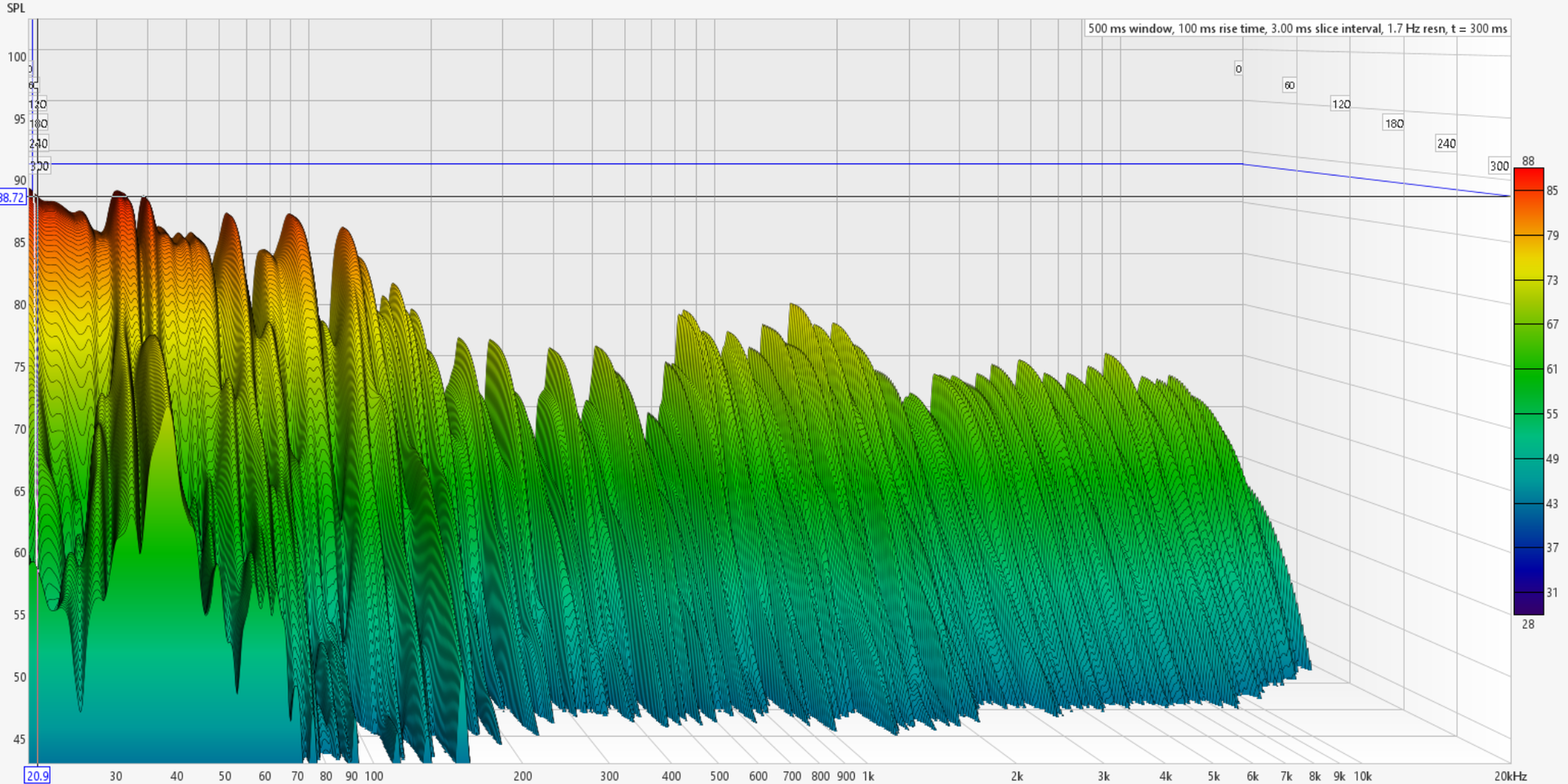
The waterfall below shows the same EQ, but this time, phase correction is added. The frequency response difference between the two is clearly visible, but the time domain difference is another matter entirely.
Waterfall with EQ and phase correction applied
The same modal peaks are present since the room has not changed, but their decay is significantly faster and more uniform. The red and orange tips shrink. The energy is released more cleanly and more quickly across the entire bass region. The 70 to 90 Hz area, our most problematic zone throughout this entire analysis, shows a noticeably more controlled and faster decay than the EQ-only result.
This is the most important takeaway of this entire chapter. A flat frequency response measured at the listening position means very little if the system achieves it with sources that are fighting each other in the time domain.
Phase correction is what turns two subwoofers and two speakers from four competing sound sources into a single coherent system. Everything else: EQ, volume calibration, placement, builds on top of that foundation. Without it, we strongly believe the foundation itself is compromised, and no amount of equalization applied afterward can fully recover what misalignment takes away.
Conclusion and food for thought
Every measurement presented throughout this analysis represents an average of 10 individual captures, each taken at a 512k length, which translates to roughly 10 to 15 seconds per measurement. The comprehensive research, classification, and iterative refinement of positions, phase values, and EQ settings took well over two weeks of dedicated work. We share this detail to give an honest sense of what proper subwoofer integration actually demands when done with the rigor that a reference system deserves. Each placement change required a full new set of measurements. Each phase adjustment required verification across multiple listening positions. Each EQ decision required comparison against the previous best result. Overall, the entire process seemed to flow better when given time and patience.
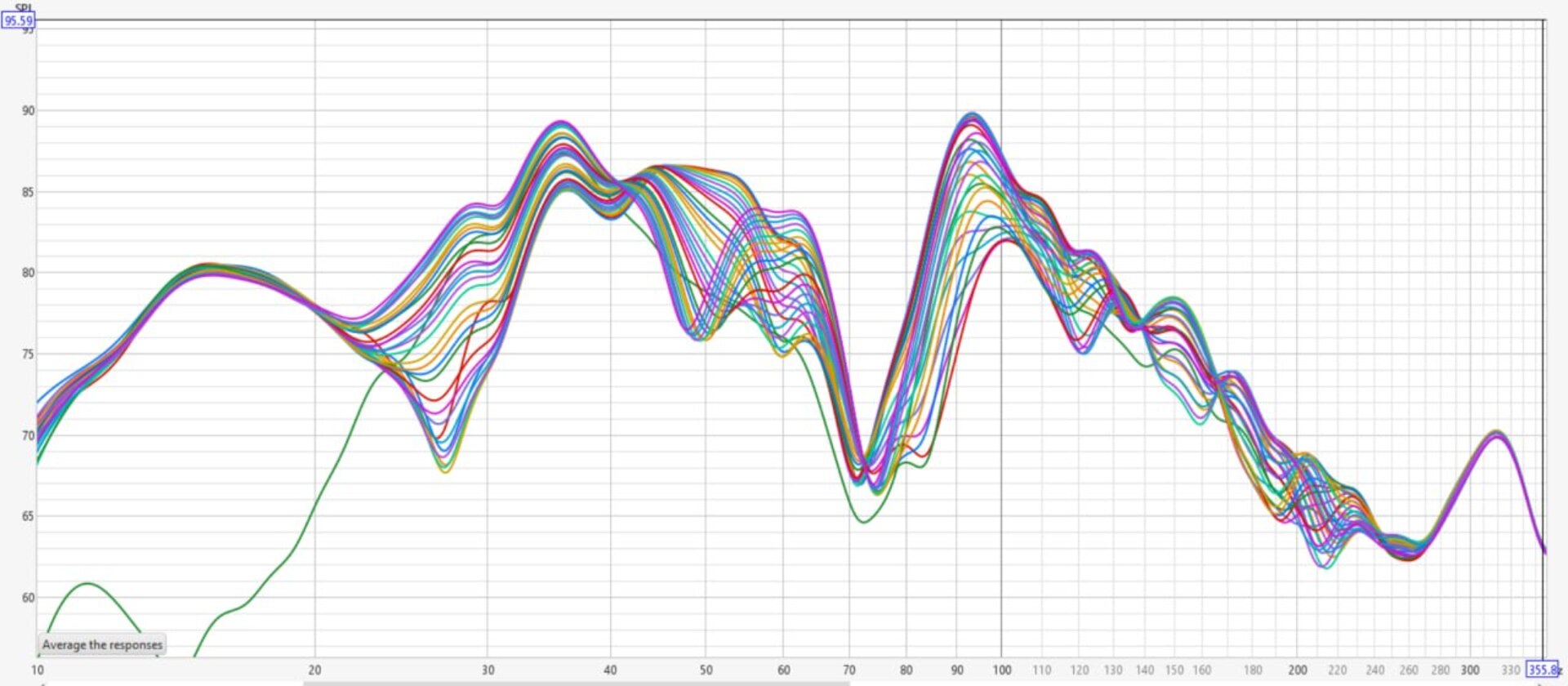
Below, we want to break down something most people completely underestimate. The following graph shows measurement captures of the system’s response with both subwoofers kept in the same physical position, while both their phase was incrementally adjusted from 0 to 180 degrees in 6-degree steps. Each curve represents a different phase setting, revealing just how dramatically phase alone can reshape the bass response. Without moving a single component, the interaction between the subwoofers, the main speakers, and the room changes entirely, reinforcing or cancelling specific frequencies. What we are seeing here is not subtle fine-tuning, but a fundamental transformation of how the system behaves within the room.
Phase Sweep Analysis: How Phase Alignment Reshapes the Room (both subwoofers 0 to 180 degrees in 6-degree steps)
Let’s analyse it a bit. First, look at the low bass region, roughly 20 to 50 Hz. The curves are spreading quite a lot there, but not randomly. You can clearly see that certain phase settings produce strong reinforcement around 30 to 40 Hz, while others introduce deep cancellations in the exact same region. That means the subwoofer is sometimes working with the room mode, and sometimes directly against it. Same position, same subwoofer, completely different outcome.
Another very interesting find is what you are seeing around 42 to 44 Hz, and then again in several other regions. This is a transition point, a place where the phase relationship between sources changes the dominant summation behavior at the listening position. In plain terms, one phase setting stops helping and starts hurting, while another one that was previously less favorable begins to take over. Here, the curves reorder themselves, it’s not just spreading apart, angle to angle, as they do when looking at other frequencies.
That is extremely important because it shows that the phase is not simply increasing or decreasing bass level in a smooth, global way. It is redistributing energy differently across the entire spectrum, frequency by frequency. Around 42 to 44 Hz, the graph suggests a clear handoff between constructive and destructive interference patterns. Some traces that were sitting higher below that region begin to fall away, while others rise and become more favorable above it. This region is especially interesting because it sits right around one of the room’s dominant modal areas, where the system is particularly sensitive to timing. In a zone like this, a small phase change can move the system from one interference regime into another, it doesn’t just simply trim the response. That is why the traces cross so decisively there rather than just drifting apart gradually, very interesting to observe indeed.
Here we see the signature of a system where the timing relationship between the subwoofers, the mains, and the room reflections is changing enough for the acoustic summation itself to flip.
This is why the graph feels almost as if the subwoofers are being moved through the room. In a way, acoustically, they are. Each phase increment changes the arrival relationship of the low-frequency wavefronts at the listening position, so the room “sees” the source differently. At certain frequencies, that creates reinforcement, at others, cancellation. And at these transition points, the preferred phase setting can suddenly switch.
Now move to the 60 to 90 Hz region. This is where things become even more dramatic. There is a very deep and narrow null around 70 Hz that shifts in both depth and position depending on phase. Some curves almost recover it, others make it collapse further. This is classic destructive interference between the subwoofer and the main speakers, and phase is the only thing changing that relationship here.
Above 90 Hz, toward 120 to 150 Hz, you still see meaningful variation, though less extreme. The curves start to converge, which makes sense because modal dominance begins to reduce and wavelengths get shorter. Still, even here, the phase is subtly affecting integration and tonal balance.
The key insight from this graph is that each curve is effectively a different spatial interaction between the subwoofers and the room. Even though nothing physically moves, the pressure field at the listening position changes as if the source itself had been repositioned. By rotating the phase, we are changing the timing relationship between sources. That timing shift alters how waves add or cancel at specific locations in the room. Since room modes are fixed in space, changing the phase is equivalent to changing where the subwoofer “sits” inside that standing wave pattern. This is why the differences look so large.
In practice, there is no single curve that is “best everywhere”. Some phase settings improve one region while degrading another. This is where the real challenge is. The goal is not perfection at one frequency, but the best global balance across the entire bass range. And this is exactly why coarse phase controls alone are not enough. If the steps are too large, we simply jump over optimal alignment points without ever landing on them. This graph shows how sensitive the system is. A few degrees can shift a null, reduce a peak, or completely change the perceived weight and control of the bass. What this ultimately shows is that phase adjustment is not a secondary refinement applied at the very end of the process, but one of the central tools of the entire integration itself. In a real room, with fixed speaker locations, a sofa pushed close to the back wall, and aesthetic constraints that leave little freedom for ideal placement, phase becomes one of the very few remaining ways of meaningfully shaping how bass energy arrives at the listening position. Once that is understood, the role of a properly equipped subwoofer changes completely: it is no longer just extending the low end, but actively helping the system and the room work together instead of against one another.
Add all that fine-tuning and multiply it by two, and the findings become even clearer: two subwoofers, properly understood and correctly integrated, transform what a constrained real-world stereo system can achieve in the bass region. The benefit goes well beyond simple extension. When we know the room, when we have mapped its modes, when we understand which frequencies will cancel and which will reinforce at the listening position, and when we are bound by strict positioning constraints that cannot be changed, two symmetrically placed subwoofers with independent phase control become one of the most powerful tools available in an audiophile’s arsenal. This system addition addresses modal problems that a single unit, let alone no subwoofer at all, simply cannot touch. They improve the time domain behavior of the entire system. They extend the frequency response to regions that the main speakers will never reach, either from their aesthetically constrained positions or from construction-imposed limits (eg: bookshelves). And they do all of this while remaining partially invisible in the room, placed where the constraints allow them to be placed, sometimes even looking like they belong there.
What this analysis also revealed, perhaps more clearly than any single graph, is the hierarchy of integration tools and the order in which they must be applied. Placement comes first because no DSP can compensate for a fundamentally incorrect position within the room’s modal field. In this particular case, placement was especially constrained to demonstrate what we could achieve with deep knowledge and hard work.
Phase alignment, we believe, comes second, because without temporal coherence between the subwoofers and the main speakers, EQ is correcting a system that is already working against itself. Volume calibration comes third, ensuring that the level relationship between subwoofers and main speakers is correct before any spectral shaping is applied. EQ comes last, as the final layer of refinement applied to a system that is already coherent in both space and time. Reversing this order, or skipping any step, seemed to produce a result that looked acceptable on a graph but sounded incomplete in the room. The waterfall plots we included throughout this chapter make that distinction impossible to ignore.
The SVS SB-3000 R|Evolution gave us the precision to execute every one of these steps correctly. The 1-degree phase resolution meant we could arrive at 32 degrees and 7 degrees with ease, knowing that the optimal alignment point had actually been found rather than approximated. The parametric EQ gave us the surgical control needed to address individual modal peaks without disturbing the surrounding frequency bands. The 295 MHz DSP processed every correction in real time with no audible artifact. And the raw capability of the 13-inch driver and 1,200-watt amplifier ensured that the subwoofers never ran out of headroom during the most demanding listening sessions, maintaining dynamics, speed, and composure throughout the listening sessions.
But the hardware was only as good as the understanding behind it. A powerful subwoofer placed without knowledge of the room’s modal structure is a powerful problem. The same subwoofer, deployed with a clear map of where the room’s energy concentrates and where it cancels, with phase aligned to the main speakers, with EQ applied only after temporal coherence is established, becomes something genuinely transformative.
That transformation is what this chapter has documented.
In the end, the room will always have the first word. What we have shown here is that, with the right tools and knowledge, it does not have to be the last one. Perfection is not required to achieve transformation. Our room is far from ideal. The listening position is compromised. The speaker placement is dictated by aesthetics. And yet, with enough understanding and careful application of the right tools, the result moves into a completely different category of performance. Not perfect, but profoundly better in every meaningful way.
Let’s dive into the app
After three weeks of measurements, mode maps, waterfall plots, and phase adjustments, it was finally time to sit down, stop analyzing, and just listen. Because all of that work only has meaning if it translates into a musical experience that justifies every hour spent with a microphone and a laptop. Before we move into the listening impressions, we feel compelled to pause for a moment and talk about what made everything you have just read possible in the first place. The quiet enabler behind every graph, every adjustment, every breakthrough moment along the way: the app.
It is very easy to underestimate it. To treat it as a convenience feature, something that replaces a few knobs on the back panel and saves you from bending down behind a cabinet. That would be a mistake. In practice, it became the central control point of the entire system, the place where understanding, action, and small, incremental decisions translated into measurable and audible changes. So it is worth understanding just how much control the app gives you over the subwoofer, and more importantly, how intelligently that control is structured.
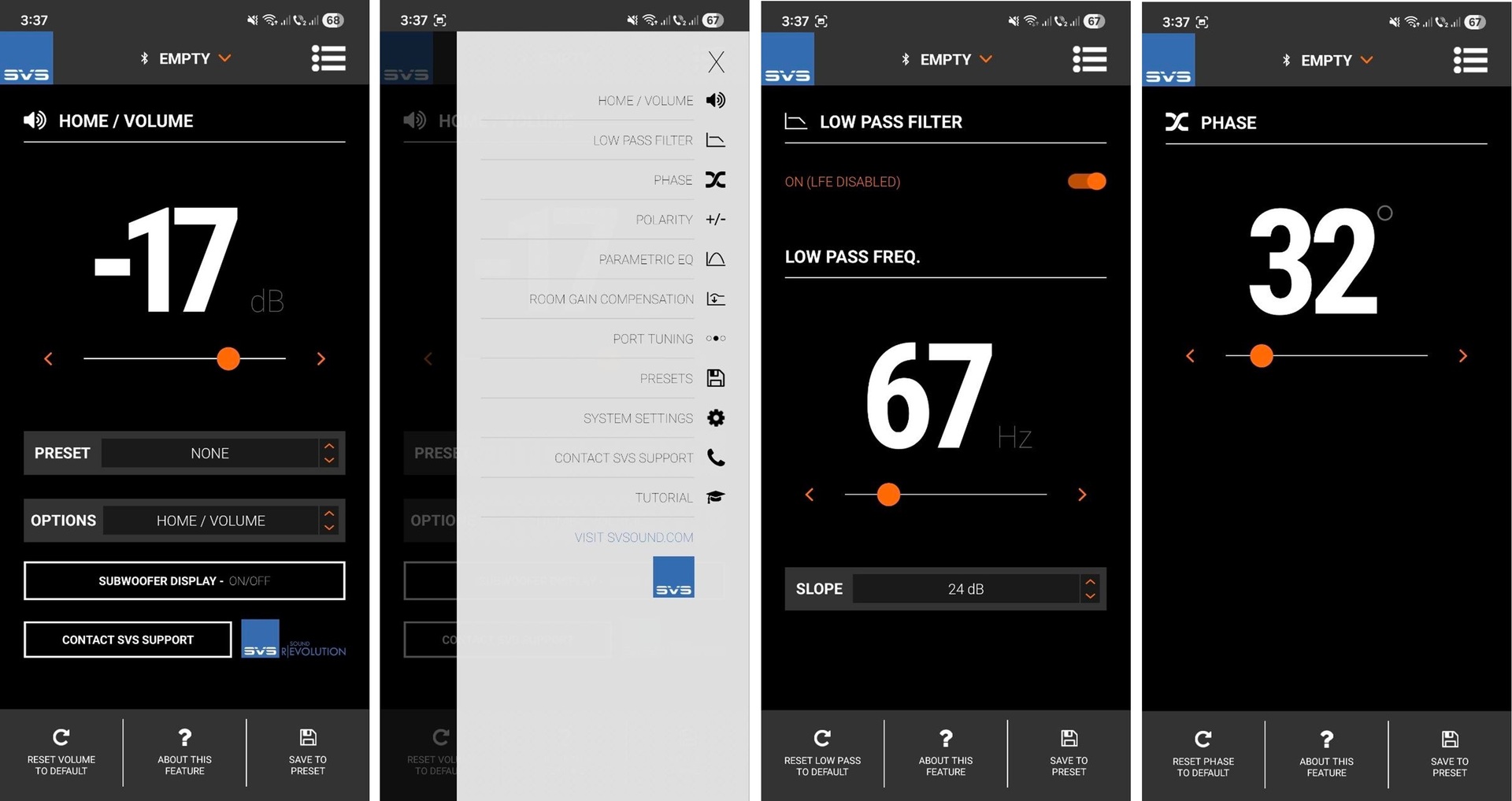
Starting with the Home / Volume screen, this is your central access point and, in practice, the place you will return to most often. Volume is displayed clearly in decibels, allowing for precise level matching with the main speakers.
The Preset section allows you to store and recall different configurations instantly. This becomes extremely useful once you start experimenting. You can save multiple setups, one optimized for music, another for movies, or even different phase and EQ combinations, and switch between them without losing your reference points.
Moving into the main menu, the app reveals its real depth.
The Low Pass Filter section gives full control over the crossover frequency and slope. Fine-tuning this setting allows for a first layer of the clean handoff you can do between the main speakers and the subwoofers. The ability to define both frequency and slope is critical. It determines not only where the subwoofer stops, but how it blends into the mains. A poorly chosen slope can smear the transition, while a correct one makes the subwoofer effectively disappear.
The Phase control is, without exaggeration, the most powerful tool in the entire app. Adjustable in single-degree increments, it allows for an extremely fine alignment between the subwoofers and the main speakers. As we already demonstrated in the measurements, even a few degrees can completely reshape the response. Having access to that level of precision directly from the listening position is what makes proper integration realistically achievable.
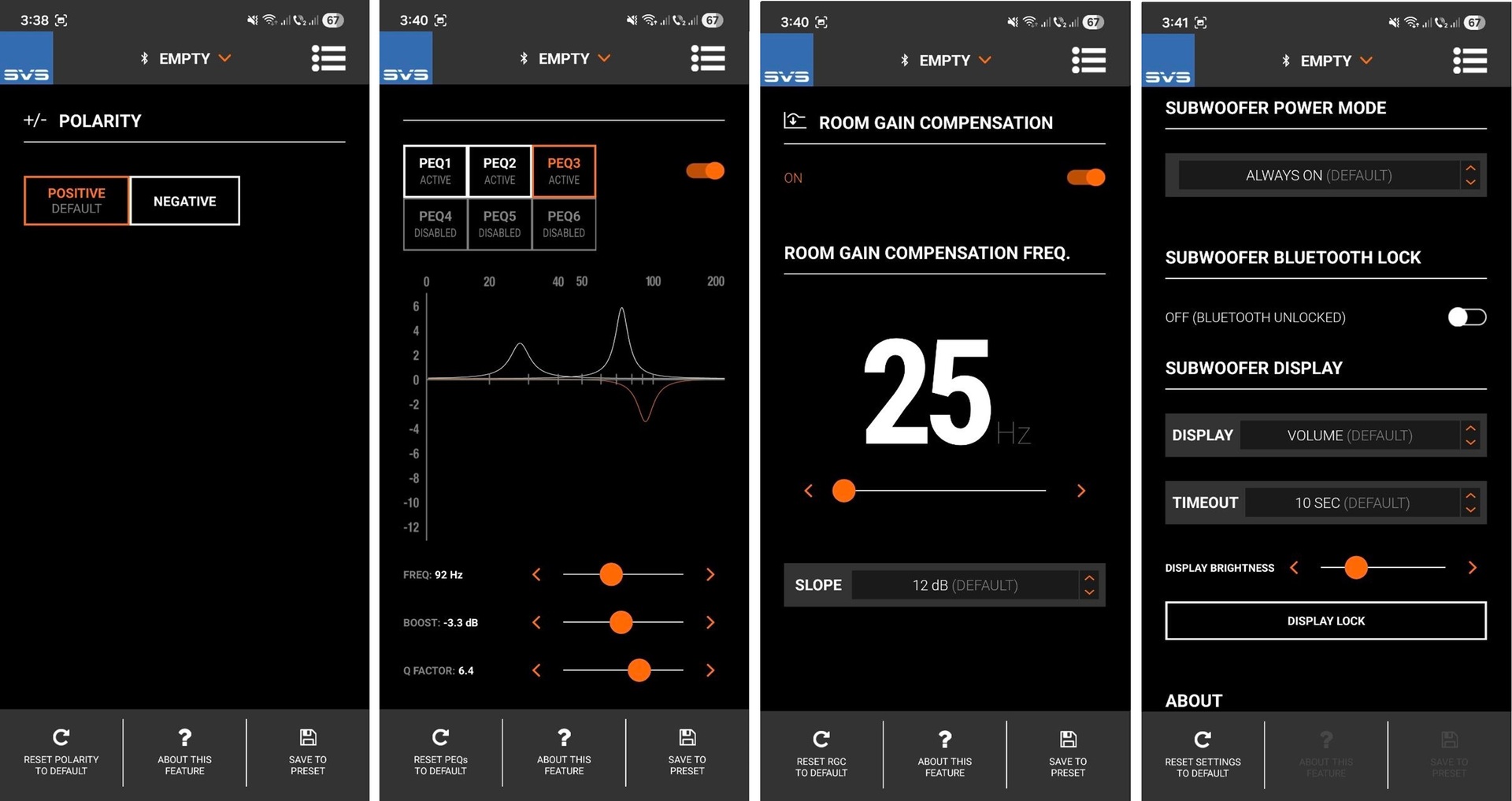
Next on the list is the Polarity setting, which offers a quick inversion option, useful for initial alignment checks. While coarse compared to phase adjustment or parametric equalisation, it remains a valuable diagnostic tool when identifying major cancellation issues and is one found in all modern subwoofers.
The Parametric EQ section is the second most important tool provided by the app. It enables full manual control over any frequency, gain, and Q factor. This is where surgical corrections happen. Instead of applying broad, generic adjustments, you can target specific room-induced peaks without affecting the surrounding frequencies. It is precise, transparent, and essential for final refinement once placement and phase are already optimized.
Room Gain Compensation is designed to manage excessive low-frequency buildup, particularly in smaller rooms where natural room gain can exaggerate the lowest frequencies. Used correctly, it can help maintain balance without sacrificing extension.
Port Tuning (because we had the sealed versions on review, it was not applicable for us) allows further tailoring of the subwoofer’s behavior depending on configuration. Its presence shows the level of flexibility and attention that was put into building the app.
Finally, System Settings, Presets, and Support options round out the experience, but what matters most is that everything is accessible, clearly laid out, and responsive in real time.
What ultimately makes this app stand out, besides the depth of control it offers, is how effortlessly it translates complexity into something usable in a real-world environment. Every adjustment is immediate, repeatable, and precise, allowing the user to move from rough setup to fine integration without friction. Just as importantly, the connection itself was flawless throughout our entire time with it. The app connected every single time, responded instantly, and never once gave us bugs, dropouts, errors, or moments of instability that could interrupt the process. That reliability matters more than it might seem, here, and we want to emphasize it because when we were deep into iterative measurement and calibration work, the last thing we needed was for the control interface itself to become a problem. It never did.
The app also removed the traditional interaction between us, the user, and the physical box, turning what used to be a tedious trial-and-error process, get up from the couch, move a knob, go back, into something much more pleasant, precise, and intuitive. In our case, it was not simply a convenience, but one of the key reasons proper integration became realistically achievable at the level documented throughout this review. Much appreciated!
The sound
From the beginning, we would like to start with a fast, tight, groovy track from George Duke – From Dusk Till Dawn is one of those tracks that immediately exposes how a system handles groove, layering, speed and low-frequency coherence. It’s about how the entire foundation of the track breathes, moves, and supports everything built on top of it.

Through the dual subwoofer setup, what stood out first was the sense of scale. The bass line, which sometimes can feel slightly compressed or confined between the output of the speakers alone, now expanded naturally and dynamically into the room, carrying real physical weight without ever becoming overbearing. It had that rare combination of authority and control that lets each note start and stop with precision and speed while still maintaining a fluid, almost organic flow.
What we discovered and surprised us was how this foundation affected everything else. The groove itself became more convincing, more alive. There is a subtle interplay between the bass line, the kick, and the rhythmic accents that defines the track’s momentum, and with the subwoofers properly integrated, that interplay gained a level of clarity and separation that we had not experienced in this room before. Each element occupied its own space, yet remained tightly locked in time, giving the entire presentation a sense of effortlessness and power.
The midrange benefited from this stability as well. George Duke’s instrumentation, with its rich textures and layered harmonics, floated more freely above a foundation that no longer felt like it was shifting or fighting the room. There was a sense of calm and control across the entire spectrum, as if the system had finally settled into a natural balance.
But perhaps the most striking aspect was the realism. The track took on a physical presence that went beyond simple reproduction. The low-frequency energy was not just heard, but felt in a way that mirrored a live performance, subtle pressure changes in the room, a sense of air being moved, of space being energized. Music became more grounded and believable.
This is where the system crossed a threshold. It stopped sounding like a system trying to reproduce music and started behaving like a space in which music simply existed. And with a track like From Dusk Till Dawn, built on groove, texture, and flow, that transformation made all the difference.
Let’s continue with Dominic Miller’s London Paris Cardiff.

Dominic Miller’s guitar work on this track is intimate and precisely recorded, with a presence and immediacy that instantly reveals the quality of a system’s midrange and how it works within the lower registers of the spectrum. The acoustic guitar body carries fundamental energy that sits right in the region our modes had been fighting over for three weeks, and through our fully integrated dual subwoofer system, that body weight arrived with a naturalness and solidity that we had not heard from this room before. The instrument felt anchored in space, grounded in a way that gave every note a physical reality that floated convincingly between and beyond the speakers. The subtle low-frequency information that underpins the recording, the room ambience, the resonance of the instrument’s body against the recording space, came through with a weight that the speakers alone, constrained as they are by their position, simply could not deliver.
The subwoofers added a foundation so seamlessly integrated that they announced their presence only through what they gave the music, never through anything that drew attention. Coherence was absolute. At no point did the bass feel like it was arriving from a separate source or a different location in the room. The three-dimensional soundstage that formed in front of our very un-audiophile listening position was complete, unified, and convincing, exactly what two properly integrated subwoofers, set up with the knowledge and patience the previous chapter has documented, are capable of delivering.

Infected Mushroom, as a band, occupies a completely different sonic universe from Dominic Miller, and that contrast is precisely why we chose them. Never Ever Land, Heavyweight, and Avratz are three tracks that share a common DNA: dense layering, relentless sub-bass pressure, and a production approach that deliberately pushes low-frequency energy into regions that most speakers in most rooms simply cannot handle with any sense of control or definition.
Through our integrated dual subwoofer system, all three tracks revealed something that we had not fully anticipated, even after two weeks of measurements. The sub-bass on Heavyweight, which in lesser setups arrives as an undifferentiated wall of pressure, now had more texture and a defined physical shape. Individual bass types within the mix were distinguishable from each other, each with its own attack and decay, each sitting at its own specific point in the frequency spectrum, never collapsing into a single low-frequency mass. The physical impact was considerable, as was the chest-thumping kick, which we came to appreciate even more.
Avratz pushed the system harder still, with its layered bass synthesizers stacking sub frequencies in a way that deliberately challenges both the listener, the system, and the room. The dual SB-3000 R|Evolution units handled every demand the track made with ease. The 1,200-watt amplifiers and 13-inch drivers never suggested strain or compression, even at levels way beyond what the normal audiophile would ever listen to. Never Ever Land brought a more musical and melodic low end to the session, and here the integration showed, dare we say, its most refined side: the subwoofers extending and supporting the system’s bass response so naturally that the music simply connected, coherent from the very bottom of the audible spectrum to the top, without a single seam in the presentation.

Geoff Castellucci’s Sound of Silence is a track we return to constantly, precisely because that baritone voice, sitting deep in the frequency range where room modes do their worst damage, tells us everything we need to know about how well a system handles some of the lowest frequencies.
Through the dual SB-3000 R|Evolution system, Castellucci’s voice arrived with a physical presence and a chest resonance that had us in awe. The lowest notes of his vocal range, the ones that in lesser setups either disappear entirely or arrive as an indistinct rumble with no sense of pitch, were now fully formed and precisely placed within the soundstage. Each phrase carried its full harmonic weight from fundamental to overtone, and the space around the voice felt vast and three-dimensional in a way that is difficult to put into words.
The foundation the subwoofers provided was so well integrated into the overall presentation that Castellucci’s voice sounded complete, natural, and really convincing. The track was transformed into an experience that made us sit through and forget to take notes.
Next, we’ll look at Yosi Horikawa’s In the Wind, a recording built entirely around spatial information. Every sound on this track, from the rustling leaves, the scattered percussive elements, to the layered ambient textures, was designed to exist in three-dimensional space. This song rewards systems that can place sound with precision and convey genuine depth and distance, tridimensionality, and holography in equal measure.
Through our integrated dual subwoofer system, the track opened up in a way that managed to surprise us. The low-frequency foundation that underpins the entire soundstage, largely invisible on lesser systems, was now present and fully formed, giving every ambient element a physical anchor in the room. Sounds that had previously floated somewhat disconnected from any real sense of space now had a kind of weight and groundedness that made the three-dimensional image feel very believable.
The sub-bass texture on this track is subtle and complex, and it is precisely that subtlety that makes it such a demanding test. The SB-3000 R|Evolution units resolved every layer of low-frequency information the recording contained, from the deepest ambient sound to the more defined percussive bass elements, each sitting in its own precise position within a soundstage that extended well beyond the physical boundaries of the room.
The result was an experience that felt like being inside the space where the recording was made. We thoroughly enjoyed every minute of it, and it taught us something that measurements alone cannot fully communicate: the sub 30 Hz region carries information that goes far beyond bass weight and extension.
The sub 30 Hz region carries the acoustic signature of the space itself, the ambience, the air, the sense of physical scale that transforms a good track into an immersive one. Our speakers, constrained as they are by position and by physics, demonstrated exactly what is lost when this region is absent: a layer of the music that most listeners sometimes never even hear, because most systems don’t show it. Once experienced through a properly integrated subwoofer system, it becomes a permanent reference point and raises the bar for everything that follows.
Throughout our listening sessions, this same sense of ambience, physical scale, and immersive three-dimensionality was felt and heard consistently across many tracks. Boris Blank’s Magnetic Lies, Francine Thirteen’s Queen Mary, Heilung’s Traust and Svanrand, and Woongsan’s Vivaldi’s Song each one, in its own way, revealed a layer of musical information that our room, our constraints, and our speakers alone had not been able to deliver. Genres built around low-frequency energy revealed perhaps the most immediate and dramatic transformation. EDM music became more engaging, not just through increased impact, but through a clearer sense of layering within the sub-bass itself. The rolling bass lines, often sitting deep below 40 Hz, gained texture and movement, no longer collapsing into a continuous pressure but evolving with the track’s progression. Rap and hip-hop, on the other hand, became noticeably more physical. Kick drums hit with a defined leading edge, followed by a controlled and weighty decay that you could feel as much as hear. The sub-bass lines carried real mass, anchoring the rhythm in a way that made the entire presentation more grounded, realistic, fun, and authoritative. What stood out across all these genres was better bass, tighter, faster, more articulate, and far more believable, turning what was previously a good listening experience into something closer to a live, visceral one.
And, something else happened, something simpler, yet just as important. The system became more fun. The dual SB-3000 R|Evolution system, set up with the knowledge and patience this review has documented, brought all of it to the surface.
Ok, but no drawbacks?
Reaching a perfectly balanced and coherent bass integration is genuinely difficult. We want to be honest about that. A single SB-3000 R|Evolution already adds considerably to the experience. The extension, the physical presence, the way it fills in the lowest registers that the main speakers cannot reach from their constrained positions, all of this is immediately audible and immediately appreciated with just one unit in the system. For many listeners, that alone will feel like a good transformation.
But our research shows clearly what happens when the second unit enters the picture. The modal irregularities that a single subwoofer can only partly manage begin to be addressed much more effectively. The lateral modes, the tangential modes, the asymmetric pressure distributions that one source always excites unevenly, all of these respond to the symmetry that two units provide in a way that no amount of EQ or phase adjustment applied to a single subwoofer can replicate.
The improvement is measurable, visible in every graph we produced, in both the frequency and time domains, and immediately audible in every track we listened to.
Two subwoofers solve the fundamental modal problem but introduce their own demands. The integration process is long, intense, and requires careful listening at every step. Phase alignment alone took days of iterative measurement and comparison. EQ decisions required verification across multiple listening positions. Volume calibration had to be revisited every time anything else changed. This is not a plug-and-play proposition, and anyone expecting an easy path to the results we documented here should understand clearly what that journey involves.
There is also the simple, unavoidable reality of two additional boxes in a living room that was never designed to accommodate them. Aesthetic compromises are always there, and the floor plan has to absorb two objects that, however compact the SB-3000 R|Evolution is for what it delivers, still occupy physical space that a family living room does not always offer willingly.
And yet, once all of these obstacles are cleared, once the system becomes coherent, once the phase is aligned and the EQ is settled and the room’s modes are working with the system and not against it, what emerges is a reference-grade listening experience at a price that, given everything it delivers, feels almost unreasonably generous.
We would like to extend our sincere thanks to AVstore for providing the pair of SVS SB-3000 R|Evolution subwoofers for this review. Having more than a month to live with them, measure them, push them, and integrate them into our system was essential for the depth of analysis this review required. Their trust and generosity made this entire journey possible, and as always, their support allowed us to offer the kind of honest, thorough evaluation that we believe our readers deserve.
Conclusion
The SVS SB-3000 R|Evolution earns its place in a serious system by transforming and vastly improving what a room, with real and proper constraints, can actually sound like. Two of them, properly integrated, become a permanent reference point, one that raises the bar for everything else.
Pros
- A single SB-3000 R|Evolution already addresses the most significant modal problems in a domestic room, delivering meaningful improvements in extension, coherence, and overall bass quality that any listener will immediately appreciate
- Two units, placed symmetrically, resolve modal problems that are almost impossible to solve without them, transforming the system’s bass behavior in both the frequency and time domains simultaneously
- 1 degree phase resolution: the single most important integration tool available, and one that competitors at this price point do not offer
- Parametric EQ with full control over frequency, gain, and Q factor
- Exceptional extension to 17 Hz in a cabinet measuring just over 15 inches cubed
- Compact enough to live in a family room without dominating it
- SVS app makes the entire integration process accessible and precise from the listening position
Cons
- Proper dual subwoofer integration is a long and demanding process that requires patience, measurement tools, and careful iterative listening
- Two units require physical space and aesthetic compromise in a domestic environment
- The full potential of the system can be realized only after significant investment of time and knowledge. Dedication is key!