Cambridge Audio L/R X Active Loudspeaker Review: The Pleasure of Simply Listening

TLDR:
The L/R X is the flagship of Cambridge Audio’s new L/R range, an active stereo pair that holds amplification, streaming, source switching, digital crossover, and room correction inside its two cabinets. Cambridge Audio specifies 800 W of total Class D power, or 400 W per enclosure, a newly developed 28 mm Torus tweeter, dual 5-inch woofers, and dual side-mounted force-cancelling passive radiators per speaker, all coordinated by 64-bit processing and the StreamMagic Gen 4 platform.
Three qualities define this speaker for us:
1. Warm, pleasant timbre. Voices and instruments create a tonal colour that we find pleasant and inviting from the first bar. The midrange has body and texture, giving the singer weight and presence in the room and the guitar, for example, a sense of physical wood behind the strings.
2. True listening pleasure. Some systems are built around details and pinpoint accuracy, while others exist just to be enjoyed. The L/R X definitely belongs to the second group. Long listening sessions passed without our reaching for a notebook, and that says a lot about their voicing.
3. Value. Measured against what the pair costs, the sound reaches further than we expected, and the feature count is generous by any standard we can think of.
The L/R X asks for one concession: dynamic compression becomes audible as the volume climbs toward its limits, and the DSP protection makes its presence known. Microdetail and texture are present in modest measure, and subbass extension stops a tad higher than the most ambitious designs in this price category.
This is a speaker for the everyday listener who wants clutterless high quality. Someone who cares how music sounds, who has no appetite for a rack of separate devices, a multitude of cables lying around, and of course, the famous ritual of matching one component to another. If you do not care about these, you will find the L/R X close to ideal. We recommend it immensely for you.
A very important note here must be said about the listening position and room acoustics. If you plan on using the speakers in a near-field type of setup, then everything we said in this review becomes null. Microdetail, tweeter presentation, timber, bass response, everything changes once the listening becomes nearfield. Keep that in mind if you plan on buying it!
Introduction
Some products make complete sense only once you understand the reasoning behind them. To appreciate what these speakers set out to be, it helps to look at the long road Cambridge Audio has travelled to reach this point.
We write this review as people who live and breathe traditional hi-fi. We know what well-chosen separate devices and passive loudspeakers deliver in scale, dynamic range, and textural nuance. A great deal of the lasting magic in this hobby lives in the patient pursuit itself: matching an amplifier to a source, choosing cables by ear over many weeks, moving speakers by the centimeter, and chasing a balance that suits the room and personal taste over years. As we have spoken and been adamant about across our other reviews, this journey is shaped by experimentation, by feeling, and by memory. We cherish it. That perspective is exactly what makes an active loudspeaker interesting to us, because it takes every one of those decisions out of the listener’s hands and makes them once, at the factory, on the listener’s behalf.
Our goal here is a simple one. We have no intention of repeating a marketing brochure, and we have no intention of asking whether the L/R X can dethrone a carefully assembled system of separate devices, since that is rarely the point of a speaker built this way. The more honest question, and the more interesting one, is how convincingly the L/R X delivers on its own promise: complete, room-filling, deeply musical sound from two enclosures and a power cable, with respect for the listener across long sessions.
There is a personal dimension here as well. Cambridge Audio has been part of the furniture of our listening lives for a long time, in the way that only a handful of British brands manage. The name turns up in the systems of friends, in second systems, in the rooms of people who came to this hobby through a modest amplifier and a pair of bookshelf speakers and never looked back. Sitting down with the L/R X carried some of that affection with it.
With that in mind, let us turn to the company first, and then to the speaker itself.
I. From the P40 to an Active Flagship
Cambridge Audio traces its beginning to 1968, when a group of young technology graduates set up a high-technology research and prototyping business in Cambridge, England. The company’s own account of its history describes that origin plainly, and the first product to carry the name tells you a great deal about the intent behind it. The P40 integrated amplifier delivered 2 x 20 W, and it arrived wrapped in a slim case design that drew attention on the shelf as much as in the listening seat.

The P40 earned its place in the record books for something it pioneered. It stands as the first amplifier to use a toroidal transformer, a component that went on to become a standard inside high-end amplification everywhere. A young company reaching for a solution that the rest of the industry later adopted is something Cambridge Audio can and should be proud of, because it shaped hi-fi culture forever.
The P40 proved difficult to build in volume, and the P50 followed in 1970 at 2 x 25 W with an active volume control and better manufacturability. From there, the company moved through decades of amplifiers, CD players, and digital sources. The DACMagic became the breakthrough digital product of the 1990s and 2000s, a standalone converter that improved the sound of whatever digital source it was connected to, and it introduced a generation of listeners to the idea that the converter matters as much as the transport feeding it.
Ownership shifted in 1994, when Audio Partnership acquired the company. Cambridge Audio was the first acquisition for a business set up specifically to find British brands with technical and design credibility that lacked the funding to lead their markets. More than thirty years later, it is now owned solely by James Johnson-Flint, and the operation runs from London.
We had the pleasure of a long conversation with James Johnson-Flint recently, and the subject of active loudspeakers came up directly. The candour was refreshing. Anyone running an independent audio company today faces a market where the traditional separates chain sits under pressure from every direction, and where a growing share of listeners want music in the room without a shelf of components to manage. The L/R range is Cambridge Audio’s answer, and it arrives from a company with the engineering history to make the answer very exciting.
Great British Sound is the company’s slogan. In this case, the phrase points at something we can hear and feel. There is a tonal character running through Cambridge Audio’s equipment across decades, weighted toward warmth and ease, generous through the midrange, comfortable to sit with for hours. The L/R X carries that character truthfully, and we will come back to it when the music starts.
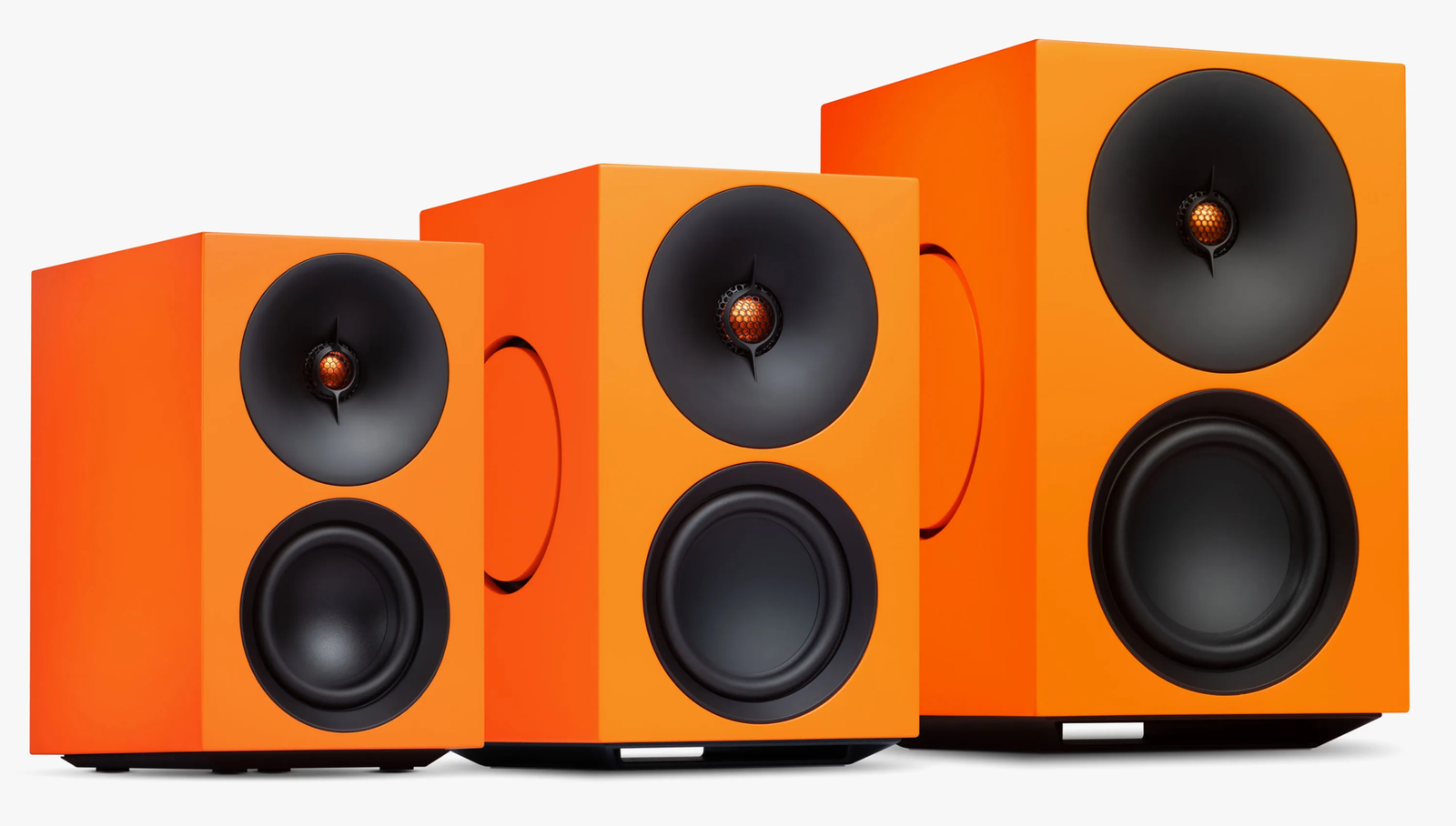
Cambridge L/R lineup
The L/R range comprises of three models:
- The L/R S sits as the entry point of the range, at a remarkably affordable 500 euro price point. This is a solely active speaker rated at 100W total power, with a Bluetooth input design, so no streaming module is present here. It is worth mentioning that the only digital inputs available are Audio (USB-C) and an Optical TOSLINK. NO HDMI Input available. The extremely good news is that the newly designed torus tweeter is present here, albeit in a smaller diameter, at 21mm. The rest of the drivers used in the S model are just the 2 active ones: a 3-inch woofer & a 3-inch subwoofer. No passive radiators at the sides, so by the power rating and driver size, don’t expect these to go as low as the M and X. These could be great office pc speakers, but nothing more.
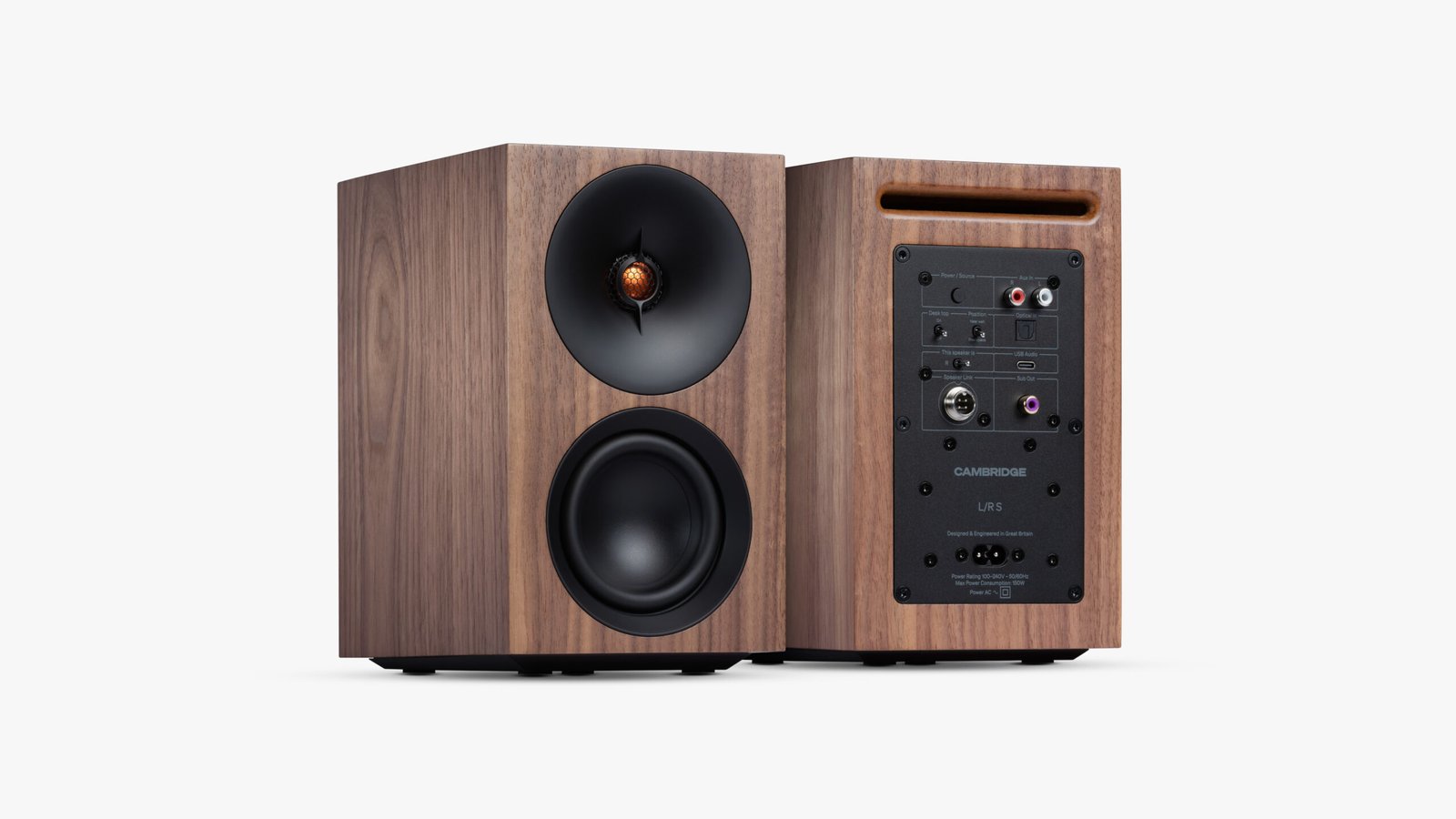
Cambridge L/R S model
- The L/R M is where, for us, the range truly begins to show what the whole L/R concept is capable of. At 1,399 euros per pair, this is the first model that feels like a clever pair of compact active speakers, maybe even, dare we say, start to look more like a Hi-Fi system for a small room. StreamMagic Gen 4 makes its appearance here, bringing proper high-resolution network streaming over Wi-Fi or Ethernet, alongside Spotify, TIDAL, Qobuz, Amazon Music, Roon, AirPlay 2 and Google Cast. Connectivity also becomes substantially more serious, with HDMI eARC, USB Audio, TOSLINK, analogue input and even a built-in MM phono stage. More importantly, the acoustic architecture takes a massive step forward. The L/R M uses Cambridge Audio’s bigger 28mm torus-chambered tweeter in a 2.5-way configuration, joined by two 4-inch active woofers per speaker system and a pair of 4.75-inch force-cancelling passive radiators on the sides. Total amplification jumps to a much healthier 300W, or 150W per speaker, while the specified frequency response reaches down to 40Hz at ±3dB. This is the point where the L/R family starts looking like something we could confidently place in a small listening room and expect proper scale, bass weight and dynamics from. With the L/R M, we move away from the idea of desktop speakers and timidly enter the Hi-Fi space.
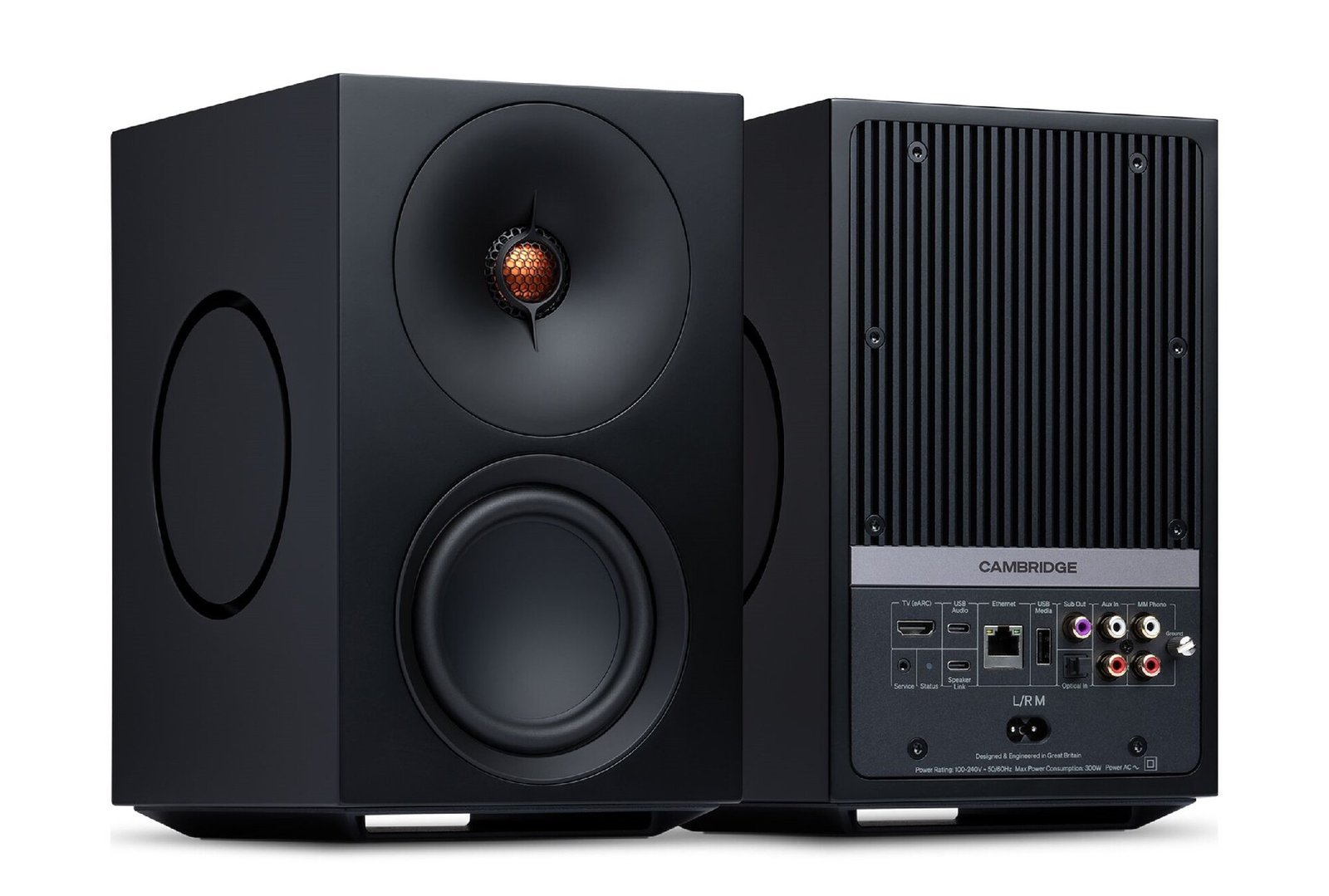
Cambridge L/R M model
- The flagship model, L/R X, is priced at 1,999 euros per pair. This is the model that starts to fully embrace the idea of a serious active Hi-Fi system. Amplification jumps dramatically to 800W in total, while the acoustic architecture grows to two 5-inch active woofers and two 6-inch passive radiators, joined by the same 28mm custom torus-chambered tweeter used in the M. Cambridge specifies a frequency response reaching down to 35Hz at ±3dB, so on paper at least, we are now looking at genuinely full-range performance from a surprisingly compact enclosure. At this point, we are no longer talking about glorified desktop speakers or even a tentative step into Hi-Fi. The L/R X is Cambridge Audio going all-in on the concept: streaming, serious connectivity, considerable amplification, and enough driver surface to suggest real scale and dynamics. At 1,999 euros, it also enters a very different competitive space, where it no longer needs to be judged simply as a convenient active speaker, but as a more complete Hi-Fi system in its own right.
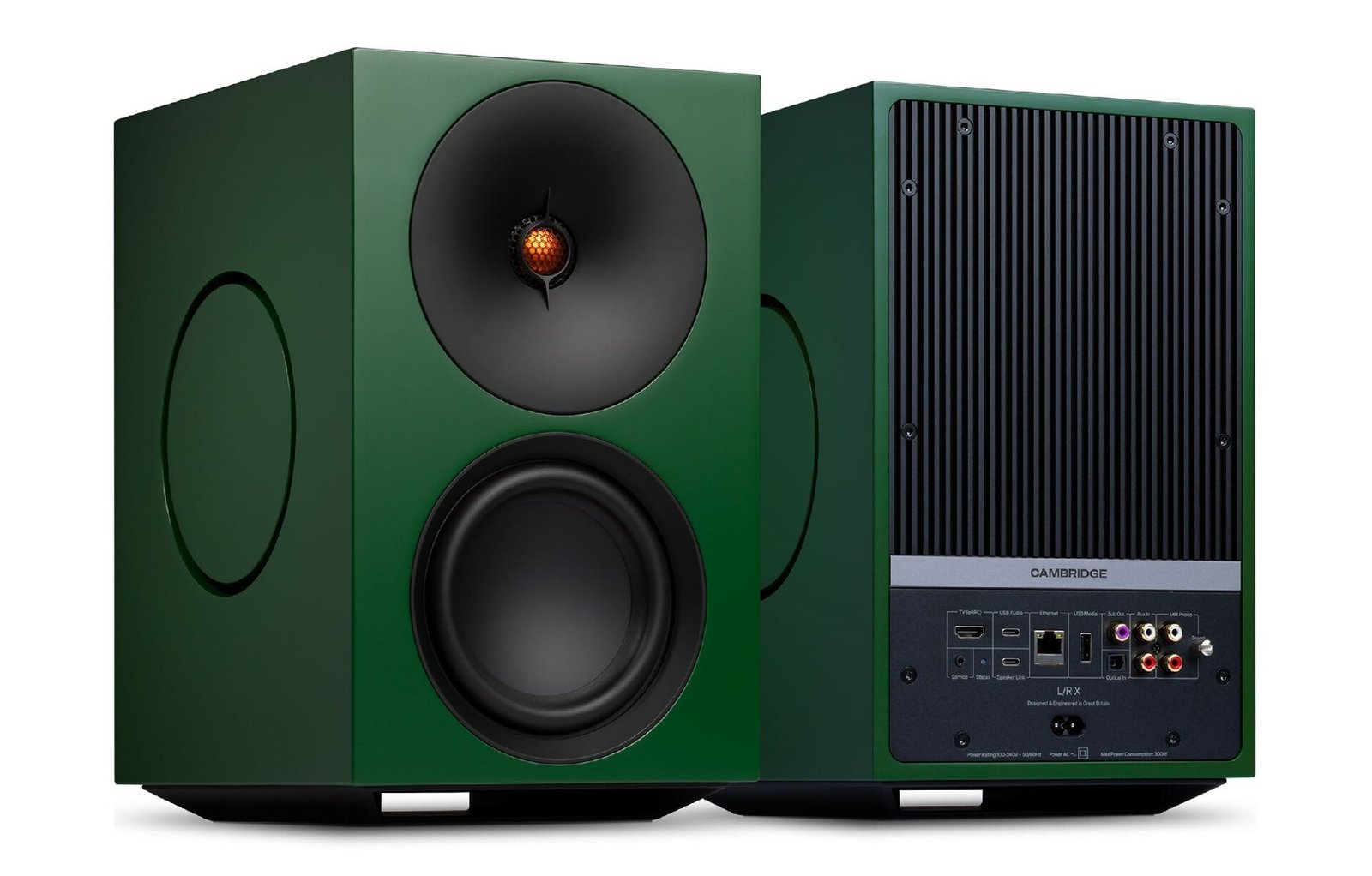
Cambridge L/R X model
II. Build Quality and Technical Overview
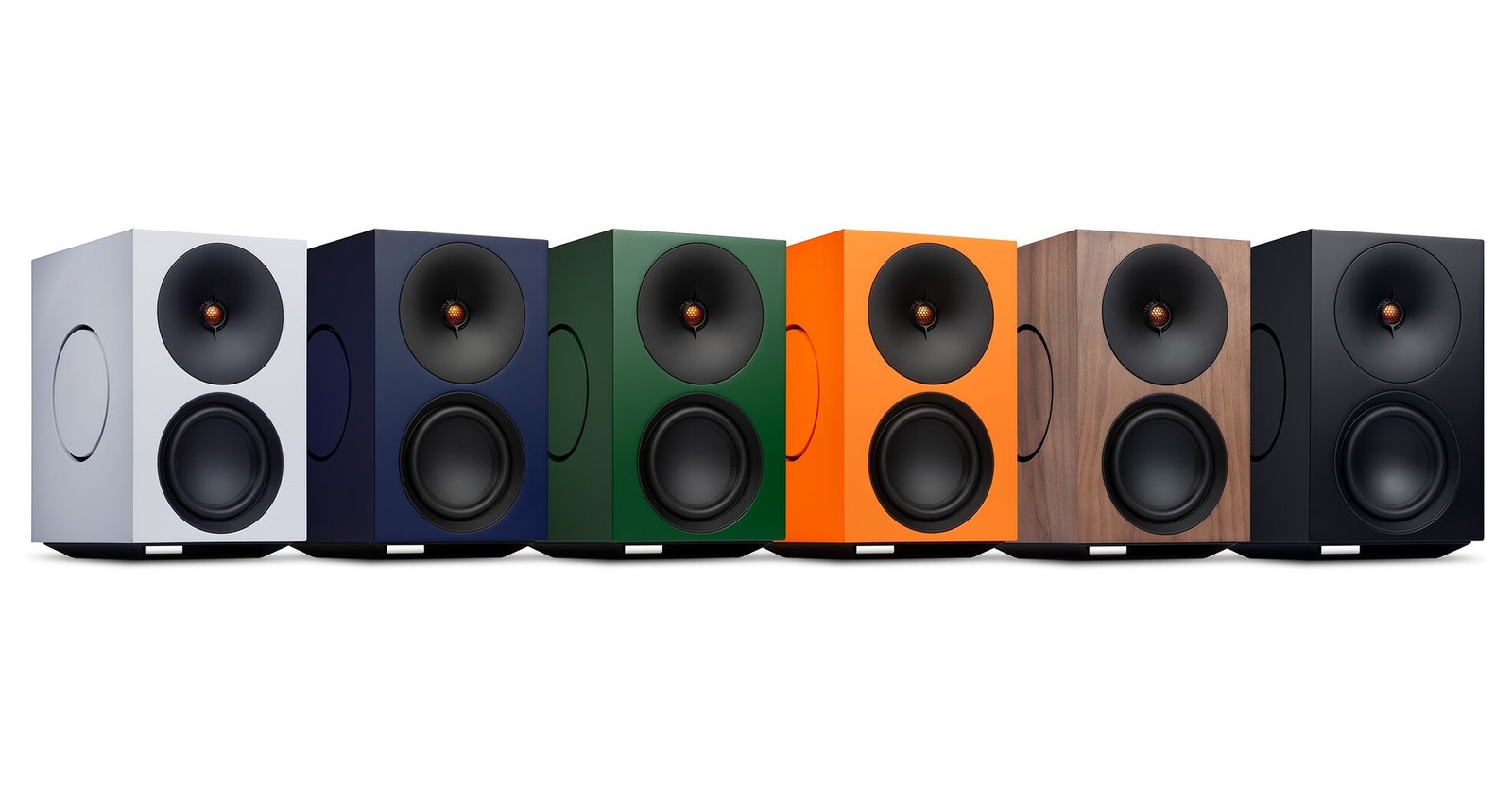
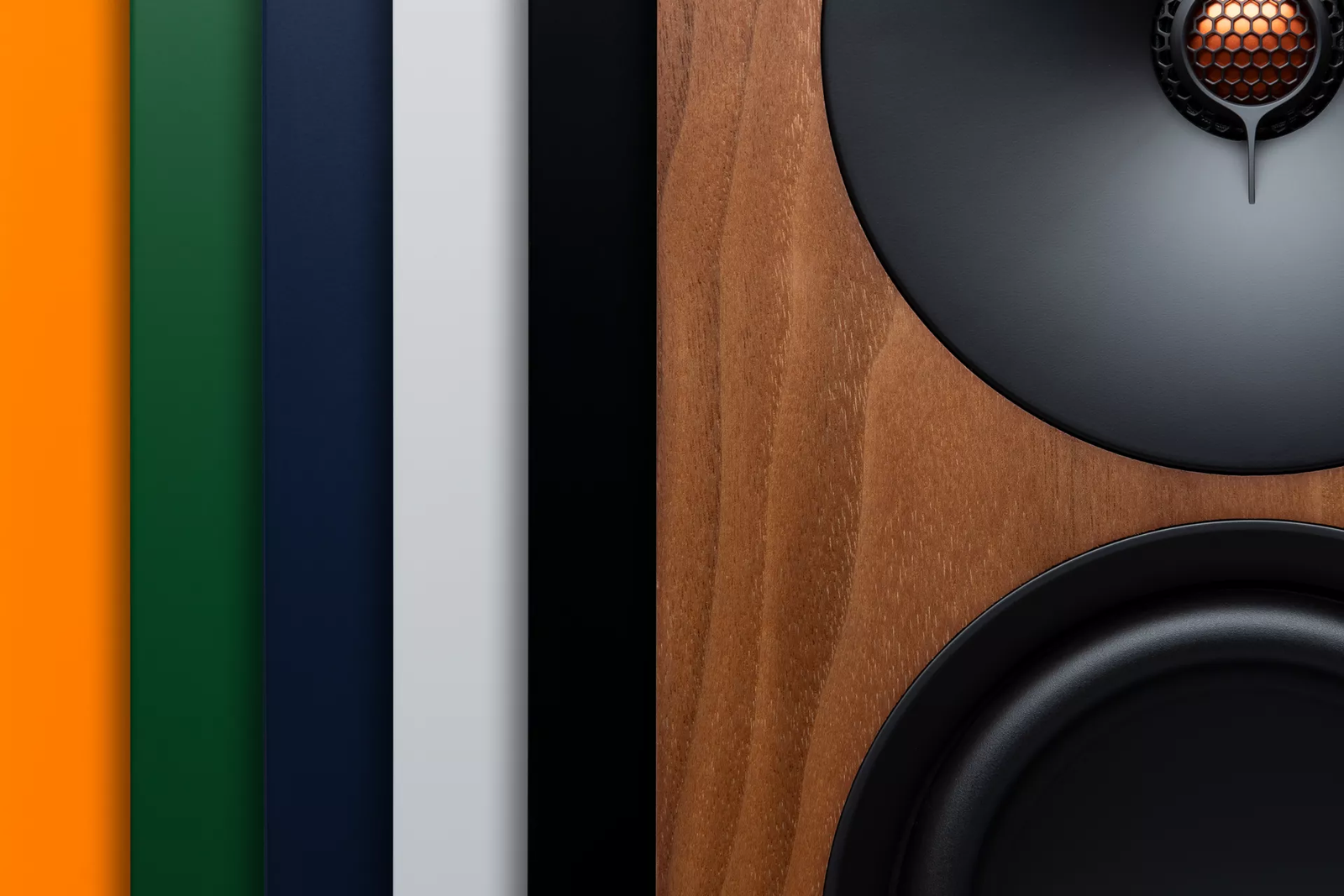
Our review pair arrived in the dullest finish possible, unfortunately, the dark ones. They are of course, very easy and friendly to integrate in any space. That is certainly one of the advantages of this particular finish, but Cambridge offers considerably more freedom on the aesthetic side. The L/R models are available in Black, White, Blue, Green and Orange, covering everything from understated and easy to integrate to considerably more playful choices, while the sixth option, a real Walnut veneer, sits above the standard colour palette as the more luxurious alternative and comes at an additional cost.
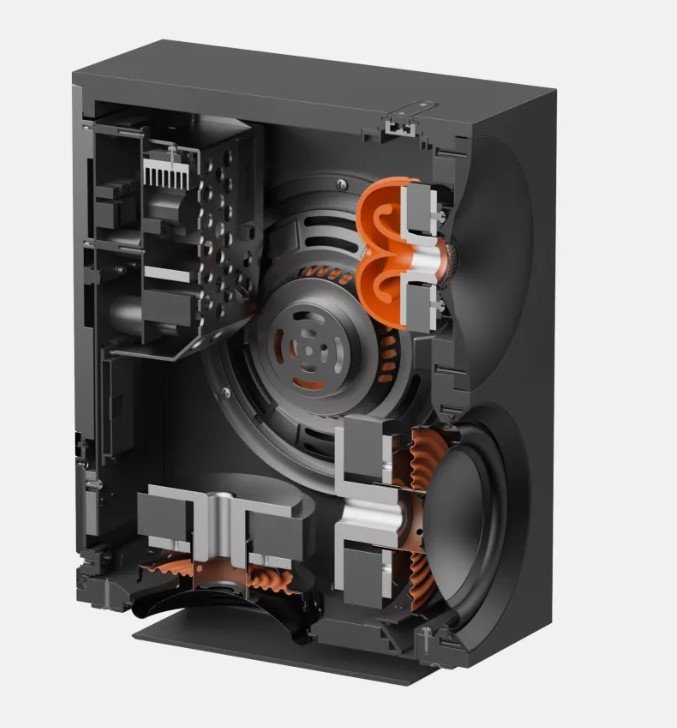
The cabinet. Lifting the first enclosure out of the packaging tells us there is serious hardware inside. The cabinet meets our hands with no flex and no sense of hollowness anywhere to be found. Knuckle taps around the different panels return a short, dense response, with no obvious ringing trailing behind them, exactly the kind of behaviour we look for, admittedly, one we rarely encounter at this price point. It is also worth considering that, given the compact dimensions of the enclosure and just how much hardware Cambridge has managed to pack inside, multiple drivers, passive radiators, amplification and the accompanying electronics, there simply isn’t much empty volume left to resonate in the first place. Cambridge Audio has clearly used this densely packed architecture to its advantage, resulting in a cabinet that feels remarkably inert for its size.
The Torus tweeter. The headline element of the acoustic design is a 28 mm tweeter the company calls Torus, and it is new for this range. The name describes the geometry. The dome is ring-shaped, with a tapered horn inside the rear chamber and a dual radius profile that runs flatter across the top and steeper down the sides. Cambridge Audio’s reasoning is that the ring shape suppresses reflections inside the chamber that would otherwise smear the output, and the company points to the larger surface area of a 28 mm design over the more common 25 mm dome as the source of increased air displacement. The figure Cambridge Audio quotes for that increase is approximately 25 percent, and we pass it along as the maker’s own claim.
What matters to us is the outcome, and we will come to it in the listening sessions. For now we note that the rear chamber is generous by the standards of a driver of this size, and that Cambridge Audio credits the Torus geometry for the wide soundstaging and stable imaging it promises for the range.
Woofers and passive radiators. Beneath the tweeter we have dual 5-inch woofers, and at the sides of the cabinet dual 6-inch passive radiators. The two radiators face outward in opposite directions, so the reaction forces from their movement work against one another and arrive at the cabinet walls cancelled out. The benefit shows up as a cabinet that you cannot hear, and one that sits calmly with the energy going into the room, not the furniture underneath, no matter the volume.
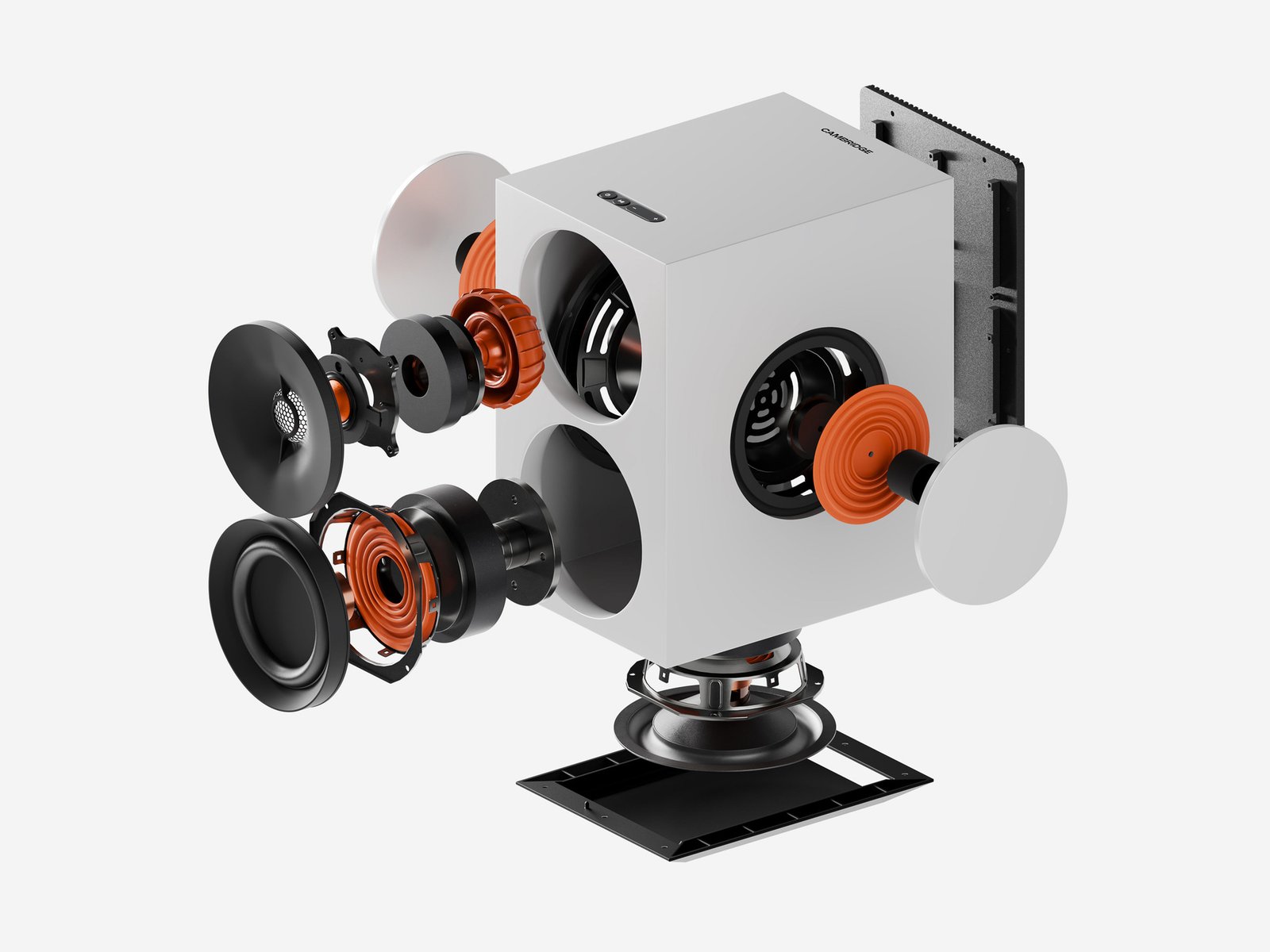
Tapping the radiator cones returns a well-controlled response with no metallic character behind it, which suggests careful attention to material choice and damping. Cambridge Audio describes the overall arrangement as a 2.5-way design, and quotes bass extension reaching down to approximately 35 Hz.
Amplification. Cambridge Audio specifies 800 W of total system power, delivered as 400 W per enclosure through Class D amplification. Class D is the sensible choice for a design of this kind. It runs cool, it packs a great deal of controlled power into a compact space, and it leaves room inside the cabinet for the rest of the electronics, providing a plethora of integrated features. The company also includes what it calls Advanced Speaker Protection, a system that keeps the drivers safe when the speaker is pushed toward its limits.
Digital processing, DynamEQ, and room optimisation. A 64-bit processor handles the crossover work and the correction inside each speaker. Managing the crossover in the digital domain gives an engineer freedom that a passive network cannot offer: precise slopes, time alignment between drivers, and corrections applied exactly where they are needed. This is the same approach that serious active studio designs have used for years, and its appearance at this price is worth acknowledging.
DynamEQ is Cambridge Audio’s own contribution here. The company describes it as a system that adjusts bass and treble across the volume curve so that the balance holds at low listening levels. Anyone who has turned a system to low listening levels, especially late in the evening and found the music thinning out, understands the problem being solved. Our own experience with the L/R X at quiet volumes supports the claim, and the balance held together at levels where we expected the bottom end to disappear.
The StreamMagic app adds a seven-band equaliser, a set of preset tunings, and room optimisation settings. We spent time with all of them and settled on flat. Our reasoning is simple: the voicing Cambridge Audio arrived at suits our room, and every adjustment we tried moved the sound away from something we were enjoying. This was our final outcome in our own space. A room with different proportions or a more difficult placement will benefit from the correction tools, and their presence is a demonstration of force for the entire platform.
The speaker link. The connection between the two enclosures can run wirelessly through WiSA HT, or through the supplied USB-C cable. Both paths carry playback at 24-bit/96kHz. We chose the wired link for our sessions, on the principle that a cable removes an entire category of variable from the listening, and the connection behaved perfectly throughout. For anyone whose room makes cable routing difficult, the wireless option exists and carries the same resolution.
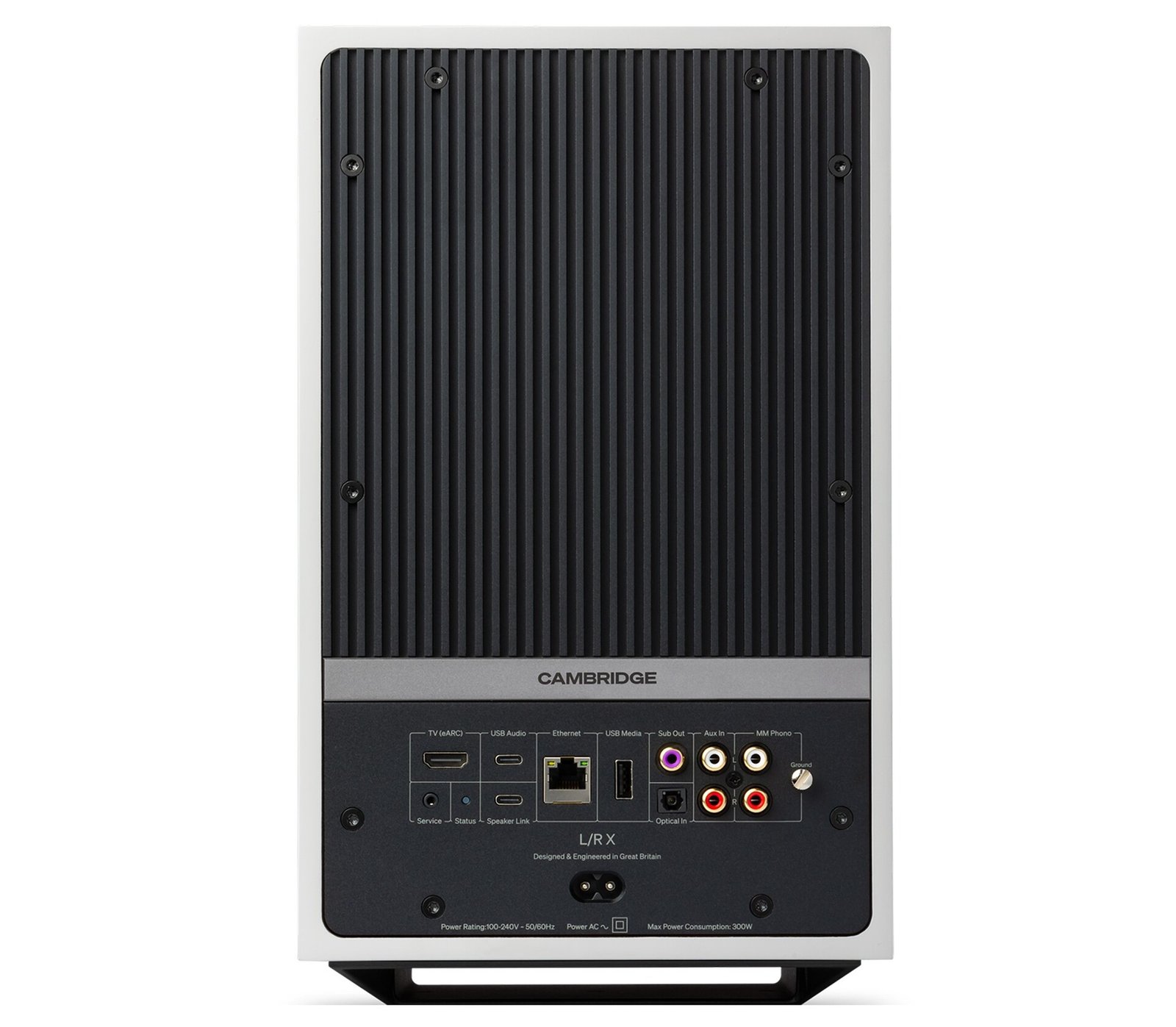

Connectivity. This is where the L/R X makes its argument most forcefully, and it is the reason versatility sits among the four qualities we named at the top. StreamMagic Gen 4 handles the network side with high-resolution streaming from TIDAL Connect, Spotify Connect, Qobuz, Amazon Music, Deezer, Roon Ready operation, UPnP, and internet radio. Multiroom arrives through Google Cast and AirPlay 2, which lets the L/R X sit inside a wider system across the house.
The physical connections are equally generous. HDMI eARC brings a television into the system with a single cable. A moving magnet phono input takes a turntable directly, with no external phono stage required. USB, optical, and RCA cover the remaining digital and analogue sources, Bluetooth handles quick casual playback, and an RCA subwoofer output waits for anyone who wants to extend the bottom end further. Ethernet and Wi-Fi both serve the network connection.
Assembling this same feature set from separate devices would mean a streamer, a converter, a preamplifier, a power amplifier, a phono stage, and the cabling to join them. Cambridge Audio delivers it inside two loudspeakers and one power cable per side. This is the strongest practical argument the active category has, and the L/R X makes it as well as anything we have handled.
App, remote, and daily use. Setup ran smoothly from the start. The speakers found the network without problems, the firmware update completed without bugs, and the pairing between the two enclosures took just seconds to complete. We had braced ourselves for the familiar patience that streaming speakers demand, especially coming from a company that is new to this space, but the experience with Cambridge L/R X was smooth as butter in every usage scenario. The StreamMagic app behaved flawlessly throughout our time with the pair, kept its connection, and stayed bug-free.
A Bluetooth LE remote comes in the packaging, with dedicated buttons for source selection, volume and EQ presets. Having physical source switching or volume adjustment within reach can be useful for someone who does not want to use a phone. We used it occasionally.
Underlighting and finishes. The L/R X comes with a white LED underlighting. You can customise its warmth, but there is no RGB option available. There is something quietly pleasing about the glow at the base of each cabinet during evening listening, and it gives the pair a presence in a darkened room that suits the design language. The six finish options let the pair suit a range of interiors, and our dark review sample disappears into a living space with ease.
Specifications
| Configuration | 2.5 way active stereo pair |
| Tweeter | 28 mm Torus, one per enclosure |
| Woofers | Dual 5 inch per enclosure |
| Passive radiators | Dual 6 inch side mounted, force-cancelling, per enclosure |
| Total system power | 800 W, 400 W per enclosure |
| Amplification | Class D |
| Processing | 64 bit, DynamEQ, digital crossover, Advanced Speaker Protection |
| Frequency response | 35Hz – 24kHz +/-3dB |
| Streaming platform | StreamMagic Gen 4 |
| Streaming services | TIDAL Connect, Spotify Connect, Qobuz, Amazon Music, Deezer, internet radio |
| Network | Wi-Fi, Ethernet, Roon Ready, UPnP, Google Cast, AirPlay 2 |
| Inputs | HDMI eARC, moving magnet phono, USB, optical, RCA, Bluetooth |
| Outputs | RCA subwoofer |
| Speaker link | USB-C wired or WiSA HT wireless, 24-bit/96kHz |
| Finishes | Six, including walnut veneer at extra cost |
| Dimensions and weight | 200 (h) x 330 x 260 mm |
| Price | To be confirmed for the local market |
All specifications above are as published by Cambridge Audio.
A Note on Measurements
Measurements have always mattered to us. They let us check a maker’s claims against the behaviour of a product in a room, and they give us an engineering foundation underneath what our ears report. We consider measuring at the listening position is very important because that is where the listener sits and that is where the room has the most impact on real-life, day-to-day auditioning.
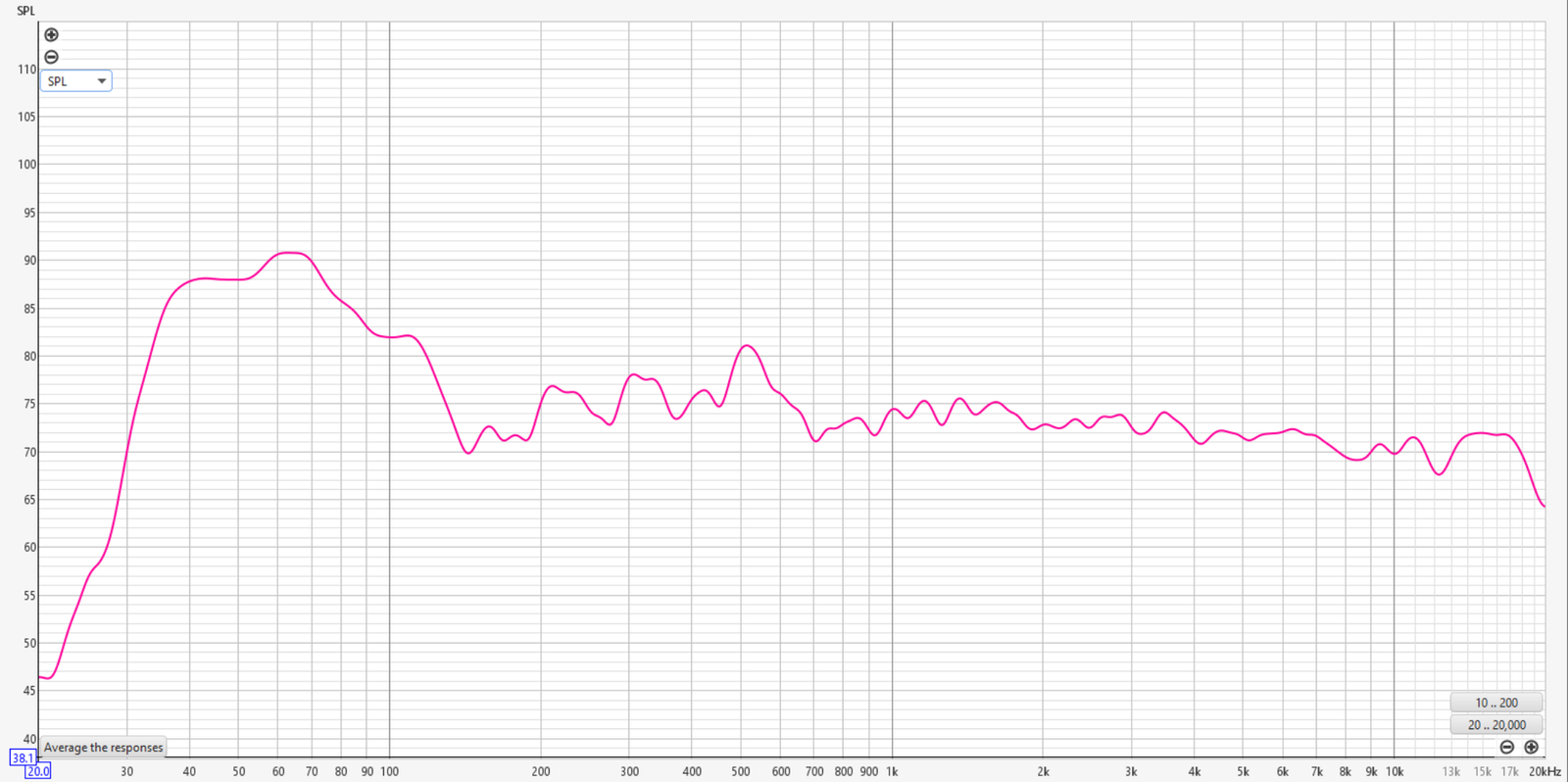
Default settings measurement at the listening position
This first sweep shows a strong room contribution in the bass area, with a large boost from roughly 35 to 100 Hz. Above 200 Hz things settle considerably, with only a few smaller irregularities through the lower midrange. From about 1 kHz upwards, the response is much more controlled, with no aggressive peaks and only a few mild dips around 8 and 12 kHz. Overall, the L/R looks composed through the midrange and treble, while the bass is clearly dominated by room interaction.
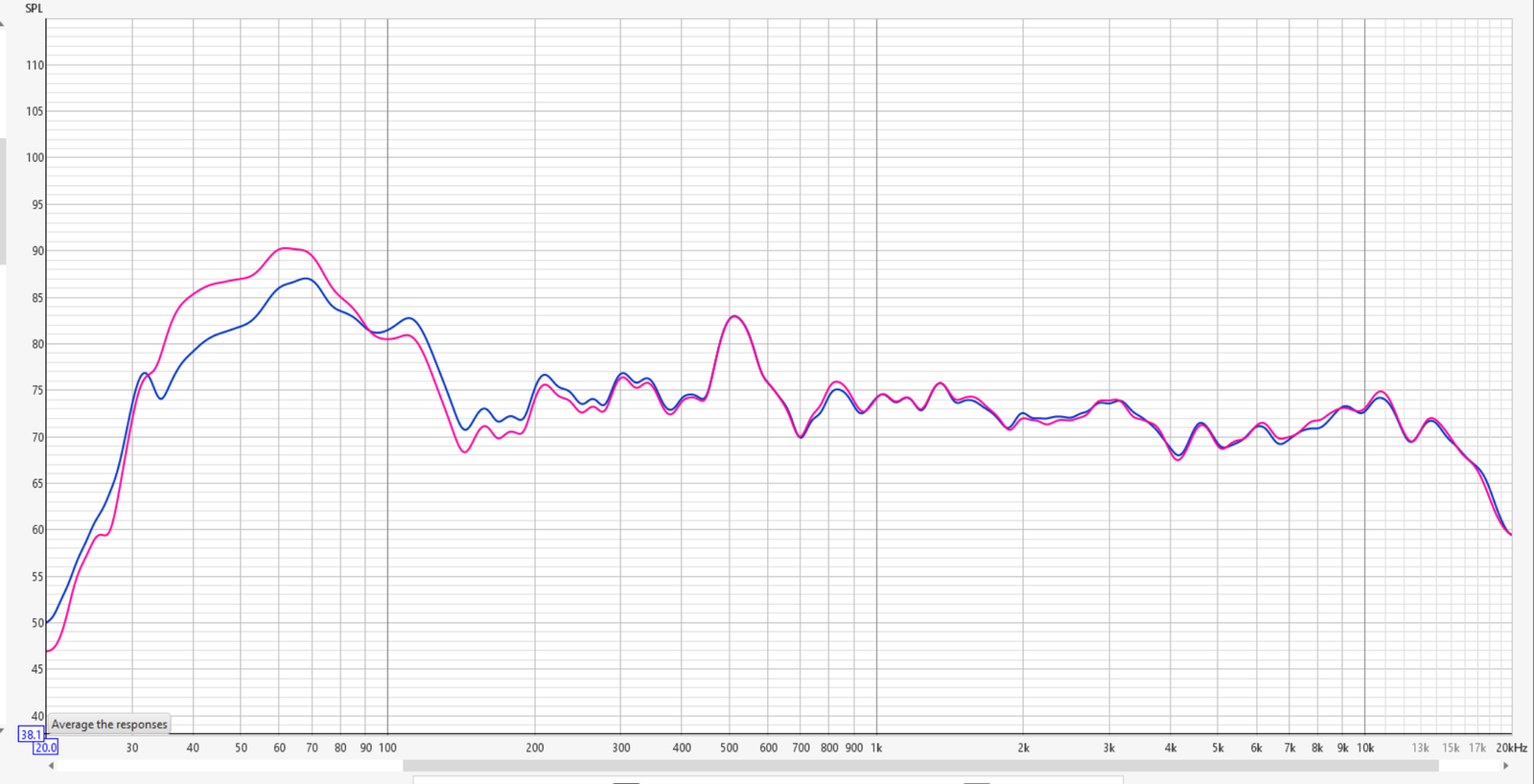
Parametric EQ applied (blue trace)
The red trace shows the speaker in its normal configuration, while the blue one shows our attempt at correcting the most obvious room-related excesses using Cambridge Audio’s rather basic seven-band parametric EQ. Most of the work was done below 200 Hz, where we reduced the broad bass hump and slightly cleaned up the transition into the lower midrange. Above that point, we left the response untouched.
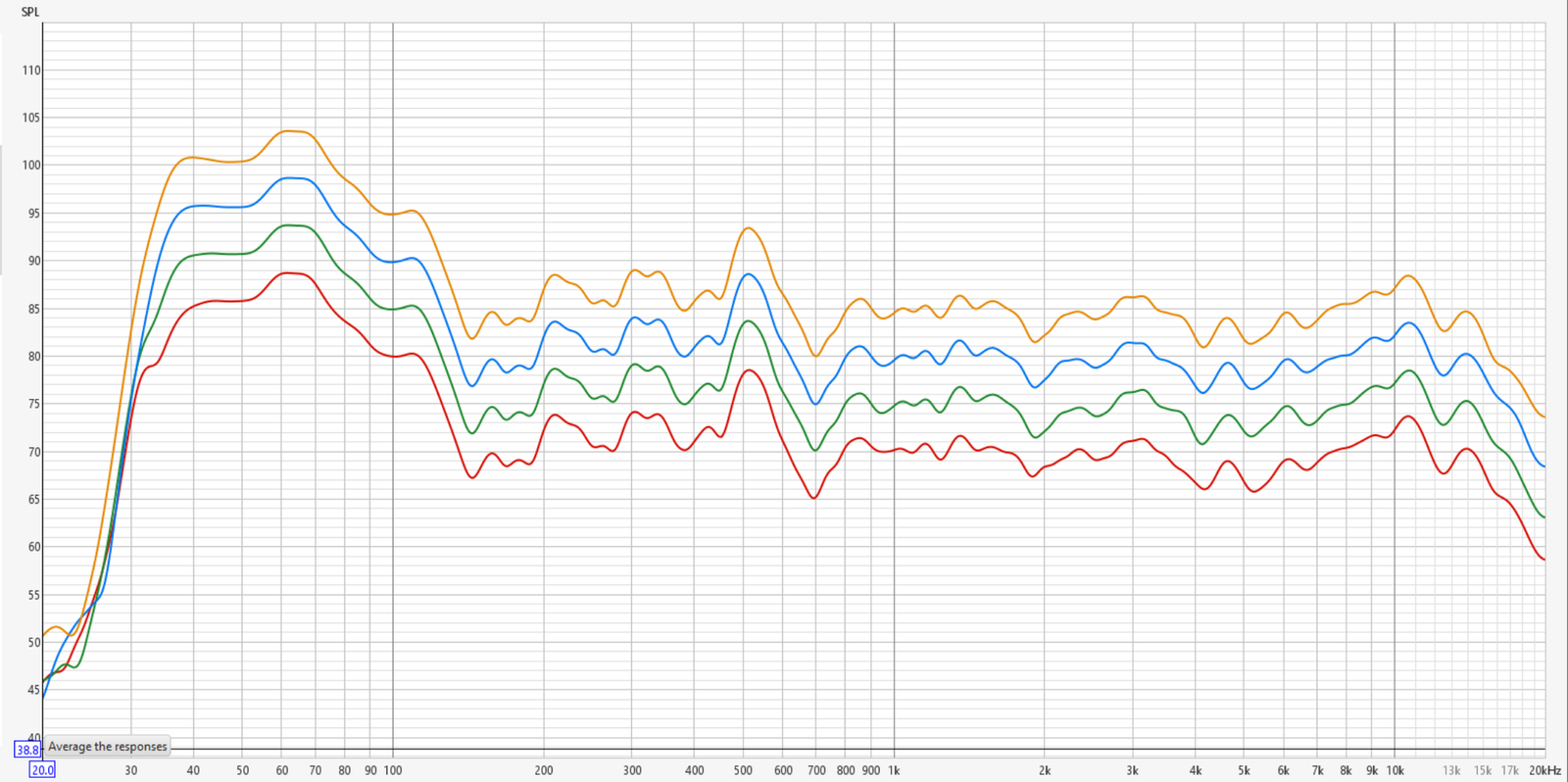
Dynamic compression check at 50% (red), 60% (green), 70% (blue), 80% (yellow) volume
These sweeps were taken at 50, 60, 70, and 80% volume to check for dynamic compression. The curves keep essentially the same shape as level increases, with no meaningful collapse in the bass or elsewhere in the spectrum. In other words, the L/R X scales cleanly with volume and shows no obvious signs of compression within the levels we tested.
This is an excellent result, showing impressive dynamic headroom and remarkable composure even as volume rises significantly. Harmonic distortion was not audibly noticeable at any of the tested levels either.
III. Setup and Room
Our listening room measures a little over twenty-four square metres, which places the L/R X inside the range Cambridge Audio has voiced it for. The pair sits on a sideboard along the short wall, spaced approximately two and a half to three metres apart, with our listening seat around three and a half metres away. The two enclosures are joined by the supplied USB-C cable.
Sideboard placement deserves a word, because it is how a great many owners of a speaker like this will use it, and it differs from the dedicated stands we would ordinarily reach for. A cabinet surface loads the bass differently and introduces boundary effects that a stand keeps out of the picture. We chose it deliberately. We think a speaker built to remove complication from a listener’s life should be assessed in the conditions that listener will create, and a sideboard along the wall is the most common answer.
We fed the pair over the network throughout, using TIDAL Connect and Qobuz. Both ran without a single dropout across weeks of use. As we have spoken and been adamant about across our other reviews, first impressions carry weight and they are never the whole story, so we lived with the L/R X long enough for its character to surface: late evenings at low volume, ordinary afternoons, and several sessions pushed hard enough to find where the limits are.
Our sessions ran with the EQ flat and room optimisation left out of the picture.
IV. Listening Impressions
Treble and Air
The treble is where our enthusiasm first arose, and for good reason. The Torus tweeter delivers a top end with openness and a sense of air that lifts the whole presentation, and it does so with a smoothness that made long listening sessions totally fatigue-free.

Jesse Cook, Canción Triste. This track demands a tweeter that can resolve the fine texture of string plucks while keeping the energy intact. The L/R X gave us the physicality of each note, a convincing snap to the guitar, and the sense of fingers moving across strings. Air surrounded the instrument, decay tails extended cleanly. The recording sounded pleasant, nothing felt added or missing. The overall feeling this track gave us was one of easygoing and melodious, a pleasant-to-the-ear type of sound.

Idrissa Soumaoro, Cherie. A recording that reaches high into the top octave, and one we have used before to find where a tweeter runs out of composure. The highs here stayed open and clean throughout. Nothing became harsh as the track played on, and the top end kept its ease at every level we tested.
Lizz Wright, Barley. Her voice arrived natural and unforced, free of sibilance and free of any harshness in the upper registers. The tonality felt right, and the emotional nuance in her voice came through with the articulation between sound sources being obvious enough that anyone could hear it. This is a recording that punishes a system with any edge in the presence region, and we can say the L/R X did good.

Diana Krall, Temptation. An unforgiving test, with closely miked percussion and a voice that turns edgy really fast on the wrongly matched system. The Cambridge Audio impressed us with restraint. Diana’s voice carried detail and warmth, always intelligible and most importantly never biting, never harsh. Brushed cymbals and the shimmer of the ride were airy and open, with no glare anywhere in the picture. Sibilance was totally absent here.
The treble was sparkly, and a bit subdued, giving the overall timbre a warmer quality. The tweeter never leaps forward to draw attention to itself, and it never leaves the listener bracing for the loud passages. As we have spoken and been adamant about across our other reviews, a treble that turns harsh under pressure ruins a long evening and adds fatigue into a mix that does not need fatigue. The L/R X gave us none of that, at any volume we asked of it.
Midrange, Timbre, and Body
The treble set the tone. The midrange is where our affection for these speakers took root. The warm, inviting timbre is the defining characteristic of the L/R X. It is the quality we will remember longest.

Danit, Naturaleza. The guitar has body and an organic quality, its harmonics and decay of a piece with the voice above it. Danit’s vocal came through with warmth and a great sense of presence, placed cleanly in front of us with weight behind it. The whole picture hung together as one voice from the bottom of the range to the top, which speaks well of the coherence a properly implemented digital crossover can achieve. Nothing sounded stitched together or weird.
Chris Stapleton, Death Row. Here we tested the L/R X for physicality and punch. Chris’s voice showed a sense immediacy and presence, and the tonality was full, textured, and rich, with no artificial warmth laid over the top and no thinness anywhere in the picture. Given the compact cabinet, we had arrived with reservations about the weight the midrange could carry, but those reservations proved unfounded. The transition from bass into midrange and onward into the treble was seamless, and the soundstage that grew out of it was broad and involving. We also tested and paid great attention to intermodulation distorsion, the one that makes voices wobble when bass has a more sinewave-like presence. We observed no IMD, even at top volumes (70-90 in the app).

Leonard Cohen, You Want It Darker. Leonard’s deep, resonant voice showed authority and emotional weight, sitting perfectly inside a nice 3d soundstage. The separation between the vocal, the bass beneath it, and the background harmonies was very good, with each element feeling carved out. This is a recording that reveals a system with tonal honesty in the lower midrange, and the L/R X honoured it the right way.
Timbre is very important. Instruments and voices carried a kind of colour here that we found warm and pleasant across every genre we tried, and to top it off there was also good, physical body underneath that colour. The midrange has texture, and it gives music a physical quality that a great many designs in this category lack entirely. This is the Great British Sound the company talks about, arriving through a thoroughly modern platform.
Bass, Extension, and Dynamics
The bass is well-rounded. Extension reaches lower than the footprint suggests, there is weight here, and there is articulation alongside it.
Nils Frahm, All Melody. We used this one to hear how the pair handled a slow build from delicate beginnings up to full weight. The L/R X followed the climb with composure, filling the room without losing its footing. The move from near silence to full scale was convincing and well made. We honestly enjoyed it.

Dead Can Dance, Opium. A reference for us on both subtlety and depth. Differences in bass texture were obvious, layers in the arrangement were separated well, and Brendan’s voice showed the tonal accuracy this recording demands. The low end kept its shape as the arrangement thickened and most importantly we heard no wobble in his voice. This track played on many 2.5 way systems on top SPL levels tends to present a wobbly voice due to the sinewave-like bass present throughout it’s length. There was no IMD problem here and we have to say, this is a hard test to pass for such a small speakers. The L/R X passed it with flying colours.

Geoff Castellucci, The Sound of Silence. Here we tested the physical presence and articulation of the lowest male vocals. Every note stayed audible and dynamic, and the chest resonance came through with good weight behind it. The subsonic weight in the deepest passages was not that obvious and it’s something to be expected from such a small speaker. Even so, the warm timbre, the weight in Geoff’s voice was very well rendered so it’s a plus here also.
Boris Blank, Electrified. A trial by subbass, with passages that challenge full-size tower speakers. The L/R X handled the upper bass and midbass with authority and drive, and each note stayed distinct with no blurring anywhere. We also paid great attention to bass overhang, the effect that leaves a note ringing on after it should have stopped and turns a fast passage into a smear. Due to the passive radiator design, one might expect there to be some overhang. We can confirm that the bass is not the tightest and not the fastest we ever heard. Also, the deepest content in this track, the material sitting below where the woofers and radiators can reach, arrived reduced. The speaker rolls off before the recording finishes speaking.

Subbass extension is present in modest measure, and this is physics doing what physics does. Two 5-inch woofers and a pair of 6-inch radiators in a cabinet this size can only move so much air. Cambridge Audio has chosen to keep the output clean at the bottom of what the drivers can manage. That is definitely the correct decision. The RCA subwoofer output waits for anyone whose listening leans deeper, and if electronic music with heavy subsonic content fills your evenings, you will want to use it.
Dynamics at Volume
We pushed the L/R X across the whole range of the volume scale, from quiet evening levels up past 90 in the app.
Dynamic compression became audible as we approached the top. Large swings softened, the sense of impact on transients reduced, and the presentation flattened as the protection system started to work. Nothing distorted, and nothing sounded mechanically stressed, which speaks well of the Advanced Speaker Protection doing exactly the job Cambridge Audio designed it to do. The character of the music changed under that protection, an experienced listener will hear it happening.
Proportion matters here. At the levels most people use in a room of this size, across the great majority of an ordinary evening, the compression stayed out of the picture. It arrives when the speaker is pushed toward what it can physically deliver, and every design of this kind reaches that point somewhere. On the L/R X it sits closer to the top of the dial than we would like in twenty-four square metres. For anyone in need of measurable data, we managed to reach a maximum of 105.3 db (C) in our listening spot, 3.5 meters away from the speakers. If you are planning to fill a larger space at party levels, audition the pair at those levels before deciding.
Microdetail and Texture
Microdetail is present in modest measure, and the subdued top end has a hand in this. The atmospheric cues that expand a soundstage on more resolving systems felt quiet to us. The fine reverberant tails that carry the sense of a recording space did not bloom the way we know they can. Textural information in dense passages smoothed over as the arrangement thickened.
This is where the all-in-one form factor shows its hand, and a listener coming from carefully matched separate devices will sense the difference here first. The L/R X trades the last measure of analytical retrieval for a presentation that is easy to sit inside for hours. We believe Cambridge Audio made that trade deliberately and with open eyes. The same voicing that keeps fatigue away also keeps the finest detail at a polite distance.
A very important note, as we mentioned in the TL;DR section is the way you plan on using the speaker. If you will use the L/R X in a nearfield setup, then everything changes. Microdetail, sparkle, soundstage, listening fatigue will have a totally different impact.
Soundstage and Imaging

James Blake, Retrograde. A track that turns muddy and congested on a system that struggles with layering. The L/R X kept each texture and vocal layer distinct, and the dense production held its scale and structure throughout. Physical presence held as the arrangement built, and the picture never collapsed into a blur. We found articulation and layering to be a worthy quality of the L/R X throughout our listening sessions.

Tonebloom, Violin. The string was placed with good separation, sitting clearly between the two enclosures and reaching a little beyond them. Instruments occupied their positions and stayed there even as the volume rose. The soundstage spread out naturally for our listening position, wide and open, with the two cabinets disappearing from the picture in the way a properly time-aligned design allows.
Width and stability were the strengths here. Depth was good, with a sense of layering that surprised us for a pair of enclosures this compact, and the last degree of front-to-back separation belongs to dedicated systems built for that purpose. Cambridge Audio credits the Torus geometry for the width it promises across the range, and on the evidence of these two recordings we are inclined to agree.
V. On Listening Pleasure
We want to spend a moment on something that resists measurement.
Somewhere in the second week with the L/R X, we noticed that our sessions had changed a bit. Notes and analysis were not important anymore, and we found ourselves finishing whole albums without reaching for the next test track. Evenings that were meant to be forty minutes of critical listening turned into hours of pleasurably sitting down and just listening to music.
This has happened to us with a handful of components over the years, and it is one of the highest compliments we know how to pay. A system either invites you to sit down or it does not. No measurement we have ever taken predicts which way that will go. The technical picture matters enormously, and we have spent our lives inside it. The technical picture exists in service of the moment you stop analysing and start listening.
The L/R X earns that moment. The warm timbre, the body in the midrange, the beautifully engineered tweeter that just disappears, and the ease across long sessions add up to a speaker that welcomes the listener in. This quality deserves to sit alongside the specifications, because it is what an owner will experience every single evening.
VI. Versatility and Everyday Use
For our review, we ran the pair as a dedicated stereo music system, which is the role we know best and the one we can speak about with authority. The connections available reach a long way past that. A television joins the system over HDMI eARC with one cable. A turntable connects directly through the moving magnet phono input, with no separate phono stage and no extra shelf required. Multiroom through Google Cast and AirPlay 2 lets the pair sit inside a wider system through the house, and so on.
Assembling this capability from separate devices means a rack, a collection of interconnects, a power distributor, and a great deal of patience. For the listener who wants the music and has no appetite for the assembly, the L/R X delivers all of it from two enclosures and a pair of power cables. Cambridge Audio has made that argument as cleanly as we have seen it made.
Conclusions
Living with the Cambridge Audio L/R X, installed as a stereo system inside our 24 square meter acoustically treated listening room with the sweet spot sitting at 3.5 – 4 meters away from the speakers, left us with a clear and consistent impression: these speakers deliver music with a warm, pleasant timbre, they offer an ease of use that is exemplary, and they just invite you to sit down and listen to music, any type of music.
Timbre is the defining quality: warm, pleasant, and fatigue-free, with body and texture through a midrange that gives voices weight and instruments a somewhat physical presence in the room. The treble is sparkly and sits a touch behind the midrange, and that disappearance act is what feeds the warmth we keep describing. Sibilance was totally absent across every recording we tried, and fatigue was never an issue no matter the volume. The bass is well-rounded and articulate, and it reaches lower than the cabinet size suggests. The soundstage is wide and stable, with instruments holding their places as the volume climbs.
The concessions are honest ones. Dynamic compression becomes audible as the speaker approaches its limits (at 80% higher volume), and it is the single thing we would change if we could. Microdetail and texture are present in modest measure, and the last word in analytical retrieval belongs elsewhere. Subbass extension stops a tad higher than the most ambitious designs in this price category manage, but there is a much-welcomed subwoofer output waiting for anyone who needs to go deeper.
At their cost, the sound goes beyond what we expected, and the feature count is generous by any standard we can think of. USB input, HDMI eARC, a moving magnet phono input, the full StreamMagic Gen 4 platform, room correction, and, as of writing, a seven-band equaliser all come together packaged at an honest price, alongside a cabinet built with a care the price does not oblige. Set the L/R X against what a comparable system of separate devices would cost to assemble, and the argument becomes difficult to answer.
For the everyday listener who wants clutterless high quality, who cares how music sounds and has no appetite for a rack of components and a floor of cabling, the L/R X is close to ideal. We enjoyed these speakers enormously, and we recommend them with warmth.
We extend our deepest gratitude to AVstore for making the Cambridge Audio L/R X available for this review.
Pros
- Warm, pleasant timbre across the whole range, with good physical body and texture through the midrange that gives voices and instruments harmony and presence in the room.
- Sparkly, slightly subdued treble from the new 28 mm Torus tweeter with no trace of sibilance whatsoever, and makes long sessions effortless.
- Well-rounded, articulate bass with extension that reaches lower than the cabinet footprint suggests, and no bass overhang anywhere.
- No audible intermodulation distortion, even at the top of the volume scale.
- Wide, stable soundstage with good depth and instruments holding their positions as the volume climbs, and the two cabinets disappear from the picture.
- A speaker that invites long listening ahead of analysis, which is among the highest compliments we know how to pay.
- Comprehensive connectivity: HDMI eARC, moving magnet phono input, USB, optical, RCA, Bluetooth, and a subwoofer output.
- The full StreamMagic Gen 4 platform with Roon Ready operation, TIDAL Connect, Spotify Connect, Qobuz, Amazon Music, Deezer, plus Google Cast and AirPlay 2 multiroom.
- Dense, inert cabinet with excellent finish and detailing, built well past what the price obliges.
- Flawless setup and daily operation through the StreamMagic app, from a company new to this space.
- Choice of wired USB-C or wireless WiSA HT link between the two enclosures, both at 24-bit/96kHz.
- Six finishes, including a real walnut veneer, covering everything from understated to playful.
- Excellent value at 1,999 euros for the sound quality and the feature count delivered.
Cons
- Dynamic compression becomes audible as the volume approaches the speaker’s limits, softening large swings and reducing transient impact as the protection system takes hold.
- Microdetail and textural retrieval are present in modest measure, with the subdued top end keeping fine reverberant tails and atmospheric cues at a polite distance.
- Subbass extension stops a tad higher than the most ambitious designs in this price category reach, leaving the deepest content on electronic material reduced.
- The last degree of front-to-back layering belongs to dedicated systems built for that purpose.
- The platform is closed, with no upgrade path for the amplification or the conversion inside it.
- The walnut veneer finish carries an additional cost above the standard colours.
Equipment Used
- Cambridge Audio L/R X active loudspeakers, stereo pair, black finish
- Speaker-to-speaker connection over the supplied USB-C cable
- Streaming over the home network through TIDAL Connect and Qobuz
- StreamMagic app for control, source selection, and configuration
- Supplied Bluetooth LE remote
- Sideboard placement along the short wall, approximately 2.5 to 3 metres apart, listening position approximately 3.5 metres away
- Listening room of a little over 24 square metres
- EQ flat, room optimisation left out of the signal path