Listening rooms: the small living room, 4 m by 5.3 m with a 2.7 m ceiling and modest treatment, and the bigger room, 5 m by 6 m with a 4 m ceiling, treated • Loudspeakers used: Yamaha NS-2000A, Monitor Audio Platinum 300 3G, Dynaudio Contour 60i
Sources and preamplification: Gustard R30, MOON 491, Aurender A1000, all three used as preamplifier into MAIN DIRECT • Cabling: Roboli XLR 2100 and HP8000, Roboli Power5200, ZenSati Razzmatazz RCA, HMS Armonia Carbon Power, Realcable CHEVERNY Power
Measured from the wall: around 290 W maximum, around 60 W at idle • Loaned by: HifiExpert
TLDR
What qualities we enjoyed the most in the A-S3200 after a month with three pairs of speakers and two rooms? Three things worth mentioning.
- There are two amplifiers inside one chassis. Set it up as an integrated, and you get a coloured characteristic sound that belongs to this specific model from Yamaha. Put the INPUT selector on MAIN DIRECT, feed it from a preamplifier, and the sound signature is totally different. The presentation becomes a lot more transparent, closer to the source material, more detailed, more airy, straighter and truer. Two different sound signatures from the same device. We spent most of our time listening in the power amp mode.
- It’s a tube voicing without the inconvenience. The warmth is present in both modes, emphasised in the integrated mode and subtler in MAIN DIRECT (power amp mode), and it’s noticeable on the fastest transients. In integrated mode, the bass is rounder, softer, slower, with more bloom and less articulation, which is closer to the shape of a tube amplifier. The advantage is that there’s no re-tubing every year, no bias check, no searching for an out-of-stock matched quad. This is a solution we like.
- Musicality is the whole point here. There’s no cutthroat detail, no absolute microdynamics or macrodynamics. The power ceiling is also a reason for the last two. There is, however, a certain pleasantness that makes you go on listening for more, and more, and more. We think this is what Yamaha set out to build. It’s musical, it’s pleasant, it’s engaging, it’s tempting.
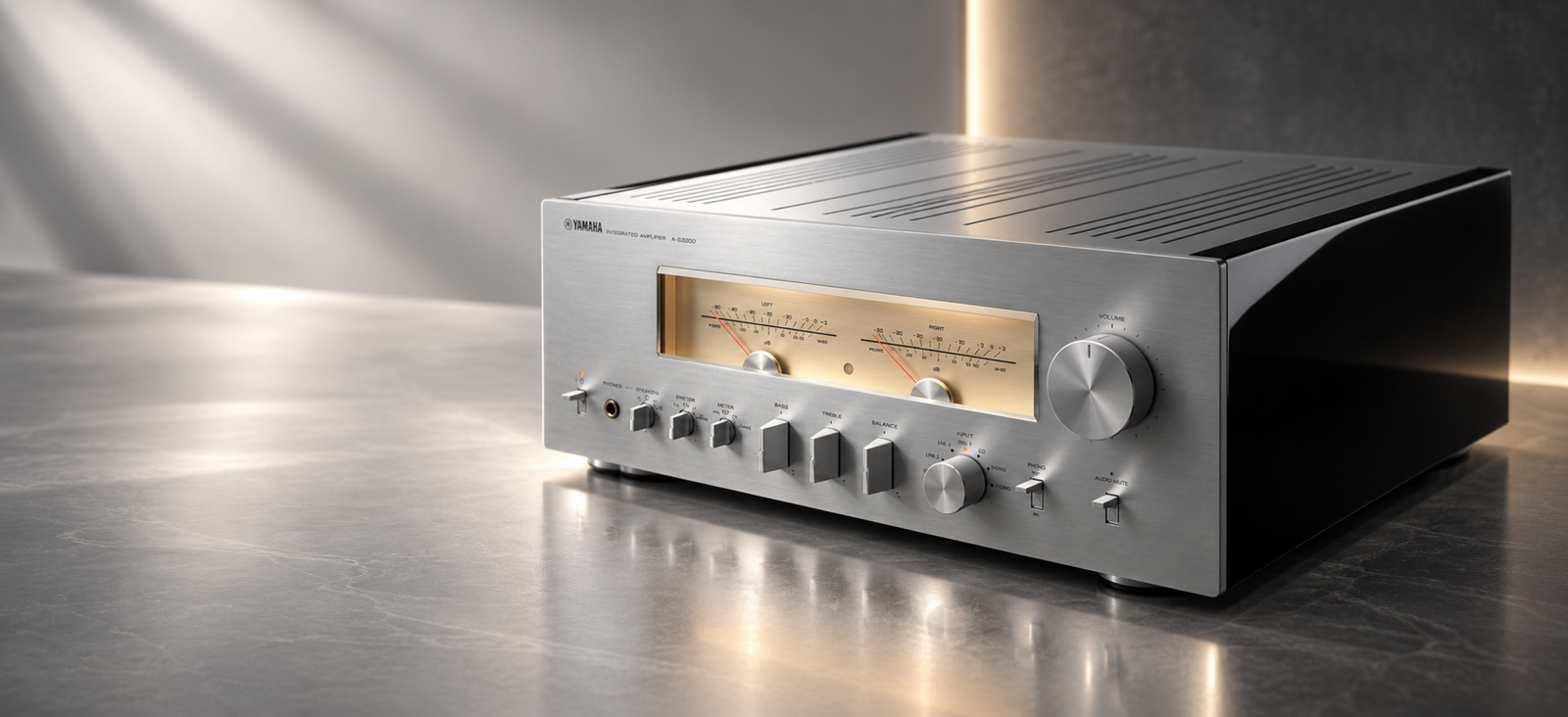
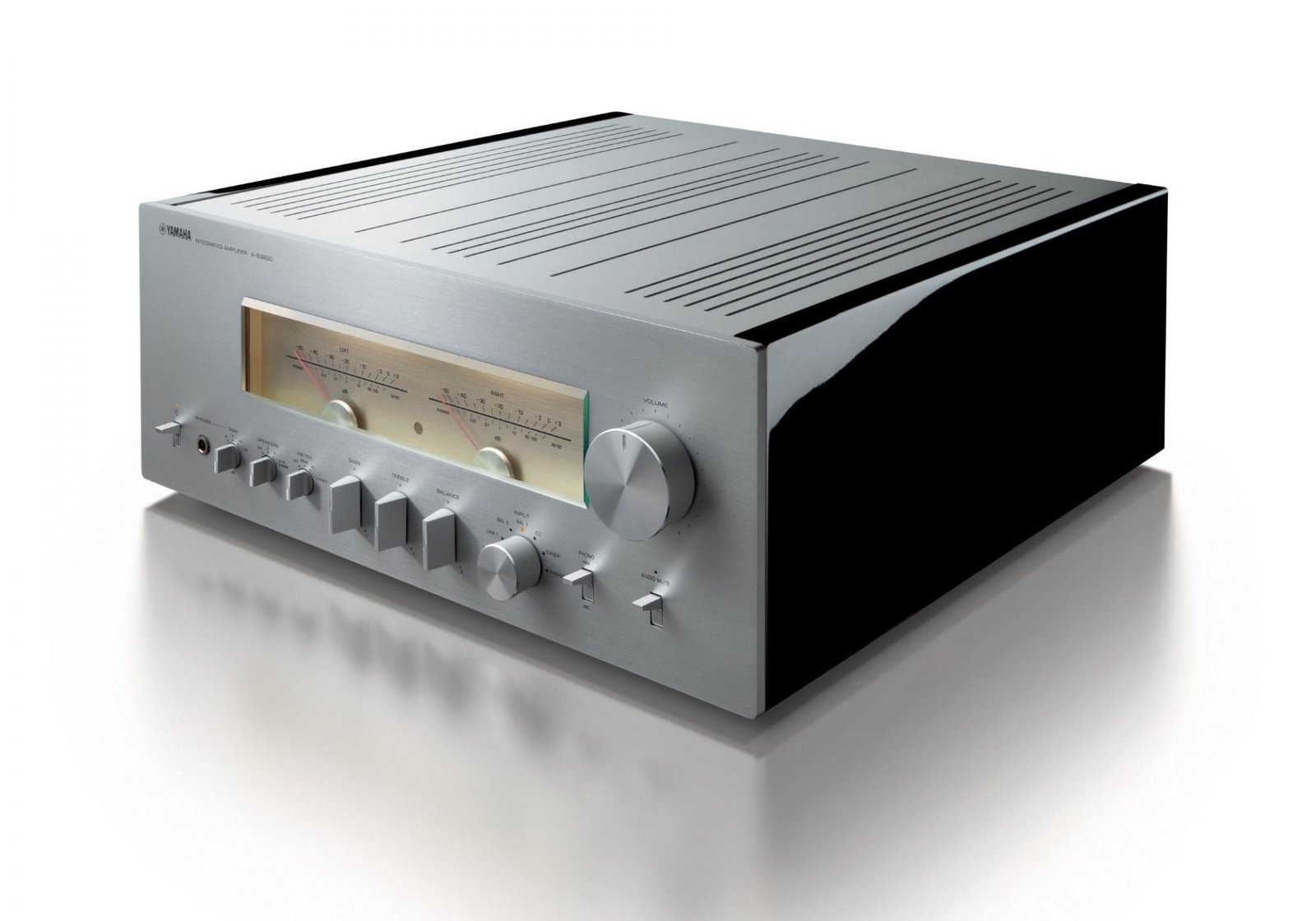
We need to talk about the looks as well. In some cases, buyers prefer the looks first, and then analyse the sound quality. This is a very beautiful amplifier. Piano lacquer flanks, brass under the feet, the VU meters glowing behind a beautifully cut glass front in a dark room. Every note was pleasant and enjoyable. Add it to the list of things this amplifier does beautifully!
We kindly recommend the A-S3200 to someone with a sensitive loudspeaker load, who listens at low and moderate levels, who values a warm and present midrange. The last measure of air, sparkle, and detail is not in the menu. And to anyone who likes the idea of buying an integrated now with the option of turning it into a power amplifier later. Anyone who wants high SPL, physical slam, or a party in the living room is going to look for more. In the end, it all depends on preferences.
We all listen differently, we have unique musical tastes, we use different electronics, and we occupy distinct listening spaces. What follows is what happened in our two rooms, on our matching electronics and cables, nothing more.
Yamaha, and where Natural Sound started
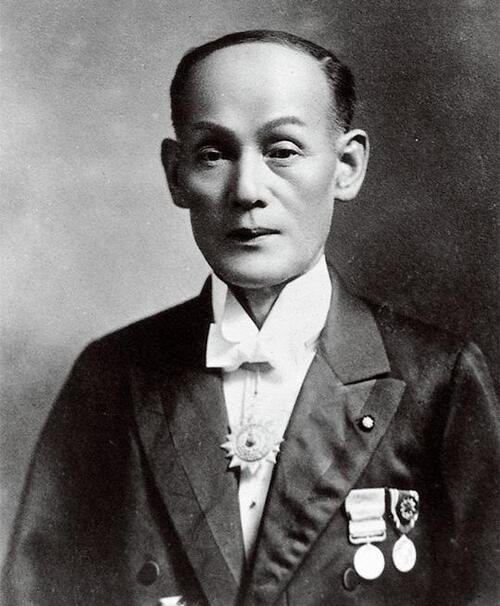
Torakusu Yamaha repaired watches and medical equipment for a living. In 1887, an elementary school in Hamamatsu asked him to look at a broken reed organ, he fixed it, and he then decided he could build a better one. He did, with an ornament artisan named Kisaburo Kawai. There was no railway between Hamamatsu and Tokyo at the time, so the two of them shouldered the finished organ on a pole and walked it over Mount Hakone to the Music Investigation Committee. Two men, an organ, and a mountain.
By 1889 he had founded the Yamaha Organ Manufacturing Company, Japan’s first maker of Western musical instruments, and in October 1897 the business was incorporated as Nippon Gakki. The tuning fork logo dates from 1898. The three forks in it stand for melody, harmony and rhythm.
What does this story have to do with our review? In 1967 Yamaha released the NS-20 and the NS-30, the first loudspeakers designed around the concept of a piano soundboard, and the company called them Natural Sound speakers. That is where the NS prefix originates, on every Yamaha loudspeaker made since, the NS-2000A in our room included. The name described the material. The woofer of the NS-690III used carefully selected straight grain spruce of grand piano soundboard grade, and we’ve spoken previously about the spruce woofer in the NS-2000A and about what a company that builds musical instruments does somewhat differently when it builds a driver. This is where that thread starts.
Then the 1970s. The CA-1000 integrated amplifier, introduced in 1973, was the world’s first Class A and Class B switchover, 15 watts per channel in Class A or 70 watts in Class B, and introduced a front panel switch.
The NS-1000M studio monitor launched in 1974. It used pure beryllium diaphragms at 99.99 percent purity, on an 8.8 cm midrange dome and a 3.3 cm tweeter dome, which is the first time anyone put that material into a commercial loudspeaker. The Finnish and Swedish national broadcasters installed NS-1000Ms in their studios and used them for decades.
The same year, the B-1 power amplifier. Yamaha calls it the first all FET power amplifier, meaning field effect transistors in every gain stage and not only in the output. Thirty nine of them, 150 watts per channel, 335,000 yen in 1974 money. The devices are static induction transistors, the SIT, announced by Junichi Nishizawa, who was advising Yamaha on semiconductor development at the time. Sony released a V-FET amplifier in the same month, so treat that world first as Yamaha’s narrower claim about an all FET signal path.
The modern chapter opens with the A-S3000 in 2013, then the NS-5000 in 2016, then the C-5000 preamplifier, the M-5000 power amplifier and the GT-5000 turntable in 2018. Yamaha’s chief sound designer Susumu Kumazawa and his team set out to answer the oldest criticism aimed at Japanese audio design, which is that it measures beautifully and leaves you cold. Yamaha says the 5000 series took over eight years to develop. Having heard where the A-S3200 ended up, that figure is easy to accept.
The A-S3200 integrated amplifier was announced in May 2020, and it replaces the A-S3000. Yamaha positions it as the flagship integrated and, more usefully for a buyer, as the component that brings the 5000 series engineering into a single chassis. The feet were engineered for the C-5000 and the M-5000. The mechanical grounding, the toroidal transformer with the drawn out wiring, the thick low impedance ground connections, the PC-Triple C internal speaker wiring, the four block capacitors, all of it is inherited from the flagship devices.
Yamaha’s reference listening room for HiFi, the room where these amplifiers get listened to, is inside a piano manufacturing factory near Kakegawa. It is 2.8 m high, 5 m wide and 8 m deep, a plain rectangle by choice, since that is what customers usually have at home. Layered rubber and plywood floor, around thirty absorbing panels on the ceiling, an RT60 quoted at around 0.5 seconds. The room where they voice the amplifiers is in the building where they make the pianos. Wouldn’t you agree that tells you something?!
Core Design Concepts and Key Decisions
The amplifier is built around four core ideas, and everything else inside the chassis follows from each of them.
The Floating and Balanced Power Amplifier. Yamaha’s patented topology, and the centre of the design. In a conventional push-pull output stage, the positive half of the waveform goes through one polarity of a device and the negative half through the opposite polarity, an NPN paired with a PNP, or an N-channel MOSFET paired with a P-channel. Those two devices differ. The two different transistors are made on different processes, they have different transconductance curves, and the manufacturer selects them in pairs to get as close as possible. Close being the operative word.
Yamaha’s solution is to electrically “float” four separate power-amplifier circuits, meaning that the positive and negative halves of each channel operate independently rather than sharing a common ground reference. All four sections use MOSFETs of the same polarity, giving the circuit a highly symmetrical structure. In its Japanese-language technical material, Yamaha describes this as achieving complete symmetry in push-pull operation and even uses the term “pull-pull” to distinguish the topology from a conventional push-pull output stage. By using the same type of output device throughout, Yamaha avoids the mismatch normally present in a conventional complementary output stage. At the same time, the floating arrangement keeps the ground reference outside the signal path.
The whole unit is balanced from the input connector to the speaker terminal. Yamaha’s phrasing is “fully balanced circuitry from Input to Speaker Out”. Even if you use an RCA connection, the signal is converted to balanced inside. With an XLR input, it is balanced the whole way, which is how we have it connected.
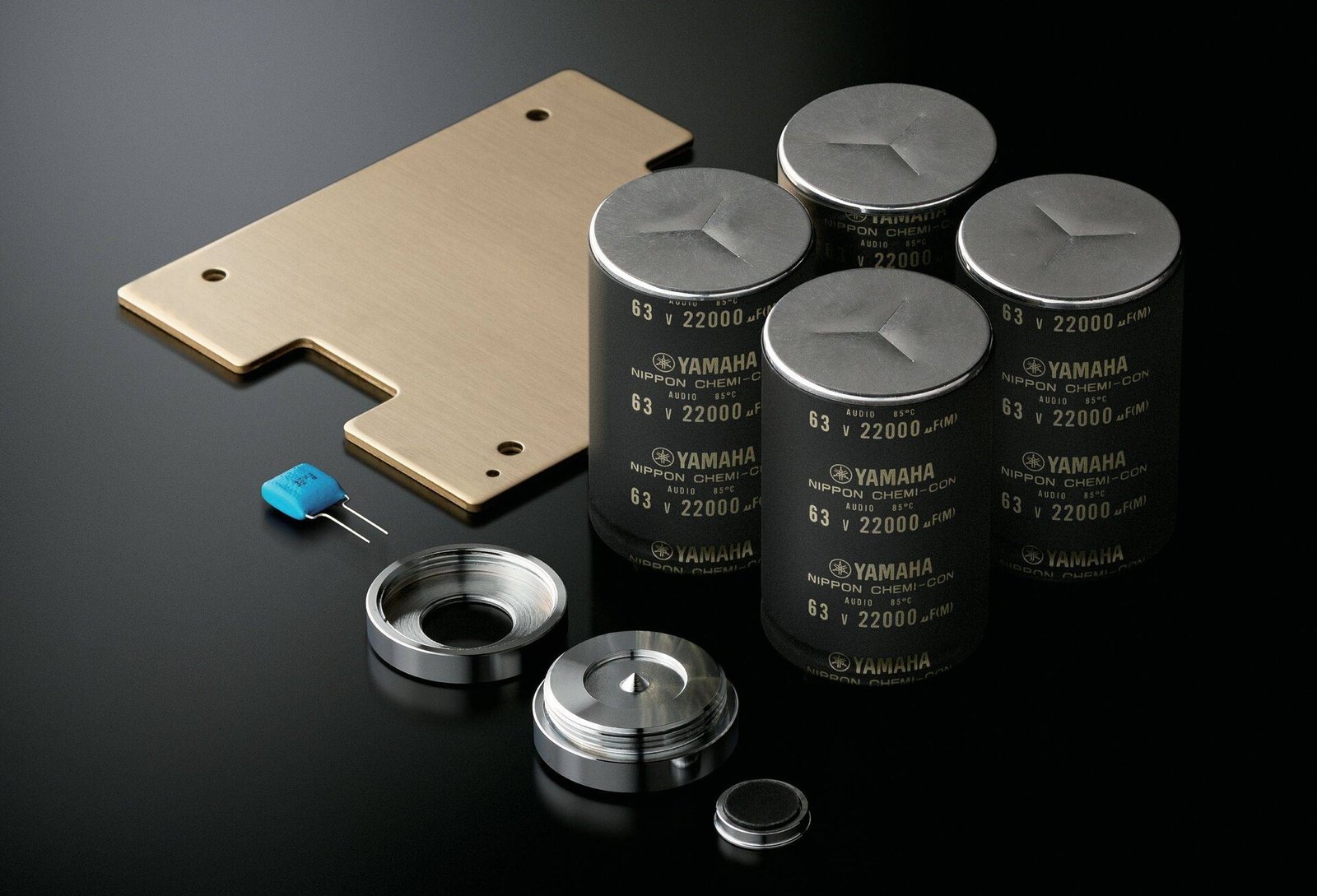
The Mechanical Ground Concept. The chassis is symmetrical, with the power supply in the centre and the power amplifier blocks left and right. The heavy parts that vibrate, meaning the power transformer and the four block capacitors, are mounted to the base frame. The feet attach to bolts welded directly into that same base frame. The idea is a continuous mechanical path from the mass inside the amplifier through to the surface underneath it, so that vibration has a route out and does not circulate through the chassis and into the boards. Yamaha introduced this on the 5000 series, and the idea is used in the construction of the A-S3200 as well. There is also a 3 mm thick brass base plate between the bottom of the transformer and the inner chassis.
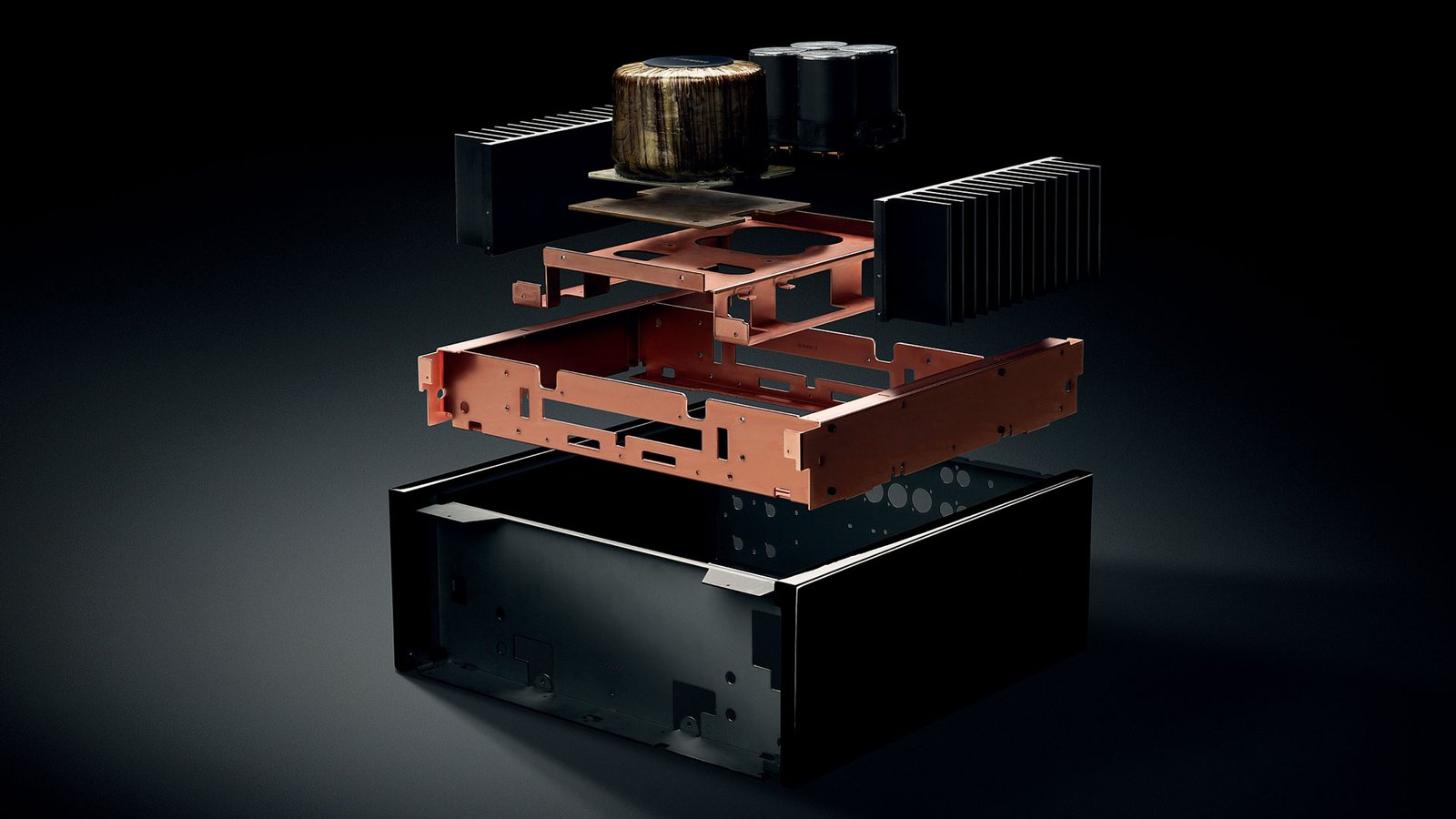
Rigid Streamlined Construction. Yamaha’s own line is that the A-S3200 “has an original Rigid Streamlined Construction that further suppresses vibration”. Their comparison chart lists it as exclusive to this model.
The low impedance design concept. Yamaha’s English language technical material says that “adopting the low impedance design concept minimizes energy loss while maintaining absolute integrity in the audio signal”, which is a sentence that could mean almost anything. The Japanese manual is specific and gives the number: 50 µm-thick copper foil through the current-handling sections of the power amplifier. Thick copper, short paths, low resistance, and the ground connections sized to match.
There is no digital section of any kind present, so no DAC, no network board, no USB input, no room correction. What the money buys is one job done thoroughly.
Confident engineering.
Component Level Details
Output stage. Same polarity MOSFETs, as described above. The heatsinking is generous. This amplifier runs warm in normal use regardless, and a high bias current is the usual reason for that, which ties with everything else about the design.
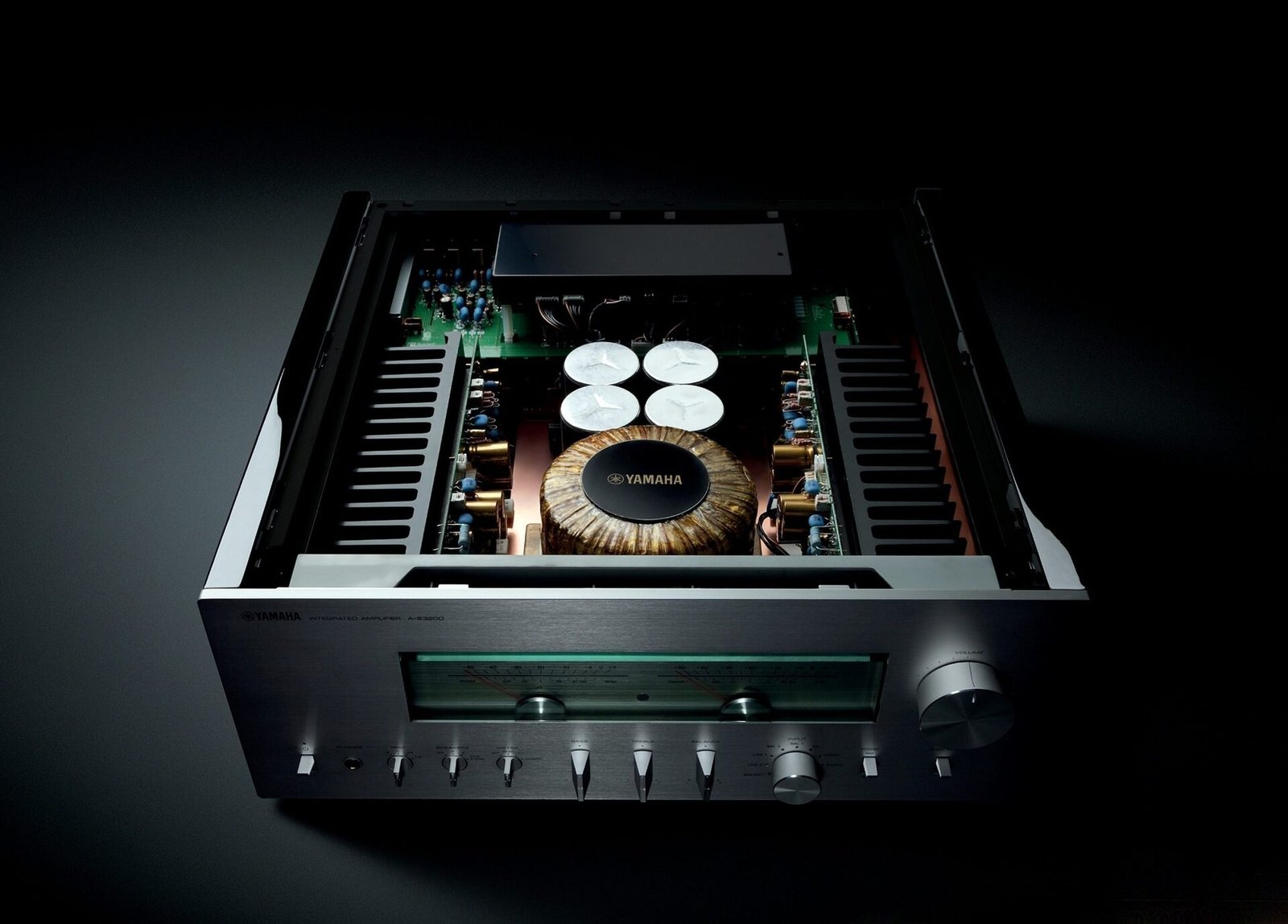
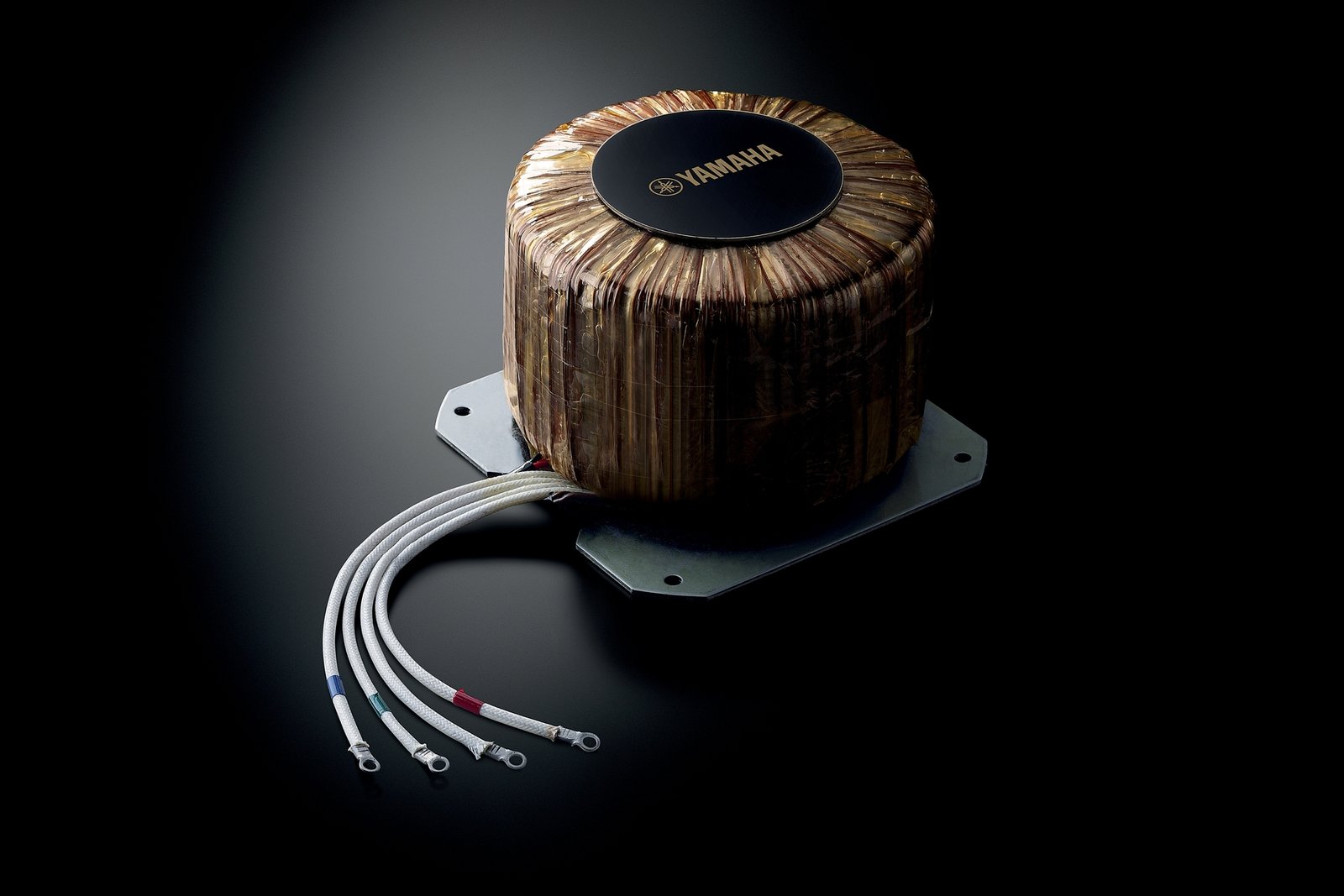
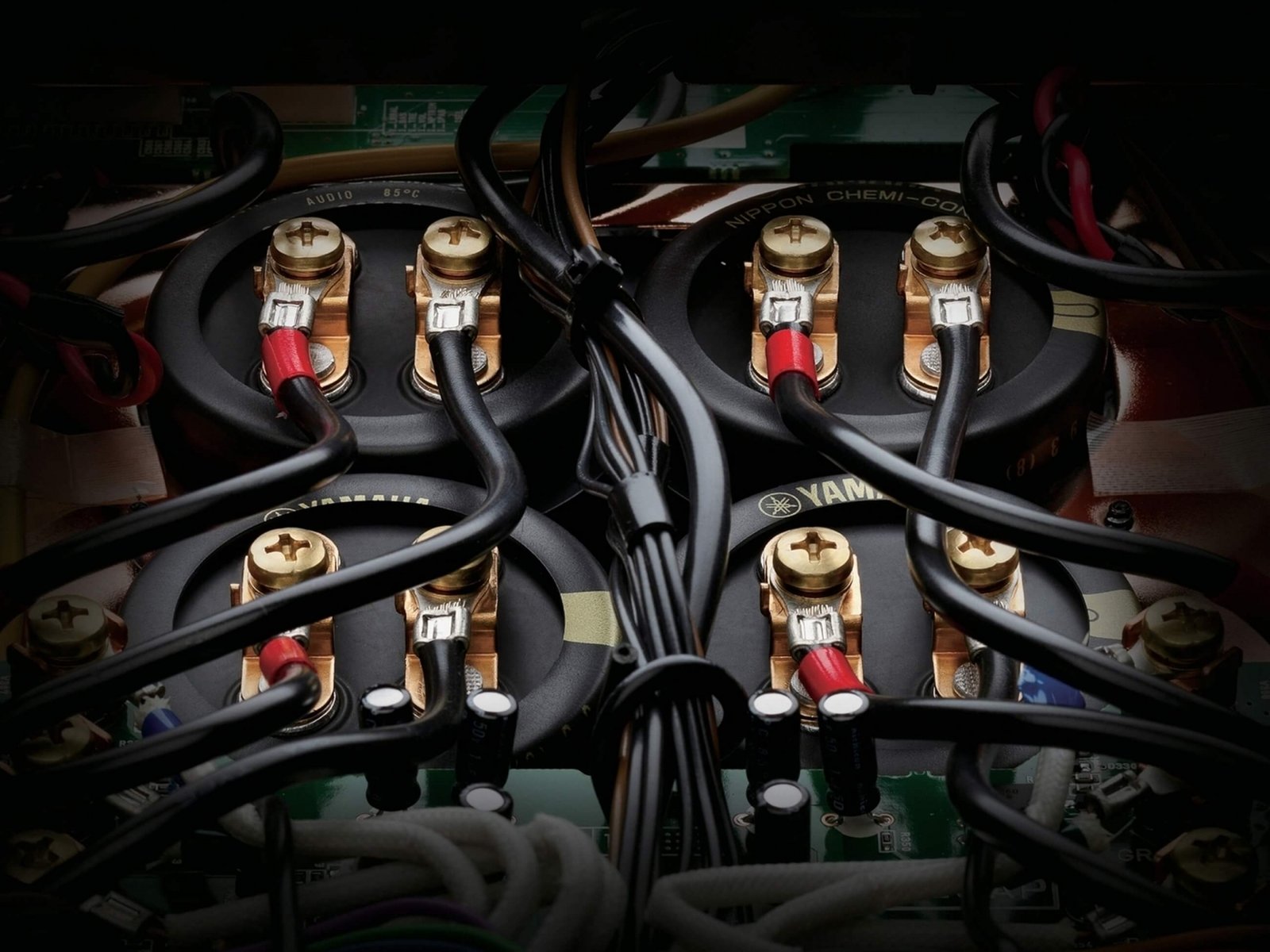
Power transformer. A 623 VA toroidal. The secondary windings are drawn out directly and terminated on lugs in place of solder, which takes a solder joint out of the highest current path in the amplifier. The transformer is mounted on the base frame, on the 3 mm brass plate, under the Mechanical Ground scheme.
Filter capacitance. Four 22,000 µF / 63 V block capacitors, so 88,000 µF in total, fastened with brass screws and terminated on gilded oxygen-free copper terminals.
Volume control. A motorised, machined aluminium knob on the front.
Phono stage. This is the part of the amplifier we most regret leaving alone. We ran line level for the whole month, so it went unheard. On paper it is serious. Yamaha’s wording: “The phono amp is comprised of an MC head amp and an equalizer amp, each of which are discretely configured”. Two discrete blocks, no operational amplifier chips, a dedicated MC head amp feeding a discrete RIAA equaliser. MM sensitivity is 3.5 mVrms into 47 kΩ, MC sensitivity is 150 µVrms into 50 Ω, RIAA deviation is specified at ±0.5 dB, and signal to noise at 96 dB for MM and 90 dB for MC. Loading is fixed with no adjustment for it, which is the one thing we would change.
Chassis and materials. The side panels are built with a high gloss piano lacquer finish on both the silver and the black versions, which is a very nice touch from a company that finishes pianos for a living. The feet are heavy duty brass, height adjustable, with a choice of spikes or a scratch resistant base, and Yamaha states they were originally engineered exclusively for the C-5000 preamplifier and the M-5000 power amplifier. The vu meter window is 8 mm thick crystal glass. Non magnetic brass fasteners are used through the chassis, and the high current paths are screwed down on lugs with no solder joint anywhere in them.
Internal wiring and terminals. The internal wiring to the speaker terminals is PC-Triple C at Φ2.7 mm, a figure Yamaha publishes directly. PC-Triple C is a conductor produced by intensive forging, a process that aligns the crystal structure along the direction of the wire and leaves none of it randomly oriented. The speaker terminals themselves are cut from pure brass. Yamaha names the conductor as PC-Triple C, and PC-OCC is a different process entirely.
Signal capacitors. PPS film and PP film capacitors through the audio path.
Power is rated at 100 W + 100 W into 8 Ω and 150 W + 150 W into 4 Ω, from 20 Hz to 20 kHz at 0.07% THD. Signal to noise on the balanced inputs is 114 dB and residual noise is 33 µVrms. Damping factor is specified at 250 or higher into 8 Ω at 1 kHz. Yamaha quotes 350 W of power consumption. From our wall socket we measured around 290 W at maximum and around 60 W at idle, which tells you the output stage runs a serious bias current.
Two amplifiers, one chassis
The INPUT selector has a position marked MAIN DIRECT. It routes the MAIN IN sockets on the back straight into the power amplifier section, removing the preamplifier stage and the volume control out of the circuit. When using this mode, the signal level should be set by the source player or the preamplifier, just before the 3200. This is a power amp mode.
With the amp set in MAIN DIRECT mode, the sound signature completely changed in a very positive way.
In integrated mode, the A-S3200 has a specific colouration. Mellow, warm, closer to a tube design than to a damped solid state one. The bass is rounder, softer and slower, with more bloom in it. There is also less articulation in both the bass and treble area. Midrange is presented a bit forward and physical. The top end is recessed.
In MAIN DIRECT, with a preamplifier doing the level, that colour drops back significantly. The sound gets closer to the source material, with much less of a character added on top. It is more transparent, more detailed, more aired, straighter and truer. The warm, tube like quality is clearly present, subtler than before, and noticeable on the fastest transients. Sparkle and air are much better. The soundstage gets deeper. Bass tightens up, gets faster, loses some bloom and gains pitch definition, with a good part of that roundness surviving.
What this means is that you can get two distinct sound signatures from the same amplifier.
You can buy the A-S3200 now, set it up as an integrated, enjoy the warm voicing. And later you can add a preamplifier, flip the device into MAIN DIRECT, and the whole presentation opens up. That is a very substantial upgrade path, one worth seriously considering.
System Matching, a Matter of Nuance
The Gustard R30 is a warmer, mellower-sounding source, and it was not an appropriate match here. Warm on warm, the presentation became soft through the midrange, while the bass sounded slower, laggier, and less detailed. The Aurender A1000 moved things considerably closer to where we wanted them. Its overall character follows a faster, more direct, and punchier presentation, making it a much better match for the Yamaha than the R30. For reference, we also compared both sources with the much pricier MOON 491, however, it proved to have more midrange presence and harmonic richness, while bass notes were now stopping quite quickly and more realistically.
The source needs to complement the Yamaha naturally. The 491 is fast, direct, and punchy, and together they produced a more balanced result than either component tends to suggest on their own. So, if system matching is part of the equation, we would look toward a fast, direct and punchy source or preamplifier of this type. The Aurender A1000 already worked well in that role, while the MOON 491 was even better, albeit pricier. An R2R DAC with a pronounced warm presentation is where we would be less inclined to start. In the end, much of this comes down to preference, but we enjoyed the A-S3200 most when the surrounding electronics brought a little more speed and balance into the system.
Loudspeakers next. We used the Yamaha NS-2000A, the Monitor Audio Platinum 300 3G and the Dynaudio Contour 60i throughout the month, and the match we liked best by a clear margin was with the Yamaha NS-2000A.
What happens there is a very neat piece of mutual harmonisation. The NS-2000A has an elevated, sparkling top end, so it adds everything the A-S3200 is missing up there. The A-S3200 emphasizes the mids, which add everything the NS-2000A is kinda missing. Two components that are each unique and work wonders together.
This is also a sweet spot for the NS-2000A loudspeakers. If you are looking for a tendency towards a warm and physical presentation with plenty of light on top of it, this is where the amplifier feels like home, and we feel it repays every cent spent by its lucky buyer!
The Contour 60i is the hardest of the three, since it dips as low as 2.5 Ω measured, which draws a great deal of current. The Platinum 300 3G is not far behind. Both of them are loudspeakers that require a lot more than the 100 watts A-S3200 has on tap.
Another thing that needs some care is the room, and here we have good news. We ran the A-S3200 in the small living room, 4 m by 5.3 m with a 2.7 m ceiling and modest treatment, and in our bigger room, 5 m by 6 m with a 4 m ceiling and proper treatment. It filled both. The bigger one is a lot of air for 100 watts and we were expecting the amplifier to sound thin and out of its depth in there but that was not the case. In both rooms the amplifier felt comfortable, and both were pleasant to sit in for a long time.
Voices, weight, dynamics

Pernille Rosendahl’s Feet on the Ground has exposed the shortcomings of many components in this room, so it was the first thing we played. Her voice was clean, correctly sized, free of hardness at the top of her range. In the integrated mode, it also had a warmth around it that is absent from the recording. Pleasant, audible, but that warmth clearly belonged to the amplifier. Through MAIN DIRECT, the warmth was dialed down. What was left was closer to the original sound. Bass was articulate enough and felt strong up to the rated power, which was reached a lot sooner than we would have liked.

Chris Stapleton’s Death Row is where we changed our minds about this amplifier. What the kick has as an integrated is weight and body, a leading edge that is rounded, and a decay that takes its time. There is impact with very little tension underneath it. Once you hear it that way, it remains the same over time. What it reminded us of was the sound of a good tube amplifier. Switch to MAIN DIRECT and the leading edge sharpens, the decay shortens, the pitch definition improves, with a good part of that roundness surviving. Better in both directions, if that makes sense.

AURORA’s A Different Kind of Human handled the dynamic swing with authority at sensible levels. The transitions from the quiet passages into the full arrangement were clean, the small expressive details in her delivery present without ever being pushed forward. The machine-gun type of bass was articulate enough so that we could almost, barely count the shots, but that only happened in the MAIN DIRECT mode.
We want to be careful with the word mellow, because it can easily sound like criticism, and that is not what we mean here. The A-S3200’s low end has a slightly rounded character, with more emphasis on body and flow than on absolute grip or sharply outlined bass transients. In a large amount of music, that is a very pleasant balance. Stapleton is one of those cases, so is anything built around acoustic bass, and so is what we tend to play after at night. There is weight, fullness, and an easy sense of scale to the lower registers, without making the presentation feel dry or overly controlled. The tradeoff appears when the recording depends more heavily on speed and separation. Fast bass sequences can lose some definition between individual notes, and the leading edge of each impact is not always drawn with the same firmness as with amplifiers that prioritise control above everything else. The notes are still there, and the weight behind them is certainly there, but the space between them can become a little crowded.
This is where MAIN DIRECT helped most, tightening the presentation enough for those rapid bass pulses on AURORA to become easier to follow.
So the character itself is not the issue. A rounded low end can be one of the reasons this amplifier is so pleasant to listen to. What it costs is some grip and, in certain cases, articulation, especially when the music demands very fast stops and clearly separated low-frequency events.
Soundstage, placement and bass articulation
In the Wind by Yosi Horikawa is one of our benchmarks for how a component handles small, fast, precisely located events, so we used it to learn where things are in the room. Each specific sound had its own spot. The spots are very specific. The soundstage has to be wide and extended well past the physical boundaries of the loudspeakers. On the A-S3200 we had a great wide soundstage, but the tridimensionality was a bit lacking. We would have liked to feel more space. Spatial precision was quite good but not the sharpest to pinpoint, so a bit of a hit-and-miss here.
Running as an integrated, the layering was pretty flat, with a limited sense of one element sitting well behind another. MAIN DIRECT increased the sense of depth. It was better, but with the same flatness underneath. The downside is losing a sense of tridimensionality, but the upside is the gain of a mellow warmth that is very, very pleasant to listen to. Be it coloration or whatever you wish to call it, it works.

Heilung’s Traust is the harder test, since the recording is dense and layered, it will collapse into a muddy presentation through the wrong equipment chain. Up until the rated power, nothing collapsed. The micro vibrations and the ambient detail at the start of the track were retrieved cleanly. Through the integrated path, the low end underneath filled more of the space between the notes than a tighter amplifier would have left empty. As the arrangement built, the specificity of the placement softened a bit. Elements that were separate at the start became a bit harder to point at. In MAIN DIRECT mode, the softening was milder, the entire presentation was a bit cleaner and presented with more sharpness.
Infected Mushroom with any song is a good test for the low end, and a good way to check how a component behaves when a track is congested and bloated. At a normal listening level, the subbass filled the room with weight, and there was plenty of pressure. Turn it up to gain a higher sense of scale and impact, and the definition disappeared, the kick lost what outline it had, and the whole presentation compressed a bit. Same in both modes.
Scale, and the power ceiling

100 watts into 8 ohms and 150 into 4 is the true maximum here. There is no hidden reserve above the specification. Push past it, and the warmth turns into bloom, the low end loses its definition, the peaks stop short of the scale in the recording. The presentation remains whole when the amplifier runs clear of clipping and the tonal character remains the same, at full scale or at whisper levels. Same behaviour in both modes.
We use Mahler’s Symphony No. 2 Resurrection and Stravinsky’s The Firebird Suite to test for two things: the quiet passages black underneath, the big swings at full size. At moderate levels the A-S3200 laid out the scale and the detail clearly, with the low noise floor doing a lot of the work under the soft material. Past a certain point the swings stopped growing at the rate the music was truly made for.
With Armand Amar’s HOME we discovered the same story but this time from the other side. On The Desert the wind instruments were rendered with body, the breath behind them intact, at a level where the amplifier was working comfortably. On Fire, at the volume that track is made for, we were at the edge, with the bloom clearly audible under everything else.
High SPL is not what this amplifier is for, and impact is not one of its defining characteristics. If loud is what you are looking for, or if physical slam is the thing that makes you smile, then you might better be off looking elsewhere. The A-S3200 sounds excellent at low and normal listening levels. Low level listening is one of its most important highlights, a clear recommendation if that is your style of listening.
Tone, intimacy and the top octave

Diana Krall’s voice in Temptation was correctly sized, free of sibilance, presented exactly where she should be, forward and physical. The brushes on the snare had their body, albeit with the shimmer that follows them somewhat shortened. But in MAIN DIRECT mode the shimmer extended further, and the brush regained some of its edge, which we appreciated a lot.
Loreena McKennitt’s Dante’s Prayer is a very intimate vocal performance. It is where you can discover if the equipment has the necessary qualities to elicit an emotional response. It did. Her voice was close, quiet, presented in front of us, with the decay of each phrase rendered down into the noise floor and that dark background behind it, the one we’ve spoken about previously and been adamant about.
Italia, from Chris Botti’s album of the same name with Andrea Bocelli, is a recording we know very well, one we often use. Bocelli occupied the room with weight and chest resonance, sized correctly, presented in front of the plane of the loudspeakers. The trumpet presented plenty of body with no glare on the note. The brass had a physical presence we could feel in the chest as much as hear. Spot on!
We use Mike Dawes and Jump to check two things: the percussive slaps on the body of the guitar separated from the harmonics, and the fingernail on the string drawn very sharply. The slaps were presented apart from the harmonics, the tapped notes gained their own identity, the bass string work underneath was articulate enough to sound realistic. The fingernail is where this amplifier parts company with the finer amplifiers we’ve hosted. The highest harmonics were somewhat blunted, especially in the treble range. MAIN DIRECT sharpened them and improved them, short of solving it.
Idrissa Soumaoro’s Cherie extends into ultrasonic information, so we use it to test the very top of the frequency spectrum. Air and sparkle above 10 kHz were in short supply through the integrated mode. MAIN DIRECT was better. From a tonal accuracy point of view there is nothing wrong up in the high frequency region. There is no cutthroat detail, no last measure of illumination either. Everything feels polite, as if nothing is meant to disturb or challenge the mainstream.
Nils Frahm’s All Melody is always on the test list. At low levels the presentation was structured completely, the soundstage the same width it had at a normal listening level, the imaging precise, the piano present and close and physical in a very good way. This speaks a lot for the inter note silence and for the noise floor underneath all of it.
One interesting thing we noticed. The soundstage somewhat changes with the volume knob. The width is there at every level. What changed slightly was the depth: at lower knob positions the presentation flattened a bit. Turning it up gave a better defined centre image, with more tridimensionality. It’s a very subtle thing, not noticeable at first. In MAIN DIRECT we noticed none of this, at any level. Could the volume control be behind it..? We have no way to confirm it.
The tone controls and their implication
Leave them alone.
BASS and TREBLE each run −10 to +10 dB with a centre detent. We tested them properly. Move either one off its detent and you hear a relay clicking, and besides the aforementioned attenuation/gain, the sound character changes, the soundstage shrinks, detail goes bye-bye, the tridimensionality flattens out. The cost is a lot higher than the benefit. We found no track where the trade was worth making.
There is one job they do very well. It’s late, someone is asleep in the next room, you want the bass pulled down so the neighbours and the family survive the evening. For that, they are perfect. For anything you are listening to on purpose, put them back at their detents and forget the knobs exist.
Closing Thoughts
The A-S3200 is a very beautiful amplifier. High gloss piano lacquer down both flanks, on the silver version and on the black one. Brass under the feet, brass through the fasteners, brass at the speaker terminals. Two VU meters behind a beautifully cut 8 mm crystal glass front, lit by LEDs chosen to imitate the colour and the softness of an incandescent lamp, with a DIMMER position for when the room is dark and the meters are too much. After a month with it, testing three pairs of loudspeakers and changing two rooms, we have discovered two distinct sound signatures.
Yamaha has built a tube amplifier out of MOSFETs. In topology, it is a solid-state amplifier, but the voicing tells another story. The forward physical midrange, the rounded leading edge on the kick, the warmth that fills the space between low notes, the recessed top octave, the modest power that softens when you push it to the extremes. As stated before, there is no retubing, no bias check attached to any of it, which is a solution we really like.
The engineering is beyond question. The floating and balanced topology, the same-polarity MOSFETs, the mechanical grounding, the 50 µm copper foil, the brass, the drawn-out transformer windings terminated on lugs. This is a serious piece of industrial design. The build quality is worth every euro of the asking price. Our reservations are about the voicing and the power, they have nothing to do with how it’s constructed.
What you get is presence, warmth and musicality. What you give up is polish, grip and headroom. That means that you need to get the right electronics and cables around it. Since a warm source on a warm amplifier amplifies the colour, a demanding loudspeaker may find the amplifier’s ceiling sooner than expected.
The idea is to buy it, set it up as an integrated, and live with the warm voicing. And, later on, add a preamplifier, put the selector on MAIN DIRECT, and discover that a more transparent and detailed amplifier was just sitting there, waiting. You get two different signatures from the same chassis.
We keep thinking about the piano factory near Kakegawa and the listening room inside it. Maybe that is where the particular character of this unit originates? It is musical, pleasant, engaging, and at times tempting as we went on listening for more and more throughout an entire month. But its presentation is not fun, exciting, or exaggerated in anything. It does not offer a deliberately larger-than-life presentation, with oversized dynamics and spectacular transients. No, there’s no extravagance here.
For anyone running the NS-2000A speakers, or anything else sensitive and easy to drive, in a room of any size, this is a piece that deserves the utmost attention. In every case, book a demo, bring your own preamplifier, try that power amp mode before you decide.
Acknowledgment
We would like to extend our thanks to HifiExpert for lending us the Yamaha A-S3200 and for giving us the time to live with it properly across two rooms and three systems. Having a component in the room for a month, in our own space, with our own loudspeakers and our own cables, is how we learn what it does over time. Shout-out to all the dealers out there doing awesome work for all of us.
Pros
- Two sound signatures in one chassis, with a serious upgrade path once you add a preamplifier and use MAIN DIRECT
- A warm, physical, tube-like voicing with none of the retubing, biasing, or tube hunting required
- Outstandingly pleasant to listen to at low and normal listening levels, where the warmth and the forward midrange work great together
- An exceptional match with the Yamaha NS-2000A, where the two of them work wonders together
- Build quality, materials, and looks that are very impressive
Cons
- Musical, pleasant, and engaging, but without any fun factor at all. This is in no way a party animal
- Rated power is reached a lot sooner than we would have liked. High SPL and physical slam are not what this is for
- The top octave is short of a convincing high-end character in both modes, and tridimensionality is a bit lacking