Graphite Audio ISSB-40 & IC-35 – Black Lead, and Other Beautiful Misunderstandings

Black Lead
Sometime before 1565, in the Borrowdale valley of what is now the English Lake District, a storm tore an old tree out of a hillside. The shepherds who came to look found something black and greasy tangled in its roots. It left a mark on everything it touched. So they did the practical thing shepherds do, and used it to mark their sheep.
Nobody knew what it was. It looked like lead, and it smeared like lead, so they called it black lead, and the learned men who came later gave it a Latin name that meant roughly the same thing: plumbago, that which acts like lead. It contained no lead at all. It weighed a fraction of what lead weighs. It was the wrong name for a material that was plainly doing something nobody could explain, and the name stuck.
It also turned out to be priceless. Borrowdale held the purest deposit of solid graphite ever found, and the black stuff became valuable enough to cast cannonballs, valuable enough for the mine to be guarded against armed robbers, and valuable enough that in 1752 Parliament made stealing it a felony. For two centuries England mined, guarded, smuggled and fought over a material it could not correctly name.
It took until 1779 for the Swedish chemist Carl Wilhelm Scheele to show that black lead was not lead at all but carbon, and until 1789 for the German geologist Abraham Gottlob Werner to give it the name it should have had from the start. Graphite, from the verb to write.
And here is the part I love. More than two centuries later, you still ask for a pencil lead. The name was wrong in 1565, and it is wrong today, and nobody has bothered to fix it, because the pencil works regardless of what we call it.
I have been thinking about Borrowdale since Vienna, when Szymon Rutkowski put one of his cones in my hand, and my hand got it completely wrong. I told that story in our interview a few weeks ago, so I will spare you a second telling. What stayed with me afterward was not the lightness itself. It was how quickly I decided what it was, based on what it looked like, before it had done anything at all.That is the whole problem with this category of product, and possibly with this hobby. We name things by what they resemble. Then we spend years arguing about the name.

TL; DR — The Short Conclusion
For those of you who go straight to the verdict, here it is:
The Graphite Audio ISSB-40 spike bases went under my Wilson WATT/Puppy 50th Anniversary, replacing the aluminum bases Wilson supplies, and they never left. I never switched back and never felt the need to compare again. The bass gained control, detail, and precision; the midrange opened up; and the whole presentation became more layered and coherent. At €720 for a set of eight, it is the most sensible money in this review.
The IC-35 Premium cones went under the Aesthetix Calypso preamplifier and then under the Rockna Wavelight streamer, and did the same thing in both places: a blacker background, more meat on the music, more palpability and liquidity, better layering and definition. Crucially, no change in tonality and no lightening of the sound.
Then I put them under the Aesthetix Atlas power amplifier, and that was my revelation of the year. Everything I had tried under that amplifier before either thinned it out or pushed detail ahead of music. The IC-35 did neither, and the improvement was bigger than rolling the Atlas’s 6SN7 input tubes. They are still there, and I cannot find anything to replace them.
€890 for three cones with their base cups. Both products take the SoundNews Editors’ Choice Award.
The honest caveat, in a category that has earned its skepticism: I can only tell you what happened in my system, over months, in the only test that matters with an accessory. Would I put the old thing back? No.

The Elephant Standing on Three Cones
Let’s deal with it now, so it doesn’t follow us around for the rest of the review.
Resonance control is the most argued-about corner of high-end audio after cables, and on a bad day it wins. Somewhere right now someone is typing that a cone cannot possibly change the sound of an amplifier, and somewhere else someone is paying more for four feet than for the amplifier. Both of them will read this review. Neither will be entirely happy.
So here is where I stand.
The physics of the problem isn’t controversial. Transformers hum mechanically; chassis panels ring; vacuum tubes are microphonic, which is a polite way of saying they are small and very expensive microphones sitting in the middle of the signal path, and my preamplifier and power amplifier are full of them. A loudspeaker cone pushes air forward, the cabinet pushes back, and that reaction force has to go somewhere: into the spikes, into the floor, and partly back into the speaker. None of this is voodoo. It’s Newton.
What is genuinely debatable is how much any particular footer changes any of it, in any particular system, and whether you can hear the result. That is a fair question, and plenty of products in this category do not survive it. I have heard footers that did nothing, footers that did something I didn’t want, and a few that made the system sound more impressive for a week and more tiring for a month.
Szymon knows the argument better than I do. When people come up to him at shows asking for measurements, he answers with a question: Can you hear a measurement? I’ll be honest, that line wouldn’t satisfy an engineer, and I say that as one. What I found far more convincing was the rest of his answer: that measurements guide the research, but the relationship between physics and human perception is rarely a straight line. Anyone who has ever voiced anything knows that sentence is true.
So my method was deliberately boring. No quick A/B swaps at a show. Months of living with each product, in positions I know intimately, followed by the only questions that have ever really mattered to me with an accessory. When I take it out, do I miss it? And would I put the old thing back?
If you believe none of this can possibly work, I won’t change your mind in five thousand words, and I won’t try. Borrow a set from a dealer and use your own ears in your own room. It’s the only argument I have ever respected in this hobby anyway.

Family Savings and a Polymer Recipe
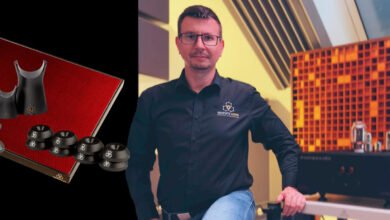
Graphite Audio was founded in 2020 in Bydgoszcz, Poland, by Szymon Rutkowski, a man who describes himself first as a music lover and who spent years on the sales and marketing side of the audio business before building anything of his own.
The beginning, he told me, was born out of endless sleepless nights, spent testing heavy, polished metal footers packed with bearings and ceramic balls. Every one of them gave something and took something back. Higher resolution, at the price of aggressive vocals. More focus, at the price of lost bass impact. His benchmark was simple and very hard: the organic energy of live music, at home, without the trade-offs.
What he did about it is the part I admire. He didn’t design a prettier cone. He went looking for a different substance. And when he finally cracked the recipe, the material turned a dark graphite grey, and the company named itself. It wasn’t marketing theory, he said; it was literally what was in front of us.
The least romantic sentence of our whole conversation was also the most revealing. The frightening part, he said, was not deciding to go commercial. It was investing the family savings in years of research before he knew any of it would work.
Two years after founding, the products were at Munich High End. A year later they were in eight rooms, under TAD, under Estelon, under Stenheim, under LampizatOr. That isn’t a résumé you can buy. Nobody spends years voicing a loudspeaker or a DAC and then puts a stranger’s feet underneath it to be polite.
Where the Energy Goes
Here is the technology, as far as the company will tell it and as far as I understand it.
The material is a proprietary polymer doped with graphite in a very precise proportion. Graphite on its own is a strange and wonderful thing: flat sheets of carbon atoms arranged in a honeycomb, stacked on top of each other and held together only loosely, which is exactly why a pencil leaves a mark. It is soft, yet very strong under pressure. It conducts heat extremely well. And it is far too brittle to be used on its own, which is why it lives inside a polymer host.
Szymon’s explanation of why that matters is the clearest I have read from any manufacturer in this field.
When unwanted kinetic energy from audio components hits graphite, its flexible structure converts those vibrations directly into minute amounts of heat, rather than storing that energy or bouncing it back into your signal path.
Metal, in his view, tends to ring. He is careful and generous about the competition, and his objection is not that metal footers don’t work. It is that they bring a character, often a touch of brightness or emphasis in the upper frequencies, that strays from a natural live presentation. His whole company exists to remove that signature.
Then there is the weight, which is where my hand went wrong in Vienna. Forty years of audio orthodoxy say vibration control means mass: granite, steel, lead shot, sand. Graphite Audio goes the other way entirely. A set of three IC-35 Premium cones carries 50 kg. Four ISSB-40 bases carry 180 kg. The load capacity comes from the structure of the polymer matrix, not from bulk, and Szymon’s line on this is the one I keep repeating to friends:
Mass can make something heavy, but material intelligence is what actually makes it quiet.
Two more ideas complete the picture, and both explain what I heard.
The first is that he doesn’t want to kill resonance. If you damp everything to death, he told me, you end up with a sterile, lifeless sound. The goal is management, not destruction. That, I am now convinced, is exactly why these products don’t thin out the sound, which is what I have learned to expect from aggressive damping.
Second, they work in both directions. They isolate a component from vibrations coming up through the rack or the floor, and at the same time they drain the micro-vibrations the component generates itself, from transformers, chassis chatter, and the airborne sound of the music playing in the room. And the three cones? Partly geometry, since three points define a plane and cannot rock. But his real reason is better. With four feet, one of them almost always carries less load, and a foot that isn’t pressing firmly cannot drain anything. Three guarantees equal contact pressure on every point. He also admits, with refreshing candor, that sets of three keep the price down.

The Only Thing LampizatOr Sells That LampizatOr Didn’t Make
If you want an endorsement that cannot be bought, look at LampizatOr.
Łukasz Fikus fell for the IC-35 Premium long before Munich 2023, and when he showed his flagship Horizon DAC there, alongside Taiko and AlsyVox, the Graphite cones were under it. That wasn’t a sponsored placement. It was a designer trusting a stranger’s cones with his own sound, in the most important room of the year.
It didn’t stop at one show. Go to the LampizatOr North America website today and open the Accessories menu. There is exactly one product in it. Among the DACs, the Final Touch cables and the Western Electric 300Bs, the only thing on that site not made by LampizatOr is a set of three grey cones from Bydgoszcz, the IC-35 Premium.
I own a LampizatOr Pacific, so I read that page with more than professional interest. For LampizatOr owners, the IC-35 Premium has become something close to the default choice, the accessory the people who build the DAC recommend putting underneath it. For a small accessory maker, I can’t think of a stronger recommendation than the designer of the component telling his own customers what to stand it on.
Disclaimer
You won’t see the IC-35 Premium under my LampizatOr in the photos, and there’s a simple reason for it. A long time ago, I screwed a set of Arya Audio Labs RevOpods directly into the Pacific, and I’m a little wary of unscrewing them, in case one of the threaded posts stays stuck in the DAC’s aluminum housing. I also like the RevOpods a lot, not least because they let me level the DAC perfectly. So, to be clear: LampizatOr’s recommendation is what made me curious about the IC-35 Premium in the first place, but I didn’t verify it under my own Pacific. Everything I describe in this review comes from the cones under the rest of my system, every component except the DAC. That says nothing against either product. It is simply the limit of what I tested.
Unboxing Almost Nothing
Let me start with the boxes, because they deserve a better line than the one I was about to write.
The packaging is genuinely lovely. Each set arrives in a proper, sturdy box that has clearly been designed rather than simply ordered from a catalog, with everything sitting securely in its place and nothing rattling around at the bottom. It is the kind of presentation that tells you somebody cared about the moment you lift the lid, which is exactly how it should feel when you have paid close to a thousand euros for a set of cones. Szymon may insist on no visual drama for the products themselves, but he clearly made an exception for the first impression.
It is also slightly comic. You open a box that takes itself seriously, reach in for the contents, and your hand goes up far too fast all over again. The box has presence. What is inside it has almost none, at least until you hear it.
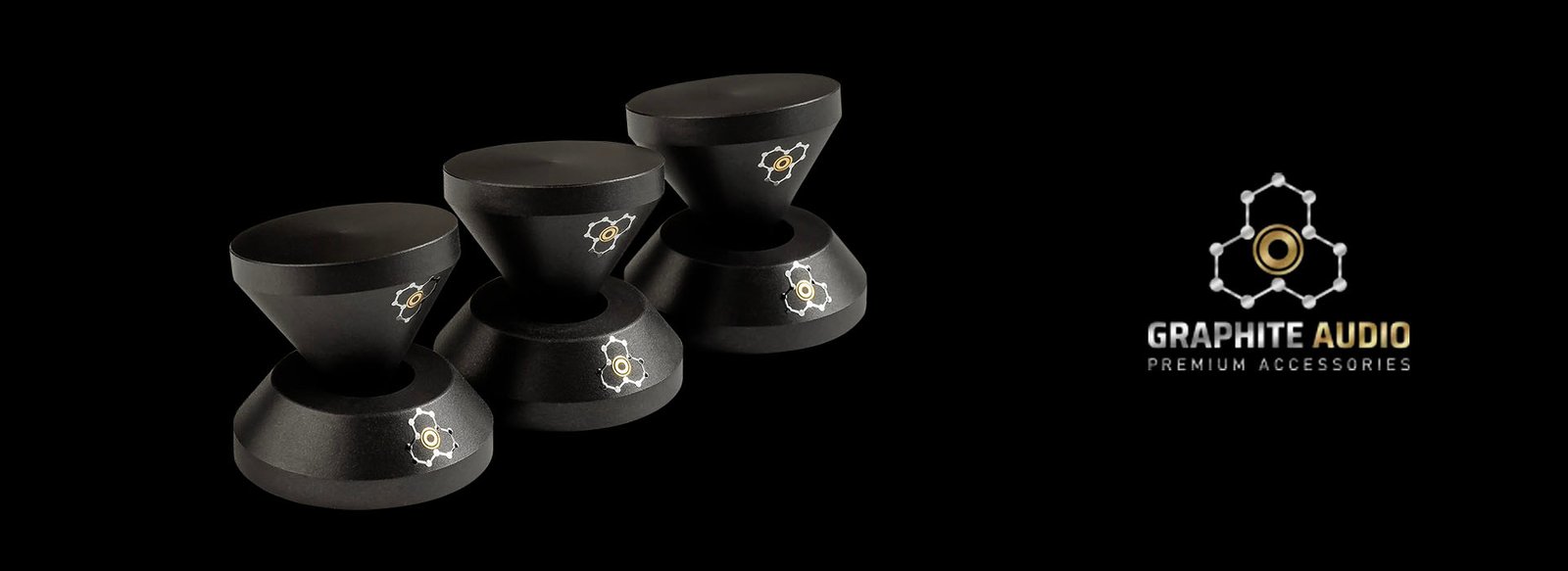
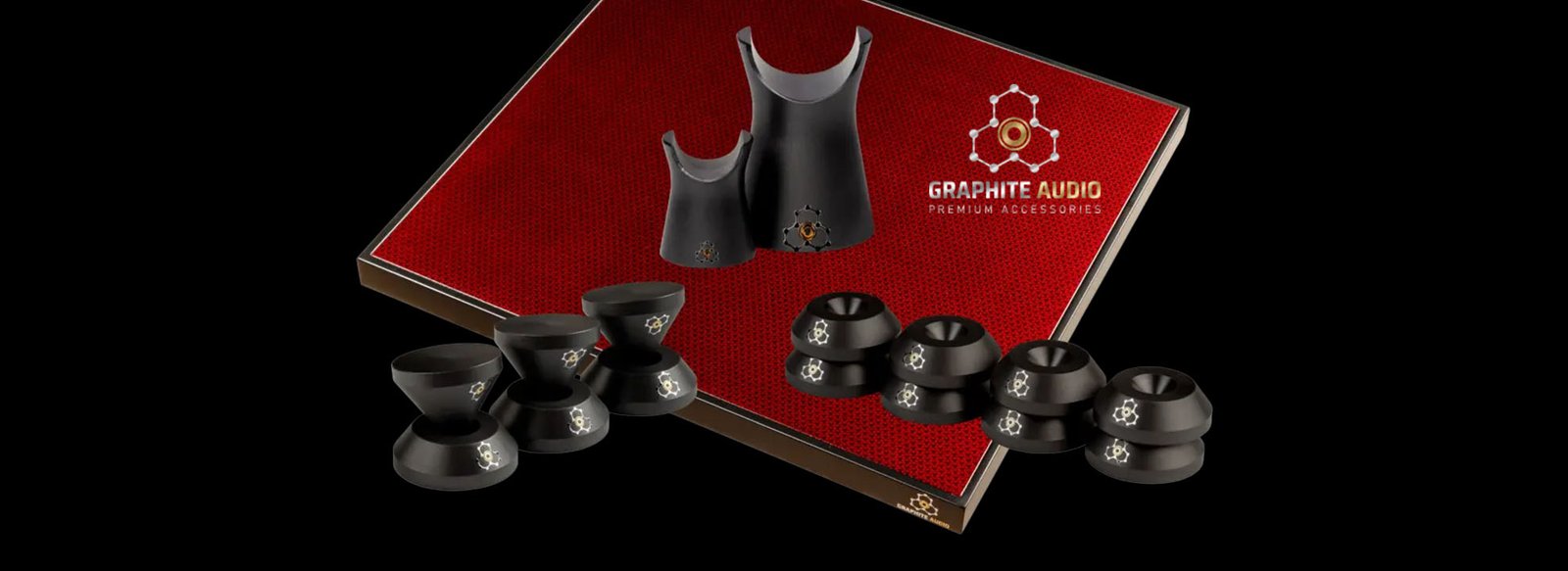
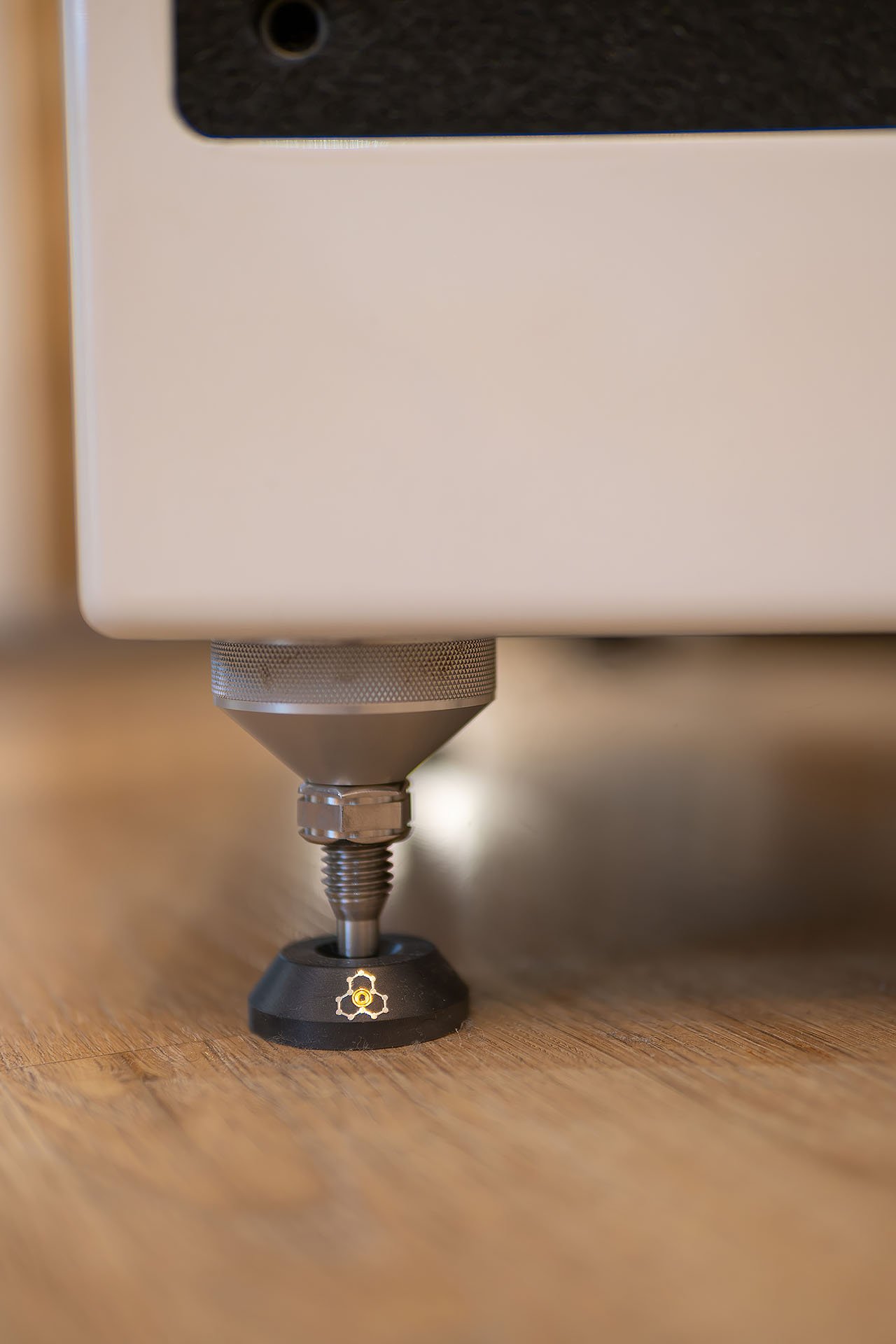
The IC-35 Premium Isolation Cones arrive as a set of three cones and three base cups. Each cone is 35 mm tall and 35 mm across, and sits in a 40 mm base. A set carries up to 50 kg. They are dark grey, matte, slightly warm to the touch, and they weigh almost nothing, which is still slightly funny to me months later.
The base cups are the Premium part, and their story is the most honest product-development story I know. The original IC-35 was cones only. Then dealers and customers started trying them together with the ISSB-40 bases; the feedback was overwhelming, and once 90 percent of sales had moved to the combined setup, Szymon discontinued the standalone cones. His customers designed the Premium version for him. He just listened.
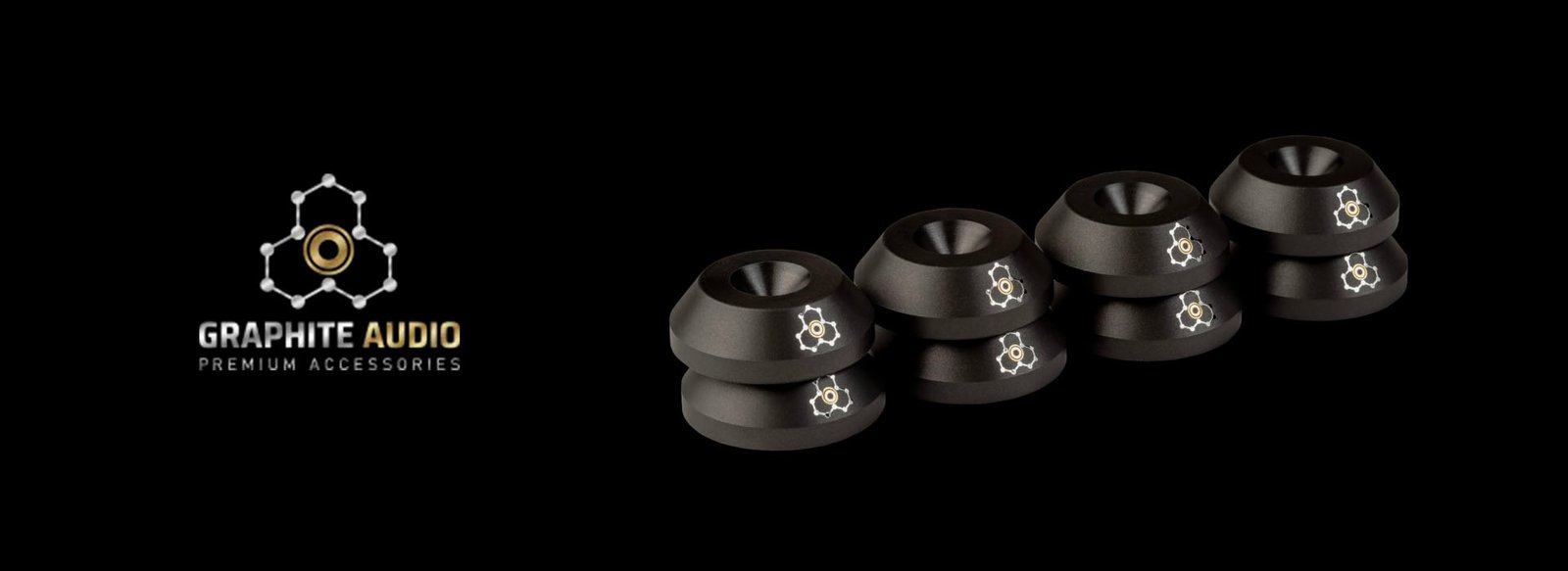
The ISSB-40 Isolation Speaker Spike Bases come as a set of eight: 13 mm high, 40 mm across, rated at 180 kg for every four. They go under loudspeaker spikes, replacing the metal discs almost every speaker manufacturer supplies, and they protect the floor as a pleasant side effect. They also work under the spikes of racks and stands.
Two honest notes, which I appreciate the manufacturer printing on its own spec sheet. The material scratches easily, which doesn’t affect performance. And under heavy loads, the tip of a cone can reshape slightly, which doesn’t affect performance either. Worth knowing before you lift one after a few months and wonder what happened. As Szymon put it in our interview, every millimeter is engineered purely for performance, not visual drama. That will cost him sales to people who buy with their eyes. Their loss.
Setting them up
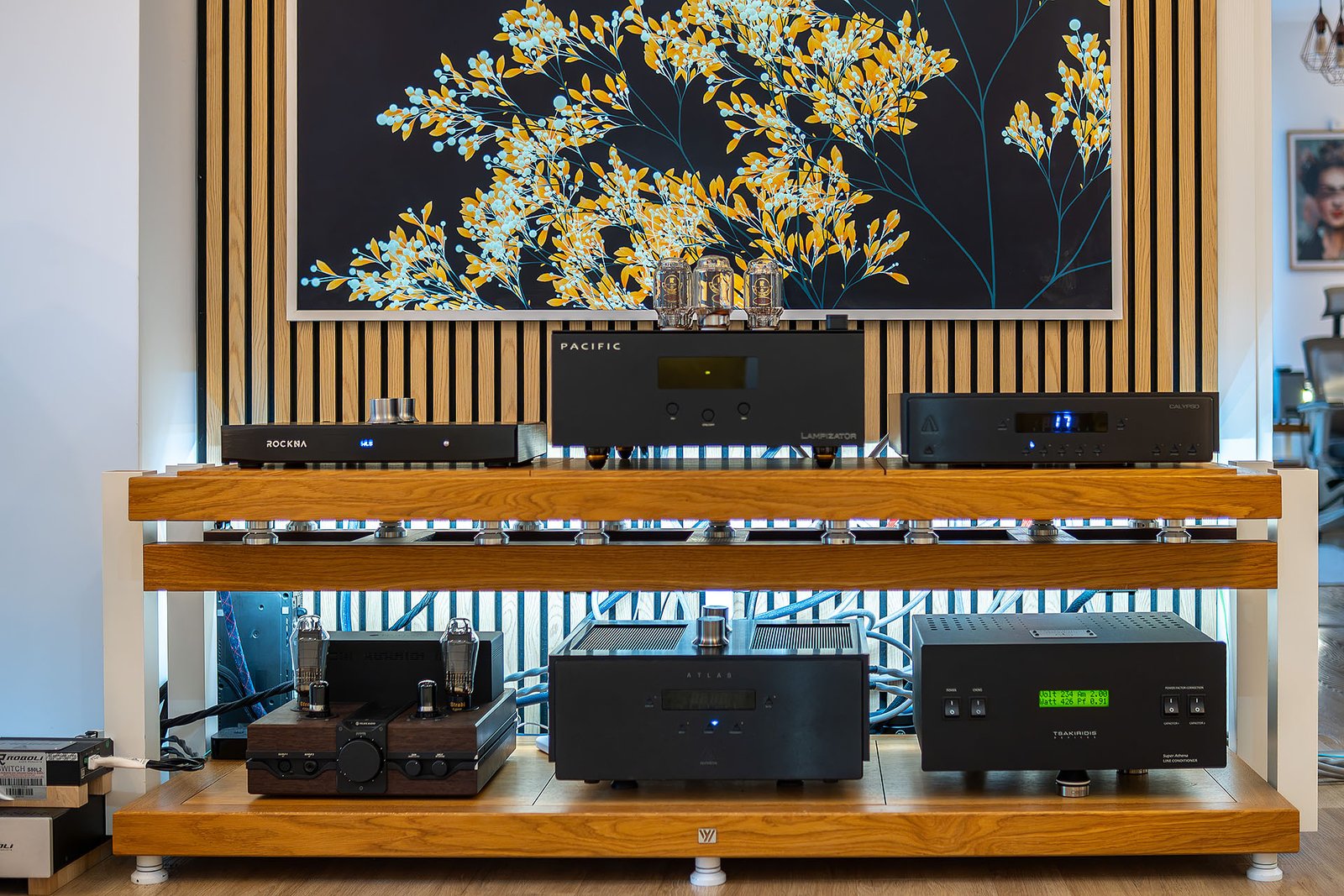
Szymon’s placement advice for the cones is two under the heaviest part of the component, usually where the main transformer sits, or under the tubes to fight microphonics, and one under the lighter side. Then try flipping the triangle, because sometimes the opposite layout sounds better in a particular system. It’s ten minutes well spent, and it costs nothing.
The System
Everything here was heard in my own room, over several months, through a chain I know better than my own handwriting: Wilson Audio WATT/Puppy 50th Anniversary loudspeakers, the Aesthetix Eclipse trio of Atlas power amplifier, Calypso line preamplifier and Rhea phono stage, a LampizatOr Pacific DAC, a Rockna Wavelight Server as streamer and Roon endpoint with a Gustard S26 as Roon Server, and an Acoustic Signature Montana NEO turntable with the TA-5000 NEO arm, carrying an Ortofon MC A95 or a Hana Umami Red. The full list is at the end.
Vinyl and digital both, on purpose. Some of what follows only makes sense on one or the other, and I’ve marked each record.
Only the Music, Part One — The ISSB-40 and the Wilsons That Stopped Arguing with the Floor
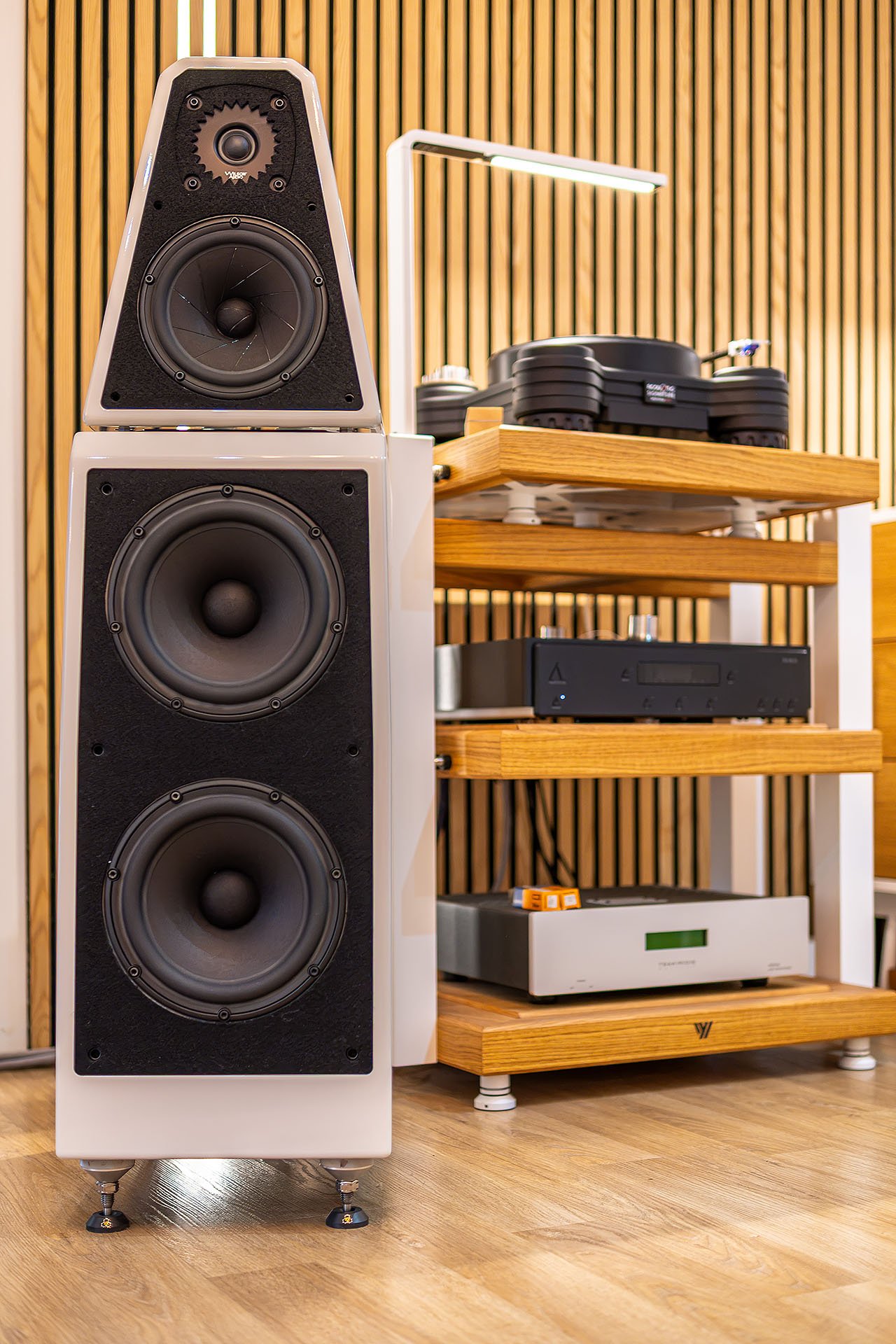
The ISSB-40 went under the Wilsons first, replacing the aluminum bases that come with the WATT/Puppy. I had planned a careful, weeks-long back-and-forth.
It never happened. The improvement over the aluminum plates was so dramatic that I simply never felt the need to switch back, or to compare again. That almost never happens to me with an accessory. So instead of a comparison, let me describe what changed, and then show you where.
The bass came first. There was more of it in the sense that matters: more control, more detail inside it, more precision in where each note starts and stops. Not more boom. The Puppy woofers have always been quick, but on metal they carried a faint halo, a slight bloom I had long accepted as the room. Some of it, it turns out, was not the room.
Then the midrange opened up, as though a very thin veil had been lifted off the front of the WATTs. And the whole picture gained layering and coherence: instruments stacked more clearly in depth, and the top and bottom of the speaker sounding more like one voice than two very good ones.
Bill Evans Trio — Sunday at the Village Vanguard (Riverside, 1961), “Gloria’s Step” · vinyl
Scott LaFaro‘s bass on this record is a test of whether a system can let a double bass sing melody without dissolving into warm fog. On the aluminum bases, it was good. On the ISSB-40, LaFaro stepped forward from Evans‘s left hand; the notes had edges, and the lowest stayed pitch rather than pressure. Behind the trio, the Vanguard itself, the glasses and the murmur, fell into layers.
What surprised me most was the drums. Paul Motian plays this set so quietly, mostly with brushes, that on many systems he becomes a texture behind the piano. With the ISSB-40 he became a third musician, with his own place slightly behind and to the side, and the famous interplay of this trio, three people listening to each other in real time, became far easier to follow. It is the difference between hearing a recording of a trio and hearing a trio.
Miles Davis — Kind of Blue (Columbia, 1959), “So What” · vinyl
The opening conversation between Paul Chambers‘s bass and the piano is my favorite test of low-end timing. With the ISSB-40, Chambers’s figure had a leading edge and a proper ending, and the gap between his phrase and the horns’ reply became a silence instead of a decay. Tiny thing. Changes everything.
Then Jimmy Cobb‘s cymbal crash announces the first solo, and the bass didn’t sink beneath it. Chambers kept walking, clearly traceable, underneath Miles, then Coltrane, then Cannonball. That is exactly what tighter control in the low end should give you. Not more bass. Bass you can follow.
Jon Hopkins — Immunity (Domino, 2013), “Open Eye Signal” · digital
And to make sure it wasn’t only acoustic jazz: this track is built on a relentless synthetic pulse and a throbbing bassline under constantly shifting layers. More grip, more control, and the layers on top stopped leaning on each other. For the first time in my room, the track sounded architectural rather than simply loud.
The quieter passages told the other half of the story. When the track thins out to a few pulsing elements, the opened midrange showed itself: small melodic details that used to blur into the pads became separate sounds, each with its own position between the speakers. Then the beat comes back, and the whole thing lands on the floor with real weight and without a trace of overhang.

Only the Music, Part Two — The IC-35 Premium Under the Calypso and the Wavelight
The IC-35 Premium went under the Aesthetix Calypso first, which is the sensible place to start with a tube preamplifier: 12AX7 and 6922 tubes, small, sensitive and microphonic, sitting at the very heart of the signal.
Then I moved them under the Rockna Wavelight, which I use purely as a streamer and Roon endpoint. A completely different component, with a completely different kind of noise, and the same result. That convinced me more than the first result did.
Here is what they did, in both places.
They kept the tonality. That sounds like faint praise until you have used footers that improve a component by quietly making it leaner. The IC-35 doesn’t lighten the sound at all. If anything, there’s more meat on the music.
The background went blacker. Notes emerge from a deeper silence, and fade back into it more slowly.
Palpability and liquidity. Voices and instruments became more physically present, and the transitions between notes smoother and less mechanical.
Layering and definition improved together, which is much rarer than it sounds. Usually you buy one with the other.
Charlie Haden & Pat Metheny — Beyond the Missouri Sky (Verve, 1997), “Spiritual” · digital
Two instruments, a lot of air, and nowhere to hide. With the cones under the Wavelight, Haden‘s bass gained body without gaining weight, and Metheny‘s guitar had more wood in it and less string. The silences between phrases felt deeper, and on this record the silences are half the music.
What I noticed most was the decay. Haden lets his notes ring, and Metheny‘s guitar has a long, soft tail on every chord; both tails now fade into black rather than a faint grey. It made the recording more intimate, as though the two of them had moved a couple of meters closer to my chair. And the tonal balance stayed exactly where it was. No added brightness, and none of the leaner, cooler sound I have heard from other footers under digital components.
Keith Jarrett — The Köln Concert (ECM, 1975) · vinyl
Recorded on a piano Jarrett famously didn’t want, on a night when almost everything went wrong, which makes it a wonderful test of whether a system can make an imperfect instrument sound like a piano rather than a recording of one. With the IC-35 under the Calypso, the piano had more mass and more liquidity, and Jarrett‘s own voice, the hums and groans, sat behind the instrument in their own space instead of on top of it.
Part I spends long stretches on a repeated figure in the left hand, and the test is whether that left hand stays a piano or turns into a drone. It stayed a piano: individual notes, each with its own hammer and its own decay, with the wooden body of the instrument behind them. The right-hand melodies floated above with more liquidity, and the long climaxes gained weight without getting harder.
Boards of Canada — Music Has the Right to Children (Warp, 1998), “Roygbiv” · vinyl
Electronic music is where a thinned-out component gives itself away fastest, because warmth is everything on this record. With the Calypso on the cones, the analog haze stayed warm and round, but the layers inside it separated. The little melodies on top kept their melancholy, which is the whole reason anyone listens to this band. The whole album has a deliberately worn, tape-like quality, and a quieter background could easily have made it sound clinical. It didn’t. It simply made it clear that the wear is part of the composition, placed there on purpose, rather than noise sitting on top of the music.
Only the Music, Part Three — The Atlas, and the Cones That Never Left
Now the part of this review I would have bet against.
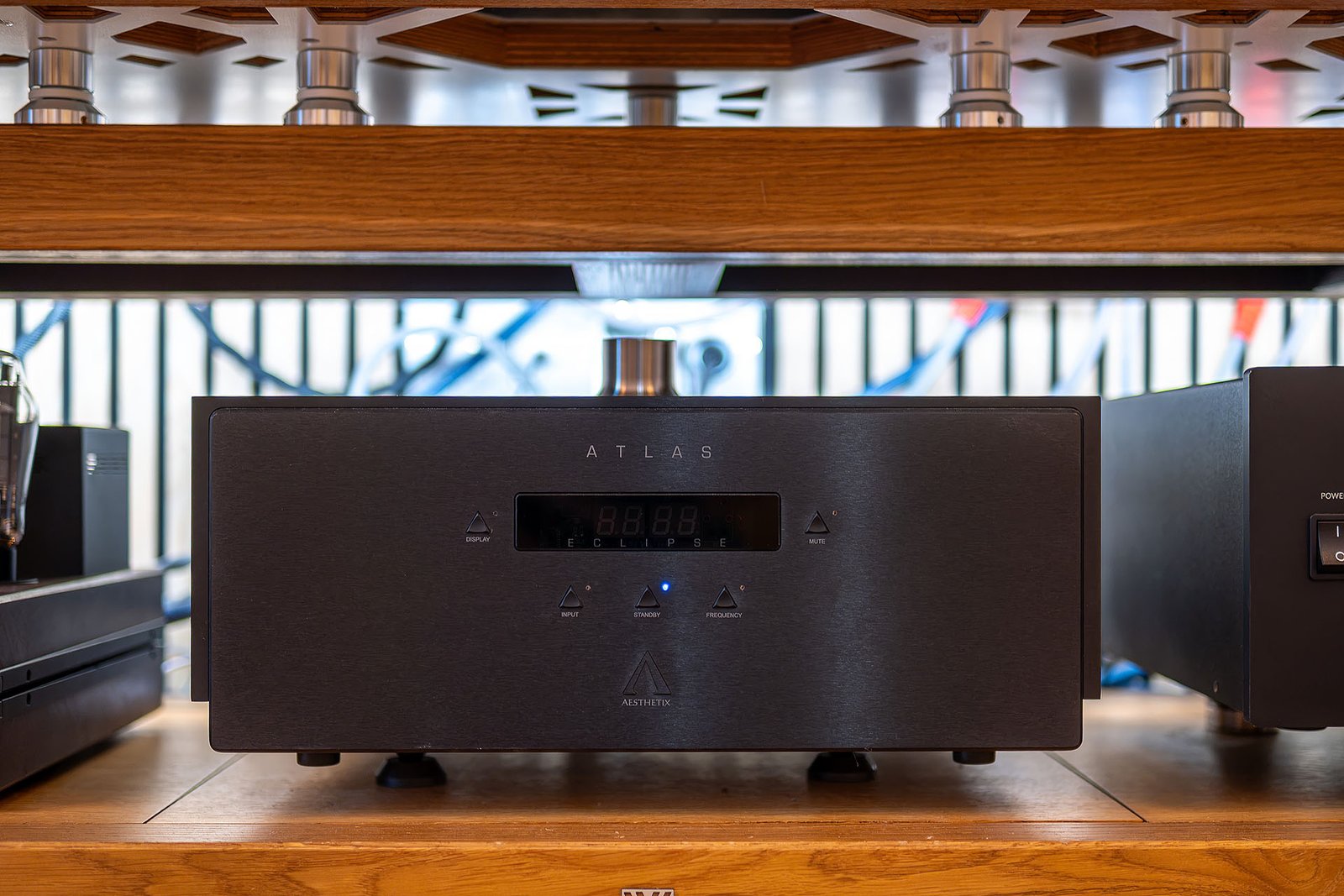
The Aesthetix Atlas Eclipse is the component in my system that I have tried hardest to improve with footers, and the one that has punished me most for trying. Everything I put under it before changed the amplifier’s tonality. Most of it made the sound thinner. Some of it made the Atlas more detailed in a way that pulled my attention towards the detail and away from the music, which is a trade I have learned to refuse.
The IC-35 Premium was a revelation under the Atlas. Not a subtle one. The tonality stayed exactly where Aesthetix put it, and around it everything improved at once: a blacker background, more body, more palpability, deeper layering.
The best comparison I can give you is one other Atlas owners will understand immediately. The difference was greater than rolling the 6SN7 input tubes. I have spent far too many evenings rolling 6SN7s. Three grey cones outdid them all.
Then something I didn’t expect. With the IC-35 under the Atlas, every other change in the system became easier to hear. A cable swap, a tube, a small VTA adjustment on the turntable. The amplifier had stopped adding a layer of its own mechanical noise to everything, and suddenly I could hear exactly what I was doing upstream. Without planning it, I had installed a diagnostic tool.
So I kept them there. Partly out of professional duty, I have tried to find something to replace them. I can’t.
John Coltrane — Ballads (Impulse!, 1963), “Say It (Over and Over Again)” · vinyl
My test for thinning. Coltrane‘s tenor on this record is fat, round and burnished, and any component that leans out will quietly turn it into an alto. With the Atlas on the IC-35, the tenor kept every gram of its weight, McCoy Tyner‘s piano had a new sense of space around each chord, and Jimmy Garrison‘s bass sat lower and more solidly in the room.
The tempo is slow, almost reluctant, and the track lives on the breath inside each phrase. I could hear the air moving through the horn just before each note formed, and the end of every phrase fading away instead of simply stopping. It sounded less like a great recording and more like a man standing a few meters away, playing very quietly for someone he likes.
Burial — Untrue (Hyperdub, 2007), “Archangel” · digital
Crackle, rain, pitched-up vocal fragments and a sub-bass you feel more than hear. This record is built from noise floor, and on a quieter amplifier the noise becomes texture rather than haze. The vocal ghosts floated in clear space, and the sub had shape instead of just pressure.
Burial’s music is about the space between sounds as much as the sounds themselves: the drops of rain, the crackle, the voice from somewhere far away. A noisier amplifier fills that space with a kind of grey mist. With the IC-35 under the Atlas, the space stayed dark and empty, and the fragments inside it became more haunting, not less.
Moderat — II (Monkeytown, 2013), “Bad Kingdom” · digital
And one for energy. Big synthetic bass, a busy rhythmic midband, and Sascha Ring‘s voice out in front. Coherent from top to bottom, and at volume the midrange didn’t harden. The Atlas sounded as though it had more power in reserve, which is exactly what you’d expect if less of its effort was going into shaking itself. The build towards the chorus is usually where amplifiers start to show strain on this track, with synths, bass and voice all fighting for the same space. Here everything kept its own lane. The voice stayed clear and forward, the bass stayed tight, and I found myself turning the volume up rather than down, which is always the most honest verdict of all.

Market Value
Let’s speak plainly about money, as we always do here.
The IC-35 Premium costs €890 for three cones with their base cups. The ISSB-40 costs €720 for a set of eight, which works out at €90 per spike.
Where does that sit? In the middle of a very wide market, and much closer to the sensible end than the prestige end. A few reference points, all approximate and all per set as described:
- IsoAcoustics Gaia II, around $330 for four. A different approach, since it replaces the spikes rather than sitting under them
- Nordost Sort Kone, from about $100 each in aluminum to about $425 each in titanium, so roughly $1,300 for three TCs
- Finite Elemente Cerabase Classic, around $800 for three
- Stillpoints Ultra SS, about $225 each, and the Ultra 5 around $840 each, so roughly $2,500 for three
- Townshend Seismic Podiums for speakers, from roughly $1,700 to $4,000 a pair
So Graphite Audio is not cheap, and I won’t pretend otherwise. But the IC-35 Premium costs about what three mid-range metal cones cost elsewhere, and a fraction of the flagships it is so often compared with. And the ISSB-40 is, quite simply, the least expensive meaningful upgrade I have ever made to my loudspeakers.
Prices vary between countries and dealers, so check locally. As always, the only way to decide is to listen with your own ears in your own system. Ask your dealer for a trial.
Conclusion — Marking What Belongs to You
Back to Borrowdale, and the shepherds.
For two hundred years, the most valuable black stone in England went by the wrong name. It looked like lead, so it was lead, until a Swedish chemist proved otherwise. And even then the old name refused to leave. There is still lead in your pencil. We are, it turns out, spectacularly reluctant to let go of what a thing looks like.
Graphite Audio suffers from exactly that. Its products look like small grey cones and small grey discs. They weigh almost nothing. They don’t gleam. In a hobby that buys with the eye first and the ear second, they are the wrong shape for their own reputation, and people who never try them will keep naming them by what they resemble.
I can only tell you what they did in my room, over months. The ISSB-40 made my Wilsons more controlled, more open and more coherent on the first evening, and never left. The IC-35 Premium kept the tonality of every component it touched and made each one quieter, fuller and more present. And under the Atlas it did the one thing nothing else ever has: it improved my amplifier without changing its character.
The shepherds of Borrowdale didn’t know what they had found, and they didn’t need to. They did the most sensible thing you can do with a material that works. They used it to mark what belonged to them. I have marked mine. The ISSB-40s are staying under the Wilsons, the IC-35 Premium is staying under the Atlas, and I have stopped looking for anything to replace them.

Thank You — Szymon Rutkowski
My sincere thanks to Szymon Rutkowski for sending the IC-35 Premium and ISSB-40 for review, for the long, open, and generous conversation that became our interview, and for laughing along in Vienna when my hand got his cone completely wrong.
Szymon is a genuinely great guy, friendly and open, the kind of manufacturer who answers the hard question instead of the easy one, and who talks about his competitors with more respect than most of them manage for each other. He bet his family’s savings on a polymer recipe, and it shows in everything he makes. I am very curious about the Enso Rack System he is launching at the Audio Video Show in Warsaw this October.
Graphite Audio: graphiteaudio.com
The Award — Editors’ Choice, Twice
There are moments in this work when hesitation would simply be dishonest, and this one comes twice.
Based on everything documented in the pages above: a technology with a clear and coherent explanation behind it, from a designer willing to say not only what his products do but what they deliberately refuse to do. A material that carries serious loads with almost no mass. Two products that improved every component I placed them under without changing its character, and in the case of the ISSB-40, did it on the first evening and never gave me a reason to go back. The quiet endorsement of LampizatOr, who chose the IC-35 Premium as the one accessory they sell. And pricing well below the polished metal names this category is usually measured against. The Graphite Audio ISSB-40 Isolation Speaker Spike Bases and the Graphite Audio IC-35 Premium Isolation Cones each receive the SoundNews Editors’ Choice Award.

Associated Equipment
Under review
- Graphite Audio ISSB-40 Isolation Speaker Spike Bases, set of 8, €720
- Graphite Audio IC-35 Premium Isolation Cones, set of 3 cones and 3 bases, €890
Reference system
- Floor-standing loudspeakers: Wilson Audio The WATT/Puppy 50th Anniversary Edition
- Power amplifier: Aesthetix Atlas Eclipse (hybrid, zero feedback: upgraded 6SN7 tubes in the first input gain stage, bipolar transistors in the rest)
- Line preamplifier: Aesthetix Calypso Eclipse (full-tube balanced preamplifier)
- Phono preamplifier: Aesthetix Rhea Eclipse (full-tube balanced phono preamplifier)
- DAC: LampizatOr Pacific 5 (E12x2 engine, 4 × KR Audio 300B, 1 × KR Audio 5U4G, 2 × Philips Miniwatt E182/7119 CV5766)
- Roon server: Gustard S26
- Roon endpoint: Rockna Wavelight (Squeezelite endpoint)
- Network switch and optical converter: Roboli S80L-2, LHY Audio AS6 Pro
- Turntable: Acoustic Signature Montana NEO
- Tonearm: Acoustic Signature TA-5000 NEO
- Cartridges: Hana Umami Red, AIDAS Tru Stone Violet Gold
- Power conditioners: Tsakiridis Super Athena (upgraded with rhodium-plated Furutech FI-E30 sockets), Tsakiridis Athena (rhodium-plated Furutech FI-E30 sockets)
- Power cables: Albedo Gravity I (monocrystal silver, rhodium-plated Furutech FI-50 NCF connectors), Pure Line Audio Cryocore Silver (purelineaudio.com)
- Interconnects: Albedo Monolith Reference MKII (monocrystal silver, Furutech connectors)
- Speaker cables: Albedo Monolith Reference MKIII (monocrystal silver, silver spades)
- Digital cables: Pink Faun USB and Ethernet
- Racks: WoodYard HiFi (made in Romania, solid wood, multiple decoupling, composite wood/metal and carbon-fiber platforms, custom-built; woodyard.ro)
- Mains: two dedicated lines (solid-core 4 mm² copper cable, rhodium-plated Furutech NCF sockets, HiFi Tuning Diamond Supreme3 fuses on both lines)
- Accessories: Arya Audio Labs RevOpods, Graphite Audio ISSB-40 Isolation Speaker Spike Bases and IC-35 Premium Isolation Cones, Authentic Audio Image Pads Mini+
- Acoustic treatment: wooden slat panels with sound absorber, Vicoustic Echo Frame Geo and Echo Frame Stripes absorption panels
Until next time, I wish you to hear only the best!