The Weight of Things.
We spend a fortune training our ears and almost nothing training our hands, and yet the hand is the faster judge. It arrives at a verdict before the brain has finished forming the question. Pick up a coffee cup that someone has already emptied and your arm overshoots — a tiny, comic misfire, over in a fraction of a second, but it reveals something remarkable. Your body had already calculated what that cup should weigh. It ran the numbers before you reached out. Ceramic, that size, probably half full. The hand is not receiving information; it is checking a prediction.
We are all carrying these tables around inside us. Steel is heavy. Aluminum is light but cold. Wood is warm and honest. Glass is heavier than it looks and always about to betray you. Decades of picking things up have built a private database of what the world is made of, and it runs so far beneath conscious thought that we only notice it when it fails.
In Vienna, this year, it failed.
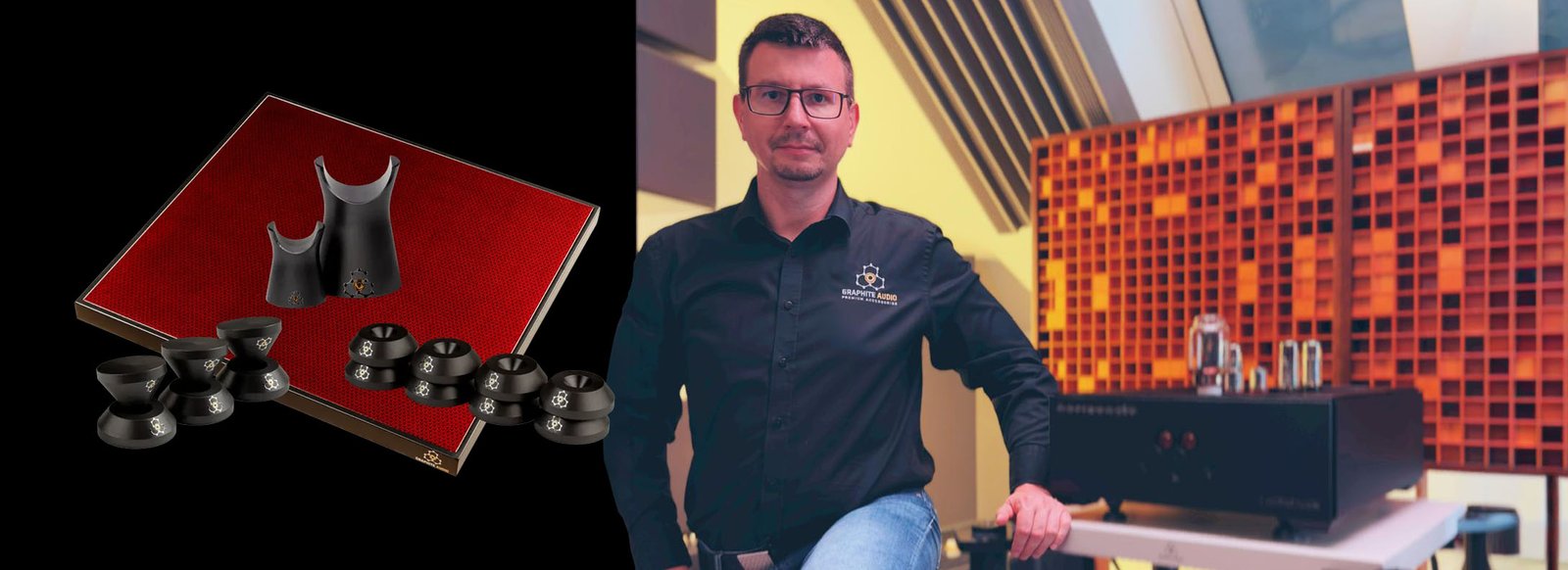
Szymon Rutkowski handed me one of his cones on the show floor at High End 2026, and my hand went up too fast. I looked at the object: a proper, solid, engineered thing, the size of something that should have authority, and my body had already filed it under dense. What arrived instead weighed almost nothing. I remember laughing, and I remember turning it over twice, the way you do with a stage magician’s prop, looking for the trick. There is no satisfying word for that sensation. The closest I can get is alien — not strange, but genuinely foreign, as though the object had been made somewhere that runs on different physics and had arrived here by accident.
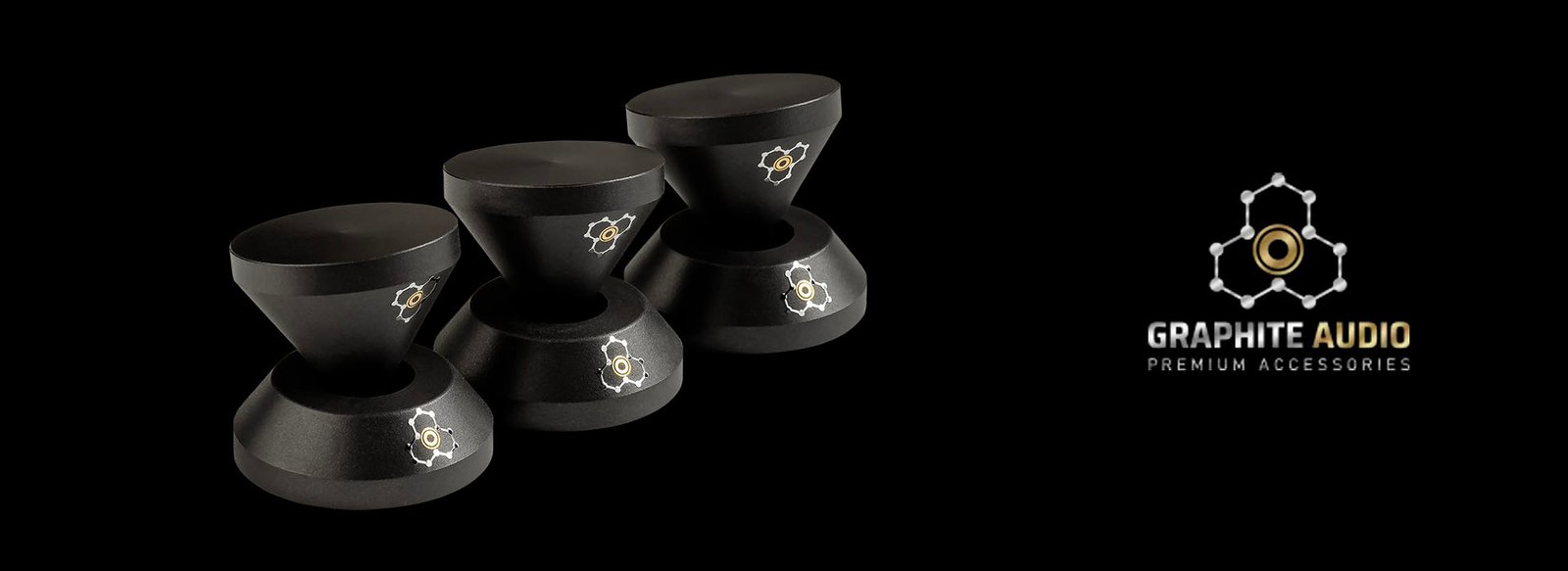
And then he told me it works in threes. Not four. Three cones under a serious, heavy component, and the result is not a compromise you accept but an improvement you argue with. Because that is the other thing about Graphite Audio. Most companies in this category sell you a shape. Szymon sells you a substance, and then names his company after it, and builds his logo out of its molecule.
He founded the company in 2020, in Bydgoszcz, in the worst year in living memory to launch a product that has to be held and heard to be believed (the Covid years…). Two years later, he was in Munich. A year after that, his feet and platforms were under gear in eight rooms — TAD, Innuos/Estelon, WayCables/Stenheim, AlsyVox/Taiko/LampizatOr. This year, among presence in rooms, a dedicated booth in partnership with David Laboga. Those are not courtesies. Nobody voices a loudspeaker for three years and then puts a stranger’s feet underneath it to be kind.
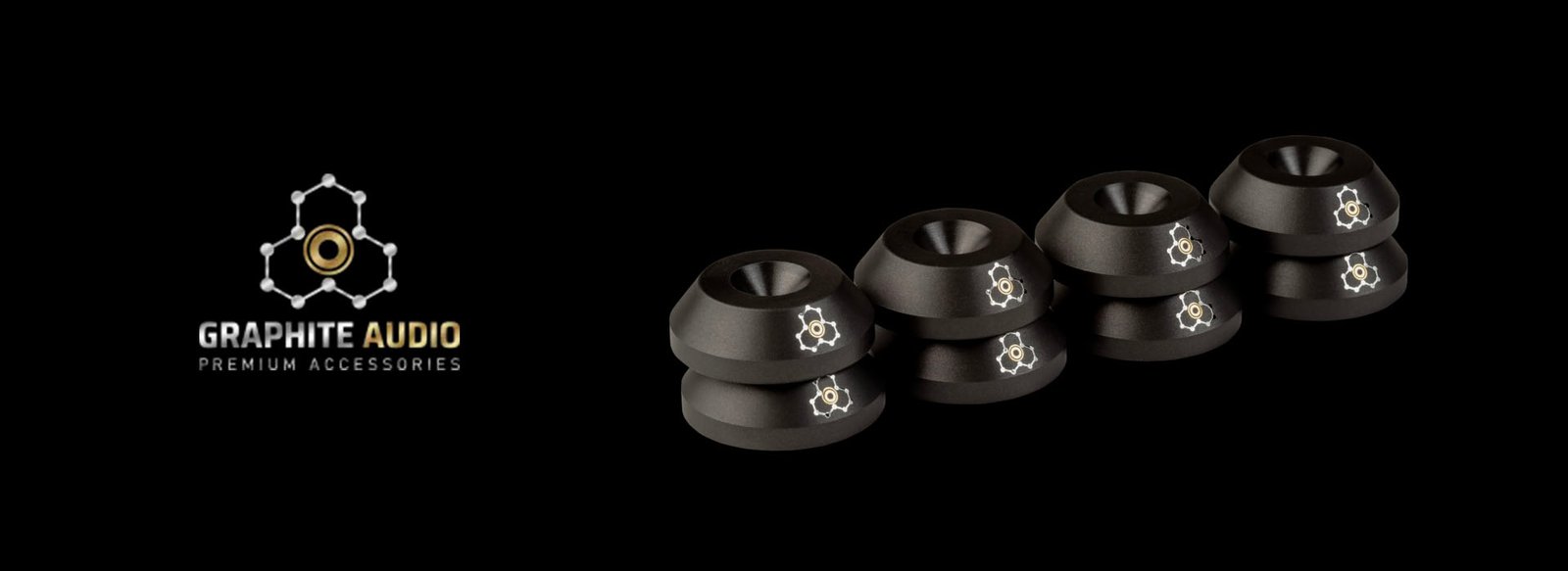
The IC-35 Premium isolation cones and the ISSB-40 speaker spike bases are with me now, and the full review will follow. But before I write a word about what they do to music, I wanted to understand the man who spent years of his life on a problem most people cannot hear and would rather not think about.
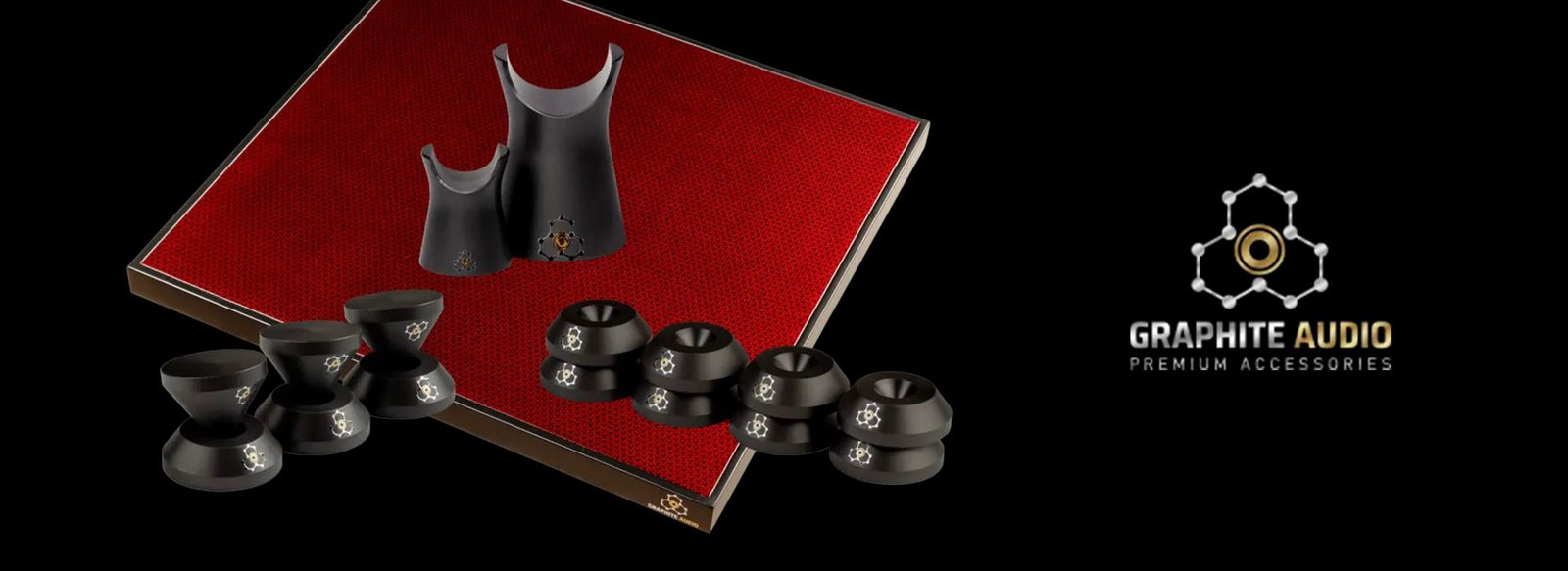
Graphite Audio — a young Polish brand.
Founded in 2020 in Bydgoszcz.
Product line: IC-35 Premium Isolation Cones, ISSB-40 Isolation Speaker Spike Bases, CIS-40 and CIS-60 Cable Isolation Stands, and the CLASSIC 40 / 40 ULTRA / 100 / 100 ULTRA Isolation Platforms.
Munich debut in 2022; by High End 2023, the products were in eight rooms, including TAD Labs, Innuos/Estelon, WayCables/Stenheim, and AlsyVox/Taiko/LampizatOr.
The Interview — Szymon Rutkowski, owner and designer of Graphite Audio.
Q1
SoundNews: We met at High End Vienna 2026, and what stayed with me was not a specification but a sensation: the weight my eyes predicted and the weight my hand received refused to agree. Before we get to physics and philosophy, I would like the readers to meet the man. Who is Szymon Rutkowski? What was your road into high-end audio, and what were you doing before Graphite Audio existed?
Szymon Rutkowski: First and foremost, I’m a music lover. Music filled my home growing up, and today, I’m passing that same passion down to my children. Professionally, I’ve always been connected to the audio industry. I spent years handling sales and marketing for local brands, learning the business from the inside out, while steadily building relationships with global audio players.
Q2
SoundNews: Every company of this kind begins with a private irritation. Someone sitting in their own listening room, hearing something they cannot unhear, and not being able to buy the solution. Where was the beginning for you? Was there a specific evening, a specific component, a specific record, where you understood that vibration was the problem you were going to spend years on? And what did you try first, before any of this became a company?
Szymon Rutkowski: It’s a story born out of endless sleepless nights. I had the privilege of testing countless anti-vibration devices, most of them massive, polished metal designs packed with bearings or ceramic balls.
They certainly changed the sound right away, but it was always a compromise. You’d get higher resolution, but at the cost of aggressive vocals or lost bass impact. My benchmark was simple: the genuine, organic energy of live music that I love to experience whenever I can. I wanted those real emotions at home, without hi-fi colorations or trade-offs. Realizing it was hard to achieve with the solutions on the market back then was the spark that started it all.
Q3
SoundNews: The step from private experiment to actual company is the one most enthusiasts never take. It requires deciding that the thing you made for yourself is good enough to ask strangers to pay for. What convinced you to cross that line? Was there a moment (someone else hearing it in their own system, perhaps) when it stopped being a hobby and became a business? And how frightening was that decision in practice?
Szymon Rutkowski: In truth, it was never meant to be just a private experiment. I had invested far too much into research and development early on to ever let it stop at my own listening room.
The turning point came when I finally cracked the ideal polymer composition. The sonic results were undeniable, and I knew I was close to something special. I’m fortunate to have a trusted network of beta testers around the world who were eager to come along for the ride and test each iteration as the designs evolved.
Honestly, the scary part wasn’t deciding to go commercial; it was taking the initial leap to invest our family savings in deep R&D. Once I achieved the right sound and validated it with listeners worldwide, the business became the natural next step.
Q4
SoundNews: The name fascinates me, because it is not a name, it is a commitment. You did not call the company something abstract and safe. You named it after the substance itself, and then built the logo out of the molecule. How did the name arrive? Did the material come first and the name follow naturally, or was there a moment of deliberate decision? And do you ever feel boxed in by it, if your research one day led somewhere better than graphite, could Graphite Audio follow?
Szymon Rutkowski: The answer is actually much simpler than it seems! Graphite (and finding the exact proportion for our polymer blend) was the final piece of the R&D puzzle. When we hit that sonic sweet spot, the material turned a distinct graphite color, and the name just appeared naturally. It wasn’t marketing theory; it was literally what was in front of us.
As for being boxed in, not at all. Graphite Audio has grown into a strong, recognizable brand, but it’s defined by a core philosophy rather than just a single material. Whatever we create, our goal is always the most natural, involving, live-like sound. For our listeners, the name has become a synonym for that listening experience, and that commitment will never change, no matter where our future research takes us.
Q5
SoundNews: Your position on materials is unusually firm for this industry. Most of your competitors (Finite Elemente, Franc Audio Accessories, Harmonix, Kryna, TiGLON, to name just a few) build with metal, ceramic or glass. You state plainly that you have never been enthusiasts of those materials because of their tendency to color certain frequencies. What exactly do you hear when a steel or ceramic footer colours the sound? Was “non-metallic design” a conclusion you arrived at through listening, or a conviction you started from and then had to prove?
Szymon Rutkowski: First, I want to emphasize my deep respect for the brands you mentioned and for anyone who puts on an entrepreneurial hat to solve these complex challenges. Their work shaped my early understanding, and I’m grateful for how they helped educate the market on why vibration management matters.
Rather than a fixed belief, I repeatedly observed a pattern of non-metallic design across setups. Metal, ceramic, or bearing-based designs usually introduce a distinct character; of course, some more noticeably than others. While they can bring welcome traits like added definition, they can also introduce a touch of brightness or emphasis in the upper frequencies that strays from a natural live presentation.
That’s why I took a completely different path. I wanted to break away from that signature metal coloration and offer the market fresh, natural results. I know our accessories, like the IC-35 Premium cones or ISSB-40 Isolation Speaker-Spike Bases, look compact and inconspicuous compared to the massive, polished metal feet out there. But every millimeter is engineered purely for performance, not visual drama. Shifting a listener’s focus from ‘big and shiny’ to pure sonic authenticity is still our biggest hurdle, but once people listen, the performance speaks for itself.
Q6
SoundNews: Graphite is a strange and beautiful choice. It is one of the four allotropes of carbon, flat honeycomb layers held together by nothing more than weak van der Waals forces, which is exactly why a pencil leaves a mark on paper. Soft, yet strong under pressure. Highly thermally conductive. And far too brittle to be used on its own, which is why it lives inside your polymer. What is it about graphite’s specific structure that makes it right for this job? Is it the interlayer slip, the thermal conductivity, or something else entirely that we would not guess? And how did you arrive at the right proportion of graphite in the blend?
Szymon Rutkowski: Graphite is uniquely suited for vibration control because its layered atomic structure acts as a natural mechanical damper. When unwanted kinetic energy from audio components hits graphite, its flexible structure converts those vibrations directly into minute amounts of heat, rather than storing that energy or bouncing it back into your signal path. Unlike metals, which tend to ring and introduce artificial brightness, graphite absorbs resonance rapidly across a broad spectrum without leaving a sonic footprint.
That said, graphite is only part of the story. The real secret lies in the full polymer composition. Finding the exact proportion of graphite was a long process of trial and error, backed by countless listening sessions. Many formulas that looked perfect on paper simply didn’t translate to natural, emotional music reproduction in practice. In the end, theory gets you into the ballpark, but your ears have to make the final decision.
Q7
SoundNews: Now the question that has been bothering me since Vienna. Your products are extraordinarily light, a CIS-60 stand weighs 190 grams, and at the same time they carry serious load: 50 kg per set of three cones, 180 kg per four spike bases. Everything the audio industry has taught us for forty years says that vibration control means mass. Granite, steel, lead shot, sand. You have gone the other way entirely. How do you get resistance and load capacity without mass? And should we finally retire the idea that heavy equals quiet?
Szymon Rutkowski: It comes down to shifting the paradigm from heavy mass to material efficiency. To manage vibrations effectively, you have to look deeply at how mechanical energy behaves across different material properties: density, structural integrity, damping factors, and internal friction, rather than relying solely on raw weight.
High load capacity isn’t inherently tied to heavy steel or granite; in our case, it’s achieved through the specific structural composition of our polymer matrix. It allows our products to support massive loads like 180 kg without compressing or losing their damping behavior.
As for retiring the idea that ‘heavy equals quiet’, I think the audio industry is slowly realizing that high mass often just stores and shifts energy rather than eliminating it. Mass can make something heavy, but material intelligence is what actually makes it quiet.
Q8
SoundNews: You describe your platforms as uncoupled, and you say the vibration energy is converted into heat and dissipated through material selection and mass redistribution. This is the part I most want the readers to understand properly, because it is where most accessory marketing becomes vague. It also touches the oldest argument in this field: drain the energy away, or refuse to let it in at all. Can you walk us through what actually happens to a vibration when it enters a Graphite Audio product? Where does the mechanical energy go, over what timescale, and how much of it never comes back into the component? And where do you stand in the isolation-versus-coupling argument, given that your cones carry the word isolation in their name?
Szymon Rutkowski: First, I’d like to clarify a philosophy that sets us apart: I don’t believe in trying to ‘kill’ resonances completely. Vibrations and energy are how musical emotion travels, if you damp everything to death, you end up with a sterile, lifeless sound. The goal isn’t total destruction; it’s intelligent management.
People often come up to me at shows with a smirk asking for measurements. My answer is simple: Can you hear a measurement? Data is crucial during our initial R&D to guide us, but connecting those test results to what we actually experience in the listening room is where the real work happens. And believe me, the relationship between physics and human perception is rarely a straight line—that’s what makes this work so fascinating!
Regarding isolation versus coupling: our products work in both directions. We isolate the component from external vibrations coming up through the rack or floor, while simultaneously draining the internal micro-vibrations generated by transformers, chassis chatter, and airborne acoustic waves during playback.
Take our flagship CLASSIC 100 ULTRA platform as an example of what actually happens to that energy:
- Energy Transformation: The top surface is our custom ULTRA board polymer. When mechanical vibrations hit it, the material’s unique molecular structure acts like a microscopic shock absorber, trapping kinetic energy and converting it directly into harmless micro-heat. Instead of reflecting energy back into the chassis, as hard metal cones or ceramic bearings often do, the vast majority of unwanted resonance is dissipated right on contact.
- Controlled Drainage: For any lingering frequencies, the platform uses a downward, one-way exit path. Energy transfers down through a custom high-density plywood core (which acts as a natural mechanical damper) and drains out through our high-density polymer feet into the rack below. Nothing bounces back upward.
By transforming energy into heat at the surface and channeling whatever remains safely away, the noise floor drops dramatically. You get cleaner transients, a deeper background, and subtle micro-details that were previously masked.
Q9
SoundNews: In Vienna you demonstrated something that genuinely surprised me: three cones. Not four. And the result under a serious heavy component was not a compromise; it was better. Why three? Is this purely the geometric argument that three points define a plane and cannot rock, or is there something about how energy travels through a three-point interface that four points destroy? And how should the reader position three cones under a real chassis to get the best of it?
Szymon Rutkowski: The argument for three cones is both geometric and mechanical. Three points define a triangle, meaning three cones cannot wobble.
With a four-cone setup, imperfections in the shelf or component chassis mean one point almost always carries less load. If a cone isn’t making firm, consistent contact, it can’t dissipate micro-vibrations effectively. Three cones guarantee 100% equal contact pressure across all points, allowing our polymer material to drain energy evenly and completely.
Plus, offering sets of three keeps the cost more accessible for audiophiles without compromising on performance.
For best positioning, a great rule of thumb is to place two cones under the heaviest area (typically where the main transformer sits) or directly beneath sensitive areas like vacuum tubes to minimize microphonic effects, with one cone under the lighter side. That said, audio is personal—I always encourage listeners to experiment with flipping the orientation. Sometimes the opposite layout simply sounds better to your own ears in your specific system.
Q10
SoundNews: I have the IC-35 Premium cones and the ISSB-40 spike bases here for review. The Premium succeeded the original IC-35 by adding the base cups, and yet with the earlier model you were reported as believing the cones worked best placed directly on the floor or the table, without them. In Munich, you then deliberately showed the CLASSIC platform both with and without its bases, and described the choice as a way to adjust the sound to the system. So how much of your work is voicing rather than engineering? When you tell a customer they can choose with or without bases, what are you actually offering them — a correction, or a flavor?
Szymon Rutkowski: Let me clarify the product evolution first: the original IC-35 was just a set of three cones. But as dealers and customers tested them with our ISSB-40 bases, the feedback was overwhelming, they were hearing a genuine leap in sonic performance, alongside the practical benefit of protecting delicate surfaces. Once 90% of our sales shifted to the combined setup, we discontinued the standalone cones and made the IC-35 Premium set our standard.
Our CLASSIC platforms include custom floor and rack protectors for the same practical reason: people have high-end racks and expensive hardwood floors that need protection from massive conical feet.
To answer your question on engineering versus voicing: engineering always comes first. Every material choice is designed to eliminate stored kinetic energy cleanly. But in high-end audio, every physical interface matters. Providing the choice to listen with or without protectors isn’t about selling ‘flavors’ or masking flaws; it’s about offering micro-adjustments so the listener can match the system’s energy to their room acoustics and equipment balance.
Q11
SoundNews: Looking at the range as a whole: cones, speaker spike bases, cable isolation stands, and four isolation platforms, it reads less like a catalog and more like a single argument applied at every point where a system touches the world. Is that how you think about it? If a reader can only afford one Graphite Audio product to begin with, where in the system does your material do the most audible work, and why?
Szymon Rutkowski: That is precisely how I view it. We don’t build products just to fill out a catalog, we look for every mechanical contact point in a system where vibration management can deliver a meaningful, positive impact on the music.
For someone looking to take their first step into the Graphite Audio universe, I usually recommend starting at one of two critical points: under your primary source component with our IC-35 Premium Isolation Cones, or under your speakers using our ISSB-40 Isolation Speaker Spike Bases.
Starting at the source cleans up micro-vibrations before they ever get amplified down the signal chain. On the other hand, decoupling your loudspeakers immediately stops mechanical cabinet energy from corrupting the room and floor. Either entry point provides an immediate, eye-opening introduction to what our products can do.
Q12
SoundNews: Cable isolation stands are, for many readers, the most contested product you make. Lifting a cable off the floor is easy to mock and hard to explain. What is physically happening to a cable lying on a floor, and what changes when it sits on a CIS-40 or CIS-60? What would you say to a sceptical but honest listener who has not heard it yet?
Szymon Rutkowski: Ah, so we’re getting into the ‘snake oil and voodoo magic’ territory, are we? Jokes aside, cable lifters are easily the most debated products in our catalog. But when you’re chasing true sonic perfection, the physics behind them is straightforward—they act as a mechanical and electrical barrier against three specific degraders:
- Self-Induced Micro-Vibrations: passing electrical signals generate internal magnetic forces that cause cable conductors to vibrate against their insulation, smearing fine transient detail. Our CIS stands absorb that kinetic energy.
- Static & Floor Coupling: floors, especially synthetic carpets or heavy woods, act as unpredictable dielectrics that hold static charges and alter cable capacitance, compressing dynamic range. Elevating cables decouples them from that interference.
- Acoustic & Floor Energy: floorstanding speakers send powerful mechanical vibrations directly through the floor, which travel right back into unisolated cables.
To a skeptical listener, I’d say: I completely understand your doubt. And I genuinely believe people who say they don’t hear a difference; there can be many reasons for that, from system resolution and room acoustics to simple personal listening habits or bias. Cable lifters aren’t a ‘magic cure’; they are designed for high-resolution systems where you’re fine-tuning the last few percent of performance. But we’ve had countless music lovers laugh at the idea, try them out of curiosity, and end up being completely blown away.

Q13
SoundNews: Let us talk about the hardest part, which I suspect was not the engineering. You launched in 2020, the one year in modern history when nobody could gather in a room, and shows and demonstrations simply stopped. And your product is perhaps the worst possible candidate for remote selling: it has to be held to be understood and heard to be believed. A photograph of a cone tells the reader absolutely nothing. How did you get anyone to take you seriously in those first two years? What did you actually do — who did you send products to, what did you say to them, and how many people said no?
Launching a brand in 2020 was a trial by fire. Let’s be honest: everyone needs amplifiers, sources, speakers, and cables just to get sound out of their system. Vibration accessories aren’t essential to produce sound; they’re essential to produce great sound. And you can’t hear a photo.
The only way forward was direct demonstration. People were curious because we weren’t just making another heavy, shiny metal cylinder—we were offering a completely different approach with no compromises. That non-traditional design has been both a blessing and a challenge, since many audiophiles still instinctively look for weight and polish.
What saved us in those first two years was organic word-of-mouth. Long before our official launch, we had sent prototypes to trusted audiophiles and industry contacts. They listened, they were blown away, and they started talking. In high-end audio, especially during a time when shows were completely off the table, there is no marketing tool more powerful than an honest recommendation from a fellow music lover.
Q14
SoundNews: Then came Munich. A stand and four rooms in 2022; eight rooms by 2023, with TAD Labs, Estelon, Stenheim, AlsyVox, Taiko and LampizatOr choosing to demonstrate on your products. Those are people with nothing to gain from a courtesy; nobody spends years voicing a loudspeaker and then puts a stranger’s feet under it to be polite. How did those relationships actually begin? Did you approach them or did they come to you? And what does it feel like to walk into a room at a show and find your work already underneath somebody else’s flagship?
Szymon Rutkowski: It wasn’t a master plan, it was word of mouth spreading through the industry.
Lukasz Fikus at LampizatOr had fallen in love with the IC-35 Premium cones long before Munich. When he showcased his flagship Horizon DAC alongside Taiko and AlsyVox, our cones were under it because he trusted them with his own sound. Miroslav from WayCables asked to use our cable stands with their flagship cables at Stenheim’s room; Ilias from Estelon called asking for speaker bases and cable lifters for their collab room with Innuos; TAD Labs followed a similar path.
Walking into those rooms and seeing our products supporting million-dollar systems is an incredible feeling.
Q15
SoundNews: Distribution is the unglamorous half of this business, and you now have partners in Denmark, France, the UK, Germany, the Netherlands, Singapore, Mexico, the US and Canada. For a small manufacturer, every one of those is a negotiation, a shipment, a leap of faith in both directions. How difficult was it to build that network from Bydgoszcz? What do you look for in a distributor, and what is the single hardest thing about being a small Polish manufacturer trying to be taken seriously in a market dominated by much older names? And is there something specific about Poland right now: LampizatOr, J. Sikora, Ferrum, GigaWatt, hORNS, Fezz, Divine Acoustics, what explains this generation of brands?
Szymon Rutkowski: Where you’re physically located isn’t an obstacle anymore today, you can run a global business from anywhere. Building an international distribution network, however, is immensely challenging. Being a boutique brand in a specialized niche is exciting, but it requires partners who truly share your vision.
When I look for a distributor, I am not just looking for a logistics partner; I need advocates. I need partners who are willing to spend real time with dealers and end users, educating them on the critical role of vibration management and conducting hands-on demonstrations to fine-tune systems.
As for the surge of Polish audio brands, behind these brands lies a shared foundation of relentless passion, deep engineering talent, and hard work. Historically, it wasn’t easy for Polish companies to gain international visibility. But today, without physical borders, the only limits are our own creativity and determination. We are all striving to prove that Polish audio engineering can stand shoulder-to-shoulder with the very best in the world.
Q16
SoundNews: Finally, the future. I know you are close to releasing a full audio rack built around this material structure, and after living with the cones, I find the prospect genuinely exciting, the same thinking applied not to one contact point but to the entire architecture that holds a system. What can you tell us about the rack? What did you have to solve that a platform did not force you to solve? And beyond it, where does this material still have room to go, is there a ceiling to vibration control, or does every improvement simply reveal the next problem?
Szymon Rutkowski: The rack we previewed in Vienna was a teaser for what’s coming next: the official launch of the Graphite Audio Enso Rack System at the Warsaw Audio Video Show in October 2026.
The biggest challenge was staying 100% faithful to our non-metallic design principle across a large, load-bearing architecture. Because our custom polymer is extremely expensive, building massive solid pillars out of it wasn’t practical. I had to engineer a viable, high-performance structural alternative that perfectly aligns with the Graphite Audio house sound. The system will be modular: customers can specify shelves in our signature ULTRA version, utilizing the same polymer composition as our CLASSIC ULTRA platforms, and later upgrade to our polymer ULTRA spikes in 2027.
As for whether there’s a ceiling to vibration control: there are no limits unless we place them on ourselves! But as we push engineering boundaries, we must never lose sight of why we stepped onto this audiophile path in the first place: the music. Upgrades and technical improvements are exciting, but bringing listeners closer to the raw emotion of a live performance is always the ultimate goal.
Closing Words
Thank Szymon for his generosity and trust in sending the IC-35 Premium cones and ISSB-40 spike bases for review, and for the conversation in Vienna!
Stay close, as a full review of IC-35 and ISSB-40 will be here soon.