TLDR:
The Denon PMA-3000NE is an amplifier built around warmth, ease, and emotional generosity, and it especially shines at low-volume listening levels. The midrange is its crown, carrying a harmonic richness we’ve encountered only a handful of times at this price range. The highs are the diamonds set in that crown: silky and airy, extended and refined, with shimmer and sparkle wrapped in a smoothness that turns long sessions into a real pleasure. The bass is bloomy and warm, room-filling and generous to a fault. This is its softest spot: it leans towards the mellow side, rounds off the leading edges, and trades grip for body. Kick drums land with weight, but without much punch, and bass lines bloom outward when you’d sometimes want them to stop and start on a dime. In a treated room or with speakers that already run lean, that generosity can tip into thickness.
The perceived phantom center is locked dead between the speakers, solid and precise, with voices anchored exactly where they should be. The soundstage opens up wide until the speakers’ edge, but deep around it, well-organized and easy to follow, giving instruments room to breathe and sit in their own space.
On our bench, it measured close to 250 watts per channel into 4 ohms before distortions appeared, far beyond its modest rating, driving demanding speakers with effortless authority. It ranks among the finest low-volume amplifiers we’ve spent time with, fatigue-free across hours of listening, and a joy with voices, jazz, classical, and chill, atmospheric music.
The PMA-3000NE is for the listener who seeks warmth. Pair it with a streamer, and it’ll keep you happy for years. It’s pleasant, musical, and it does exactly what it sets out to do. An easy recommendation for anyone who values these qualities.
History and the idea behind the geniality
Denon was founded in 1910. The company has watched the shellac disc, the vinyl LP, the compact cassette, the compact disc, and the streaming era arrive one after the other, and it has built reference machines for every single one of them. We believe that very few brands on this planet can claim a similar perspective on recorded sound, and this perspective is audible in the way Denon voices its flagship stereo amplifier. There is a feeling of patience in their engineering that you only find in companies old enough to have seen fashions come and go many times over. The PMA-3000NE we are reviewing today is the direct product of that century of patience, and from our very first hours with it, we recognised that we were dealing with a deeply considered machine, voiced by people who know exactly the kind of listener they want to please.
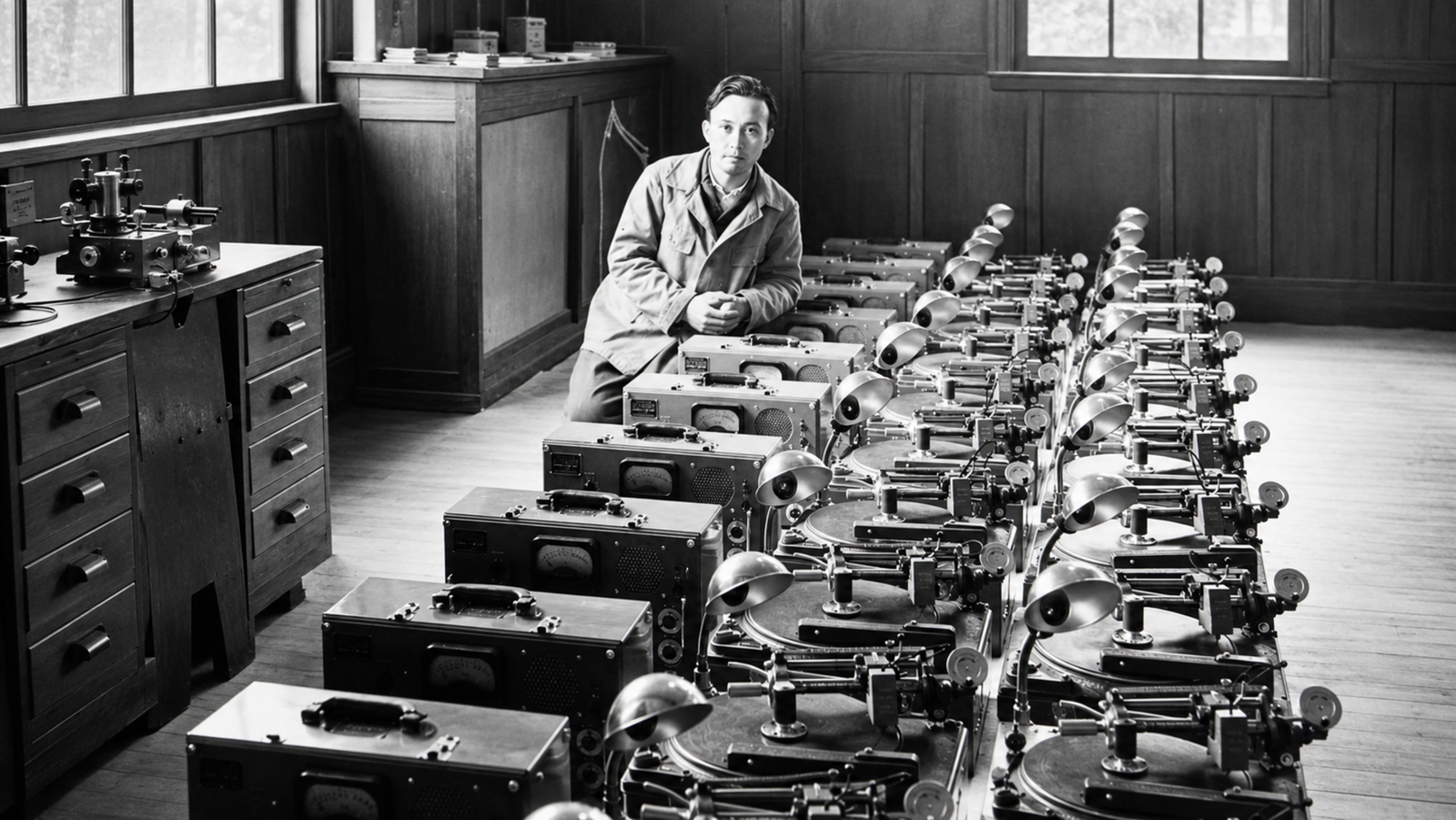
Denon gramophones
The name itself tells part of the story. Denon grew out of Denki Onkyo, two Japanese words meaning electric sound, and the company spent its early decades serving the professional broadcast and recording world before it ever courted the living room. Working with the national broadcaster NHK in the early 1960s, Denon created the DL-103 moving-coil cartridge, a design so musically correct that it remains in production today, more than sixty years after its introduction, essentially unchanged. In 1972, the company built one of the first practical PCM digital recorders, capturing commercial recordings in digital form years before the compact disc existed. When a company has been recording, broadcasting, and reproducing music at the professional level for over a century, we find that its consumer products carry that DNA whether the marketing department mentions it or not.
In 2002 Denon merged with Marantz under the D&M Holdings umbrella, and the two brands have shared the Shirakawa Audio Works facility ever since. Our regular readers will remember Shirakawa. It is the same Japanese facility whose obsessive culture of refinement we explored at length in our recent Marantz Model 10 review, the place where engineers hand-tune, measure, and listen to every flagship component before it ships. The PMA-3000NE is conceived, engineered, and built in that same building, by people who breathe the same air and share the same uncompromising standards. The two amplifiers could hardly sound more different, as we shall discover, and we find it beautiful that a single facility can produce two such distinct musical philosophies under one roof. It speaks to a culture that honors identity, and we love this idea. There is no homogenised house sound being pushed down from above, just two engineering teams chasing their own truths. It just happens that they share a postcode and a tradition.
Denon’s truth, the one expressed by this amplifier, is the truth of warmth. The PMA-3000NE is the tenth generation of Denon’s top-tier integrated, the direct successor to the long-serving PMA-2500NE, and it inherits a long list of refinements first developed for the PMA-A110, the limited anniversary model Denon built in 2020 to celebrate one hundred and ten years of existence. Across that long evolution, the brand has held onto a single voicing idea: an amplifier should welcome you, make you feel relaxed, and let you stay. It is our feeling that this idea, while quietly out of fashion in a market obsessed with detail retrieval and forensic precision, defines a category of listening that no measurement chart will ever capture, and after weeks with the PMA-3000NE, we believe Denon has refined this idea to a level few competitors can match at this price.
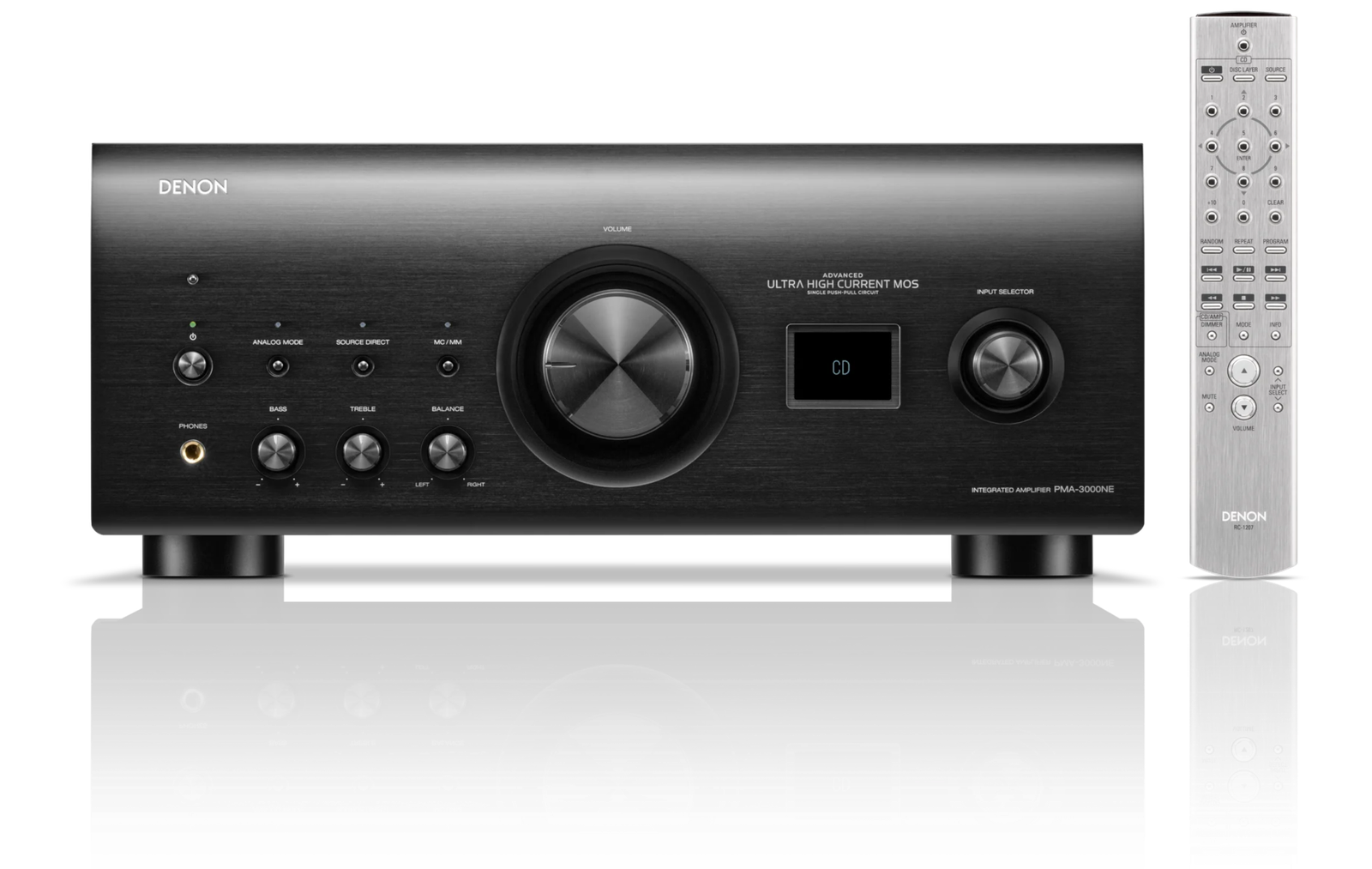
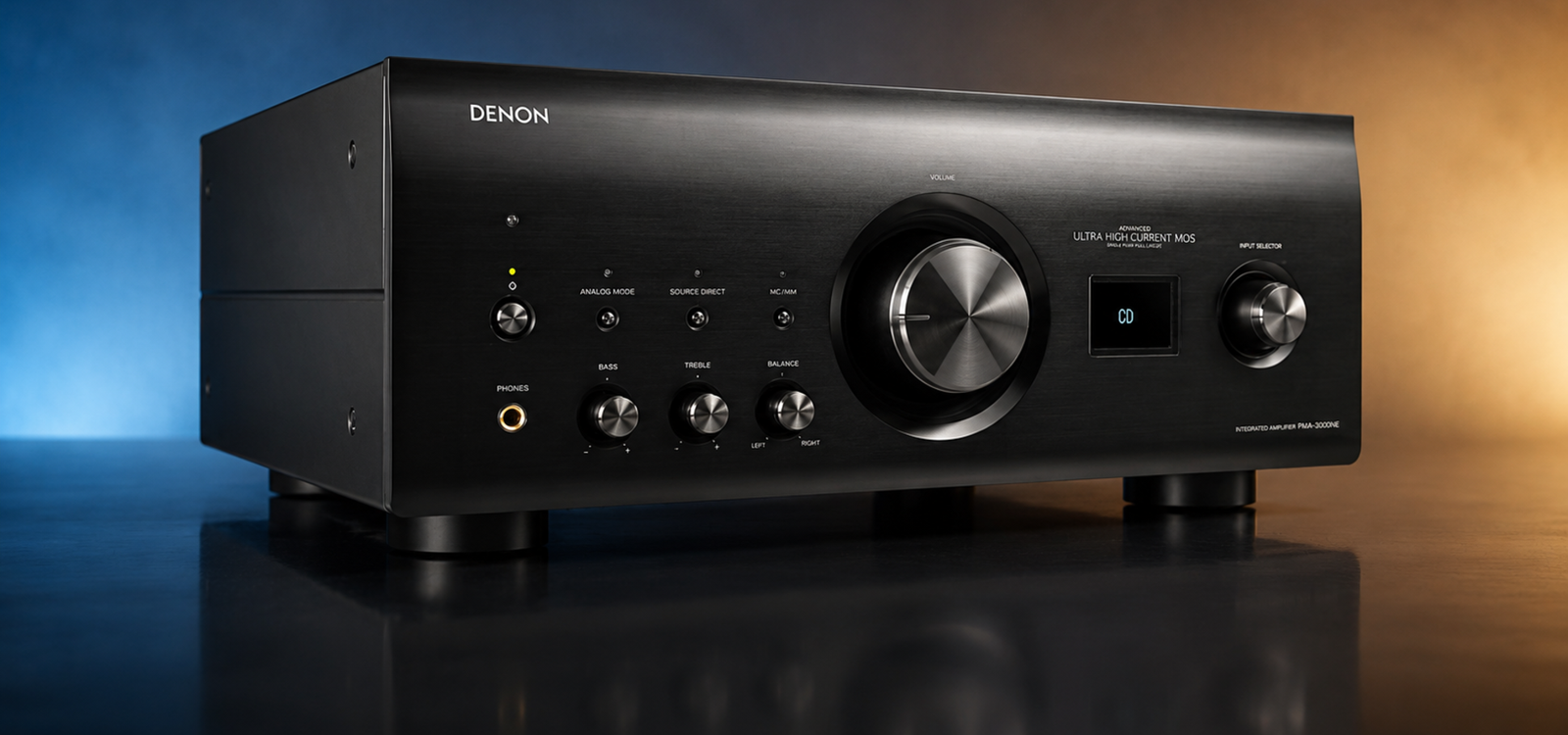
The Denon PMA-3000NE, in its might and glory, with the beautifully finished remote
We will hint at our conclusion here, it’s a thought shaped by our time spent with the amplifier: the PMA-3000NE is the closest a modern, mass-produced, solid-state integrated amplifier has come, in our experience, to the soul of a fine tube amplifier. We will explain exactly what we mean by that further down, after you have read how it handles timing, voices, instruments, smoothness of highs, and bass, because the comparison deserves to be earned and not merely asserted. For now, we simply plant the idea, the way the amplifier planted it in us during our first warm evening with it.
The PMA-3000NE is a very friendly, welcoming, all-in-one solution. You plug a streamer into one of its inputs, you connect a pair of speakers, and you are done. The music is there, it is presented in a warm, pleasant, and satisfying way. There are no menus to fight, no software updates to chase, no toggles to second-guess. The amplifier presents itself as a complete musical machine, with a quality phono section for vinyl, a quad ESS DAC for digital, a Pure Analog mode for the analogue purists, and a power section that delivers far more than its specifications. We believe this is exactly the kind of product that a tired listener, returning home from a long week, wants to switch on. No homework. Just music.
On paper, its rated output of 80 watts per channel into 8 ohms and 160 watts per channel into 4 ohms reads modestly in a market obsessed with big numbers. As you will read further down, those numbers tell a small part of the real story. We have measured this amplifier approaching 250 watts per channel into 4 ohm loads, a result that sits far above the printed specification and confirms what our ears were already suggesting: there is a quiet, large reservoir of power hiding underneath the gentle character. Denon’s engineers know what they have built, and they chose the humble approach. Not bragging about specs on the box is the first step.
Before moving forward, a quick, important note: this is a completely independent review; it is not paid in any shape, way, or form. No one has influenced our impressions, and we have had full freedom to explore the PMA-3000NE on our own terms. What follows is our honest take, guided only by what we hear and feel across many long evenings with this amplifier sitting at the heart of our system.
Construction and Design Philosophy
The PMA-3000NE is not exactly light. At almost 25 kilograms, it weighs more than some dedicated power amplifiers we keep around, and lifting it onto the rack tells you a great deal about Denon’s priorities before you ever press the power button. The mass is structural and deliberate. The top and bottom panels are sandwich constructions built from 1.6 millimetre steel plates, and the side panels are thick aluminium. Place the unit on a quality rack, tap the top panel, and listen to the dead, dry response. Resonances have been engineered out of the structure from the very first step of the design, and this mechanical silence is one of the foundations of the musical silence we heard between notes throughout our listening sessions.
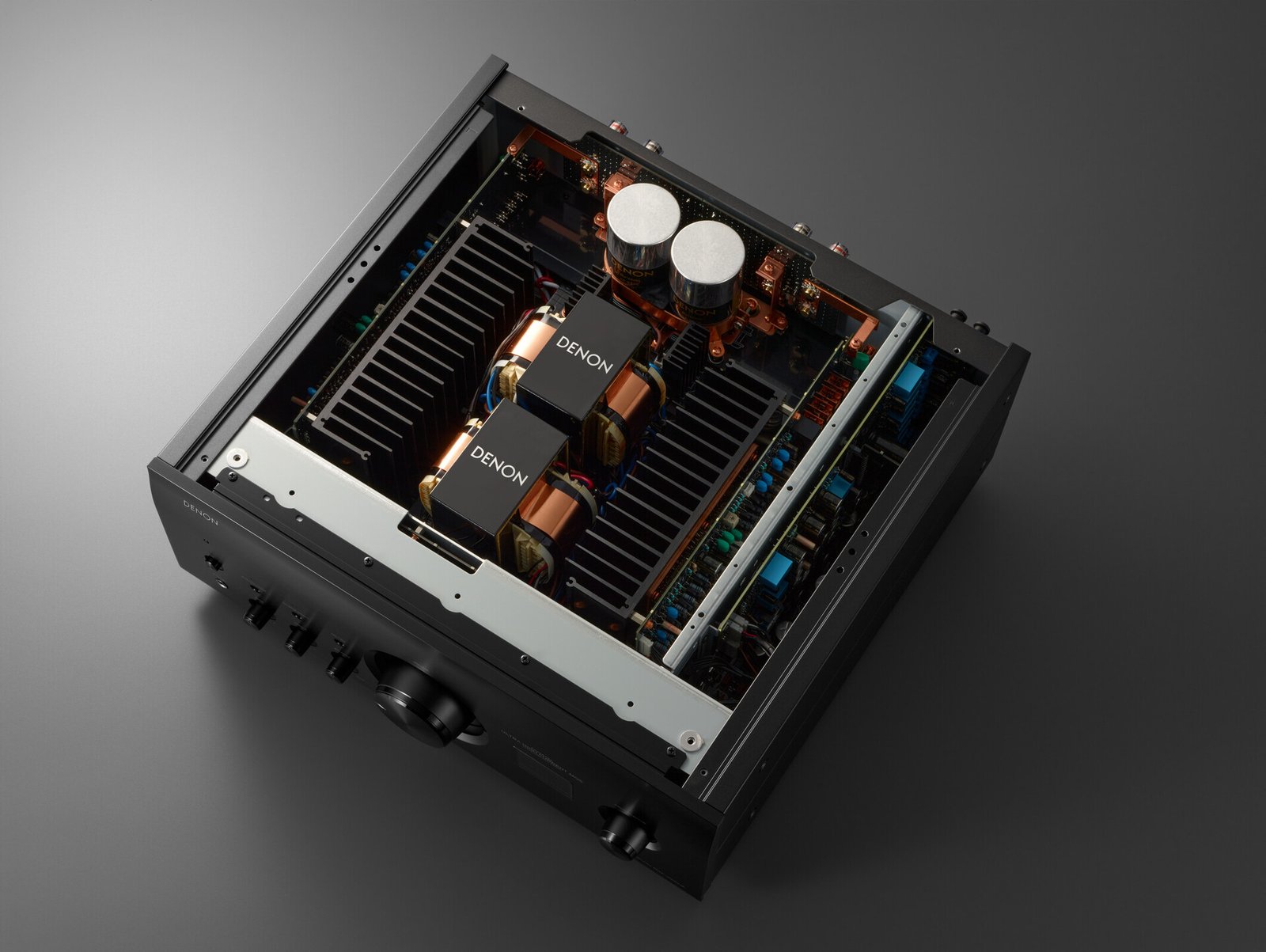
Internals view from the top
Open the lid, which we always do because we want to understand what we are about to live with, and the layout reveals itself in a typical Japanese disciplined order. The internal architecture divides the amplifier into six individually shielded blocks: the phono equaliser and input circuitry, the volume control circuitry, the digital conversion circuitry, the amplification circuitry, the power section, and the control section. Each block sits behind its own shielding, with the two channels receiving separate power supply feeds. This compartmentalised approach is one of the reasons behind the deeply quiet noise floor of this amplifier. Every section has its own shielded home, never interferes with its neighbours, and the music benefits from that discipline in ways that are easy to hear and difficult to put into words.
At the centre of the chassis sit two power transformers, mounted facing opposite directions in what Denon calls a leakage-cancelling arrangement. The idea is elegant: the stray magnetic flux from one transformer partially cancels the stray flux of the other, so the sensitive small signal circuits living around them work in a quieter electromagnetic environment. The transformers themselves are suspended on vibration-damping materials of varying composition, so mechanical hum never couples into the chassis. Even the heatsinks are built from materials of varying thickness to break up resonances. These are the kinds of decisions you make when you have been building amplifiers for generations, and you have learned, the hard way, where the gremlins hide. They are also the kinds of decisions that don’t show up on a marketing brochure, and we love finding them when we look inside.
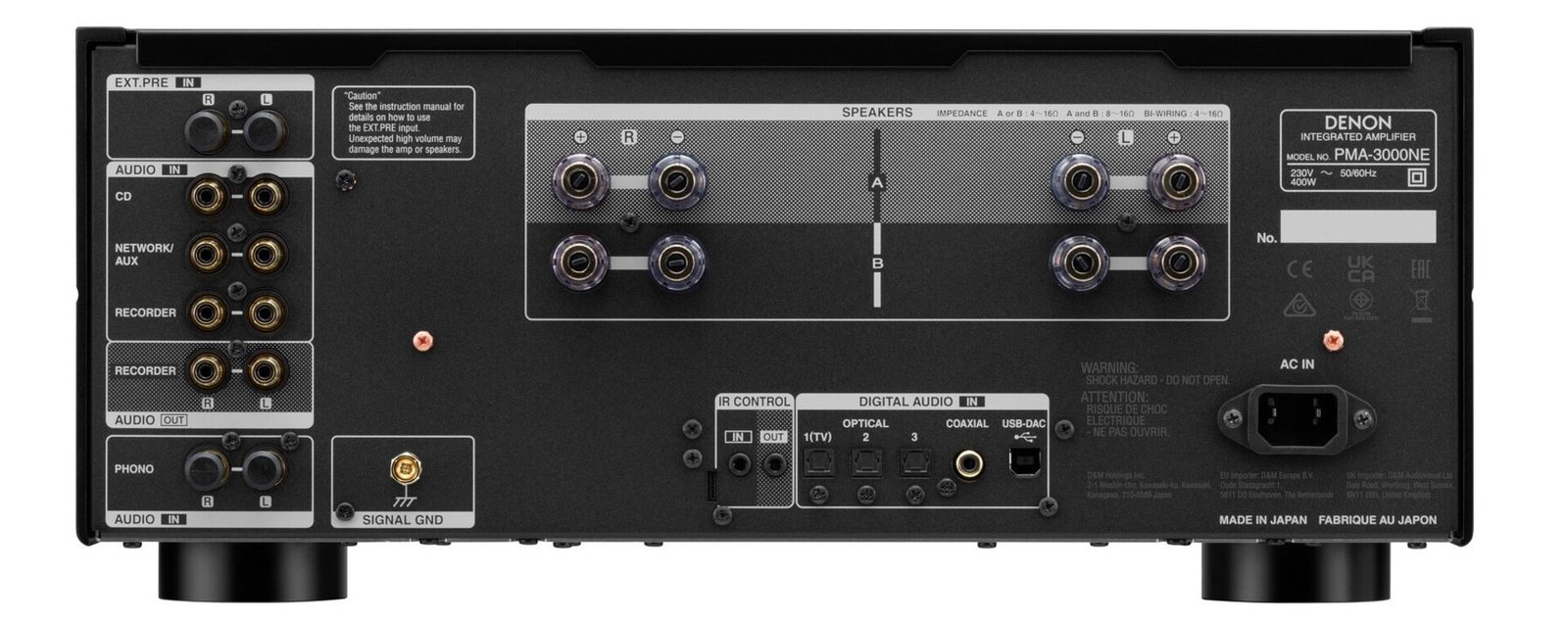
Connectors on the back
The output circuit is where the PMA-3000NE becomes special, very interesting, and somewhat unusual. Denon calls it the UHC-MOS Single Push Pull circuit, where UHC stands for Ultra High Current.
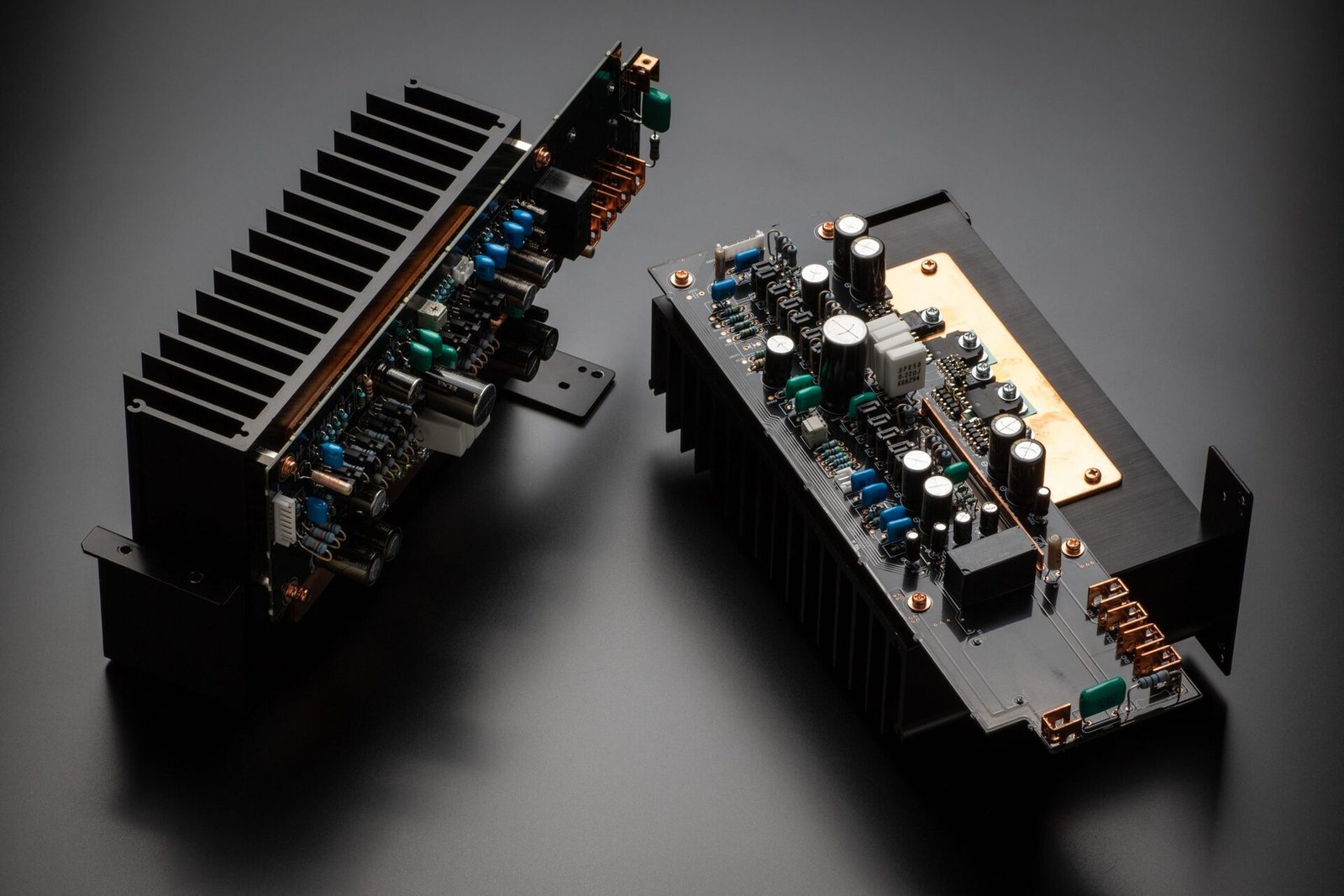
Amplifier boards
Most powerful amplifiers achieve their muscle by paralleling many pairs of output transistors per channel, sharing the current load across them. The engineering price of that approach is matching: every transistor behaves slightly differently, and a bank of loosely matched devices smears the signal in subtle ways that are difficult to remove later. Denon takes the opposite road. Each channel of the PMA-3000NE is driven by a single pair of enormous, ultra-high current MOSFET transistors, biased in Class AB. The model used is a Toshiba TK70J20D. One pair. That is the entire output section per channel. The topology has a small and noble lineage, having appeared in designs from GamuT and Gato Audio in Denmark and in Sony’s TA-A1ES, and we believe its appeal is easy to understand: with one perfectly matched pair, there is nothing to disagree, nothing to smear, and the signal path stays as short and as simple as physics allows. Denon pairs this output circuit with a differential amplifier topology and a variable gain volume architecture that adjusts the gain itself, keeping the signal path minimal at every listening level. It is a beautifully engineered piece of audio thinking, and the musical character we shall describe later flows directly from these choices. A single matched pair driving each channel is, after all, exactly the philosophy behind the most cherished single-ended tube designs, and we suspect this kinship is no accident.
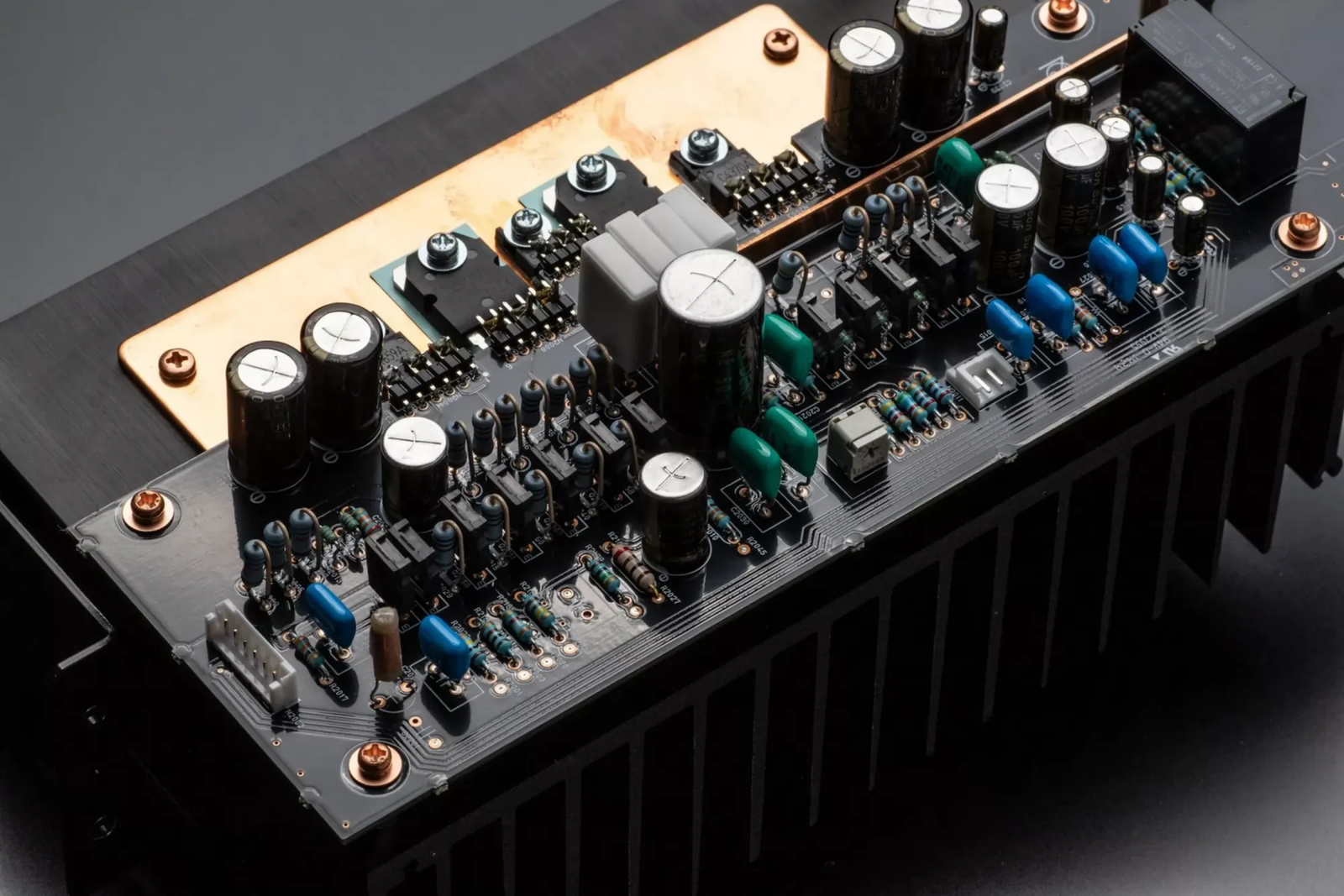
View of the pair of transistors
The digital section received a complete rethink compared to the PMA-2500NE. Gone is the Burr-Brown solution of the predecessor, and in its place sit four ESS ES9018K2M converter chips arranged in a symmetrical configuration, fed by Denon’s Ultra AL32 Processing, the latest evolution of the company’s long-running waveform interpolation algorithm. The digital inputs accept PCM up to 384 kHz and 32 bits over USB, alongside DSD up to 11.2 MHz, with three optical inputs and one coaxial input handling up to 192 kHz. There is also a master clock design with asynchronous USB operation, keeping jitter at bay. What you will search for in vain is HDMI ARC or network streaming. The PMA-3000NE is a purist machine in a market full of all-in-one solutions, and we respect Denon for the courage of that decision. Bring your own streamer, plug it in, and live happily ever after; this amplifier will honour whatever you feed it.
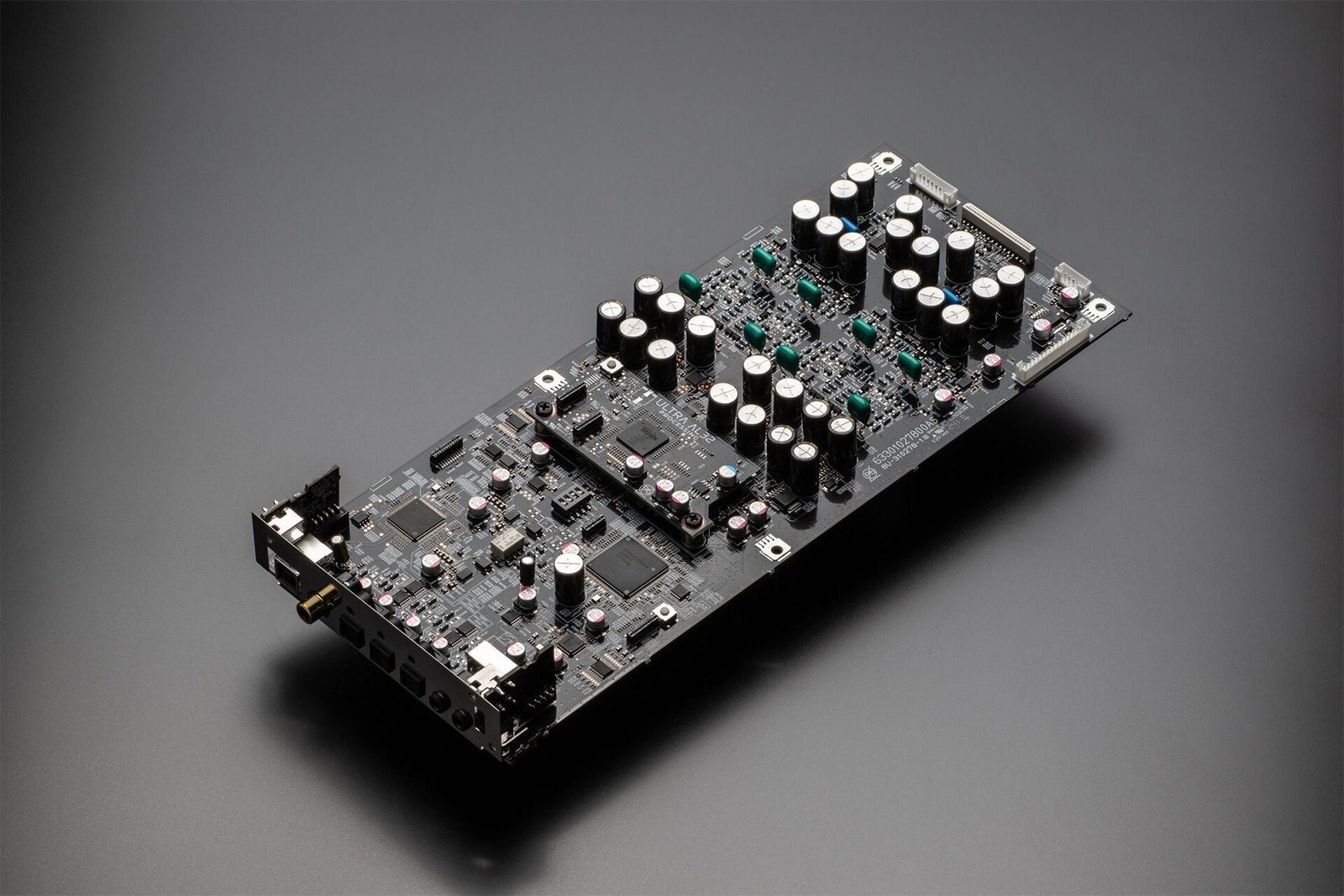
DAC mainboard used in the Denon PMA-3000NE
Analogue lovers are treated with equal seriousness. The phono input handles both MM and MC cartridges through a CR type equaliser circuit chosen for its stability in the high frequency range, and the brand makes a point of the synergy with its own DL-103 cartridge, which feels like a lovely closing of a sixty-year circle. A Pure Analogue mode shuts down the entire digital section, display included, so the analogue signal travels through a fully analogue machine. Source Direct bypasses the tone controls for the shortest possible signal path. The four analogue RCA inputs use machined brass, gold-plated connectors, and the speaker terminals are the same heavy-duty gold-plated type that Denon fits to its flagship AVR-A1H. Around the back, everything communicates quality and longevity.
At the front, the PMA-3000NE is unmistakably a Denon flagship: a gently curved aluminium fascia, broad chamfers, a generous machined volume knob at the centre with a small display beside it, tone and balance controls keeping the traditionalist feel alive. It is sober, it is serious, and the machining showcases the craftsmanship of Shirakawa from the very first touch. The volume knob in particular is a tactile pleasure, weighted with the right amount of resistance, turning with a quiet authority that you only get from properly machined metal. The remote control is a standard Denon affair, functional and unremarkable, and after our experience with a certain dark green object that shipped with a far more expensive amplifier from the same building, we found ourselves enamored with this one.
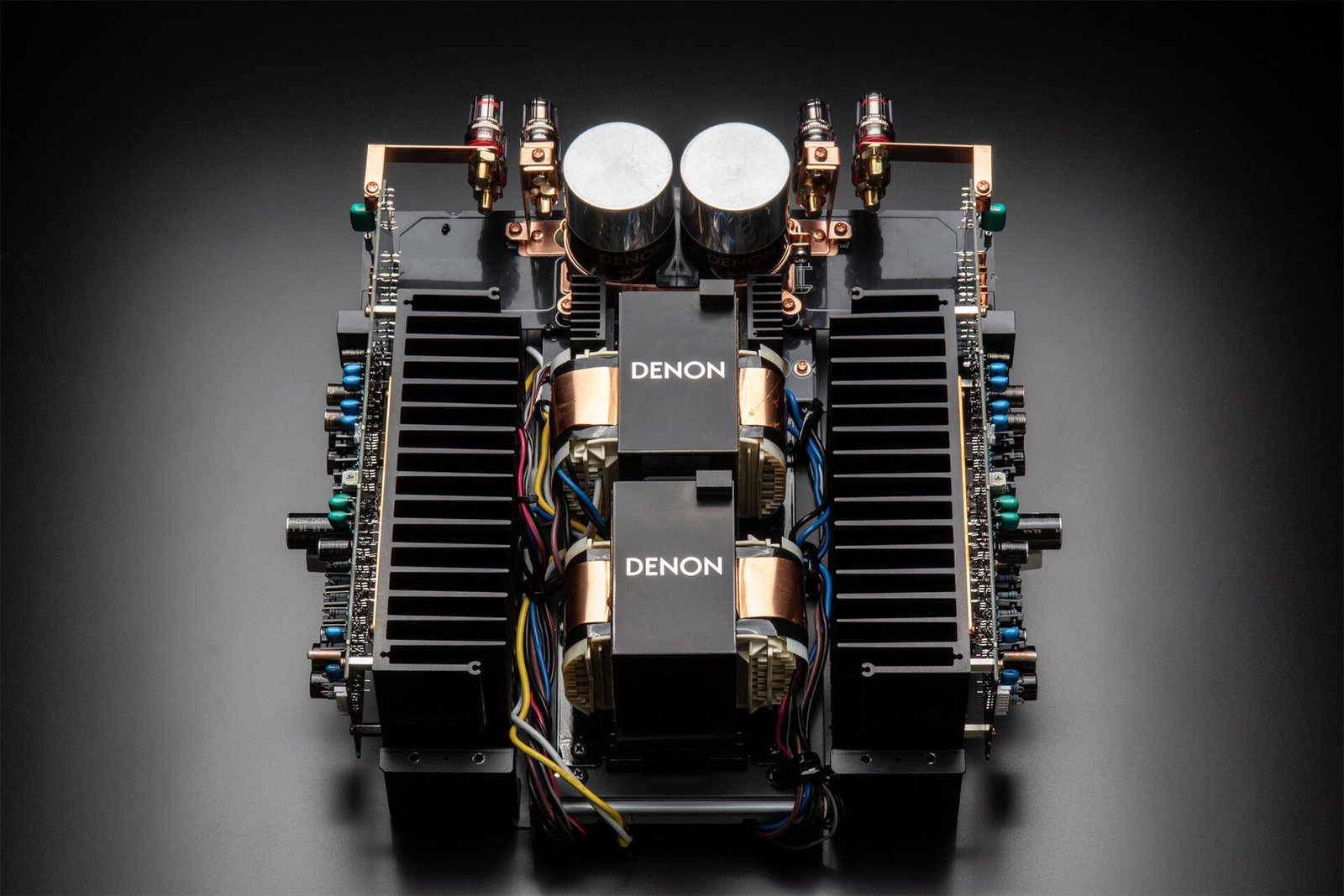
Components without the chassis
In summary, the construction philosophy of the PMA-3000NE can be described in a single sentence: take the shortest possible signal path, give it huge current reserves, isolate every section from every other section, and let the music flow. The result is an amplifier that feels enormously over-engineered for its price, with an internal layout you would expect from machines costing two or three times as much. Combined with a complete feature set that covers digital, analogue, and vinyl with equal seriousness, the PMA-3000NE positions itself as the warm, welcoming heart of a complete musical system, the central piece you can build a long-term setup around without ever feeling the urge to look further. Now that you have reached this point of the read, you may feel as we felt: a single chassis promising the heart of a much bigger amplifier, engineered with patience by people who have been doing this for over a century. The only thing left is to find out how it sounds.
Listening and pairing
The setup remains identical to the one we use for our reference integrated amplifier reviews, for consistency purposes. We switched the source between the Gustard R30 and the 3DLab Nano Network Player Platinum v5 as digital transports, Roon server, and DAC, feeding the PMA-3000NE through Roboli Stars Digital RCA interconnects, with the amplifier driving the loudspeakers through the Roboli HP8000 speaker cables. Power delivery is handled by Roboli Power5200 cables throughout. We also play the same reference tracks we used for the Marantz Model 10, deliberately, because the two amplifiers are born in the same Shirakawa facility, they compete for attention in the same listening rooms, and hearing them through identical material reveals their personalities with a clarity that no specification sheet can match.
The set of speakers that we had the pleasure of testing this amplifier with are the Monitor Audio Platinum 300 3G, the Dynaudio Contour 60i, and the Indiana Line Lira 6. This way, we managed to cover a wider range of prices in the speaker department. In all these cases, we used the same sources and cables.
One housekeeping observation before the music. The PMA-3000NE needed time. Where the Model 10 sounded identical from its first hour to its last, the Denon opened up gradually across the first week, the midrange gaining body and the top end relaxing into its final, silky character. We mention this because early impressions of this amplifier, formed in a showroom on a fresh unit, will undersell what it eventually becomes. Give it a week of music. The amplifier will reward your patience.

Pernille Rosendahl, Feet on the Ground. We began, as we always do lately, with our bass laboratory disguised as a song. Regular readers know this track by heart through our descriptions: the 65 Hz foundation modulated with 25 Hz underneath it, the second voice arriving at the one-minute mark, the full bass symphony unfolding by 2:20 with multiple lines demanding their own space and timing. The Model 10 dissected this track with surgical authority, every leading edge defined, every layer separated with the cleanest possible borders, and we carried that fresh memory straight into the Denon session.
The PMA-3000NE told the same story in a different language. Through the Platinum 300 3G, the 65 Hz foundation arrived with a generous bloom that filled the room with warm low-frequency air. We sat there during the opening seconds smiling, because the sensation was the one we associate with great vintage amplification: bass that breathes, that occupies space, that surrounds you with the kind of warm pressure you feel as much as you hear. When the 25 Hz modulation joined underneath at thirteen seconds, the floor of the soundstage descended with a soft, dignified weight, never harsh, never tightened up artificially, simply present and full.
The bass through the Denon is mellower. The leading edges of the lowest notes are rounded with a touch of harmonic warmth, the notes blooming outward into the room with a presence that fills the listening space. When the second voice arrived at the one-minute mark, sitting at 80 Hz, it’s weighty and full of body, blending into the foundation with a richness we found pleasant. By 2:20, when the full bass arrangement unfolded with the 105 Hz line joining the lower layers, the presentation became dense, warm, and physically engaging. The layers were all there, separated enough to be followed, and the soundstage held together through the densest passages.
The Dynaudio Contour 60i made this character even clearer. Those big Dynaudio woofers love current, and the Denon fed them without complaint, the bloom growing larger and the room pressurising in a way that had us reaching for the volume again and again. The Indiana Line Lira 6 told the gentler version of the same story, the warmth suiting the smaller floorstander beautifully, the low end fuller than we expected from a speaker at that price. Across all three, the message was the same. This is the moment to be honest about the trade. Listeners who define bass perfection as the tightest, fastest, most surgically articulate presentation will recognise that the PMA-3000NE chooses bloom and body over ultimate control. The note shapes are softer at their edges than the very sharpest references we know. For us, the bloom was the quality that made the track emotionally engaging, and Pernille’s voice floating above the warm, low-frequency architecture gained a touch of humanity and a roundness that moved us. The amplifier paints with a soft brush. For some, the brush may be too soft.

If the Pernille track measured precision, Center of the Universe (Freedom Fighters Remix) by Mandragora measures depth and stamina, ours and the amplifier’s. The synth lines sit in a frequency range that punishes any hardness in the electronics, and the deep modulated bass that runs underneath demands a power supply that can deliver real current at low frequencies without sagging. We have heard plenty of amplifiers turn this track into a fatiguing experience within minutes. The Denon turned it into a long, grinning session.
The chest-pounding bass note arrived with authority, the kind of mass and pressure you feel in your sternum, and the slower massaging frequency underneath did its bodywork exactly as the producers intended. The Platinum 300 3G drivers were moving serious amounts of air, the room responding with the gentle compression of well-loaded bass, and the PMA-3000NE never showed a single sign of strain. The single pair of those enormous MOSFETs simply held on, delivering current after current, while the twin transformers kept the rails clean and the warmth intact. We pushed the volume past the levels at which we usually take measurements, and the amplifier did not flinch.
This is where the powerful story revealed itself. Denon rates this amplifier at 160 watts per channel into 4 ohms. During our loudest sessions with this track, our measurements showed the amplifier approaching 250 watts per channel into the 4 ohm load before showing any audible sign of strain. We double checked the numbers because we did not believe them the first time. The Contour 60i was the real test here, a demanding load that humbles smaller amplifiers, and the Denon drove it with an ease that surprised us, given the modest rating on the box. The conservative rating is, in our view, a quiet act of Japanese modesty, and we firmly believe that buyers comparing amplifiers by their printed wattage will walk past this machine without ever suspecting what lives inside it.
The bass’s character confirmed everything we heard with Pernille. The presentation is bloomy, warm, generous, and room-filling. The lowest octaves carry a sense of presence, and you can feel the air moving in the listening space. The amplifier is not chasing the taut, dry, fast bass that some modern designs deliver, especially those employing class D topology. It is producing the kind of bass that vinyl lovers and tube amplifier veterans recognise on first contact: full-bodied, dimensional, and emotionally rich. Some listeners will find it too generous for their taste, and we will name those listeners in the conclusion. For us, on this track, the experience was deeply satisfying.

Our history with Infected Mushroom needs no reintroduction for our regular readers. These tracks shaped us, and the REBORN version of Dancing with Kadafi has become one of our favourite torture tests for low-frequency layering and articulation. The track is built on rapid bass lines that come and go in tight rhythmic patterns, with multiple percussive elements demanding their own clear positions in time. Through the Model 10 in our previous review, every leading edge had its own crisp identity, every kick carrying surgical definition.
Through the Denon, the track was a warm, physical event. The bass notes had mass, weight, each one carrying its own distinct shape, yet the rapid succession of attacks showed where the articulation loses to the warmth of the interpretation. When the bass pattern moved through its fastest sequences, the notes blended slightly more than we are used to from the sharpest references, the leading edges arriving a touch later and rounder than we know is possible from this exact recording. The amplifier did not lose its grip; it chose to prioritise the body of each note over the speed of its onset. The Indiana Line Lira 6, with its lighter, quicker woofers, actually tidied this up a little, the smaller drivers naturally giving the bass lines a touch more separation, while the Platinums and the Dynaudios leaned further into the warmth. For an integrated amplifier at this price, the articulation is good, honest, and musical. It is, in our honest assessment, not the best we have heard, and we want to flag this for anyone for whom the absolute control of complex bass lines is the deciding factor.
Avratz, with its ten minutes of constantly evolving bass density, confirmed the pattern. Every layer remained audible and followable, the 123 BPM pulse never hesitated, and the upper bass texture that gives this track its warmth came through with even more body than we are used to. The PMA-3000NE’s harmonic generosity made Avratz feel fuller and more alive than strictly neutral electronics render it. Ten minutes passed very quickly. We listened again, which is becoming a tradition with this track, and we accepted the trade Denon offers, slightly softer articulation in exchange for a far warmer, more engaging presentation. We were happy to make it.

The sparkling explosions that open EBE’s Captain Hook gave us our first detailed look at the soundstage character of this amplifier, and the picture revealed itself within seconds. The opening percussive flashes occupied a dimensional space in front of us, each element placed at a clearly defined distance, some forward, some recessed, some sitting in the middle ground. The depth was excellent, three-dimensional, and we could close our eyes and walk our attention from the front of the soundstage to the back through several distinct planes. The soundstage is genuinely 3D.
The width told a different story. The lateral spread extended modestly beyond the outer edges of the Platinum 300 3G speakers, and at no point did it create the kind of wall-to-wall panorama that some of our reference electronics produce. The amplifier presents a soundstage that is dense, dimensional, and deep, with sound coming toward you and pulling away from you, and with a more contained left-to-right footprint. The Dynaudio Contour 60i, set wider apart in our larger room, opened the soundstage out somewhat, so some of the width comes down to speaker and placement, yet the essential character held: depth ahead of width. For listeners who define soundstage primarily by its width, the PMA-3000NE will read as slightly compact. For listeners who value depth and dimensional density, as we do, the presentation satisfies.
The build toward the 1:25 moment carried real tension, and when the bass finally dropped, low, massive, relentless, the Denon delivered it with an authority that had us exchanging looks across the room. The vocal sat clear and separate in its own pocket of the soundstage, warmer and more human through the Denon than we remembered it, occupying a defined position roughly between the speakers and slightly forward of the plane connecting them. The contrast between the explosive low end and that intimate voice was handled with grace, the spatial separation convincing and stable. The dark background that we have spoken about previously throughout our reviews served the quiet moments beautifully; the silences between the explosions felt deep and clean.

ATB, Seven Years (full album). Our readers already know what this music means to us. We grew up inside it. Our father, the electrician smelling of solder smoke and reel-to-reel tapes spinning in the background, was a full-on rocker, and he still let us fall in love with ATB, Tiesto, Armin, Chicane, and all the others who soundtracked our teenage years. Those years live somewhere in our hearts, and certain amplifiers know how to find the door.
The Denon found it, even at low-volume listening. This is one of the defining qualities of this amplifier, the one we suspect will keep buyers smiling for years after the purchase: the PMA-3000NE is one of the finest low-volume amplifiers we have ever heard. Playing Seven Years through the late evening at a volume our neighbours would actively approve of, the warmth in the synth pads remained intact, the bass kept its body and presence, the vocal lines stayed close and human, and the entire album felt alive and full at SPL levels where most amplifiers begin to sound thin and emotionally absent.
This quality matters far more than the specification sheet will ever capture. Many great-sounding amplifiers come to life only when you push them hard, and they sound shy at the levels you actually use late at night, on a Sunday afternoon, or in any apartment where loud listening is not an option. The PMA-3000NE has no such timidity. The harmonic richness it carries everywhere keeps voices physical and atmospheres dense at whisper levels, and we found ourselves listening for hours at volumes that left the music feeling close, warm, and complete. We paired it with the Indiana Line Lira 6 for much of this listening, a sensible real-world match, and the combination filled a normal living room with warmth at a fraction of full power. For the city dweller, the apartment listener, the late-night listener, or the parent of small sleeping children, this trait alone justifies the purchase.
The forgiveness extended to masters that were never created with audiophiles in mind, the complete absence of glare or grain at the top octaves, all of it combined into one of those sessions where the evening simply disappeared. This music was mastered loud and hard for clubs, and analytical electronics love to remind you of that fact. But the PMA-3000NE never once did it. It handed us the emotion and kept the forensics at bay. For an entire category of listeners, the ones that own large libraries of imperfectly mastered music that they love beyond reason, this quality is worth the entire asking price.

Chris Stapleton, voice from Death Row, became the single most memorable moment of our entire time with this amplifier, and we will spend more words here because this is the heart of what the PMA-3000NE does, the trait around which every other characteristic seems to organise itself. The opening guitar notes floated inside the dark background that we have spoken about previously, carrying texture and convincing dimensionality, and then the voice arrived, and the room changed.
Stapleton’s chest resonance, the grain of his performance, the slight rasp at the back of his throat, the harmonic halo around every sustained note, the Denon rendered all of it with a warmth and a physical presence that pulled us forward in our seats. The midrange through this amplifier carries something magical, body, texture, the kind of harmonic density you associate with the great vintage amplifiers, the warm valve units of memory, the classic Japanese integrated amplifiers of the seventies and eighties at their absolute peak. Voices sound close. They sound human.
This is the amplifier’s heartland, and it is the reason we believe the PMA-3000NE will find a particular kind of devoted listener. If voices are the centre of your musical life, if you love singers, if you put on an album because you want to feel a human being communicating with you, this amplifier is voiced for you with care. The richness of the midrange is a gentle harmonic generosity that brings the singer closer to you, removes the glass between you and the performance, and lets the emotional content of the voice arrive without obstruction. The Platinum 300 3G, with its detailed midrange, found the best balance of body and clarity here, while the Dynaudio added even more weight to the chest of the voice.
Raising the volume thickened the presentation slightly, the warm voicing leaning toward density where the Marantz stayed surgically separated, and lowering the volume revealed once again the Denon’s second great gift: the emotional engagement survived at whisper levels. Late night listening, the exact territory where we found the Marantz Model 10 emotionally reserved, is where the Denon quietly shines. It is our feeling that these two amplifiers from the same facility were voiced for two different hours of the day, and that the late evening, with one warm light burning and a glass of something dark on the side table, belongs entirely to the Denon.
A Tube Heart in a Solid State Body
We have reached the moment to make good on the promise we planted at the start of this review. Sitting with Stapleton’s voice still hanging in the air, the two of us said the same thing out loud, almost at the same time: this sounds like a really good tube amplifier. We want to be careful with that comparison, because it is overused in our hobby, thrown at any component that sounds vaguely warm. We do not use it loosely. We use it because, across weeks of listening, the PMA-3000NE kept reminding us of the specific musical pleasures that send people down the valve rabbit hole in the first place, while quietly avoiding most of the compromises that usually come attached.
Consider the midrange first, because it is where the kinship is most obvious. The harmonic richness this amplifier pours into voices, the body, the texture, the sense of a singer breathing in the room with you, is precisely the quality we all chase when we audition tube gear. It is the reason people tolerate heat, weight, retubing, and bias adjustment. The PMA-3000NE delivers that same harmonic generosity in the midband, the same gentle saturation that makes a human voice feel full and present, without asking you to own a single glowing tube. For the listener who has always been curious about the tube sound but never wanted the maintenance, this is one of the most honest shortcuts available at the price.
The highs complete the picture. A great tube amplifier does not give you a rolled off, dull top end, contrary to the lazy stereotype; it gives you a treble that sparkles and breathes with air around each note while staying free of grain and glare. That is exactly what we heard through Ruth Moody and through the Vivaldi violins: silky, airy, extended highs that shimmer where the music asks for shimmer and never turn hard. The PMA-3000NE has that valve-like sweetness in the upper octaves, the openness we love, delivered with a refinement that lets us listen for hours.
And here is where the Denon improves on the formula. The classic complaint about tube amplifiers, the real one, beyond the folklore, is that many of them struggle to grip a demanding loudspeaker in the bass, running low on current and letting the woofers wander. The PMA-3000NE answers that complaint with the brute reality of its power supply. With close to 250 watts per channel into 4 ohms on tap, far more than the rating suggests, the amplifier drives the low end with an authority and an effortlessness that few tube designs at any sane price can equal. We heard it most clearly on the Dynaudio Contour 60i, a speaker that would leave most valve amplifiers gasping, driven here with complete composure. The bass keeps its warm, bloomy, room-filling character, the character we have praised throughout, and it arrives backed by a reservoir of current that does not run dry. So you get the tube voice in the mids and highs, and you get solid state muscle holding everything up from below. We believe that this combination, the harmonic soul of a valve amplifier wedded to the current delivery of a serious solid state power section, is the single most seductive thing about the PMA-3000NE, and the reason we found it so very hard to send back.

Mark Knopfler and Ruth Moody, Wherever I Go
This duet became our laboratory for the upper frequencies of the PMA-3000NE, and what we heard pleased us deeply. Ruth Moody’s voice floated delicately inside the soundstage with a sweetness the amplifier rendered with what we can only describe as silk. The top of her vocal range, the gentle sibilance, the breath at the end of phrases, the soft consonants, all of it arrived smooth and refined, with an airy quality that floated above the harmonics of the guitar without ever turning harsh or splashy. This is not a dark amplifier. The treble is open, airy, and present, and the quality of its extension is what we mean when we say silky: there is air, there is sparkle, there is shimmer, and all of it is delivered with a refinement that makes long listening a pleasure.
Knopfler’s guitar had body in every pluck, the metal of the strings ringing cleanly above the warmth of the soundboard, the harmonics of each note rising into the upper octaves with the right kind of natural decay. The articulation of each string was good, honest, but a step behind the almost surgical precision we heard from the Marantz Model 10 on this same recording, with each note beginning a shade more gently and decaying with a longer, warmer tail. The trade was agreeable on this material. The Platinum 300 3G, with its ribbon-like top end, drew the most air and sparkle from the recording, while the Indiana Line Lira 6 gave a softer, rounder read that suited the intimacy of the song. The sense of two musicians in a shared acoustic space came through with an ease that invited us to stop taking notes. So, for a while, we did.
The soundstage again revealed its character. The two voices occupied distinct positions in front of us, with Ruth Moody slightly to the right and Knopfler slightly to the left, both placed at a believable distance forward of the speakers. The depth was beautiful, the guitar resonating in a space that felt three-dimensional, and the lateral spread stayed contained within roughly the speaker boundaries. It was an intimate soundstage, one that pulls you toward a small acoustic venue with the musicians a few metres away, which is exactly what this recording captures. We loved it.

Michelle Shocked, Quality of Mercy gave us our clearest reading on the resolution and microdetail character of the PMA-3000NE. The opening bass lines came forward with grip and pleasing texture, the kick drums carried mass, and the entire presentation flowed with a coherence that made the track feel whole. Detail retrieval was good. We could hear the small reverberations on the vocal, the inflections in Michelle’s phrasing, the gentle decay of percussion into the dark background, and the production touches that we know live in this recording from years of listening.
The microdetails are present. They are easy to follow. They are not exaggerated, they are not pushed forward into your face, and they do not arrive with forensic insight, a character that some highly resolving electronics produce. The PMA-3000NE’s presentation of small information is ok, honest, and pleasant. It is not the most resolving amplifier we have heard at this price, and the listeners who organise their listening life around the retrieval of every last micro event will find more of that quality elsewhere. We say this clearly because we believe in calling each trait by its true name.
What the Denon offers is musical flow. The track played from beginning to end with a coherence that made us forget about the analysis entirely. Detail was sufficient. Resolution was sufficient. The music felt complete. We played it three times in a row, which our notes describe, verbatim, as research, and on the third pass, we noticed how easily the amplifier kept us in the song, how naturally the production touches blended into the performance, how warmly the vocal occupied its space. There is a feeling of pleasure that comes from an amplifier that does not constantly poke you to admire what it is showing, and the PMA-3000NE delivers exactly that pleasure.

Armand Amar, Cum Dederit (HOME ost). Here we arrive at the inversion that defines the relationship between the two Shirakawa amplifiers, and the moment when the romantic, vintage soul of the Denon revealed itself in full. Cum Dederit relies on softness, atmosphere, and gradual immersion, and through the Marantz Model 10, we found its emotional core remaining at a respectful distance, rendered with precision yet never fully reaching us. Through the PMA-3000NE, the track simply opened its arms.
From the first note, the meditative pull worked. The voices were presented with a rich harmonic density, one that this composition needed in order to breathe, and was present at every volume we tried, including the lowest ones. The cello and the voices entered the soundstage with a warmth that felt close and welcoming, the upper voice floated above with its silky, airy quality, and the entire piece unfolded with a romantic, dignified emotion that we found transporting. We sat through the entire five-minute composition in silence, looked at each other, and pressed play again.
If your listening life lives at moderate levels, in the evening, with music that whispers, if you find yourself drawn to slow vocal music, to sacred music, to acoustic recordings, to the kinds of pieces where atmosphere and emotion matter more than slam and impact, the PMA-3000NE is voiced for you in a way that far more expensive and technically impressive amplifiers are simply not. We believe that this is the natural habitat of this amplifier, the music for which Denon’s engineers tuned every harmonic balance and every transient choice. The romantic, delicate, welcoming character is at its purest on this kind of material.

Vivaldi, The Four Seasons (Royal Festival Orchestra). Our long-time readers will remember that this particular recording defeated our patience through the Marantz Model 10, whose total honesty presented every forward decision of the mastering desk without mercy. We returned to it through the Denon with curiosity, and the experience completed the portrait of this amplifier in a way we did not expect.
The forward upper register of the violins, the very quality that tested us so thoroughly before, was delivered through the PMA-3000NE with a silky, airy refinement that turned the recording into a pleasure. The strings carried their full energy, their full presence, their full upper octave bite where the music calls for it, and yet the entire top end was wrapped in a smooth, refined air that removed the glare without removing the life. We listened through Spring, Summer, and onward, with active enjoyment, and the recording revealed beauties we had not been able to focus on previously, simply because the top end had been too challenging to live with through more analytical electronics.
The treble of this amplifier is silky smooth. It is not soft in the sense of being closed off. It is open, it is airy, it is extended, it carries shimmer and sparkle where the music demands it, and all of that energy arrives with a smoothness, a refinement of texture, a polish that makes long sessions with bright recordings possible and pleasant. The amplifier wraps the top end in silk while keeping every harmony in place. This is one of the harder qualities to engineer into a solid-state amplifier, and Denon has clearly invested deep thought into achieving it. It is also, we note once more, deeply tube-like, delivering a sweet and open top end that valve lovers appreciate.
We closed the listening period the way we always do, with long unstructured days of music: Schiller, Morten Granau, Carbon Based Lifeforms, Estas Tonne, Two Steps from Hell, Hans Zimmer, Lab’s Cloud, and many hours of voices, always voices, because this amplifier kept pulling us toward singers the way a fireplace pulls you toward the warm side of the room. After twelve-hour sessions, we felt no fatigue whatsoever, and we want to underline this: across our entire time with the PMA-3000NE, through every genre and every volume level, fatigue simply never arrived. This is one of the greatest qualities an amplifier can possess, and the Denon definitely has it!

Lo Steele has the kind of voice that the PMA-3000NE was built to serve. Deep, smoky, and full of body, her contralto sits low in the register with a richness and a grain that many amplifiers thin out or flatten. We came to Greenz late one evening, and the Denon held the voice exactly where it belongs, close and physical, with all the chest weight and woody lower harmonics intact.
The opening bars set the tone. The double bass walked underneath with that warm, bloomy character we have praised throughout, and Lo Steele’s voice entered above it with a velvet weight that filled the room. The Denon rendered the tones of her delivery with real density, a harmonic saturation that makes a jazz voice feel like it is breathing in front of you. As her phrasing moved from a low murmur to a fuller, open note, the amplifier followed the swell with ease, the warmth never tipping into thickness, the body always present.
It is our feeling that this is where the tube hearted character of the PMA-3000NE pays its richest dividend. The smoky lower midrange of a voice like this can sound lean and lifeless through clinical electronics. Through the Denon, it sounded full, rounded, and realistically human, the harmonic halo around each sustained note glowing softly inside the dark background. The brushed drums comping sat slightly behind and to the sides, giving the voice its own pocket at the front of the soundstage, intimate and close, the way a small jazz club places a singer a few feet from your table.
We played Greenz, then let the rest of her catalogue run. The amplifier kept pulling us back to that voice, warm and low and full, the way it kept pulling us toward singers all through our time with it.

Lizz Wright has a deep modern jazz voice, darker and lower even than Lo Steele, a true contralto. The song is built on repetition, a slow blues structure that circles the same lines like an incantation, and it asks the amplifier to hold a single low voice steady and full for five minutes without ever letting the spell drop. The PMA-3000NE did the job stupendously.
The opening guitar set the scene, the strings ringing with wood and body inside the dark background, and then Wright’s voice arrived, low and close and dark. The Denon gave her bottom register real density and mass, the warm midrange letting every repeated line gather a little more emotional pull than the last. There is a lullaby quality to Barley, a sense of a blanket thrown across the shoulders, and the amplifier leaned into exactly that feeling, the harmonic richness turning the repetition into comfort.
As we have been adamant about with the other voices, here too, the magic was in the body. Wright’s slow phrasing, the way she lets a low word hang and then settles it further down, came through with weight and patience, the rounded leading edges of the Denon suiting her unhurried delivery. The voice sat at the front of the soundstage, the guitar and the soft accompaniment placed behind and around it, deep in the layered space the Denon builds so well, even if it keeps that space narrow. We listened at low volume, late, and the amplifier kept every ounce of the emotion intact at a whisper.
We believe that an amplifier should be judged on what it does with a voice like this, and the PMA-3000NE passed the test with flying colors.
Conclusion
As is often the case with every component that passes through our room, time remained the ultimate teacher, and with time, we have to say, the true voice of the PMA-3000NE revealed itself. This is an amplifier built around warmth, ease, and emotional generosity. The midrange is its crown, rendered with a harmonic richness we have rarely heard at this price point. The high frequencies are the diamonds in its crown jewel, silky and airy, extended and refined, delivering shimmer and sparkle inside a smoothness that makes long sessions a pleasure. The bass is bloomy, warm, room-filling, on the mellower side, generous, not extremely tight, and the presentation as a whole is pleasant and easy to live with.
We will say plainly what we have circled throughout this review: the PMA-3000NE carries the soul of a fine tube amplifier inside a solid-state body. It has the harmonic richness in the mids that we all search for when we listen to voices, it has the sparkle and the airiness in the highs that we love, and it backs both with a power section so far beyond its rating that the bass is driven with an authority and an effortlessness most valve designs can only dream of. For the listener who has always been drawn to the tube sound but wanted none of the maintenance, the heat, or the fragility, this Denon is one of the most satisfying answers on the market today at this price range.
Above all, this is one of the friendliest, most welcoming, integrated DAC amplifiers we have ever placed at the heart of our system. You plug a streamer into one of its digital inputs, you set the speakers, and you forget about the chain. The music is there, it is warm, it is satisfying, and it stays that way evening after evening. The complete absence of listening fatigue across weeks of long sessions stands among the finest achievements we have encountered in any integrated amplifier, regardless of cost, and the preservation of full emotional engagement at low volume is one of this amplifier’s most precious qualities.
Underneath that gentle character lives a quietly enormous power reserve. The rated 160 watts per channel into 4 ohms proved deeply conservative on our bench, with the amplifier approaching almost 250 watts per channel into 4 ohm loads before showing signs of distortion. Across the Platinum 300 3G, the Dynaudio Contour 60i, and the Indiana Line Lira 6, it did not meet a load it could not drive with attitude. The single pair of ultra-high current MOSFETs per channel, fed by those twin suspended transformers, drives real-world loudspeakers with an authority that the specification sheet actively hides. Denon’s engineers know exactly what they built, and chose to let listeners discover it for themselves.
This amplifier is the natural choice for a particular kind of listener, and we want to name that listener with clarity. If you are seeking the vintage warm sound, the welcoming and delicate presentation, the romantic atmosphere, the bloomy bass that fills the room and surrounds you with presence, the kind of musical experience that the great integrated amplifiers of an earlier era used to deliver, the PMA-3000NE is a modern realisation of that ideal. It belongs in a living room, paired with a quality streamer, driving a pair of speakers chosen for their tonal richness, and switched on without further worry every evening for the next twenty years. The music will be there.
There are honest boundaries to this character, and we have named them throughout the review. The bass, while generous and full of presence, is not the most articulate we have heard, and listeners who chase ultimate control and tightness in the low frequencies will recognise the bloom as a stylistic choice that may or may not match their priorities. The microdetail retrieval is good and sufficient for musical enjoyment, while listeners who organise their hobby around forensic resolution will find more of that quality in more analytical designs. The soundstage is three-dimensional with excellent depth, while its lateral width is modest.
Everything else is on the side of pleasure. The warmth, the silk, the air, the mellow ease, the low volume engagement, the romantic atmosphere, the complete absence of fatigue, the power reserves, the build quality, the Shirakawa craftsmanship, the complete feature set, and the deeply welcoming character all combine into one of the most lovable integrated amplifiers we have spent time with this year. We believe the PMA-3000NE is the right amplifier for the listener seeking warmth, a vintage-hearted musical companion to plug a streamer into and live with happily for many years. The music is there. It is pleasant. It is satisfying. We recommend it to the person who values these qualities.
We want to close with our warm thanks to AVstore for their generosity in lending us the PMA-3000NE and for letting us keep it for so long. Having an amplifier in our room for weeks, across every hour of the day, and using it for every kind of music, is the only honest way to know a component, and that freedom is a gift. It is also the only way we can write so many insights about it. It allowed the Denon to open up at its own pace, it let us return to the same voices night after night, and it shaped every word of this review. We are grateful, and we look forward to the next one.
Pros and Cons
Pros
- Exceptionally warm, harmonically rich midrange that gives voices a close, full, physical presence we associate with the finest vintage amplifiers
- Silky and airy high frequency reproduction, extended and refined, delivering shimmer and sparkle inside a smoothness that makes long sessions with any kind of recording a pleasure
- Bloomy, generous, room filling bass with beautiful presence, a true vintage warm low frequency character that surrounds the listener with body and atmosphere
- Outstanding low volume listening, with full emotional engagement, body, and tonal richness preserved at whisper levels, a precious quality for apartment living and late night listening
- Mellow, pleasant, completely fatigue free presentation that remains comfortable across very long sessions at every volume we tried
- Beautifully three dimensional soundstage with excellent depth, layering, and dimensional density
- Friendly all-in-one philosophy with a quality MM/MC phono section, quad ES9018K2M digital section, Pure Analog mode, and Source Direct, the perfect partner for a streamer in a single chassis solution
- Enormous real world power reserves, approaching 250 watts per channel into 4 ohm loads in our measurements, far above the rated specification, driving demanding speakers like the Dynaudio Contour 60i with effortless authority
- Forgiving and merciful with imperfect masters and bright recordings, expanding the listenable portion of any music library
- Outstanding Shirakawa build quality with six shielded blocks, twin suspended transformers, and a minimalist single push-pull output circuit, at a price that undercuts its own refinement
- Romantic, welcoming, vintage-hearted musical character ideal for the listener seeking a long-term companion they can plug a streamer into and simply forget about
Cons
- The presentation is not the most detailed we have heard, with microdetail retrieval that is good and pleasant, while staying a step behind the most analytical references at this price
- Bass is not the most articulate, with a bloomy character that some listeners seeking ultimate control and tightness in the low frequencies may find slightly too generous
- Soundstage width is modest, with a lateral spread that stays close to the speaker boundaries; listeners who prize a wide left-to-right panorama will find more of it in other designs
- The warm voicing asks for care when matching with already warm or soft-sounding loudspeakers
- No XLR input
Associated Equipment
- Digital Transports / Roon Server / DAC: Gustard R30 and 3DLab Nano Network Player Platinum v5
- Loudspeakers: Monitor Audio Platinum 300 3G, Dynaudio Contour 60i, Indiana Line Lira 6
- Interconnects: Roboli Stars Digital RCA
- Speaker cables: Roboli HP8000 2.5m
- Power Cables: Roboli Power5200