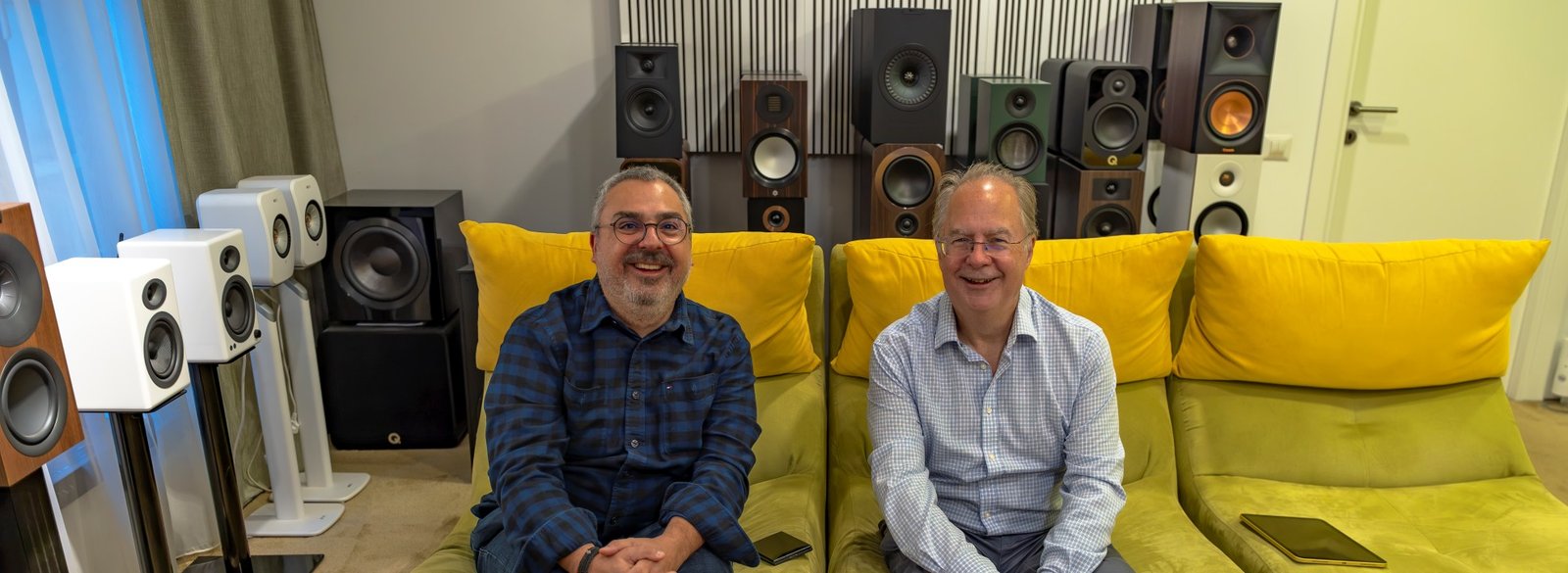
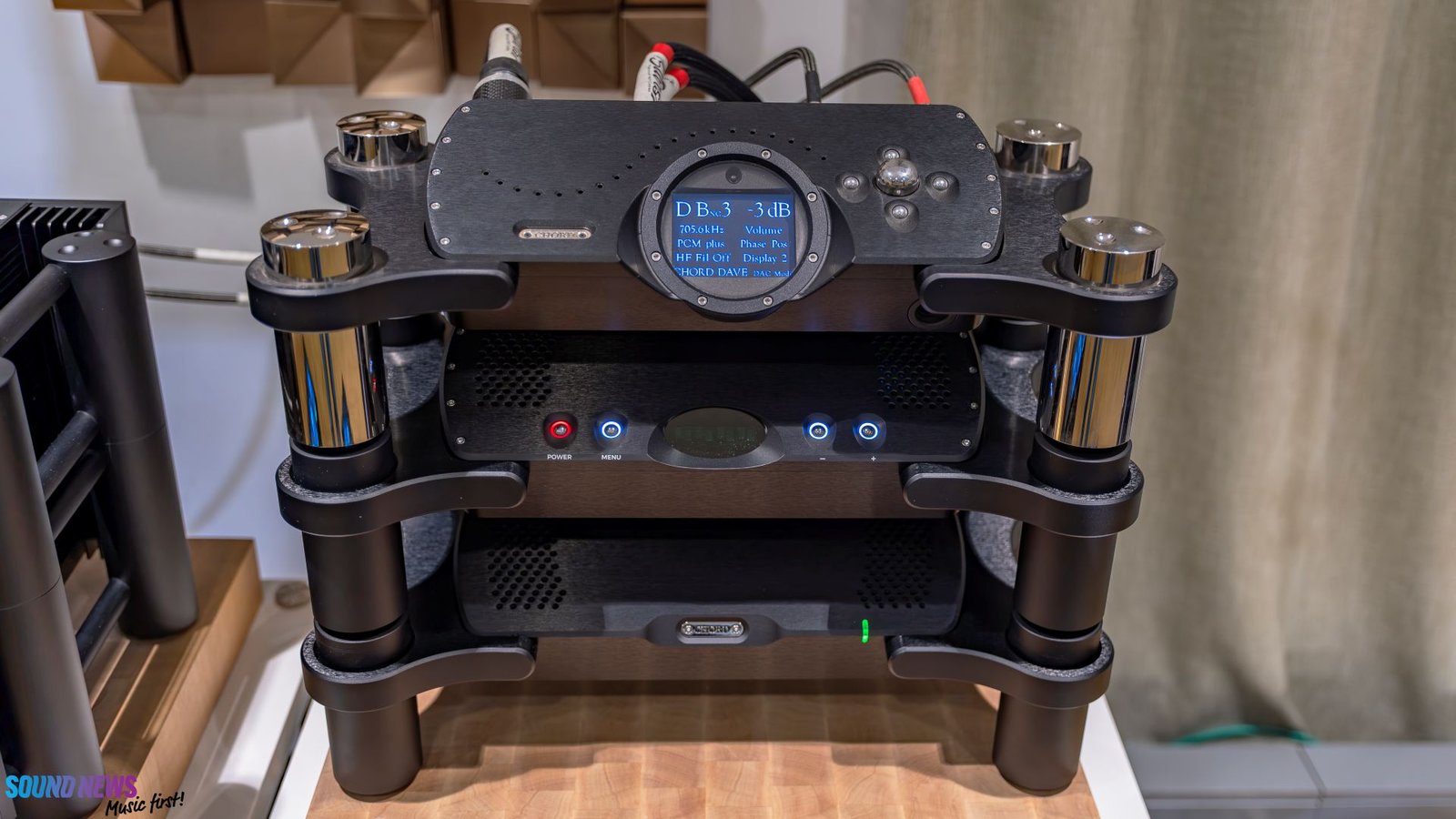
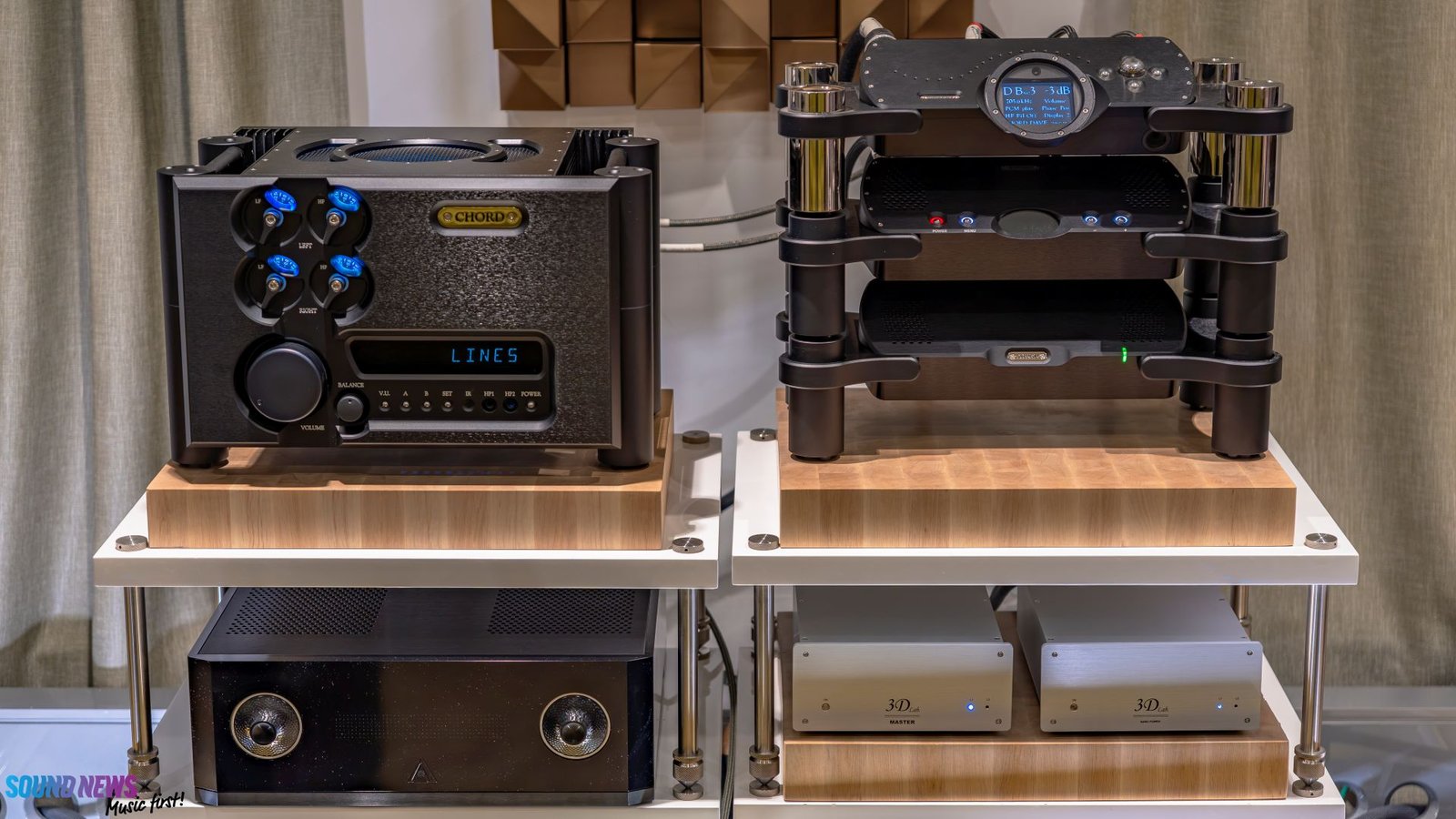
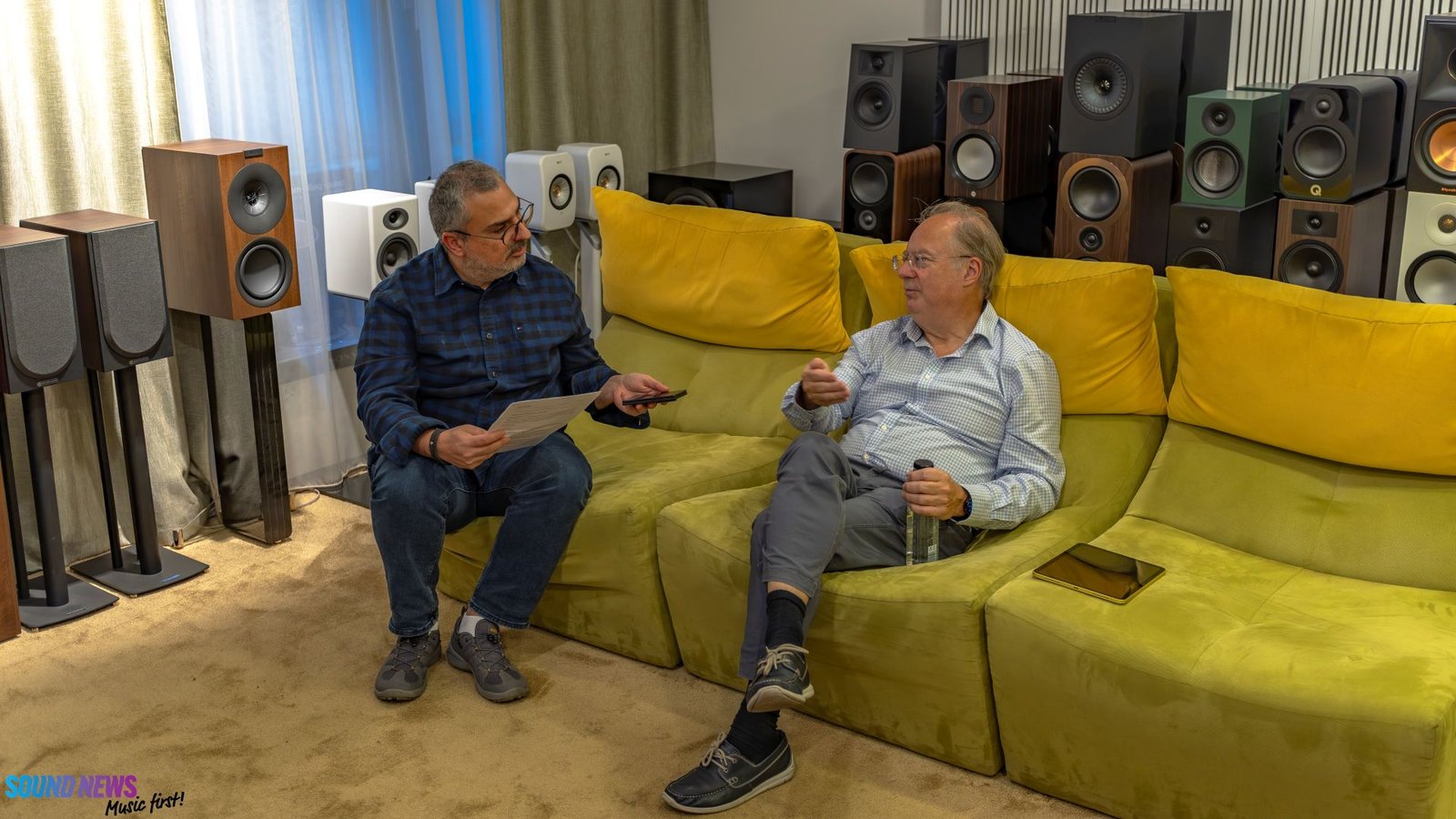
In April we stood in the Chord Electronics factory in East Farleigh, Kent, and listened to a product we were not yet allowed to name. A month later, Quartet was officially launched: five AMD Xilinx FPGAs, 3,700 DSP cores, four million filter taps and, for the first time in a Chord upscaler, an analog-to-digital converter. This autumn, Quartet arrived at the AVstore showroom in Romania, and the man who spent eight years designing it came with it.
Rob Watts is the designer behind every Chord digital product, from Mojo to DAVE to the M Scaler. He is also, as he was keen to point out at the end of our conversation, completely independent of Chord. He runs his own company.
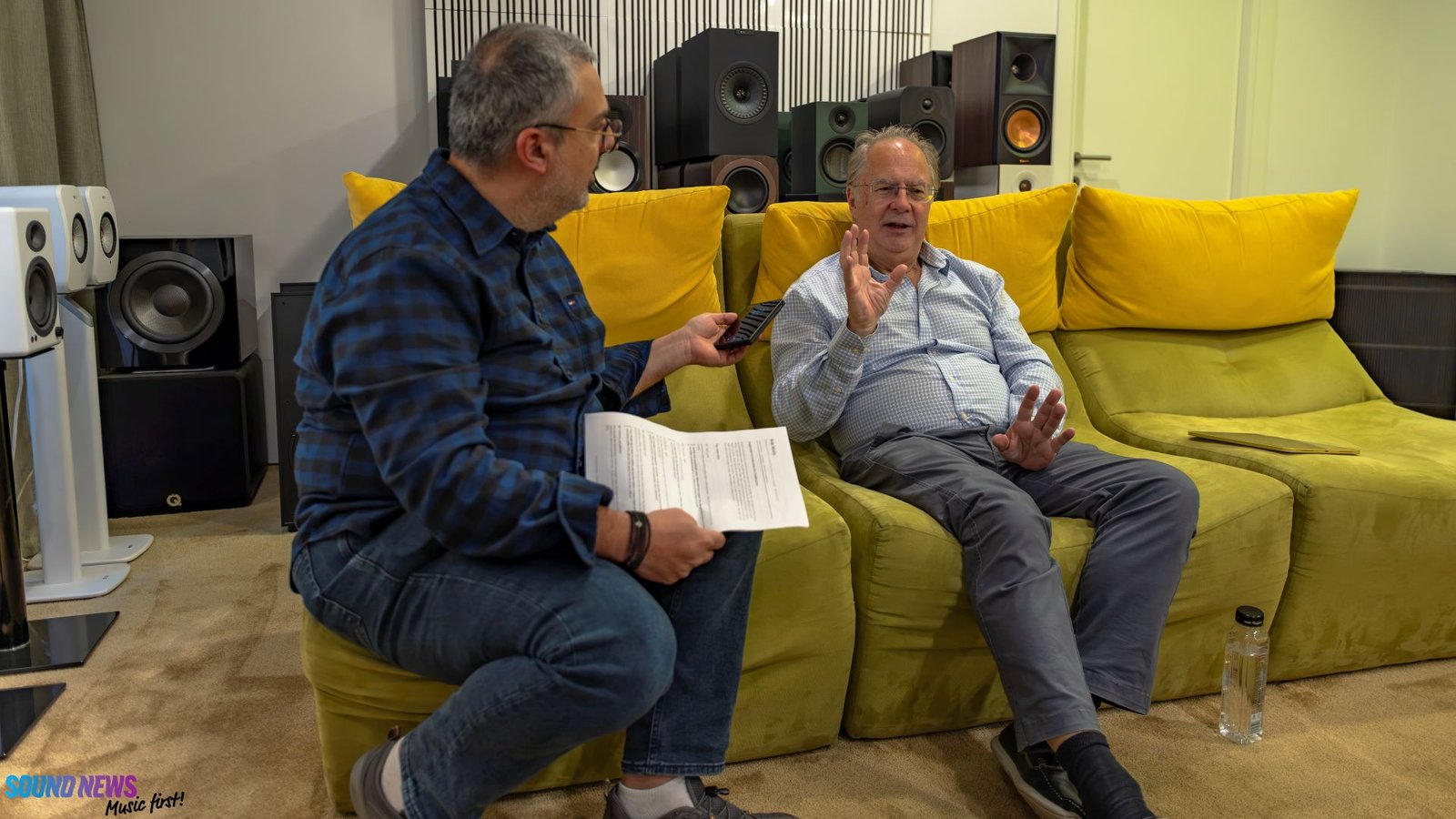
I came with fifteen questions. We got through most of them; the conversation went in directions I hadn’t planned, and Rob kindly answered the rest afterward in writing. What follows is our conversation, edited only for the flow of spoken language and approved by Rob.
The Interview
1 · Eight years
SoundNews: Quartet took around eight years in the making.
Rob Watts: Yes. It’s by far the most difficult and demanding project I’ve ever worked on.
SoundNews: Why did it take so long? Because of the hardware? Because of waiting for FPGAs powerful enough to run it?
Rob Watts: The hardware, yes, that was a problem. But the first part of the exercise was research: trying to understand why interpolation filters make the changes that they do, and working out exactly what’s going on. It started in 2018, when the M Scaler was finished.
When you finish a project, you think about what you’re going to do next. How are you going to improve it? You also think about what you would do differently if you started the design again. You make design decisions, you end up with a product, and sometimes you think, if I’d done it this way or that way, it may have been a better way of doing it. That occurs with all your processes once you finish the design. Was there a better way of doing what I was doing? You’re constantly reappraising what you were doing and why you were doing it, and constantly reappraising listening tests that you may have done ten years ago. Things change. Your assumptions change. So it’s always an iterative, ongoing process, the kind of design work that I’m doing.
But anyway, I had some fundamental questions that I wanted to answer after the M Scaler was finished. The first question was, how many taps do we need to get the best sound quality? Are we going to need 10 million taps, or 100 million taps? At what point is this thing going to stop?
The other question came from when I was developing the WTA algorithm for the interpolation filter that went into the M Scaler. There are five variables in the equation that calculates all the coefficients, and you could tweak those five variables to within 10 parts per million. You’d increase the value of one variable, and it would sound better. Increase it again, it would sound better. Increase it again, it would sound better. Increase it again; it sounds worse. So then you backtrack, increase it again a little bit, find the crossover point, and you just keep getting smaller and smaller until you hit the sweet spot, where you can’t make any more changes. That sweet spot was 10 parts per million on these five different values. So a lot of real fine sensitivity in terms of getting the best with the million taps.
And I thought to myself, why is it doing that? What’s going on? Why is it so sensitive, and why is there a sweet spot in the first place? I kind of knew the answer to that, but I needed to prove what was going on. So the research program was to investigate these issues. After a lot of work and a lot of trying different things, I realized that there are actually two problems, two different effects going on with the WTA filter, and it’s true of all interpolation filters. There are two things degrading transient timing, and they’re contrary to one another. You improve one, you make the other one worse. That’s a fixed problem with a single-stage filter.
So I then worked out what was going on, and I could put a number to when these effects would disappear. Putting that number in, I could then work out how many taps I needed to get reasonably good sound, a reasonably good approximation to the original unsampled signal. How many taps do you think we would need, given that we’re at a million taps with the M Scaler?
SoundNews: I would say four million taps.
Rob Watts: Four million? It’s much, much bigger than four million taps.
SoundNews: Much bigger?
Rob Watts: Yes. It’s four times 10 to the 28. So 28 zeros.
SoundNews: Jesus...
Rob Watts: The delay on that would be 900 trillion years. That is 66,000 universe lifetimes. And this isn’t the best. This is getting to a good reproduction ability.
So I thought, right, we’re in serious, serious trouble. We’ll never get these kinds of numbers; that’s crazy. So was there a way of filtering where you could have one filter that solved one problem, and other filters that solved the other problem? You separate out these two problems and optimize them. That realization led to the Blackbird WTA structure.
Now, there are two things that happen when you use a Blackbird WTA. The sinc function aspect immediately gets ten times better, so your reconstruction accuracy due to the sinc function gets ten times better. And the other problem I can completely eliminate with the new filter structure. Now, instead of 900 trillion years, we’re talking about tens of seconds. So it’s a radical change to how this thing is functioning. And as I said, that led to the Blackbird WTA, which is what we’ve got in Quartet. So the 4 million taps isn’t the story. The story is the new algorithm, the new filter structure. That’s the important thing.
And then there was also the hardware side of things. We had issues getting the heat out. We had issues converting from a research test bench, where you could just throw heat sinks around, to converting this concept into a commercial product. I think we got through nine different prototypes, and there are over 2,000 components within the Quartet board itself. Then there’s the issue of how we make it so that whatever BNC cable you use, it sounds the same, so you don’t need expensive BNC cables. You’ve got the issue of the power supply, and how to make Quartet sound as good as battery power, so that you’re not injecting noise into the mains, or getting mains noise into Quartet, which then gets into the DAC. All these issues needed to be improved as well. These are just engineering design problems: prototypes, building it, testing it, and listening to it. And this is a new way of doing it.
The benefit I had with Quartet was that budget wasn’t an issue. It wasn’t designed to meet a certain price. It had to meet certain technical and sound-quality performance requirements, and then the price is what it is. That’s the way we were.
2 · A name, and an aircraft
SoundNews: There are five FPGAs inside, and it’s still called Quartet.
Rob Watts: Quartet. Four million taps.
SoundNews: From the four million taps, not from the FPGA processors?
Rob Watts: Yes, exactly. We could have called it Quintet, but Quartet rings better. People know about quartets.
SoundNews: And the name of the filter, Blackbird. Where did the inspiration come from?
Rob Watts: Oh, I was always fascinated by aircraft.
SoundNews: So it’s from the aircraft, not from the Beatles?
Rob Watts: No, no, not from the Beatles. It’s from the aircraft, the SR-71. It’s the fastest production jet in the world; they built it in the 1960s in 18 months. Unbelievable engineering, something we’ve lost the ability to do nowadays. It just impressed me, that’s all, and I wanted to come up with a really good name.
3 · Where do the taps end?
SoundNews: We went from 164,000 taps in DAVE, to a million, and now four million. You said the number of taps needed would take longer than the age of the universe.
Rob Watts: Well, the time it would take for the signal to get through the filter.
SoundNews: But you have settled on four million taps now. Do you think you need to increase it?
Rob Watts: Yes.
SoundNews: Still?
Rob Watts: Yes, still. Because I think the limit is now tens of seconds, and that will be a project in the future, to do an Ultima scaler.
Also, we’re now doing 768 kHz recordings with the Pulse Array ADC. We’ve now got the ability to take those 768 kHz recordings, decimate them down to 48 kHz, bring them back up to 768 kHz again, and then compare and see what the losses are in that process. That will allow better decimation, and it will also allow better interpolation filters. The objective is to get the difference subjectively so small that we don’t need to worry about it. And if we find that there’s a huge change, then we need to keep working.
4 · Vinyl through a digital box
SoundNews: Just a personal curiosity. If you had a perfect analog chain, wouldn’t that still be better?
Rob Watts: No.
SoundNews: No? Why?
Rob Watts: Here’s an interesting thing. We’ve got the analog input on Quartet.
SoundNews: For a vinyl turntable, for example.
Rob Watts: Exactly. I was testing it doing our own recordings in studios, and Chord was testing it with vinyl. They had a turntable and the Chord phono stage connected to a preamplifier, and they also connected the phono stage to Quartet, to DAVE, and then from DAVE back to the preamplifier. They could switch between the two. Not only did DAVE and Quartet sound better, it sounded a lot better. And when they told me this, I said, “That doesn’t make sense. That doesn’t make any sense at all.” Because there are always losses involved in digital. No matter how good it is, there are going to be losses. Then I realized why.
SoundNews: Why?
Rob Watts: Built into Quartet is an 18 kHz filter, which is used as part of the decimation process within the ADC, and you completely eliminate everything above 20 kHz. You eliminate the distortion and noise that vinyl, or any source, is generating above 20 kHz. Now, you may think, well, you can’t hear the distortion and noise above 20 kHz, so how can that matter? Actually, you can hear it, because it changes the transient timing. When the timing gets corrupted, you perceive it.
And by eliminating all of that out-of-band noise and distortion, you radically improve the sound quality. The transparency losses involved in DAVE and Quartet are smaller than the benefits we’re getting by completely eliminating all the high-frequency noise. And you can’t do that with analog. With an analog filter, A, it’s impossible to do what I’ve done in terms of eliminating high-frequency noise, and B, even if you did have a very good filter that could attenuate everything above 20 kHz, it would not be transparent, because analog itself is not a transparent process. You want to keep your analog as simple as possible.
And that’s exactly what we’re going to be doing with the Pro ADC. It’ll have microphone inputs, and you’ll have just one op amp connecting directly to the ADC. Then everything gets processed in the digital domain. The mixing will be done in the digital domain, with the 108-bit processing that we’ve got, and all of that will be done transparently. So it won’t be going through an analog mixing desk with lots of contacts, lots of amplification, lots of capacitors, all of them degrading the sound quality. It’s going to end up being a huge change to the way recording is actually done. Analog has got huge losses with it, and conventional digital has got huge other problems. If you solve those other problems, you end up in a much better place.
SoundNews: Really interesting. I never thought about that, but you are totally right.
Rob Watts: And the funny thing is, a lot of people think you must have wide-bandwidth amplifiers. Well, all you’re doing is letting the rubbish in and creating more distortion. You’re much better off completely filtering the high-frequency content. The issue is trying to do it completely transparently. You can do that with digital, but it’s very difficult to do.
SoundNews: When you say completely transparent, you mean not affecting any other part.
Rob Watts: Yes. And the reason I know these high-frequency filters are completely transparent is that I put two filters together in cascade, so the signal was going through two high-frequency filters, and there was absolutely no difference in sound quality whatsoever. If it weren’t transparent, you’d hear a loss.
SoundNews: Or you put three or four.
Rob Watts: Well, I could only get two into a 200T. It’s a huge filter, it takes up a whole 200T. So in itself it was completely transparent. But getting to that stage was actually a big struggle. There are details I just don’t talk about because it’s too involved and it’s proprietary. But we work to a very high degree of mathematical accuracy to get this level of performance.
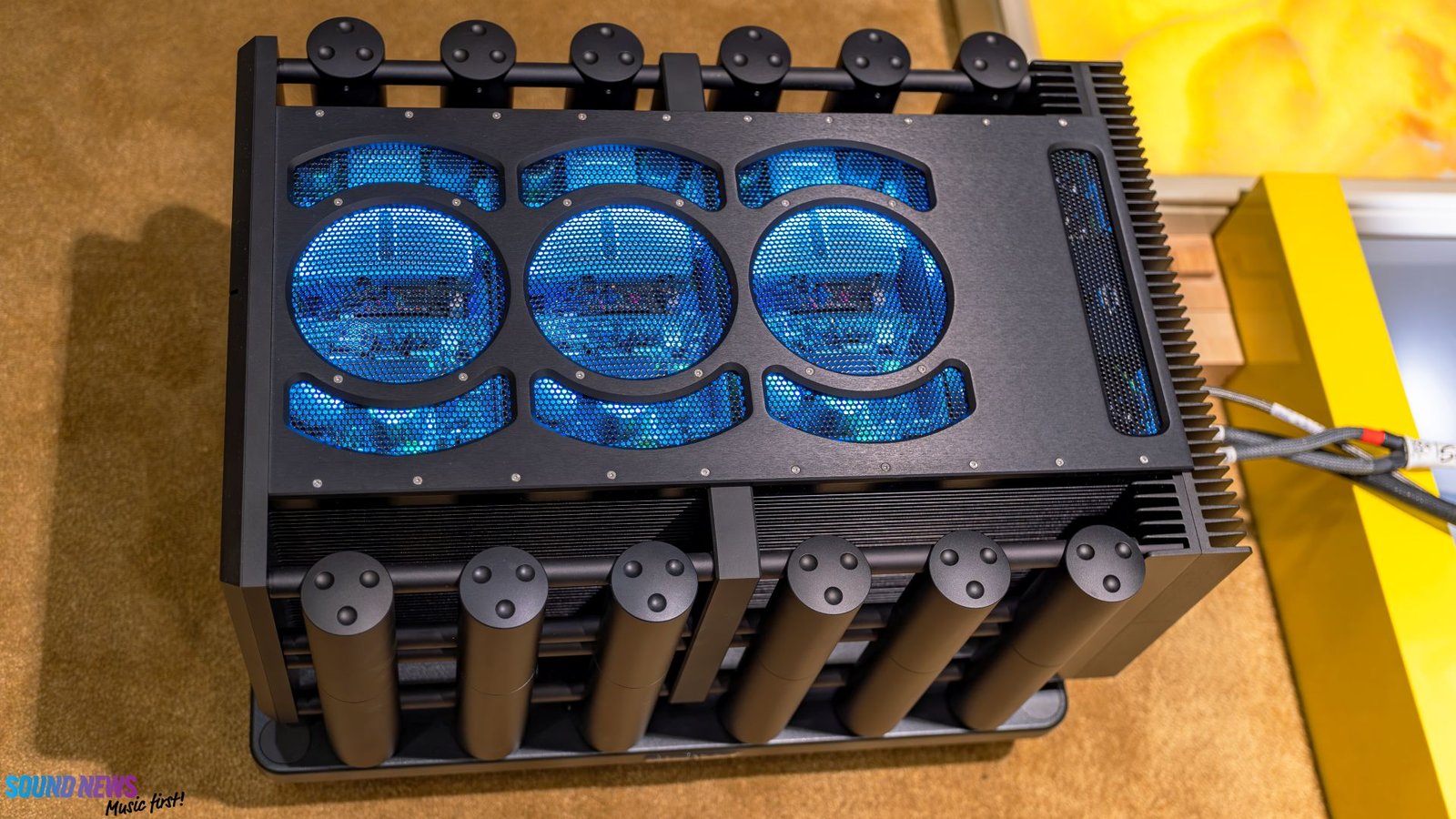
The 200T is an AMD Xilinx XC7S200T FPGA. The Hugo M Scaler uses one; Quartet uses five.
5 · Taps on a PC
SoundNews: My next question was about filters. Many listeners upsample on a powerful PC, and with a powerful enough PC, maybe you can go above four million taps.
Rob Watts: Well, I’m not sure they are doing that. The companies that claim they’re doing more taps use convolution, FFT convolution. They turn it into an FFT, make the changes in the frequency domain, and then do an inverse FFT to get it back to real time. Now, that process has its own set of problems, one being Fourier frequency resolution, and this degrades transient timing. What they don’t publish is how big the sizes are that they’re using to process this, and that is of much more interest than what the equivalent tap length is. They just don’t tell you what those numbers are. So I’m very, very skeptical when people say this is millions and millions of taps, because they’re not using taps. It’s being done in a different way.
SoundNews: In my mind, the question was whether you could provide software, your filters, running on a very powerful computer instead of the dedicated hardware.
Rob Watts: We do these kinds of things on our own processing, to create coefficients, and the PC takes forever. I’ve got a very, very fast PC, and it takes a very long time. So this is why I’m skeptical.
SoundNews: So in the end, it’s very highly optimized hardware.
Rob Watts: Exactly. And that’s the benefit of doing it with the FPGA, because you can work to the precision that you need to work to, and it’s a direct FIR filter. It doesn’t have these tricks of FFT convolution, which cause other problems in other areas. The other issue, of course, is what you are actually doing, and how you are doing it. The algorithm itself is much, much more important than the number of taps, as the Blackbird illustrates and as the WTA illustrates. I don’t think you can do a WTA-type solution directly with convolution. Well, actually, you could do it, but it would be really, really difficult.
6 · DAVE, and a Mojo 2 surprise
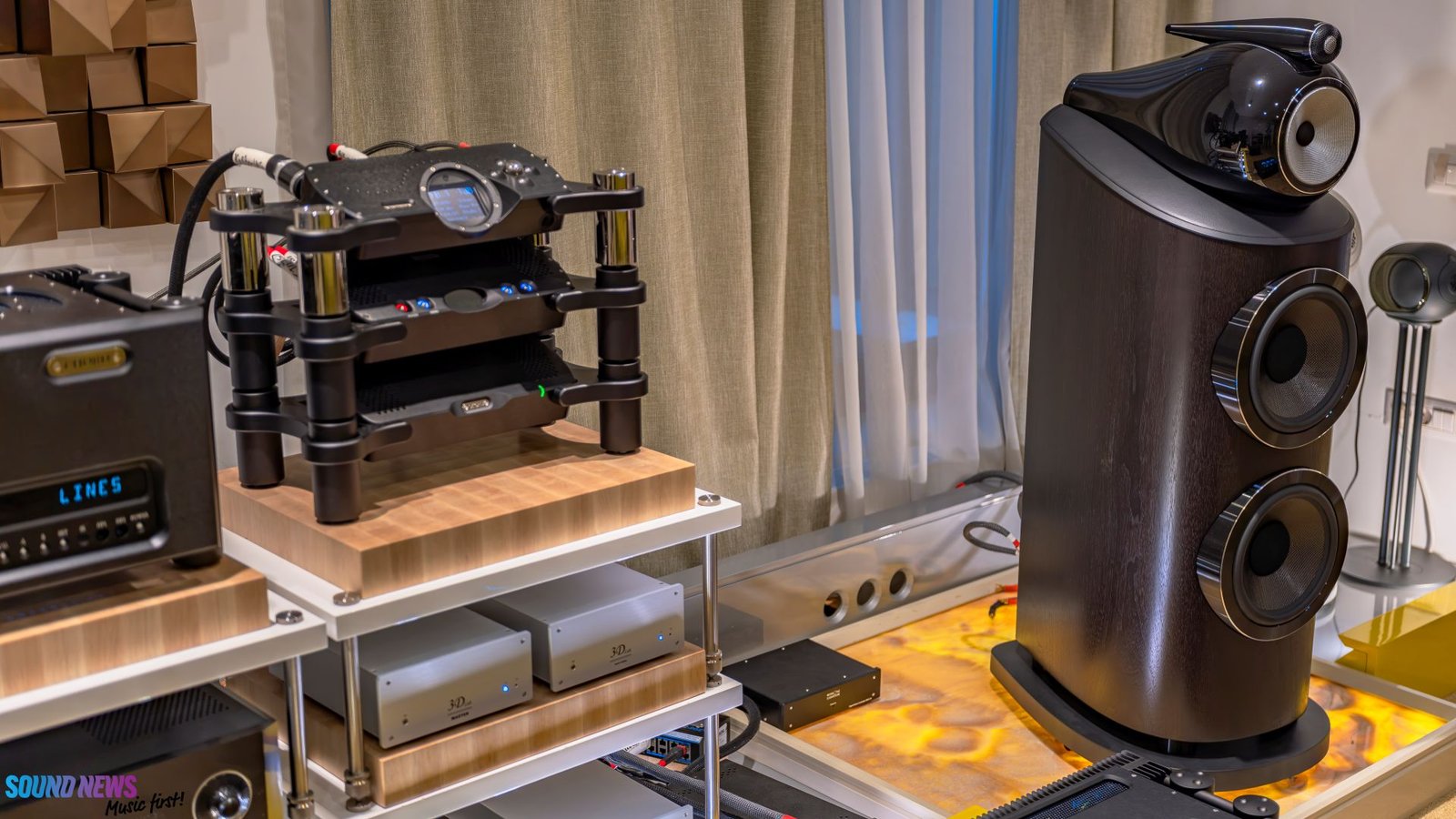
SoundNews: Quartet unlocks DAVE’s full 768 kHz. But DAVE is over ten years old now. Is it still the perfect partner for Quartet?
Rob Watts: Absolutely. But let’s be clear, it is not the perfect DAC. If I were to say it’s the perfect DAC, and then in five years’ time came out with a better DAC, I would be shown to be a liar.
SoundNews: You know how many are doing this, year after year.
Rob Watts: I know. And they always say, this is now perfect, this is the best thing we can do, the best thing since sliced bread, blah, blah, blah. And then, oh, we’ve got a new one that’s the best thing since. Year after year. I’ve never done that. I’ve never said this is a perfect DAC, because I always see room for improvement.
But the question is, is this the best DAC on the planet today? Yes, it is. If you’re interested in being emotional with the music, if you’re interested in hearing the original recording as an original musical event, then Quartet and DAVE is by far the best combination you’re going to get.
When we first showed one of the prototypes at Munich, just over two years ago, a customer who had sold his DAVE managed to sneak in and listen to it. And he said, oh dear, I’ve made a big mistake, because this transforms DAVE into a completely new category, and you can so clearly hear it. I’m going to have to go out and buy another DAVE, ready for when Quartet comes out.
SoundNews: And for a Qutest or a Hugo TT2 owner? Does Quartet make sense with a smaller DAC, or is it just a jet engine on a bicycle?
Rob Watts: I’ll raise the stakes on that argument. When we put the 4.4 mm connector on Mojo 2, my listening tests were done with Quartet. And I couldn’t believe how good Mojo 2 sounded with Quartet. It just completely transforms the performance. It made me realize how damn good Mojo 2 actually is when given a proper signal. It’s an amazing DAC. So yes, it works with a Mojo 2. You’d never buy a Quartet and use it with a Mojo 2; that’s for the fun of it. It wouldn’t be a sensible pairing. But yes, it works.
7 · Why an ADC
SoundNews: Quartet is the first Chord upscaler with an ADC. You have already answered part of why: it sounds better this way.
Rob Watts: The key question is why we did it, because that’s a different story. I’ve been working on the ADC for a long time. It was a project in the background. It never had high priority. It was something I wanted to do, rather than something driven commercially. And by the time I got to test Davina, some of its components had been discontinued and there was no replacement. So I thought, right, there’s no point in me testing this thing, because we can’t produce it. So the design was scrapped. Then I had this quandary about what I was going to do to replace this crucial part. It was a flash converter. So I parked it.
Then Chord came to me and said that what they’d like to do with Quartet is to have an analog input. They reckoned they’d sell about 20% more scalers because of having an analog input, and people could do their own recordings from vinyl and all that sort of thing, which makes it more attractive. We were looking at doing a separate ADC or integrating it with the scaler.
The benefit of integrating it with the scaler is that the cost is minimal, because the cost of an ADC, even the discrete ADC that we’re using in Quartet, is the FPGA, the power supplies, and the metalwork. The actual integrators and audio components to do the ADC are small compared to the cost of Quartet. It’s a rounding error in bill of materials costs. So we could put it in, and it wouldn’t impact the selling price.
So I didn’t buy the idea that it would increase sales by 20%. But what it meant was that we had to finish Quartet, and I had to finish the ADC. So it went from a project that I’d like to do to a project that had to be done. Sometimes you need a kick to get things done, and this was the kick.
And when we started doing the test recordings, and we’ve done two test recordings so far, the difference has been extraordinary. I really, really wish I’d done the ADC many years ago, because it would have put the recording world in a different place than where it is today. If I’d actually done Davina and got that working in 2016, because that’s when Davina was started. But it wasn’t a high-priority project. It was something I wanted to do.
But now I’ve proven the technology. I’ve proven what it can do from a sound quality point of view. And I’ve got my son as well, who is a recording engineer, and he is now working full-time on this, so he can do the bulk of the work and we can get it done. And it’s not going to be a normal interface ADC. It’s going to combine lots of things that people probably do in mixing as well. So it’s more of a mixing desk than a processor.
8 · An EQ for purists
SoundNews: Quartet has a lossless 108-bit EQ. In a reference product, purists don’t use tone controls, for the simple reason that it screws up the sound.
Rob Watts: I use it a lot, and it doesn’t degrade the sound quality. I know Quartet doesn’t degrade the sound quality because we’ve got a ten-band equalizer. You can set one to plus a half, the next one to minus a half, plus a half, minus a half, plus a half, minus a half, so you’re actually getting quarter-dB ripples through it. And when you do that, there’s no loss in transparency. There’s no loss in detail resolution. There’s no loss in depth. The instrument separation and focus sound exactly the same. So you can have this thing working, and it doesn’t do anything.
I also know that when I set it to extreme limits and put a minus 301 dB signal into it, I’m looking at whether the phase shift is accurate to within a thousandth of a degree, and whether the level is within a thousandth of a dB compared to 0 dB. If it passes that measurement test, then it’s going to be transparent, and it does pass. It’s so good that it will reproduce a minus 301 dB signal perfectly. So there’s no noise floor modulation. You’re completely accurately encoding very small signals, and the phase delay is consistent. That’s going to be really important with pro audio, because they use EQ all the time.
SoundNews: They want to tone it, adjust it, pan it.
Rob Watts: Yes, exactly. So being able to do the panning, the EQ, and we’re thinking of doing compression and reverberation within this project as well. A studio engineer will have all the tools at his fingertips, at a much higher level than you can get with existing DAWs, the digital audio workstations. It’ll change the way recording engineers do things, because a lot of what they do is trying to compensate for the losses that the ADC is creating, and you won’t need to do that with the Pulse Array ADC. So it’s going to be interesting.
We’ve got people in the pro audio business who have heard the ADCs, and they’re very, very excited about the possibility. One of them is Warner Music Group. They’ve got a lot of tape from the 1950s.
SoundNews: It’s a great opportunity to salvage it, to preserve and archive their material.
Rob Watts: Yes, at a very high quality level. So that’s why they let us into their studios. We had a day’s studio time with a really good pianist and a really good vocalist, so we could test out what the ADC could do. They’re very keen on the project.
9 · One box or two
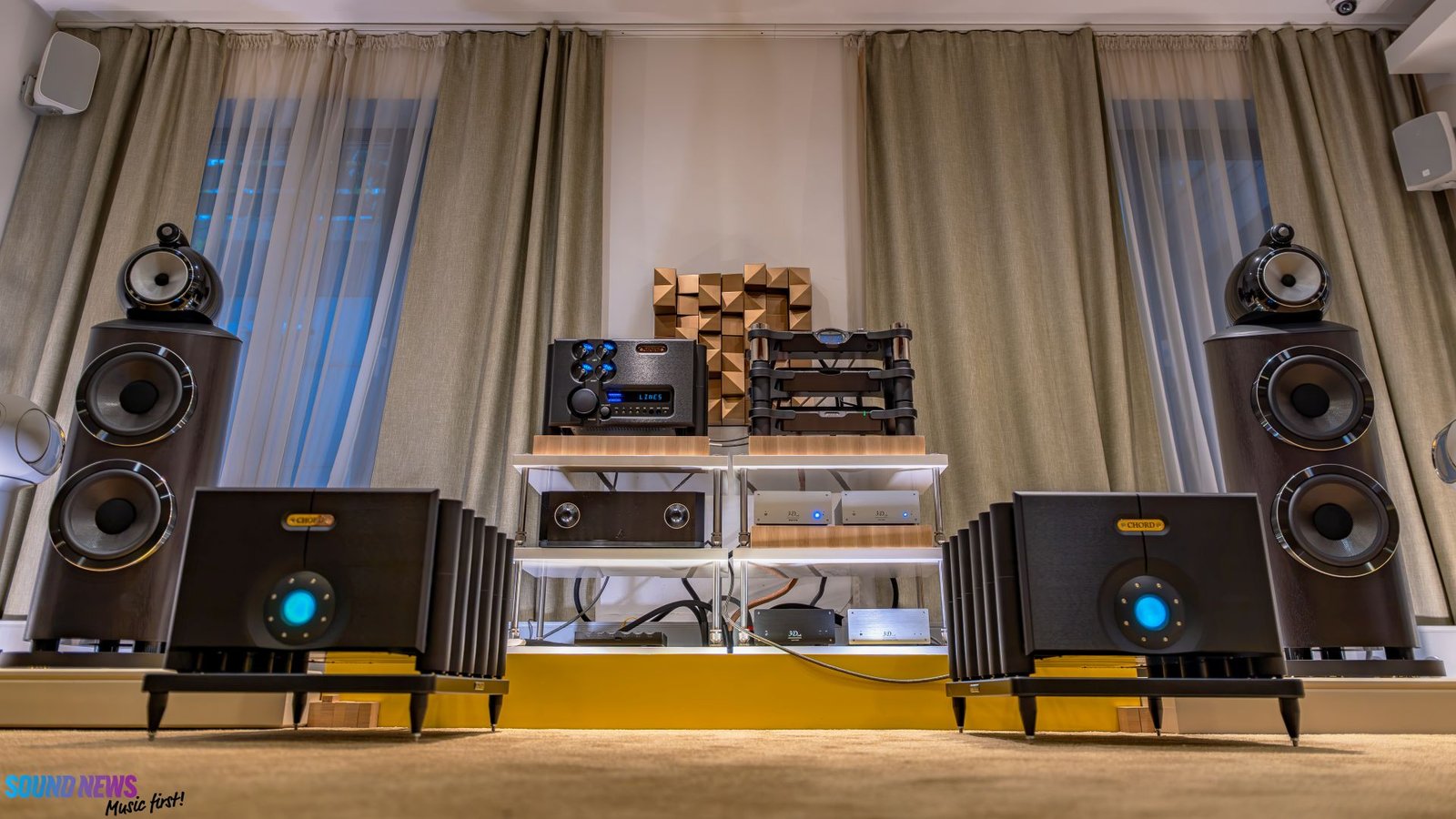
SoundNews: Now, the question everyone here wants to ask. Will there be a successor to DAVE? A DAC that needs Quartet, or one that can contain it? Could you have Quartet and a DAC inside one chassis?
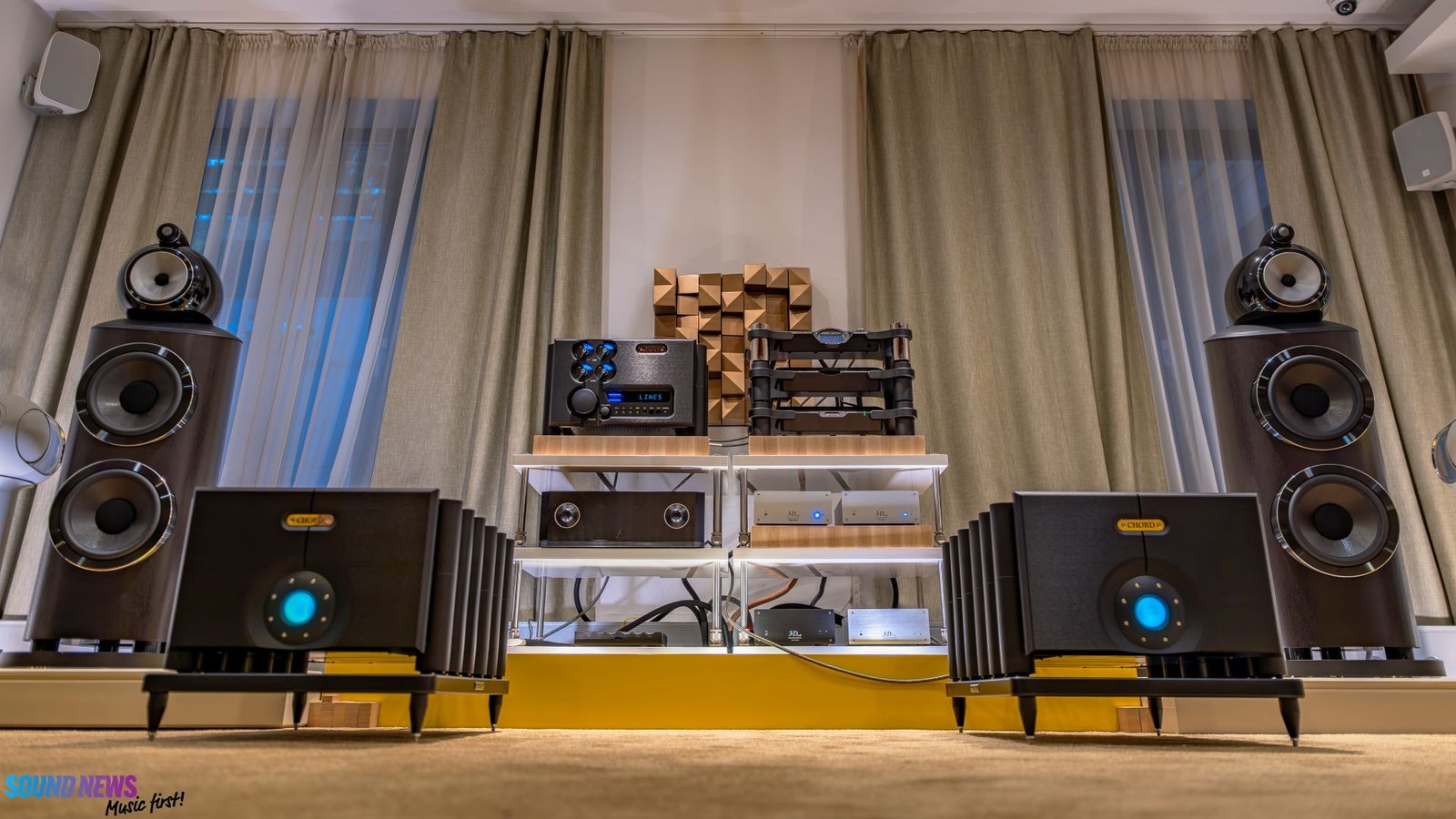
Rob Watts: I think that would be a nightmare. An absolute nightmare. I never say no, but the difficulty of preventing the noise of all the processing from upsetting the DAC was an enormous challenge. That’s why we’ve got separate power supplies, and that’s why I had to develop a new type of RF filter, which I’ve called a pinch-off filter. It has two roles. There are actually two filters built into it, one to stop noise escaping and one to stop noise coming in, and each RF filter is some 200 components. Putting all of that together, with the electromagnetic noise, in one chassis would be a huge, huge challenge. So it’s easy to say no, it’s got to be kept separate.
Long term, maybe there’d be a solution, but I don’t know how we’d do it. By keeping it separate, with separate power supplies, you completely eliminate that issue. But it’s been really, really tough to make it work. And I know it works because I compared it to a very large lithium-ion battery feeding it. The target was to get sound quality as good as a lithium-ion battery, and I’ve succeeded in doing that. But that took a lot of work.
10 · What comes next
SoundNews: So beyond DAVE, what else is coming from the digital side of Chord?
Rob Watts: I’ve still got the Ultima DAC to finish.
SoundNews: That’s still on the map?
Rob Watts: Yes, it’s still on the map.
SoundNews: But it’s not actually a DAVE successor, right?
Rob Watts: It’s a completely different product, and it’s going to be much, much more expensive than DAVE currently is. So I can get back to that. I had to forestall that project because I got so involved in Quartet, and the lessons learned in Quartet were going to be more valuable than what I would learn with the Ultima DAC. And of course we’ve got this project with pro audio, and that is really, really exciting, because that will improve everybody’s life.
11 · The recordings
Rob Watts: I’ll send you copies of these recordings, because they are extraordinary. The really interesting thing came out of both recordings.
SoundNews: They’re PCM recordings?
Rob Watts: Yes. One is 768 kHz, 24-bit, and one is 192 kHz, 24-bit. The 192 kHz one was based on an analog tape that Daniel made using an analog mixing desk, no Dolby. It was there to set up the ADC, because we needed a repeatable source, so I could make changes to the ADC and hear what the difference was. You can’t use a digital source; you have to use your own source. And I also wanted to find out how much of a difference it made compared to commercial pro ADCs. So it was for two reasons.
And the strange thing I noticed was that the female vocalist’s pitch reproduction was very, very different on the Quartet ADC. The purity, being able to follow it. She sounded out of tune on the commercial ADC and in tune on Quartet. I can actually show it on my phone, if it’s quiet next door. You can hear the difference on this little phone.
Rob plays the same passage twice on his phone, first through the high-end Pro-ADC, then through the Quartet ADC.
Rob Watts: Just listen to her voice, the quality of her voice, the pitch. The way she says “room”. Before, it’s the wrong pitch, but on here it’s the right pitch. And it’s exactly the same cut, exactly the same tape.
SoundNews: It’s weird. And through the speaker of a smartphone.
Rob Watts: Yes. And when you hear it on headphones, you hear all the other things that are better, the soundstage depth and everything else. But of course that is using tape, so the next stage is doing digital recordings. When I did CanJam LA, on the Friday we went to Glenwood Place Studio in Burbank, California, and had really good musicians there, a vocalist and piano. It was the first time I’ve ever heard a piano sounding like a real piano. We didn’t have enough time to mic it correctly, particularly when the pianist and the vocalist were together, because they only had half an hour of overlap. We weren’t paying for the sessions or anything, so we had to live with what we got, and Daniel would have done things a little bit differently. But playing it back, the first time we played it back, it just put tears in my eyes, because it was so different to what you normally hear a piano sounding like. And when I was actually in the room and the pianist was playing, I was standing close to the piano, and it was so much like that sound.
So this is really, really exciting. And remember, this is just a test of the ADC itself. The pro ADC will be a completely different beast. In technical terms, it’s like Mojo against DAVE. The pro ADC will be DAVE standard, and what we’ve currently got is sort of Mojo standard. And it was going through a 1970s Neve mixing desk, and all of that structure will be eliminated on the pro ADC. You do the mixing in the digital domain, the EQ in the digital domain, everything. The analogue section will be very, very simple, just one op amp feeding straight into the ADC. So it’s really, really exciting.
SoundNews: Very nice!
Rob Watts: The benefit is that everybody wins. You don’t need to spend large sums of money on a Quartet, because your recordings will get better.
SoundNews: If they release 768 kHz recordings. And also preserving the old tapes.
Rob Watts: Yes. So it’s not just about preserving them. It’s about getting the quality right from the word go. There are two issues: preserving the old tapes, and getting the transcription that we can hear to a much better standard. That’s something they’ve been talking about: that we’ll be able to get access to some of these master tapes and work on them. So that’s a potential for the future.
SoundNews: You know what’s happening at Iron Mountain, where they keep the tapes? What you can do is provide an ADC.
Rob Watts: Absolutely. And that is a real value to this process.
SoundNews: Because now, if you need a tape, you just call them. They put it on the original tape machine that was used to record it, or as close as possible, because they have many, and they digitize it. You get a digital copy. You will never see the tape again.
Rob Watts: Absolutely. So they’re really intrigued by that. It’s good.
SoundNews: Thank you so very much!
Rob Watts: Thank you so much.
Rob’s recent seminars on Quartet can be downloaded at rnd-audio.co.uk/seminars, and the Quartet recordings at rnd-audio.co.uk/recordings, with more to be added in due course.
Four Questions, Answered in Writing
We ran out of time on the day, so Rob kindly answered these afterward in writing.
A · What a listener hears first
SoundNews: When I heard Quartet in Kent, the speed of the transients struck me first. Leaving the numbers aside, what should a listener notice first, before they even know what to listen for?
Rob Watts: That’s a really difficult one to answer, as Quartet was developed over many years with many changes and improvements, so I never had a finished design to listen to! A huge amount depends upon the listener too. Also, there are so many things that change, and the speed of transients is certainly one of them. The way an individual instrument can leap out from a dense mix with a huge sense of power is another. Timbre variation and soundstage all get a lot better. Another huge thing is being able to unpick lots of instruments simultaneously. They don’t disappear when a very loud instrument comes in. Then there is the natural sense of flow: tempo doesn’t sound mechanical or jerky. And finally, playing well-loved music and experiencing the emotions as if for the first time.
If you wanted me to say one thing, it would be that instruments sound so much more real.
B · Setting it up right
SoundNews: Setup advice for owners: the connection to DAVE, latency for music, cables, power, placement. What mistakes do you see most often?
Rob Watts: Make sure the HF filter is set to 18K!
C · The steak
SoundNews: You’ve compared digital audio to putting a steak through a mincer. With Quartet, how much of the steak do you think we get back now?
Rob Watts: Lots! But the key question is how much difference we get when decimating from 768k down to 48k, then back up to 768k. Is that loss acceptable, or is there more work needed on decimation and/or interpolation? This is a question we can answer soon, and it’s why we need to build up a bank of test recordings, which we are doing now and into 2027.
D · The engineer at home
SoundNews: At home, do you ever just listen for pleasure, or is every record a listening test? And what was the last record that made you forget you’re an engineer?
Rob Watts: Absolutely, I listen for pleasure. Philip Glass, Koyaanisqatsi, is on at the moment! And I don’t listen as an engineer, except when doing subjective testing.
Thank You
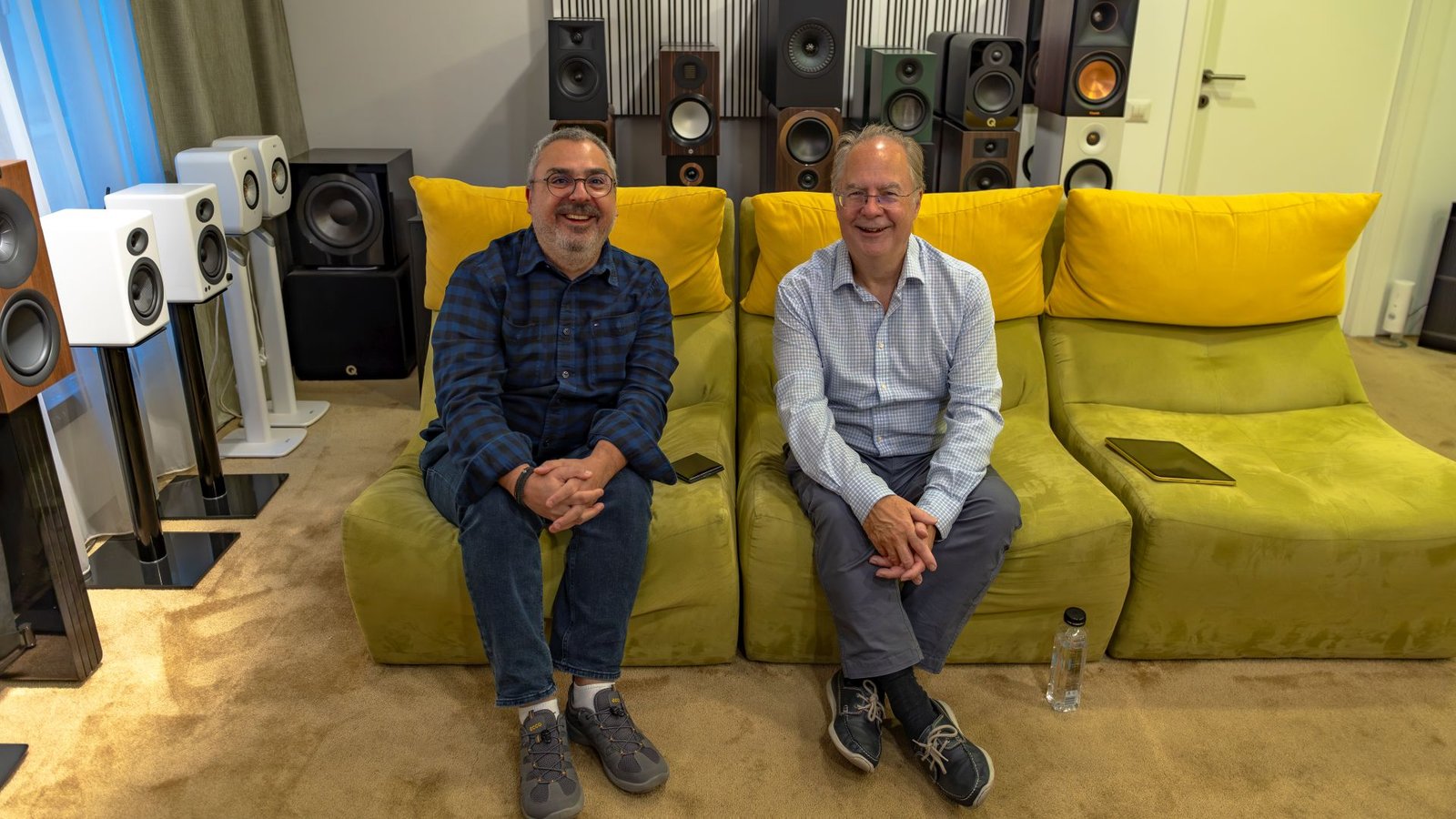
My warm thanks to Rob Watts for his time, his patience, and his generosity with ideas, and to AVstore (avstore.ro) for hosting the Romanian launch of Quartet and for making this conversation possible.