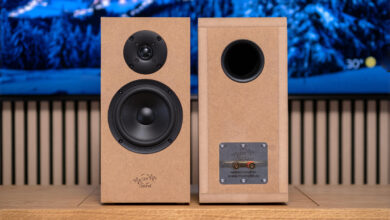
A conversation about listening, wood and the soul of handmade things.
Introduction
Before a violin maker glues the top to the body of an instrument, he does something that has no place in an engineering manual. He holds the thin plate of spruce between two fingers, close to his ear, and taps it. Then he listens. He shaves a little more wood away, taps again, and listens again. No chart tells him when to stop. The plate tells him, and only an ear that has heard a thousand plates before can understand the answer.
I kept thinking about that gesture during my conversation with Sven Boenicke. Not because he builds violins, but because everything he told me pointed back to the same quiet discipline: listen first, and let the measuring instruments help you only once you know what you are listening for.
Sven Boenicke is not a typical loudspeaker designer. He is also a sound engineer, and he records acoustic music for his own label, B:THERE Records. He has stood in the room while the music was being made many, many times, and he carries that memory into every product he voices. His cabinets are milled from solid wood; his drivers are held by their heavy part, not their light one; his bass-midrange drivers run without a high-pass filter. And his loudspeakers are even allowed to move. Each of these choices goes against the grain of the industry, and each one, as you will read, came from listening rather than from theory.
The W5, the small speaker that started the W series some thirteen years ago, has become something of an icon, copied many times by hobbyists, which Sven calls free advertising. This autumn, the Basel company takes its biggest step since then: the AIO, an all-in-one amplifier, preamplifier, DAC, and network switch, developed with two Norwegian engineers and built, like the speakers, around the idea that fewer boxes and fewer cables leave more room for the music.
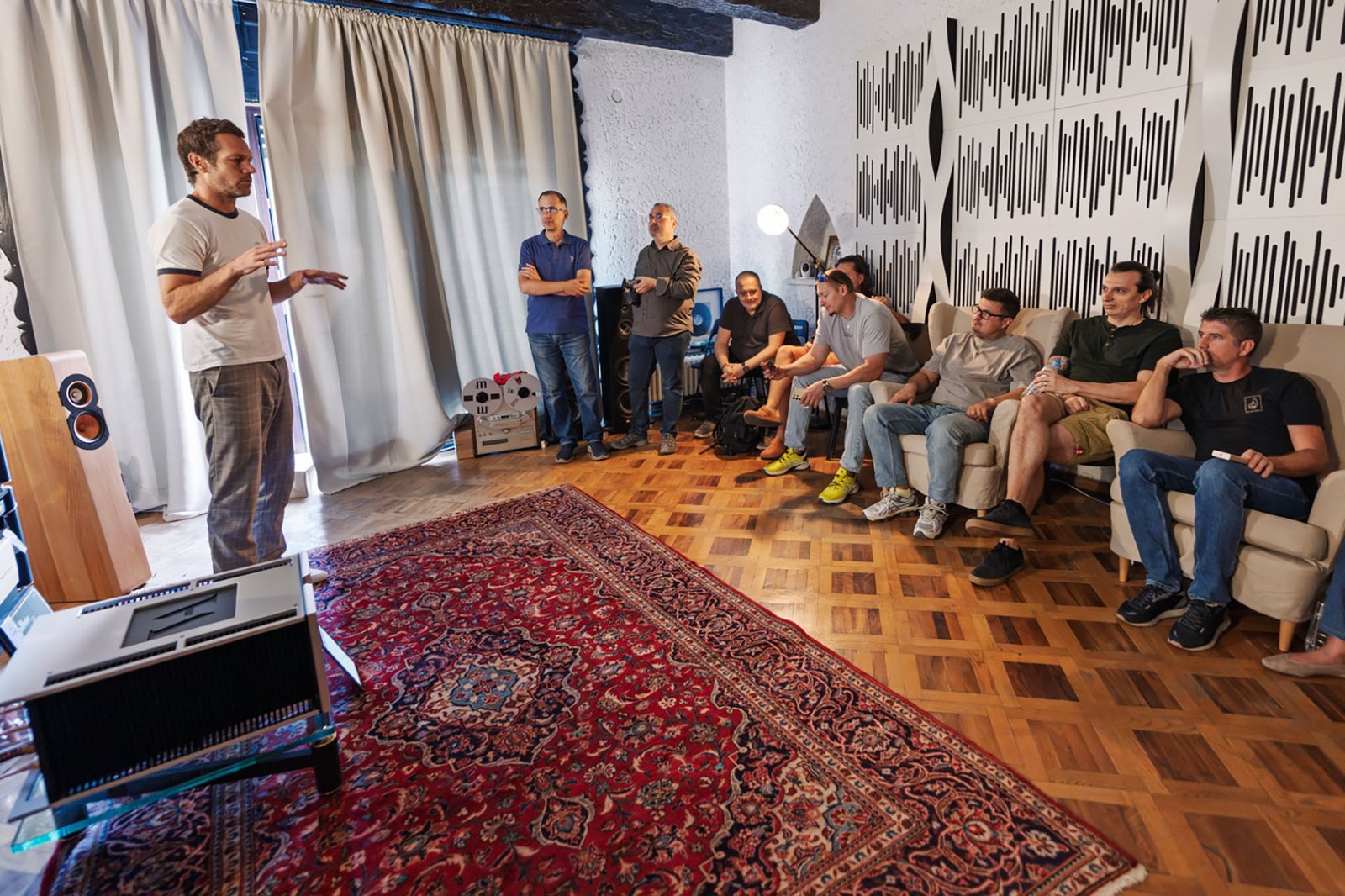
We talked on 19 September 2026, with a pair of W11 playing in front of us at HiFi Expert. I came with twelve questions. Sven answered them, and then took the conversation further than I had planned, from paper voice coil formers to 432 Hz, from a laser-engraved wooden carrier on every magnet to our place in nature in the age of AI.
My warm thanks to Sven Boenicke for his time, his patience, and his candor. And a heartfelt thank you to the team at HiFi Expert (hifiexpert.ro) for their warm welcome and for an event of rare quality, from the care taken with the system to the atmosphere in the room. Evenings like this are why I still love this hobby.
Some of these ideas will be new to many readers, and some will be debated. I asked every question with curiosity rather than suspicion, because a designer who has thought this long about something deserves to be heard in his own words. That is what follows. Sven’s answers have been edited only for the flow of spoken language, and approved by him. Listen first. Then decide.

1 · The sound engineer’s ear
Soundnews: You also record music for your own label, B:THERE Records. To be honest, most speaker designers have never been in the room while the live music was being played. So when you voice a speaker, how much is based on measurement, and how much on your experience and your memory of the recording?
Sven Boenicke: Of course, we do have measuring equipment, and using it to voice a speaker helps you save time. But only once you know what a measurement should look like for the speaker to sound correct. If you think a measurement should look like a straight line for the speaker to sound correct, that’s not the case. If you know where the measurement shouldn’t look like a straight line, the measurement system can save you a lot of time.
And the reason why the measurement should not look like a straight line is that our ear-brain complex, the mechanism of how we perceive sound, has not much to do with a measuring microphone. If you look up charts of the isophonic curves on Google, you’ll see the inverse curve of our hearing sensitivity. That means our hearing sensitivity isn’t equal across the whole frequency band. We don’t hear as well in the high treble or the low bass, and we hear best around 3 kHz. This is done by nature. When a newborn child really cries and yells for its mom to look after it, it cries at around 3 kHz. That’s quite high up; I couldn’t imitate it anymore. That’s why nature made our hearing most sensitive around 3 kHz.
So if you design a speaker, you can actually look at the isophonic curves. If you design a speaker according to that curve, it will sound more natural, and with more image depth, than a speaker that measures completely flat.
And yes, my own recordings were of course a big help to find out, originally, which curve actually sounds the most natural. As a sound engineer, I’ve been in the sound field many, many times, so I know what real music sounds like, and I have quite a good ability to remember sounds. So I can compare what I hear from a speaker with the original sound. Making your own recordings is a good tool. That way you really know what you’re doing.
2 · Wood and time
Soundnews: Wood is the one material a cabinet engineer is told to avoid, because it ages and its structure changes over time, so it should change the way it resonates and reacts. Does a Boenicke speaker sound different after five years, once the wood has settled?
Sven Boenicke: Actually, over time, the changes the wood goes through with changing humidity become less and less. A wood that has aged really well will be less prone to change with humidity. Let’s say you have very low air humidity in the first winter, mostly when you heat. The air becomes really dry, maybe down to 15 percent or so, which is way too dry. It’s also too dry for us; it’s not healthy anymore. And if the speaker has survived that in the first year without any cracks, it will very likely survive it in the second and the third year and so on. So it becomes less and less sensitive to changes in air humidity.
But the warranty we give is void if you operate the speakers below 35% relative air humidity, anyways.
3 · Holding the driver by its heavy part
Soundnews: It seems everybody is trying to isolate their drivers from the cabinet. On the W11 you do the opposite: you force-fit the magnet into the whole wooden mass. Why?
Sven Boenicke: What do you mean by everybody decoupling the driver from the enclosure?
Soundnews: Mostly the tweeter. Many brands try to decouple it from the cabinet by putting it on some kind of suspension, away from the resonances coming from the mid-range.
Sven Boenicke: Well, I’m actually not aware of any brand that really decouples a driver from the cabinet. Maybe very few do it with the tweeter, but to be honest, I’m not aware of any brand that decouples, let’s say, the mid-range driver from the enclosure.
Because this is what we do with our flagship model, the W22. We totally decouple the bass-midrange driver and the tweeter from the enclosure because that is desirable. But it means a lot more effort to actually do it. It’s quite a complicated construction, and that makes the cost rise too.
With the W11 and 13, I really do force-fit the bass-midrange driver magnet onto the structure, so that the driver is virtually held by the heavy part, which is the magnet, and not by the light part, which is the basket. It makes more sense to hold the driver where the kinetic energy is actually produced, which is in the magnet, and this I try to achieve by force-fitting the magnet onto the structure.
If you hold a driver by the basket in the normal way, and the connecting bars between the flange and the magnet are not infinitely stiff (which they never are), you create an undesirable mass-spring system with a resonance frequency somewhere in the critical audible band.
So you’re right, it is very desirable to completely decouple the drivers from the whole structure, and hold them by the magnet. What we do in the W22 (except the subwoofer drivers).
4 · The crossover that is not there
Soundnews: Your bass-midrange drivers have no high-pass filter. What does that bring you?
Sven Boenicke: In the case of the W5 and the W8, the bass has no filter at all. None. And in all the other speakers there is no high-pass filtering for the bass-midrange, that’s right.
Whenever you use crossover components, they add some distortion, some losses, and some microphonic issues. Even the absolute best ones do. So when you manage to get rid of crossover components without sacrificing a good frequency response, it’s always desirable. Plus, when you have a so-called three-way speaker where the bass driver has no crossover, and you then add a bass-midrange driver with a high-pass filter, that bass-midrange driver will actually be up to 90 degrees out of phase, depending on frequency, which would not give you a good energy summation between the two drivers. So you have much better time and energy coherence when you operate the bass-midrange driver without a high-pass filter. The low-pass filter, which is needed in the W8, 11, and 13 bass-midrange driver, will still create a phase shift of up to minus 90° towards the bass driver, but that phase shift is far away from the frequency band where you need phase stability for the creation of energy and punch.
So the bass-midrange does have a low-pass filter, because otherwise it would play too far up into the wideband driver’s range. We can’t eliminate that without sacrificing the correct frequency response.
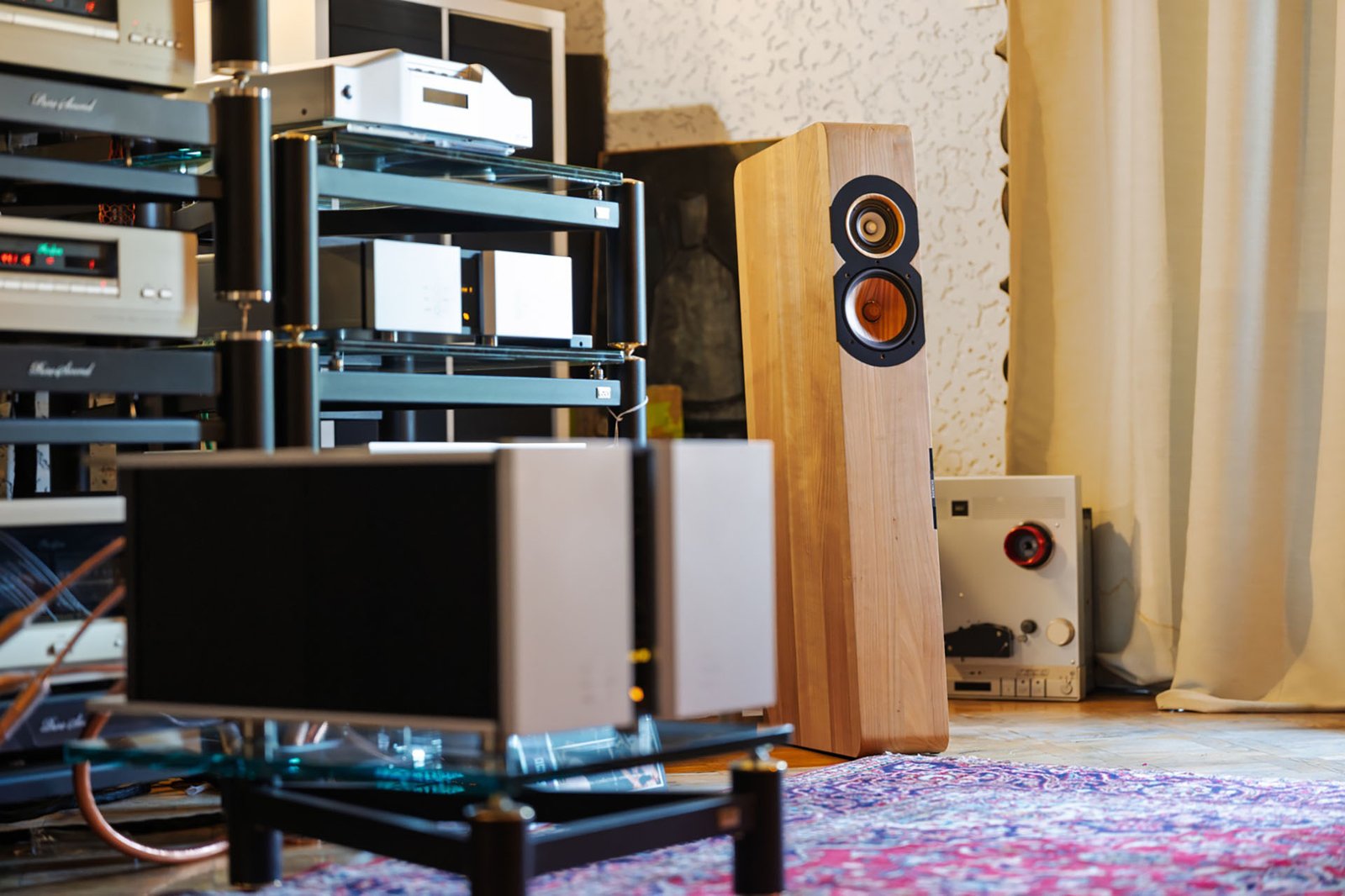
5 · A voice coil former made of paper
Soundnews: You use a paper voice coil former, a part nobody ever sees. How did you find out that it mattered?
Sven Boenicke: Just by listening. I ordered the same driver in about three different versions, using different voice coil former materials, and then you just listen to which one sounds the most natural. I did expect the craft paper to sound the most natural, and it was the case. There are other materials that don’t sound quite as good as paper, but get pretty close.
But unfortunately, the material most used, which is aluminum, is by far the worst. It sounds coloured, it sounds smeared, it sounds less alive. It sounds boring, so it’s not desirable. What is also quite good is Nomex and titanium. In the widebander, we use titanium. There, paper was not the best choice because the frequency response of paper was too non-linear, and its heat-dissipation ability is much poorer than what titanium can achieve.
6 · Made for Boenicke
Soundnews: By the way, do you make these drivers yourself, or do you order them?
Sven Boenicke: They’re custom-made for us. The bass drivers in all the models are actually off-the-shelf, so anyone can buy them, but all the other drivers are custom-made for us.
7 · A loudspeaker that is allowed to move
Soundnews: Everyone spikes their speakers rigidly to the floor. With the Swing Base, the whole speaker is allowed to move. What’s the idea?
Sven Boenicke: When you have speaker membranes moving, that means the whole speaker tries to move in the opposite direction of the membrane. Right? So if, let’s say, the membrane was one kilo and the whole speaker was one kilo, you would have an opposite movement of the whole speaker and the membrane with the same amplitude. Of course, in reality the membrane is much lighter than the whole speaker, so mostly it’s only the membrane that’s moving. But the whole speaker will, to a much lesser degree, still move in the opposite direction. It will always do it to some degree, inevitably.
And you always have to think about what you want to do with energies, and relative energies. You cannot destroy energy; this we all know. So you have to think about whether you can move that relative energy into a frequency area where it’s less harmful. Let’s say you try to bolt the speakers down on spikes as rigidly as possible. They will stand very still in the whole bass, but somewhere in the mid-range there will be a relative movement with quite a high Q, where the whole speaker starts to vibrate in the orientation of the driver movement. You don’t actually see that with your eye, but you can measure it with a laser interferometer or with accelerometers. We have done that. So you can actually measure that somewhere in the more critical frequencies the speaker starts to vibrate more than it does when you let it move in the horizontal plane freely, with as low friction as possible, and that vibration frequency and also the steepness of Q depend on the hardness of the spikes / underground and on the front-to-back distance of the spikes.
And when you allow the whole speaker to move in the horizontal plane as freely as possible, with the least amount of friction possible, you can move this relative frequency down very low. We have a system resonance of the whole speaker moving at maybe 3 or 4 Hz. So it’s in the infrasonic range. It does happen, but it’s completely irrelevant. The human ear doesn’t bother about a relative frequency of 3 or 4 Hz. It’s completely out of the audible range.
8 · The W series, from W5 to W22
Soundnews: Can you tell us about the speaker range from the W5 to the W22? What’s the goal of each one?
Sven Boenicke: Yes, the first one of the W series was the W5.
Soundnews: An iconic speaker.
Sven Boenicke: Yes, in the meantime it has reached quite a bit of a status, and as you said, it got copied many times by individuals, which is actually nice. I think it’s free advertising. This was back, like, thirteen years ago. We tried to make something more affordable than what we had done before, and back then I also started working with an industrial designer. That’s why the design of the W series is much different from what we had before. And this became a really big success.
And then from there, the W8 was born as a bigger version of the W5. Then the W11 came, the W13 came, and they all try to achieve the same thing, which is to transport as much music as possible within a package as small as possible, and also tailored for different budgets, of course. So the W5 is for a completely different budget than the W22. The W22 is our flagship model, where we would say the least amount of compromises have been made. At the moment, we cannot do anything better than the W22.

9 · Why electronics, and why now
Soundnews: Until recently, in my mind, Boenicke meant speakers and cables, and now you are starting with electronics, with the AIO, everything in one piece. Why did you start on this electronics path?
Sven Boenicke: Yes, very good question. Actually, it’s not because I’m bored and looking for more work. Making electronics actually started about ten years ago, and I have come up with several designs, but I was never really, really satisfied and happy. That’s why I never really released them to the market through my distributors and the dealer channels. I kept it on a very low flame. But now the AIO is the culmination of maybe thirty years of being into hi-fi and high-end.
And the real reason why we started with electronics was that no matter which electronics I was looking at, also under the covers and under the hood, I could see, not necessarily from the circuits that are in there but from many other details, that there is actually no brand on the planet that really, really pays as much attention to details as I would like to see. And so I thought we have to do it ourselves.
And also to make life for our partners, which are the dealers and distributors, as easy as possible, so they don’t have to go through a whole variety of brands in order to find an amp, let’s say, that matches well with our speakers. They just know we offer a solution that is a no-brainer, that works really well with the speakers.
And the reason why we came up with the AIO, the all-in-one, is that in my experience, if you get rid of multiple components and go into a one-box design, you save unnecessary enclosures for, let’s say, an additional preamp, an additional DAC, an additional switch. It’s just the one enclosure. You need just one power supply, although we actually have more than one transformer inside, and you need only one power cord. And you can get rid of interconnect cables. In our profession, we know that a really good cable can easily cost as much as a whole component, if not more. So the price-performance ratio of a well-designed all-in-one solution will beat anything else, if you compare it to individual components. That is a promise.
And that’s why we have been working for a very long time to finally release the AIO, which will finally be the case this fall. Right now we still have only a pre-series model, one piece, with which I have done all the shows. But serious production will finally start this fall, in 2026.
10 · The analog computer
Soundnews: Is it class D amplification?
Sven Boenicke: So far, this is class D amplification. But my partner who is responsible for the electronic layouts, he is an absolute genius. His name is Trond Seland, from Norway. He has found a way to design input stages for class D that he can make part of the feedback loop, and he calls that input stage an analog computer. With it, he can actually, to a very, very high degree, somewhere up in the 90 percent, dictate and control the sonic behavior, especially in the time domain, of any output stage, of any class. So the real magic will happen in the combination of the output stage, which we buy and slightly modify, and this analog computer input stage.
For a start, we will use an ICEpower module. Later on, most likely next year, we will even have our own class D output stage for the AIO. Then we will come up with an AIO 2 sometime in the next few years, and that will have a fully in-house designed class AB output stage, one that has the sonic properties of class A without being class A, so much more energy efficient. Also designed by Trond.
11 · All in on all-in-one
Soundnews: And the AIO will replace your existing power amplifier?
Sven Boenicke: The P1, yes. That will be replaced by the AIO quite soon.
Soundnews: So you go all in.
Sven Boenicke: Oh, we go all in on all-in-one, yes. The DAC is actually designed by another Norwegian, Børge Strand-Bergesen. He is Trond‘s counterpart in the digital domain. It’s a design he has come up with, and the very special thing, which was actually my order to be added, is the so-called 432 Hz downpitching. This is an add-on module that goes on the DAC.
It lets us play back music as if it were recorded at a lower tuning pitch of 432 Hz, instead of 440. You can engage or disengage this special downpitched mode as you want. But I would say, once you have experienced what 432 does to you and your whole body when you listen to it, you will never switch it off again.
12 · 432 Hz
Soundnews: I’ve never listened to music that way, but I’ve heard a lot about it. Isn’t there also a streamer that does this?
Sven Boenicke: There is this company, the Belgian company 432 EVO, that came up with this a few years back. If I understood it right, they did it in software. But they do have to live with the fact that they have to eliminate some data, because if you downpitch, the musical piece is automatically played back slower; therefore, the whole piece gets longer. And if I remember correctly, they did not do a time stretch, so the musical files stayed at their original length, and they had to get rid of those 1.8 percent of the data.
We decided not to do it in software, but to actually clock the whole DAC slower. So we bought a custom clock, which was especially made for us. It clocks the DAC about 1.8 percent slower, so you get the correct pitch if the original material was recorded at 440, which is actually the standard pitch. So we play back the whole music a little bit slower, and therefore the musical piece gets a little longer. If you have a five-minute piece, it gets about five seconds longer.
Soundnews: What do you think it brings to the table? Calmness, and naturalness?
Sven Boenicke: Absolutely, absolutely. From a high-end standpoint, it sounds more like an analog reel-to-reel tape compared to a CD. It brings much more naturalness, more calmness. It’s more grounded; it seems to have much more stable bass and more organic highs. But what it really does is, it actually communicates with every cell in your body. So it’s actually, if you want to call it that, a healing device. As it stands, we might get medical certification for it so doctors can prescribe it as a healing device.
13 · Harmonisation
Soundnews: What about harmonization?
Sven Boenicke: Yes, you ask all the good questions.
Soundnews: There is a wooden carrier on every magnet in your speakers, and you dared to publish that rather than hide it. It’s in plain sight for everyone. What is it? And how do you answer the engineer? I’m an engineer myself.
Sven Boenicke: If an engineer comes to me and asks what it is, I would have to tell him to kindly speak to the inventor of the technology, which is a German guy, actually a good friend of mine. We have a very successful collaboration. He himself is a master electrician. He and a small team around him are responsible for all the electricity at Munich Airport and make sure everything there works correctly, so he knows a lot about electricity. And he has come up with this. He has found a way, with the help of a laser, to engrave information into a carrier material, and that information apparently stays permanently in the information carrier material. And my ears tell me it totally works.
Soundnews: So you measure the drivers to know what should be engraved?
Sven Boenicke: No, this cannot be measured. Maybe one day, if the correct measurement device were built so that such a thing could be measured, who knows, maybe then it could be measured. But up to now, I think such a thing cannot be measured. They designed those information carriers actually for my products, but they are all the same for all the products and for all the drivers. So it works for all the drivers.
Soundnews: So the information is specific to your brand? For other brands, it could be different?
Sven Boenicke: For my brand, exactly. For other brands, it could be different, because other people stand behind other brands. The way those carriers relate to who I am. So it’s designed for me personally, for my spirit, which is inside my products and is being transported.
I am convinced that dead matter does not exist, as matter in reality is just condensed energy. And energy is never dead, unanimated. So, the more artisanal a product is, and the more a product is made by a really small team, the more information, or hand-writing, from the maker it carries. Let’s say you take a musical instrument that is really handmade by a master. It will carry much more of his signature than a musical instrument mass-produced by some big factory, by anybody at random. It will not be the same product.
14 · Being part of nature
Soundnews: Do you think many people will understand that, in this world we’re living in, with the AI rush, mass manufacturing and the hurry for more and more?
Sven Boenicke: Again, a very good question you ask. I don’t know if many people will understand it, but I think those who do understand it have a high chance of becoming our customers. And, you know, we cannot serve the whole world anyway. But people tend to forget that we are part of nature, and always will be. And if we remember this, I think we will have a more natural and potentially a healthier life than if we think we are not part of nature and can put ourselves above nature. I think we would lose that battle at some point. So I think it’s wise to remember that we are part of nature.
Soundnews: There’s a lot of humanism in your technology, in the way you build things. That’s becoming scarce.
Sven Boenicke: Yes, it becomes scarce. But you know, I think everything in life works in waves. So if something becomes scarce, at some point it will come back. Like vinyl: it became scarce maybe twenty, thirty years ago, and now it has come back and has a great revival. I think this cycle happens with most things in life.
Soundnews: And if we scale that to the big, fundamental disruption that is AI, and where it’s going?
Sven Boenicke: It’s a challenge. But humanity is free. We are the only species on the planet that is really free, but we are also free to carry the responsibility for our own doings.
15 · The team
Soundnews: About the team: on your website I see only three people, but it seems you have a much larger engineering team.
Sven Boenicke: No. Actually, I don’t have anybody hired. The people you have seen on the website work for themselves, and the two Norwegian gentlemen I mentioned also work for themselves. And when they work for me, they simply invoice me. So it’s actually subcontracting.
16 · A Romanian hora on a Swiss record
Soundnews: On one of your albums, Taufrisch, there is a Bessarabian hora. Bessarabia is part of Moldova, historically Romanian territory, and it’s the longest track on the record. How did it get there?
Sven Boenicke: Oh yes. I did the recording, but it was maybe back in 2007 or so, a really long time ago. It wasn’t my choice to put it there. I just did the recording, and the musicians chose the tracks that went on the album, so I cannot tell you how it got there.
Soundnews: It was emotional for me to find it.
Sven Boenicke: So you bought the CD at some point?
Soundnews: No, I found it on your website.
Sven Boenicke: If I had known, I could have brought it.
17 · The compromise
Soundnews: Maybe a last question. As we know, everything is a trade of compromises. What is your compromise? What do you give up for what we are hearing?
Sven Boenicke: That’s a tough question. Of course, in a W5 I have to give up much more than in a W22. That’s normal; the flagship tries to reach a really very high percentage of what the original sound would be. Let’s say I gave up physical size. I’m not so much impressed by big speakers. I tried to make speakers as small as possible and as attractive as possible; also for the women. The wife-acceptance factor really exists. So I do give up sheer physical size, and maybe a show-off factor, for this. And I do think there are countries where my speakers don’t sell particularly well because of this.
Soundnews: Really?
Sven Boenicke: Yes, Russia for example, which is a pity, as i am very attracted by this country and the people living there. For the money, they might expect a bigger speaker. If you pay something like €6,000 for a W5, for the same amount of money you can get, let’s say, a Klipsch, which is ten times bigger. And if those people listen to, let’s say, loud rock music where physical impact matters a lot, just to name an example, the Klipsch will pretty much leave the W5 behind with that music. So yeah, that’s my answer, I guess. I give up physical size for the way we build and design the speakers.
Soundnews: I should say, I’ve been a great admirer for many years. I looked for you in Munich.
Sven Boenicke: There you heard them, you just didn’t see me?
Soundnews: Yes, but a show is not a controlled environment.
Sven Boenicke: I’ve made some changes to the W11 in the meantime, so you have to come back and listen to it again.
Soundnews: I really appreciate the craftsmanship, and the dimensions too. In my view, the size is a big plus, not a minus.
Sven Boenicke: For us, yes. As I said, others want more material for the money, so for them something else is the plus. We are all different.

Four Questions answered in writing
What wood gives you?
Soundnews: Beyond how it ages, what does solid wood give you sonically that no inert material can?
Sven Boenicke: Solid wood first and foremost gives you excellent sonics. It has long fibers, much, much longer than any MDF or the like, so it actually offers a much better stiffness-to-weight ratio. It offers much higher inner damping than, let’s say, aluminum, but still does not sound damped; it sounds very uncolored, natural, and alive. Have you ever experienced any musical instrument in a concert hall made from MDF, high-damping composite materials, or aluminum?
Besides that, it grows organically and naturally, and you can make a beautiful finish just using a good oil, so no artificial synthetic covers like lacquers and varnishes.
Six switches in series?
Soundnews: The network section of the AIO has six switches in series, while most designers try to remove steps from the network path. What does each stage do, and why did you stop at six?
Sven Boenicke: Actually, we would have to rephrase that question, as we in reality did not quite manage to get that 6-switch thing to work stably.
I am now using two very different switch PCBs in series, and the combination of the two is sonically very miraculous! What generally seems to be crucial when it comes to switch design, again, is the quality of the power supply and grounding (noise removal) layout. And there again, my two Norwegian gents are capable of delivering absolute world-class designs.
At home
Soundnews: Which Boenicke is in your own listening room, and why that one?
Sven Boenicke: The W22 is permanently there because our demo room is huge, and the W22 can fill it accordingly. A W13 and W11 are still capable of playing it very well, but the additional USPs of the W22 can fully show off in this room.
Closing
A luthier never really finishes listening to his wood. Even after the varnish is dry and the strings are on, the instrument keeps changing, and so does the ear of the man who made it. Talking to Sven Boenicke, I had the feeling I was talking to someone who still taps every plate. He told me that every product has a soul, and that the more artisanal it is, the more of its maker it carries. You may agree with him about harmonization and 432 Hz, or you may not. But you cannot read this conversation, or listen to his loudspeakers, without hearing the man behind them.