Walt Disney’s Bumblebee
In the late 1930s, Walt Disney had a problem with an insect.
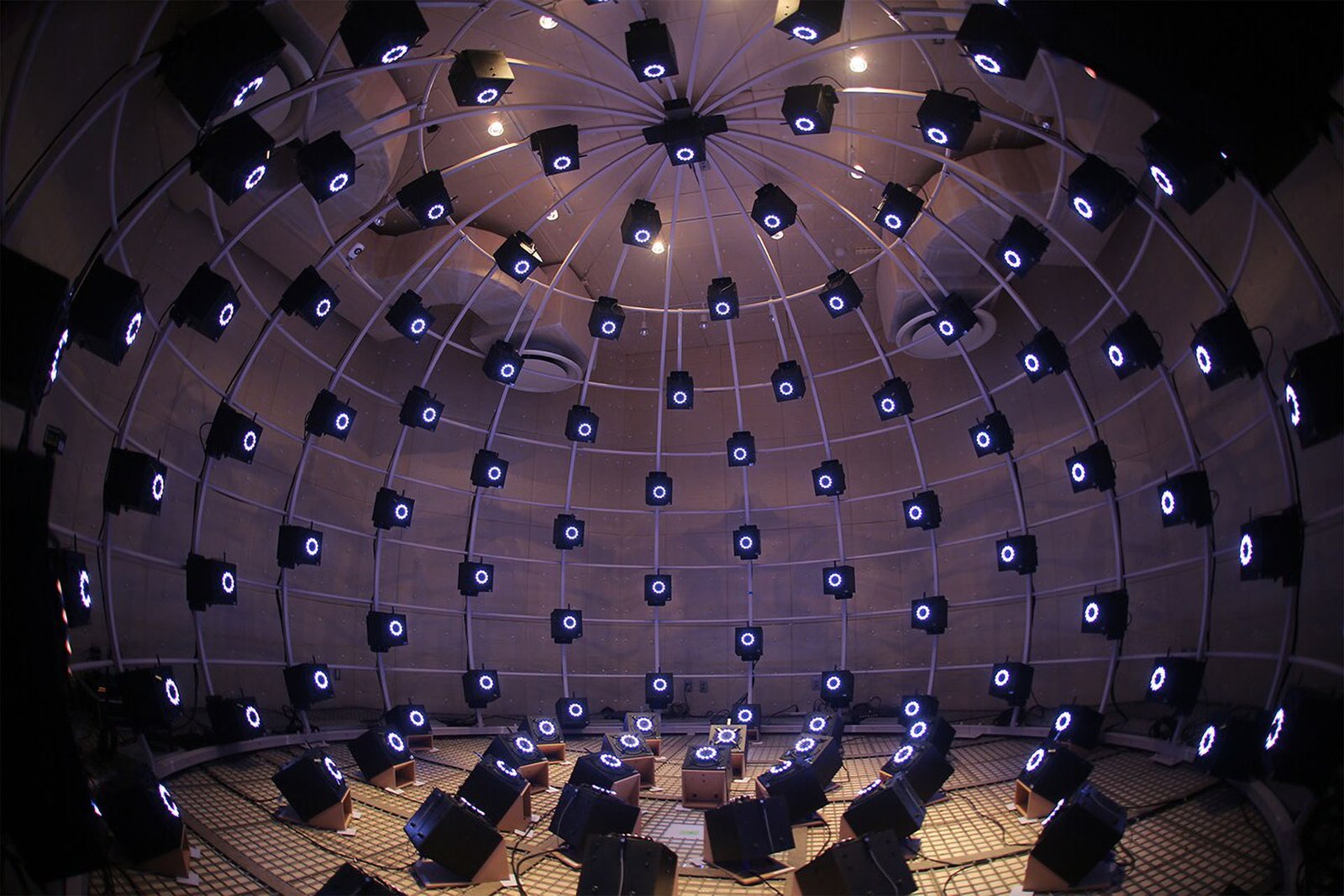
He was building Fantasia, his feature-length gamble on classical music, and he wanted a sequence for Rimsky-Korsakov‘s Flight of the Bumblebee. Not a bee on a screen. A bee in the theatre. He wanted the audience to hear it buzz past their left ear, circle behind their heads and dive at them from the back of the room. In 1938 that was roughly as reasonable as asking for a bee that could also do your taxes.
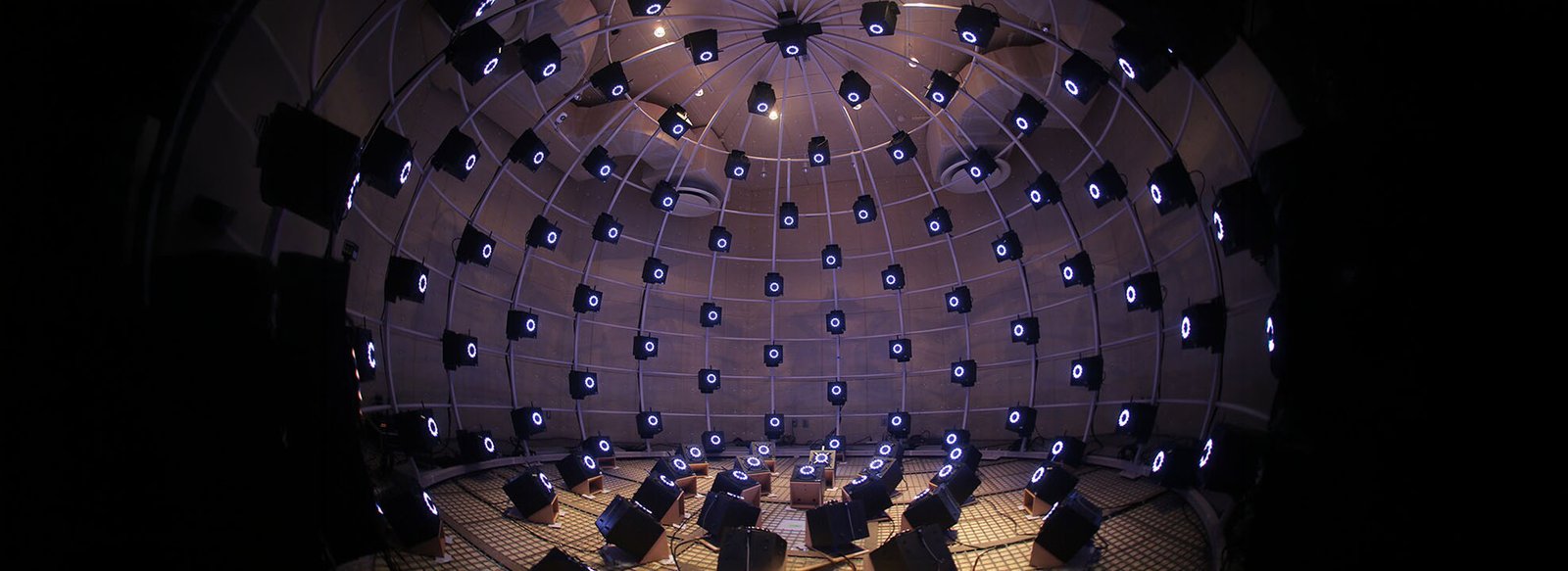
So his engineers, led by William Garity, invented surround sound to oblige him. They called it Fantasound. When Fantasia opened at the Broadway Theatre in New York on 13 November 1940, tickets cost ten dollars, a frankly obscene sum at the time, and behind the walls there was a system nobody had heard before: speakers behind the screen, dozens more around the stalls and the balcony, and a team of people riding pan controls in real time so the music could travel around the room. Contemporary accounts can’t even agree on how many speakers it took. Sixty, ninety, more than a hundred, depending on who you ask and which theatre.
It nearly bankrupted the project. Only a handful of cities ever got the full installation; the war swallowed the equipment, and the bumblebee itself was cut from the film before it ever flew. Disney’s dream of sound coming from everywhere took another forty years to become ordinary in cinemas, and another forty after that to reach a living room without a man with a drill.
I have been thinking about that bee for a month because it’s been flying around my office. In a thirteen-square-meter room. From a bar under the television, a subwoofer in the corner, and two large battery-powered thermos speakers. And before I can tell you how that happened, I have to eat some words.
I Take It Back
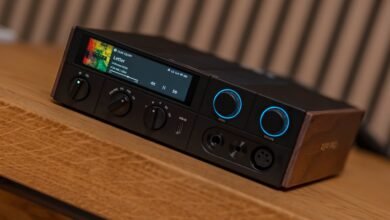
In November 2023, in my review of the KEF LSX II, I wrote something I was very sure of. Two small, honest speakers, even in a poor position under a television, will take a soundbar apart. I didn’t just say it once. I built half the review around it. The original LSX had replaced a soundbar from a well-regarded brand in my office and embarrassed it so thoroughly that the episode got its own chapter. The LSX II ruined soundbars for me, I wrote, and I meant it.
I’d like to formally withdraw that sentence. Not quietly, in a footnote. Here, at the top, where you can see me do it.
Not because I was wrong about stereo. A good pair of speakers still does things no bar can, and on music, in the right room, the argument hasn’t moved. I was wrong about what I was comparing. I was comparing two good speakers against a decent stereo soundbar, a long box doing its best to pretend. What I had never lived with was a proper surround system built around a bar: real speakers behind me, height channels coming off the ceiling, a dedicated subwoofer, and enough processing to stitch it all together.
The Yamaha True X Surround 90A showed me that territory. In my office, with the same 65-inch Samsung OLED on which the news is still permanently forbidden, it sounded larger, beefier, more powerful, and simply more impressive than the stereo pair and subwoofer that have lived there for years. Not slightly, but obviously, from the first evening.
TL;DR — The Short Conclusion
For those of you who go to the end first, and I know there are plenty of you, here it is:
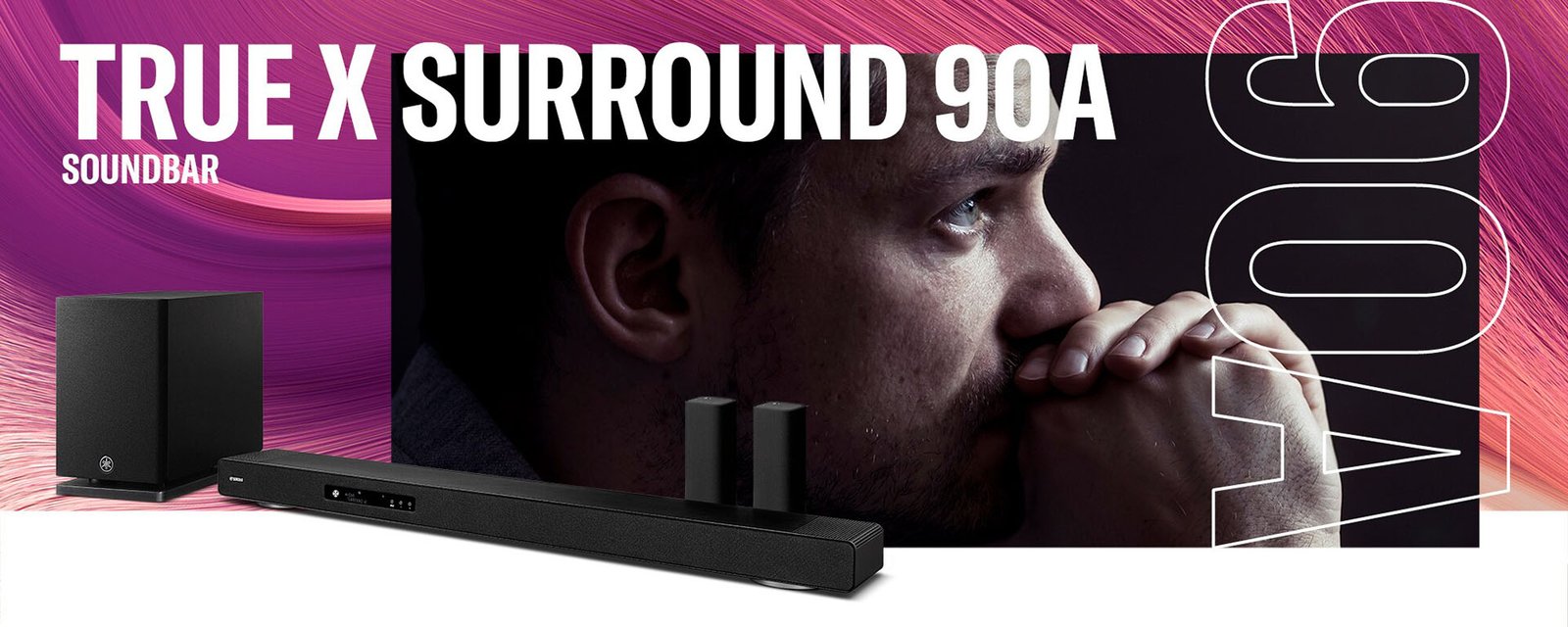
The Yamaha True X Surround 90A is Yamaha’s flagship soundbar system: a slim bar with front, center, and twelve upward-firing beam drivers, a wireless subwoofer with a new port design, and two fully wireless, battery-powered rear speakers with their own charging cradles. It decodes Dolby Atmos, DTS:X and, a world first for a soundbar, Auro-3D. Inside is the same Qualcomm processor and the same Surround:AI that Yamaha uses in its top AV receivers.
In my thirteen-square-meter office and movie room, it transformed films. The rears work. The height beams, which I fully expected to be a marketing illustration with arrows on it, work convincingly. The subwoofer is deep and clean rather than boomy. Dialogue stays anchored to the screen. And with music, the AI surround mode is far more musical than I expected.
The honest ceilings: the rear speakers are small and do surround effects rather than full-range sound, there is no automatic room calibration, the menus ask for patience, and you get one HDMI input. None of that changed my verdict.
At around €2,500 (13,499 lei in Romania), it is not cheap. It is a complete 5.1.2 system that sets up in an evening with no cables across the room, and it made every film I watched more exciting than it has ever been in this house. A Highly Impressive Award, and an apology to soundbars everywhere.
A Stereo Man in a Surround World
I owe you some honesty about who is writing this, because it matters more than usual. My life in this hobby has been stereo. Two speakers, a lot of thinking about the space between them, and a reference system in the next room that cost more than I like to say out loud. I know what a well-recorded double bass should feel like. I can tell you why a 300B sounds the way it does. What I can’t do is give you a confident ranking of the best soundbars on the market, because I’ve never lived with them. I haven’t had the Sonos Arc Ultra here, or the Sennheiser Ambeo, or Samsung’s or Bose’s flagships. When I compare, I’ll compare against what I actually know: my own stereo setup in the same room, and a real speaker system as I understand it.
What I do have is a very long love affair with films. I’m the person who watches the credits to see who did the sound. I’ve always believed that good sound counts for as much as good picture, and I’ve spent real money making sure the picture in my office is excellent. A 65-inch OLED is a wonderful thing. Feeding it with sound from two small speakers was, I now realise, like hanging a beautiful painting and lighting it with a desk lamp.
So this review is written by an outsider. A curious one, a sceptical one, and by the end of the month, a converted one.
More Than Twenty Years of Bending Sound
Yamaha isn’t a newcomer pretending to know cinema sound. It’s one of the oldest names in it. In 1986, Yamaha released the DSP-1, the world’s first digital soundfield processor for the home. The idea was to measure the acoustics of real concert halls and recreate them in a living room. It sounds quaint now. At the time, it was a small revolution, and it became the foundation of Cinema DSP, which Yamaha has included in receivers ever since.
Then, more than twenty years ago, came the YSP-1, the first Digital Sound Projector, and the beginning of what Yamaha calls beam speaker technology. The principle is lovely once you understand it. Put a row of small drivers side by side and feed them the same signal, and the sound waves add up into a strong, focused beam. Delay each driver by a tiny, precisely calculated amount, and you can steer that beam. Point it at a wall, and the sound arrives from the wall. Point it at the ceiling, and it arrives from above.
That’s what the twelve little drivers on top of the 90A are doing. They aren’t simply firing upward and hoping, like most Atmos soundbars. They’re aimed, by digital signal processing, at a spot on your ceiling, and the angle can be adjusted in the app until the reflection lands where your ears believe it. A company that makes concert grands, touring mixing consoles, and AV receivers has earned the right to tell you where sound should come from.
What’s in the Boxes
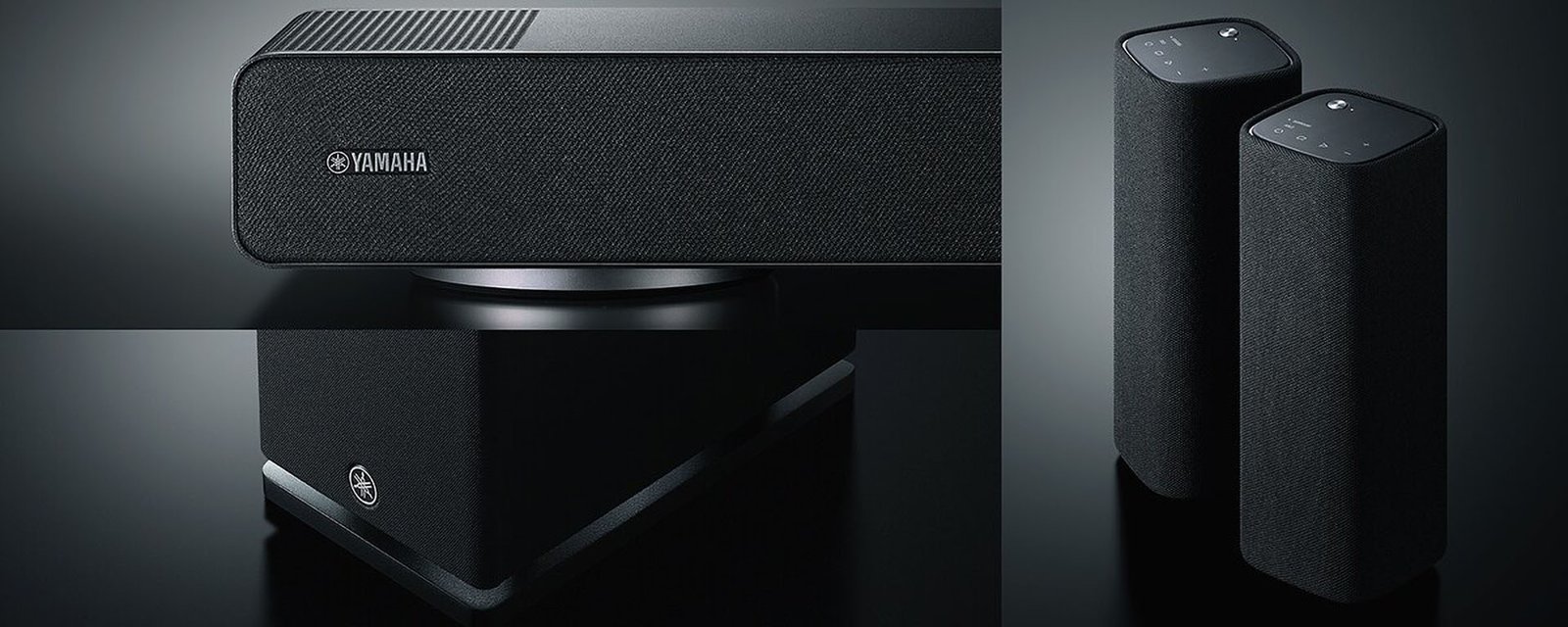
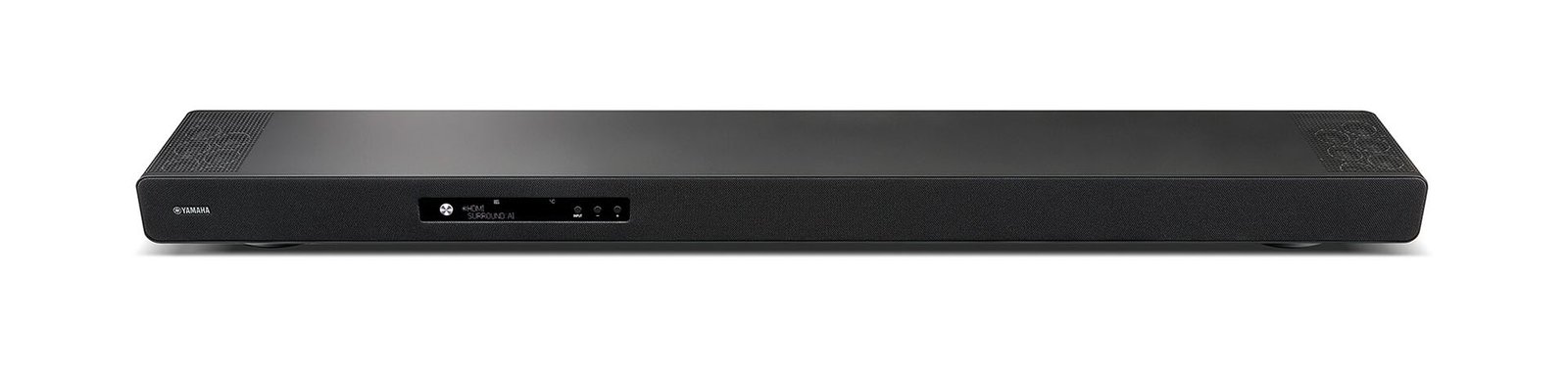
The bar (SR-X90A). 1,180 mm wide, 143 mm deep, and just 71 mm tall in its body, 85 mm on its legs. It weighs 11 kg, which you notice the first time you lift it, and that weight goes into a stiff, quiet cabinet standing on big resin feet. Inside:
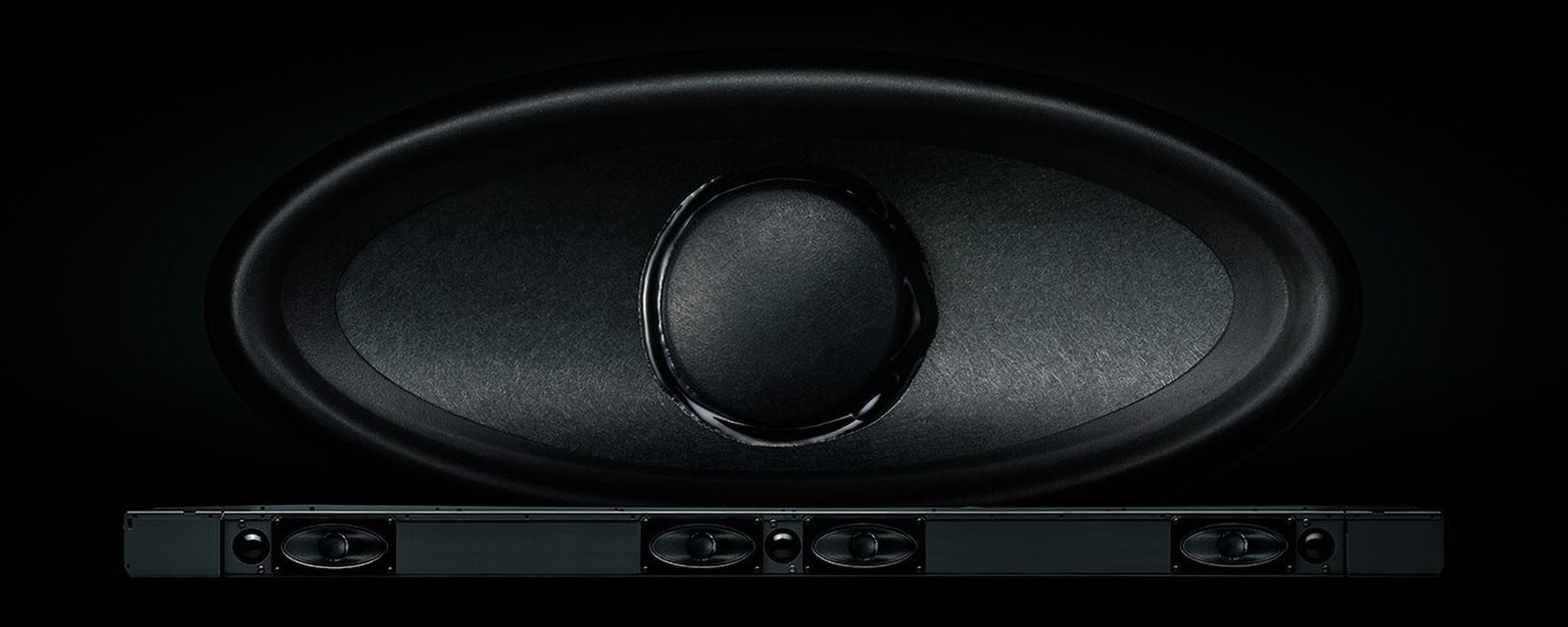
- Front left and right: two custom oval cone drivers, 110 × 53 mm, and two 25 mm dome tweeters
- Center: one oval driver and two tweeters, a dedicated center channel, which matters enormously for dialogue
- Height: twelve 28 mm cone drivers, six per side, on top of the cabinet, forming the beam arrays
- Amplification: Yamaha’s own YDA-141 amplifier, driven by a Qualcomm QCS407 64-bit processor, the same chip as in Yamaha’s flagship AVENTAGE receivers
The oval “eye-shaped” drivers are the clever part: more cone area, and so more midrange body, without a taller cabinet.
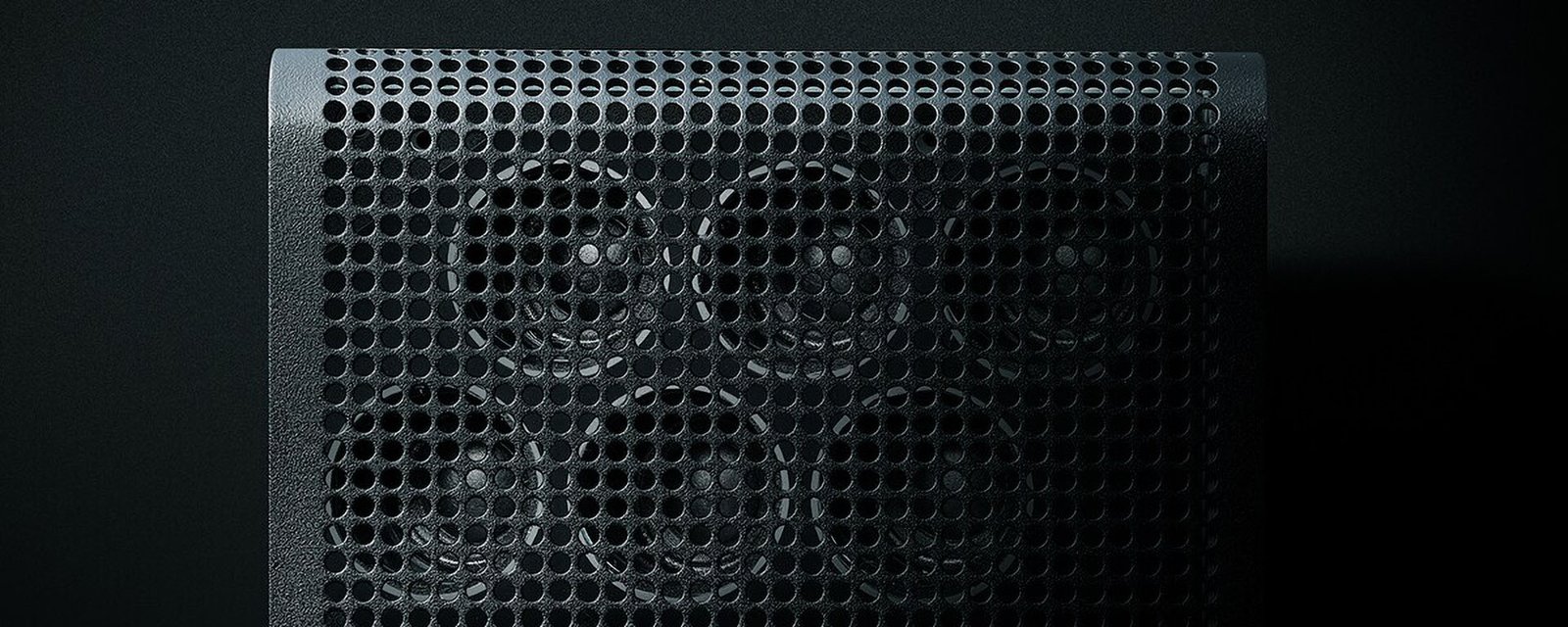
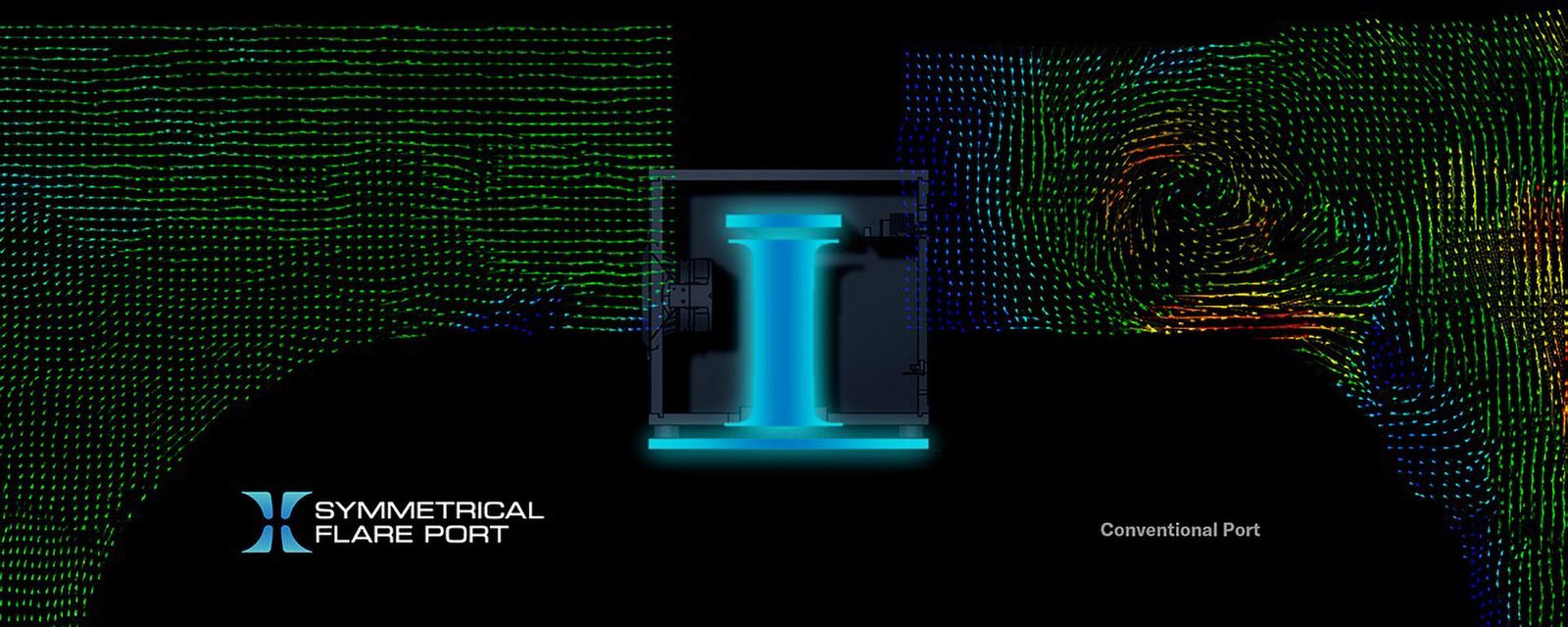
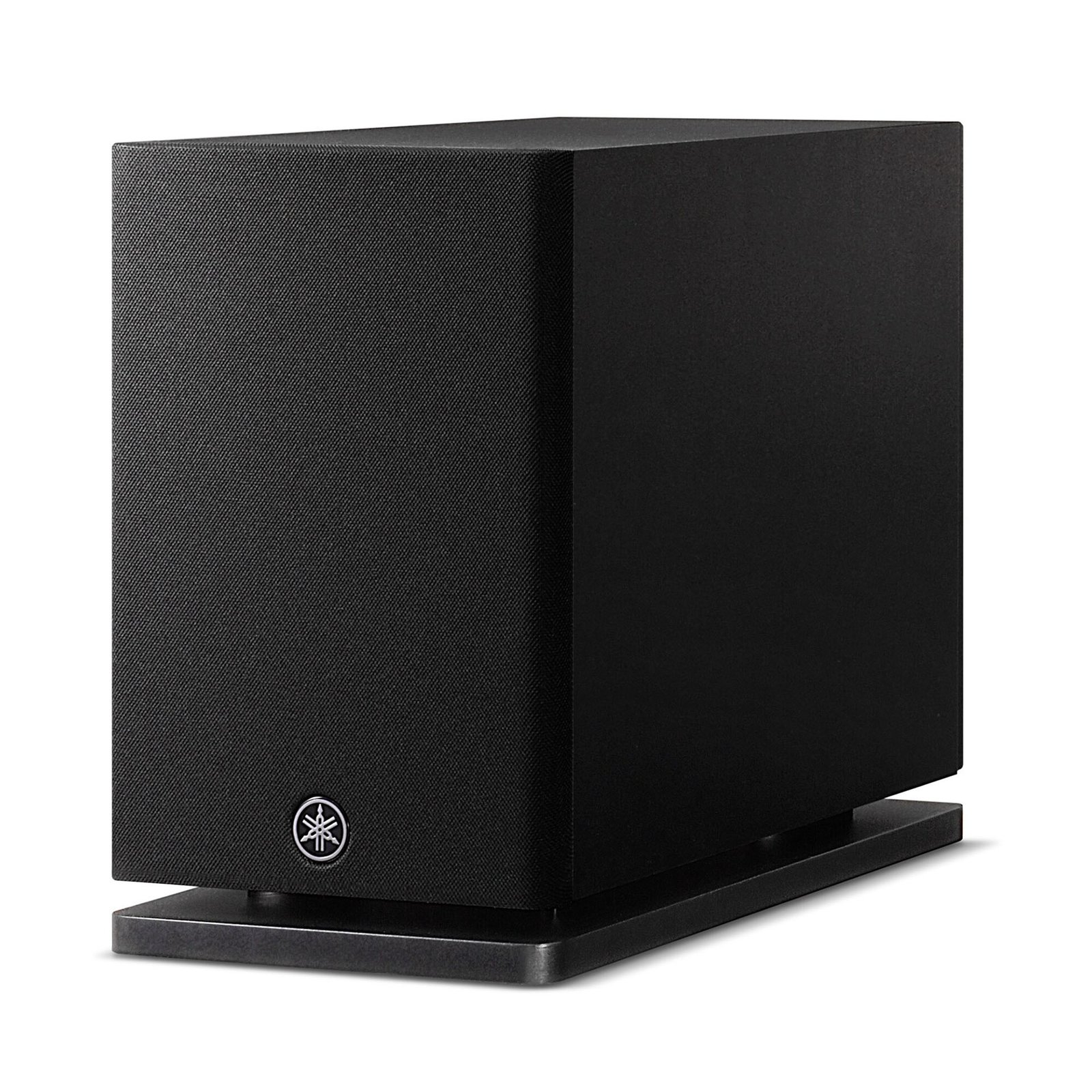
The subwoofer. A 17 cm (6.75-inch) driver in a cabinet of 241 × 378 × 414 mm, 12.7 kg, connected wirelessly on 5 GHz. Small by home-cinema standards. The interesting part is the port. Yamaha developed a new Symmetrical Flare Port using particle image velocimetry, filming the air coming out of the port, and shaped it so the air leaves smoothly in both directions. The claim is 20 dB less port noise than a conventional design. I can’t measure that. I can tell you that in a small room, where port chuffing would be the first thing to give a small subwoofer away, I never heard it once.
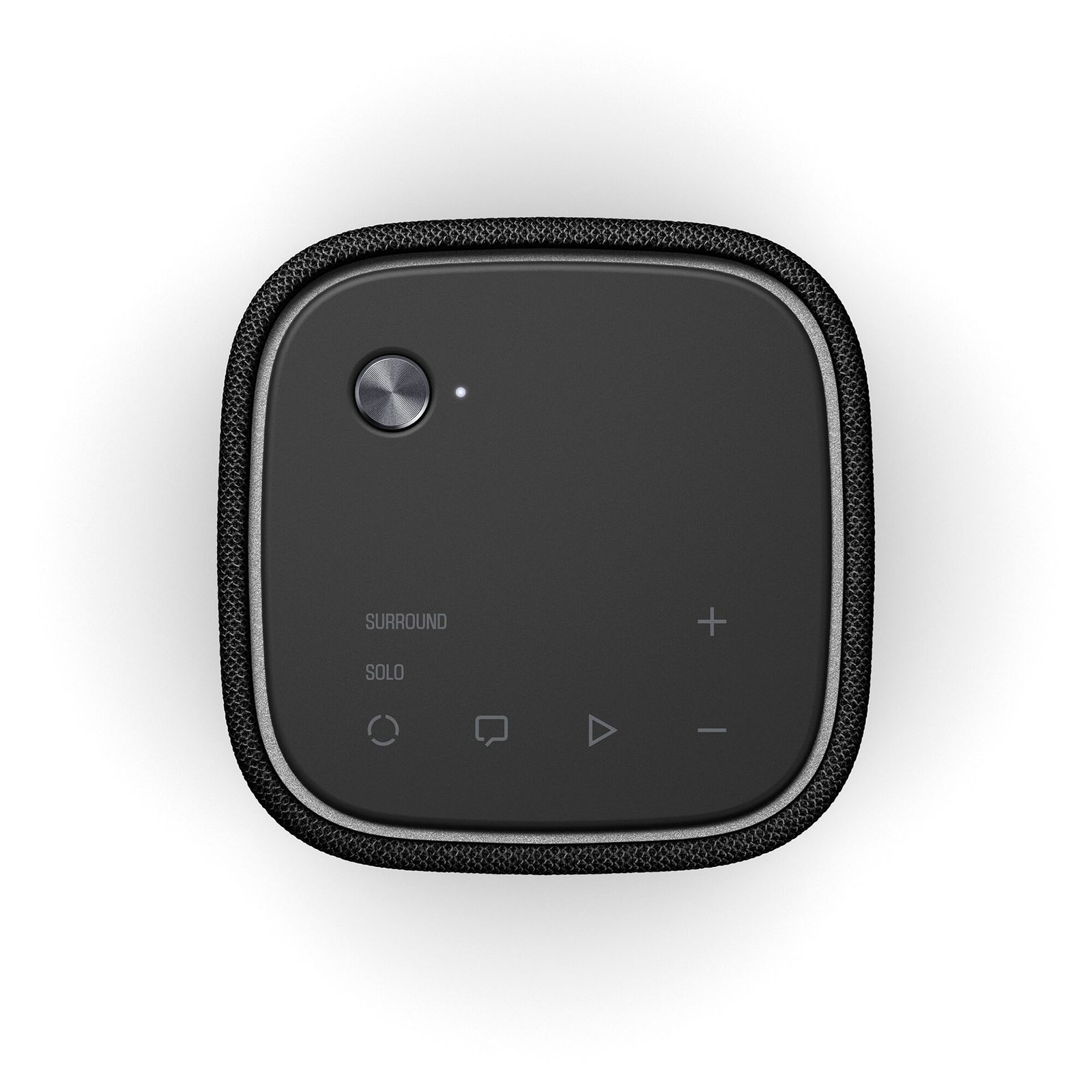
The rears (True X Speaker 3A). Two cylindrical speakers, 88 × 220 × 88 mm and 1 kg each, with two 58 mm full-range drivers and two passive radiators. They’re fully wireless, battery-powered and IP67 rated, so you can also take one into the garden as a Bluetooth speaker with the Solo button. Yamaha rates the battery at about 10 hours in surround mode, and each speaker has its own charging cradle, which makes the battery question mostly disappear. Put them back on the cradle after the film, the way you put your phone down at night.
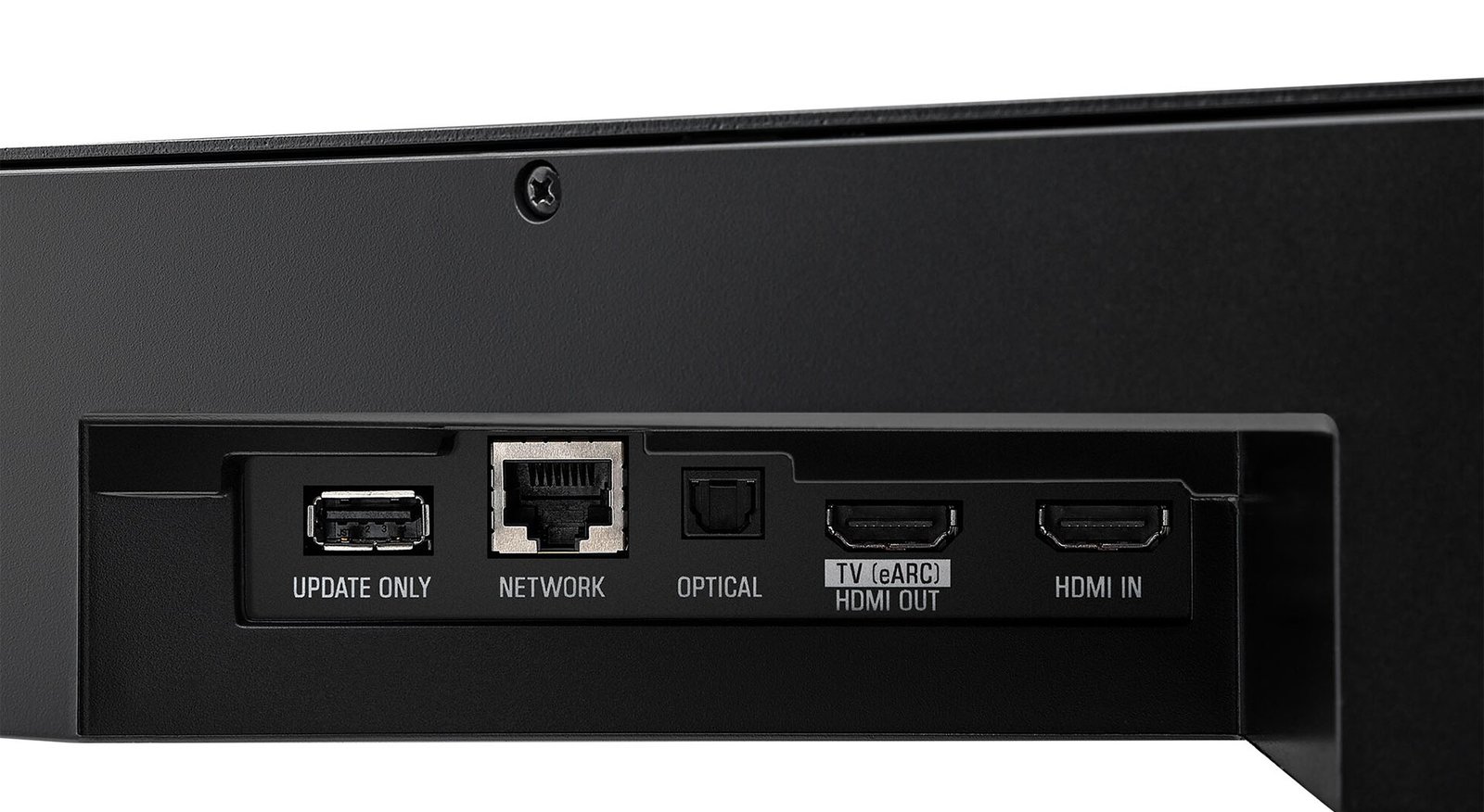
Connections. HDMI eARC to the TV, plus one HDMI input with 4K passthrough, optical, Wi-Fi with MusicCast, AirPlay 2, Spotify Connect, Bluetooth 4.2 with SBC and AAC. No analog input and no subwoofer output, since the subwoofer is part of the system.That makes a 5.1.2 system from boxes that need power sockets and nothing else. With an AV receiver you’d need seven speakers, a subwoofer and about thirty meters of cable. Here, the only cable crossing the floor is the subwoofer’s power lead.
Surround:AI, or a Sound Engineer Living Inside the Bar
Every soundbar now has an “AI” button. Most of them, as far as I can tell, are a loudness setting wearing a lab coat. Yamaha’s deserves a closer look.
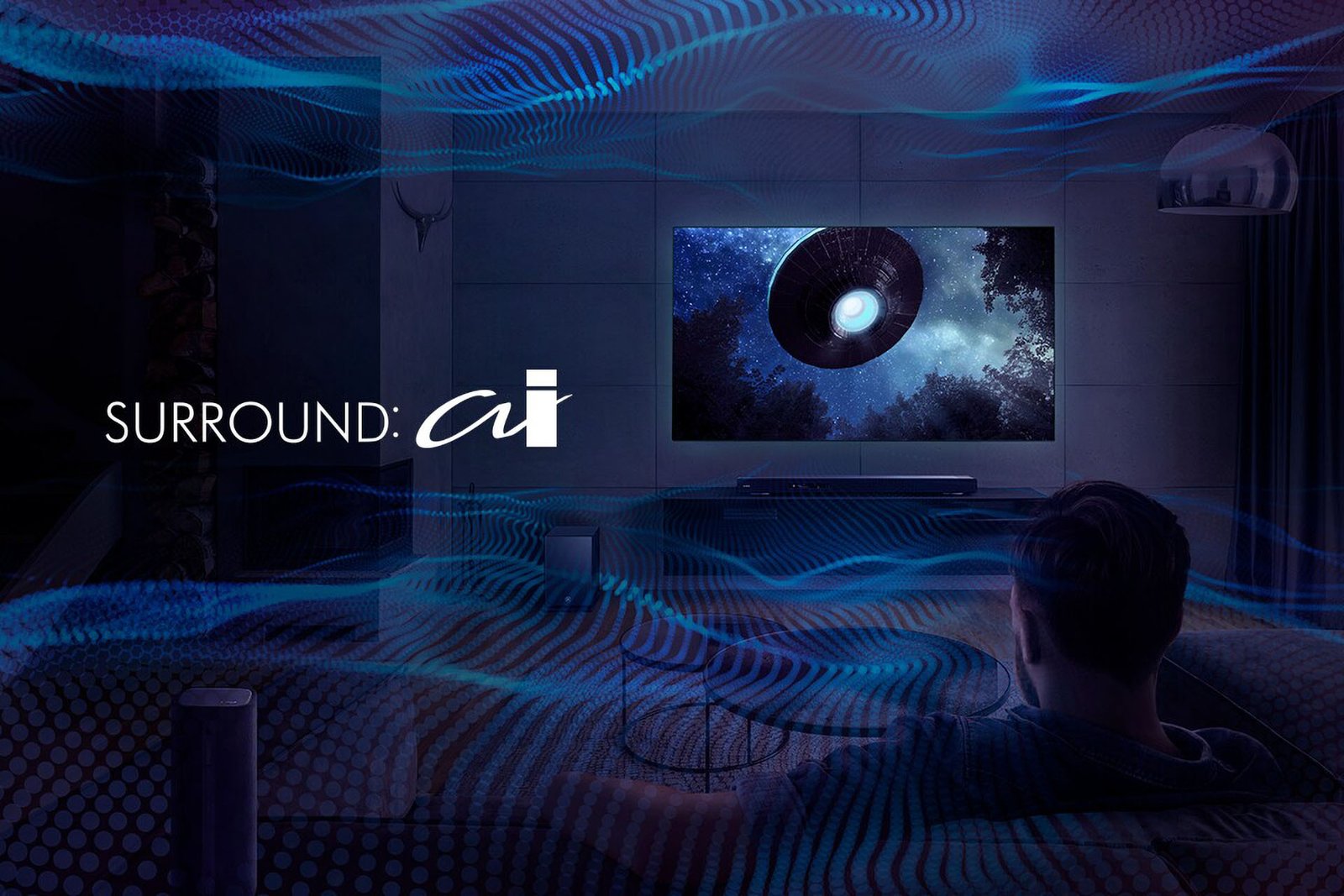
Surround:AI came to the bar from Yamaha’s high-end receivers. It analyses the soundtrack five times a second and sorts what it hears into dialogue, background music, ambient sound, and effects. Then it adjusts the soundfield on the fly. More space and envelopment when the scene is atmosphere, tighter focus when someone is talking, more width and impact when something explodes. Yamaha’s description is that it’s as if a team of their sound engineers was fine-tuning each scene for you.
My instinct as a stereo purist was to switch it off and choose Straight, the “give me what’s on the disc” mode. I did, for the first two films. Then I went back and watched the same scenes in Surround:AI, and I kept it on for the rest of the month.
The changes are never dramatic, which is precisely why they work. You don’t hear processing pump in and out. You just notice that a voice in a busy scene stays clearer than it should, and that a quiet exterior shot suddenly seems to have air above it. It’s the opposite of what I feared. I expected an AI that would make everything bigger. What I got was one that knows when not to.
There are also 3D Music, Stereo, Auro-3D, Clear Voice, and Bass Extension. More on those later.
Unboxing and Set it Up
The system arrives in more boxes than you expect, and everything inside feels expensive. The bar looks like Yamaha studio equipment rather than a lifestyle object. With HDMI CEC, the TV remote handles volume and power, which is what everyone in my house actually used.
My office is about thirteen square meters, a little longer than it is wide. The OLED sits on a higher credenza on one of the long walls, and the seat is about 2.5 meters away. It’s a small room by home-cinema standards, and I want to be clear about that, because it shapes everything that follows. A small room is easier on the subwoofer and the rears, and it brings the ceiling close, which helps the beams. In a 40-square-meter living room, your experience will differ.
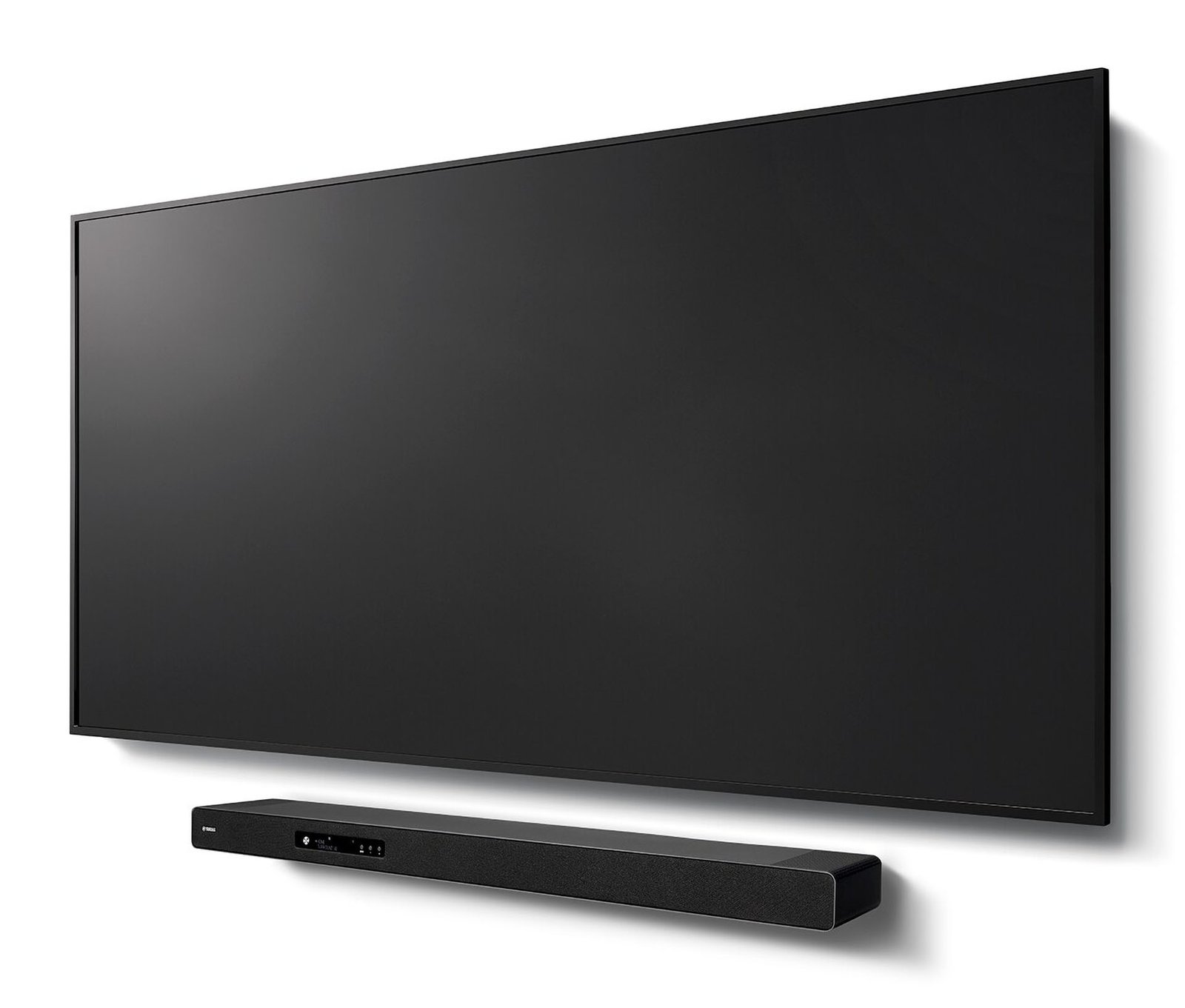
The bar went onto the rack in front of the TV, low enough not to block the screen. (Wall-mounting is possible, with the legs removed.) The subwoofer went into the front right corner, and the rears onto the shelves, at ear level.
Then the MusicCast app. This is where I have to be fair to the people who’ll complain. There is no automatic room calibration. No microphone, no YPAO, the system Yamaha uses in its receivers, and no “hold your phone up and wave it around”. You set the distances and levels of the rears yourself, and you adjust the angle and level of the height beams by ear. The menus are deep, sometimes oddly organized, and the first evening involved more scrolling than I’d like.
But here’s the thing. Setting it up by ear forced me to listen to what each part was doing, and I think I ended up with a better result than an automatic routine would have given me. Rears down a couple of steps so they don’t call attention to themselves. Height beams adjusted until the rain in a test scene seemed to start above the screen, not inside the bar. Subwoofer level a notch below the default, because the corner was already doing its job. Half an hour, two test clips, done. My one real request to Yamaha would be a simple calibration routine in the app for people who’d rather not think about any of this. Most buyers won’t adjust the beam angle, and they deserve to hear what I heard.
Movies
This is the heart of it, so let me tell you how I watched.
Everything came through Samsung’s apps or from 4K discs through the passthrough, at the volume I’d use for a proper evening film. Loud, but not neighbor-hostile. First in Straight, then in Surround:AI, then often once more in my old stereo setup for comparison, which turned out to be the most humbling part of the month. Most of it was watched in the dark, the way it should be.
Five films. Two from this year, three old friends I know well enough to hear every change.
The Mandalorian and Grogu
Jon Favreau, 2026 · Music: Ludwig Göransson
Let’s start with the fun one, because this film is fun, and its best quality is its sound.
Göransson’s score is the first thing that tells you something has changed. In stereo, that low, breathy woodwind of the Mandalorian theme sits between the speakers and is very nice. On the Yamaha, it seems to come from a wider, deeper place, a dark room with the orchestra spread across the front and the reverb wrapping around you from behind. The western flavor of the music finally has its landscape.
Then the action. Ships don’t pass across the screen anymore. They come in from behind your right shoulder, cross over your head, and leave through the screen. I know that sentence sounds like a soundbar advertisement, and I’d have rolled my eyes at it a month ago. It happened repeatedly, and the first time it happened, I laughed out loud alone in the room.
The quiet scenes surprised me more. When Grogu is alone in the swamp, the whole room fills with small sounds: insects to the sides, water dripping somewhere behind, creatures you never see moving through the dark. The rears aren’t playing explosions here. They’re playing the world. That’s what surround is actually for, and it’s what two speakers, however good, cannot do. And the low end. Blasters have a crack and a little thump you feel in your seat. Engines have weight. Nothing booms. For a 17 cm subwoofer in a corner, the control is excellent.
Disclosure Day
Steven Spielberg, 2026 · Music: John Williams · Sound: Gary Rydstrom, Andy Nelson
Spielberg’s return to science fiction is, for long stretches, a film of conversations, and that makes it a better test than any explosion. A soundbar that can’t hold a voice still and clear in the middle of the screen, while a John Williams score swells around it, is a soundbar you’ll be fighting with all night.
The 90A didn’t fight. The dedicated center channel, with its own oval driver and two tweeters, keeps voices rooted to the faces on screen. Emily Blunt and Josh O’Connor speak from where they stand, not from a vague area under the TV. And when Williams’s orchestra comes in under them, it opens out to the sides and behind rather than piling up on top of the words.
The film’s strangest sound, Blunt’s alien clicking language, was a small revelation. In stereo it’s an effect. With the height beams working, it seems to come from slightly above and around her, unplaceable, wrong in exactly the way the film wants. I don’t know how much of that is the mix and how much is the processing. I know it gave me goosebumps both times.
And the train chase. This is where the system showed its size. The rumble arrives in the floor before you see the train, the rears carry the rush of the carriages past you, and the score drives over the top of it all without anything going hard or shouty. I turned it up. Then I turned it up again. The bar stayed composed long after I’d normally have backed off.
Rydstrom has said in interviews that the guiding principle of the mix was empathy. I understood that more in my office than I expected to.
Blade Runner 2049
Denis Villeneuve, 2017 · Music: Hans Zimmer and Benjamin Wallfisch
I’ve seen this film more times than is healthy. I know where every sound is supposed to go. Which is why it was the film that convinced me.
Blade Runner 2049 is less about effects than about atmosphere: rain on concrete, the hum of a city that never stops, enormous synthesizer chords that seem to come from the architecture rather than from a band. In stereo, in this room, the score is impressive, and the rain is a sound in front of me.
On the Yamaha, the rain is above me. That’s the height beams doing what I didn’t believe they could do. It isn’t a pinpoint “a speaker is on my ceiling” effect. It’s a canopy. During K’s spinner flights, the city passes around you, and when the camera drifts through the empty, orange Las Vegas, the silence has height to it, which is a ridiculous thing to write and exactly what it felt like.
The famous low brass and synth blasts of the score are the subwoofer’s showcase. They’re deep, heavy, and, crucially, clean. A small subwoofer usually gives itself away here, with port noise or a kind of woolly overhang that blurs the next note. I heard neither. In the scene where Deckard’s hologram showroom glitches, with Elvis and Sinatra flickering in and out, the sound cuts and jumps around the room in a genuinely disorienting way, as it should.
At the end, by the sea wall, with waves crashing all around, the system played louder than this room probably needs and never strained. I sat through the credits. With this film, I always do. This time I also sat a while after they finished.
Dune: Part One
Denis Villeneuve, 2021 · Music: Hans Zimmer
If you want one film to demonstrate why surround matters, it’s this one. Dune won the Academy Award for Best Sound, and it deserved it.
Start with the Voice. When the Reverend Mother speaks with it, and later when Paul does, the sound is layered: a normal voice and, underneath, something deeper, older, almost physical. In stereo, it’s a striking effect. On the Yamaha, the lower layer seems to fill the room and press on you, while the main voice stays locked in the center. It’s unsettling, and it’s meant to be.
The ornithopters were my favorite sound of the month. Those insect wings, a fast fluttering buzz, sweep from the front over your head and away. Disney’s bumblebee, finally airborne, eighty years late and the size of a helicopter. The height beams and the rears hand the sound between them seamlessly. I never heard the join.
And then the worm.
The spice harvester sequence is a deliberate assault, and it’s the subwoofer’s finest moment in my notes. The approach starts as a vibration below hearing, then becomes a rumble you feel through the floor, then the sand itself seems to roar. In a small room, a 17 cm driver has a fair chance of doing this convincingly, and it does more than that. It does it without losing the definition of everything else: shouted orders, metal groaning, Zimmer’s choir. My old stereo setup with its subwoofer could produce the low notes. It couldn’t produce the space around them, the sense that the sound was coming up from below and out from everywhere at once.
The night attack on Arrakeen is the other set piece: ships overhead, explosions to the sides, chaos behind. It was so immersive that I paused it halfway through simply to sit in the silence for a moment. My office has never felt so large.
Tenet
Christopher Nolan, 2020 · Music: Ludwig Göransson
I saved the hardest test for last, and for a specific reason.
Tenet is notorious. Nolan mixes his films loud, often keeping dialogue deliberately low under the music and effects, and this film generated more “I can’t hear what they’re saying” complaints than almost any blockbuster I can think of. It’s also, on the disc, a 5.1 mix rather than Atmos, so it’s an honest test of what Surround:AI does with a traditional soundtrack.
First, the dialogue. In Straight mode, some lines in the noisy scenes were still hard to follow, as they are everywhere. I switched on Surround:AI, which recognizes dialogue several times a second, and the difference was clear. Voices came forward just enough. When I added Clear Voice, I could follow every word in the opening opera siege, which I don’t think I’ve ever managed before. It didn’t sound processed. It sounded as if someone had finally turned the mix right.
Second, the inversion. The film’s reversed sounds, the bullets that “un-fire” and the sucked-back explosions, are disorienting by design. Surround:AI upmixed them into the height channels with real conviction, so that during the inverted car chase the sounds seemed to tear backward through the space around me. Purists will say the upmix adds something the director didn’t put there. They’re right, technically. I enjoyed it enormously anyway.
Third, Göransson’s score, which is heavy on pulsing low synth and percussion. Here the subwoofer played very low and very hard, and the room handled it. This is the film where I finally understood what people mean when they say a system has authority. It isn’t loudness. It’s the sense that the system has more in reserve than the film can ask for.I’ll say it plainly: this is the best Tenet has ever sounded in my house, by a distance.
What the Height Beams Taught Me
I want to pause for a moment on what I was most skeptical about, because I suspect many of you feel the same.
Reflecting sound off a ceiling sounds like a gimmick. It sounds like something that works in a showroom with a perfectly treated ceiling and nowhere else. My office has an ordinary flat ceiling, with nothing on it to help the reflections. I expected a slight extra sense of air at best.
What I got was a genuine, consistent impression of sound from above. Not pinpoint, and not as precise as a real speaker on the ceiling would be. But real enough that, after a week, I no longer noticed the effect as an effect. I just noticed when it was gone, every time I switched back to stereo. Steerable beams, with the angle adjustable to your room, are clearly the right idea. Yamaha has been working on this for twenty years, and it shows.
What the Rears Taught Me
The True X Speaker 3A rears are small, and they sound small if you put your ear to one. Take one off the cradle and play music on it in Solo mode, and you’ll hear a pleasant portable speaker, not a hi-fi.
In the system, that doesn’t matter nearly as much as I thought. They aren’t asked to play full-range music. They’re asked to place sounds behind you, and they do that convincingly. Rain, crowds, passing ships, distant voices, reverb. The subwoofer and the bar carry the weight. The rears carry the space.
Could they be bigger and better? Yes. Some reviewers have called them the weakest part of the package, and on pure sound quality I agree. But I’d still rather have these two small cylinders behind me than nothing at all, and there are no cables to them. In a small room, at ear level on the shelves, they did exactly what I needed.
Only the Music, Briefly
I didn’t expect to write this section at all. A soundbar for music, in the house of someone with a reference system in the next room? But I listened, a lot, mostly over AirPlay and Spotify Connect while working, and I owe it a few honest paragraphs.
In plain Stereo mode, the 90A sounds clean, full, and a little reserved, with deep, tight bass from the subwoofer. It’s very good for a soundbar, and pleasant, but it’s not the reason to buy it. My LSX II, with its real stereo image between two separated speakers, still does a finer job on a simple acoustic recording.
The surprise was Surround:AI and the 3D Music mode. I fully expected to hate them, the way I hate every “concert hall” button I’ve ever pressed. Instead, the music opened up around the room in a way that was natural rather than gimmicky. Voices stayed centered and focused, and the reverb and space of the recording spread gently to the sides, behind and above. Large-scale things benefited most: orchestral film scores, ambient electronic music, live recordings.
Is it how the record was mixed? No. Purists, my usual self included, will object. But it’s enormously enjoyable, and at the end of a long day I found myself leaving it on. Treat it like a fine room, not like a reference. Auro-3D’s Auro-Matic upmix, the third option, was impressive with live concert videos, a little more spacious and slightly less focused than Surround:AI.
Comparisons, Including the One That Started It
Against My Own Stereo Setup
This is the comparison that matters to me, and it isn’t close.
My KEF LSX II and subwoofer, in the same room, beside the same TV, have been my film sound for years, and I thought they were very good. Next to the Yamaha, on films, they sound small. The stereo pair gives a fine, focused front image and clean dialogue. But the sound stays in front of you, framed by the TV, like looking through a window. The Yamaha puts you through the window. Height, width behind you, a subwoofer integrated by the system rather than by me, and processing designed specifically for film soundtracks.
On dynamics and scale, the gap is the most surprising. The Yamaha simply sounds bigger, beefier and more powerful. There’s more of everything, and it’s organized. The LSX II still win on stereo music, on imaging precision and on that open, airy quality two well-separated speakers give. On films, I’ll never go back.
Against the KEF LS LUXE, Earlier This Year
This summer, the KEF LS LUXE stood beside the same TV, and I wrote that it had ruined the LSX II for television. It’s a better pair of speakers than anything in this system, and on music, it’s not even a discussion.
On films, though, it’s still a stereo pair. Phenomenal dialogue, superb bass, a beautifully stable image, and nothing behind you and nothing above. The Yamaha costs less and does something the LS LUXE simply can’t. Different tools, and it took me far too long to accept that.
Against a Real AV Receiver System
Let’s be fair to the traditional route. A good AV receiver with seven proper speakers and a decent subwoofer will beat this system on precision, on the size and quality of the rears, and on headroom in a large room. Yamaha would be the first to tell you, since it makes those receivers.
But consider what it takes. Seven speakers, a receiver, a subwoofer, cables to every corner of the room, and probably to the ceiling. In a small office, a rented flat or a living room shared with a family, that system is never going to happen. The 90A is the one that actually ends up in the room, connected and working on the first evening.
The Honest Ceilings
- No automatic room calibration, and deep menus. Patient people will get excellent results. Impatient people may never hear the system at its best.
- Small rears. Convincing for effects, not a match for the bar and subwoofer.
- One HDMI input. Fine if everything goes through the TV, limiting with a console and a disc player.
- Batteries and Bluetooth. Ten hours and the cradles make the first a non-issue if you’re disciplined. For the second, use AirPlay 2 or Spotify Connect rather than Bluetooth 4.2.
Market Value
Let’s talk plainly about money, as we always do here.
The Yamaha True X Surround 90A system, with the bar, subwoofer, and two True X Speaker 3A rears with cradles, has a suggested price of around €2,500 in Europe. In some markets, Yamaha also sells the bar and subwoofer without the rears, but after a month with them behind me, I wouldn’t recommend that version to anyone who cares about films.
€2,500 is a big number for something people still call “a soundbar”. So let me reframe it. To build a comparable 5.1.2 system the traditional way, you’d need an AV receiver with Atmos, a center speaker, front left and right, two surrounds, two height speakers, and a subwoofer, plus cables, stands, and installation. You can’t do it with this big intrusion into a room, and you can’t do it in an evening.
I haven’t heard the rival flagships from Sonos, Sennheiser, Samsung, or Bose, so I won’t rank them. Several offer automatic calibration, which the Yamaha doesn’t. As far as I know, the 90A’s unique offering is the combination of beam-steered height channels, a dedicated center, Auro-3D, Surround:AI from a real receiver company, and genuinely cable-free rears.
As always: talk to your dealer, ask for a demonstration with a film you know, and ask whether you can try it at home.
Yamaha Europe: europe.yamaha.com/en/audio/home-audio/products/sound-bar/truexsurround90a/
Yamaha Europe · HiFi Expert, Romania: hifiexpert.ro

Conclusion — The Bumblebee, Eighty-Six Years Later
Back to Walt Disney and his bee.
In 1940, making sound fly around a room took a theatre, an orchestra conducted by Leopold Stokowski, a team of engineers riding pan controls by hand, dozens of speakers in the walls and, in the end, a fortune nobody got back. The bee itself never flew. It was cut from the film. Disney’s idea was too far ahead of the equipment.
Eighty-six years later, I sat in a thirteen-square-meter room, with a bar under the TV, a subwoofer in the corner, and two battery-powered cylinders on the shelves, and listened to the ornithopters in Dune fly over my head. The thing Disney wanted, sound that comes from everywhere and makes you forget there are speakers at all, is now a box you can carry home in a car.
I used to think the clever thing was to avoid all this. I used to think two good speakers would always beat a bar, and that surround was for people who didn’t know better. I was half right about the music and completely wrong about the films. A film is not a record. It’s a world, and worlds have sound above and behind you. The Yamaha True X Surround 90A gave me that world, in my office, without a single cable across the floor.
So, for the second time in this review, and the last time, I take it back. The LSX II will go back to music duty, which is what they were always best at. And the next time someone asks me what to put under their TV, I’ll give a very different answer from the one I gave in 2023. The bee flies. Walt would have loved it.
Thank You — HiFi Expert
This review exists because HiFi Expert loaned me the True X Surround 90A for as long as I needed it, with no conditions and no questions about what I might conclude. They took a stereo man and handed him a surround system, and they were right to. If you’re in Romania and curious, go and hear it with a film you know well. Bring Dune.
HiFi Expert: hifiexpert.ro · Thank you, as always, for the trust.
The Award — Highly Impressive
Based on everything in the pages above: a complete 5.1.2 Dolby Atmos, DTS:X and Auro-3D system with genuinely wireless rears. Height channels from steered beams that work in a real room. A clean, deep subwoofer that never betrayed its size. Dialogue anchored by a real center channel. Surround:AI that improves films without drawing attention to itself. And all of it set up in an evening, for around €2,500.
The Yamaha True X Surround 90A receives the Soundnews Highly Impressive Award. It also receives something rarer from me: a public correction.

Associated Equipment
Under review
- Yamaha True X Surround 90A (SR-X90A bar and subwoofer, 2 × WS-X3A True X Speaker 3A rears, 2 × CC-T1A charging cradles), around €2,500 / 13,499 lei
Room and sources
- Office and movie room, approx. 13 m², seat about 2.5 m from the screen
- Samsung 65-inch OLED, connected over HDMI eARC · Streaming apps on the TV and 4K UHD discs via HDMI passthrough
- Music over AirPlay 2 and Spotify Connect, controlled from the MusicCast app
Used for comparison
- KEF LSX II with subwoofer, in the same room · KEF LS LUXE, reviewed earlier this year in the same position
Specifications
- Configuration: 5.1.2, Dolby Atmos, DTS:X, Auro-3D
- Bar drivers: front L/R 2 × oval 110 × 53 mm + 2 × 25 mm tweeters · centre 1 × oval 110 × 53 mm + 2 × 25 mm tweeters · height beam 12 × 28 mm
- Subwoofer: 17 cm driver, Symmetrical Flare Port, wireless (5 GHz)
- Rears: 2 × 58 mm full-range + 2 passive radiators each, battery about 10 h in surround mode, IP67
- Processing: Qualcomm QCS407 64-bit SoC, Yamaha YDA-141 amplifier, Surround:AI, Clear Voice, Bass Extension
- Surround modes: Surround:AI, 3D Music, Stereo, Straight, Auro-3D (Auro-Matic)
- Connections: HDMI 1 in / 1 out (eARC), 4K passthrough, CEC, optical, Wi-Fi, MusicCast, AirPlay 2, Spotify Connect, Bluetooth 4.2 (SBC, AAC)
- Bar: 1,180 × 85 × 143 mm, 11.0 kg · Subwoofer: 241 × 378 × 414 mm, 12.7 kg · Rears: 88 × 220 × 88 mm, 1.0 kg each
Until next time, I wish you hear only the best! And as always, the comment section below is the best part of this website. Tell me what you’re watching.