Devialet Phantom Ultimate 108 dB – Redefining Versatility in High-End Audio

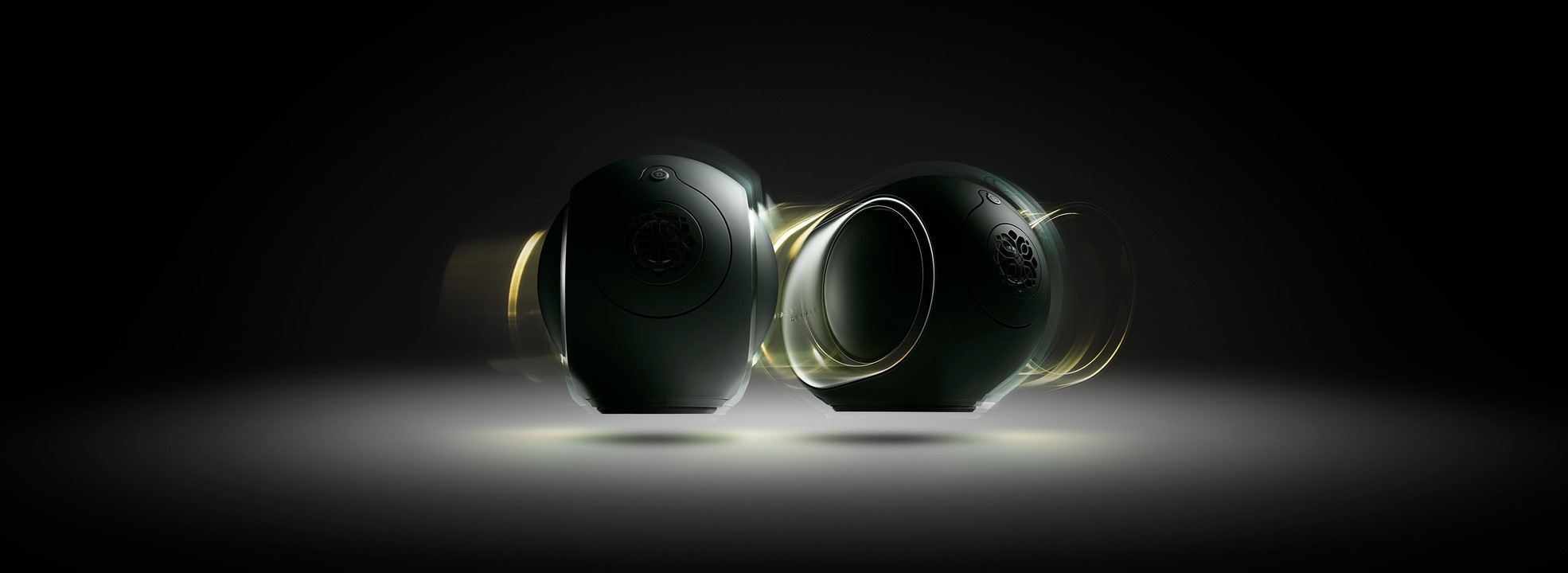
We sometimes encounter a product that, at first glance, doesn’t seem to fit into any of the predefined Hi-Fi categories. This active speaker, we believe, is precisely that sort of creation, in our view, the defining trait of the Phantom Ultimate being its remarkable versatility. It is engineered to play many roles, like a living room centerpiece, a TV’s companion, an audiophile statement, and even a party starter, all with an unmistakable sense of style. In this respect, few all-in-one systems even attempt to be this versatile, let alone succeed.
Our journey with Devialet started early on, nearly at the company’s inception in 2007. Back then, three passionate Frenchmen launched a bold idea in the heart of Paris: to blend the refinement of pure class A amplification with the efficiency and muscle of class D, all wrapped in an avant-garde aesthetic that could not be mistaken for anything else. Their vision quickly took form in the first D-Premier amplifier, a futuristic slab of chrome and glass that looked more like a kinetic sculpture than a piece of hi-fi hardware. It was a genuine revolution in both form and function, a device that integrated streamer, DAC, amplifier, and even a phono stage under one impossibly thin shell. Hearing the D-Premier for the first time was an interesting experience!
That spirit of innovation and integration continued with the birth of the original Phantom series. The spherical design, the pulsating side-firing woofers, and the promise of seismic bass from a desktop form factor all of these quickly became Devialet’s hallmarks. We remember our first sessions with the early Phantom and how it defied our expectations, especially for what a single, low-volume sealed box could achieve in the bass department. Later on, the Reactor line condensed much of this philosophy into an even more compact package.
That experience matters because Phantom Ultimate 108 dB represents the most mature and ambitious interpretation of this concept yet. The core recipe remains instantly recognizable: a specified 1100 watts built-in amplification, a cabinet shape that is both visually striking and acoustically purposeful, real bass extension below what should be physically possible, and a full sweep of streaming options. Everything feels more refined now. The new tweeter shows promise of even greater extension and air, the driver materials have been carefully rethought, and the processing power under the hood has been boosted to keep up with the growing demands of modern music playback and room integration.
To us, what stands out above all is just how seamlessly the Phantom Ultimate adapts to different environments and listening habits. It can live happily as a solitary system beside a TV, step up as a full-range stereo pair on dedicated stands, or slot into a larger multiroom setup without any visible struggle. There are not many solutions out there that let you go from a quiet evening with jazz in a purposefully built attic room for maximum comfort and silence, to easily moving the speakers downstairs, in a full house of friends asking for some electronic party music, to enjoying a movie night with the missus, all with the same device. That, in our book, is true versatility, and for Devialet, we believe it has always been central to the Phantom philosophy.
At the same time, we approach this review with the perspective of people who live and breathe traditional hi-fi. We know what separate electronics and passive speakers can deliver in terms of scale, dynamic range, and textural nuance. Part of the magic in this audiophile journey is exactly that, carefully matching amplifiers, source, and cables, chasing that perfect balance over time. This requires patience and experimentation, each step shaped by personal taste.
We know the tradeoffs that come with putting everything into a single enclosure, no matter how well executed. Our goal here is not to repeat the marketing brochure, but to discover where the Phantom Ultimate’s strengths truly shine, where its limitations might show, and how it stacks up against both the world of design-forward wireless systems and the best conventional hi-fi we know.
With that in mind, let us turn our attention first to the build quality and technical story beneath this instantly recognizable exterior.
I. Build Quality and Technical Overview
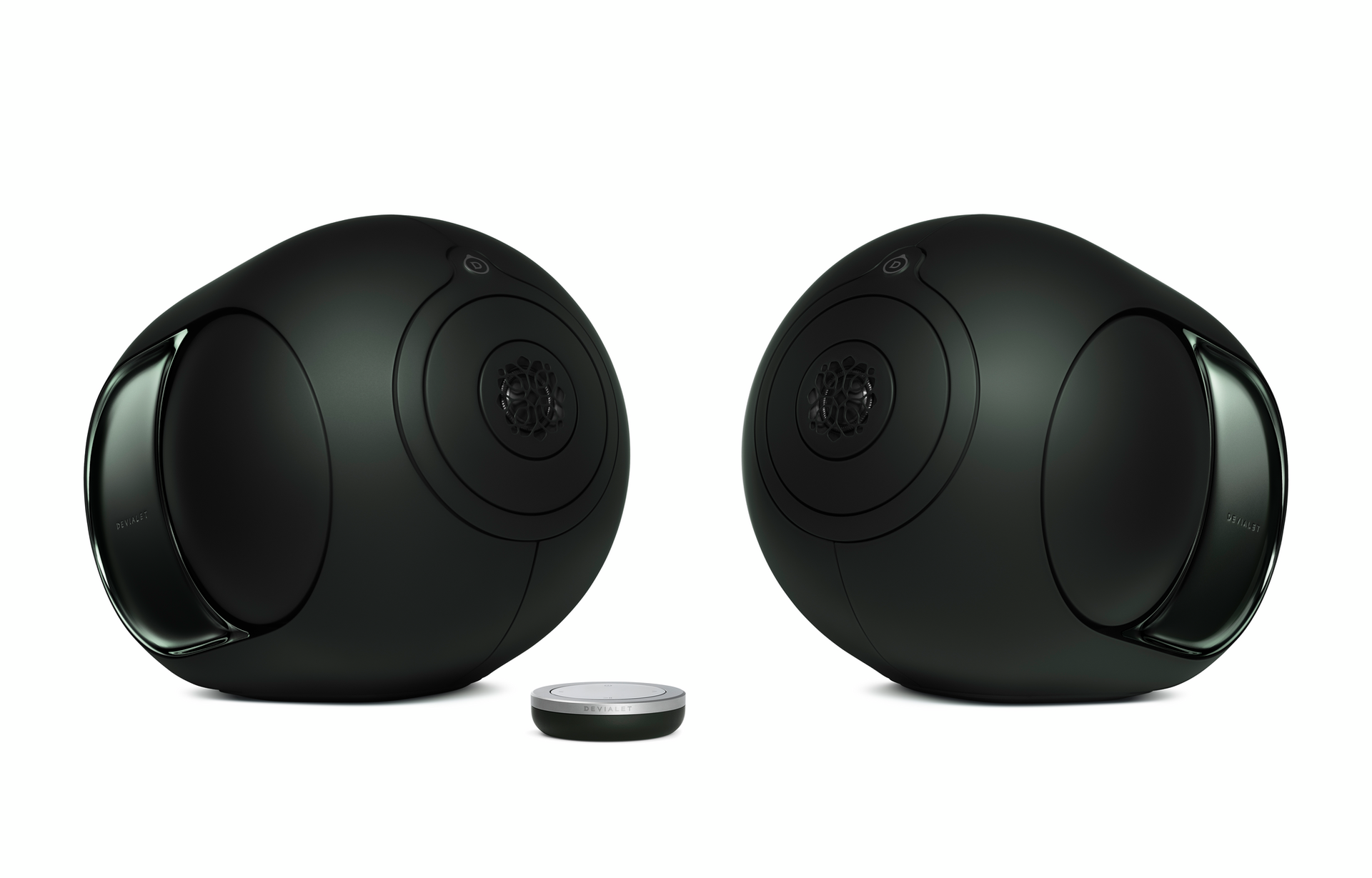
Devialet’s Phantom Ultimate 108 dB stands as a testament to the idea that exceptional sound can and should be delivered in a package that refuses to compromise on either form or function. The moment we unbox it, regardless of finish: Deep Forest, Light Pearl, or a more exclusive Gold leaf, the sense of density and monolithic build is immediately apparent. Every line and contour feels precise, with a seamlessness that sets it apart from mass-market wireless speakers. The sealed, pressure-resistant enclosure is sculpted from a proprietary multi-layer composite, intentionally overbuilt to withstand the intense internal forces generated by the bass drivers. Devialet’s choice of a spherical geometry is as much about visual identity as it is about controlling resonance and ensuring even pressure distribution for the drivers inside.
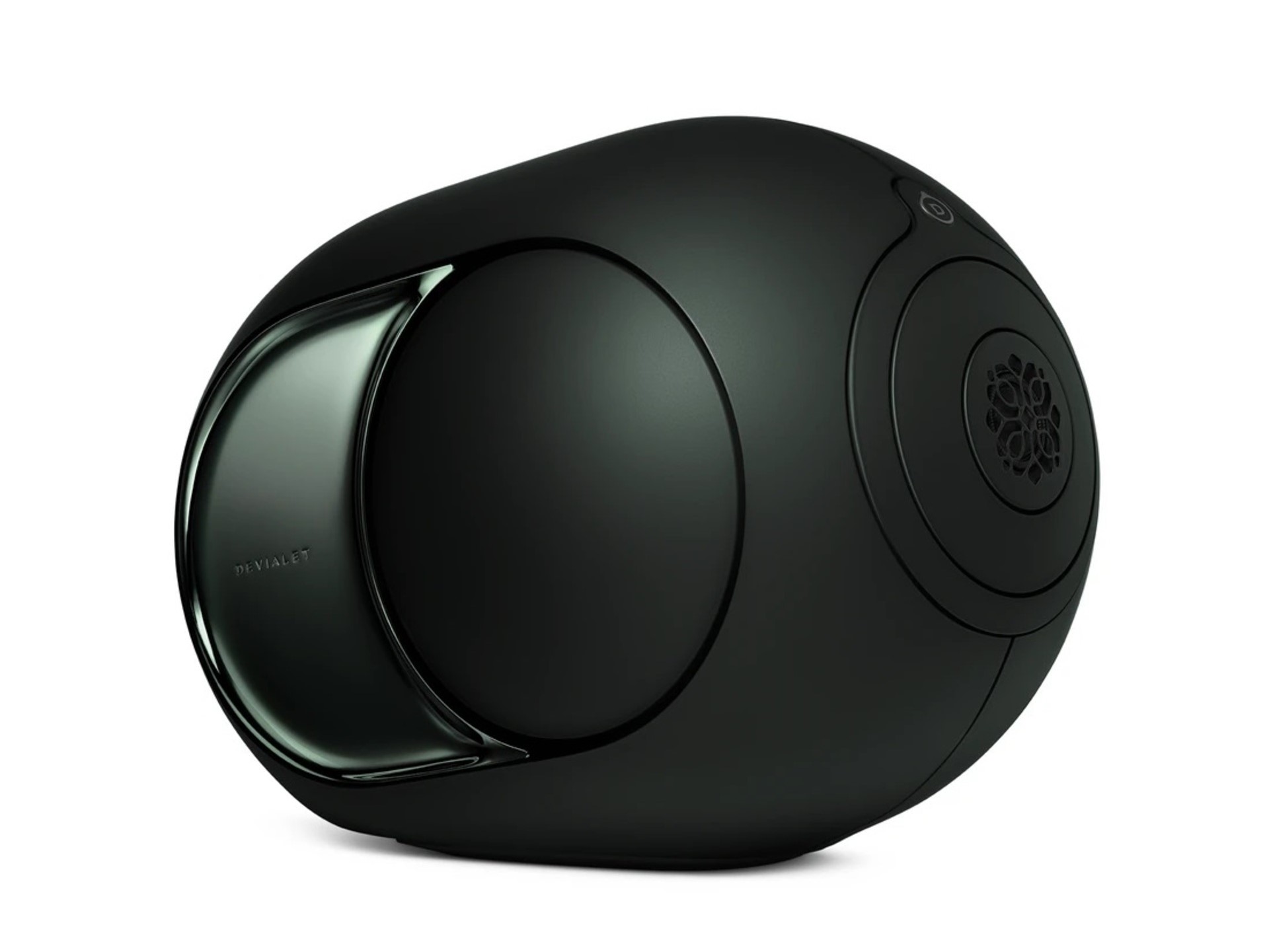
The most visually arresting elements remain the pair of side-firing woofers. In the new Ultimate 108 dB, Devialet chose to change the material for the bass dome, now made from a newly designed ABS material. This material offers improved damping and can lower distortion at extreme excursions, compared to the original aluminium design. Taping the new woofers gave us a small glimpse into how well the new drivers are damped. While the old ones sound like a thin metallic can, these new ABS domes have no trace of that metallic resonance. Both woofers move in push-push configuration, operating in a sealed enclosure that embodies Devialet’s Heart Bass Implosion principle: an engineering solution that allows true in-room extension down to a “claimed” 14 hertz, with virtually no cabinet vibration, even at high output. We will see that the claim is indeed proven to be correct in the measurement section below. Witnessing these drivers in action is a reminder that physicality and finesse are not mutually exclusive.
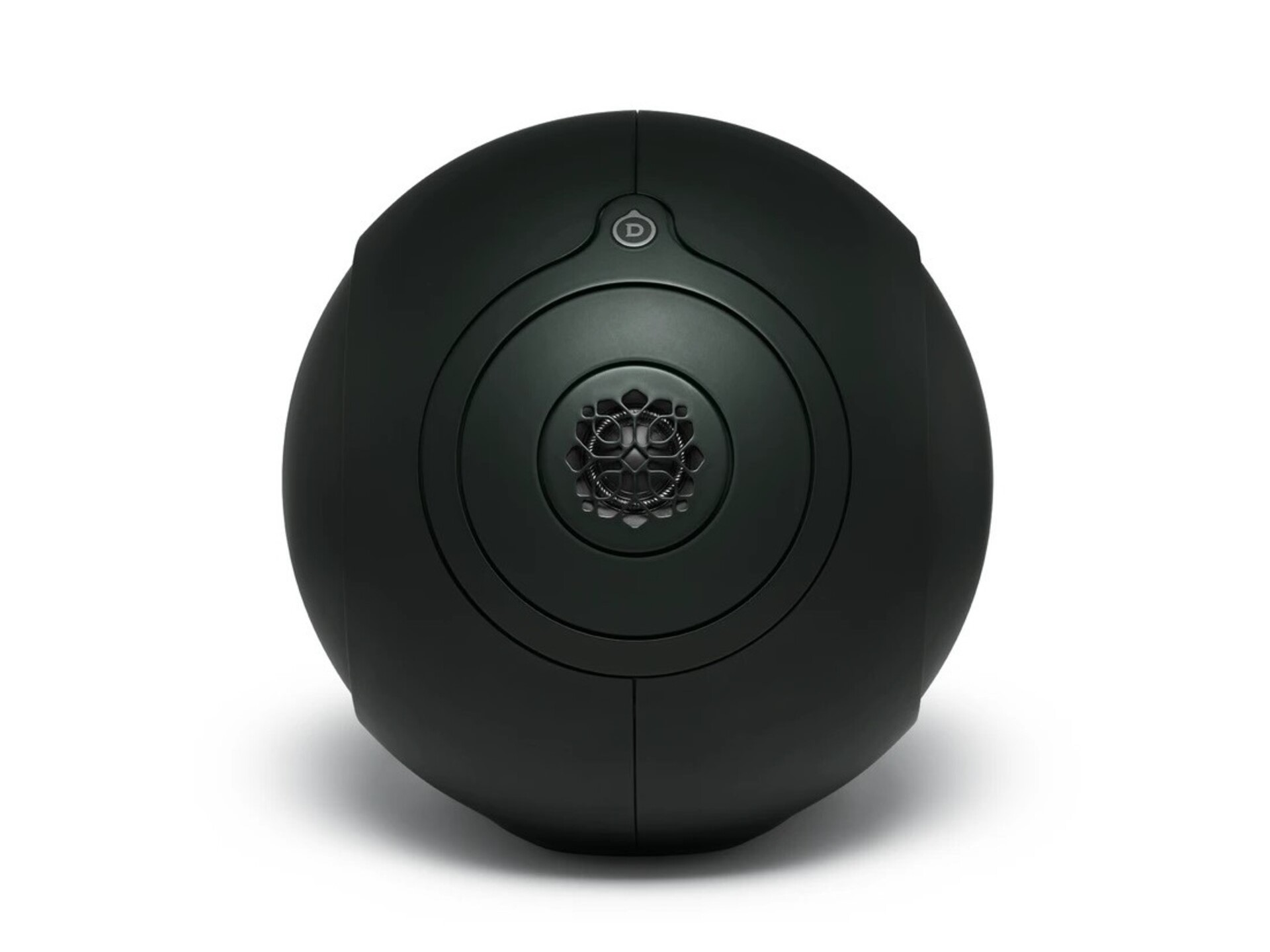
Centrally, the new-generation 13 cm midrange driver is formed from aluminium and sits exposed on the face of the enclosure, without a protective grille. While the previous generation also relied on aluminium, the new driver stands out for its exceptional damping. The usual metallic shimmer is gone. Applying a gentle tap now reveals a character more reminiscent of a well-damped polymer than a metallic dome. This is a direct demonstration of the engineering effort Devialet has made in taming the resonances and metallic ringing that so often compromise aluminium membranes. The result is a midrange that remains pure and free of unwanted coloration, a subtle, critical improvement that experienced listeners will immediately appreciate.
Rounding out the driver array is a newly developed aluminium dome tweeter, the final element in Phantom Ultimate’s updated acoustic lineup. This is a significant shift for Devialet. Previous flagship Phantom models used a titanium dome tweeter, but for the new Ultimate line, the company has moved to an all-new aluminium dome design. From the very first listening session, it becomes clear that the treble is now part of the speaker’s highlights. Where older Phantom models sometimes suffered from a sibilant or harsh upper range that could become fatiguing over long sessions, the new tweeter changes the experience entirely. High frequencies are rendered with a silkiness and effortless sense of air, entirely free from the glare we used to notice, but, and this is a very important observation, there is a total absence of any metallic shimmer so often heard from typical metal dome tweeters. This is a true testament to the quality of damping materials used throughout the newly designed drivers. Cymbals, strings, and subtle vocal nuances now sound more natural, allowing us to enjoy extended listening without fatigue. For the first time in this family, the treble is genuinely refined, detailed, and spacious, and remarkably smooth even at high volumes, bringing the overall tonality much closer to the standards we expect from high-fi loudspeakers. As the last piece in the driver lineup, the switch to aluminium for the tweeter marks a decisive leap forward for the Phantom series and one we applaud.
One of the core technologies of this speaker is Devialet’s Speaker Active Matching (SAM), always engaged, continuously analyzing and correcting the driver’s behavior in real time. SAM builds a complete physical model of the driver using laboratory measurements, including displacement, speed, resonance, and casing effects, then applies precise digital processing to synchronize the acoustic output of the midrange with the original signal. This means the Phantom Ultimate delivers a more accurate and coherent reproduction, preserving spatial qualities and offering genuine protection from overload even at higher volumes. This kind of technology is rarely seen on traditional wireless loudspeakers.

The core of the Phantom Ultimate is the same ADH (Analog Digital Hybrid) amplification that has defined Devialet since its inception. By blending a Class A voltage stage with multiple Class D current stages, the Ultimate delivers a staggering “claimed” 1100 watts, controlled and distributed across all four drivers. In reality, we only managed to measure a maximum draw of 300W from our power conditioner.
Inside, a next-generation NXP iMX8 processor handles crossover management, thermal protection, DSP, and room adaptation, ensuring the system remains responsive, dynamic, and safe under all conditions.
Connectivity is equally futureproof. Wi Fi, Ethernet, AirPlay, Google Cast, Spotify Connect, Tidal Connect, Bluetooth 5.3, UPnP, and Roon Ready are all onboard, making the Phantom Ultimate feel very comfortable in a streaming ecosystem. The RJ45 Ethernet port and optical input add welcome flexibility, reinforcing Devialet’s philosophy that everything necessary is already built into the box.
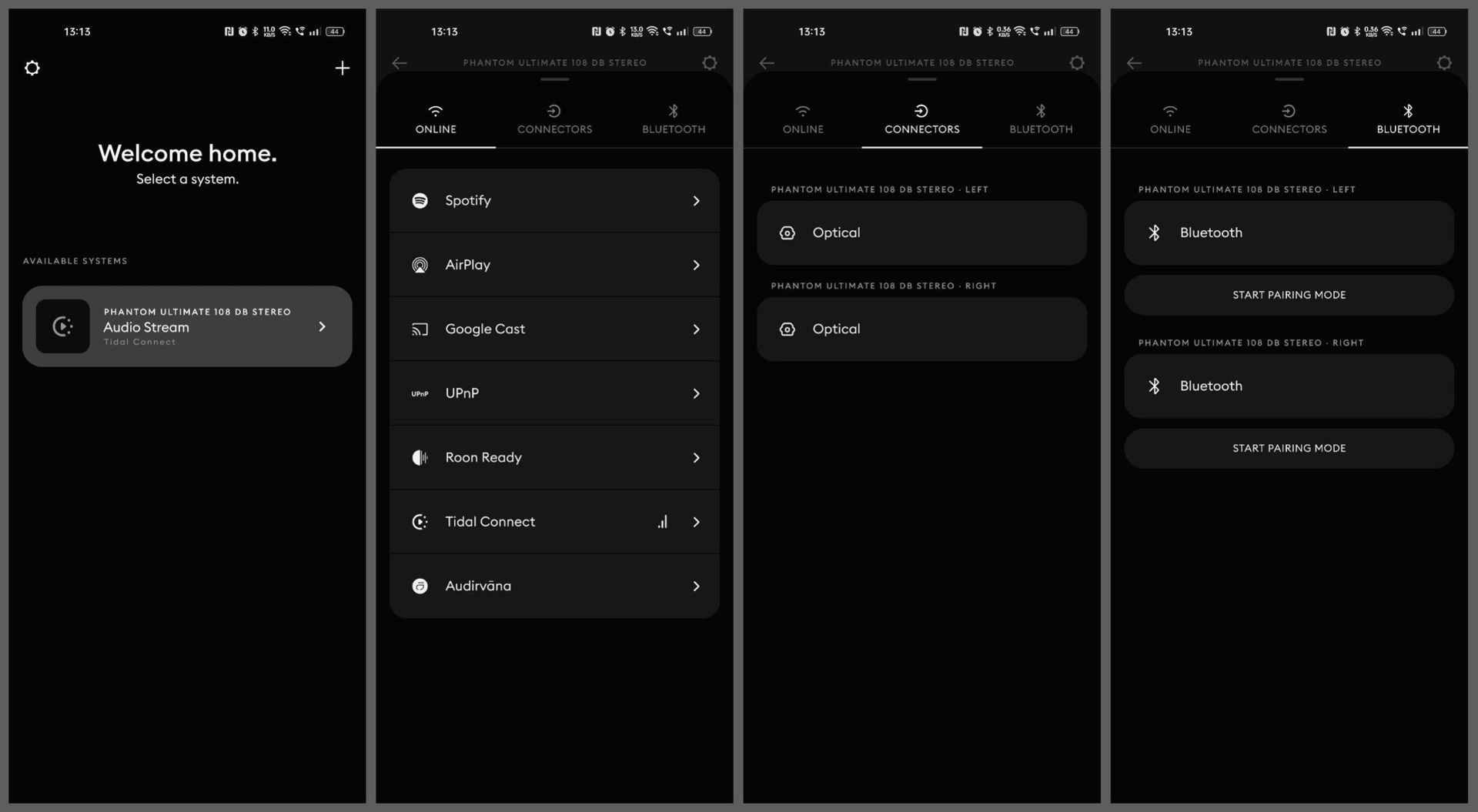
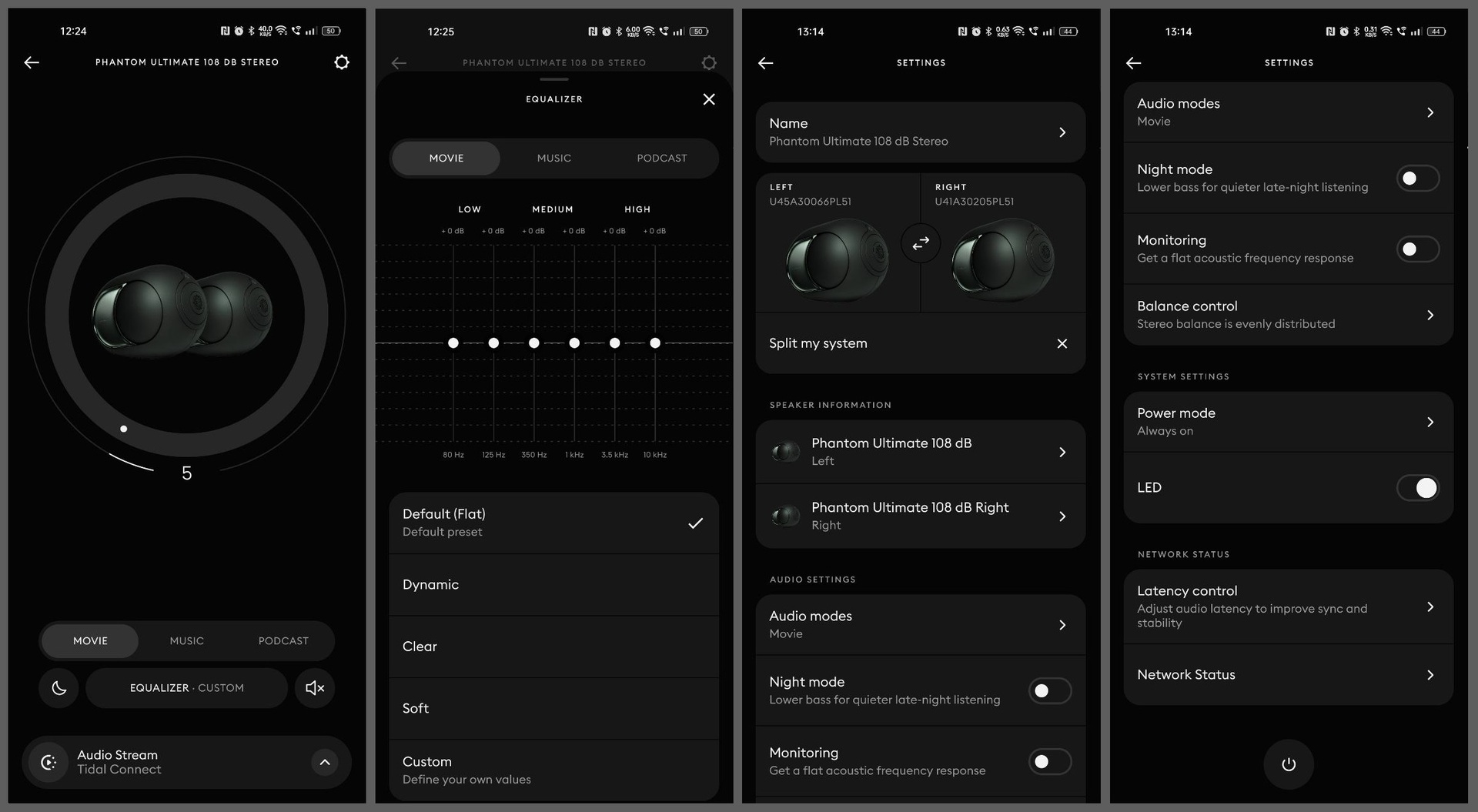
With the latest DevialetOS (OS3), the operating system now provides three dedicated listening modes: Movie, Music, and Podcast, each tuned for a specific type of content. There is also a fully configurable six-band EQ, alongside Bass Reducer and Loudness options, allowing for fine adjustment of the speaker’s response to match both taste and room. Streaming has been further integrated directly into the speaker software, making it easier than ever to access content from modern platforms without extra boxes or cables. All of these changes underline Devialet’s commitment to evolving not just the hardware, but the entire experience of living with Phantom Ultimate day to day.
A superbly great news is that Devialet has not raised the price as some manufacturers have with their entire portfolio.
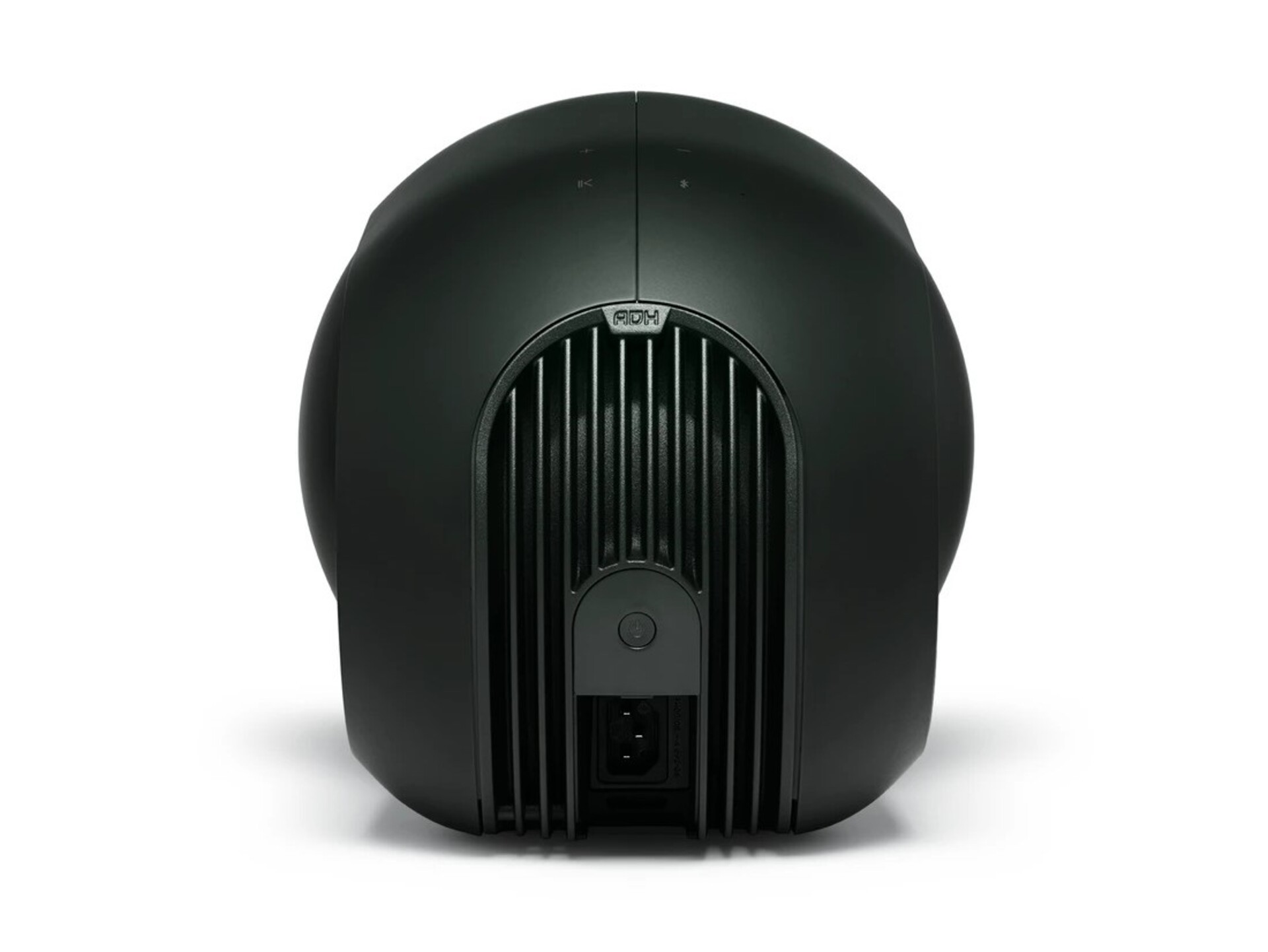
Control comes by way of a tactile touch panel with four zones atop the enclosure, and the included Devialet Remote, a solid, circular controller that exudes quality. The experience is smooth, from basic commands to fine volume adjustments, adding to the experience of a truly premium system.
Before we move on to the subjective impressions, and since we are still in scientific territory, we feel it is only natural to turn our attention to measurements and analysis. Measurements have always played an important role for us to check on the manufacturer’s claims, and as a way to engineeringly understand how a product behaves in a real environment, under real conditions. That is why we measure at the listening position. The presence of digital processing, advanced drivers, and multiple EQ presets in the Phantom Ultimate made us especially curious. With this in mind, we set out to capture the frequency response and behaviour for each of the presets, wanting to see how the system adapts its character to the different scenarios.
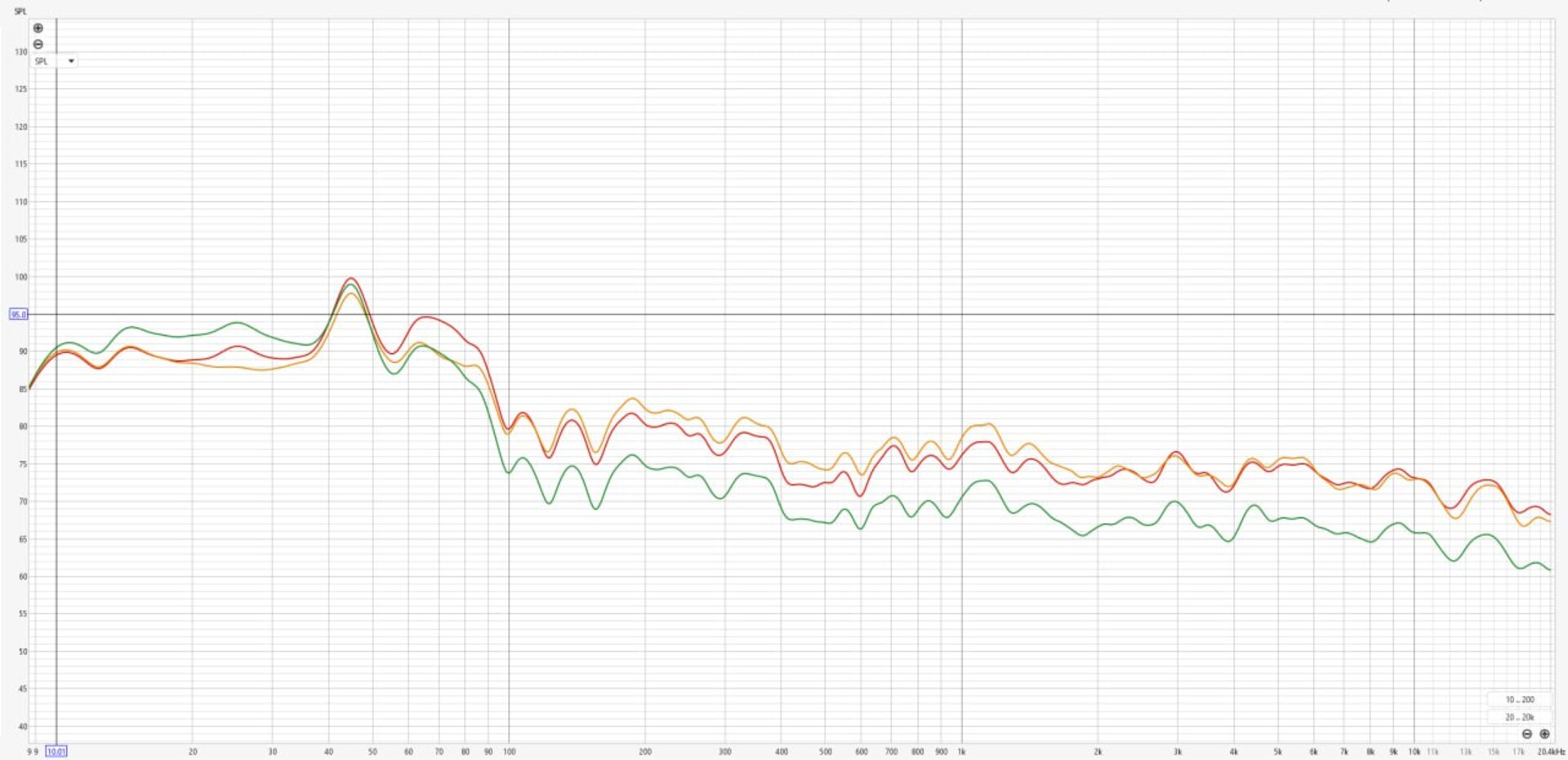
Movie (green) – Podcast (yellow) – Music (red)
As you can observe, Movie mode (green) stands out with the highest energy in the bass and sub-bass region, resulting in a weightier presentation. The response is elevated from about 15 to 80 Hz, then dips sharply through the mids and treble by approximately 5 dB compared to the other modes. This creates a sound profile that prioritises cinematic impact and presence, but with a more recessed upper range, making effects and dialogue feel more grounded yet less airy.
Podcast mode (yellow) shifts the balance, retaining some warmth in the low end but delivering a smoother, more even midrange. The upper midrange and presence region are lifted above both Movie and Music modes, which directly improves speech clarity and intelligibility, a logical tuning for spoken content. Treble remains moderate, which helps avoid fatigue during long listening sessions.
Music mode (red) offers the flattest and most balanced response of the three. Bass extension is robust, with a smoother transition through the mids, delivering a boosted kick that makes the kick drum sound much more lively and present. There is also a gentle rise in the upper midrange and a subtle lift in the sparkling area of the treble, providing a sense of air and detail ideal for music listening.
This is precisely what we heard and felt when switching between modes, even before taking any measurements. We wanted to test whether our listening impressions would be visible in the frequency response graphs, and they clearly are. Each preset distinctly shapes the sound, once again confirming that what we experienced subjectively is rooted in objective reality.
II. A Tale of Two Generations: Comparing Old and New
We feel it is important to put our long-term experience with the new Phantom line into context. Our journey with Devialet’s speakers has been anything but superficial since we lived with the old generation in our own rooms, and followed the evolution of their acoustic philosophy from the earliest days. Yet, if we are being perfectly candid, our impressions of the earlier Phantom models were mixed when it came to pure audiophile standards.
For all their technical spectacle and visual drama, the original Phantoms often struck us as leaning too heavily toward the “boom-box” end of the spectrum. Yes, they delivered bass that defied their size, and yes, the maximum output was remarkable for such a small, single closed enclosure, but the balance was never quite right. The bass was so forward and prominent that it sometimes overwhelmed the rest of the frequency range, especially in smaller or untreated rooms. The result was a presentation that grabbed attention with its energy but did not always hold it with refinement or nuance.
The treble, while extended on paper, often sounded a little glassy and sibilant, lacking the subtlety and inner detail that separates a good speaker from a truly great one. Cymbals, strings, and vocals felt pushed back or blunted, robbing recordings of their natural air and space. The midrange was similarly affected, somewhat recessed, less vivid, with vocals and instruments that did not quite step into the spotlight the way we expect from genuine high-fidelity designs. The overall impression was of a sound signature engineered to impress on first listen, but one that could feel fatiguing or one-dimensional over time.
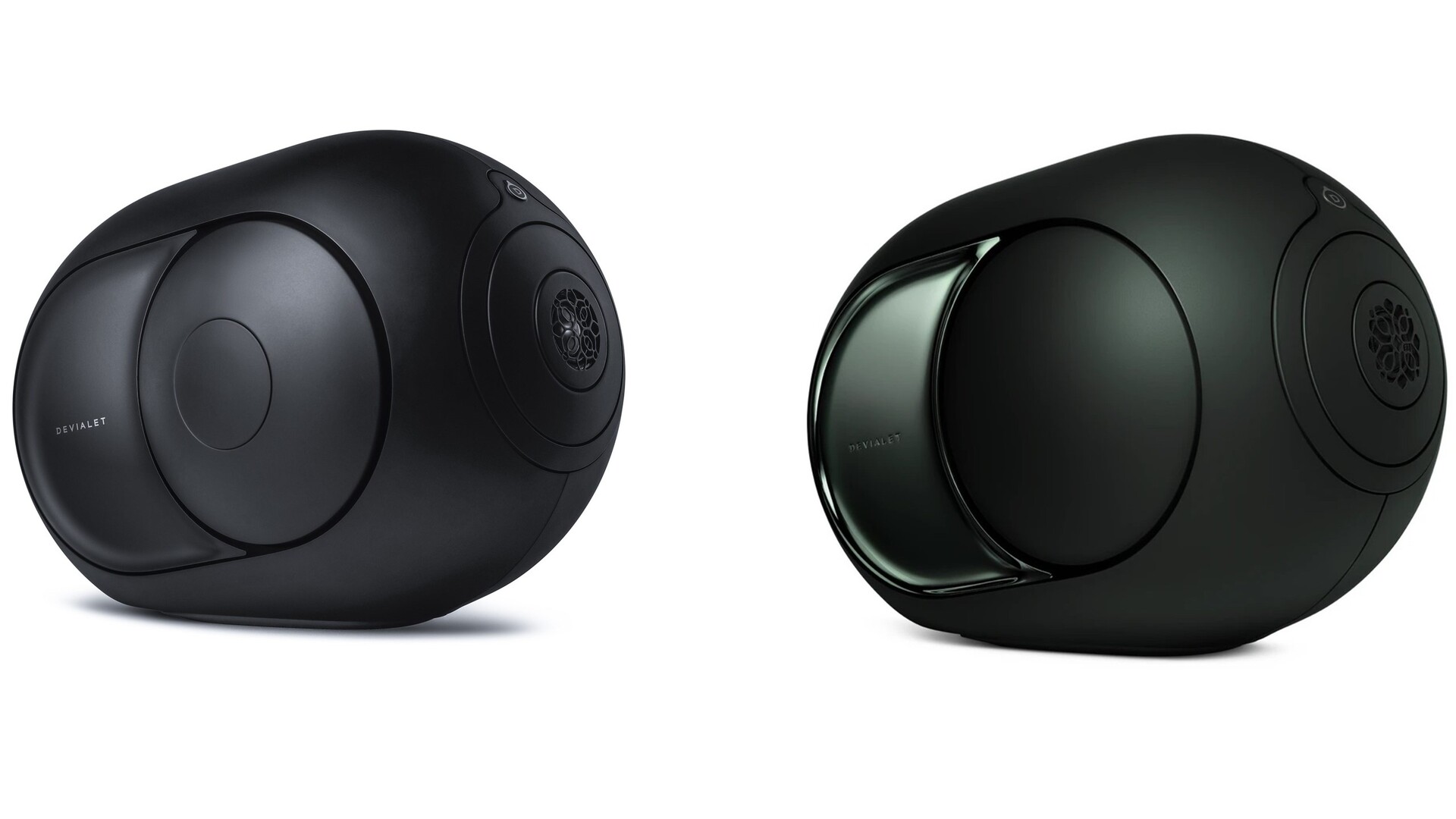
Phantom I vs Phantom Ultimate
In practical terms, the earlier Phantoms seemed most at home with pop, dance, or electronic music, where energy, punch, and scale are at the top of the wish list. These genres benefited from the muscular low end, and willingness to play loud, but acoustic material, jazz, and classical fared less well, often missing the sense of texture, tonal accuracy, and microdynamics that we value in serious two-channel listening. We found ourselves wanting more control, more transparency, and, above all, a more balanced approach, one that could shift gears between genres without leaving something essential behind.
These are not criticisms made lightly. They come from years of hands-on experience and from the same standards we apply to every loudspeaker, regardless of category or price. The promise of a redesigned tweeter, a new midrange, new materials for the drivers, and updated DSP suggests the company is improving, learning from customers and demand, and aiming for a sound that goes beyond pure spectacle. As we move into the listening sessions, we will see just how far this latest flagship has come and whether it can finally bridge the gap between technical innovation and true audiophile satisfaction.
III. Listening Impressions
Treble and Microdynamics
The first thing that comes to mind when starting the listening session is the treble performance. We have already highlighted the new aluminium tweeter’s updated design, but in practice, its impact is even more obvious than on paper. High frequencies now have a certain finesse and delicacy that eluded the older models. Gone is the sharp sibilance or glassiness that crept in during longer sessions. The upper registers now feel airy and smooth, giving cymbals, percussion, and strings the space to shimmer and decay naturally. Even on recordings that used to highlight the Phantoms’ weaknesses, complex acoustic jazz or modern indie with dense production, the Ultimates remain free from the harsh edge that was ever-present on the older model. This allows for a relaxed, fatigue-free listening experience that invites us to push deeper into our playlists without the urge to take breaks.

To better illustrate how much progress the new aluminium tweeter brings to the Phantom Ultimate, we turn to tracks that have consistently revealed shortcomings in both entry-level and high-end loudspeakers. Diana Krall’s “Temptation” is an unforgiving test for treble refinement.
Her vocals and the closely mic’d percussion can quickly turn edgy or sibilant with the wrong system. Here, the Devialet impresses with the restraint and naturalness we expected. Sibilance, once a trademark of earlier Phantom generations, is now absent; Krall’s voice is delivered with detail and warmth, always intelligible but never biting. The subtle brushing on cymbals and the shimmer of the ride are airy and open, with none of the sibilant glare that can make long listening fatiguing. The top end feels smooth and inviting, making it easy to settle in for extended sessions without the need for mental or physical breaks.

Jesse Cook’s “Cancion Triste” pushes in a different direction, demanding a tweeter that can resolve the fine texture and energy of string plucks without exaggeration. The Devialets manage to highlight the physicality of each note; there is a convincing snap to the guitar, a real sense of the performer’s fingers on the strings. While the Ultimate does not extract every micro-detail or the faintest reverberation the way a truly reference-grade system might, it still creates a soundstage that is satisfyingly deep and wide. The stereo image is stable, three-dimensional, and extends well beyond the boundaries of the acoustic space, lending the music a sense of space and presence that feels lifelike.

Lizz Wright’s “Barley” proved just as revealing. Her voice came across as entirely natural and unforced, with no trace of sibilance or harshness. The tonality felt right, allowing the emotional nuance and timbre of her delivery to take center stage, without distraction or artificial emphasis.
Passages were dynamically rendered with confidence, and the articulation between each sound source remained clear and distinct. Bass, midrange, and treble coherence was excellent, resulting in a presentation that felt seamless from top to bottom. The soundstage opened up impressively, wide, deep, and genuinely three-dimensional, drawing us further into the performance.
What is most notable is the overall tonal character: treble is neither artificially sweetened nor forced, but somehow well balanced. The result is a speaker that finally sounds at ease with subtlety and nuance, not just with fireworks. It is a significant leap from previous generations, and one of the clearest signs that the Phantom Ultimate is now a real contender in the world of serious high-fidelity listening.
Midrange, Tonal Balance, Physicality, and Realism

Now let’s shift our attention to the midrange, where the true character of any loudspeaker comes into focus. Chris Stapleton’s “Death Row” gave the Devialet Phantom Ultimate an immediate opportunity to show what it can do. The presentation was marked by striking physicality and punch, with Stapleton’s voice delivered with convincing immediacy and presence, so much so that we often forgot just how compact these speakers really are. Tonality was full, textured, and rich, without even a hint of artificial warmth or unwanted thinness. We will admit that, given the size, we initially had concerns about a thin-sounding midrange, but those worries proved completely unfounded. What also stood out just as clearly was the exceptional coherence across the frequency range. Transitions from bass to midrange and on into the treble were utterly seamless, supporting a soundstage that was both impressively broad and truly immersive.
The only criticism we could level here was in the handling of reverberations and echoes. The atmospheric cues, which on more microdetailed systems tend to expand the perceived soundstage further, felt subdued, almost missing. Microdetail was a bit reserved, and the reverberant tail did not quite bloom as much as we know is possible. Still, apart from this, the overall impression was of a midrange that is genuinely accomplished, honest, powerful, and engaging.

Anouar Brahem’s “The Astounding Eyes of Rita” offered another revealing test. The Phantom Ultimate captured the drumming with remarkable realism, allowing the subtle interplay of hand percussion and string instruments to stand out in convincing fashion. Much of this comes down to the speaker’s strong sense of tonality and coherence, which kept each element grounded and connected in the mix. Dynamics were very satisfying, swift when called for, delicate when needed, and we actually found ourselves listening through the entire album, drawn in by the natural flow of the music.

Leonard Cohen’s “You Want It Darker” further highlighted the strengths of the Devialet’s midrange. Cohen’s deep, resonant voice carried authority and emotional weight, sitting perfectly within the expansive yet stable soundstage. The separation between vocals, bass, and background harmonies was clear, each sound source being carved out with precision.
Another masterful piece we enjoyed was James Blake’s “Retrograde,” a track that can easily turn muddy or congested if a speaker struggles with midrange layering. Here, the Phantom Ultimate managed to keep each texture and vocal layer distinct, while preserving the sense of physical presence that makes this piece so involving. The track’s dense production retained its sense of scale and structure, never devolving into a flat or confused blur.
Taken together, these listening sessions confirmed that the Phantom Ultimate’s midrange is a genuine step forward for the series. It delivers music with the physicality, tonal accuracy, and realism that are essential for lasting enjoyment. The performance is convincing, coherent, and deeply musical.
Now let’s move on to the meaty part of the review.
Bass Performance, Dynamics, Extension, Impact, SPL Limits
If there is one figure that defines the Phantom Ultimate, it is right in the name: 108 dB. In our own tests, the Devialet had no trouble reaching this sound pressure level in-room, with enough reserve to spare (we measured 112 db for the pair, in our listening position in an approximately 24 square meter room with a listening distance of around 4m). This is not a marketing number but a real, repeatable result.
When pushing the Devialets, we found that dynamic compression on the bass starts to become noticeable once we cross the 55 % level on the volume dial, while the rest of the audible band actually gets even more energetic. Yet, even at these elevated volumes and all the way to the maximum, there was not a hint of distortion or mechanical noise, only a sense of the electronics carefully managing the drivers for their own protection.
In the measurements below you can clearly see the dynamic compression working its “magic” at higher than 50% volume. Measurements are done with the microphone in the listening position.
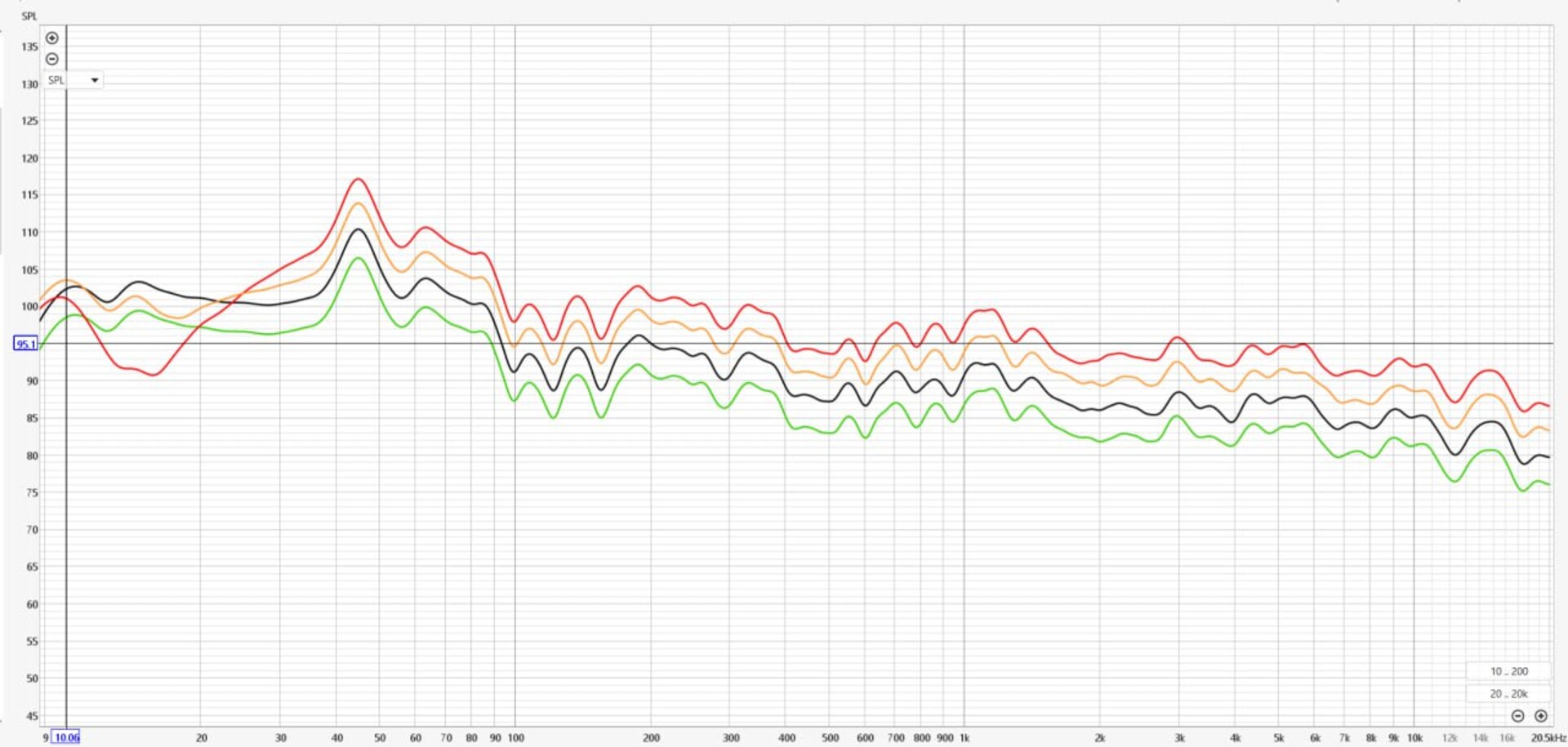
60% (red) – 55% (orange) – 50% (black) – 45% (green)
The bass itself is both punchy and physical, with a depth that defies expectations. Our in-room measurements confirmed genuine extension down to 10 Hz, a feat that very, very few traditional speakers, let alone a compact wireless design, can even approach. Articulation is strong; this is bass that is felt as much as heard, capable of a proper chest kick when called for, and delivering real scale for cinematic or electronic material.

We turned to Dead Can Dance’s “Opium” as a reference for both the subtlety and depth of the low end. The Phantom Ultimate left no stone unturned: every difference in bass texture, every layer of the arrangement was made obvious. Brendan Perry’s voice, as always, was rendered with flawless tonality, only further emphasizing how accomplished the Devialet’s performance has become. “Return of the She-King” from the same album provided another telling moment, with its rolling, earthquake-like drum passages. The entire track has a straight and defined low passage that can be split into 2 parts: the first part hits with a chest-thumping kick that should almost catch you off guard, followed by the second part, a type of bass that rumbles deep, almost earthquake like. The Devialet captured both sensations perfectly, recreating the physicality and drama that this album demands.
Geoff Castellucci’s “The Sound of Silence” is another part of our test playlist. Here, the goal is to assess not only depth, but also the physical presence and articulation of the lowest male vocals. Every note was clearly audible, dynamic, and powerful, with the Phantom Ultimate reproducing both the chest resonance and the subsonic weight without ever losing control. When the arrangement called for it, we felt the music as much as heard it, the chest beats and earthquake-like passages were rendered exactly as intended.

Electronic music tells its own story, and the Phantom Ultimate passed with flying colors. “Make Us Stronger” by Ghost Rider demonstrated remarkable bass note differentiation and drive; each hit was distinct, punchy, and dynamic, with no blurring or smearing whatsoever. Power, speed, and control were all present in equal measure. Another good track from Ghost Rider is “Speed of Soul”. This track challenges any system’s grip on pace, layering, and impact. It is a dense, high-energy production where the subterranean bassline pulses with authority. The intricate synths and atmospheric sweeps build a sense of scale that few speakers can render without confusion. The Phantom Ultimate 108 dB demonstrates exactly why its plug-and-play bass reputation is justified.
Boris Blank’s “Electrified”, a real trial by sub-bass, with passages that challenge even tower speakers, proved no match for the Devialet. Every detail, every sub-30 Hz flourish came through cleanly, with the kind of authority that puts most full-size floorstanders to shame.
It is worth highlighting that, even in the most demanding moments, the new tweeter never lost its composure. On tracks where intense bass energy often muddies the treble, the Phantom Ultimate kept high frequencies clean and open, further underlining the engineering advances Devialet has made this generation.
Overall, the bass performance and dynamic capability of the Phantom Ultimate are extraordinary for a system of this size. Whether it is chest-thumping punch, in-room subsonic extension, or sheer SPL, everything is delivered with confidence, articulation, transparency, and musicality.
Conclusions:
What sets the Phantom Ultimate apart, perhaps more than any other feature, is just how far Devialet has pushed the boundaries of bass extension. As far as we know, this is the only all-in-one loudspeaker system on the market today that can produce true, usable response down to 10 Hz in a real listening room, without resorting to any dedicated DSP measurements, specialized room correction, or an external subwoofer. There are full-size tower speakers and subwoofers that struggle to reach these depths, and yet here it is, achieved by a single, self-contained enclosure you can lift by yourself with one hand. This is not just a technical achievement; it is a statement, and it leaves the Phantom Ultimate in a league of its own when it comes to low frequency performance.
This is a very rare combination, and one of the strongest arguments for the Phantom Ultimate as a complete, all-in-one solution. It is not just about technical prowess or hitting impressive numbers on a spec sheet. The real achievement here is how effortlessly this system delivers full-range, room-filling sound with the weight and authority of a much larger setup, yet without the complexity, clutter, or compromises that usually come with separate amplifiers, cables, and subwoofers.
But what stands out, when you live with the Phantom Ultimate, goes far beyond its bass performance. The newly developed aluminium tweeter brings a refinement and ease to the treble that was simply missing from previous generations, allowing for fatigue-free, extended listening even with the most demanding material. The midrange is full, coherent, and honest, revealing both the physicality and emotional nuance in music. Transitions between frequency registers are seamless, and the system maintains composure whether you are listening at low volume or pushing up to its impressive SPL limits.
Above all, we strongly believe it is versatility that defines the Phantom Ultimate experience. This is a system that can transform from a discreet companion for background music, to a convincing soundbar replacement for movies, to the heart of a full-scale party setup, without ever needing external boxes, subwoofers, or cables. Placement is easy, streaming is fully integrated, and the user interface is as polished as the impressive visual design. In a world where specialization often comes at the expense of flexibility, Devialet has managed to create a product that truly adapts to its owner, not the other way around.
For anyone searching for a system that can truly do it all, without giving up on bass, scale, dynamics, or musical honesty, the Phantom Ultimate stands as a benchmark. It sets new expectations for what is possible from a single, beautifully engineered enclosure and, just as importantly, reminds us that high performance and versatility no longer have to be mutually exclusive.
Pros
- Standout versatility means they will work equally well as a TV companion, standalone system, or full-range stereo Hi-Fi setup; adapts easily to different rooms and roles.
- Real sub-bass delivery, without any setup needed, you get deep, physical bass down to 15 Hz in-room, just plug in and go.
- Impressive SPL and scale for the size easily filling medium and even large spaces with authority, satisfying demanding listeners without strain.
- Excellent coherence and integration, the highs, mids, and bass blend seamlessly, thanks to the true point-source behavior.
- Premium design and build result in a dense, sculptural enclosure with a flawless finish, where every detail feels high-end and purposeful.
- Effortless everyday use comes from a simple setup, a reliable wireless connection, and comprehensive streaming support through a polished app.
Cons
- Dynamic compression becomes noticeable at higher listening levels, where large swings and impact begin to soften as the system approaches its loudest limits due to DSP protection.
- Some microdetail is lost at very high output, with finely layered nuance and textural information becoming smoother as maximum SPL is reached.
- The platform remains fully closed, offering no upgrade path for amplifiers or DACs and keeping the system entirely self-contained.