We would like to start this review with a deep look into the company’s history. We believe that understanding the story and philosophy behind a product gives us essential context for what we hear and reveals the intentions behind its engineering and design. This approach helps us connect both with the sound and with the ideas and commitment that shape each piece of equipment. For us, this background is the foundation that opens the door to the beauty and meaning behind the achievements of any company.
Background and History
Rotel is a family-owned Japanese manufacturer of hi-fi audio and video equipment that built its reputation during the 1970s, 1980s, and 1990s by offering electronics that delivered a level of engineering quality and sonic performance normally associated with more expensive components. Reviewers and dealers consistently described Rotel amplifiers and source components as providing high-end performance at attainable, more realistic prices.
The company invested heavily in in-house power supply design, with particular emphasis on custom toroidal transformers. Product lifecycles were long, with designs refined over time rather than being replaced frequently. This long-term consistency allowed a distinct Rotel house sound to emerge, one that listeners recognized throughout the years. As a result, Rotel components earned a reputation for combining serious performance with more “down-to-earth” and realistic pricing.
Over time, this positioning also shaped how Rotel was perceived within the wider high-end landscape. The brand became firmly associated with value-oriented performance, a perception that limited its presence in the ultra-high-end space. Rotel electronics were rarely considered when discussing cost-no-object systems, and they rarely appeared driving top speakers from ultra high-end brands such as Wilson Audio, TAD, Marten, Sonus Faber, Raidho, and many others.
The one consistent exception has been Bowers and Wilkins. For decades, Rotel’s visibility in the higher tiers was often carried through a long-standing alliance with the Bowers and Wilkins Group and its global distributor network, a relationship that began in the early 1980s. This history matters because it created a familiar pattern. You would walk into a dealer showroom or an audio show demo room and see Rotel, and later Michi, paired with Bowers and Wilkins, almost as a default system narrative: British speakers, Japanese electronics, and a shared ecosystem of distribution and presentation.
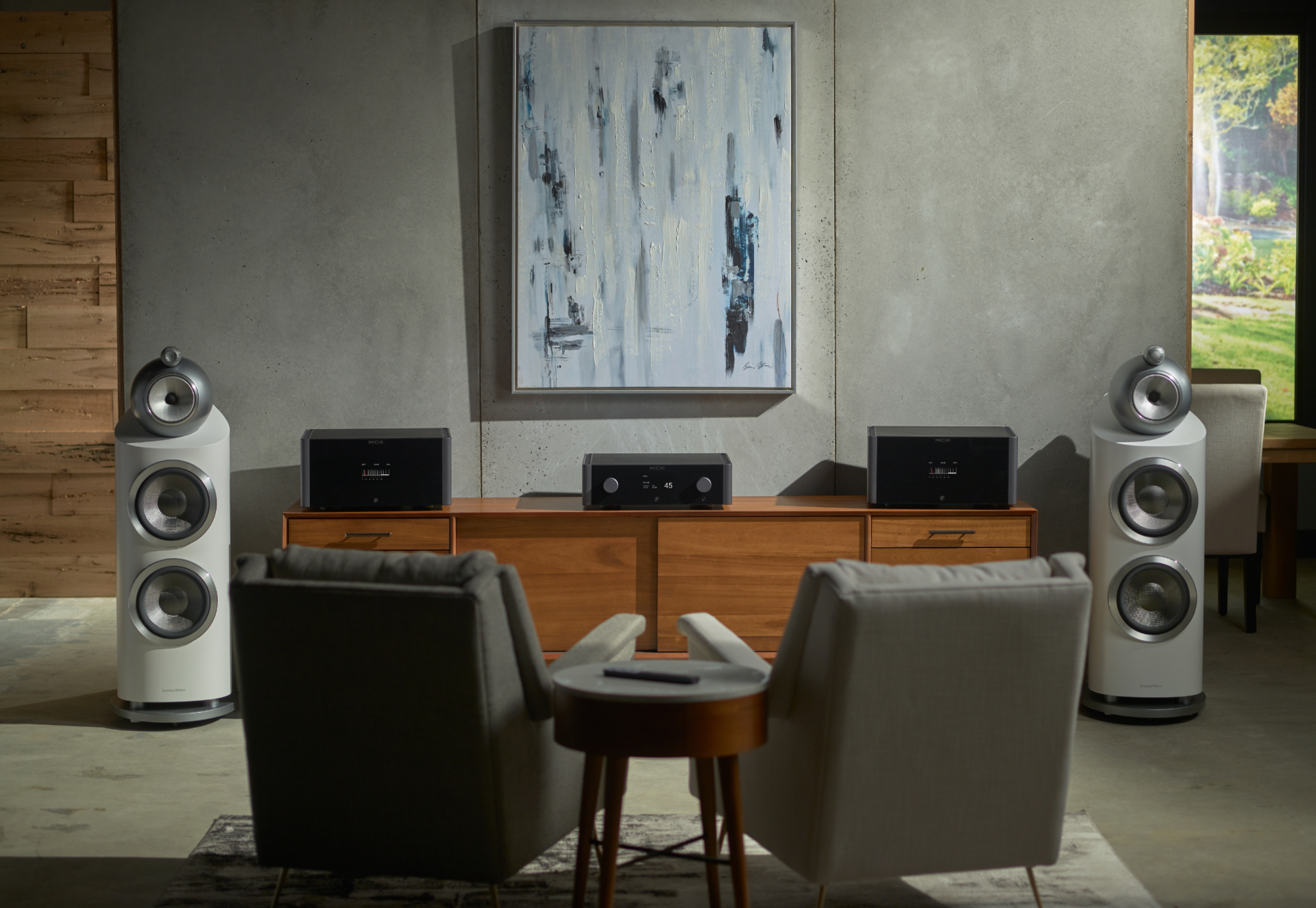
Even in the modern era, this association stays visible at public events. A good example is when we saw Bowers and Wilkins chose 4 Michi S5 amplifiers to drive a pair of the famous Nautilus at the 2025 Warsaw Hi Fi Show.
To better understand the stigmata that brands become associated with, it helps to acknowledge how deeply these perceptions root themselves in the collective mind. Once an image forms, it becomes reinforced over years of repetition, habit, and shared narratives. These associations shape expectations long before a product is experienced, and once established, they rarely shift, regardless of technical progress or isolated achievements.
A quick parallel can be drawn from the automotive world, where Renault is widely associated with practical, everyday, cheap cars. Despite that, they demonstrated undeniable engineering excellence by winning the Formula One World Championship in 2005 and 2006. Toyota earned global trust for durability and mass-market reliability, while its engineering efforts through Lexus and endurance racing required years to gain recognition beyond that image. Porsche, in contrast, established its identity at the very top of motorsport and performance engineering, allowing every road car to inherit that prestige. This pattern appears across many industries.
In the audio space, Naim became synonymous with pace, rhythm, and musical drive. Accuphase built an image centered on refinement and traditional high-end values, carefully cultivating associations with precision, longevity, and craftsmanship. Over time, this image solidified into an aura of elite status, one that formed expectations long before any listening takes place and influences perception sometimes independently of what is actually heard. On the opposite end, McIntosh established an identity centered on power, visual presence, and heritage. That image became so strong that it carried the brand through decades, even when specific models varied in character or performance. Chord Electronics became inseparable from its FPGA-driven design philosophy, and regardless of how a particular product sounded, the brand carried an expectation of technical innovation and unconventional thinking.
These examples illustrate how reputation often becomes stronger than specification. Once a brand occupies a defined space in the collective imagination, every product is judged within that framework. Breaking free from it requires technical excellence, time, consistency, and the determination to confront long-standing expectations. This is why the return of Michi carries such a high significance that extends well beyond the launch of just another product line.
By creating Michi, we believe Rotel set out to reshape its long-standing perception, moving away from value-oriented, mainstream associations and stepping decisively into the high-end arena as a serious contender among the most powerful and ambitious audio manufacturers.
MICHI
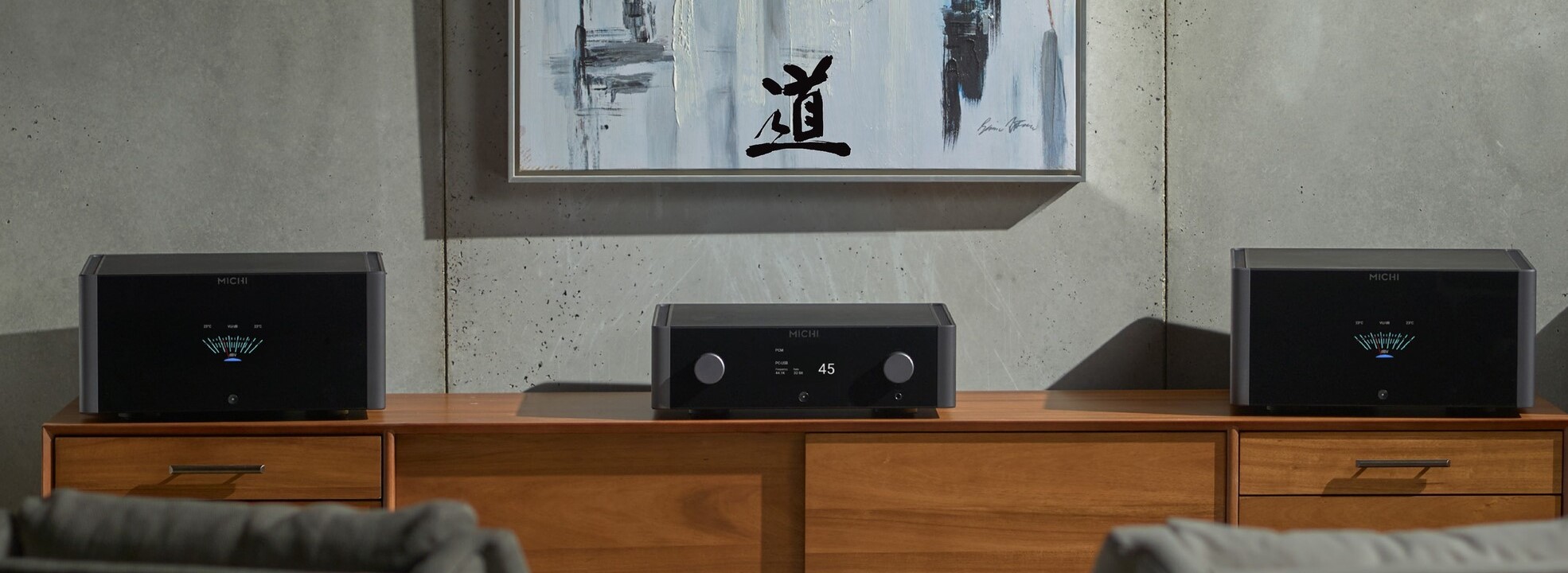
Michi (みち or 道) translates from Japanese as path, road, or way. In Japanese culture, however, the term carries layered meaning, pointing toward moral principles, discipline, and an approach to life shaped by intention and continuity, extending far beyond a simple sense of direction. It reflects a philosophy where progress is measured through consistency, refinement, and respect for process.
Viewed through this lens, the Michi name feels deliberate. It suggests a long-term pursuit of mastery, aligning the brand with the idea of an ongoing journey toward balance, control, and refinement, values that resonate strongly with how these components are conceived and voiced. This principle, or way of life, was conceived to embody the pinnacle of Rotel’s engineering expertise, using advanced circuit topologies, premium components, and overbuilt power supplies designed with margins and reserves that significantly exceed those found in the standard lineup. From its earliest iterations of Michi in the 1990s, the company quickly established the line’s reputation for technical ambition and exceptional build quality.
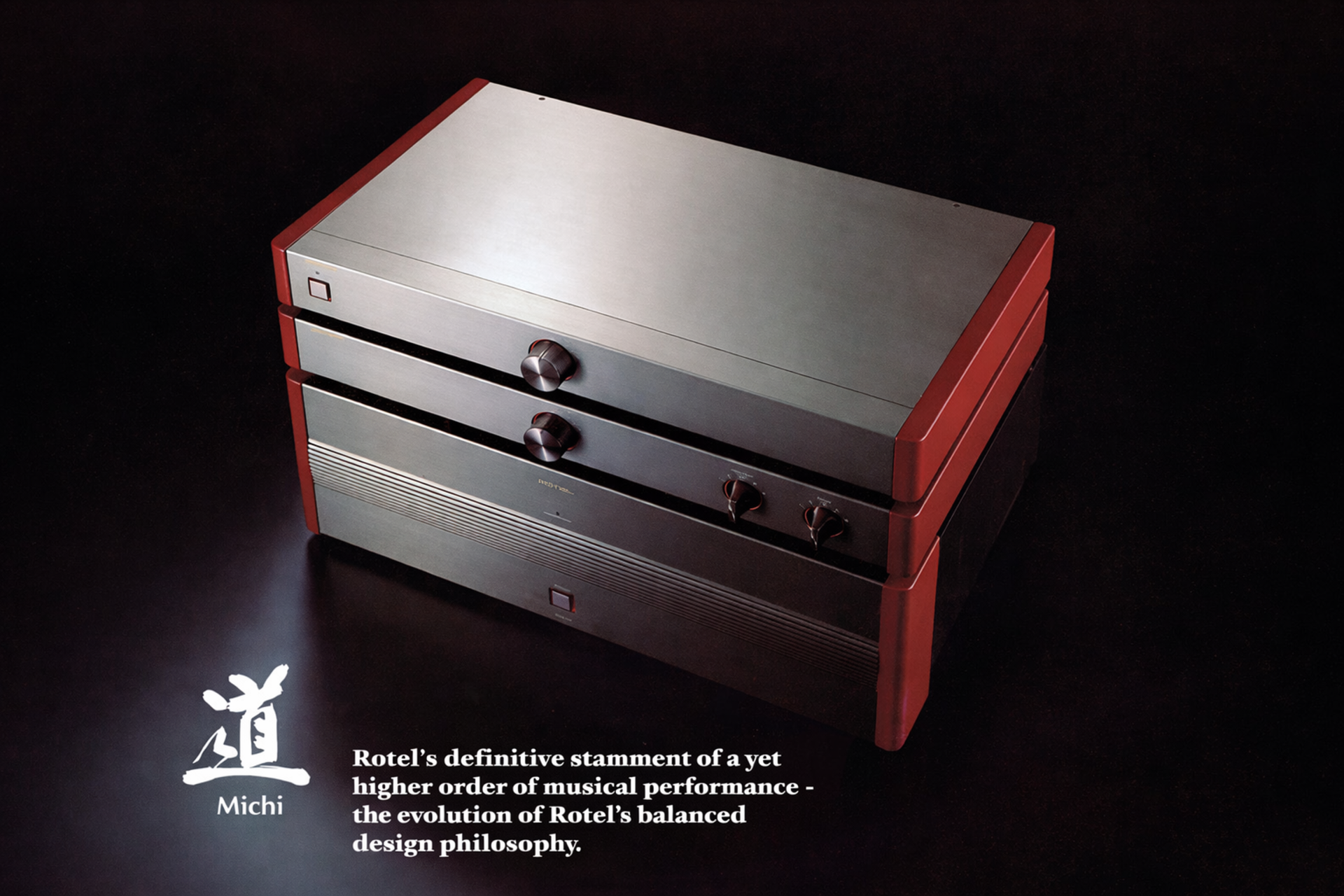
Advert from the Hi-Fi NEWS Volume 39 No 9 Vintage Audio Hi-Fi magazine from Sept 1994
Despite the acclaim and technical achievement of the original Michi models, the series quietly disappeared from Rotel’s catalog by the late 1990s, as the company refocused on its core lineup and shifted manufacturing and development priorities. For nearly two decades, the Michi name remained dormant, remembered mainly by enthusiasts who valued its ambition and build quality. The Michi brand was officially revived in 2019 with the introduction of an entirely new reference series, starting with the Michi P5 preamplifier, the Michi M8 monoblock power amplifier, the Michi S5 stereo power amplifier, and the integrated amplifiers Michi X3 and Michi X5.
The M8 and the new P5 Series 2
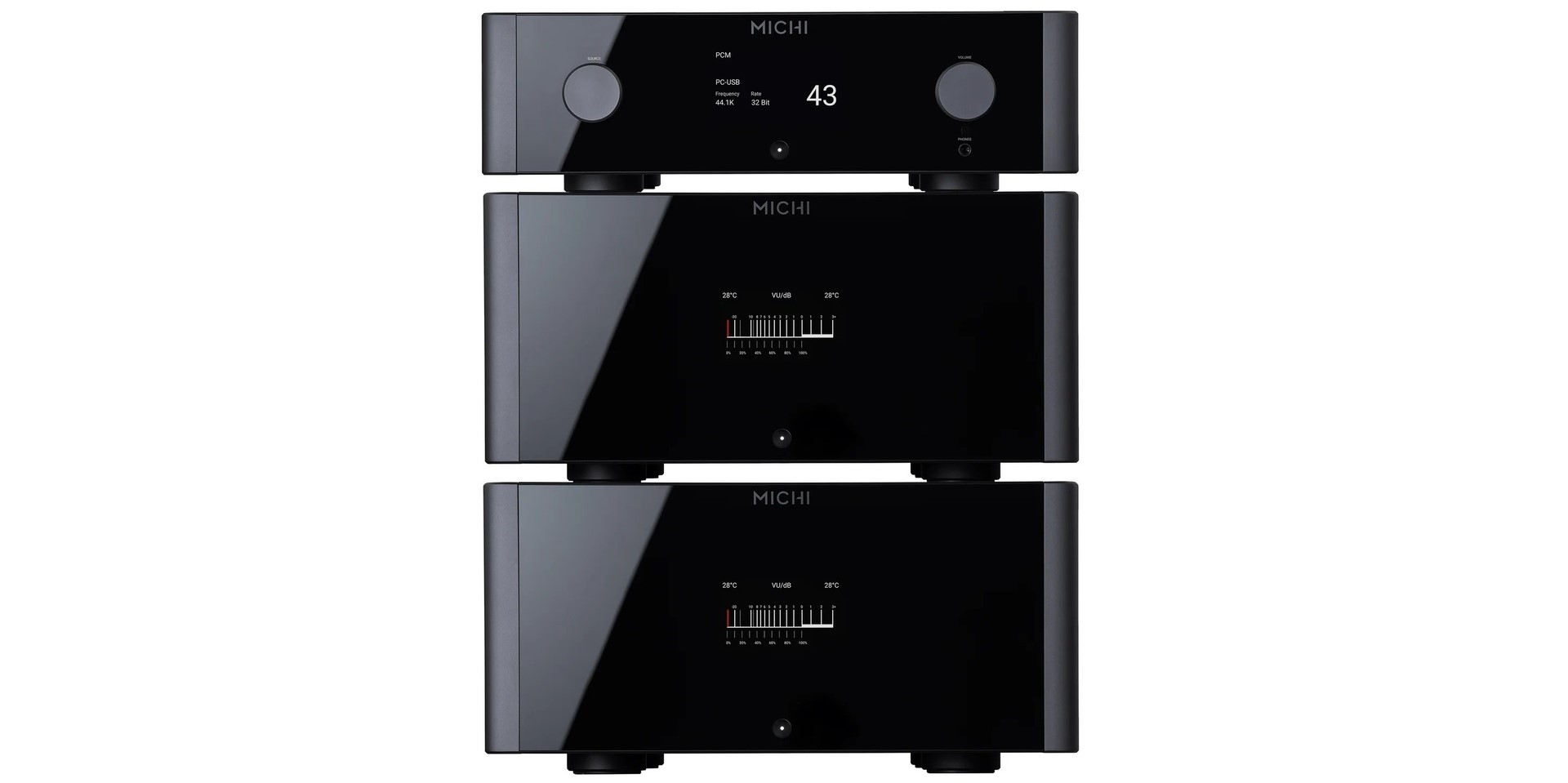
With this new generation, Michi steps forward with a statement. The M8 monoblock power amplifier and the P5 Series 2 preamplifier represent the latest evolution of the concept, expanding on the original ambition with greater power reserves, broader functionality, and a focus on control, balance, and musical expression at the highest level. These components extend specifications, yes, but they also invite a deeper question about how such capability should be experienced.

And this is where our own reflections begin. Like all eccentric, perfectionist humans, we often return to impossible dreams. What if power were truly unlimited? What kind of sound tuning would we want at the end of such an amplifier?
Sometimes we imagine chasing absolute resolution, a microscope-like presentation that unravels every micro-event in a dense orchestral recording, with enough clarity to hear a single violinist breathe between phrases during a live performance. Other times, our minds drift in the opposite direction: something warmer, more forgiving, closer to the emotional language of classic tube amplification. A sound that flows naturally, prioritizing harmonic richness and tonal density over etched detail. Then there is the elusive middle ground, a blend of authority and control with genuine texture and soul. A sound that delivers slam and scale without aggression, remains warm, pleasant, and genuinely easy to listen to.
We continuously search for the truly organic relationship between strength and musicality, with emotion as the final purpose. This pursuit eventually moves from ideas into reality, with each piece of tested equipment bringing the needle ever so closer to nirvana. One of those moments arrived when the Michi M8 entered our listening room.
The first encounter with these behemoths was purely physical: two 65 kg (143 lbs.) packages sitting in the hallway, reminding us of that gym membership we never got to use. Getting them into position was an exercise in strength and stubbornness. After several attempts, with considerable effort and more back pain than we care to admit, the amplifiers finally sat connected and ready.
Standing next to the M8, the P5 preamplifier immediately gave us the same sense of confidence and substance. With its solid construction and a weight of almost 23 kg (50.5 lbs.), the P5 felt more like a true power amplifier than a typical preamp. Thick aluminum panels, a rigid internal structure, and a carefully damped chassis conveyed a clear focus on mechanical stability and resonance control. The front panel mirrored the Michi design language with its glass display and simple interface, while the overall fit and finish reflected the same attention to detail seen in the monoblocks.
Every aspect of its build and physical presence suggested that the P5 was conceived as a natural partner for the M8, aligned in spirit, design, and engineering intent.
Michi supplies a dedicated remote control for each device. That means you get one for a single M8 as well. In this case, we found ourselves with three of them. The construction of it mirrors the brand’s overall design philosophy. Machined from aluminum and weighing in at 179 grams with the batteries included, the remote has a solid, well-balanced feel in hand and a layout that prioritizes direct access. We appreciated the lack of useless buttons and complexity. Buttons are clearly separated and logically grouped, allowing control over volume, input selection, display options, and menu navigation without the need to reach for the front panel. Volume adjustment is handled with fine resolution, making precise level changes easy from the listening position. In daily use, the remote responds promptly and consistently without the need to point it precisely at the device, reinforcing the experience of a system designed to feel cohesive and complete, both sonically and ergonomically.
Inside the Michi P5 Series 2
Components and internal design
After opening up the Michi P5 Series 2, it became immediately clear that this is not just a preamplifier but a full-fledged control center built for serious systems. The entire design revolves around channel purity, power integrity, and noise management at a level rarely encountered even in much more expensive preamps.
At the heart of the P5 Series 2, Rotel uses 2 shielded, in-house manufactured toroidal transformers. These are not off-the-shelf units, but custom-wound specifically for this circuit. Each transformer drives a network of 16 independent power supplies, isolating all the critical stages: analog, digital, control, and display. This separation is meant to drive the noise floor to vanishing levels and keep channel crosstalk impressively low.
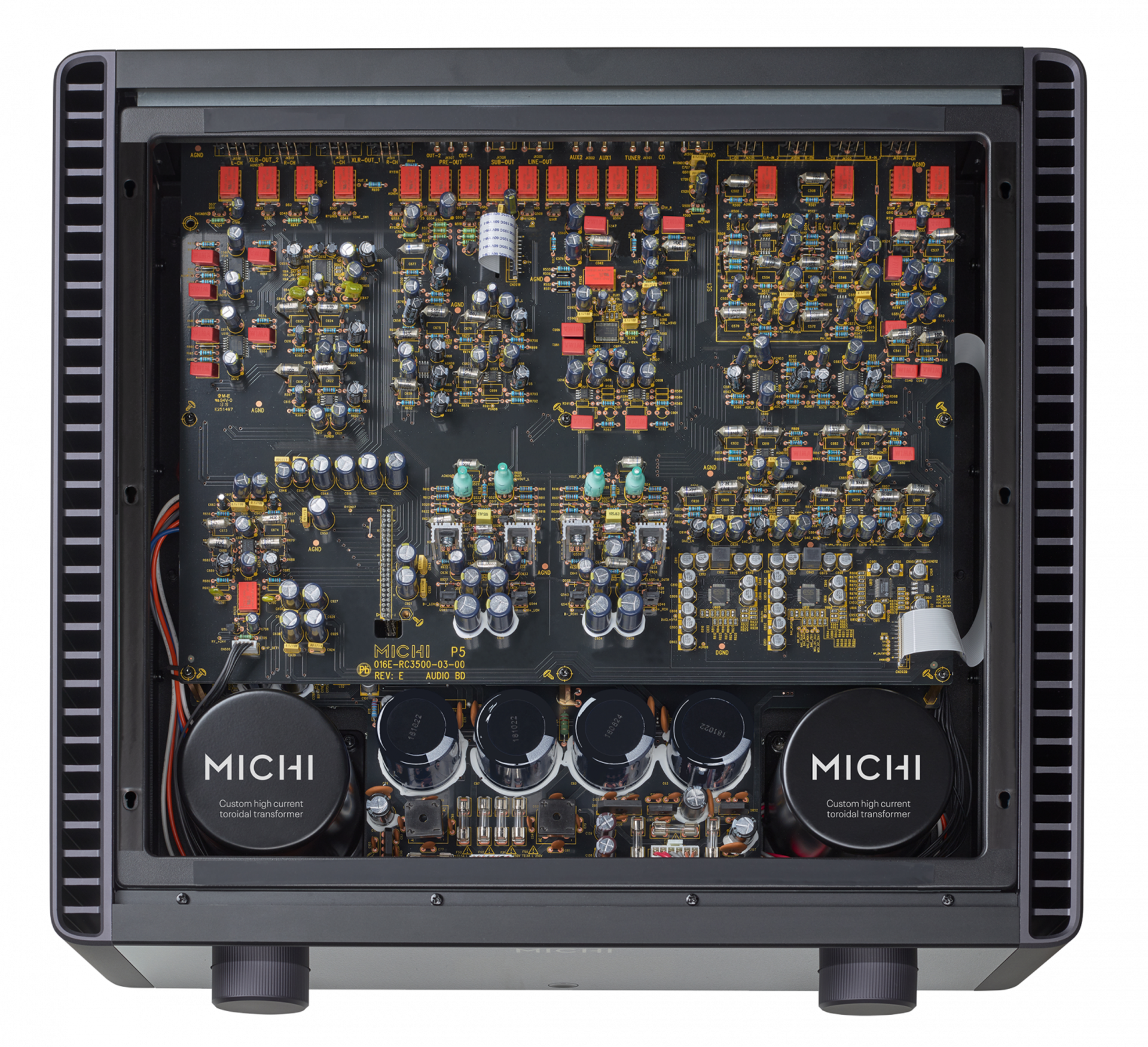
The analog stage is built as a true dual mono layout. Inputs are relay-switched, and both balanced XLR and unbalanced RCA connections are supported for every source. The circuit boards use thick copper traces and substantial grounding planes, a clear effort to minimize resistance and ensure signal integrity. Channel separation is further enforced through careful internal partitioning, ensuring that the left and right paths remain electrically and physically isolated from the transformer to the outputs.
On the digital side, the P5 Series 2 adopts dual ESS SABRE ES9028PRO DAC chips, each running in mono mode, which means all eight channels per DAC are summed for a single output. This approach gives the P5 high dynamic headroom and a floor so quiet that even the faintest microdetail stands out clearly. Every digital input is supported, including coaxial, optical, asynchronous USB with high-rate PCM up to 32-bit/384 kHz, and native DSD. The P5 Series 2 is also MQA capable and certified Roon Tested, allowing it to serve as the heart of any modern digital front end.
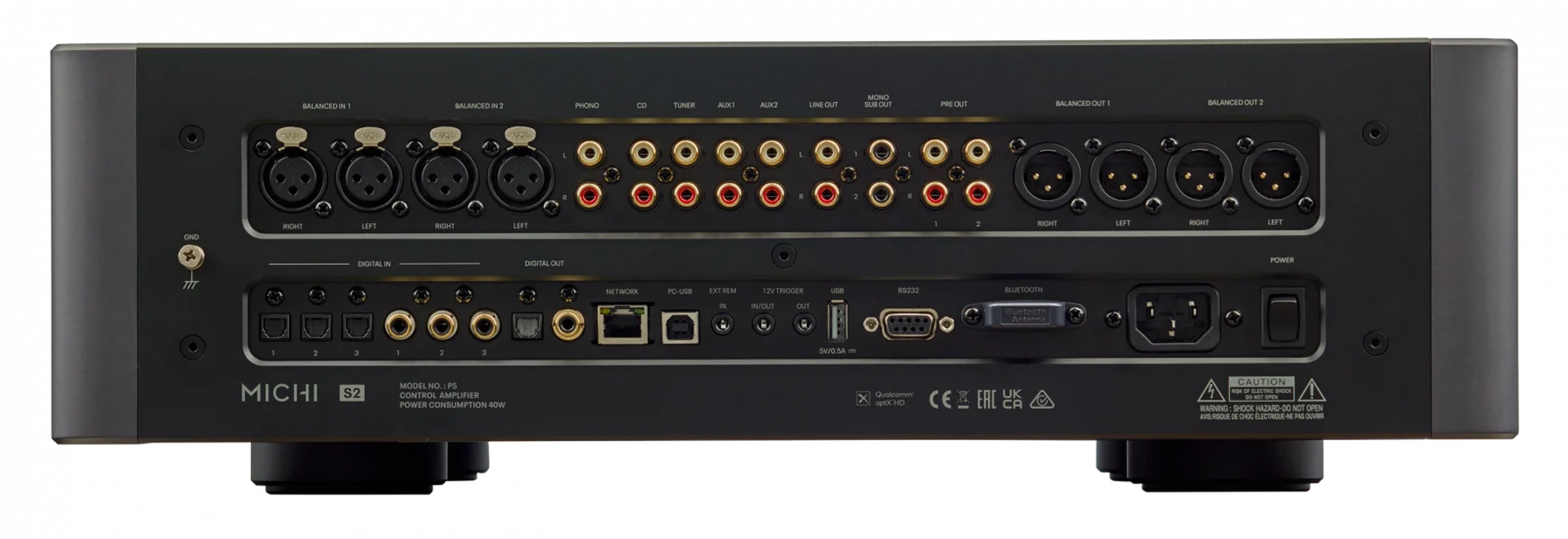
Bluetooth with aptX HD and AAC makes for quick, high-quality wireless streaming, while the phono stage offers full support for both moving magnet and moving coil cartridges. Vinyl listeners are not treated as an afterthought; Rotel gives the P5 a discrete phono section engineered for low noise and wide dynamic range, making it fully competitive with a dedicated switchable MM/MC phono stage.
Measurement results back up the circuit choices. The maximum balanced output is around 22.1 V, with a signal-to-noise ratio of 107.3 dB A-weighted, and a frequency response that remains flat to 100 kHz. Total harmonic distortion is held below 0.002% across the audio band, and the channel separation is greater than 85 dB at line level. Even the USB input is designed with galvanic isolation, eliminating the risk of noise intrusion from a connected computer.
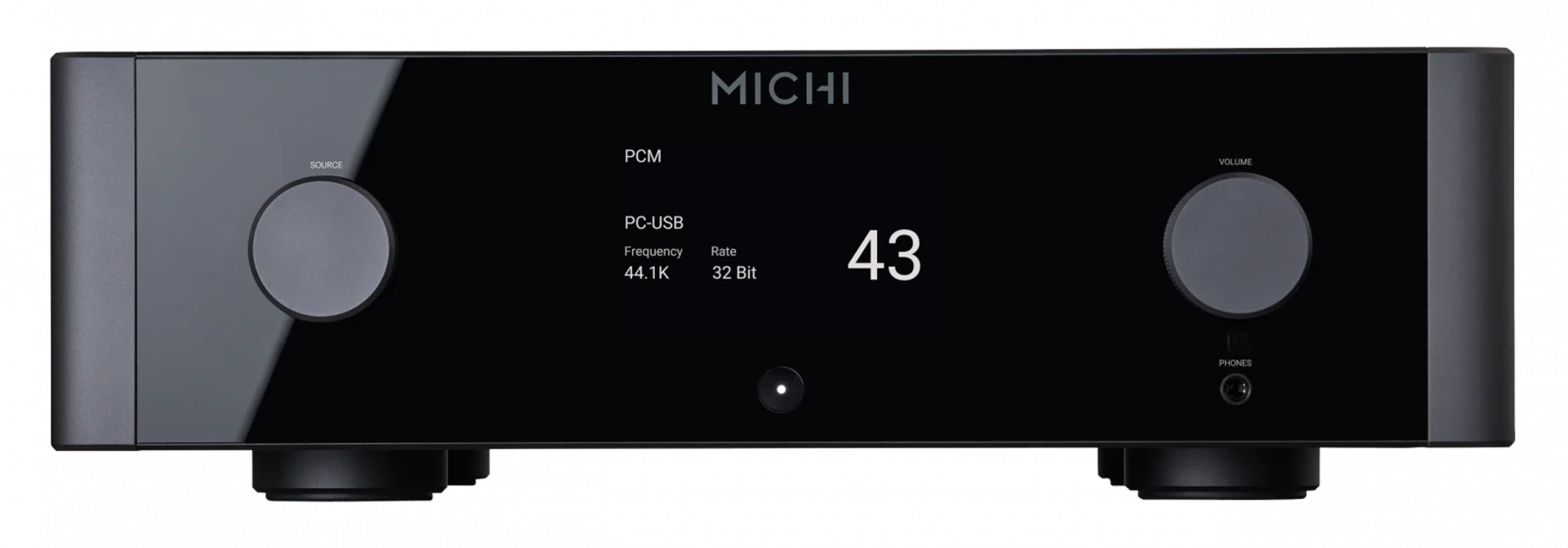
The entire package is housed in a chassis that weighs in at 22.9 kg and is built to the same physical standards as the Michi M8 power amplifier. Heavy-gauge steel, vibration control, and full internal shielding ensure that external interference stays out. No detail is left to chance, from the solid relay switching to the oversized display, every choice is made in service of performance and reliability.
We feel that, in every respect, the P5 Series 2 is engineered not just for today’s high-end systems, but to serve as a long-term reference point, immune to fashion and built to endure.
Inside the Michi M8 Monoblock Amplifier
Components and internal design
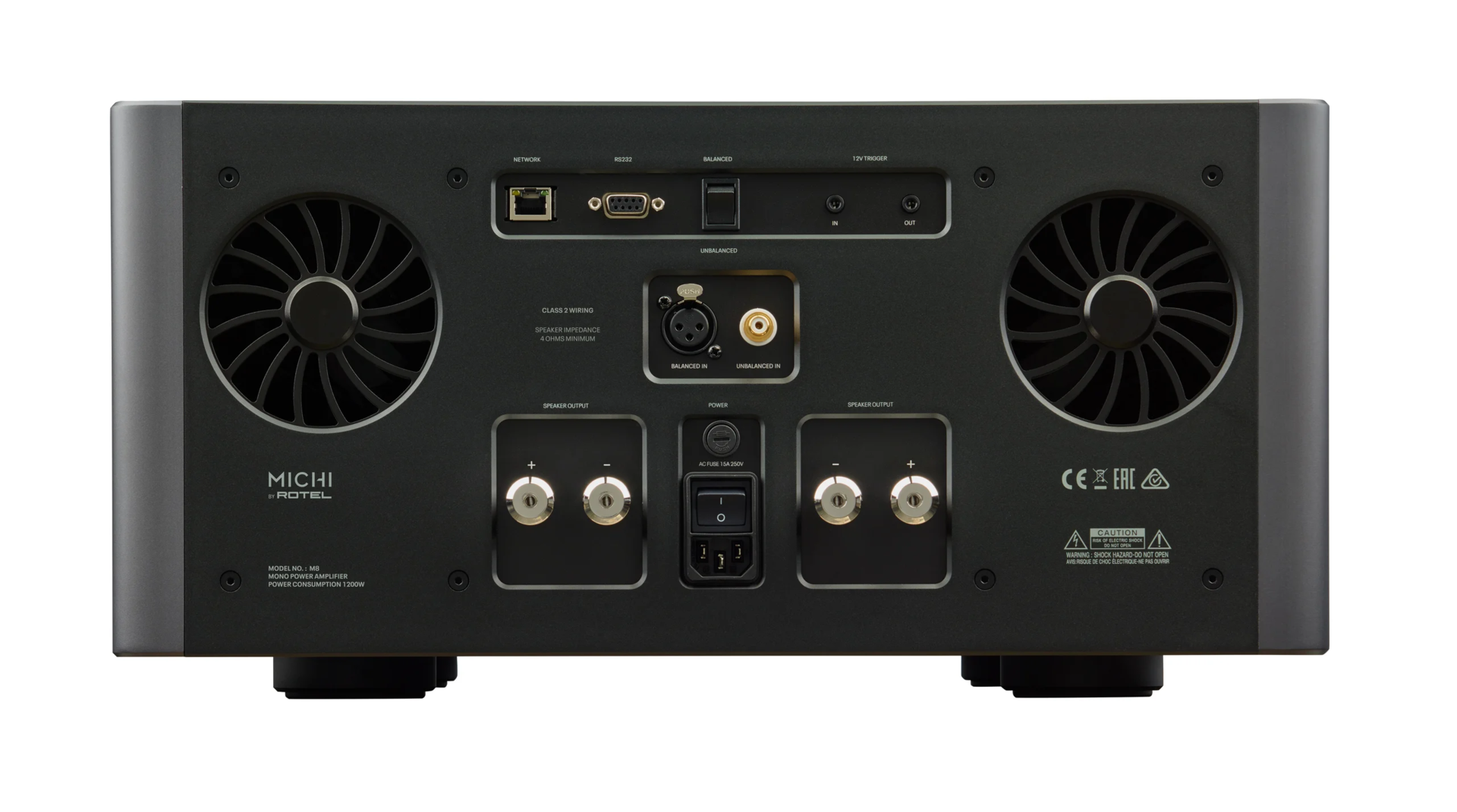
The Michi M8 is Rotel’s statement, their view of what a modern, ultra-high power Class AB monoblock can be when engineering priorities center on scale, control, and energy in reserve. It delivers 1080 W into 8 ohms and 1800 W into 4 ohms on paper, using a fully balanced design approach.
Rotel explains that the M8 served as the starting point for the entire Michi platform. The company began with the M8 as its top Michi amplifier, then tasked its engineers with creating a stereo version derived directly from that monoblock design. That work led to the dual mono S5, while the M8 retained its own dedicated power supply and PCB layout optimizations aimed at higher efficiency, stronger energy delivery, and tighter control.
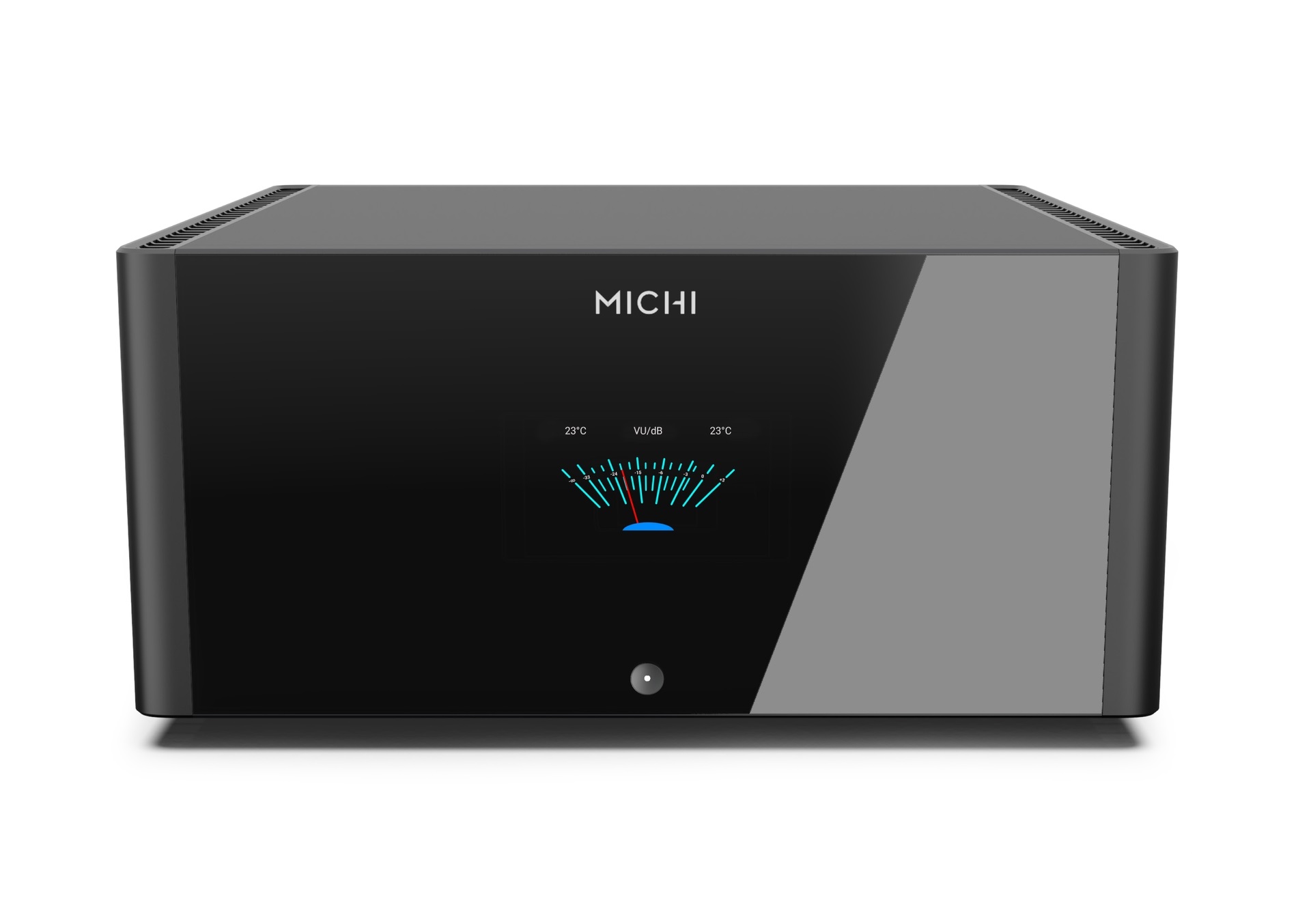
At the chassis level, it is built like a vault. Made of thick extruded aluminum panels, a glass front, Aluminium side heatsinks, and a compact front TFT display that can show either a peak power meter or a frequency spectrum analyzer. Menu control also includes network setup, firmware update, auto power off timer, brightness steps, and factory reset functions.
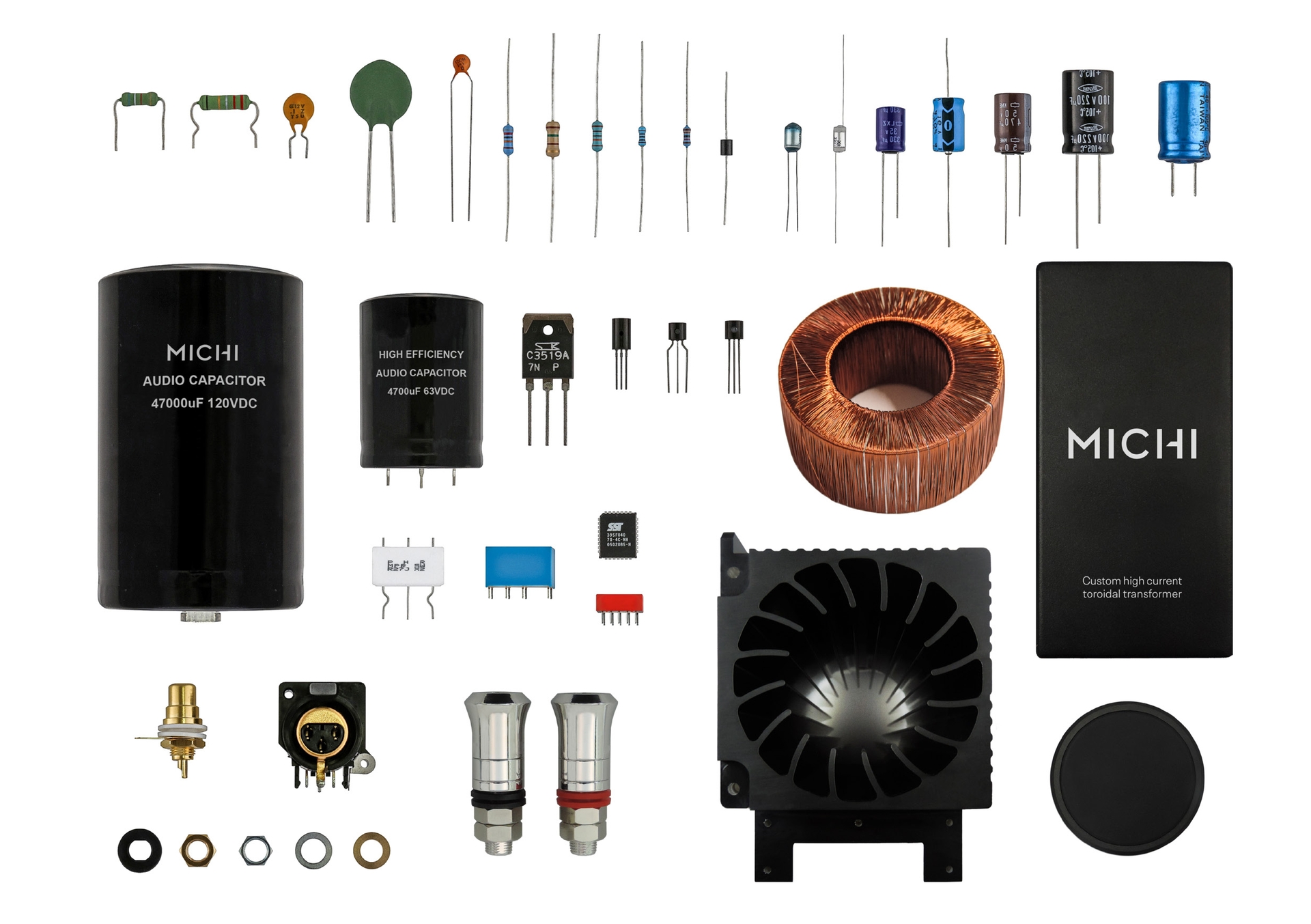
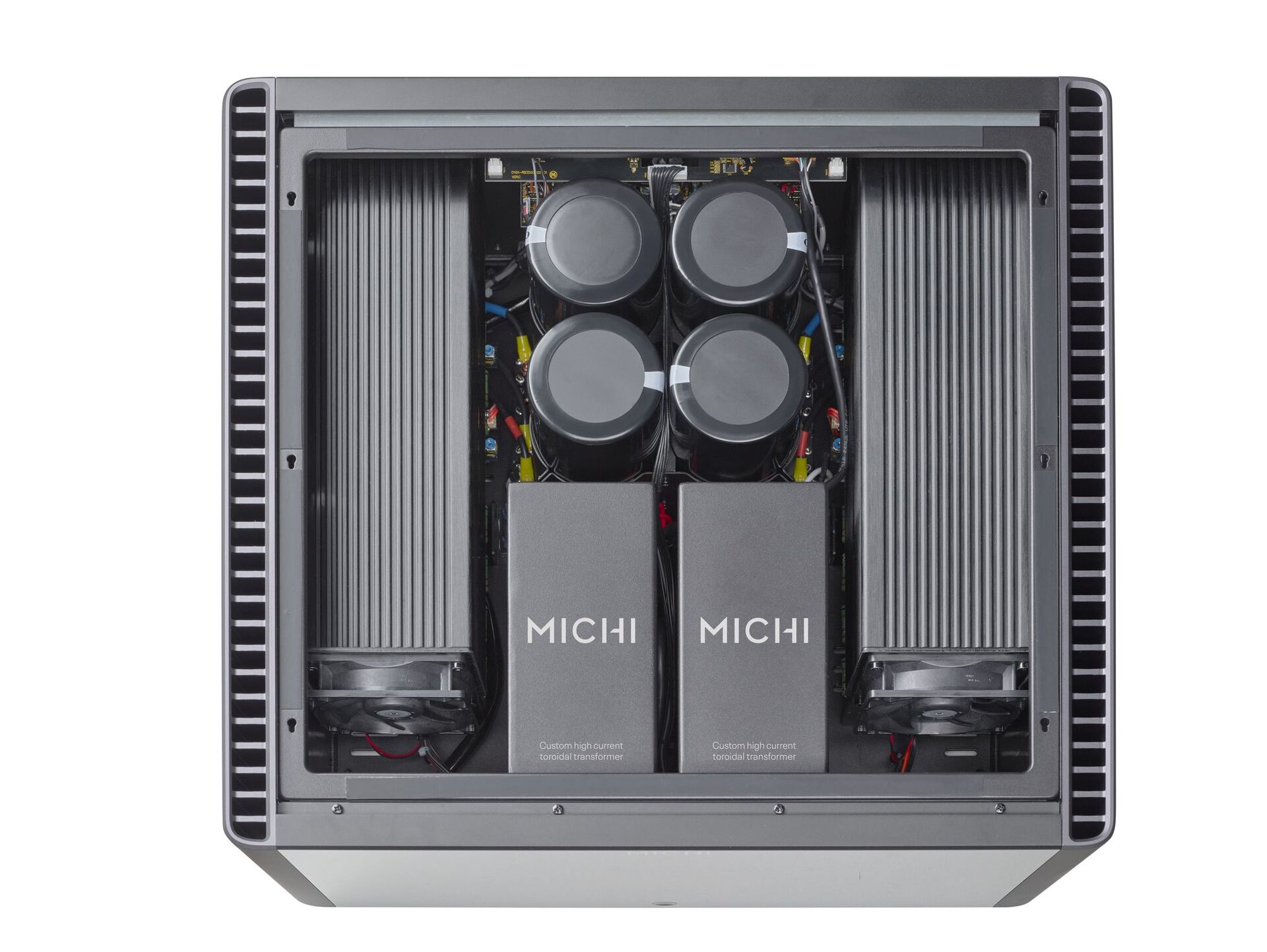
This amplifier lives and dies by its power supply, and we can all agree that Rotel put serious mass into the Michi M8. Rotel, states that both the S5 and M8 use 2 factory-wound 1200VA toroidal transformers, each contained in an epoxy-filled enclosure, plus 188.000 uF of patented slit foil, high efficiency, low ESR bulk storage capacitors feeding an array of 32 Sanken MP1526 and MN1526 transistors, custom circuit boards using a proprietary blend of CEM2 and FR4 which is Flame Retardant grade 4 substrate, a composite of woven fiberglass and epoxy resin, solid copper traces, shielded thick OFC internal wiring.
In daily use, the transformers themselves remain completely silent. At no point, regardless of time of day or operating conditions, did we hear any mechanical noise, hum, or buzz from the devices, reinforcing the impression of careful execution and attention to real-world refinement.
Cooling receives the same level of attention as the power supply. The M8 uses two ultra-quiet, thermostat-controlled internal fans that exhaust hot air through the rear vents. A very cool feature is the operating temperature shown on the front display, in either Celsius or Fahrenheit. In our room, even after hours of intensive listening, we never managed to push the temperature beyond 48 degrees Celsius, with an ambient temperature of 25 degrees Celsius. Just as important, the fans remain completely silent. Even during the hottest moments, we took our ears close to the rear panel, around 5 cm away, and still heard nothing that registered as audible noise.
Lastly, a very important aspect we believe worth mentioning is how the development work for the M8 and S5 was divided. Rotel states that the core electrical design and platform architecture were developed by its engineering teams with roots in Japan, where circuit topology, power supply design, and long term reliability targets were defined. Once the hardware design was finalized, final voicing and tuning were carried out by Rotel’s UK-based acoustic engineering team, refining tonal balance, control, and overall musical coherence through extensive listening work.
System and setup
For this review, we use two loudspeaker references we know extremely well, both capable of exposing strengths and weaknesses without mercy. The first pair is the Monitor Audio Platinum 300 G3, a speaker we have lived with extensively and one that responds immediately to changes in amplification, especially in terms of bass control and large-scale dynamics. The second reference is the Dynaudio Contour 60i, a loudspeaker that places heavy demands on current delivery and stability, with its impedance dropping to a minimum of 2.5 Ω around 100 Hz. With sufficient authority and control, these loudspeakers present coherence, tonal density, and a convincing sense of scale across the frequency range. On the other side, we found through a lot of testing that when amplifiers struggle to maintain control of these demanding speakers, the presentation collapses into a flat, bland character, with softened bass, blurred textures, and a generally muddy voicing.
Signal control and gain are handled by the Michi P5 Series 2, feeding the Michi M8 monoblocks through fully balanced connections. Interconnects between the P5 and the M8 units are Roboli XLR 2100, used symmetrically for left and right channels and kept identical in length to preserve channel balance.
Speaker cabling is provided by Roboli HP8000, the same reference we have used consistently across previous amplifier and loudspeaker reviews.
Digital source duties are handled by the Gustard R30. The R30 operates as a network streamer via LAN, playing Tidal through mconnect, and also as a DAC when fed from a laptop over USB. Analog output from the R30 to the P5 is taken via balanced XLR, keeping the entire signal path fully balanced from source to power amplification.
All electronics are powered using Roboli Power5200 power cables. Every component is connected to the same dedicated AC line, with no power conditioners or regenerators in the chain.
With signal flow, cabling, and operating conditions clearly defined, we can now move forward to the auditioning stage, focusing exclusively on how the Michi M8 and P5 perform in this fixed reference setup.
Auditioning the Michi M8 and P5
All listening sessions take place at familiar reference levels, ranging from late-night low-volume sessions to higher SPL daytime listening, and always with the same seating position and speaker placement. Our goal here is consistency, so any changes we hear can be attributed directly to the amplification and preamplification rather than to shifting variables elsewhere in the chain.
A question every audiophile needs to sit with is: What am I actually searching for sonically? Finding the answer to this question should become one of the core goals of the audiophile journey. It gives direction and turns what might feel like endless component swapping into deliberate steps toward a desired sound. As many say, the journey itself matters most because it shapes how we listen, how we choose, and ultimately who we become at the end. Sound can feel fast and transparent, sharply outlined, revealing every micro detail with clarity and speed. It can also feel expansive and warm, carrying weight and texture, surrounding the listener with a sense of flow and immersion. Many components commit clearly to one of these directions, while others attempt to shape a balance between them. In the end, it is up to each listener to decide how sound should move, breathe, and express emotional connection within their personal system.
Let’s leave the philosophy behind for a littlewhile and start a listening session. The first track we would like to talk about is The Sound of Silence by Geoff Castellucci. This piece can be revealed in different facets depending on the system through which it is played. Some components bring the lowest octave of the voice forward, emphasizing weight and gravitas, while others concentrate on articulation at the end of words, the movement of the tongue, and upper harmonic detail, leaving the fundamental body of the voice pushed further back. Some components outline subtle micro details that step into the spotlight even when they belong deeper in the ambient field, and some draw attention to every small gesture. At one point through our listening and testing journey, we even heard the piano reshaped in a way that felt embellished or detached from the voice, breaking the coherence of the performance.
Here, the Michi combination immediately showed what we mean by a natural presentation. Castellucci’s cavernous low register came through with real physical presence and always felt coherent, not emphasized or detached from the rest of the spectrum. It was not clearly outlined to the point of feeling unreal, artificial. Bass was deep, layered, and articulated, without any kind of hardness or artificiality, and complemented the rest of the frequency range with perfect coherence.
The midrange had a sense of seriousness and natural flow. Every octave of Castellucci’s voice was presented with good body, warmth, and scale, placed clearly in the soundstage. The presentation entered the emotional atmosphere of the recording without emphasis or embellishment, allowing the performance to unfold. There was a strong sense of realism, with tonal balance remaining consistent and believable throughout the track. What stood out most in the presentation was the way every element was woven together into a cohesive and complete image, where voices, harmonics, and ambience formed a unified whole rather than a collection of isolated details.
High frequencies contributed proportionally to the whole. Breath, room ambience, and harmonic overtones were rendered with precision and clarity, forming a coherent and controlled upper range. Detail emerged through differentiation and readability, supporting the music rather than drawing attention to itself.
As the arrangement expanded, the Michi M8 delivered power with ease, maintaining consistency in timbre, articulation, and dynamic expression. While raw output figures may appear to be the most daring and obvious statement on paper, our experience placed the emphasis elsewhere. We believe power on its own carries little meaning without control, and this is where the M8 truly distinguishes itself. Whether listening at very low levels (below 70 db) or pushing the system hard to over 800W per channel, the character of the sound remained unchanged, with dynamics, balance, and texture staying true regardless of the amount of power delivered. The bass shaped the performance with weight and saturation, then gave space when the music asked for it, supporting the narrative, letting the music breathe and develop naturally. The track was presented with a sense of freedom and sophistication, where power served musical expression and allowed the performance to unfold in ways many amplifiers simply cannot achieve.

With Veto by Sohn, our focus was mainly directed toward texture, layering, and rhythmic control. This track lives in gradients rather than big gestures, and the Michi M8 and P5, we believe, navigated that space with confidence. Electronic pulses were clearly shaped and timed, each transient landing with precision while remaining fully integrated into the larger sonic picture. The rhythm felt grounded and elastic at the same time, creating a steady sense of momentum without stiffness.
The midrange formed the emotional core of the track. Sohn’s voice sat firmly in place, dense and present, surrounded by finely resolved electronic textures that unfolded naturally around it. There was a strong sense of cohesion between voice and synth layers, with no part stepping forward unnaturally. The presentation allowed the track’s atmosphere to build gradually, maintaining a consistent tonal balance as complexity increased.
Low frequencies played a crucial role here, and the Michi handled them with authority. Bass lines carried weight, speed, and very good articulation, defining the rhythmic foundation while preserving space for the surrounding elements. We loved the control on display, which allowed for subtle shifts in intensity and pulse to register clearly, shaping the emotional arc of the track rather than flattening it into constant pressure. The dual Michi M8 monoblocks distinguished themselves through their command of dynamics, reshaping the meaning of authority and flow.
As the track progressed and energy accumulated, the combination maintained the same composure across the full dynamic range. As volume increased, amplitude changes were felt across the entire scale and impact, and most importantly, the character was not altered in any way, shape, or form. What resulted was a sense of flow and intent, where power, timing, and texture worked together to support the music’s internal tension and release. The result felt immersive and coherent, drawing us deeper and deeper into the track’s atmosphere.

With Fading Sun by Terje Isungset, the Michi M8 and P5 showcase their ability to construct a revealing three-dimensional soundstage. We strongly believe that the foundation for this effect begins in the sub-bass region: deep, very richly layered, articulate, and stable, the lowest frequencies build a platform that supports the entire musical structure. Every echo and whisper from Terje’s voice floats with amazing realism, suspended effortlessly in the soundstage.
Michi’s presentation reveals a unique blend of qualities that audiophiles gravitate toward. On one side stands speed, precision, and accuracy. Every transient arrives and settles, defining the placement of every percussive element and subtle overtone. At the same time, there is an unmistakable softness, velvet-like in its texture, that wraps the edges of sounds with a gentle touch. This is not a warmth of timbre alone, but we would say, a warmth of contour and shape. Sounds seem to emerge with delicacy and recede naturally, creating an immersive calmness that fills the listening space.
The interplay of these contrasting aspects, control and gentleness, clarity and refinement, anchors the listening experience. Michi achieves an equilibrium where the technical and the emotional meet, the stage remains stable, and every musical event unfolds on a bedrock of deep, controlled energy. This track underlines just how much a carefully realized low-frequency foundation can shape the entire character of a recording, making space for subtlety, realism, and a true emotional atmosphere to manifest.

From the very beginning of Trade It For The Night, the Live in Carré version, the opening vocalization by Neco Novellas sets the tone and immediately highlights the importance of real power reserves. This track shows how high output capability influences far more than bass response. The midrange, where the human voice lives, gains scale, density, and physical presence. Novellas’ vocal technique communicates emotion through sustained tone and controlled dynamics, and the Michi M8 anchors that energy firmly in the room. The sound carries weight and impact, creating a sense of presence that feels tangible and grounded.
According to the lyrics, Neco’s part conveys a poetic message about living fully in the present moment, exchanging past worries and repeating cycles, for a night of surrender to the here and now. The Michi combination translates this idea directly into sound. Large dynamic swings and subtle amplitude shifts remain equally intact, while fine changes in timbre and intensity flow naturally. The amplifier preserves both scale and nuance, allowing the emotional meaning of the performance to unfold through sheer dynamics.
Layering and texture play a central role throughout the nearly two-minute introduction. Every gradual rise in intensity, every slight variation in pitch, and every change in harmonic color is clearly shaped and placed. The presentation creates a strong sense of materiality, where sound carries mass and form, engaging not only hearing but physical perception as well. We were fully absorbed, drawn into an atmosphere built on controlled pressure and carefully sculpted dynamics.
This track underlines the beautiful qualities of the Michi M8 and P5 pairing. We strongly believe that power serves expression and, in this case, the dual Michi M8 amplifiers translate their reserves into physical impact and atmosphere, delivering controlled energy that physically resonates through the entire body. We feel the authority, we feel the articulation, and dynamic layering working together to shape a listening experience that is physical, immersive, convincing, and emotionally complete.

Our next song From Dusk Till Dawn by George Duke, sees the focus shift toward groove, timing, and the way an amplifier handles density without flattening expression. This track relies on a complex interplay between rhythm section, keys, and layered harmonic content, and the Michi M8 and P5 navigate that space with composure and flow. The groove locks in immediately, carried by a bass line that combines physical punch and kick with a deep, rumbling foundation, creating an almost seismic sense of drive and clearly showing how well the Michi M8 controls the loudspeaker bass drivers across both the upper and lower regions of the bass frequency range.
Achieving this level of grip and definition with the Dynaudio Contour 60i, places serious demands on amplification. The cabinet construction, tuning approach, and drivers used call for extreme control to reproduce the drum with natural impact, speed, and weight. Dynaudio loudspeakers are widely known for demanding precise system matching, and in our case, this pairing proved exemplary in terms of dynamics and much more. The Michi amplifiers demonstrated exactly what is required to keep these behemoth speakers under control, delivering grip, authority, and composure while maintaining delicacy and smoothness, making every genre of music very pleasant to listen to.
We can definitely say that Michi M8 amplifiers rise to any challenges. In terms of low-end delivery, the result feels grounded, controlled, and realistic, capturing the physical sensation of the drum in a way that immediately connects with the listener. This level of control stands out as a clear strength and a performance trait worth mentioning.
The midrange reveals its character through texture and articulation. The presentation forms a coherent and unified whole, allowing the music to flow naturally as a complete performance rather than as individual, disconnected elements.
Dynamics play a central role in how the Michi M8 and P5 shape the performance. Sudden accents, rhythmic shifts, and layered crescendos are rendered with precision and good scale, while fine dynamic gradations are preserved throughout the entirety of the song. The Michi combination maintains timing, energy, and momentum in a way that keeps the performance engaging and physically present.
The balance between control and ease was exceptional. The reproduction carried drive and authority, yet flowed naturally, allowing rhythm, harmony, and texture to work together. The result, we believe, felt confident and grounded, capturing the spirit of the performance and highlighting the Michi M8 and P5’s ability to handle complex, rhythm-driven material with both finesse and conviction.
What made this track stand out was the sense of balance. Delicacy and control worked together, giving the music warmth and intimacy while maintaining structure and focus. The low end provided subtle grounding without drawing attention to itself, supporting the midrange and allowing the song’s atmosphere to breathe. Through the M8 and P5 pairing, Yellow Brick Road became an experience defined by coherence, tonal beauty, and a quiet emotional pull that stayed with us long after the track ended.

Yellow Brick Road shifts the focus toward intimacy, texture, and emotional nuance. Through these electronics, the track unfolded with a sense of ease and natural flow that suited its stripped-back arrangement perfectly. The acoustic guitar carried a pleasant, soothing resonance, each pluck shaped with gentle dynamics and realistic decay, while the surrounding space felt open and proportioned.
Vocals sat at the center with convincing presence and layering. Angus and Julia’s voices intertwined smoothly, their tonal differences were defined yet naturally blended, like they would when listening to them in the room. The Michi combination preserved the softness and fragility of the performance, allowing phrasing and inflection to come through with emotion. The presentation felt unforced and relaxed, inviting long listening without drawing attention to technique. The pleasure of listening to this track was ever-present.

With Lovers in Paris by Jacob Gurevitsch, the spotlight moves to dynamics on a somewhat smaller scale and to how convincingly an amplifier can render the physical act of plucking strings. This track showed just how effortlessly the Michi M8 and P5 handle rapid dynamic swings. Each pluck carried immediacy and weight, with attack and decay shaped precisely, creating a tactile sense of strings being set into motion right in front of us. Another good track with plucks and strings we loved was Humming One of Your Songs – Ane Brun.
These moments felt physical, even when the music asked for very little overall loudness. The system reached momentary peaks well above 1 kW without any sense of effort, translating those bursts into clean, controlled energy that gave the guitar real body and substance. The dynamic contrast between gentle passages and sudden accents remained perfect, allowing the performance to breathe and sound just natural.
The presentation stayed pleasant, inviting, and convincing throughout. Energy flowed freely, impact was delivered with confidence, and the sound retained a calm, refined character that encouraged long listening sessions. The Michi combination turned subtle dynamic gestures into something tangible and emotionally engaging, showing how power, when paired with control, can serve delicacy just as convincingly as scale.
Alongside the impressive dynamic expression, this track also highlighted a specific characteristic of the P5. The soundstage formed with excellent focus and stability, especially in the center image, which felt solid, clearly anchored, and very convincingly shaped. The guitar occupied its place with precision, and image density through the middle of the soundstage carried realism and presence.
At the same time, lateral expansion stopped closer to the loudspeaker boundaries than we wished. On a track like Lovers in Paris, where spatial cues and ambient information invite a wider presentation, we expected the soundstage to extend further beyond the outer edges of the speakers. This sense of restraint in stereophonic width appeared consistently across several listening sessions, and here it became more noticeable.
In practical terms, the P5 we believe favors image solidity, focus, and center coherence over maximum width. That balance brings benefits in terms of stability and realism, yet it also defines a clear limitation for listeners who value expansive lateral spread above all else. For us, this behavior stood out as one of the few tangible shortcomings of the P5 within an otherwise highly controlled and refined presentation.

Angel Song, released in 1997, places emphasis on atmosphere, space, and the fragile balance between presence and silence. The track unfolded with a serene calmness that suited its introspective nature perfectly. The opening moments established a wide, breathable soundscape where each instrument occupied its own defined place, suspended within a quiet and carefully proportioned acoustic space.
Kenny Wheeler’s trumpet has a beautifully shaped tone, delicate yet substantial, floating effortlessly above the ensemble. The Michi combination preserved the instrument’s harmonic richness and natural decay, allowing each phrase to linger and dissolve into the surrounding air. Piano textures felt grounded, with subtle dynamic shading made apparent, and that gave phrasing a conversational quality. Bass lines anchored the performance with gentle firmness, giving the music structure and reinforcing its emotional center.
The way microdynamics and spatial relationships were handled was excellent. Small shifts in intensity, breath, and touch were rendered with intent, contributing to a sense of intimacy that pulled us deeper into the performance. The presentation felt coherent and unhurried, encouraging long, attentive listening.
We heard Angel Song became an exercise in balance and restraint, where control, tonal beauty, and spatial realism worked together seamlessly. The Michi pairing allowed the music’s emotional depth to surface naturally, shaping a listening experience defined by subtlety, focus, and a profound sense of presence.

Switching genres, we would like to further talk about Faster by Within Temptation. It is far from a reference recording from a dynamic standpoint, and not only that. Compression is heavy, density is pushed hard, and the mix remains congested for most of the track. Precisely because of this, it serves as a useful stress test for electronics, revealing how well a system manages complexity, layering, and sustained pressure when the music offers little natural breathing room. Bottom line, the question becomes simple: does the track turn into an annoying irritation, or does it become an experience?
Through the Michi M8 monoblocks and the P5 Series 2 preamplifier, the track held together with pleasant composure. Guitars, synth layers, and vocals stayed organized within the mix, avoiding collapse into a flat wall of sound. Rhythmic drive remained intact, transients kept their shape, and the low end carried weight without smearing into the midrange. The system imposed order where the recording itself offers very little.
Listening held its comfort even at high levels. Volume could be pushed far beyond what we would normally tolerate with this track, yet the presentation remained controlled, energetic, and enjoyable. The Michi combination transformed a dynamically limited, highly compressed production into a coherent and engaging experience, showing its ability to manage congestion, sustain clarity under load, and deliver power in a way that remains physically convincing and musically satisfying. Listening to this track with this specific combination of electronics became a pleasure.

With The Things We’ve Handed Down, the Michi M8 and P5 highlighted coherence and timbral fidelity at a very high level. Marc Cohn’s voice unfolded through multiple layers, each strand clearly formed and naturally connected to the next, creating a presentation that felt organic and deeply expressive. The tonal balance was spot on, centered between lightness and density, giving the presentation a sense of completeness and rightness that felt just right.
What stood out was the way focus and spatial rendering worked together. Images carried clear outlines and stable placement, while the surrounding space opened up with a gentle sense of diffusion that supported realism. Depth cues developed gradually, voices stacked with convincing separation, and ambient information wrapped around the performance in a way that felt lived in rather than constructed.
Everything about the presentation felt somewhat settled and complete. Precision, layering, and spatial scale aligned into a balanced whole, making the performance sound convincing and emotionally present.
Birds Requiem by Dhafer Youssef proved to be one of the most challenging pieces to put into words, mainly because of its depth and complexity. With this suite, the Michi M8 and P5 reached a level of emotional engagement that went beyond technical observation. The music unfolded through a vast number of layers, voices, textures, and spatial cues, all presented together in a way that felt so true and so deeply immersive that it made us awe! The M8 held this immense structure together with confidence, allowing every element to exist clearly within a carefully balanced whole.
Again, we believe what stood out most was the sense of equilibrium. Precision, calmness, density, and openness aligned so well that any imagined shift in one direction felt wrong. The presentation carried weight and detail, yet flowed with ease, creating a soundstage that felt complete and internally consistent. The layering remained intelligible at all times, and the transitions between intensity and restraint happened smoothly, without drawing attention to the mechanics behind them.
This track left us reflecting rather than analyzing. The balance achieved here felt deliberate and finely judged, to the point where questioning what could be improved became difficult. The Michi combination shaped a performance that felt whole and resolved, inviting us to listen deeper rather than dissect, and reminding us that true mastery often reveals itself through cohesion rather than excess.

When listening to Explosions‑Polka, Op. 43 – Johann Strauss II, we paid close attention to our own level of engagement, setting analysis aside and allowing the music to unfold freely. The Michi M8 and P5 Series 2 encouraged this approach, drawing us in without effort and shifting the experience from observation to feeling.
The explosive accents carried physical presence and impact, shaped with precision and clean, dare we say realistic, but not razor sharp decay. Dynamic shifts flowed naturally, preserving rhythm, structure, and momentum. The presentation felt lively and grounded, with sections clearly placed and a convincing sense of depth.
What remained at the end was a strong sense of emotional involvement. The Michi combination delivered impact, scale, and control in a way that allowed enjoyment to take precedence over critique, leaving us absorbed in the music rather than focused on the mechanics behind it.
Folketone from Sunnmøre shifted our focus back toward intimacy, layering, and tonal purity. This piece lives through subtle bow pressure, microdynamic inflection, and the way individual string lines breathe together as a single organism. Through the Michi, the ensemble formed a cohesive sound, each instrument clearly shaped yet organically connected to the whole.
The Michi combination handled the gradual dynamic swells with greatness, allowing texture and harmonic density to build naturally. String tone carried body, physicality, and contour, with a sense of elasticity that made phrasing feel fluid and alive. Spatially, the ensemble occupied a well-proportioned position within the soundstage, with depth and separation emerging without exaggeration.
As with the previous track, we found ourselves monitoring our own engagement closely. The presentation encouraged listening without analysis, drawing attention toward emotional flow and inner movement. The result was a calm yet deeply involving experience, one where tone, timing, and balance aligned in a way that felt natural and emotionally grounded.

Performed by Minnesota Orchestra, conducted by Eiji Oue The Firebird Suite placed the Michi M8 and P5 Series 2 in a context where scale, control, and orchestral complexity converge. This work demands control and dynamic prowess across the entire frequency range, from the quietest textural passages to the most forceful climaxes. The Michi combination presented the orchestra as a vast, layered structure, with each section clearly positioned and integrated into a coherent whole.
Large dynamic swings arrived with confidence and weight, shaped by control and emotion. The low end anchored the orchestra with depth and stability, allowing crescendos to rise naturally and beautifully. Strings, brass, and percussion retained their individual character, with timbral accuracy and spatial definition preserved even as the score expanded in intensity.
As the piece unfolded, our focus shifted away from analysis and toward immersion. The Michi encouraged listening, allowing the emotional arc of the composition to take precedence. Scale, color, and dynamics aligned in a way that made the performance feel complete and convincing, reinforcing the sense that power, when paired with control and balance, serves musical expression first.

Arguru by Deadmau5 places immediate demands on timing, low-frequency control, and the ability to keep layered electronic textures stable as energy builds. Through these electronics, the track unfolded, keeping a constant sense of structure. The low end was delivered with mass and pressure, extending deep with clarity and definition, forming a solid foundation that anchored everything above it without muddying the rest of the frequencies. Each pulse arrived with conviction, shaping the groove with physical presence and momentum.
The midrange and upper layers remained cleanly organized, allowing synthesizer lines, effects, and ambient cues to occupy defined spaces within the soundstage. The presentation carried scale and density, yet remained fluid, giving the track a sense of flow that felt continuous and composed. Dynamic shifts expanded with much ease, energy was built in a controlled and confident way, preserving impact without sacrificing texture or shape, and without any muddiness.

The sense of composure under sustained demand was impressive. Power delivery proved stability, control, and rhythmic certainty, and made the track’s atmosphere feel fully enveloping. The Michi combination rendered Arguru with authority and refinement, turning electronic energy into a structured, immersive experience that felt both physical and expansive.
Differently by Marian Hill places dynamics at the center of the experience, moving between restraint and sudden bursts of energy. These shifts carried a sense of scale that we often felt at large venues and concerts. The amplifiers’ vast power reserves translated directly into headroom, allowing quiet passages to remain finely textured and intimate, while explosive moments were delivered with an impressive force and immediacy.
The low pressure was felt, giving rhythmic accents a physical presence that filled the room without blurring surrounding details. Vocals floated clearly above this foundation, maintaining shape and focus as the music expanded. Each dynamic step upward felt clean and confident, with no sense of compression as the track pushed forward.
The surplus power was clearly felt, shaping the entire experience. The Michi combination used its reserves to preserve contrast, keeping soft moments delicate and large swings impactful. Dynamics unfolded freely across the full range, giving Differently a sense of drama and emotional tension that relied as much on control and scale as on sheer output.
Conclusion
The Michi M8 and P5 Series 2 combination stands out through a rare and carefully judged balance. Precision, speed, and accuracy altough not emphasized, coexist naturally with mellowness, delicacy, and tonal richness, forming a presentation that feels complete and deeply musical. There is no hardness and no excessive tension anywhere in the presentation. The sound carries a strong sense of abundance, with reserve power present in such quantity and quality that it really feels infinite. This abundance never translates into aggression. It exists as a calm authority, shaping music with confidence and incredibly good control.
The presentation is rich, multilayered, and colorful, while at the same time maintaining coherence, correctness, and transparency. Nothing feels disconnected, artificial, or bloated. Bass performance stands out as one of the major highlights. It is highly layered, articulated, contoured, diverse, and above all, extremely well controlled. We often say that the low end must provide a deep, stable foundation, and here that foundation supports the entire spectrum, giving the sound physical presence and convincing scale. This pairing shows how effective bass control can shape the entire sonic picture, with the P5 Series 2 and M8 monoblocks providing a reference-level experience.
The midrange is expressive, rendered in space with excellent physical form. Voices and instruments feel tangible and well proportioned, occupying the soundstage naturally, not emphasized in any way. Michi does not aim for cutting, knife-edge sharpness, it presents music with a natural flow and inviting character, a tuning that encourages long listening sessions and, we believe, will resonate with a very wide range of listeners.
High frequencies act as contributors to overall coherence. There is no tiring or fatiguing effect, even during extended listening sessions and across the full volume range. There is absolutely no trace of sibilance or harshness, from the lowest levels to the highest octaves. Differentiation and articulation are slightly slower than those of the fastest and most surgically precise amplifiers, and we want to emphasize and praise Michi for this choice of tuning. There is a fine line between precision and delicacy, and the Michi lands exactly where that relationship feels right. Even the highest notes sound ethereal and surreal, presented with such cohesion that nothing stands out or breaks the flow.
Microdynamics are excellent. The Michi combination performs beautifully at low and very low volumes. Dynamics and power remain constant highlights, reinforcing the impression that there is no end to what these amplifiers can deliver. Strength and gentleness coexist naturally here and are joined by a fine delicacy and a sense of sweetness that makes listening deeply pleasurable, forming a sound that feels complete, emotionally engaging, and deeply satisfying. Add to that the feeling of limitless power, and you have a combination that can compete with most of the mega-priced amps on the market.
We would like to extend a sincere thank you to AVstore for trusting us and allowing these components to live in our home for the better part of 2 months. Having the time to listen, experiment, and truly settle into their sound made all the difference, and we greatly appreciate the opportunity to experience them in a familiar space, under real-world conditions.
What we heard is inseparable from the space we listen in, the music we choose, and the ears we bring to the experience. The Michi M8 amplifiers and the P5 Series 2 preamplifier revealed their character within this specific context. Different rooms and listening preferences will shape different experiences, yet in our space and with our priorities, this combination matched what we tried to express in words, helping you, the reader, form a clear picture of its sonic character. With this in mind, nothing replaces direct experience. Go and listen for yourself, take the time to audition them properly, and trust your own ears. And while you are at it, don’t forget to ask for that often available, well-deserved discount.
Pros for the M8 monoblocks:
- Price/Quality/Performance level is off the charts
- Excellent balance between precision, speed, accuracy, and mellowness, creating a complete and musically convincing presentation
- Enormous power reserves delivered with calm authority, giving a strong sense of abundance and effortlessness at any level
- Outstanding bass performance, layered, articulated, contoured, and extremely well controlled, which forms a deep and stable foundation
- Rich, multilayered sound that maintains coherence, correctness, and transparency throughout the entire power range, massive soundstage width, expansiveness, and tridimensionality
- Excellent microdynamics and macrodynamics, including strong performance at low and very low listening levels
- A real, enhanced capability and resolution to respond to stronger upstream components
- Adds real pleasure in listening to any track, regardless of genre
- Build quality and execution are excellent with true reference-level ambition
Cons for the M8 monoblocks:
- Ultimate sharpness and cutting-edge precision are not the primary focus, which may not suit listeners seeking the fastest, most surgical, and extremely detailed presentation
Pros for the P5 Series 2 preamplifier:
- Delivers exceptional bass performance that stands out clearly among all the preamplifiers we have heard, especially when viewed in relation to its price
- Multilayered sound with strong coherence and tonal accuracy, remaining transparent and stable across all output levels
- Clean, stable center image with precise placement and convincing focus
- High output capability and drive, pairing easily with demanding power amplifiers
- Balanced presentation that favors musicality, flow, pleasure, and long-term listening comfort
- Very good value positioning within the high-end preamplifier segment
- Solid, well-built aluminum remote control with an intuitive layout offering precise volume control and easy access to core functions
- As was the case with the M8, the build quality and execution are excellent with true reference-level ambition
Cons for the P5 Series 2 preamplifier:
- The stereophonic width presented by the P5 remains centered and focused, prioritizing image stability and coherence over extreme lateral spread
- Very fine micro details, such as whispers and the smallest ambient cues, sit further back in the presentation
- Extreme transparency and resolution fall short when compared to other, albeit much more expensive, preamplifiers
Associated Equipment:
- Digital Transport / Roon Server / DAC: Gustard R30
- Preamplifier: Michi P5 Series 2
- Power Amplifiers: Michi M8 (x2)
- Loudspeakers: Monitor Audio Platinum 300 3G, Dynaudio Contour 60i
- Interconnects: Roboli XLR 2100
- Speaker cables: Roboli HP8000 2.5m
- Power Cables: Roboli Power5200
Scoring
We would like to mention that these scores reflect the system exactly as we listened to it during the review process. In the case of the Michi M8 monoblocks especially, the final result is heavily influenced by the partnering preamplifier. Then, the rest of the source chain, loudspeakers, cabling and room interaction. These amplifiers are transparent and versatile enough to shift their presentation quite substantially depending on the associated equipment. A different preamplifier alone could alter tonal density, soundstage projection, transient behaviour and overall emotional character in very meaningful ways. As such, the scoring should be viewed as a reflection of this exact setup and system synergy, not as an absolute fixed result independent of context.