Luxman E-07 phono – beautiful, elegant, versatile, and transparent with centennial excellence

One Hundred Years of Listening
There is a particular kind of achievement that becomes visible only in retrospect. A company turns a century old, and we instinctively reach for the easy tributes — heritage, legacy, tradition. But these words, when applied to a company that is still actively engineering and still releasing products capable of surprising the most seasoned listeners, become something else entirely. They become proof. Proof that the pursuit was genuine from the beginning and that whatever principles animated the first generation of designers are still alive, still restless, still trying to do something better.
Luxman turns 100 (one hundred years old) in 2025. Founded in Osaka in 1925 as a radio components manufacturer, the company has, over the course of a century, accumulated a depth of engineering knowledge that is genuinely rare in this industry. They have not been continuous innovators in the sense of chasing every new technology as soon as it appeared. They have been something more valuable: continuous learners. Amplifiers, preamplifiers, tuners, integrated amplifiers, phono stages, every category carries the weight of accumulated listening, of decisions made not for marketing reasons but for sonic ones.
The E-07 phono preamplifier is the centennial expression of that philosophy applied to the most demanding of all tasks: taking the most minute electrical signal that any audio component will ever encounter, the output of a moving coil cartridge tracing a vinyl groove, and amplifying it faithfully, musically, and without introducing anything of its own that does not belong there. A phono stage that fails at noise, RIAA accuracy, dynamic transparency, or the delicate matter of correct cartridge loading is a phono stage that fails utterly, regardless of what it costs. The E-07 does not fail. Not even close.
Engineering Intelligence
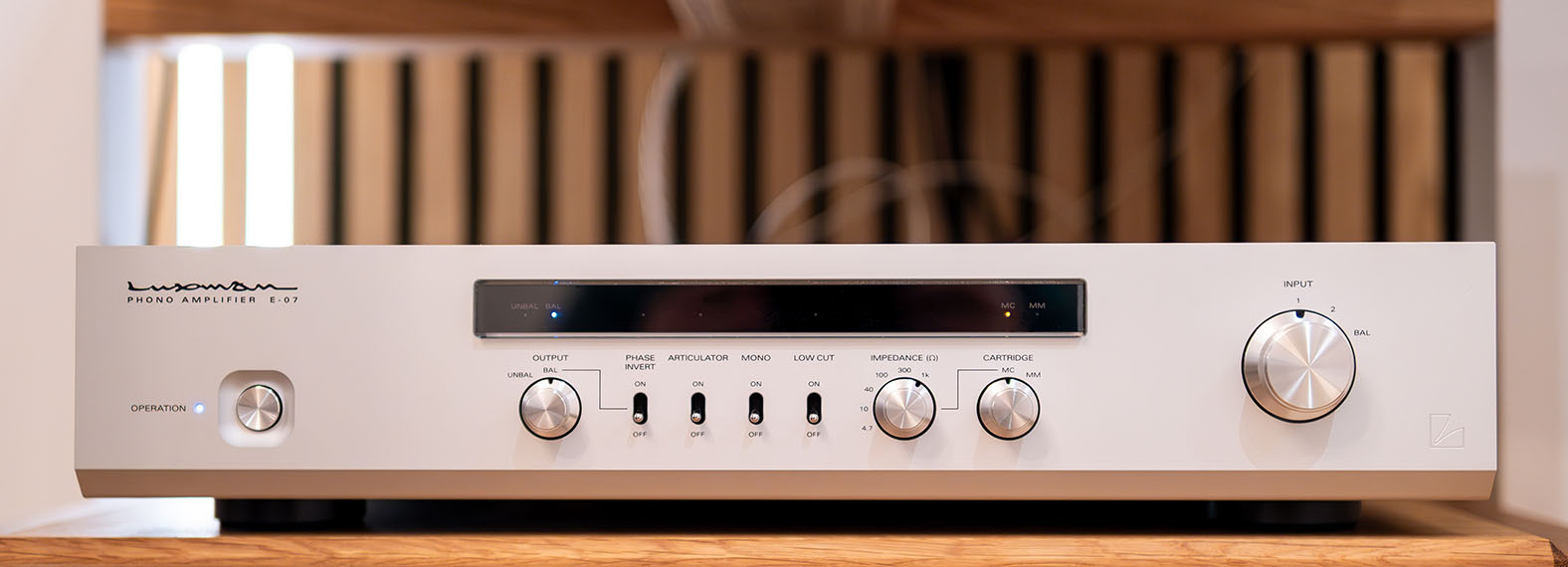
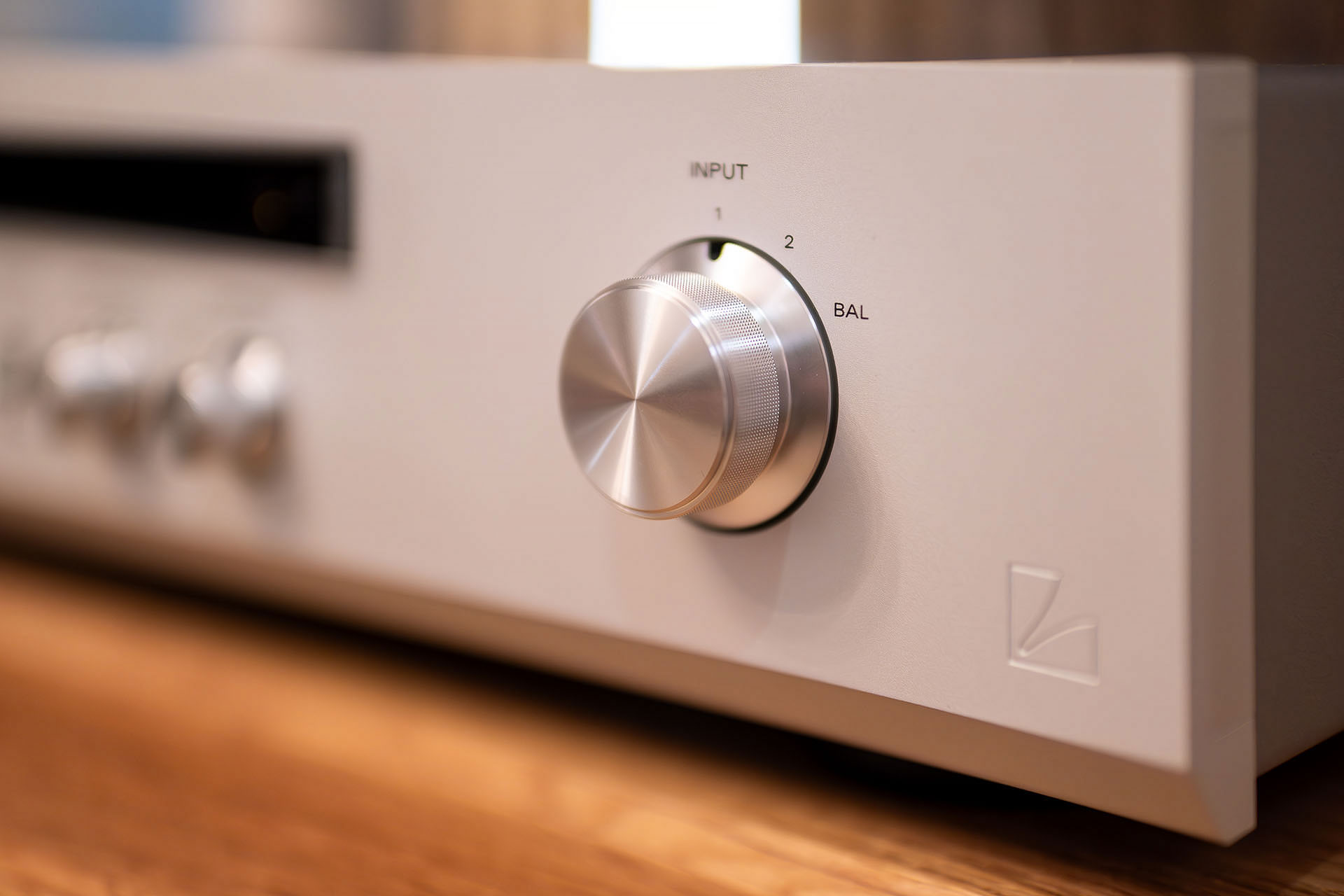
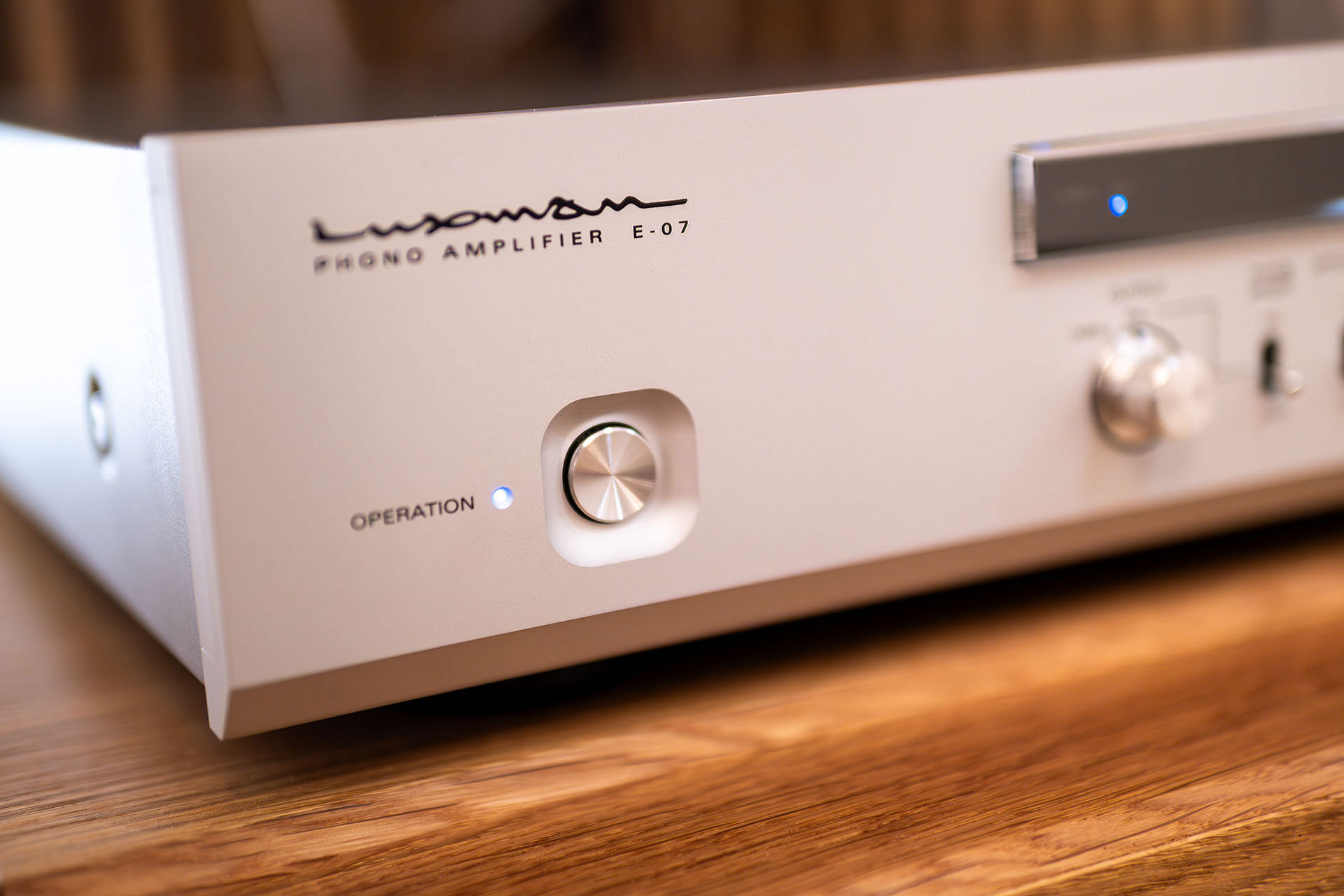
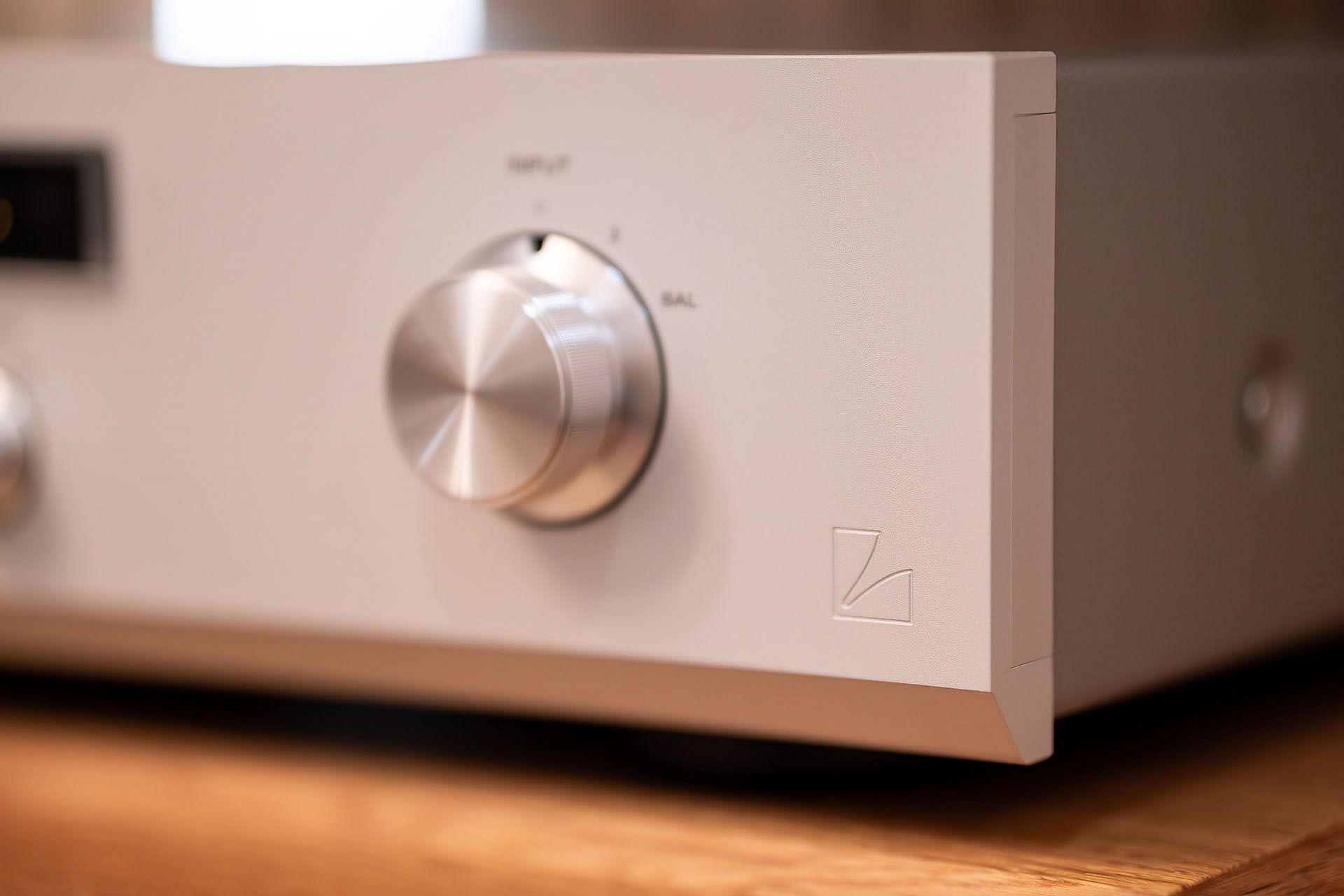
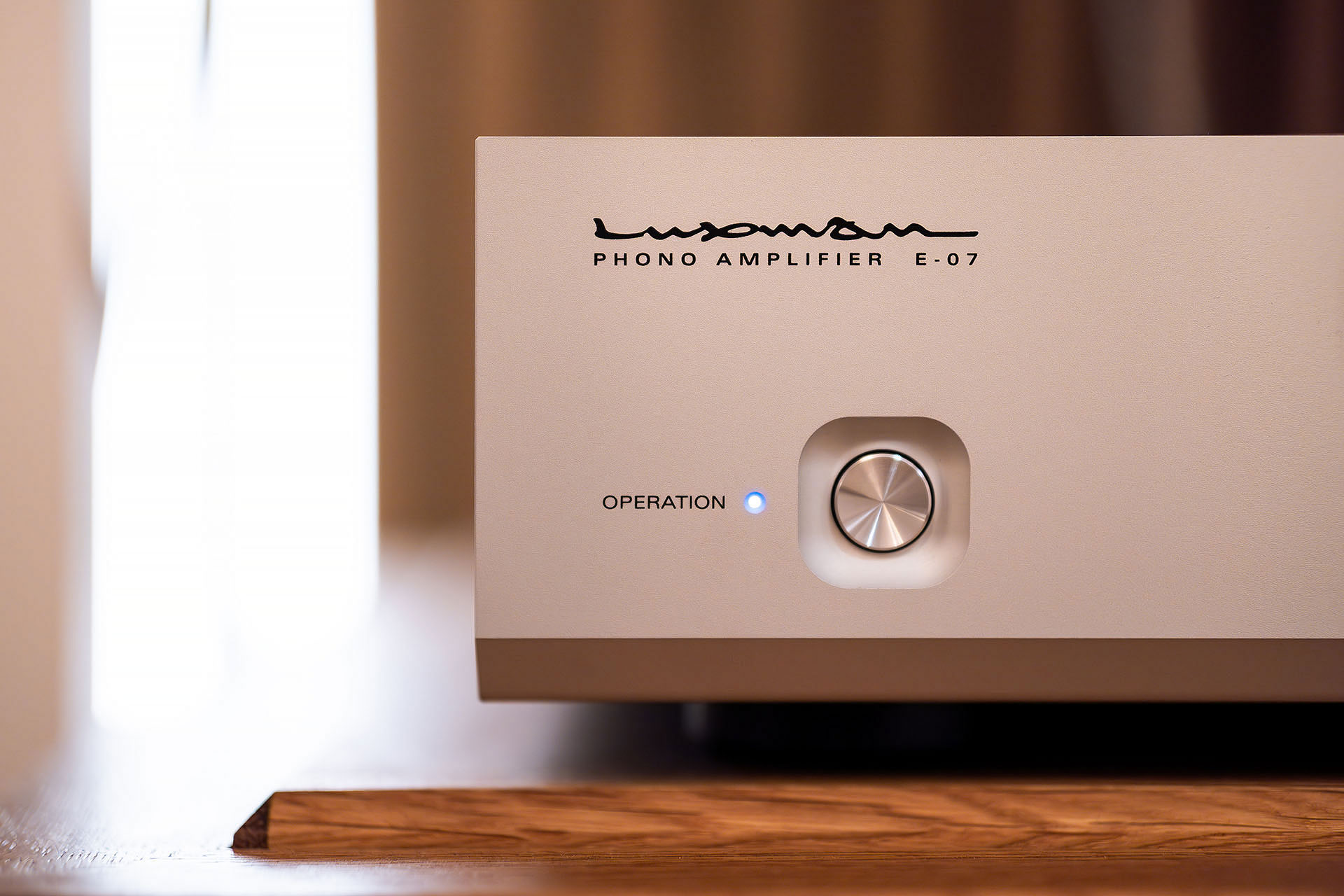
Before a single note is played, the E-07 earns serious respect simply by being examined. It occupies a slim, full-width chassis: 440mm wide, 92mm tall, and 407mm deep, with a blasted white aluminum front panel that manages to look both restrained and authoritative. This is not a product trying to impress visually. Every control has a reason for being there, positioned where it is for ergonomic and functional reasons. The front panel has the quality of something that has been considered for a very long time.
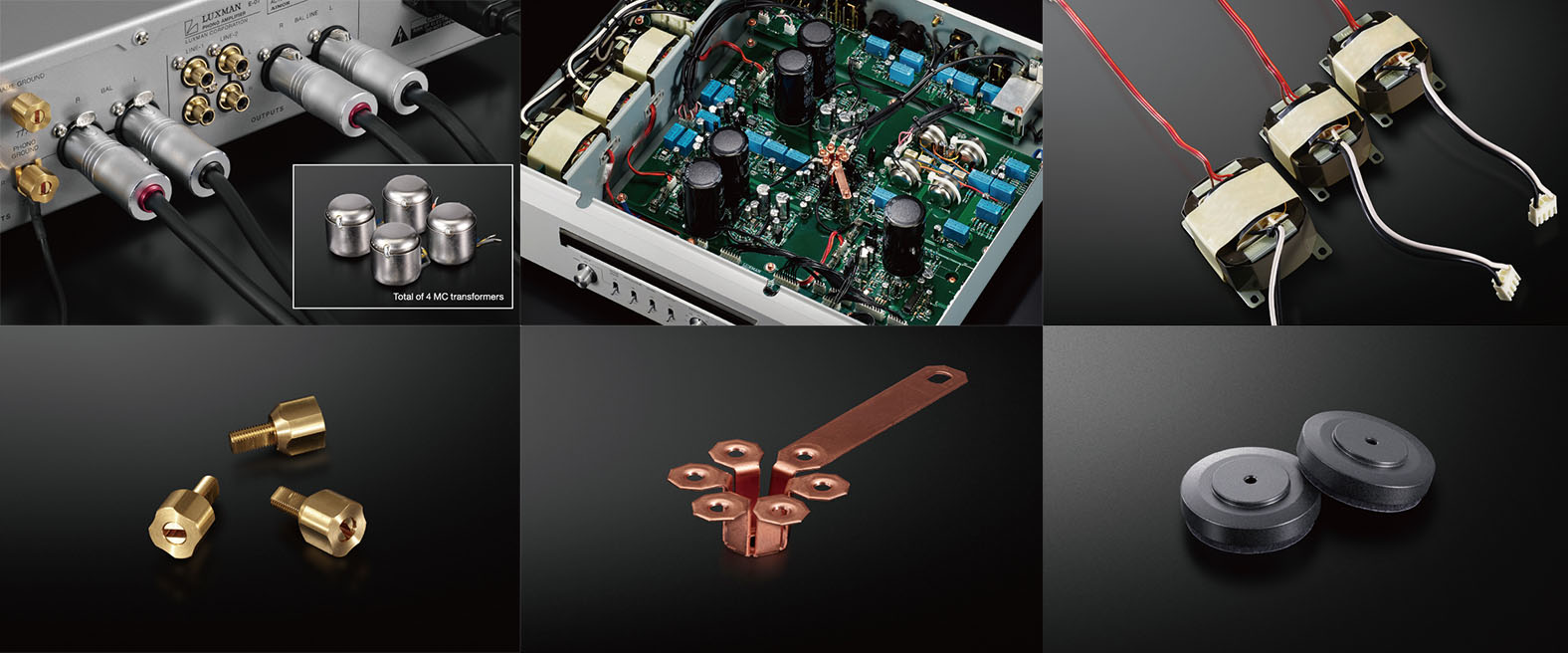
At 13.2 kilograms, the E-07 is far heavier than its slim profile suggests. This weight is not accidental. The chassis base consists of two ultra-thick copper plates, 3.6mm total, stacked together, lowering the center of gravity, increasing structural rigidity, and adding ground mass in a way that contributes measurably and audibly to the noise rejection that a phono stage at this level demands. The unit sits on density-gradient cast iron insulator feet, a choice that reflects the same careful thinking about vibration isolation that defines the very best equipment in any category.
The internal architecture of the E-07 reveals a level of engineering investment that far exceeds its asking price. Three independent power transformers are arranged to isolate the left and right channel amplification circuits from each other and from the peripheral relay and indicator drive circuits. Load fluctuations in one circuit block cannot reach another. The associated power supply regulation employs power-amplifier-grade block capacitors, 10,000 μF each, delivering the current stability that allows the amplification stages to behave freely and unrestrained. In practice, this means that dynamic peaks in the music are not accompanied by the subtle supply sag that undermines punch and authority in lesser-specified units.
The amplification circuit itself is a non-feedback RIAA-type phono equalizer with a first stage consisting of four individual FETs connected in parallel, a configuration that reduces noise through physics, by averaging the uncorrelated thermal noise of four devices. The result is a signal-to-noise ratio of 88dB for MM cartridges, 81dB for MC-High, and 78dB for MC-Low — figures that are excellent in absolute terms and exceptional given the complexity of the cartridge matching architecture that precedes this stage. Total harmonic distortion sits at 0.003 percent. The RIAA response accuracy for MM operation is ±0.1dB from 20Hz to 20kHz, a specification that very few phono stages of any price can match, and one that has audible consequences in the form of tonal correctness throughout the frequency band.
All internal wiring uses Luxman’s own oxygen-free copper cable with a precisely wound spiral shield and unplated copper conductors, an approach that prioritizes the natural transmission of the signal over any supposed enhancement. The grounding architecture deserves particular mention. Luxman developed what they call the Petal-Shaped Grounding Structure — PGS — which consolidates all circuit signal reference points into a single location, connected by ultra-thick steel plates in a radial pattern that ensures identical low impedance and uniform distance from each section. Additionally, the unique, rounded-pattern PCB trace routing reduces abrupt directional changes that can introduce signal turbulence at the microscopic level. It is the kind of detail that reviewers rarely discuss, because it is invisible in operation, but whose absence is audible in lesser designs as a certain blurriness and a loss of focus in the stereo image.
MC Step-Up Transformers — Four of Them, and Why It Matters
The E-07’s approach to moving-coil cartridge compatibility is one of its most interesting features and one of the most practical implementations I have encountered in a phono preamplifier at any price. Luxman has fitted four independent MC step-up transformers, two per channel, using super permalloy cores with extraordinarily high responsiveness to minute signals. These are not shared or compromised designs; the High- and Low-gain transformers are completely independent of each other, with no shared magnetic or electrical circuits that could introduce crosstalk or interference between the gain modes.
The front-panel six-position rotary MC load impedance selector offers 4.7, 10, 40, 100, 300, and 1,000 ohms. This range is genuinely exceptional. A cartridge with an internal impedance of 2 ohms, among the lowest-output MC cartridges in production, can be loaded correctly at 4.7 ohms, less than three times its internal impedance, preserving the cartridge’s bandwidth and dynamic behavior with a precision that most competing designs at this price cannot match. More significantly, the impedance selector also functions as the transformer selector: settings of 4.7, 10, and 40 ohms route the signal through the MC-Low transformer, delivering 66dB of gain, and are suited to cartridges with output voltages as low as 0.12 mV. Settings of 100, 300, and 1,000 ohms engage the MC-High transformer at 57dB of gain, intended for the more common 0.3 to 0.5mV output cartridges.
In practice, this means the E-07 will partner well with virtually any moving-coil cartridge in existence, from the most demanding ultra-low-output designs to standard-output cartridges, without the owner needing to purchase or insert an external step-up transformer. The four dedicated transformers, each optimally designed for its specific gain range and impedance group, make the external SUT unnecessary. This is not a small convenience. External step-up transformers, when properly implemented, can cost more than the E-07 itself, and their interaction with the phono stage requires careful impedance matching, adding complexity. The E-07 solves this elegantly by internalizing the entire problem and solving it with four separate high-quality units.
For MM cartridges, the rear panel provides a set of DIP switches offering load impedance options of 34, 47, 56, and 100 kilohms, alongside a second set providing capacitance loading at 0, 100, 220, and 320 picofarads. The 47k standard is present, but not the only option, a degree of intelligence in the MM implementation that is rarer than it should be. MM gain is 38dB, which is correct and sufficient for all MM cartridges without introducing unnecessary noise amplification.
Controls, Functions, and the Articulator
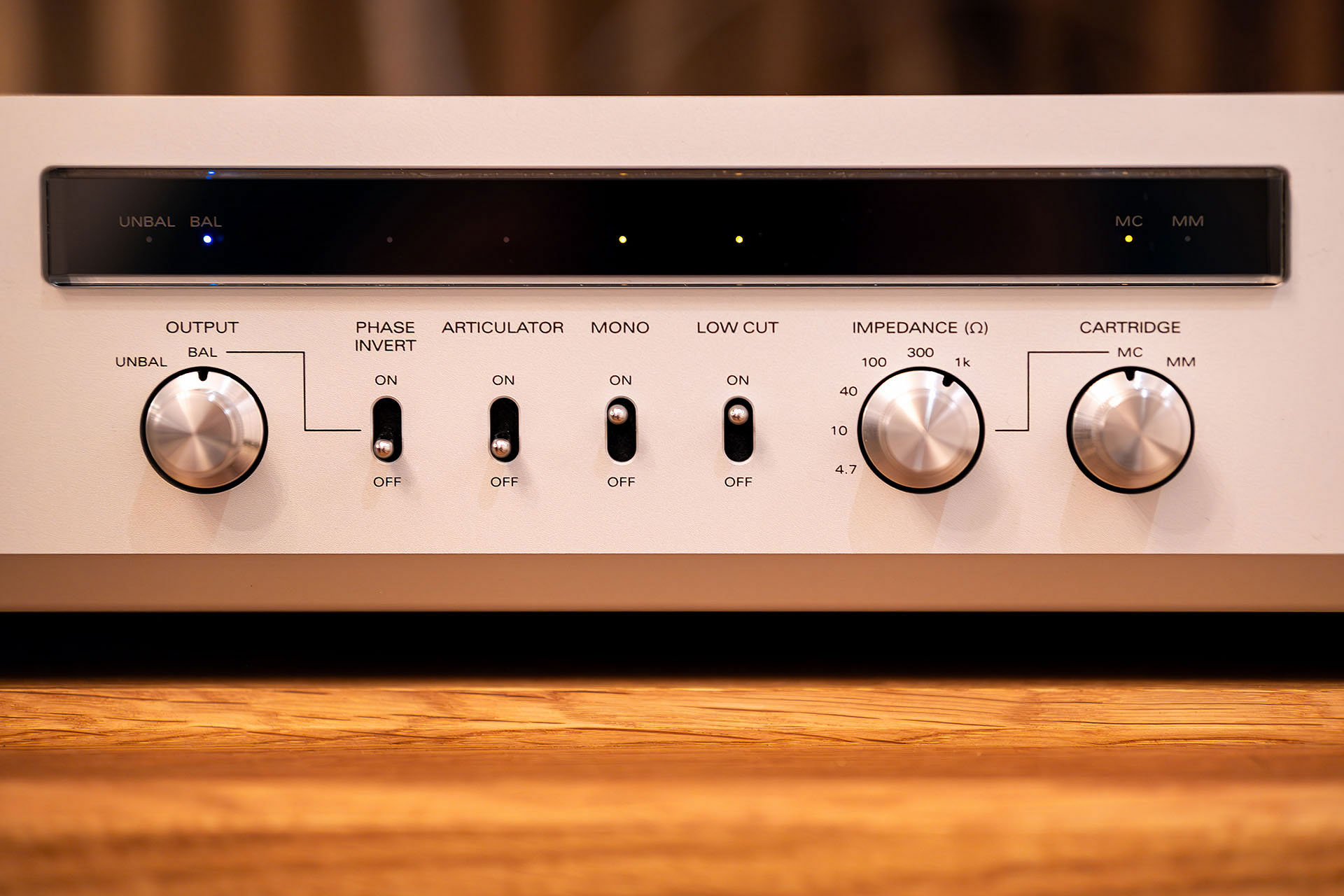
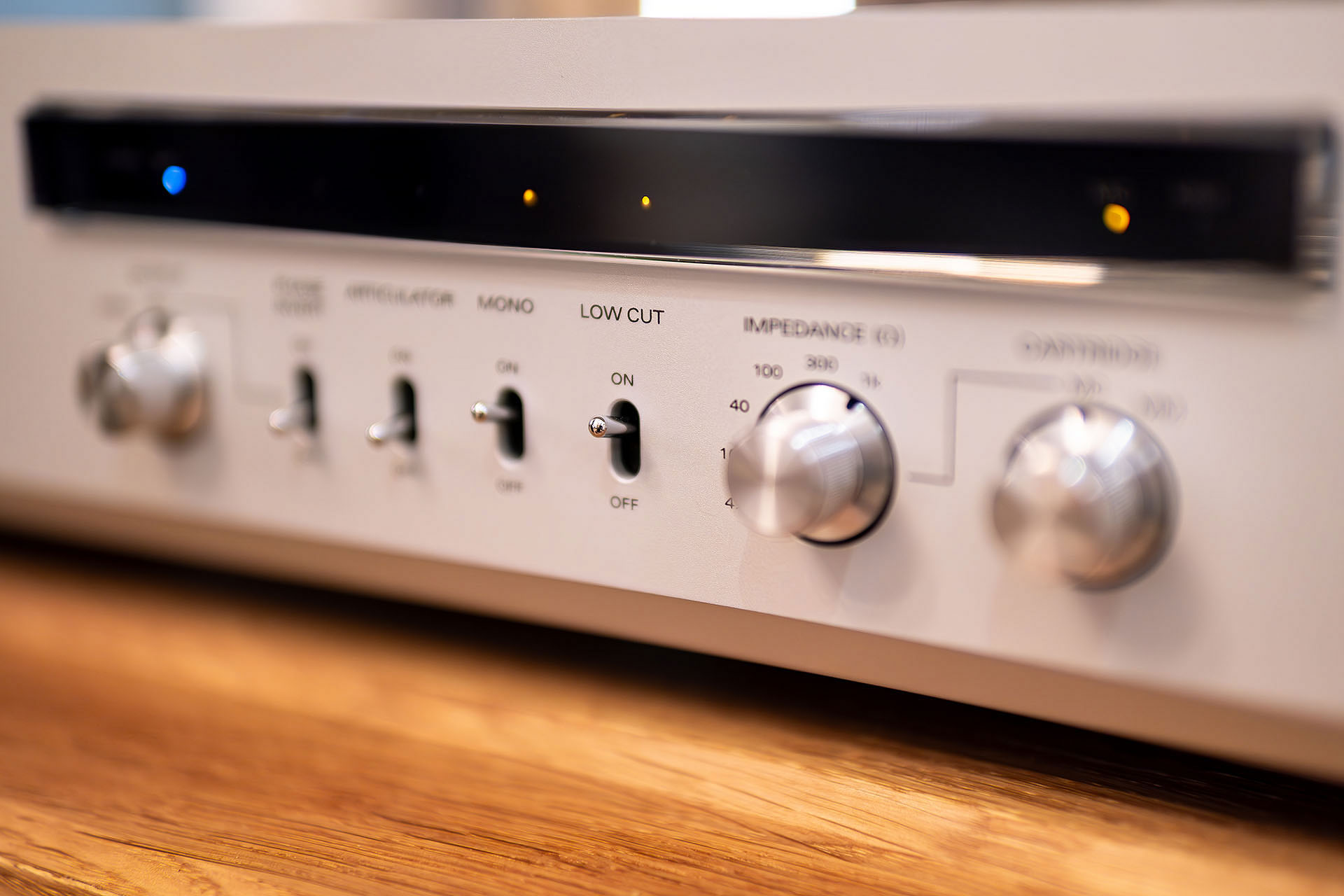
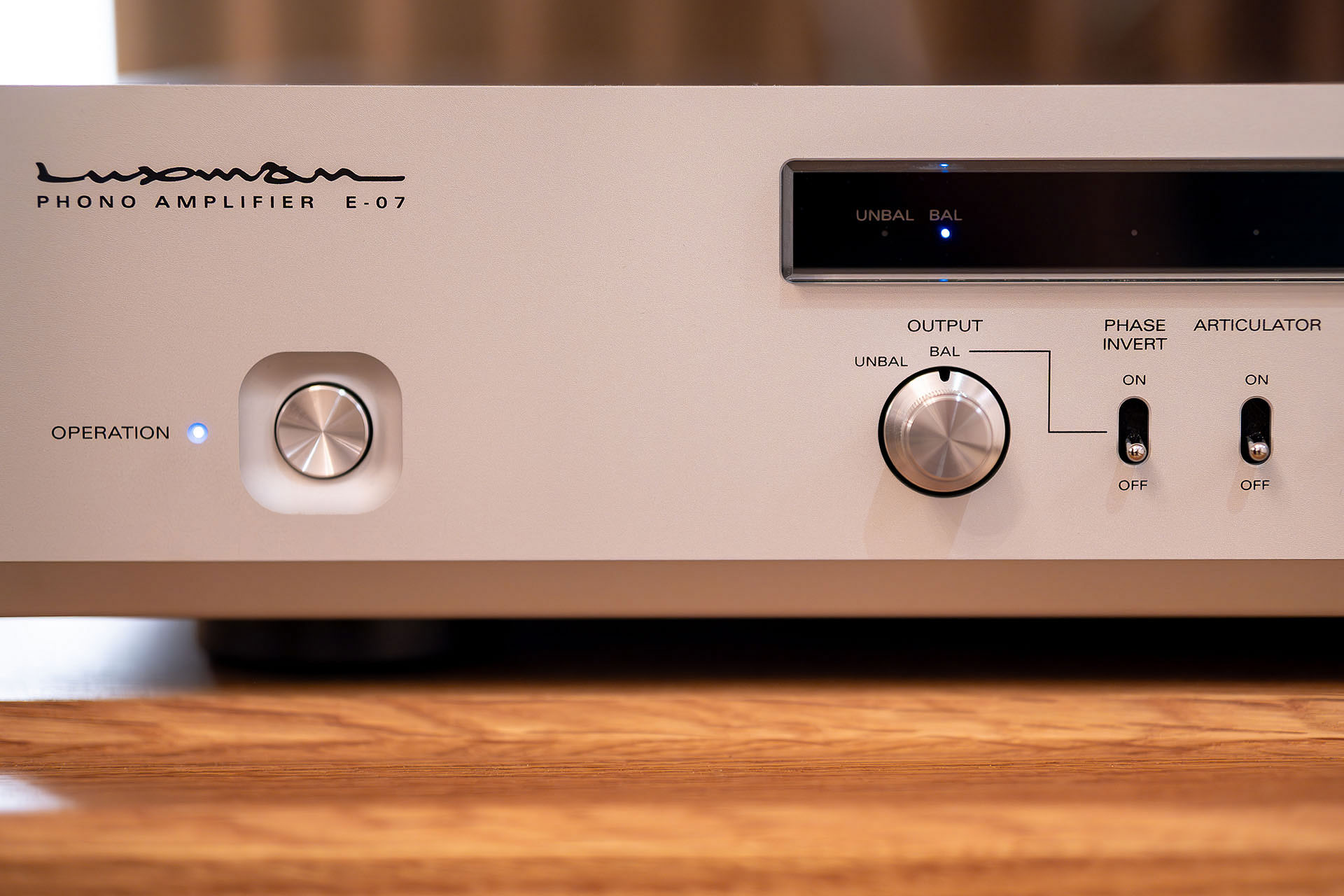
The front panel of the E-07 is organized with the kind of logical clarity that results from people who actually use equipment, making the decisions about its layout. From left to right: a power on/off button; a knob selecting between balanced and unbalanced output routing; four vertically oriented toggle switches controlling phase inversion, the Articulator function, mono/stereo mode, and the low-cut filter; an MC impedance rotary selector; an MM/MC selection knob for each of the two single-ended inputs; and a large input selection knob managing the choice between the three inputs. Running across the upper portion of the front panel is a slim plexiglass window containing small LEDs that provide a clear readout of the current status of all switches and selections. This display is neither flashy nor distracting. It tells you what you need to know and no more.
The Articulator function deserves specific attention, because it addresses a problem that most analog playback systems ignore entirely. As magnetic cartridges are used over time, and as MC step-up transformers are subjected to the cumulative effects of DC signal currents, a phenomenon called magnetization occurs, progressively degrading the clarity and focus of the reproduction. The Articulator in the E-07 performs a demagnetization routine using the playback signal itself, without requiring the owner to insert test records, connect external devices, or interrupt the listening session in any disruptive way. The toggle switch is activated, and the function takes place in the background. The result, particularly noticeable after a long listening session, is a restoration of focus, air, and inner resolution that quiet vinyl playback systems reveal but that many listeners have simply accepted as normal degradation.
The mono mode switch is implemented correctly; it sums the channels in a way that preserves level, not reducing it, making it genuinely useful for mono pressings, which respond to correct electrical mono summing with a sharply focused center image and a lower noise floor. The low-cut filter, operating at 6dB per octave below 30Hz, addresses the all-too-real problem of warp-induced subsonic energy exciting woofer excursions and introducing intermodulation distortion at audible frequencies. It is a practical tool, implemented at a sensible crossover point, and its inclusion reflects the kind of real-world thinking about how analog playback systems actually behave under real-world conditions.
Three separate phono ground terminals, one for each of the two RCA inputs and one for the XLR balanced input, connect to the star grounding reference point inside the chassis, while a fourth frame ground terminal connects directly to the chassis itself. In practice, this means that correctly grounding three separate tonearm/cartridge combinations is possible simultaneously, without resorting to improvised solutions or compromising ground paths. The gold-plated, solid-brass construction of these terminals, their large size, and their secure thread engagement ensure that ground connections remain stable under the mild mechanical stress of repeated cable connections.
The Reference System
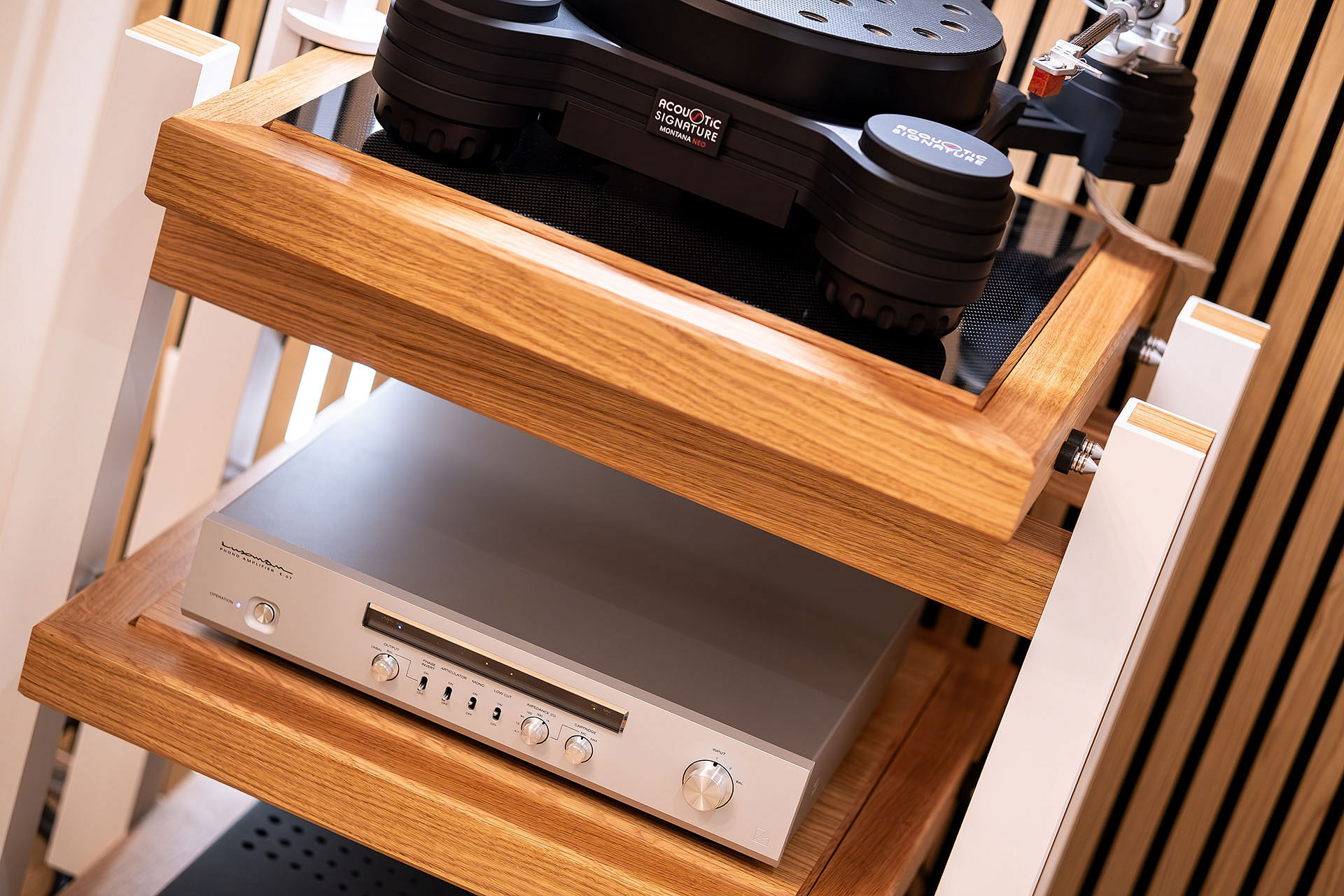
Before a single groove is traced, some clarity about the system context is essential. Equipment of this quality reveals its character through everything it touches, and it can only reveal itself fully when the surrounding components communicate without obscuring what reaches them.
The Aesthetix Calypso Eclipse preamplifier and Atlas Eclipse power amplifier completed the amplification chain, the finest tube linestage and hybrid amplifier heard in this system, also the subject of a full review here. Loudspeakers were the Raidho TD 2.2, ribbon-tweeter, two-way monitors of exceptional resolution and ruthless transparency, which reveal with equal clarity everything extraordinary and everything inadequate about what drives them. Speaker cables were the Crystal Art Series Monet or ZenSati Zorro coming in for evaluation, interconnects the Albedo Monolith Reference throughout, and power conditioning provided by Tsakiridis dedicated circuits with careful attention to grounding and isolation. The entire chain rested on a Woodyard vibration-control rack, with attention to decoupling at every component level.
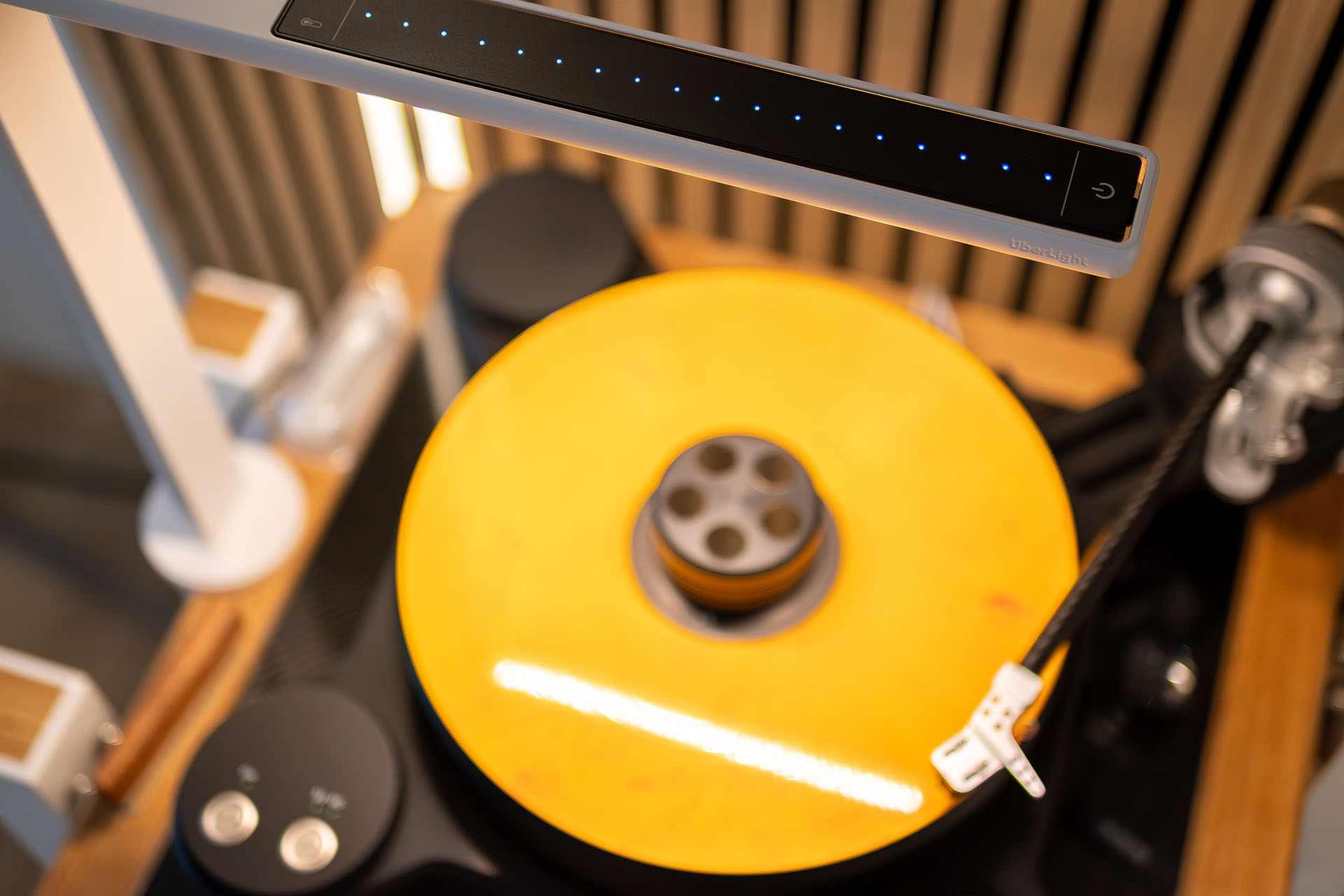
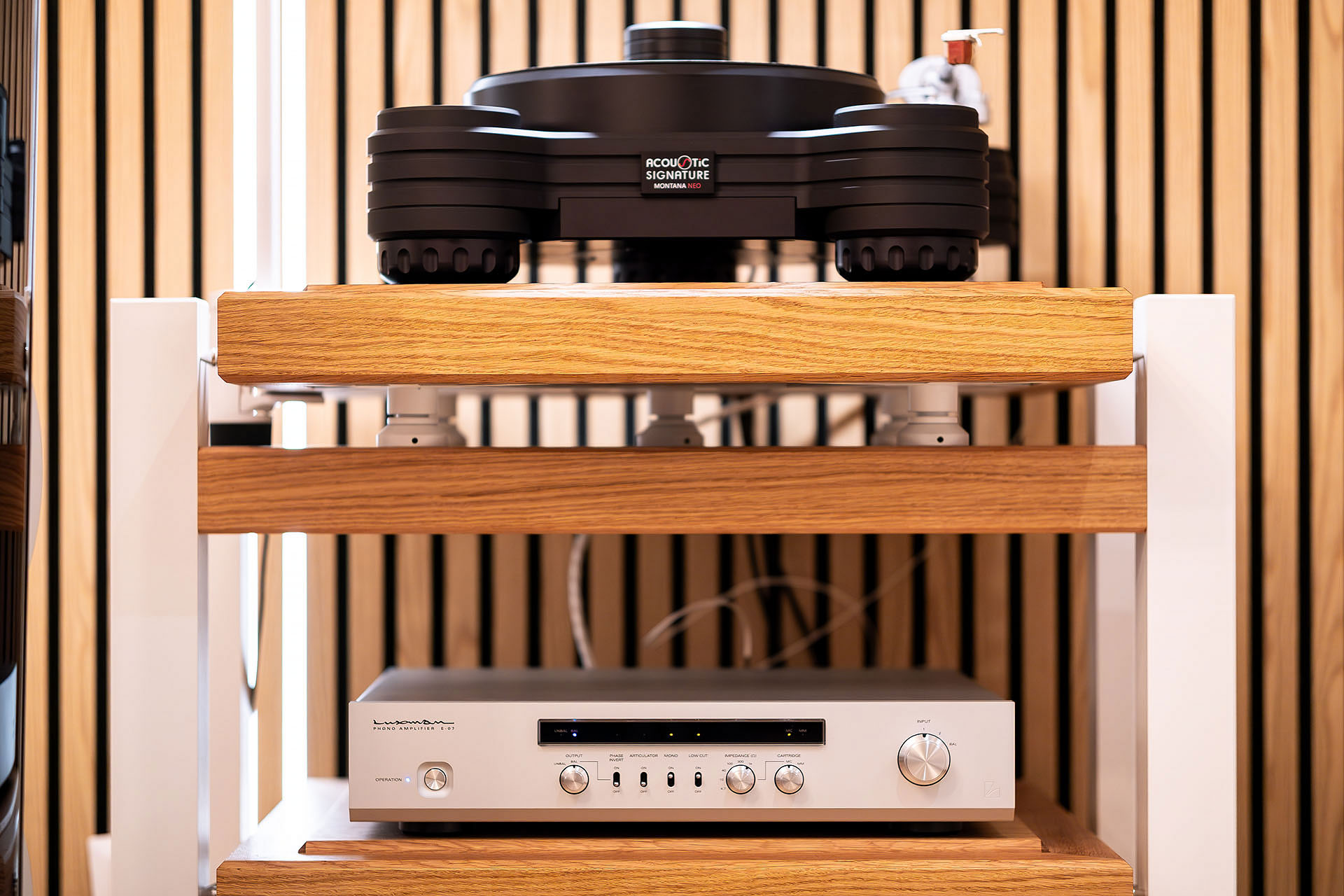
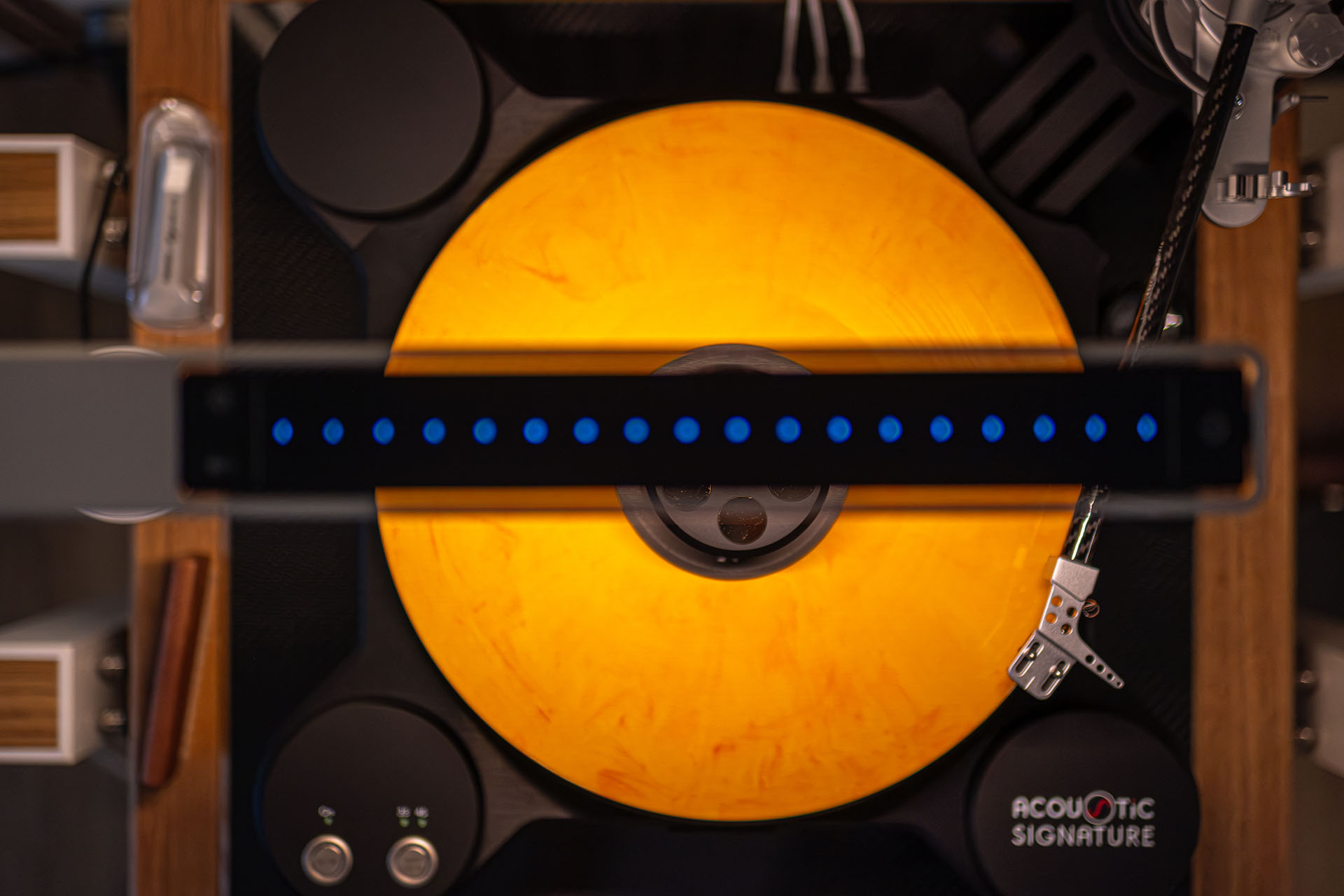
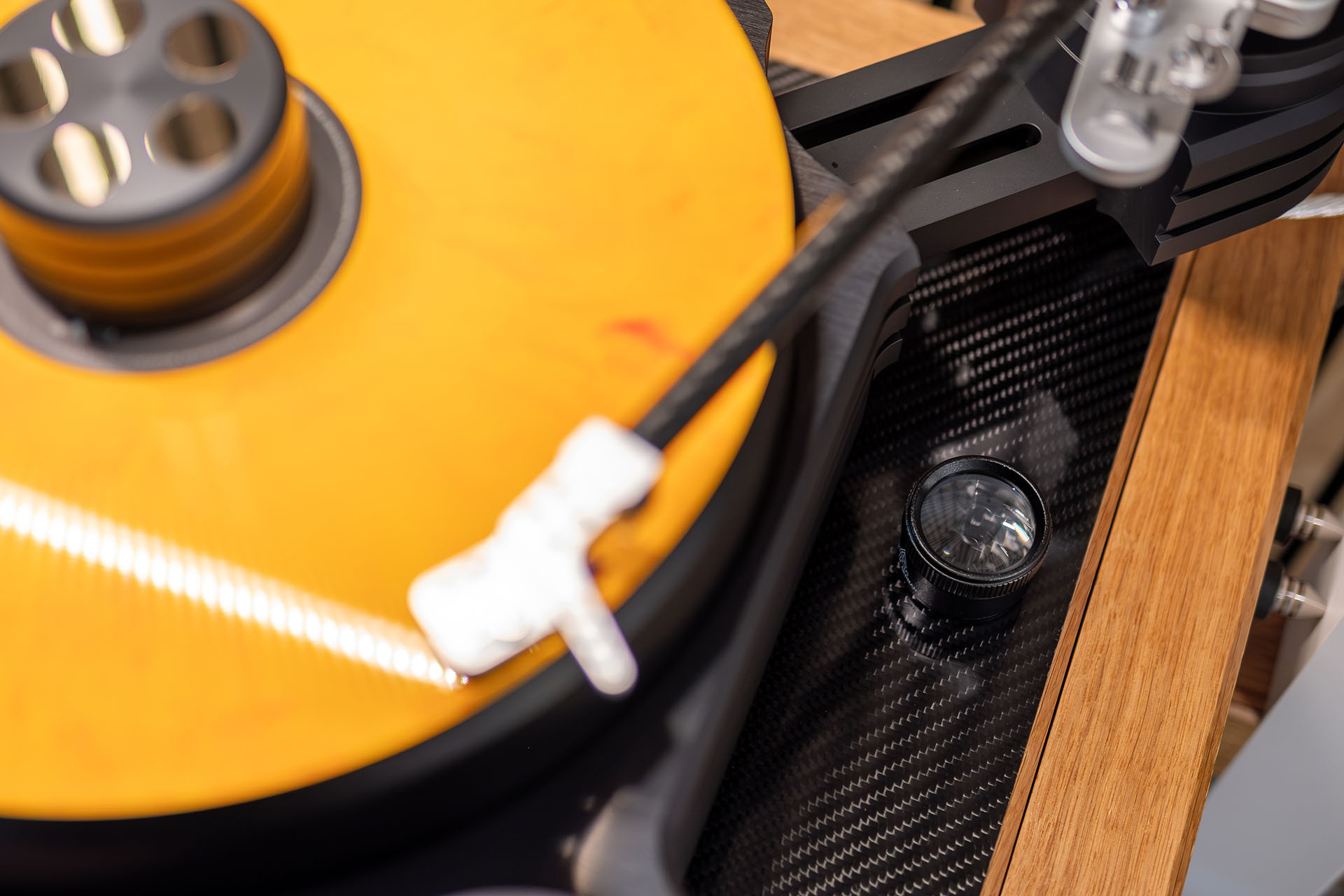
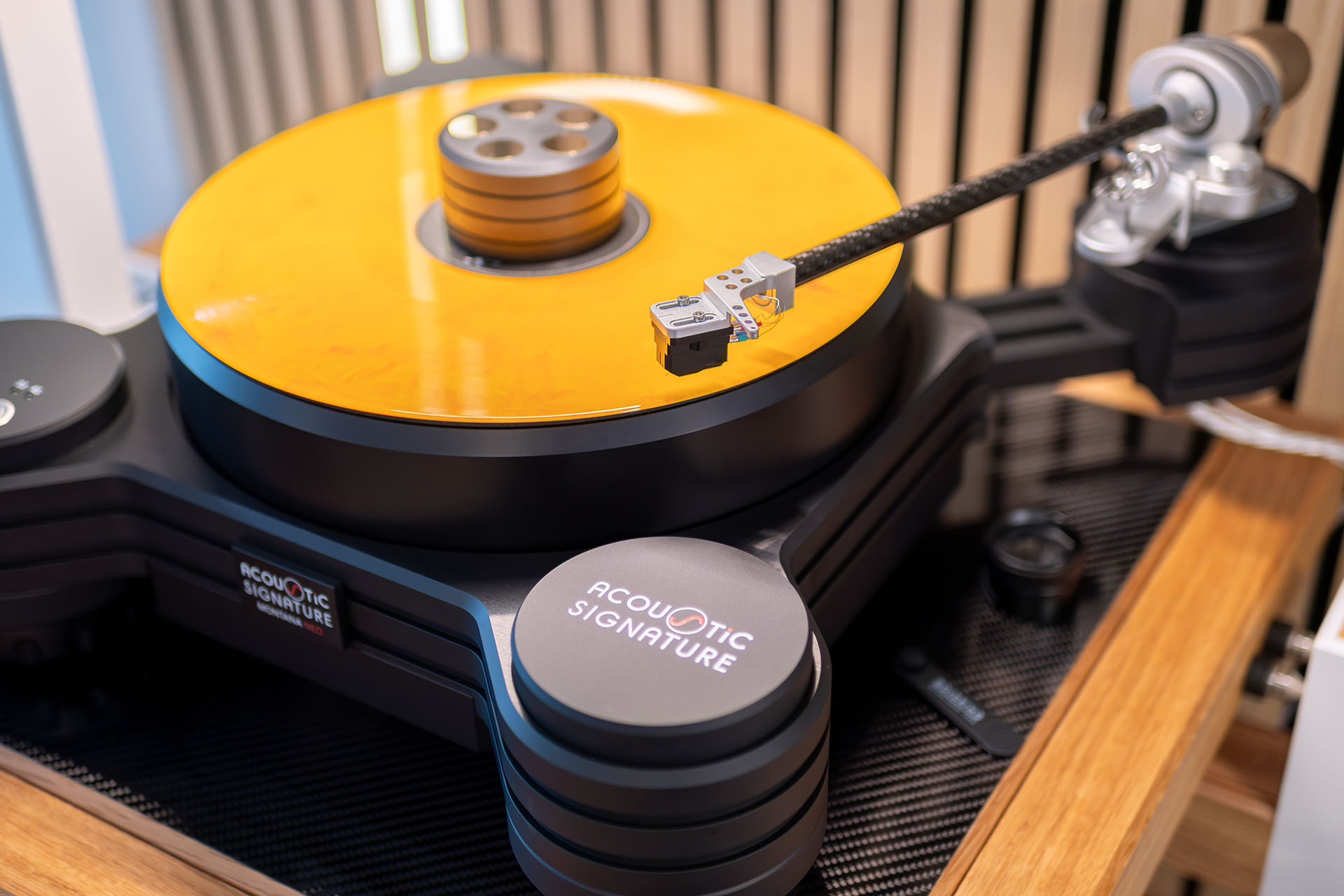
The evaluation was anchored by an Acoustic Signature Monata NEO turntable with Acoustic Signature TA-500 NEO tonearm, equipped with the Ortofon MC A95, commemorating the 95th anniversary of Ortofon’s technical leadership, and the Acoustic Signature MCX4 step-up device. The interconnect from tonearm to phono stage was the Crystal Van Gogh phono cable.
How Does It Sound? The Silence First
Let me begin where the E-07 begins: with silence. This is not a trivial thing. A phono stage amplifies the output of a moving coil cartridge by as much as 66 decibels. Everything in the circuit, every resistor, every transistor, every trace on the circuit board, every connection in the power supply, contributes something to the noise floor. The question is how much, and of what character. The E-07’s answer to this question is among the most impressive in its category. The noise floor is, in the most practical sense, inaudible. Between musical passages, in the space between a sustained note’s decay and the next phrase’s beginning, there is silence. Not attenuated hiss. Not a low-frequency murmur from the power supply. Silence. A silence that feels like a dark, high-contrast backdrop against which the music can appear with whatever luminosity and definition the recording and the cartridge can provide.
This silence has consequences throughout the listening experience. Details that would be masked by even a moderate noise floor, the initial transient of a cello bow engaging the string, the very beginning of a room’s reverb tail, the change in breath pressure before a phrase, are all present, all audible, all contributing to the sense that something complete and fully realized is happening in the room. The signal-to-noise performance described in the specifications becomes, in listening, an experience of increased musical dimensionality, not just a technical achievement.
Presence, Body, and the Texture of Real Instruments

Miles Davis, Kind of Blue, Mobile Fidelity Sound Lab, the 45rpm pressing. What the Luxman E-07 does with this recording is, at first, disconcerting in its ordinariness. Ordinariness being: it sounds exactly as this music should sound, as if no technical process has intervened between the magnetic information in the groove and the acoustic event in the room. Paul Chambers’s double bass has mass. Not simulated bass heaviness, not extended low frequencies — mass. The resonance of the body of the instrument, the specific way gut strings respond differently from wound strings, and the way the neck of the bass vibrates sympathetically with the open strings. All of it is present, resolved, and specific. John Coltrane’s tenor saxophone, the instrument he was still learning to inhabit here, is restrained in a way that would not persist for long, and breathes. The reed, the mouthpiece, the column of air: these are not concepts. They are present in the room.
This quality, this sense of body and physical reality in instruments, is the first and most persistent characteristic of the E-07. It does not project a larger or artificially inflated version of the music. It presents the music with its actual dimensions. Instruments have the mass they should have. They occupy physical space that feels correct in its proportions. When a piano is recorded in a concert hall, the piano in the Luxman’s presentation has the presence of something large enough to fill a concert hall, not the presence of a reproduction of a recording of something large.
Dynamics — Natural, Surprising, Alive

Shostakovich, String Quartet No. 8 in C minor, Op. 110. The Kronos Quartet on Nonesuch. This quartet, composed in three days in 1960, in response to what Shostakovich had witnessed of the destruction of Dresden, contains some of the most devastating dynamic contrasts in the chamber repertoire. The E-07 reproduces these contrasts with a quality that I have to call natural, because that is the only accurate description: the fortissimos arrive without mechanical exaggeration, and the pianissimos recede to a genuine, intimate quietness. The transitions between these states happen at the speed of a human musical impulse, without the slight mechanical lag that feedback-based amplification tends to introduce.
What one notices, listening to a phono stage of this caliber, is that dynamics are not simply about loud and soft. They are about the gradient between states, the rate of change, the microdynamic variation within a single sustained note as bow pressure changes, and the player’s intention shifts. The E-07 reproduces these micro-dynamics with a precision that most phono stages at this price can not match. The result is not an analytically impressive presentation. It is a musically alive one.
Four Records, One Phono Stage

Janis Ian, Breaking Silence, Analogue Productions (APP 027-45). The Analogue Productions 45 RPM pressing of Breaking Silence is one of those recordings that separates equipment with quiet ruthlessness, because the production is so transparent and the emotional content so unguarded that any coloration or grain becomes immediately audible as a form of intrusion. Through the Luxman E-07, the opening of the title track arrives with a hush that is something more than the mere absence of noise; it is the specific hush of a large recording space, its air still, its acoustic signature present in the subtle bloom around Ian’s voice before she has sung a single note. When she does sing, the voice arrives whole: its weight in the chest, its clarity in the upper midrange, its absolute absence of sibilance even on the most demanding consonants. The Analogue Productions 45 RPM transfer has more information to give than most pressings, and the E-07 accepts all of it without flinching and without adding any commentary of its own. What remains is the song, which is, of course, the only thing that was ever supposed to be there.
Joan Baez, Diamonds & Rust, Analogue Productions. Joan Baez’s soprano at its full extension is one of the most technically demanding things a phono stage can be asked to reproduce accurately. The overtone structure of the voice in its upper registers, the specific, slightly reedy quality that distinguishes Baez from every other folk singer of her generation, sits precisely in the frequency range where lesser phono stages introduce grain or phase irregularities that transform presence into sharpness. The Analogue Productions reissue of Diamonds & Rust is mastered with sufficient resolution to make this test definitive. Through the E-07, the opening of the title track places Baez at a specific, credible distance from the microphone, not close-miked intimacy, but the acoustic distance of a singer who fills a room. The acoustic guitar beneath her has body and string tension and the resonance of a real instrument in a real room. The passage where the orchestration enters does not overwhelm the voice, because the E-07’s dynamic presentation maintains the correct hierarchical relationship between foreground and background, Baez remains the source of light, and everything else is illuminated by her.

Keb’ Mo’, Keb’ Mo’, Mobile Fidelity Sound Lab. The Mobile Fidelity pressing of Keb’ Mo’s debut is a masterclass in what happens when a beautifully simple recording is given a transfer of sufficient quality to reveal its full depth. The album is built on very little: voice, acoustic guitar, occasional percussion, sparse electric touches, and its power comes entirely from the authenticity of the performance and the quality of the production. Through the E-07, the acoustic guitar on “Every Morning” has the weight and string mass that separates a correctly loaded MC cartridge from a compromised one; the low strings have fundamental density, the upper strings have the specific, slightly compressed character of a fingerpicked acoustic recorded in a room that flatters the instrument. Keb’ Mo’s voice sits in the midrange with a naturalness and a particular roughness at its edges that the E-07 reproduces without smoothing and without exaggerating. What the Luxman contributes here, more than anything else, is honesty: this is a record about the sound of a real person playing real music in a real room, and the E-07 declines to make it into anything more complicated than that.

Joshua Redman, Where Are We, Blue Note. Where Are We is a contemporary record, deliberately intimate in its production, built around a series of duets that place Redman’s tenor saxophone in close conversation with a small group of collaborators, including Gabrielle Kavese. The Blue Note pressing has an immediacy that rewards a quiet noise floor, because the engineering philosophy of the album is one of proximity and candor: the microphones are close, the acoustic space is present, and the emotional content of each improvisation depends on hearing the player’s breath and intention before the notes arrive. Through the E-07, the saxophone has the specific, complex timbre of a played instrument, with the reed, body, and keys each contributing their own acoustic signatures to the fundamental tone. Redman’s tendency to begin a phrase quietly and build within it, a rhetorical habit that defines his lyrical approach, is fully communicated, with the micro-dynamic gradations of a single sustained phrase reproduced with the kind of fidelity that turns a technically impressive performance into an emotionally involving one.
Soundstage — Architecture Without Artifice

Bill Frisell, Valentine, Blue Note Records, 2020. Valentine was recorded live at the Village Vanguard with only Thomas Morgan’s double bass for company, and its spatial qualities are inseparable from its emotional ones. The album only makes sense if you can hear the room that the two musicians share, the distance between them, the acoustic relationship between Frisell’s amplified guitar and Morgan’s unamplified bass in the same physical space. Through the E-07, that room is entirely present. The stage is not wide in the spectacular, demonstrative way of a large orchestral recording; it is wide in the way a small jazz club is wide, which is to say intimate and specific, with the sense that the walls are close and the ceiling is low and the air is warm and slightly dense. What the Luxman communicates about this recording that lesser phono stages do not is the acoustic relationship between the two instruments, the way Frisell’s sustained notes decay into the same room that Morgan’s pizzicato notes inhabit, the reverb tails of each instrument subtly altering the character of the silence before the other responds. This is not a soundstage effect. It is a room. And through the E-07, it is a room you can almost close your eyes and inhabit.
The soundstage that the E-07 constructs is not wide for its own sake. It is accurate. Mono recordings summed correctly with the mono switch sound like mono, a single, tightly focused central image with a fully dimensional acoustic environment around it. Stereo recordings spread to whatever width the recording engineer intended and no further. What the E-07 adds to the soundstage is not size but believability, the sense that the positions of instruments within the stage are the result of real acoustic events, and not just artifacts of electronic processing.
The Balanced Advantage and the MC Matching
The balanced XLR input, available for MC cartridges only, which is the correct implementation, delivers a tangible benefit in certain tonearm configurations. Differential MC cartridges and tonearms equipped with internal balanced wiring can connect directly to the balanced input and deliver a fully differential signal to the balanced output stage without any conversion losses or asymmetry. In practice, with the Ortofon MC A95 set to 40 ohms on the impedance selector — engaging the MC-Low transformer and its 66dB of gain — the result through the balanced path has a specific, additional quality of image focus and left-right stereo separation that the single-ended path, excellent as it is, does not quite match.
The low impedance loading options deserve further emphasis. Cartridges with internal impedances of 2 to 6 ohms — a category that includes some of the finest moving coil designs in current production — are loaded at 4.7 or 10 ohms through the E-07’s MC-Low transformer. This is not simply a number. Correct loading at these values allows the cartridge’s generator to operate into an impedance that is close to its internal design point, preserving its frequency response at the frequency extremes, maintaining its dynamic behavior under loud transient conditions, and avoiding the high-frequency rolloff that results from loading a low-impedance cartridge into an inappropriately high termination. The E-07 is one of the very few phono stages at its price point that takes this seriously enough to provide true 4.7-ohm loading through a dedicated step-up transformer.
Conclusion — The Art of Getting Out of the Way
There is a species of audio component that announces itself, that has a recognizable character, a specific coloration or emphasis that becomes audible with familiarity, and that eventually reveals the machine behind the music. And then there is the rarer species: the component that simply disappears. That does its work so completely and so cleanly that what remains in the listening room is only the music, in all its complexity and its human imperfection and its irreplaceable life.
The Luxman E-07 belongs firmly to the second category. It does not impose a character on the music that passes through it. It does not soften the upper frequencies to hide grain it cannot control, or push the midbass to simulate warmth it does not genuinely possess. It amplifies. It equalizes with extraordinary accuracy. It provides an extraordinarily quiet background against which the information in the groove can appear with whatever brilliance and body the cartridge, the record, and the recording chain have preserved. And then it steps aside.
The versatility of the MC loading system, six impedance settings, two independent transformer pairs per channel, genuine 4.7-ohm low-impedance capability, balanced XLR input for differential cartridge signals, makes the E-07 a phono stage that will accommodate the analog system it joins as that system evolves, without requiring replacement every time a new cartridge demands different loading. The quality of the step-up transformers, the noise floor, the RIAA accuracy, the chassis construction, and the grounding architecture represent an unusual level of engineering investment at this price point and compelling at any price point.
The Luxman E-07 is a centennial product in the truest sense: it carries a hundred years of accumulated knowledge about what amplification requires, distilled into a form that is practical, beautifully made, and most importantly, deeply, consistently musical. It is a phono stage worthy of the best cartridges and tonearms currently produced, and it will remain relevant for as long as vinyl playback remains a pursuit worth taking seriously.
The Luxman E-07 receives our Highly Impressive Award, hand it over with complete confidence and without reservation.

Thank You
Every evaluation of this quality depends on a distributor’s willingness to place a remarkable product in the hands of a reviewer with the patience and generosity to allow it to be properly heard over time. In this case, that generosity came from the excellent team at HiFi Expert Romania — our local distributor for Luxman products and one of the most professional, knowledgeable, and genuinely passionate high-end audio dealerships available in this part of the world.
The team at HiFi Expert made the Luxman E-07 available for this evaluation with the openness and trust that can only come from people who believe in what they represent and care about how it is experienced. Their support, their willingness to answer technical questions, and their enthusiasm for analog playback at the highest level made this review possible and enriched the process of conducting it. Our sincere and warm thanks to the entire team at HiFi Expert Romania. You can visit them at www.hifiexpert.ro, and we encourage every serious analog enthusiast in Romania and beyond to do so.