A Conversation at the Limits of Excellence
For anyone in the world of high-performance audio, the High End show, formerly in Munich and, from this year, in Vienna, is the closest thing to a sacred pilgrimage this hobby allows. In 2025, thousands of systems, hundreds of rooms, and the finest electronics and loudspeakers from every corner of the world competed within the confines of the MOC Veranstaltungscenter. It is an event that distills the ambitions, obsessions, and sometimes the quiet genius of an entire industry into five relentless days. It is exhausting, revelatory, and never once boring.
It was on the second day of the show that I had the good fortune of a long and genuinely engaging conversation with Dr. Ing. Stefan Schwehr, owner and CEO of AudioNet. Stefan Schwehr is not a man who talks about his products the way a salesman might. He is a physicist and electronics engineer with decades of experience, including a chapter at automotive giant Daimler, who inherited a company with extraordinary engineering DNA and set about restoring and elevating it after its re-emergence from difficult times. He speaks about amplification the way one imagines Helmholtz might have spoken about acoustics: with complete command of the underlying science, and a deep, private reverence for what that science is ultimately in service of.
Our conversation moved fluidly across several territories. We discussed the state of AudioNet’s engineering philosophy, the defining principles behind the Signature product line, and the questions that genuinely preoccupy the company’s design team. We talked about the market and the fascinating pressures that the younger generation of audiophiles is placing on the industry, their desire for integration, for elegance of form, for products that serve as streamers, preamplifiers, and digital-to-analog converters simultaneously, without requiring a dedicated equipment room and a degree in system architecture. Schwehr takes these requests seriously. AudioNet has been growing its network component line, the DNP, DNA, and DNC products, precisely because they understand that the future of high-end audio is not exclusively monastic. The next generation of serious listeners wants access to the musical revelation without necessarily sacrificing the rest of their living space.
But what was most striking in our conversation, what stayed with me long after I left the room and walked back into the noise of the show, was his discussion of perfectionism as a discipline, and specifically of the AMP monoblock as the point of entry into what he calls “serious AudioNet amplification.” He described the AMP not as a budget concession but as a statement of first principles: a product that asks, and attempts to answer, the most fundamental question in power amplification — what does a perfect amplifier actually sound like? And he was quick to add, with a quiet precision that I found immediately compelling: “It sounds like nothing. That is the beginning of Silence.”
Architecture: ULA and the Geometry of Silence
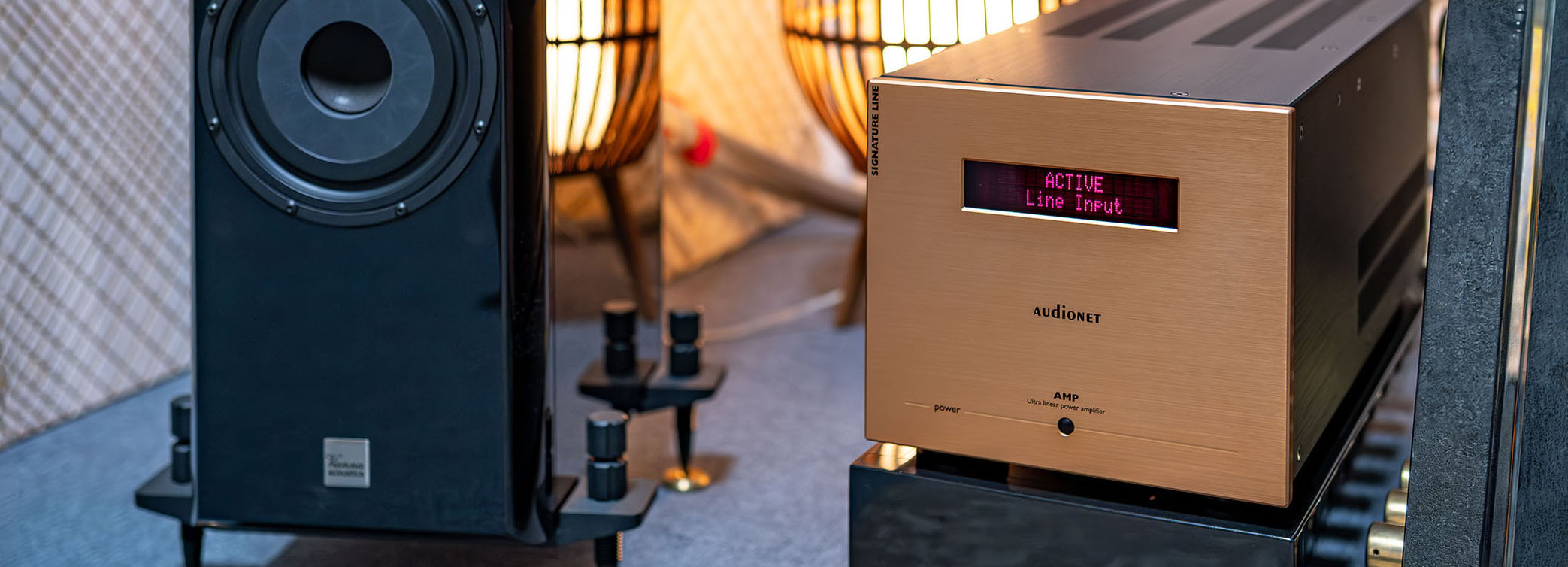
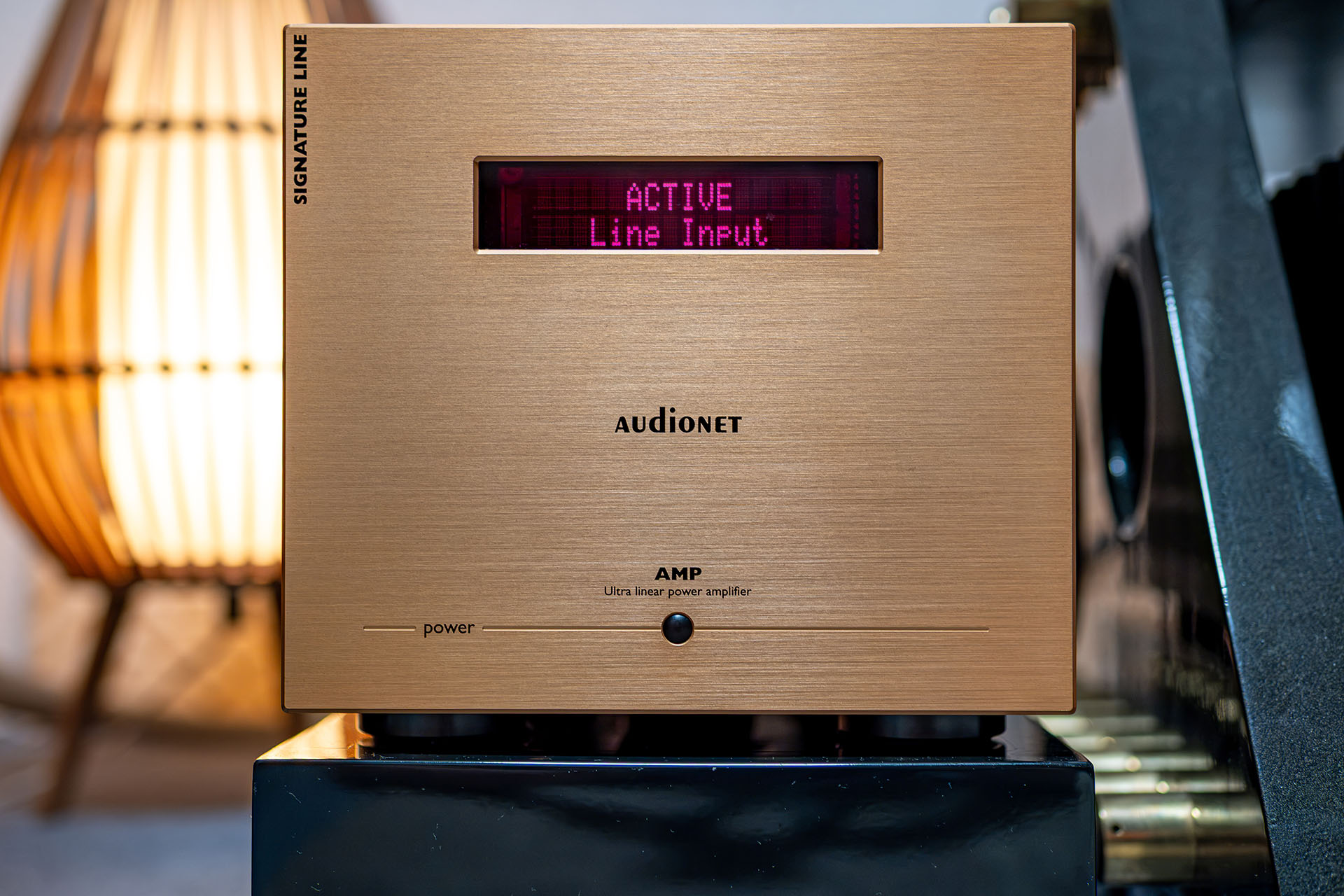
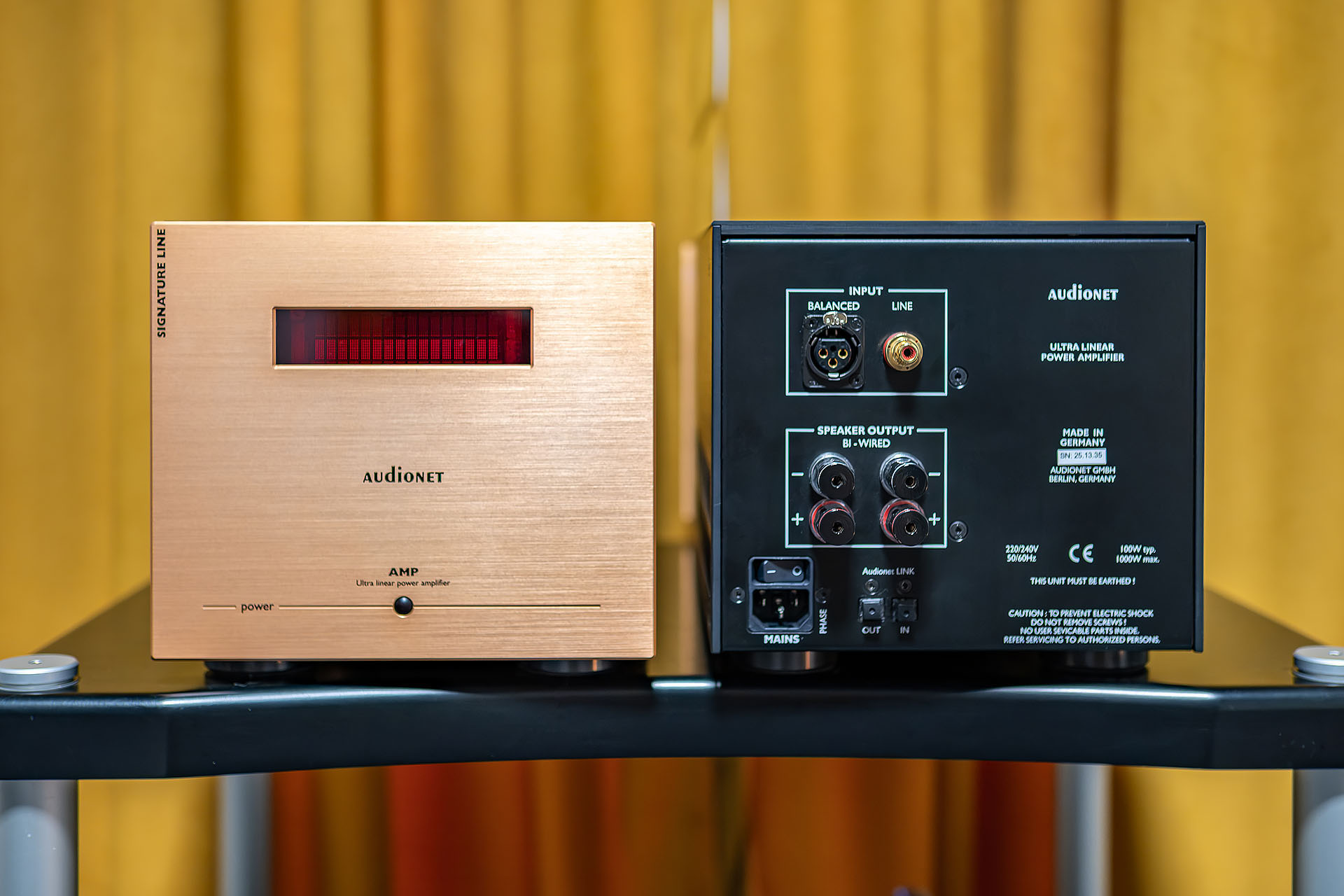
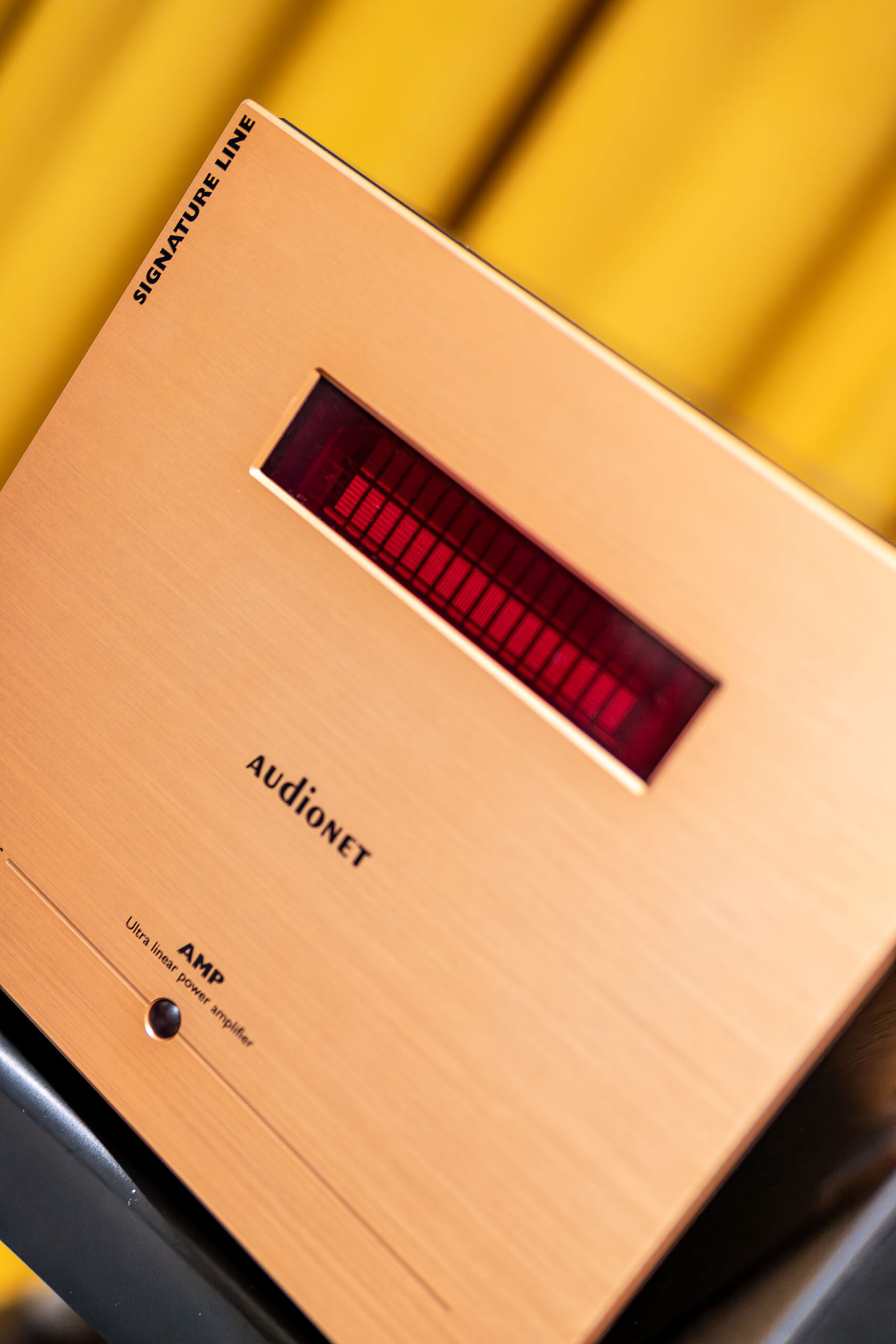
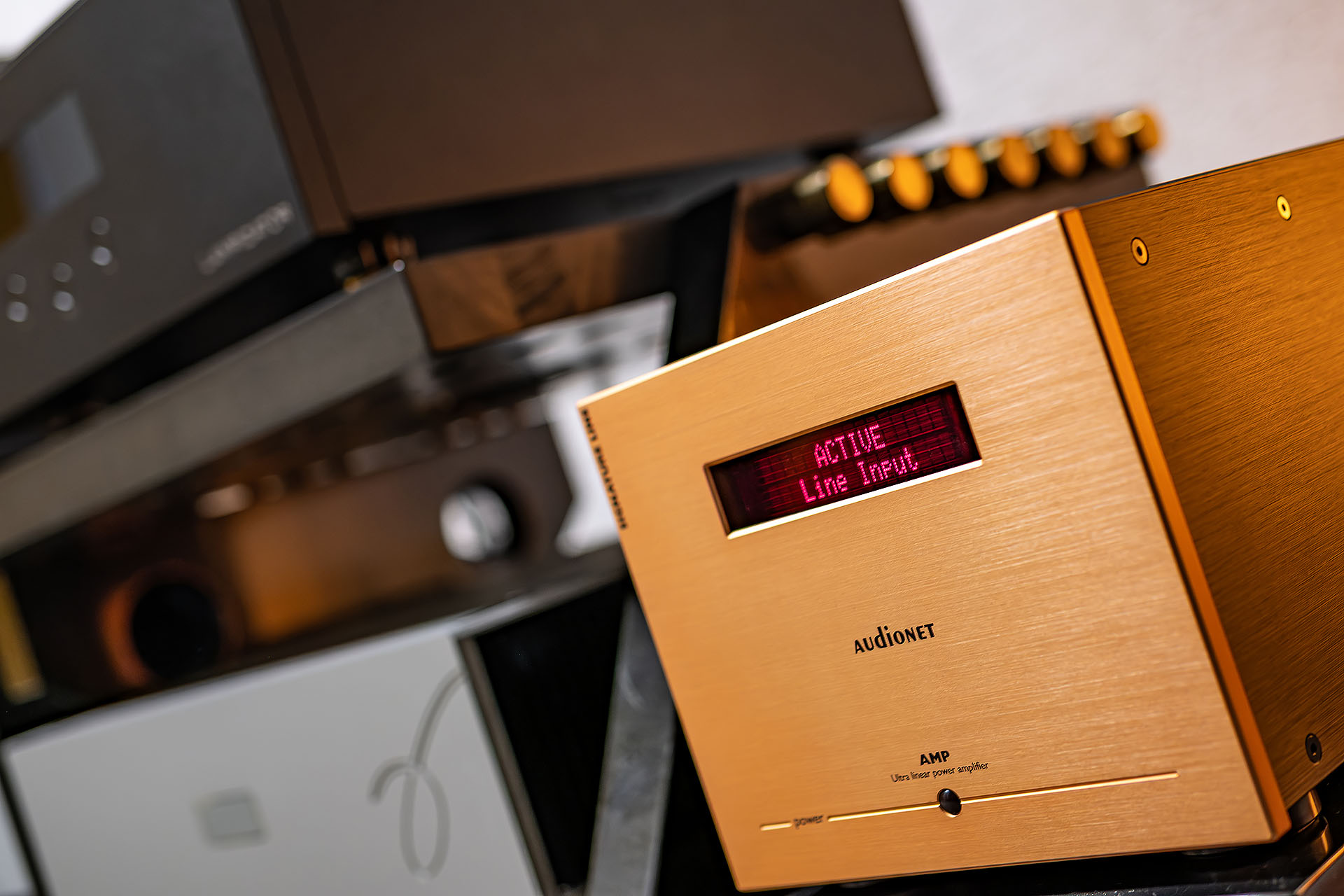
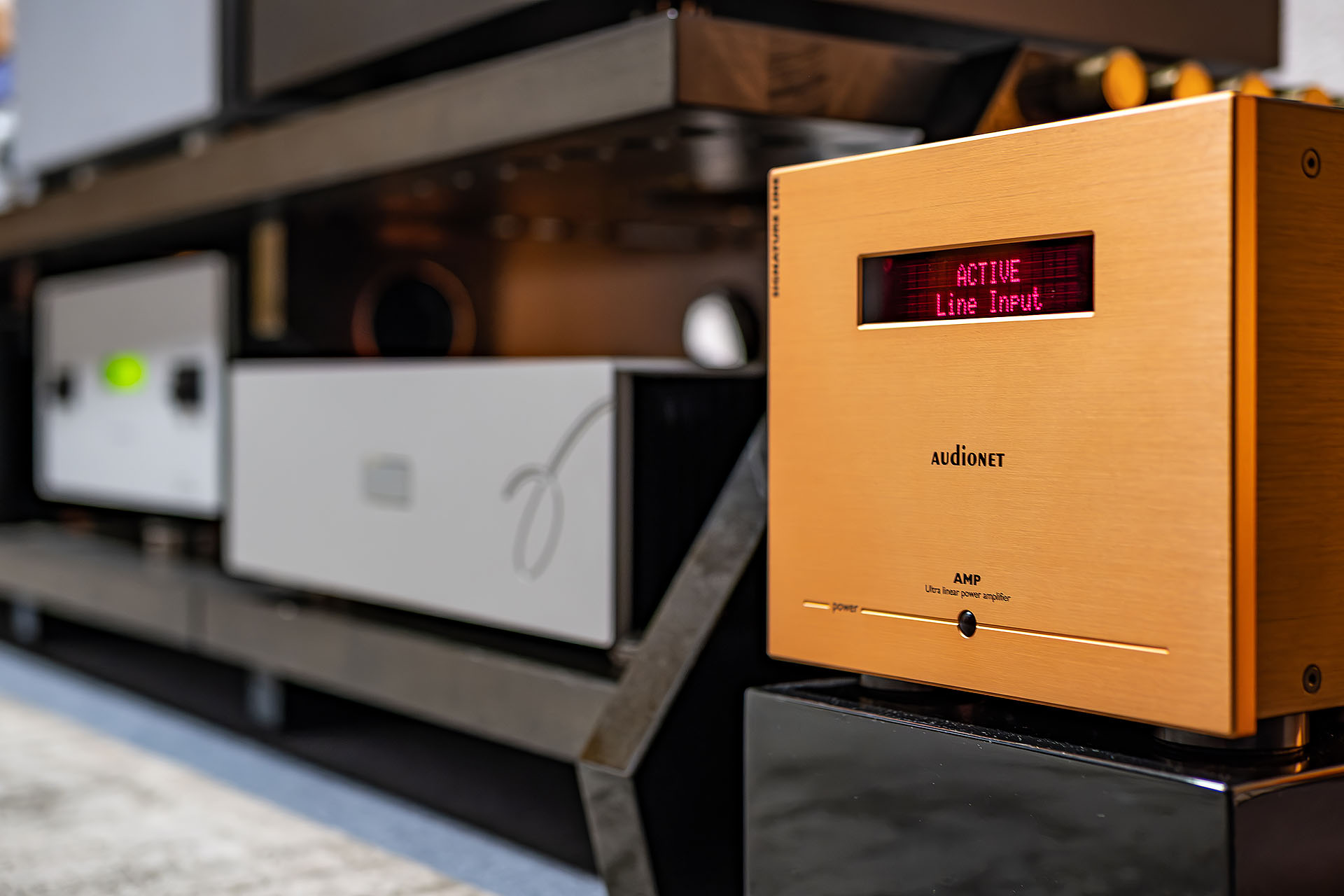
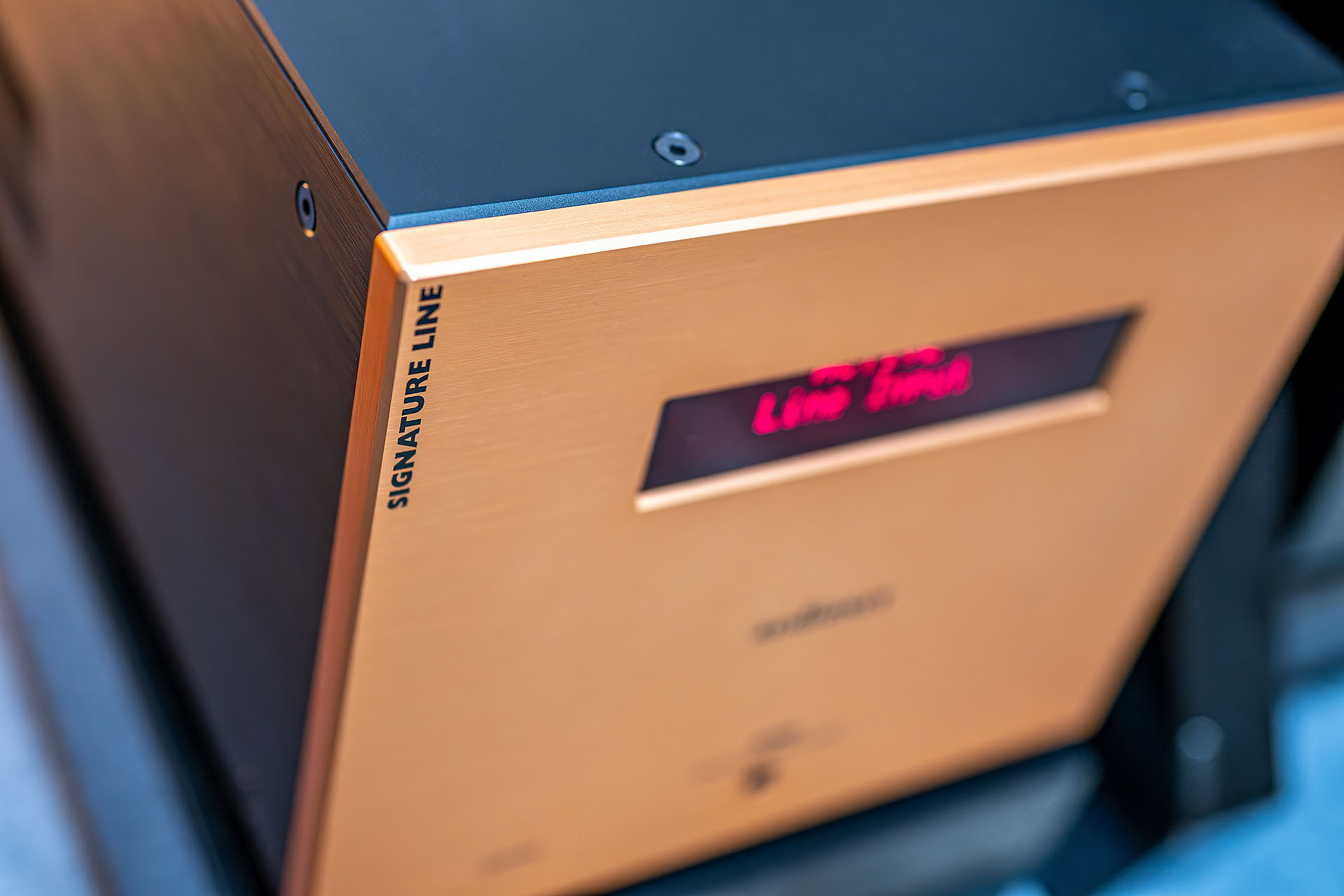
The AudioNet AMP is, in its physical dimensions, a modest proposition: 215 mm wide, 190 mm tall, 500 mm deep, and 22 kilograms per monoblock. Used in stereo, you live with a pair of these compact towers, and their visual discretion is part of their character. The 10 mm brushed aluminum front panel, available in silver or black (copper in the Signature Line), with red or blue display, offers a clean, industrial restraint that belongs entirely to the design language established for AudioNet by the legendary Hartmut Esslinger, the German-born designer who shaped Apple’s visual identity in the 1980s and whose later collaboration with AudioNet produced one of the most distinctive aesthetic signatures in the high-end amplifier world. These are machines that look serious without being theatrical. They do not demand attention. They expect to be listened to.
What lies beneath that restrained exterior is not so modest. The AMP mono-blocks represent the state of the art of AudioNet’s ULA — Ultra-Linear-Amplifier — technology, a circuit topology that the company originally developed not for audio reproduction but for the rigorous demands of medical electronics. The origin matters. Medical instrumentation operates in a world of zero tolerance for signal impurity. There are no audiophile workarounds in a surgical monitoring application; the signal either arrives intact, or it does not. The engineering discipline required to achieve that level of signal fidelity in a medical context translates, when applied to audio amplification, into measurements that push against the theoretical limits of what current technology can even detect.
The output stage of the AMP is equipped with six power MOSFETs with actively controlled bias current, supported by a unique real-time local distortion correction stage that linearizes harmonic errors as they are generated, not after the fact, and not through global negative feedback, which AudioNet avoids at the output stage. The power supply is built around an encapsulated 850 VA toroid-core transformer and two fast, impulse-resistant high-current capacitors delivering a total filtering capacity of 188,000 µF. The input stage is separately powered by its own 80 VA toroid-core transformer, achieving a gain-bandwidth product exceeding 1 GHz, and is additionally decoupled from the power stages via double bootstrapping. This separation (the input stage isolated from the output stage, each with its own power source) is a design commitment to absolute channel purity that has direct, audible consequences.
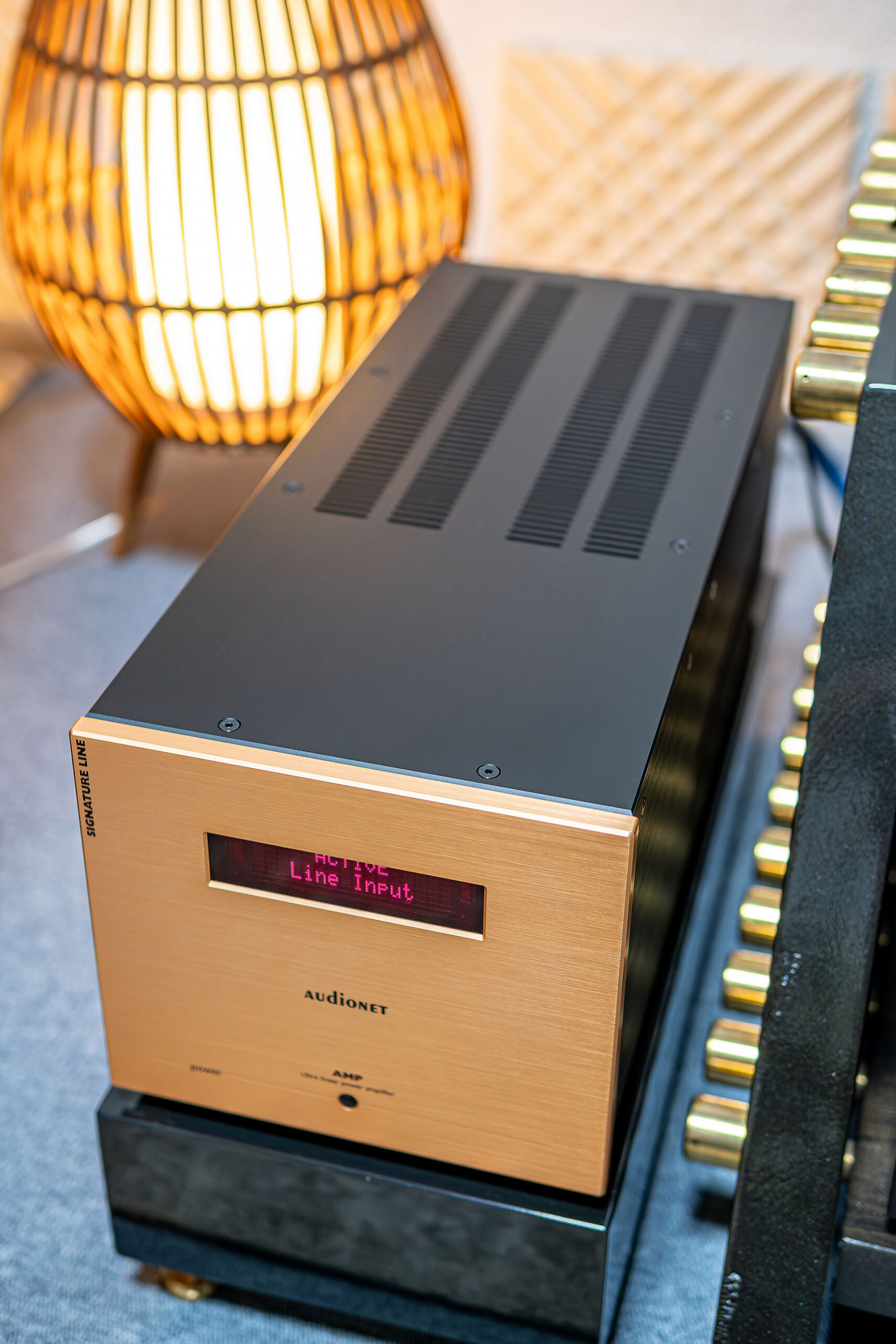
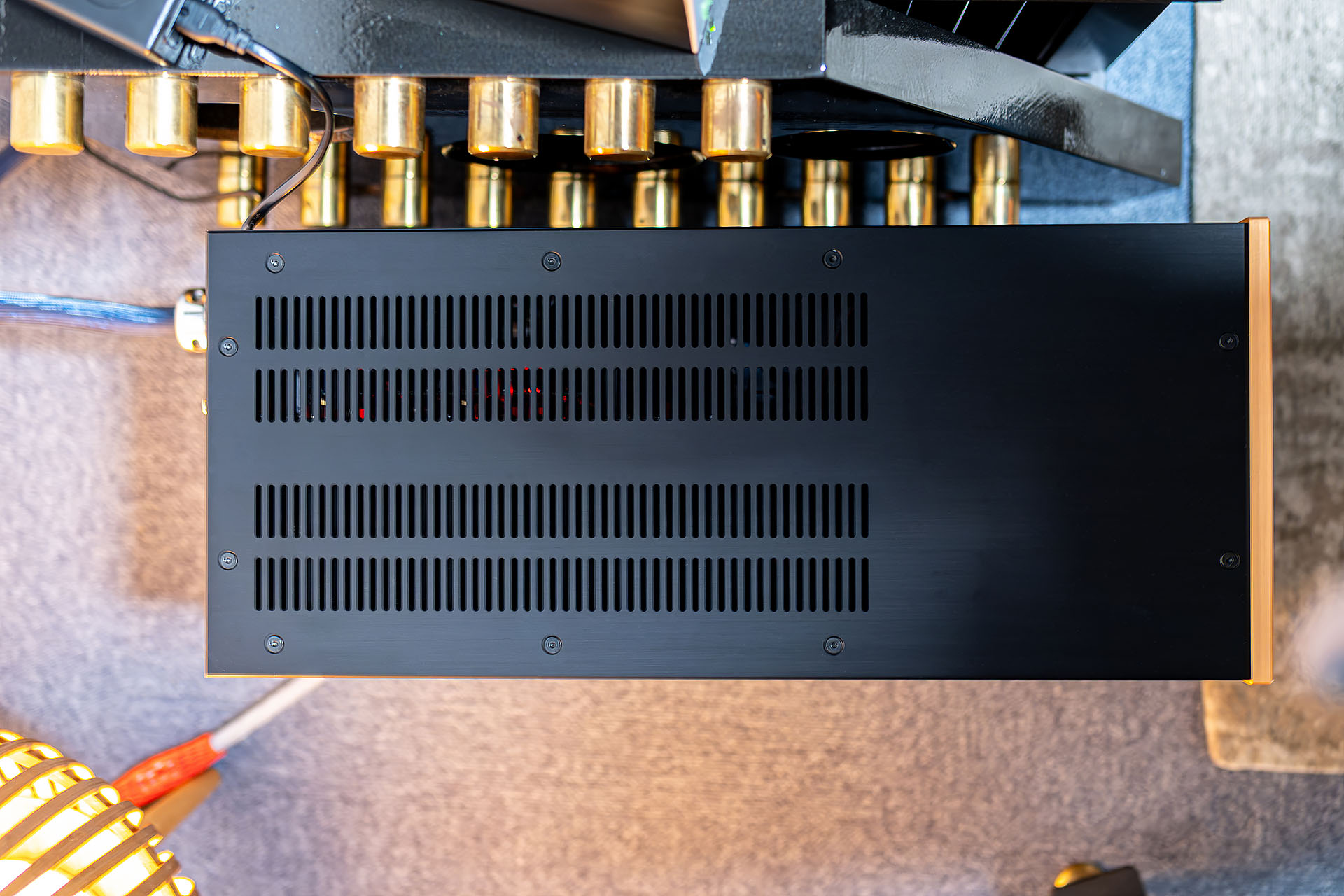
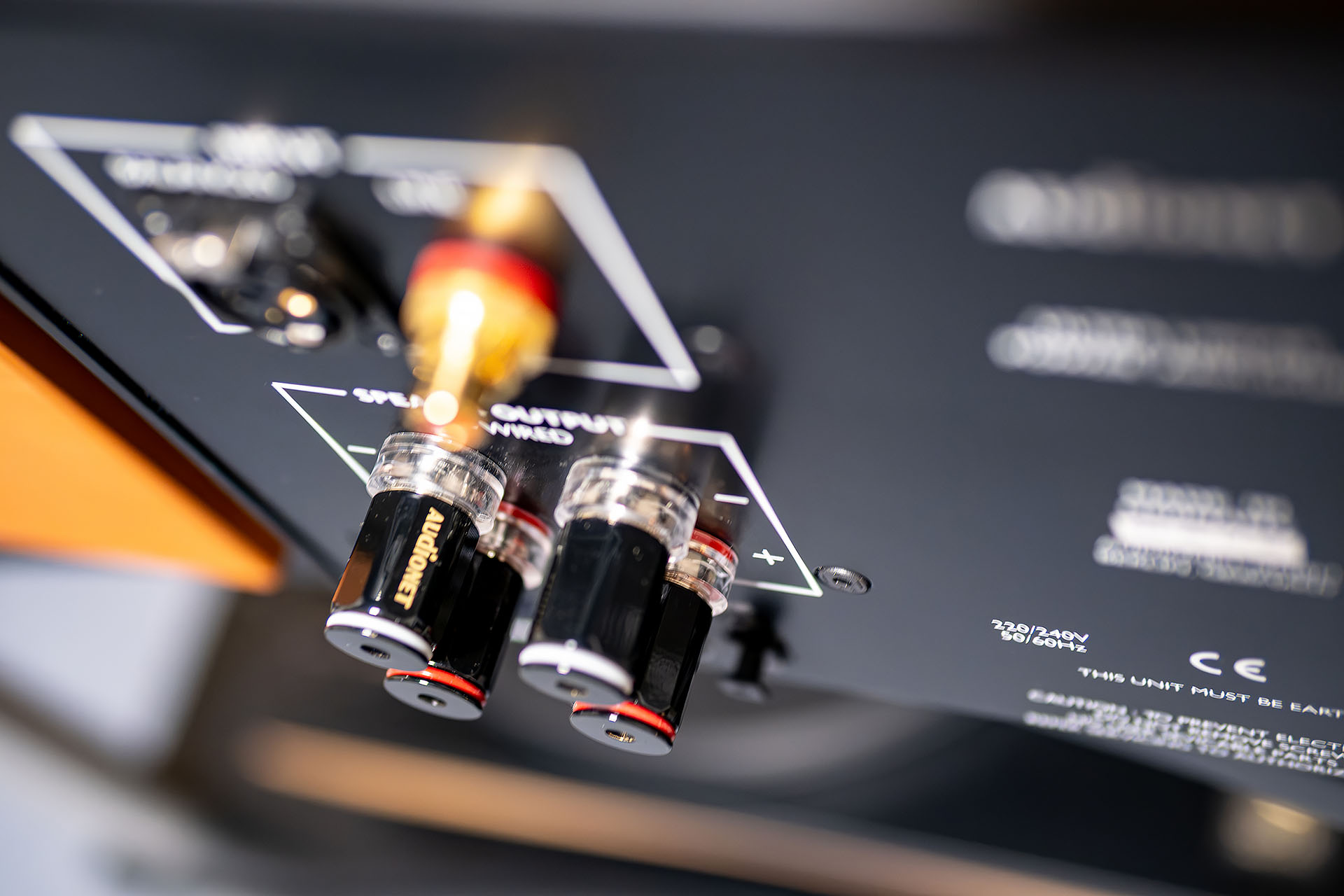
The signal path contains no sound-impairing components: no coils, no chokes, no relays in the signal path, no coupling capacitors. The amplifier is fully DC-coupled. The wiring is silver-gold alloy. The 47,000 µF filter capacitors are custom-manufactured to AudioNet’s specifications by a specialist facility in the United States. The high-audio-grade electrolytic capacitors with silk dielectric come from Japan. The low-loss mica capacitors are manufactured to order in India and China. The connector system throughout is Furutech, rhodium-plated speaker binding posts, gold-plated RCA connectors with Teflon insulation, and gold-plated XLR connectors. Every material decision in the signal path has been made based on listening tests, and in many cases, the components used are not standard catalog items but bespoke creations built to AudioNet’s tolerances.
The technical measurements that result from this architecture are, to put it simply, extraordinary. Signal-to-noise ratio exceeds 122 dB. Total harmonic distortion at 1 kHz is below -105 dB. The second harmonic at 25 watts into 4 ohms measures -117 dB; the third harmonic, -140 dB. Damping factor exceeds 10,000 at 100 Hz and 1,800 at 10 kHz, a grip on loudspeaker drivers that has no practical rival at this price point and very few at any price point. The frequency response extends from DC to 300,000 Hz at -3 dB. These are not numbers assembled for a specification sheet; they are the incidental byproducts of engineering done with the utmost seriousness of purpose.
Output power is 200 watts into 8 ohms, rising to 350 watts into 4 ohms, 550 watts into 2 ohms, and 750 watts into 1 ohm. This doubling and re-doubling of power into lower impedances tells you something important about the quality and stability of the power supply: it is not merely a paper specification. AudioNet’s AMP is genuinely capable of driving difficult, low-impedance loudspeaker loads with authority and without strain. A microprocessor unit continuously monitors all functions: DC leakage, high-frequency anomalies, temperature, and overload, and disconnects the amplifier from the mains in the event of any fault, with the nature of the fault displayed in plain language on the front panel. Remote activation is achieved through the Audionet-Link optical waveguide system, ensuring galvanic isolation. The company explicitly avoids 12V trigger connections to eliminate capacitive and electromagnetic effects on the signal chain.
The Signature Line: The Same, But Not Quite…
The AudioNet AMP has evolved across multiple generations, from the AMP II G2, which established the formula, through the current AMP, which refines and elevates it, while preserving a visual identity so consistent that only those who know the product well can distinguish generations on appearance alone. This deliberate continuity is itself a design statement. AudioNet is not in the business of cosmetic refreshes. The architecture, the topology, the underlying engineering doctrine, these do not change because a season has passed. They change when the engineering team finds something genuinely better.
The Signature line represents AudioNet’s most rigorous expression of that doctrine. Where the standard AMP represents a fully resolved and exceptional amplifier, the Signature edition applies a level of component selection, matching, and quality escalation that the standard manufacturing process does not require. Every sound-critical component is re-measured, re-evaluated, and matched during assembly. The listening tests that precede a Signature release are not a final quality check; they are a refinement process conducted by ears trained to detect differences that no test instrument can currently quantify. The result is not a different amplifier; the circuit, topology, and ULA technology remain identical, but it is a more fully realized version of the same amplifier. The Signature edition is what the AMP sounds like when every component in it is performing at its theoretical best.
This approach of refining more than replacing reflects a broader philosophy within the company. AudioNet’s clients are not asked to sell their existing components when a new generation arrives. The upgrade path exists; it is clearly defined, and it represents not a commercial strategy but a genuine commitment to the long-term value of serious engineering. A product built to these tolerances, maintained and optionally upgraded, does not become obsolete. It matures.
The AudioNet Sound Philosophy: What Silence Contains
There is a philosophical position at the heart of AudioNet’s approach to amplification that takes some time to fully understand, and more time to fully appreciate. It is the position that the ideal amplifier has no sound of its own. Not a neutral sound, not a flat sound, not a transparent sound in the usual audiophile sense — no sound. The amplifier should not contribute; it should transmit. Whatever the source provides should arrive at the loudspeakers unchanged in character, unmolested by the electronics between them.
This sounds, in isolation, like the description of a cold machine. In practice, it is the opposite. When an amplifier truly ceases to impose its own character on the signal, when the noise floor is low enough to reveal the innermost layers of a recording, when the distortion is so vanishingly small that the harmonic structure of instruments arrives at the listener’s ears as the recording captured it, the experience is not one of clinical detachment. It is one of startling intimacy. The music suddenly sounds more like itself. It sounds more like what a real musician produced in a real acoustic space. The apparent paradox of how removing the machine’s voice reveals more humanity in the music resolves immediately on first listening. Do not get me wrong… many have started on this path, but very few actually escaped the soulless, sterile, dead, cold presence of the “best measuring” circuits. These observations are based solely on how AudioNet sounds and are far from a recipe for success when following this approach. There are so many failures in the modern, never-ending line of products, especially those coming from Asia today, that have only the perfect-measurement argument, which is futile to think about…
This is the AudioNet doctrine, and it sets the company apart from a substantial portion of the high-end amplifier market, which tends to view some degree of sonic character, warmth, air, and a particular way with transients as desirable qualities. AudioNet engineers regard such colorations as polite forms of distortion. They do not regard distortion as desirable in any degree or form. They regard it as an engineering failure, however pleasant it may momentarily sound. The goal is always perfect transmission.
And yet, when the instrument is perfectly calibrated, the music it transmits contains all the warmth, all the texture, all the harmonic richness that inferior components seem to be adding. They are not adding it. They are masking their absence by substituting their own coloration. AudioNet removes the mask and reveals that the warmth was always there, waiting in the recording, needing only an amplifier quiet enough to let it speak.
How Does It Sound? Musical Testimony
The Foundation: Control and Silence
The first thing one genuinely notices, as a physical sensation instead of an analytical observation, is the noise floor. Or the absence of one. The AMP Signature is so quiet that the silence in a recording is, in fact, silence. Not a low-level hiss shaped like silence. Not a faint electrical presence against which music emerges. Silence. This is the prerequisite for everything that follows, because it is only against a truly black background that the finest gradations of musical information become audible, the breath before a phrase, the room around a piano, the decay of a cymbal into nothing. These details exist in the recordings. The AMP simply does not bury them.
The bass register is the most immediately dramatic demonstration of what the damping factor above 10,000 at 100 Hz actually means in musical terms. The AMP does not produce warm, powerful, or impressive bass. It produces accurate bass, which is to say, it produces exactly what the loudspeaker driver would produce if the electrical signal arriving at its terminals were a perfect copy of the source signal, and if the driver’s back-EMF were being returned into an output impedance so low as to be effectively zero. Bass lines have shape. They have a pitch. The fundamentals of a double bass and the overtones above it are individually legible. The attack of a kick drum and its following decay are two separate events, not one blurred impact. This is what total control sounds like, and once heard, the alternative, the slightly padded, slightly undefined low end that most solid-state amplifiers produce, sounds like the compromise it always was.

“Kind of Blue” — Miles Davis (Columbia Records, 1959). An album so familiar that it risks becoming invisible, heard through equipment one has lived with for years. Through the AMP Signature, it is not invisible. Paul Chambers’s bass on “So What” has wood, genuine resonance of a wooden cabinet, the tension and mass of gut strings, the exact pressure of his fingers on the neck. The note does not simply start and sustain; it blooms from an attack, and within that bloom, there is a universe of harmonic information that cheaper amplification compresses into a single, undifferentiated event. Bill Evans’s piano, to the left of the stereo image, has the particular tonal weight of a Steinway played by someone who uses the instrument as a vehicle for thought. The keys he does not play are as present as the ones he does. The AMP conveys this. The silence between notes has a quality.
The Midrange: A Warmth That Was Always There
The midrange of the AMP Signature is where the deepest surprise resides. This is a fully solid-state amplifier, MOSFET output devices, bipolar transistor architecture in the driver stage, no tube of any kind, and yet experienced listeners who have spent years with fine valve amplification will find themselves hesitating before reaching for that description. The harmonic structure of voices and instruments through the AMP is not the harmonic structure of typical solid-state amplification. It is more complete. The even-order harmonics that contribute to what we perceive as warmth, body, and tonal naturalness are not present because the AMP has added them; they are present because the AMP has not removed them. The ULA circuit, with its vanishingly low distortion and its avoidance of global negative feedback in the output stage, preserves the harmonic architecture of the signal with a completeness that most amplifiers, solid-state and tube alike, do not match.

“Graceland” — Paul Simon (Warner Bros. Records, 1986). The opening notes of “The Boy in the Bubble” arrive with a clarity that feels almost physical. The accordion, an instrument that solid-state amplification often renders as either too harsh or too soft, has its full tonal complexity intact: the reedy fundamental, the sharp attack of the bellows, the particular mid-frequency density that gives the instrument its character. Simon’s voice occupies a specific space in the room, not projected from the speakers but apparently present between them, at a height and depth that corresponds to something more like a human being standing in the room than a sound source in a box. The Ladysmith Black Mambazo vocals, recorded in South Africa with a different acoustic signature than the American overdubs, do not blend into a homogeneous texture; they retain their individual character, their different resonances and timbres, their spatial signatures. The AMP does not create this. It simply does not destroy it.

“Trio” — Keith Jarrett, Gary Peacock, Jack DeJohnette (ECM Records, 1983). Jarrett’s piano, recorded by ECM with their characteristic spaciousness and detail, becomes through the AMP Signature a lesson in what midrange resolution actually means. Each chord has a specific voicing, not just the notes, but the relative balance between them, the way the sustain pedal changes the harmonic interaction of the strings, the room around the instrument that exists in the recording. DeJohnette’s brushes on the snare are not a shimmer; they are individual impacts on an individual surface, with texture and direction. Peacock’s bass intonation, his ability to find the exact center of a pitch, is not an abstract quality but a physical sensation. These are not attributes of the recording that the AMP is drawing attention to. They are attributes of the recording that the AMP is not concealing.
Coherence, Scale, and the Sense of Event
Perhaps the most striking quality of the AMP Signature, the one that separates it most completely from similarly specified solid-state amplifiers at comparable or higher price points, is what might be called its coherence across the dynamic spectrum. Most powerful amplifiers excel at one end of the dynamic range or the other: they hit hard when the music demands, or they resolve quietly when it whispers, but rarely do both with equal authority and without a perceptible change in character between the two modes. The AMP makes no such concession. The transition from pianissimo to fortissimo and back again is utterly seamless. The character of the amplifier does not change with the demand placed on it. The quiet passages have the same tonal completeness as the loud ones; the loud passages have the same resolution and delicacy as the quiet ones.
“Verdi: La Traviata” — Angela Gheorghiu, Frank Lopardo, Leo Nucci, Orchestra of the Royal Opera House, Covent Garden, Chorus of the Royal Opera House, Covent Garden, Sir Georg Solti (Decca). When the full orchestra enters after a quiet passage, the strings building toward a climax, the brass entering beneath them, the percussion marking the arrival of the fortissimo, the AMP does not simply get louder. The space in the room fills differently. The orchestra occupies a physical volume that the quieter passages do not require. This is the consequence of dynamic linearity at the amplifier level: the system’s ability to scale with the music, to expand and contract in proportion to the demands of the performance, without any sense of mechanical effort or compression. Sutherland’s soprano, recorded when her voice was at its peak of power and control, arrives with a completeness of tonal color that makes the experience genuinely affecting. The AMP is not presenting a reproduction of this performance. It is presenting the recording of this performance with such fidelity that the distinction between the two things temporarily collapses.
Value, Position, and What the Market Offers
The AudioNet AMP in its standard configuration represents one of the most serious overachievements at its price point in the high-end amplifier market. The Signature version, with its additional layer of component selection, individual matching, and extended listening evaluation during manufacture, commands a premium that is immediately understandable once the product is heard in context. At approximately €17,000 per pair, depending on configuration and market, the AMP Signature enters a competitive bracket that includes genuinely excellent solid-state amplifiers from Pass Labs, Bryston, and Parasound‘s higher-end offerings, as well as exceptional hybrid designs from companies including Aesthetix. Against these alternatives, the AMP Signature distinguishes itself primarily in two respects: its technical architecture, which delivers measurement performance that most, but not all, competitors cannot match, and the resulting sonic character, which does not sound like a typical solid-state amplifier at any price.
It is worth positioning the AMP clearly within the AudioNet range itself. Above it sits the MAX — a larger, more powerful, significantly more expensive monoblock that represents a step change in capability for those whose loudspeakers or rooms demand it. Further above sits the Heisenberg, the company’s flagship statement amplifier, which operates in an entirely different financial environment. The AMP is the entry point to what AudioNet considers serious amplification, and that entry point is genuinely serious. There is no sense of looking to the AMP Signature that one is at the bottom of a hierarchy. One is at the beginning of a doctrine. The doctrine is consistent, the values are identical, and the execution at this level is complete.
The company’s commitment to long-term ownership is worth noting explicitly. AudioNet does not refresh its product lines cosmetically. The upgrade path from standard to Signature exists and is serviced by the factory. A pair of AMP monoblocks purchased today represents not a commitment to a product that will be rendered obsolete in two years but an investment in an engineering philosophy that the company has been refining for three decades. In a market full of manufacturers who treat their own previous products as competitors to be displaced, this is genuinely unusual. It is also genuinely valuable for a serious listener assembling a long-term system.
What Is Spectacular About the AudioNet AMP
It is tempting, at the end of a review like this, to reach for the language of superlatives. The AMP Signature invites superlatives. But it also, paradoxically, resists the most conventional ones, the ones about power, the ones about scale, the ones about drama. Because what is most spectacular about the AMP Signature is not dramatic at all. It is quiet.
The noise floor of this amplifier is so low that recordings reveal themselves differently. Material that has been played hundreds of times on other equipment, familiar albums, beloved performances, reveals details that were always there in the recording, submerged beneath the noise and distortion of less-accomplished electronics. This is not a figure of speech. It is a physical reality: information that exists in the recording, that the microphone captured, that the mastering engineer preserved, that digital or analog storage has faithfully encoded, arrives at the listener’s ears for the first time. This is what a noise floor below -122 dB actually means for the musical experience.
What is really interesting is the bass — not its power or its impact, but its accuracy. The AMP’s extraordinary damping factor gives it a grip on loudspeaker drivers that translates directly into bass lines with pitch, shape, and identity. Bass instruments sound like themselves. Acoustic double basses sound different from electric basses. Kick drums have a specific density that corresponds to the drum being played. Upright piano bass strings have a different harmonic character from a baby grand. These distinctions exist in the recordings; the AMP does not erase them in the service of a generalized impression of authority.
What is spectacular is the midrange — its refusal, despite being produced by solid-state circuitry, to sound mechanical or clinical. The harmonic completeness preserved by the ULA topology results in voices and instruments with body, warmth, and individuality. Listeners who have spent years with the finest tube amplification will find in the AMP Signature something that tube equipment has always claimed as its exclusive territory: the sense that the music is not being processed but transmitted. The electronics have stepped aside. What is playing is the recording, not a machine’s interpretation of the recording.
What is outstanding, above everything, is what Stefan Schwehr said to me in Munich: that the perfect amplifier sounds like nothing. The AMP Signature has come closer to that standard than any amplifier at its price point I have encountered. And in coming that close to sounding like nothing, it has achieved something remarkable. It sounds like music.
And that is why we are confident to pass our great distinction to AudioNet AMP — Signature Line Monoblock Amplifier: the Highly Impressive Sound News Award!

Reference System Used for This Evaluation
Digital source: Antipodes Oladra server/streamer/reclocker. DAC and line preamplifier: LampizatOr Poseidon. Amplification: AudioNet AMP Signature monoblocks (review units). Loudspeakers: Raidho TD 2.2. Interconnects: Albedo Monolith Reference. Speaker cables: Crystal Monet. Power conditioning: Tsakiridis dedicated circuits. Equipment support: Woodyard HiFi Racks.
Technical Specifications — AudioNet AMP
- Output power: 200 W / 8 Ω | 350 W / 4 Ω | 550 W / 2 Ω | 750 W / 1 Ω
- Frequency response: 0 – 300,000 Hz (–3 dB)
- SNR: > 122 dB
- THD + N: < –105 dB at 1 kHz, 35 W / 2 Ω
- Harmonic spectrum: k2 typ. –117 dB, k3 typ. –140 dB (25 W / 4 Ω)
- Damping factor: > 10,000 @ 100 Hz | > 1,800 @ 10 kHz
- Filtering capacity: 188,000 µF total (2 × 82,000 µF + input stage)
- Mains transformer: 850 VA toroid (output stage) + 80 VA toroid (input stage)
- Input impedance: RCA: 37 kΩ | XLR: 3 kΩ
- Inputs: 1 × Furutech RCA (gold/Teflon) | 1 × XLR balanced (gold)
- Outputs: 2 pairs Furutech 4 mm binding posts (rhodium-plated)
- Dimensions: 215 mm W × 190 mm H × 500 mm D (per monoblock)
- Weight: 22 kg per monoblock
- Finish: Brushed anodized aluminum, black or silver (Copper in Signature Line version); display blue or red
Our sincere thanks to the AudioNet team and to the local distributor Eaudio.ro, who made this evaluation possible. You can learn more about AudioNet and the AMP Signature at en.audionet.de and on the E-audio website.