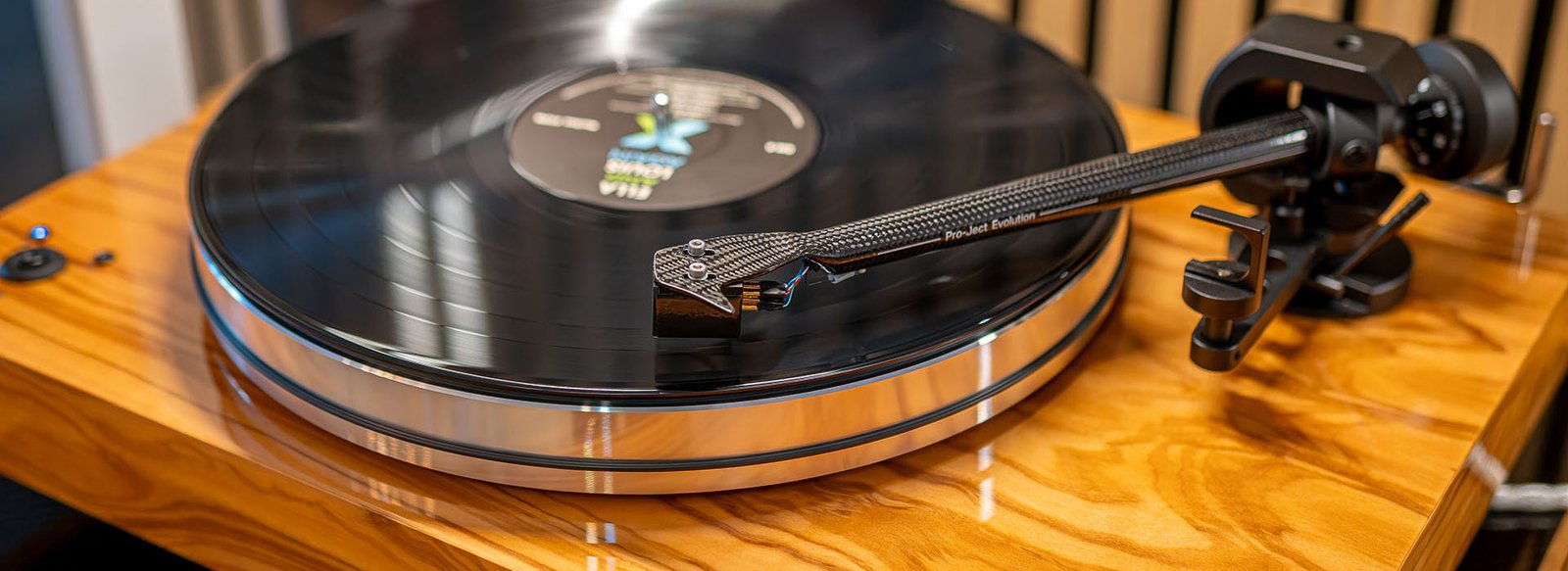
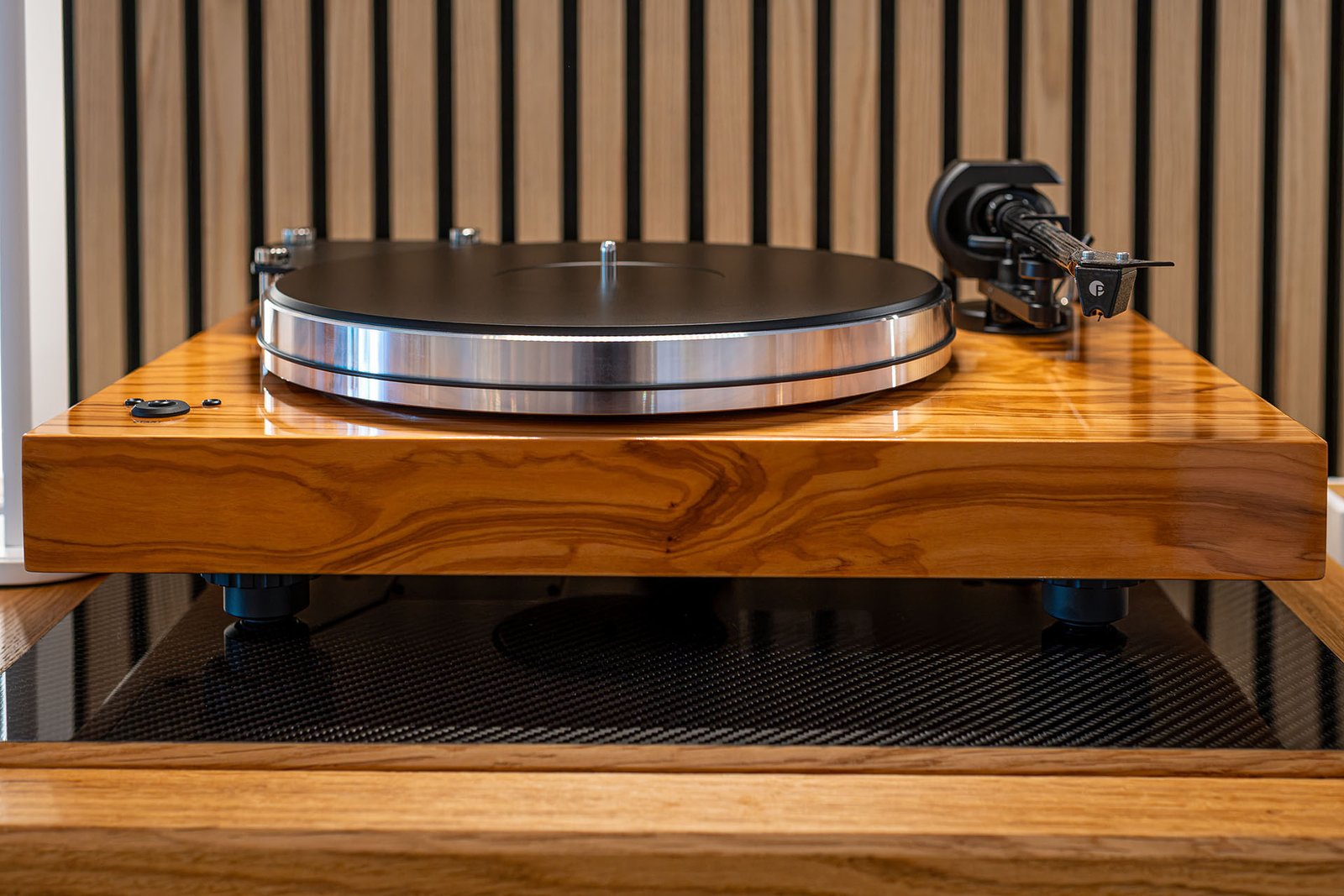
EVO 9 CC Black tonearm · Pick it DS2 MC cartridge · Olive finish
The Elegant Denial of Audiophile Madness
There is a particular kind of madness that lives in our hobby, and we all know it intimately, even if we rarely say its name out loud. It is the madness of the decimal point that keeps sliding to the right. A cartridge for four thousand euros. A tonearm for nine. A phono cable that costs more than a decent used car. A turntable that requires two strong men, a structural engineer, and a second mortgage. We have normalized this madness so thoroughly that when something refuses to play by its rules, our first instinct is suspicion rather than joy. Surely, we whisper, it must be cutting corners somewhere. Surely the physics of good analog sound cannot be bought for the price of a single premium moving coil cartridge.
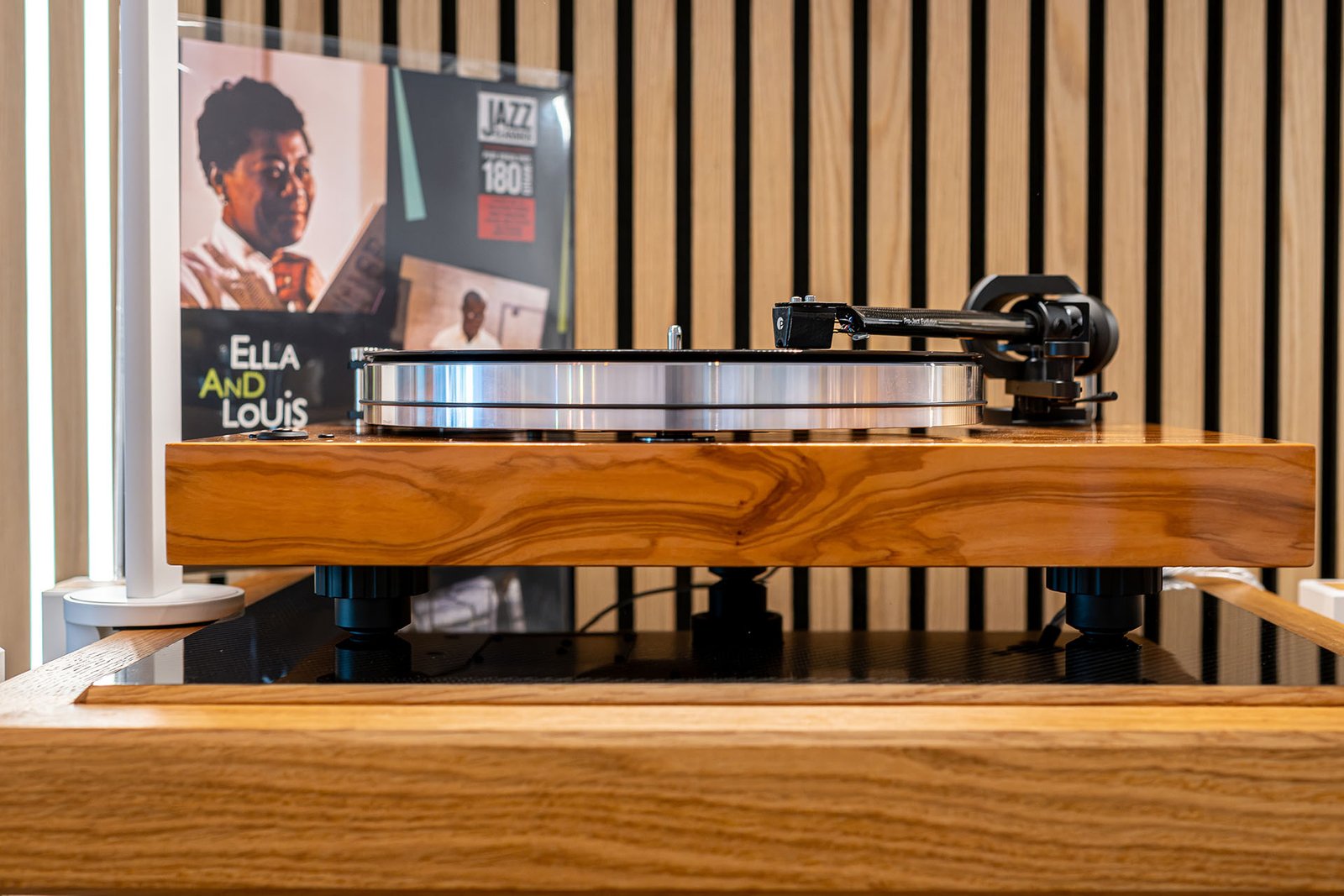
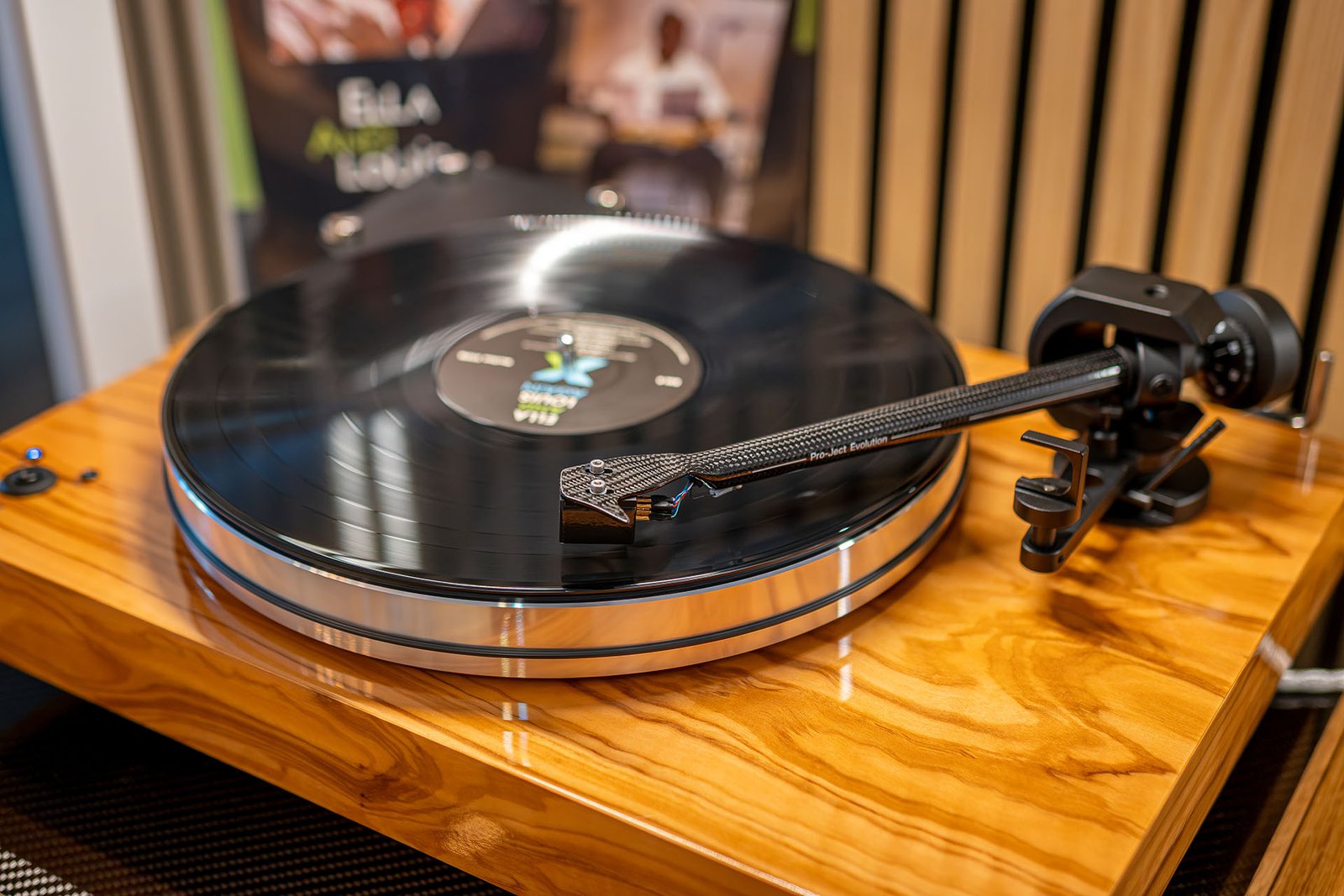
And yet, here it sits on my rack, in its olive wood dress, quietly committing heresy. The Pro-Ject Xtension 9 Evolution is a premium, high-mass, belt-driven turntable, a proper heavyweight married with serious vibration isolation and a magnetic floating principle built into its very feet, a machine that literally levitates above the shelf it stands on. It arrives fully equipped, with a genuinely excellent carbon fiber tonearm, the EVO 9 CC Black, already mounted, wired, and calibrated, and with a true moving coil cartridge, the Pick it DS2 MC, already aligned in the headshell. Everything is there. And the whole package, the complete analog front end, ready to sing within thirty minutes of opening the box, costs less than the high-end cartridge that normally lives on my reference tonearm.
Read that sentence again, slowly, because it is the entire philosophical scandal of this review. A complete high-end turntable system, plinth, motor, platter, bearing, arm, and a superior MC cartridge included, priced below a single premium transducer. Does such a thing have the right to sound this good? Does it have the right to exist at all, in a market that has taught us to equate emotion with expenditure? For a month, I lived with this question spinning at thirty-three and a third revolutions per minute in my listening room, and the answer it kept whispering back to me was equal parts humbling and liberating.
Because if a turntable at this price can deliver this much music, then the madness was never mandatory. It was always a choice.
TL; DR – The Short Conclusion
For those of you who read conclusions first, and I know you are many, here it is, distilled. The Xtension 9 Evolution is one of the most complete and most honest analog packages I have encountered anywhere near its price. Its greatest achievement is the deck’s ‘black’ background, largely free of groove noise, allowing micro-details and complex orchestral passages to shine through clearly. It bridges the gap between the “mass-loaded” and “floating” turntable principles, resulting in a rich, punchy, and highly resolving sonic signature.
The steel-pellet-loaded plinth provides the calm authority of a mass-loaded design, while the three opposing-magnet feet lend it the airy, decoupled grace of a suspended one. The EVO 9 CC Black tonearm tracks with quiet confidence, and the Pick it DS2 MC cartridge, built by Ortofon to Pro-Ject’s own recipe, delivers a warm, dynamic, surprisingly good performance that makes the bundled price feel almost like a clerical error. No, it does not dethrone my ten-times-more-expensive reference. It was never supposed to. What it does is far more subversive: it makes you question, seriously and repeatedly, how much of the high-end price ladder is physics, and how much is theater.
The Austrian Who Refused to Let Vinyl Die – A Short History of Pro-Ject
Every great audio brand has a founding myth, but few of them are as stubborn or as beautifully contrarian as Pro-Ject’s. Rewind to the beginning of the 1990s. The compact disc had won. The industry had declared the vinyl record officially dead, a nostalgic relic destined for flea markets and grandparents’ attics. Turntable production lines across Europe were being dismantled, tooling was being scrapped, and decades of accumulated mechanical knowledge were evaporating into thin air. This was the moment, of all moments, that a young Viennese audio enthusiast and distributor named Heinz Lichtenegger chose to found a turntable company.
Think about the sheer audacity of that decision. In 1991, betting on vinyl was not brave; it was considered commercially insane. But Lichtenegger had a conviction that bordered on faith: that analog playback was not a format war casualty but a musical truth, and that if turntables could be made affordable, honest, and genuinely good, people would keep buying records. He found his manufacturing home in a former Tesla electronics factory in Litovel, in what is today the Czech Republic, a facility with skilled hands, real tooling, and a workforce that still remembered how precision mechanical products were built. There, the first Pro-Ject turntable was born, a simple, sensible, belt-driven machine that did nothing exotic and everything right.
What happened over the following three decades reads like a quiet revolution. While the big Japanese corporations abandoned analog and the boutique high-end retreated into five-figure exotica, Pro-Ject occupied the vast, neglected middle ground and cultivated it with almost agricultural patience. The Debut series became, without exaggeration, the gateway drug of the entire vinyl revival, the first serious turntable for millions of listeners worldwide. When the format’s renaissance finally arrived in the 2010s, it did not find an industry ready to serve it. It found Pro-Ject, already there, already tooled up, already building more turntables than anyone else on the planet.
But reducing this company to “the affordable brand” would be a lazy injustice, and this is precisely where the Xtension story begins. Over the years, the Litovel workshops and the Viennese engineering team accumulated genuine high-end expertise: mass-loaded plinths with internal gravity cores, inverted ceramic bearings, magnetically supported platters, carbon fiber tonearm technology, sophisticated motor control electronics, and most recently, the democratization of true balanced phono connection, a topology the professional world has treated as gospel for decades and which Pro-Ject brought to real-world price points. The Xtension 9 Evolution is where all of this accumulated knowledge condenses into a single, slim, deceptively elegant machine. It is not an entry-level product from an entry-level company. It is a statement from a company that saved a format, built on thirty-five years of doing one thing with obsessive consistency: making the groove speak.
An Object of Quiet Luxury – The Olive Finish
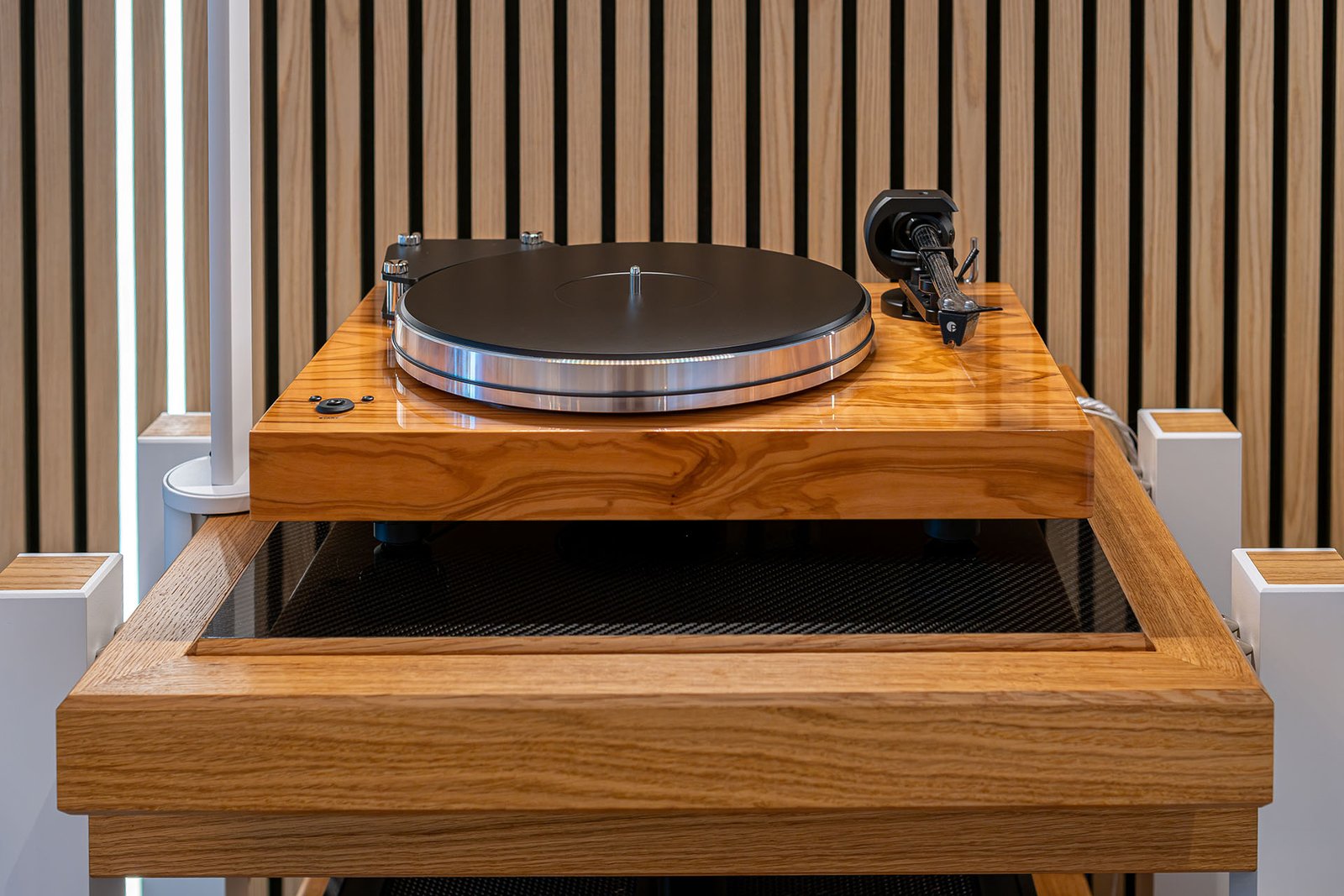
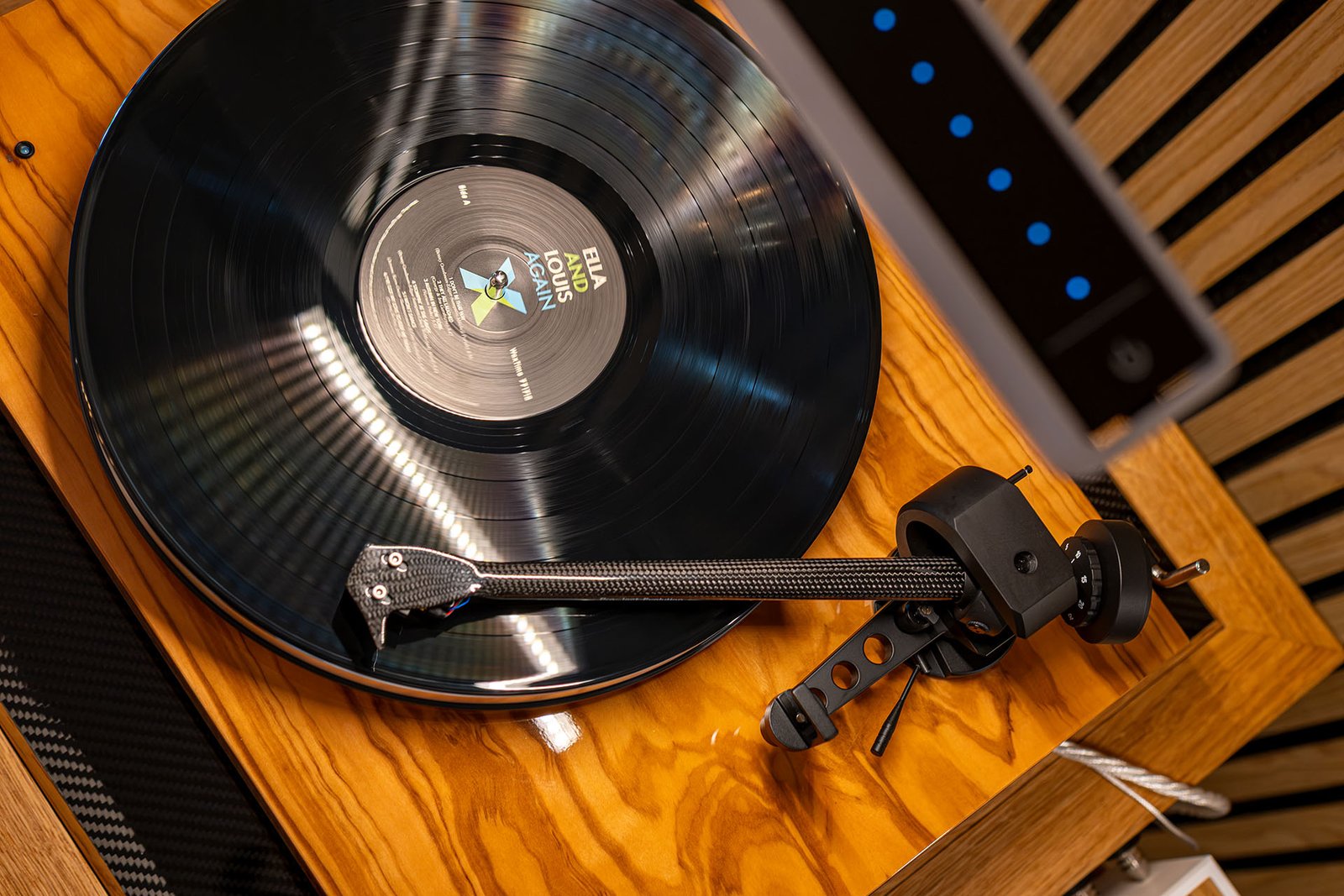
Some audio components demand attention. They bristle with towers, outboard pods, dangling counterweights, and acrylic bravado, shouting their price across the room. The Xtension 9 Evolution does the opposite, and I fell for it almost embarrassingly fast. It whispers. The proportions are slim and low, almost architectural, a clean rectangular plinth with softly radiused edges that carries its sixteen kilograms with the discretion of a tailored suit. And then there is the finish. My review sample arrived in olive wood, and I will confess that I spent the first evening not listening, just looking.
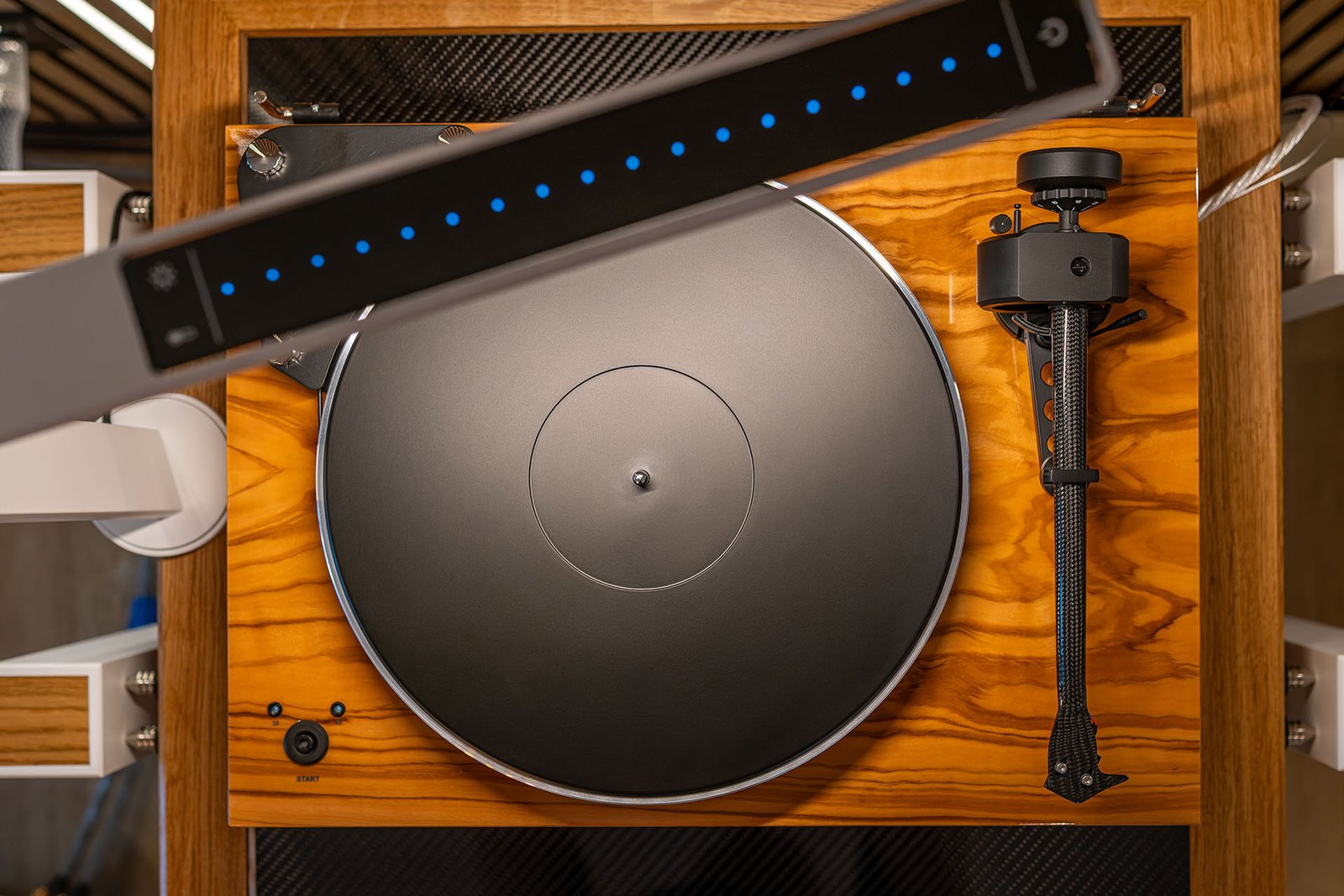
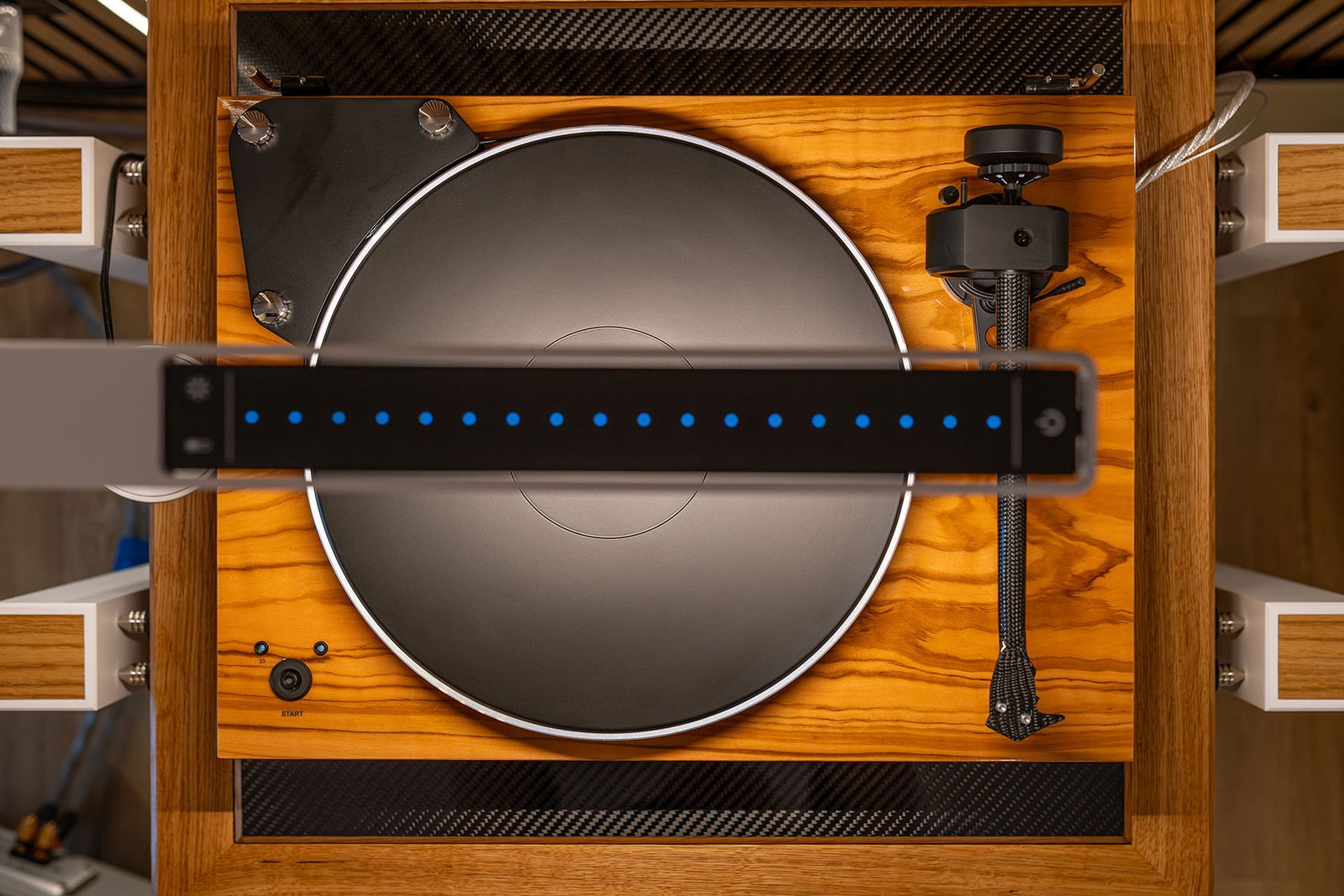
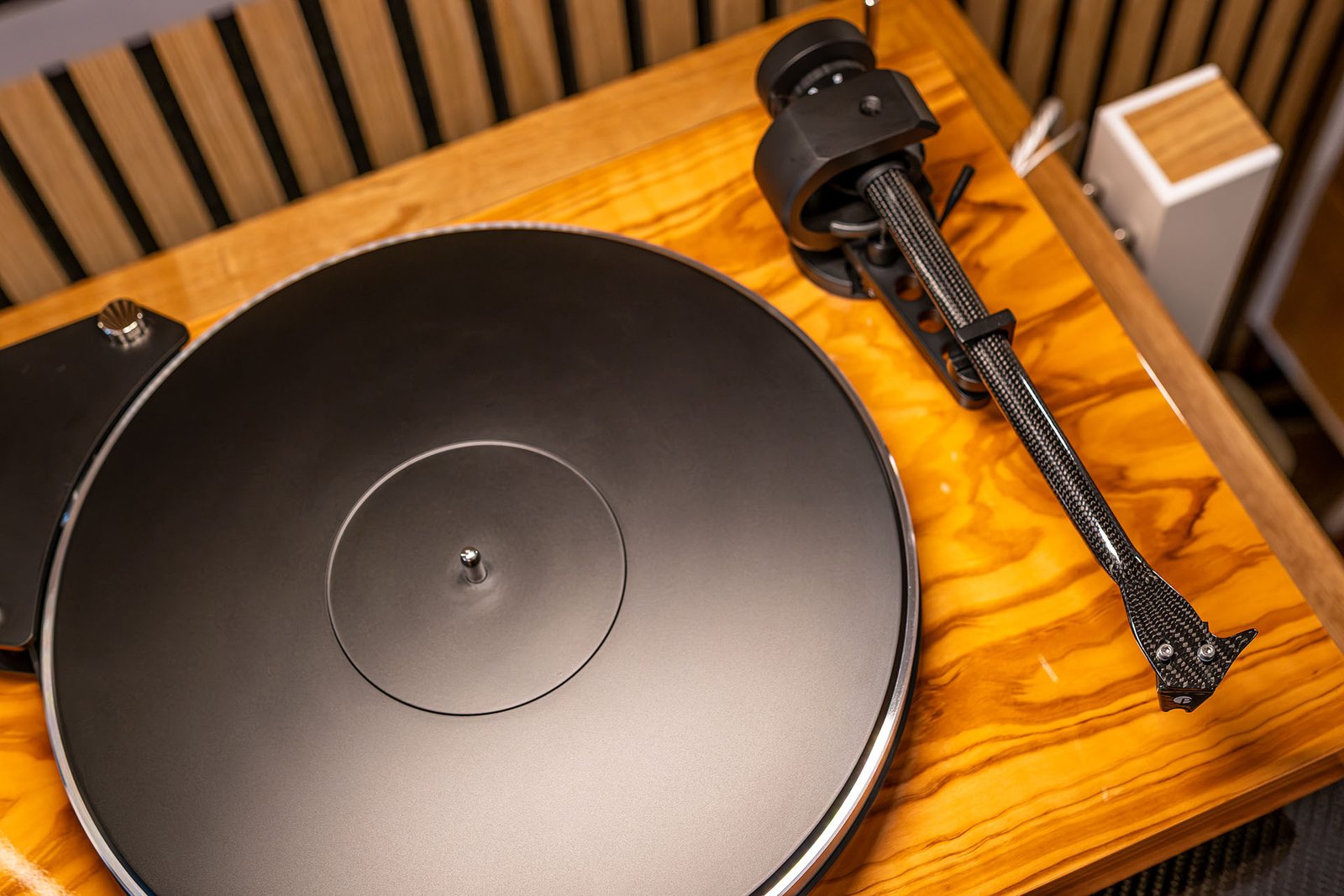
Olive is not a veneer you see often in audio, and that is a genuine shame, because it might be the most musical wood I have ever laid eyes on. The grain does not run, it flows, in warm rivers of honey, caramel, and smoked gray, with darker veins that swirl like slow currents in a Mediterranean harbor. Under the evening light of my listening room, the surface seemed to shift and breathe, revealing new patterns each time I walked past it. There is something deeply appropriate about it too: the olive tree is one of humanity’s oldest companions, a symbol of patience, longevity, and peace, a tree that takes decades to mature and then lives for centuries. A fitting skin for a machine built to celebrate a format that also refused to die. Paired with the deep black of the platter, the puck, and the EVO 9 CC Black tonearm, the aesthetic result is one of restrained Mediterranean luxury, more Tuscan villa than laboratory, and it made my listening room feel warmer just by standing in it.
Beneath the beauty, the engineering is anything but decorative. The plinth is CNC-machined from ultra-dense MDF, chosen for its natural resonance absorption, and here comes the first clever trick: inside the chassis, Pro-Ject has created internal cavities filled with steel pellets, a “central gravity point” that draws vibrational energy toward the center of the plinth and disperses it through thousands of tiny, chaotic pellet-to-pellet contacts. A solid metal block would store energy and ring; a bed of loose pellets swallows it.
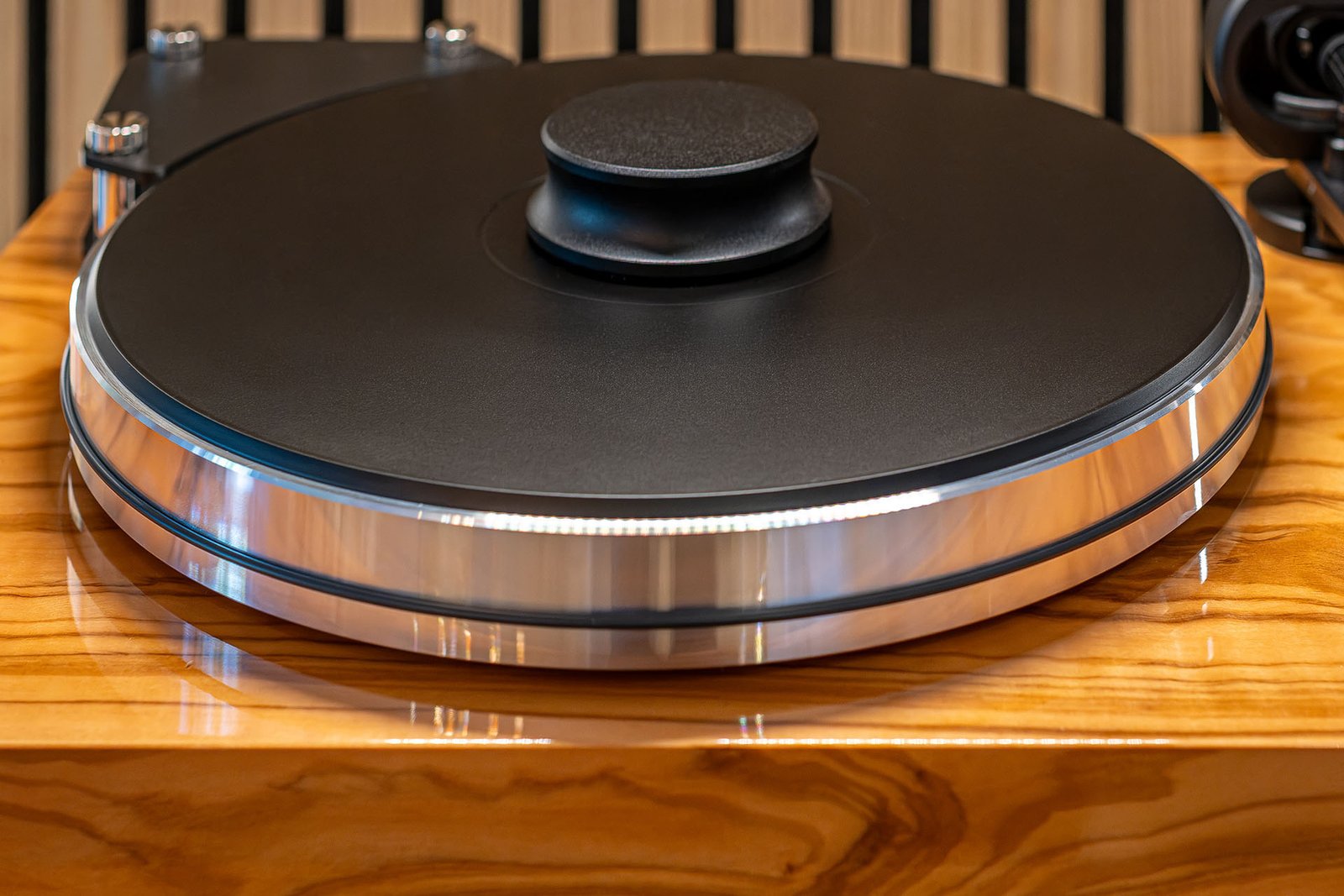
The platter continues the sandwich philosophy. Instead of a plain aluminum disc, Pro-Ject uses a precision-balanced alloy platter with a thermoplastic elastomer damping ring embedded inside, and, in a touch I find both ecological and poetic, a top layer made of recycled vinyl records, bonded and baked onto the surface. Your record, therefore, rests on the material it understands best, vinyl on vinyl, coupled firmly by the included record puck.
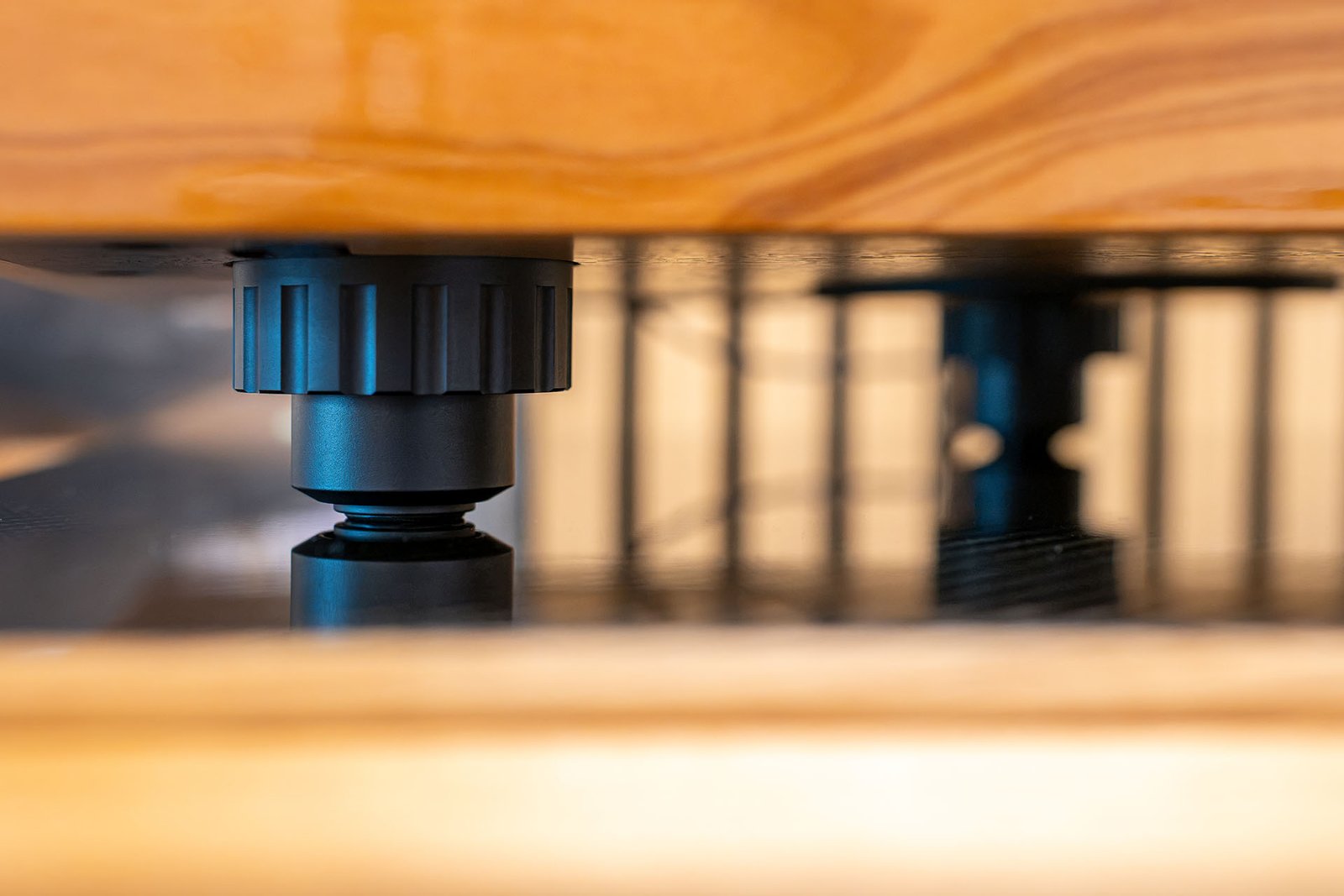
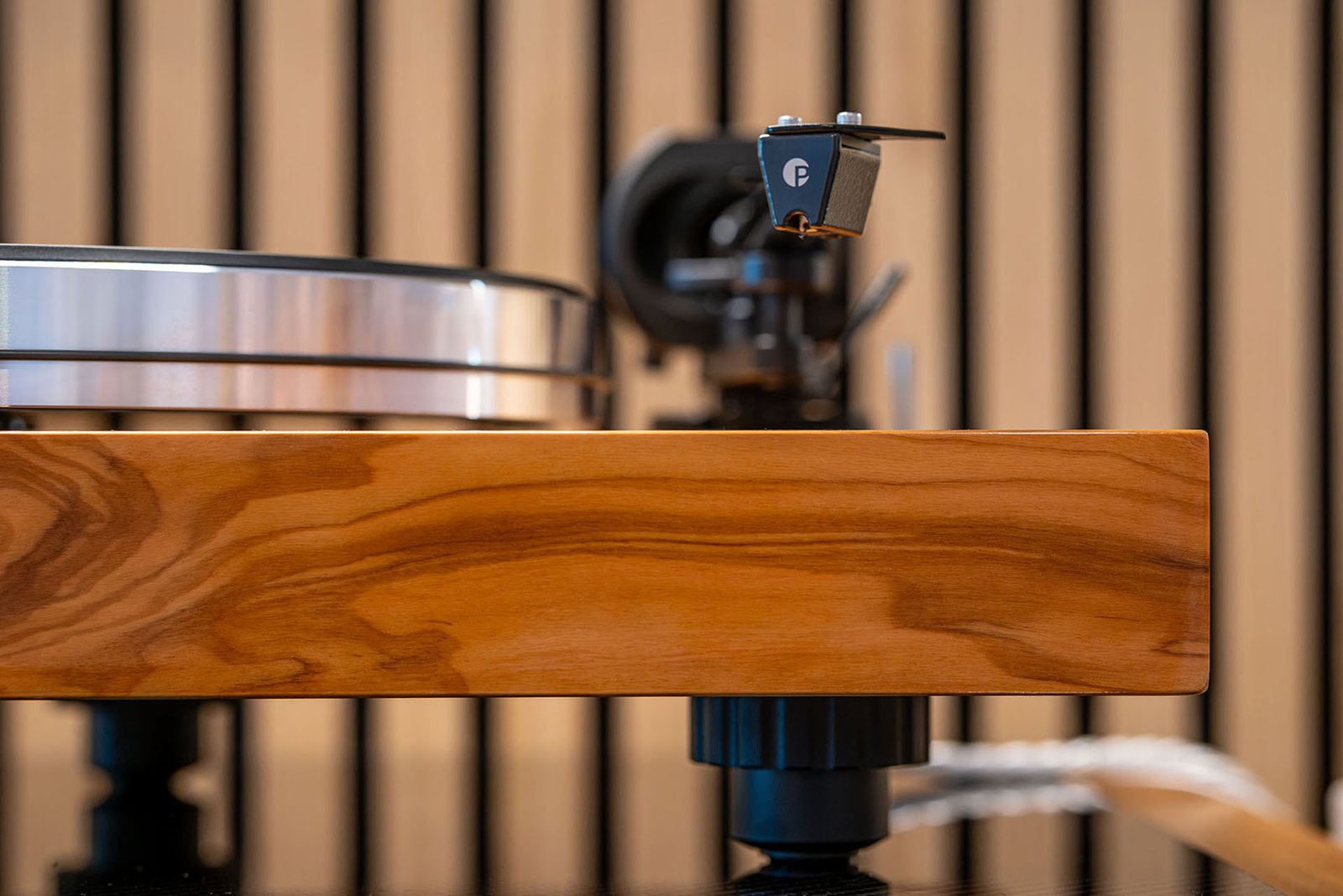
Then, the two magnetic miracles. The platter spins on an inverted ceramic ball bearing, a hard, polished ceramic sphere meeting a precision plate, and the entire rotating mass is partially levitated by an opposing magnetic support that relieves the bearing of most of its vertical load. Less pressure means less friction, less friction means less rumble, and less rumble means blacker silence between the notes. The same principle reappears at the interface with the outside world: three powerful opposing-magnet feet decouple the whole turntable from the shelf beneath it. Press down on the plinth, and it yields softly, floating on invisible cushions. This is the design’s central thesis made physical: the calm of a mass-loaded deck, married to the isolation of a floating one, without the fussy springs and pendulum wobble of classic suspended designs.
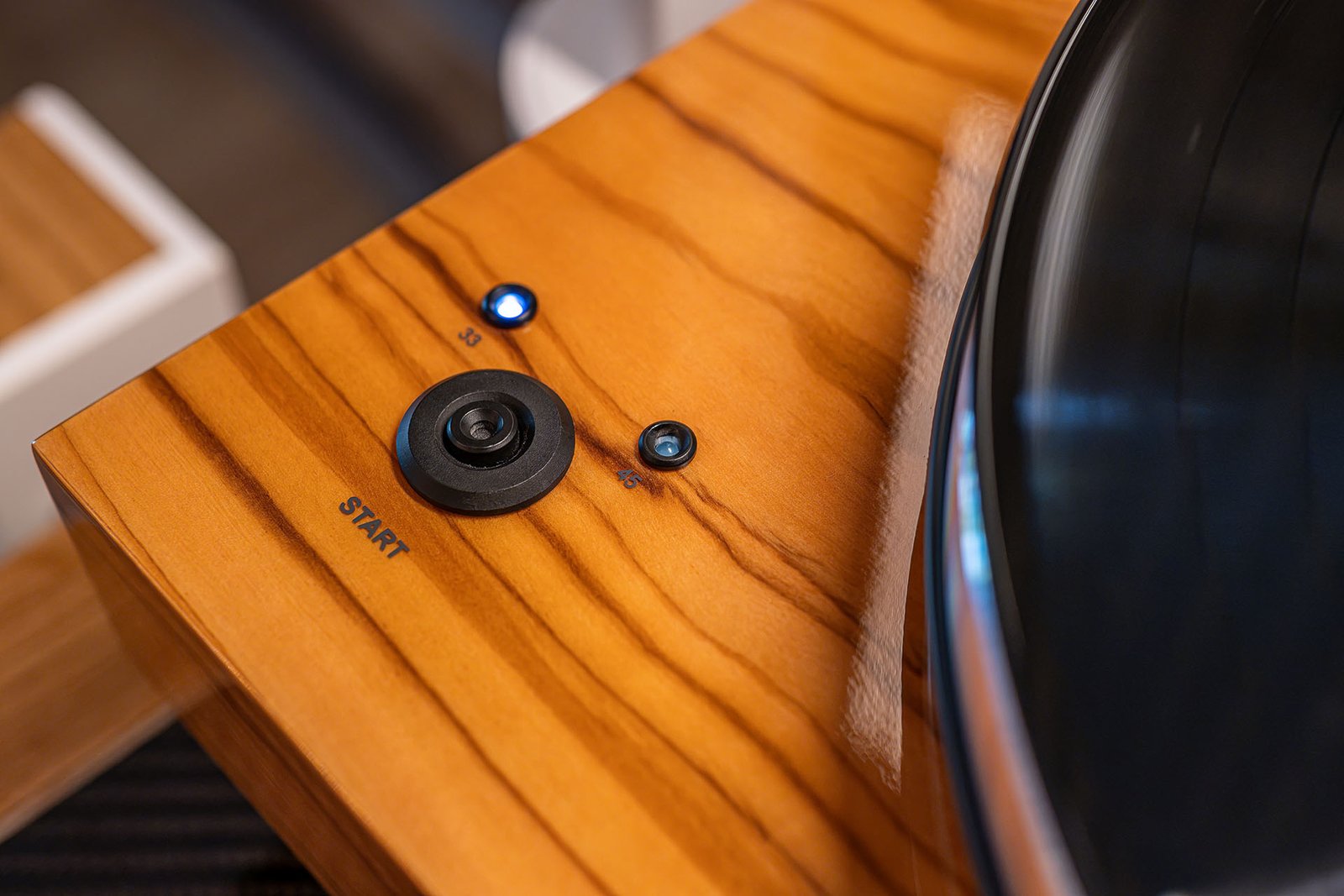
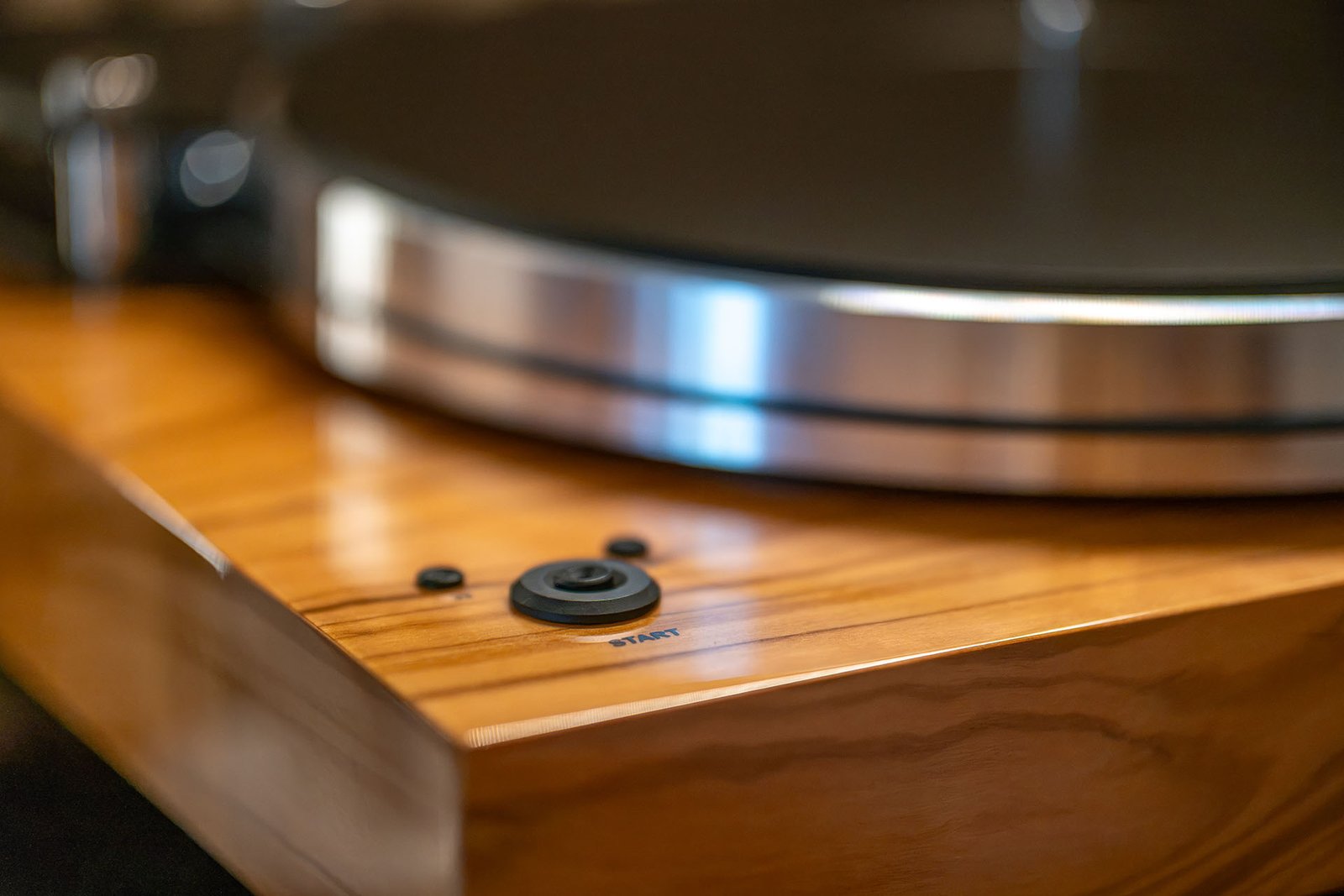
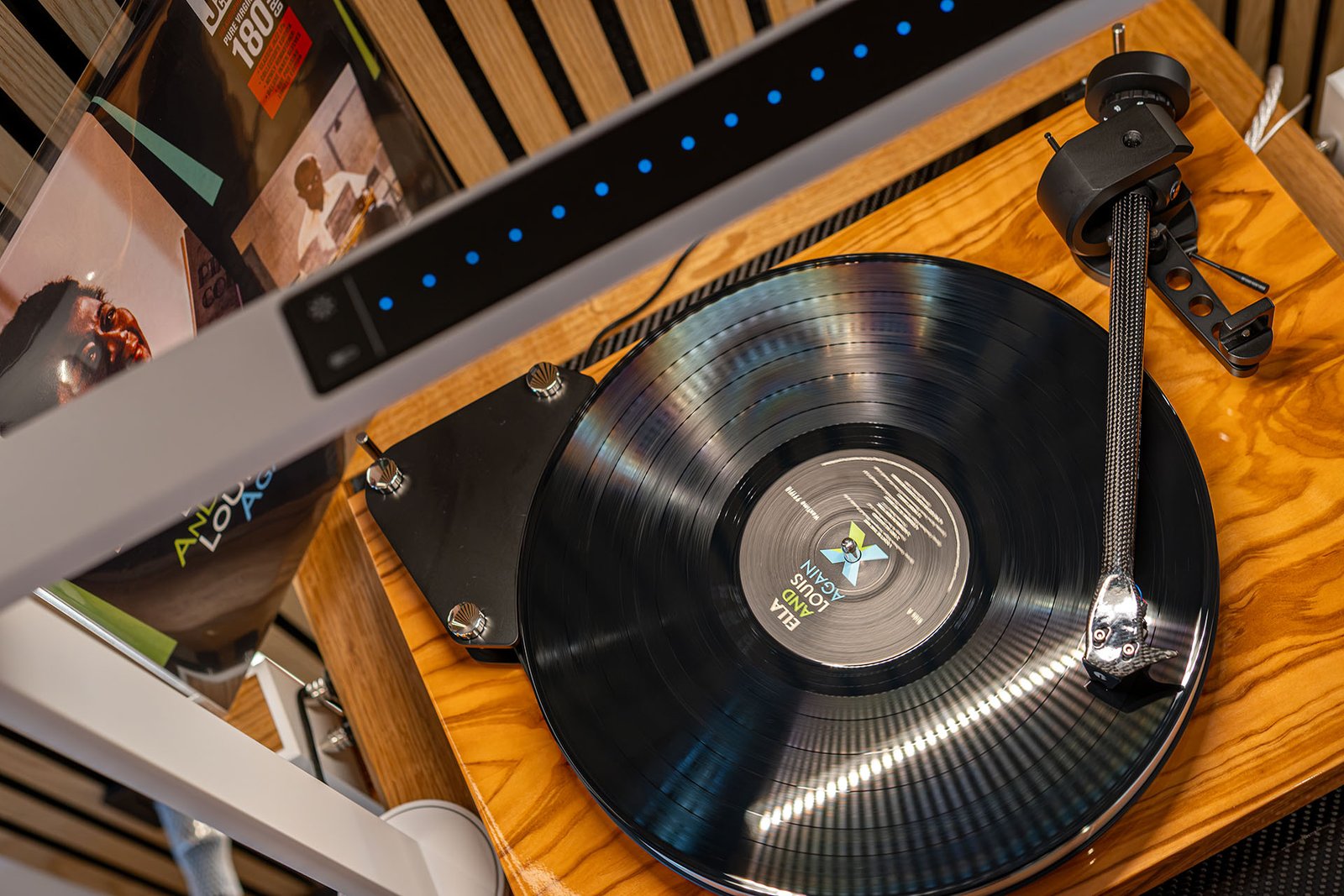
Drive comes from a belt running to a synchronous motor fed by Pro-Ject’s precision DC-driven AC generator, the mature descendant of their Speed Box technology. A microprocessor synthesizes a pristine, quartz-referenced AC waveform, completely divorced from the pollution of the wall socket, and speed change between 33 and 45 rpm happens at the push of a single elegant button. No belt-hopping, no lifting the platter, no ritual sacrifice.
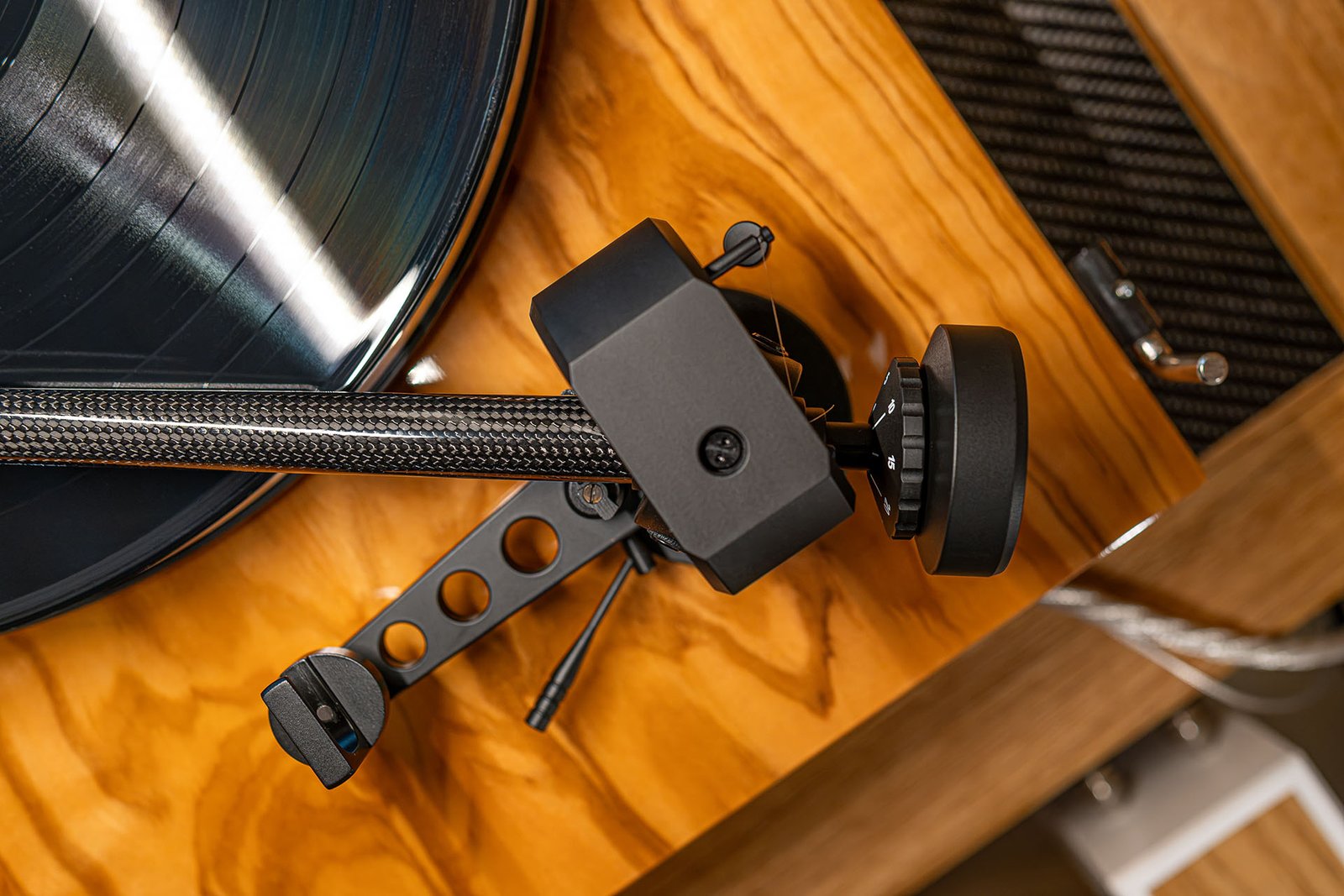
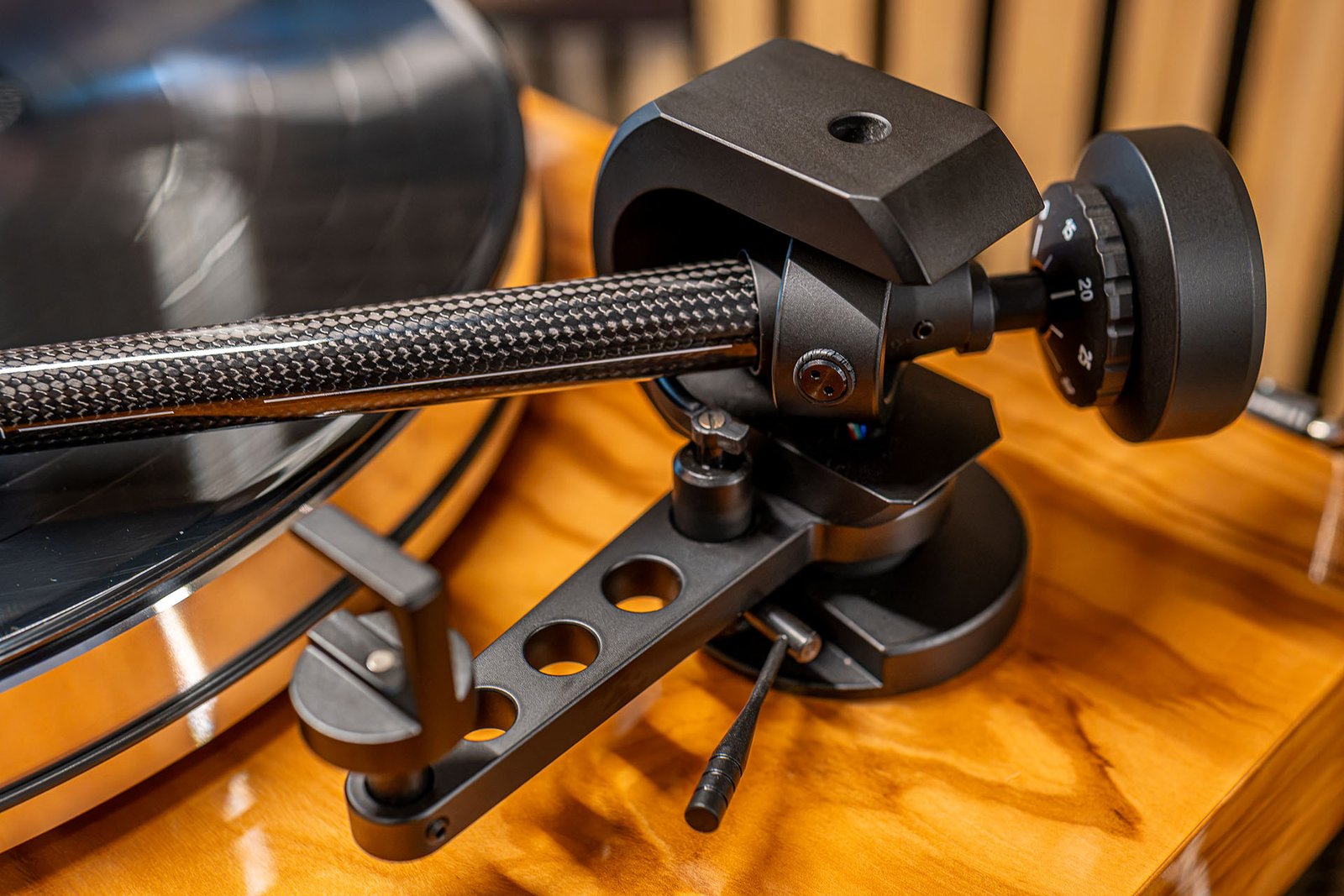
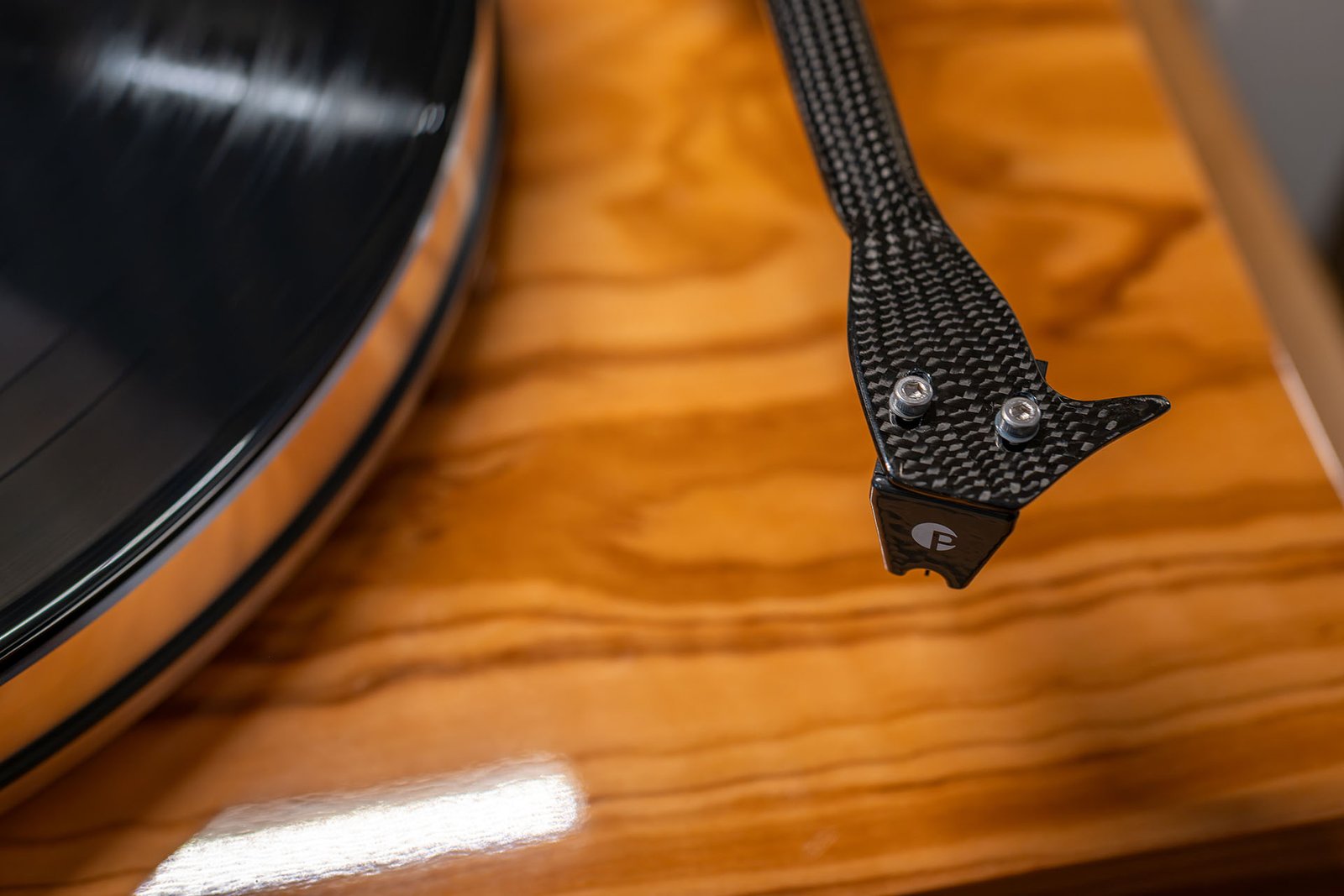
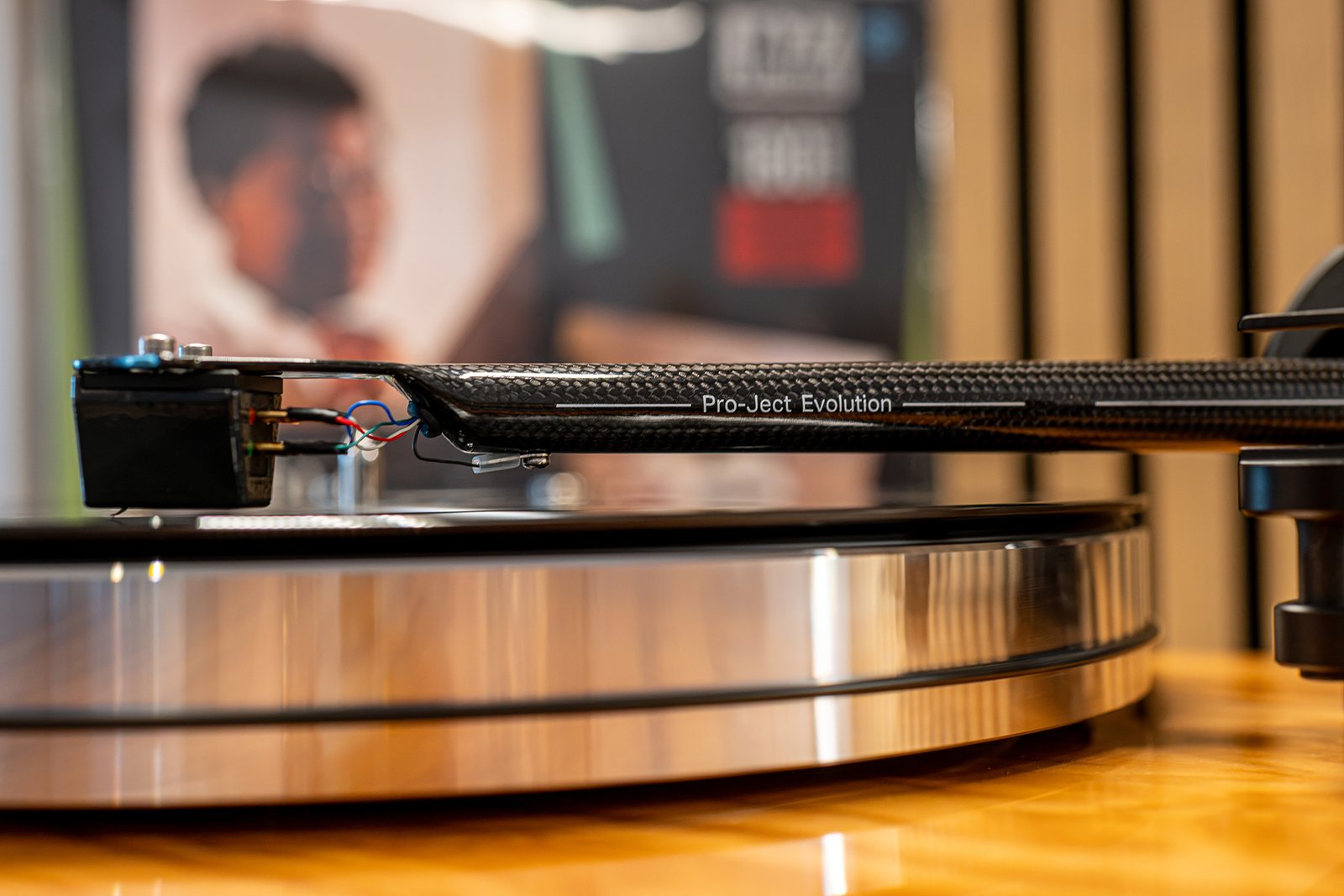
The EVO 9 CC Black tonearm: its arm tube is carbon fiber, stiff, light, and internally damped, terminating in a rigid one-piece headshell. The bearing is a proper cardanic gimbal, four hardened points arranged for freedom without slop, and the counterweight is TPE-damped to absorb the micro-vibrations that travel back down the arm from the cartridge. Internal wiring is high-purity copper, running unbroken to a 5-pin DIN output. And here Pro-Ject plays its modern trump card: the signal path is configured for true balanced operation. With a moving coil cartridge, which is a naturally balanced generator, a DIN-to-XLR cable, and a balanced phono stage, the Xtension 9 Evolution can run a fully symmetrical connection that rejects hum and interference the way professional studios have done for half a century. A DIN-to-RCA cable is included for conventional systems, so nobody is left behind.
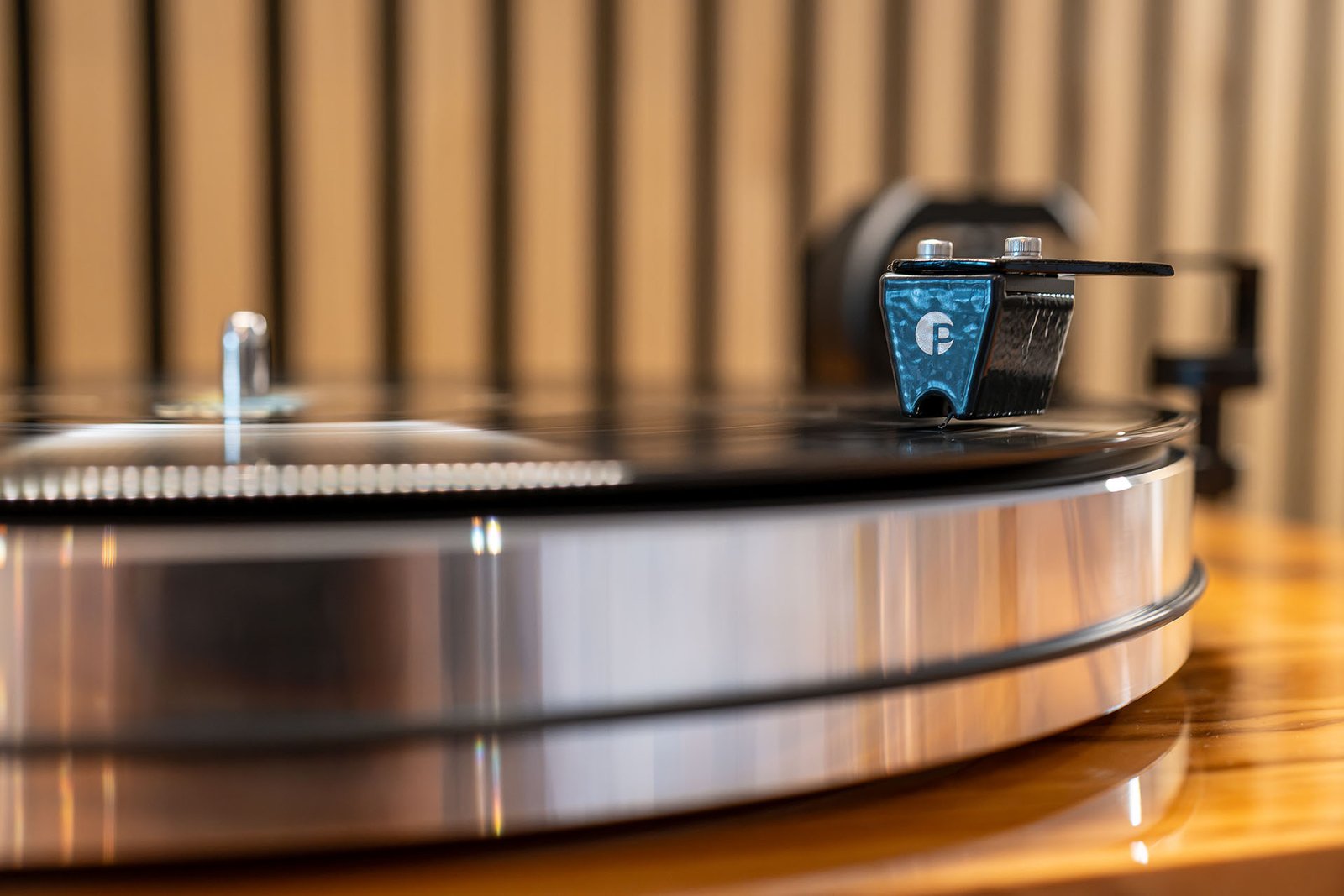
Finally, the included MC cartridge: the Pick it DS2 MC. Designed and voiced by Pro-Ject, built in Denmark by Ortofon, and loosely related to the respected Quintet family, it is a proper low-output moving coil, not a token gesture. Its body is polyamide, formed by selective laser sintering, a process in which the housing is grown layer by layer from powder under a laser, yielding a structure with remarkably low resonance. A massive metal top plate with three raised contact points couples it rigidly to the headshell, threaded inserts make mounting civilized, the connection pins are gold-plated, and at the business end sits a nude elliptical and forgiving diamond delivering a healthy 0.5 mV of output.
The Test System – Saying Goodbye, Temporarily, to a Mountain
Transparency about context is not optional; it is the foundation of everything that follows, so let me describe the room this Austrian newcomer walked into. For this review, the Xtension 9 Evolution replaced my Acoustic Signature Montana NEO turntable, with the TA-5000 NEO tonearm and the Hana Umami Red cartridge still lovingly attached to it (already reviewed here), a German-Japanese monolith that costs, in its full configuration, roughly ten times the price of the entire Pro-Ject package. Lifting the Montana off the rack felt like relocating a small planet. Placing the slim, sixteen-kilogram Xtension in its spot felt like watching a ballet dancer take the stage after a weightlifter. My expectations, I admit, adjusted themselves downward accordingly.
The rest of the chain remained exactly the analog family my regular readers already know. The signal traveled through my Crystal Cable phono interconnect into the Aesthetix Rhea Eclipse, Jim White’s all-tube phono stage, still the most honest and most musical window into a cartridge’s soul that I have had the privilege to use. From there, the full Aesthetix Saturn Eclipse family took over: the Calypso Eclipse line stage and the Atlas Eclipse hybrid power amplifier, feeding the Wilson Audio WATT/Puppy 50th Anniversary loudspeakers (in-house for a glorious upcoming review). Everything rested on the Woodyard rack, with the usual fanatical attention to vibration.
And now, the part that made me smile in disbelief: the setup. Those of you who have mounted and aligned a moving coil cartridge from scratch know the ceremony. The protractors, the magnifying loupes, the shaky hands, the whispered profanities, the forty-five minutes of existential doubt over half a millimeter of overhang. None of that happened here. The Xtension 9 Evolution arrived with the Pick it DS2 MC already installed, aligned, and calibrated at the factory. My entire installation consisted of placing the heavy sandwich platter onto the bearing, slipping the belt into place, hanging the small anti-skating weight on its filament, and connecting my Crystal Van Gogh interconnect phono cable to the DIN output. Out of professional paranoia rather than necessity, I placed my spirit level on the platter to verify flatness, adjusting the feet by tiny fractions, and checked the vertical tracking force with my digital stylus scale, with the proper counterweight installed. Thirty minutes after the box was opened, music was playing. In a hobby that often confuses suffering with virtue, this civilized welcome deserves its own small standing ovation.
A few words about living with the deck day to day, because a turntable is not only a transducer, it is a piece of daily choreography. The included hinged acrylic dust cover is substantial, well-damped, and stays obediently at whatever angle you leave it, a small mercy that owners of cheaper decks will appreciate. The electronic speed change is a quiet luxury you stop noticing until it is gone: one soft press, and the platter glides between 33 and 45 without ceremony, which matters more than usual in a review built partly on 45 rpm audiophile pressings. Cueing with the EVO 9 CC Black is silky and precise, the arm lift descending with hydraulic patience, and the anti-skating filament, that charmingly old-school Pro-Ject solution, did its job invisibly. In four weeks of daily use, the deck committed exactly zero ergonomic sins, and in this price class, that is rarer than it should be.
Only the Music – The Sound Performance
This is always the chapter that matters, the one all the previous pages exist to serve. Chassis materials, bearing geometries, and price philosophies are only the scaffolding; what counts is what happens in the dark, between the drop of the needle and the lift at the end of the side. For these listening weeks, I deliberately chose records that live across the whole emotional map, Celtic soul and Tunisian oud, British hard rock in Japanese arenas, and Urdu poetry over harp strings, because a turntable that only flatters one genre is an instrument, and I was hunting for something rarer: a storyteller.
Let me give you my opinion in short first, and then let me earn it, record by record. What the Xtension 9 Evolution delivered in my room over these weeks was a nice, truly analog sound, with a performance I simply did not expect at this price point. No, it cannot match the sheer quantity of information excavated by the ten-times-more-expensive Acoustic Signature system with the Hana Umami Red; pretending otherwise would insult both your intelligence and mine. But the music that flowed from this olive-clad machine was very organic, full of life, and warm, carried on a remarkably quiet background with very good groove noise behavior, enough micro-details to keep my analytical brain engaged, and a confident, warm dynamic punch that repeatedly made me forget I was supposed to be working. There is a wholeness to its presentation, a refusal to dissect music into audiophile exhibits, that I appreciated more and more. And the silence, that famous ‘black’ background born from levitating bearings and pellet-filled plinths, is the canvas on which everything else is painted.
Before the records, allow me to sketch the character in broad strokes, the way you would describe a new friend’s temperament. The bass is the foundation of this deck’s personality: generous, round-shouldered, and confident, with real weight in the mid-bass and enough articulation to keep bass lines melodic rather than merely rhythmic. It is not the surgically damped, almost dry low end of the great mass-loaded monsters; it is warmer, more forgiving, and frankly more fun on most real-world records. The midrange is where the Pick it DS2 earns its keep, saturated with tonal color, slightly golden, wonderfully kind to voices and acoustic instruments, with that faint analog glow that makes long sessions feel like conversations rather than examinations. The treble is clean, extended enough, and completely free of the etch and grit that plague many affordable moving coils; if I am strict, it trades the very last shimmer of air for its unshakable politeness, a trade I suspect ninety-five percent of listeners will happily sign. Dynamically, the package punches with genuine enthusiasm on the macro scale, drum hits land, crescendos swell with authority, while micro-dynamics, those tiny expressive flickers inside a sustained note, are very good for the class without being supernatural. And the soundstage is wide, stable, and honestly layered, painted on that quiet background like bright figures on dark velvet. Keep this portrait in mind; every record below is a variation on it.
I began with Van Morrison’s Moondance, in the expanded three-LP Rhino edition carrying Steven Wilson‘s new remix. What pleased me most here was the swing: the walking bass line moved with good pitch definition and rhythmic intent, and Van the Man stood between the speakers with warmth, body, and that unmistakable growling joy, clearly the sweet spot of the Pick it DS2‘s golden midrange. The horns and piano of Wilson‘s open remix were laid out in believable positions, though the ride cymbal’s finest metallic shimmer was rendered a touch softer and shorter than I know it from a more expensive pickup, pleasant rather than illuminated. On “Into the Mystic,” the deck traded the last word in air for an easy, inviting flow, and honestly, with this record, that felt like a fair trade.
Then the hardest test of silence I own: Anouar Brahem’s After the Last Sky, on a beautiful ECM double LP, where the oud whispers, Anja Lechner‘s cello sighs, and any groove noise or motor hash instantly pollutes the music. The Xtension‘s quiet background served this record well; the spaces between the notes stayed convincingly dark, and the plucked attack of the oud emerged with a warm, rounded harmonic body. To be fair, the very finest layer of the recording, the smallest fingertip noises, and the outermost edge of the studio air were presented more discreetly than through my reference cartridge, sketched rather than spotlighted. And yet the music’s meditative pull remained fully intact; I sat through all four sides with the notepad mostly idle, which is its own verdict.
Time to wake the neighbors with Wishbone Ash’s Argus, in the Analogue Productions pressing, one of the great twin-guitar records of the seventies. On “The King Will Come,” the two guitars kept their own territories, left and right, clearly enough that I could follow either voice at will, and the drums landed with satisfying, rounded weight rather than the polite tap of a lightweight deck. The leading edges of the guitars were gently smoothed, warmer and slightly less incisive than through a costlier front end, which robbed the climaxes of a small degree of bite but also made loud listening entirely fatigue-free. “Throw Down the Sword” kept its mood intact, and, in the end, that is what this album is about.
Deep Purple’s Made in Japan, in Steven Wilson‘s remix, tested composure and speed stability. Jon Lord‘s sustained Hammond chords on “Highway Star” mercilessly expose any wow or flutter, and the quartz-locked motor held them steady; the band’s drive and Ian Paice‘s pace came through with honest enthusiasm. The Osaka Hall itself was drawn on a somewhat smaller canvas than I am used to, the crowd’s ambient halo a little less airy and the furthest reverberant layers gently condensed, a natural consequence of the package’s warmer, less extended top end. But the essential thing, the sweat and momentum of a great band at full tilt, survived completely, and “Child in Time” still climbed where it needed to climb.
For intimacy, Robert Plant’s Saving Grace. Plant‘s weathered, honeyed murmur, intertwined with Suzi Dian‘s voice, sits squarely in this package’s comfort zone, and the two singers were presented as distinct, warm, touchable presences, close together but never smeared. The banjo, soft percussion, and slide guitar formed a dim, candle-lit space rendered with real affection, even if the finest textural grain of the voices was slightly rounded compared to what the Umami Red extracts. This deck clearly favors embracing voices over dissecting them, and on quiet evenings with this record, that preference felt exactly right.
Bob Dylan’s Oh Mercy followed, for atmosphere, and Daniel Lanois‘s humid production suits the deck’s temperament. On “Man in the Long Black Coat,” Dylan’s cracked voice hung stably at the center while the tremolo guitars swam in warm layers of reverberant dusk behind him. The stage had convincing width and a respectable, if not cavernous, sense of depth; the very back wall of Lanois‘s soundscape sat closer than it does through my reference, the outermost ambient details slightly folded into the mix. Still, the swampy spell held from start to finish, and this record is nothing without its spell.
Then the cruelty test: Return to Forever’s Romantic Warrior, on the Music on Vinyl pressing, four virtuosos playing music of merciless density and speed. Here, the honest boundary of the package showed itself most clearly. The Xtension kept the pulse locked and the four musicians usefully separate, and Stanley Clarke‘s bass had pleasing snap and wood, but in the densest passages, the finest layer of micro-information, the air between the notes that the Montana NEO and Umami Red resolve with ease, became noticeably simplified, the weave a touch tighter than reality. Nothing collapsed, and nothing hardened; the music stayed followable and fun. But this is where you hear where the money goes further up the ladder, and it is fair to say so plainly.
Back to pleasure with Erykah Badu’s Mama’s Gun, on Motown, recorded warm and built on grooves that must physically move you. This is home territory for the Pro-Ject’s slightly golden balance: “Didn’t Cha Know” rolled out like warm smoke, the bass thick, round, and well articulated, the drums sitting in that lazy, irresistible pocket, Badu‘s voice floating above with texture and attitude. The topmost sparkle of the vibraphone on “Cleva” was a shade subdued, but on music like this, the deck’s generosity reads as hospitality, not coloration. My head nodded for two full sides; my notes stayed brief.
I saved the most fragile record for last: Arooj Aftab’s Vulture Prince, in the deluxe Verve edition, Urdu poetry floating over harp, guitar, and bowed strings. “Mohabbat” is unforgiving of any coarseness, and the Xtension held its spell, the harp arpeggios round and complete, Aftab‘s voice hovering at center, warm, stable, and human, with the quiet background letting long decays fade gracefully. The uppermost shimmer of the harp and the last halo of air around the voice were presented more modestly than a premium cartridge would manage, the twilight a shade warmer and closer than in reality. Even so, when the side ended, I sat still for a moment before getting up, and that small pause remains a measurement no datasheet can offer.
And now, because you would rightly never forgive me for avoiding it, the direct question: how does it stand against the Acoustic Signature Montana NEO with the Hana Umami Red, the system it temporarily replaced? Let me answer with the respect both machines deserve. The reference sees deeper into the groove, full stop. It retrieves a finer dust of micro-information, resolves dense mixes with more effortless separation, extends further and more delicately at the frequency extremes, and paints the back corners of the soundstage with a lamplight the Pro-Ject only suggests. Instrumental timbres carry one more layer of harmonic truth, and in fortissimo orchestral chaos, the German-Japanese pairing remains serenely composed where the Austrian begins, gently, to summarize. This is exactly as it should be; anything else would mean the entire upper industry is a fraud, and it is not. But here is what genuinely surprised me, evening after evening: the distance in emotional delivery is dramatically smaller than the distance in price. On voices, on small ensembles, on groove-driven music, on late-night listening at civilized volumes, the Xtension delivered, conservatively, the great majority of the experience, and there were moments, I confess this freely, when its slightly warmer, more embracing balance was simply the more pleasant company. The reference is a telescope; the Pro-Ject is a fireplace. On many nights, you want the fireplace.
Summing up the listening weeks: the Xtension 9 Evolution with the EVO 9 CC Black and the Pick it DS2 MC is a warm, organic, rhythmically confident performer with a genuinely quiet background, very good micro-detail retrieval for its class, punchy and well-controlled bass, a midrange that flatters voices without falsifying them, and a soundstage that offers real width and honest depth. Its limits appear only under the most complex, dense material, where the last degree of resolution and separation is simplified compared to true high-end references, and its treble, while clean and fatigue-free, trades the final measure of airy sparkle for civility. As a complete package judged at its price, I struggle to name a more musical way to spend the money.
Market Value and Price
Let us talk plainly about money, as we always do here. The Xtension 9 Evolution, complete with the EVO 9 CC Black tonearm and dust cover, carries a European list price of around 3,299 euros, and in the Superpack configuration with the Pick it DS2 MC cartridge already mounted and calibrated, the package I have been living with, the figure rises to roughly 3,499 euros, with exact numbers depending on finish, market, and local taxes, so do check with your dealer. Now, allow me to place that number where it belongs, next to my own reference wall. The Hana Umami Red cartridge alone, just the cartridge, a thing you can hide in a closed fist, costs about four thousand euros. The tonearm it hangs from costs multiples of that. The turntable underneath, multiples again.
And this is the beautiful scandal I promised you in the introduction. For less than the price of one premium moving coil pickup, Pro-Ject hands you a complete, mature, genuinely pure analog source: a mass-loaded, magnetically floating deck built in a factory with over three decades of accumulated craft, a carbon fiber gimbal tonearm, a true Ortofon-built MC cartridge, balanced output architecture, factory calibration, and a finish, that glorious olive, that would not embarrass furniture costing a lot more. You are not paying for mystique, distribution pyramids, or the theater of exclusivity. You are paying for MDF, steel pellets, ceramic, carbon, magnets, and Czech and Danish hands that know exactly what they are doing. The cost-benefit balance is not merely on the customer’s side; at this price, it practically lives at the customer’s house.
Two practical pieces of advice for anyone tempted, and you should be tempted. First, do not starve the Pick it DS2 downstream. This is a genuine low-output moving coil, and it deserves a quiet, capable phono stage with proper MC gain and adjustable loading; in my system, it opened up beautifully around 125 ohms, gaining sparkle and agility over the lower settings, and a good phono stage in the one-thousand-euro region will let the whole package bloom rather than merely function. Second, if your phono stage offers balanced XLR inputs, spend the modest extra on a DIN-to-XLR cable and run the deck the way its architecture was designed to run; the drop in noise floor is not subtle, and it costs a fraction of what any comparable improvement would cost anywhere else in the chain. And third, a bonus thought about the future: the Xtension 9 Evolution is a platform, not a dead end. The tonearm accepts serious cartridge upgrades whenever the itch arrives, and the deck’s silence and stability will honor a considerably more expensive tonearm without embarrassment, which means the money you spend today keeps working for you years down the road. Very few products at this level can promise that kind of long, graceful ownership arc.
Conclusion
Yes, it has the right to sound this good. The physics of excellent vinyl playback, silence, stability, isolation, and honest transduction do not carry a mandatory six-figure entry fee; they carry an engineering fee, and Pro-Ject, after thirty-five years of practice, knows precisely how to pay it efficiently. The deck’s black background, its bridging of the mass-loaded and floating philosophies, its rich, punchy, resolving character, none of this is an accident or a fluke of favorable auditioning.
It did not make me forget my Acoustic Signature, the Hana Umami Red, or the Ortofon 95 Anniversary MC A95; a reference is a reference, and in the most demanding music, the mountain of German metal still sees further. But here is what the little Austrian did do: it made me spend a month of evenings genuinely happy, it made a dozen records feel newly alive, it made friends who visited ask, wide-eyed, how much it costs, and then refuse to believe the answer. And it planted, permanently, a small seditious thought in my audiophile mind: that the emotional core of this hobby, the shiver, the nodding head, the sitting in the dark after the side ends, is available at this price point, fully assembled, thirty minutes out of the box. Everything above it buys refinement. It does not buy the miracle. The miracle, it turns out, was never that expensive. The madness was optional all along, and the Xtension 9 Evolution is its most elegant denial.
Thank You – AV Store
Every experience of this depth begins with someone generous enough to make it possible. My warmest thanks go to the wonderful team at AV Store (avstore.ro), who entrusted me with the full package, turntable, tonearm, and cartridge, for all this time, with the patience and genuine enthusiasm that go far beyond any friendship or courtesy. Their passion and their care for this hobby are exactly what make experiences like this one possible, and I warmly encourage you to visit them and ask to hear this deck in person. Preferably in olive. Trust me on the olive.
The “Highly Impressive” Award
There are components that impress by ambition, and components that impress by execution. The rarest ones impress by proportion, by delivering, at their price, so much more than the market has taught us to expect that they quietly redraw the map for everyone else. The Xtension 9 Evolution belongs to this last, small family.
Based on everything documented in the pages above, the genuinely quiet, ‘black’ background, the successful marriage of mass-loading and magnetic floating, the warm, organic, punchy and resolving musical character, the excellent factory-calibrated ergonomics, the true balanced architecture, the superb Pick it DS2 MC included in the package, and the sheer, almost provocative value of the complete offering, I am delighted to award the Pro-Ject Xtension 9 Evolution the SoundNews “Highly Impressive” Award.

A complete high-end analog front end, dressed in olive, priced below a single premium cartridge, and sounding like it never got the memo about its own modesty. Heinz Lichtenegger’s people have not just built another good turntable. They have built a quiet, levitating argument that the soul of vinyl belongs to everyone. This award was earned one evening at a time, in the dark, after the side had ended.