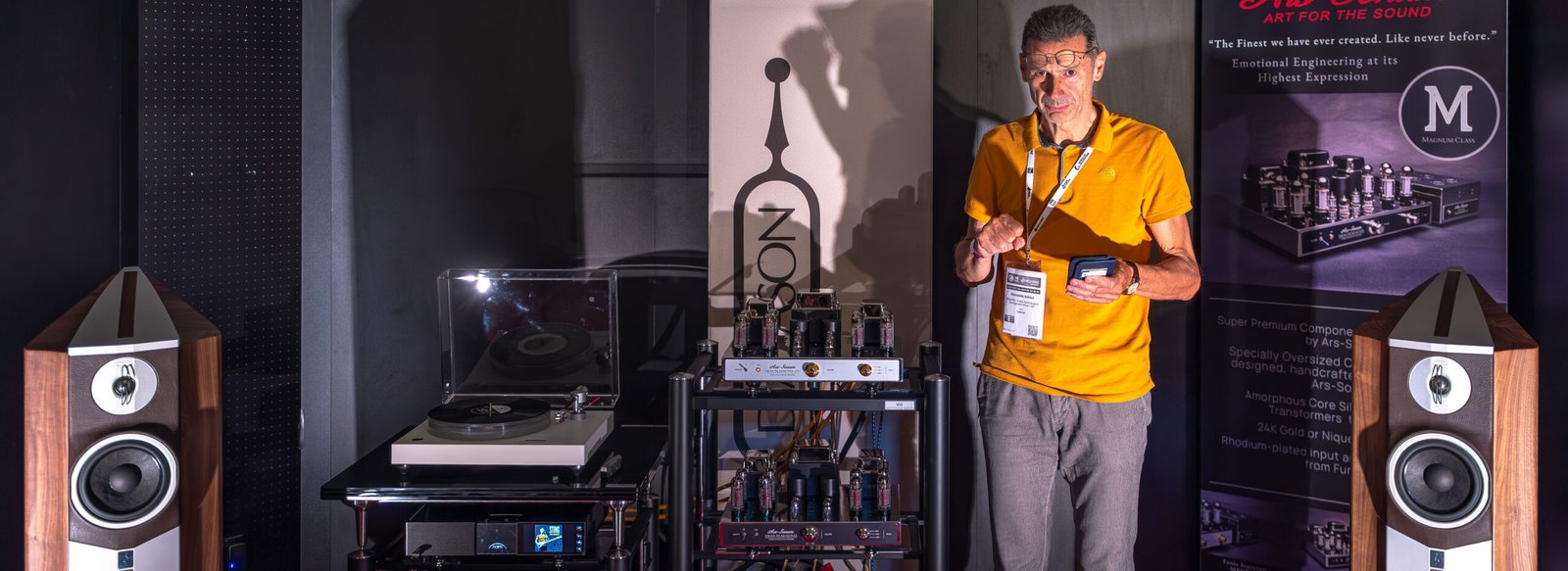
An interview at High-End Vienna 2026 with founder Alessandro Schiavi and designer Paolo Tezzon, on Didascàlia — the new Diapason’s Reference floorstander
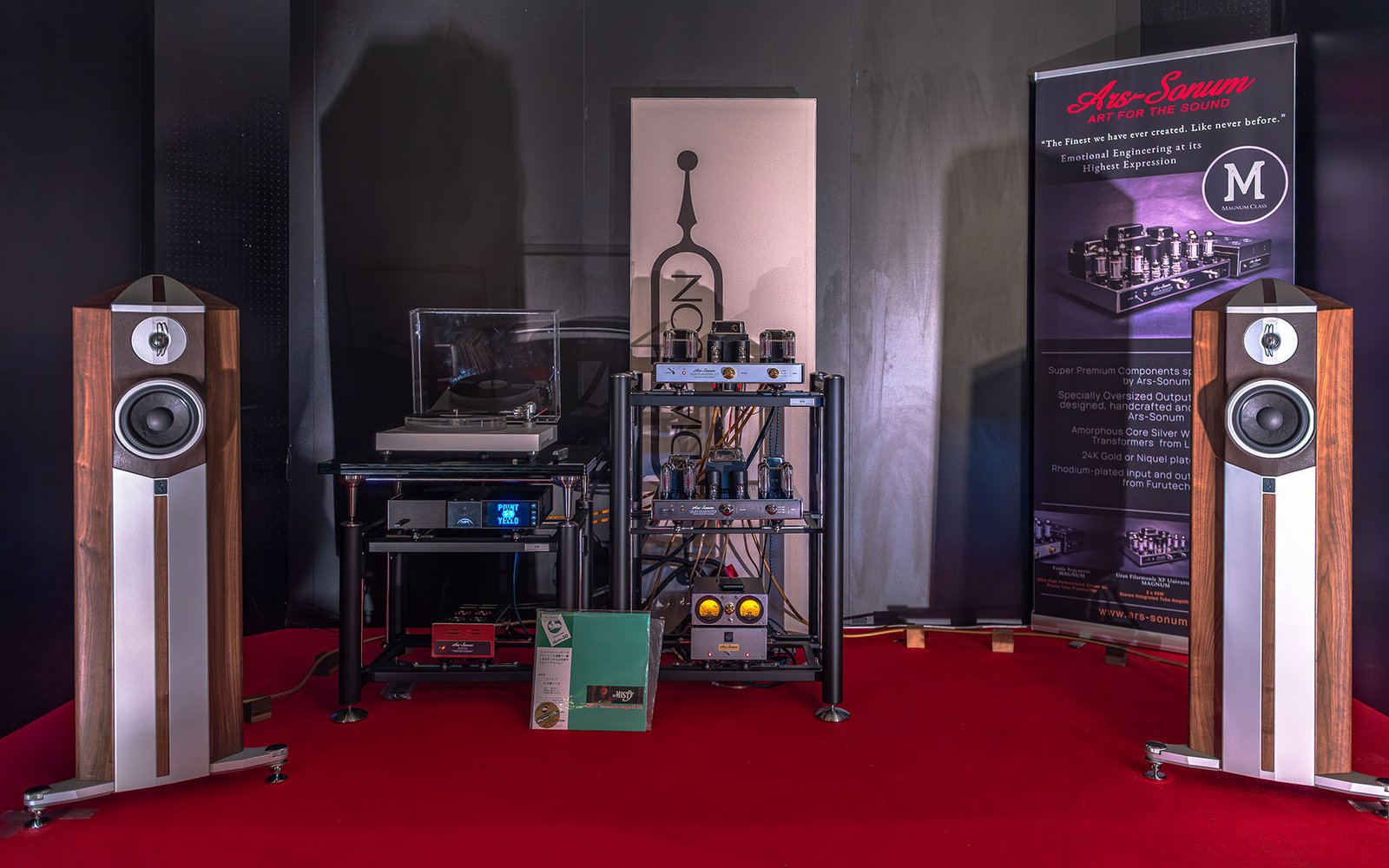
For the first time, the High-End show has come to Vienna, filling the Austria Center with warming tubes, careful system matching, and the low murmur of music slipping out of half-open doors. Diapason occupied Hall X3, Stand K04, and the room had the unhurried feel the Brescia company cultivates: a single pair of speakers, a handful of chairs in the sweet spot, and a designer happy to wait until the bass actually moved the air before saying a word. The speaker on demonstration was Didascàlia, the newest member of the Reference Collection and, in several respects, the most ambitious loudspeaker the company has built.
Diapason was founded in Brescia in 1987 by Alessandro Schiavi, who remains its founder and president. His route into loudspeakers ran through music rather than electronics: trained at the conservatory in composition for pipe organ, he became the official recording engineer of Brescia’s Festival Pianistico Internazionale at the Teatro Grande while still very young. Dissatisfied with the studio monitors of the day, he built his own — the Prelude — in 1987, tuned entirely by ear in a small control room on the proscenium of the theatre. When the musicians recording with him asked for pairs of their own, the hobby became a company. The founding principle has never moved since: that a loudspeaker is an instrument in the service of the music, and that you cannot design one well without sitting, constantly, in front of a live performance.
Out of that philosophy came a lineage of unusually long-lived designs. The faceted, diamond-shaped Adamantes (1989) became the company’s signature object, widely imitated, and still strikingly modern today; the tiny Micra (1991) opened the range at the bottom; the Karis distilled the Adamantes idea into a compact two-way; and the Ástera (2009) has remained, remarkably, untouched since its launch. Today, the catalog is organized into a Reference Collection (Didascàlia, Dynamis, and Ástera) and a Classic Collection(Adamantes V, Karis III, and Micra III Excel), alongside the Karis Wave. Cabinets are still built from solid, seasoned hardwood by the company’s own cabinet-makers in Brescia, and Diapason offers restoration and spare-parts support on a philosophy summarised on the back of every brochure: a Diapason loudspeaker is for life.
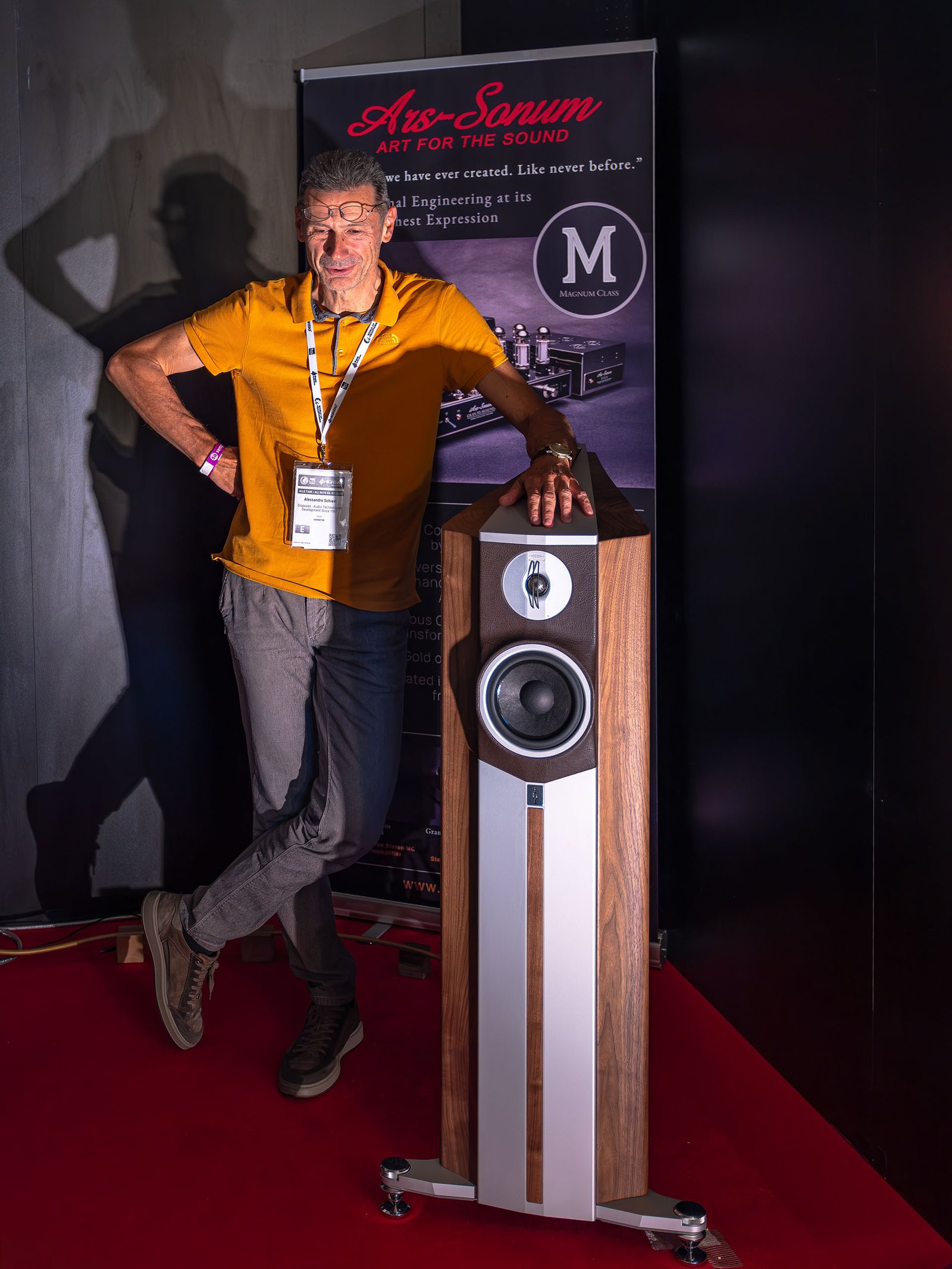
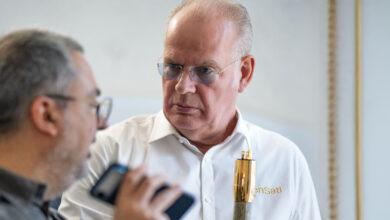
Didascàlia marks a turning point: it is the first Diapason not drawn by Schiavi himself. It was designed by Paolo Tezzon, who spent eighteen years at Sonus Faber, nearly fourteen of them as head of acoustic R&D, succeeding the late Franco Serblin, before Schiavi brought him into Diapason to carry the house’s ideas forward with his own hand. We’ve met both in Vienna. The name they chose is deliberate: didascalia, from the ancient Greek for “teaching” or “knowledge,” frames the speaker as a cultural exercise, a way of passing on the lessons of the Italian school of domestic electroacoustics rather than letting them be lost.
Before the interview proper, our thanks to Alessandro Schiavi and Paolo Tezzon for their time and openness, and for letting us hear Didascàlia, which demonstrated how to switch the Didascàlia character in real time, experienced from the center seat while the music played.
DIDASCÀLIA — A TWO-WAY THAT REACHES DEEP
Let’s start with an introduction to Didascàlia. What are we listening to?
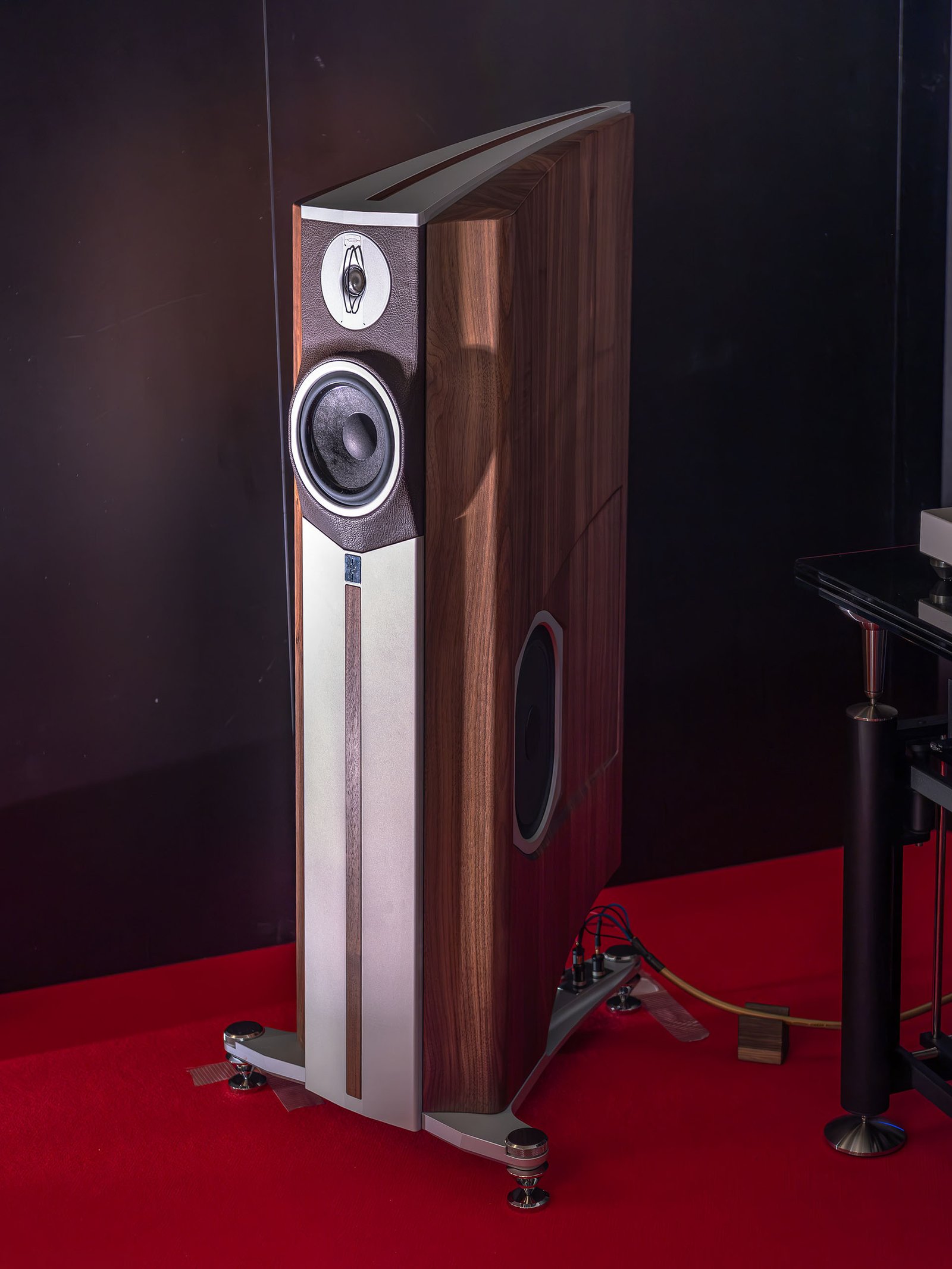
Alessandro Schiavi: Didascàlia is the last born in the Diapason company. It is a project started by Paolo Tezzon and followed by my work, and Paolo is here with us today. I’ll try to be very, very short. It is a two-way system with two passive radiators, an architecture not so common in audio technology. We adopted the double passive radiator concept to achieve a target that is very important to us: the passive range. In a two-way system, the range is always limited, but with two passive radiators, it is much more generous, extending down to around 30 Hz.
And that is not the only idea. There is also a way of managing the passive radiators. There are three positions: one in which the radiator is completely free, one in which it is lightly damped by a resistor, and a third in which the box behaves almost like a sealed enclosure. It is configurable; there is a knob on the back, and you dial between the three. From the listening seat, you feel the difference immediately. In a moment, I’ll play a track with very deep bass and change the setting while you stay in the center position, so you can hear it for yourselves.
And Paolo — you’re one of the designers.
Paolo Tezzon: Yes.
Alessandro Schiavi: He makes other things now, too.
And the main drivers themselves?
Alessandro Schiavi: Both have very impressive neodymium magnets. The bass driver uses six cylinders and our favorite material, a paper-and-nylon cone, which makes it very sensitive, very real about harmonics, very alive about the effect. And then the silk-dome tweeter: very sensitive, very fast, and very musical compared to any other material, of course, in our opinion.
Then there is the study of the shape. At Diapason, we have always had a very deep knowledge of woodwork and of how shape behaves. These wings start with a very high thickness and end very thin, in order to avoid standing waves. And you can see this little part, open in front of you, that allows the voice to be bigger, to be really present in front of the listener. The wings are worked on the inside as well, closer to the passive radiators, to give the correct internal value. And finally, the crossover network, of course, top quality, was set up very precisely during our work across different environments and with all our measurement systems.
Why passive radiators, rather than, say, a transmission line?
Paolo Tezzon: Because the goal of this design was to come up with the best two-way we could possibly realize, and to overcome the limitations of the two-way. The strengths of a two-way are phase coherence, immediacy, and the ability to convey emotion, simply because the emission is as pure as possible. The limitations, which I wouldn’t even call problems, are size, bass extension, and power handling. Power handling we could not overcome, because if you stay faithful to the two-way design, you use a single bass unit, and we wanted to stay faithful.
But the extension in the bass we could solve, and the passive radiator was the way to do it. Because we were able to design our own speaker drivers, manufactured by Scan-Speak, but one hundred percent to our design, we could come up with a set of parameters made specifically to place that mid-woofer in an oversized enclosure. The radiators’ emitting surface, combined with their compliance and the woofer’s parameters, allows us to extend the bass response linearly down to 35 Hz. The other limitation was size, and the only way to deal with that was, as Alessandro pointed out, to give the drivers those two big cheeks left and right, which provide a loading to the main emission, so that it sounds deep in the bass and very big. Any other configuration, including a transmission line, would not be possible with such geometry. So, to achieve the design goal, our choice was obvious.
FORTY YEARS OF DIAPASON
Before you play the track, in thirty seconds, tell us about Diapason itself. How far back does it go, and how long did all of this take?
Alessandro Schiavi: Diapason is nearly forty years old, thirty-nine, to be exact. I founded it in 1987, after a long period working in recording studios. Long, even though I was very young, because at the same time I was studying composition for pipe organ at the conservatory, and I had already started recording, theatre productions, the students of the school, and sessions for labels such as Fonè and EMI. For myself, I built a first prototype monitor, the Prelude, in 1987. A few months later, the other musicians I was recording with asked me to make monitors for them, too. So I opened the loudspeaker company. That is the starting point of Diapason.
And after the Prelude — how did the line grow from there?
Alessandro Schiavi: After the Prelude came the Adamantes, in 1989, the multi-faceted loudspeaker that was then copied all over the world. Then the Micra in 1991, and the Karis.
The Karis is almost an icon.
Alessandro Schiavi: Yes, I agree with you, I agree. And then the Ástera, in 2009. And consider this: the Ástera was born in 2009, and it is completely untouched today, the same project, absolutely the same, still on sale and still very successful.
The same drivers?
Alessandro Schiavi: The same drivers, the same technology, the same crossover network, everything exactly as it was. That tells you something about how Diapason works: our designs are very long-lasting, because the sound does not get old. It doesn’t age with fashion, and neither does the look. Take the Adamantes from 1989: it is still modern, still striking, still beautiful.
And Didascàlia is the moment you decided, finally, to build a floorstander?
Alessandro Schiavi: Yes. Together with Paolo, we finally decided to make this important floor-standing loudspeaker and to put something technologically interesting in it. For Diapason, it is important to create something new only when the market truly demands it. As far as stand-mounts go, the Adamantes and the Ástera are enough; we don’t need another one right now. In the future, we’ll see. But for the floor, this was the moment. And now, I think it really is time to listen.
Thank you so much.
Alessandro Schiavi: You’re welcome, absolutely.
At this point, the lights dropped, a track with deep, sustained bass began to play, and Schiavi reached for the knob on the back of Didascàlia, moving through its three settings while the room stayed silent. You can read our High-End Vienna full show report, where the Diapason room is highlighted for outstanding sound quality: “Beautiful. Just beautiful, refined, and natural sound.”
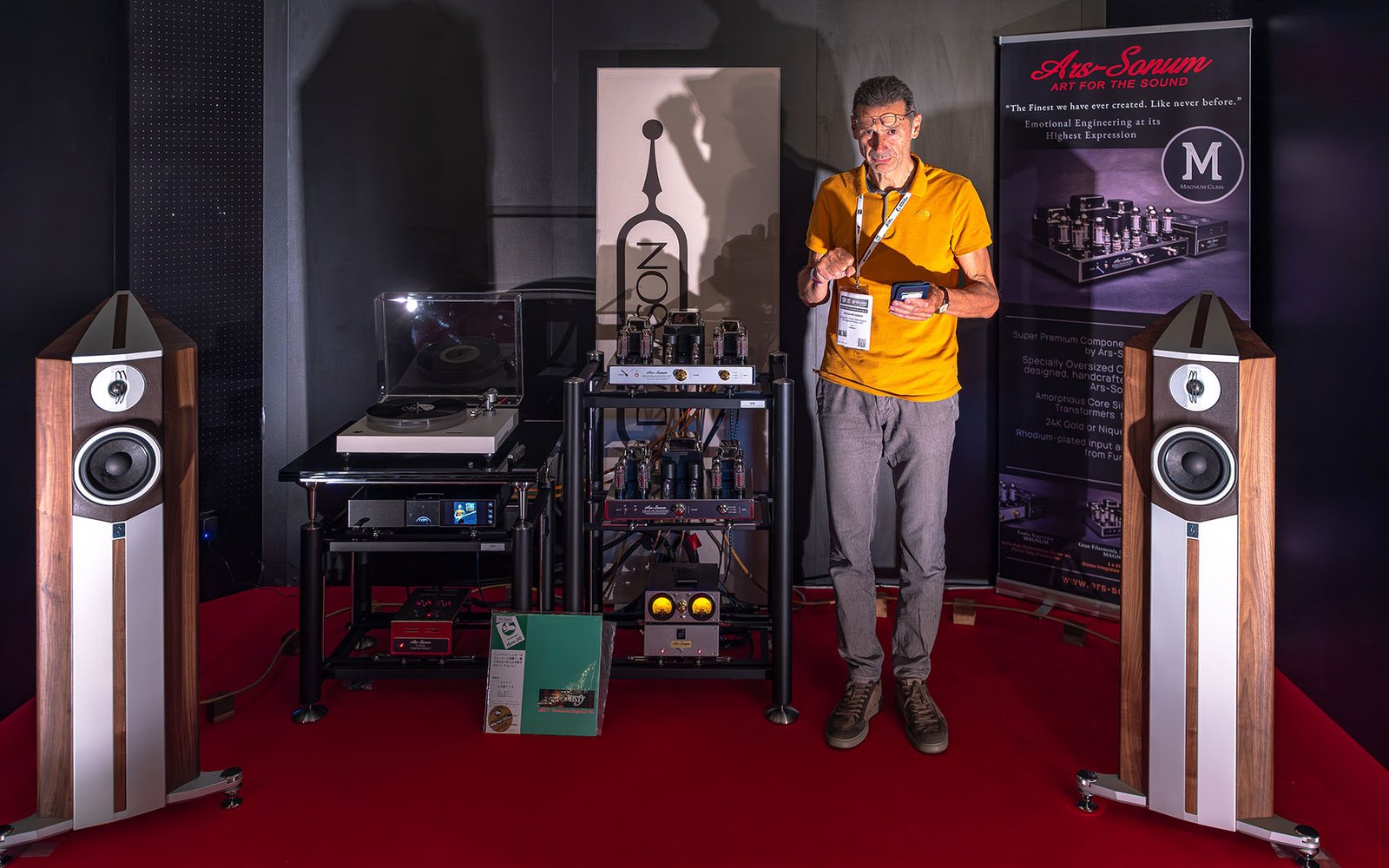
Interview conducted at High-End Vienna 2026 | Austria Center Vienna | Hall X3, Stand K04
Diapason — diapason-italia.com
Audio Technologies Development • Since 1987 • Brescia, Italy