There are components you review, and there are components you live with for a while and then measure everything else against. We audiophiles all keep a small mental list of exceptional pieces of equipment that return in our conversations years after they have left the listening room. They are the audio equivalent of Crysis in the gaming world, the benchmark pieces that make you say, “yes, it is good, but is it that good?” or “it has power, but not that kind of power.”
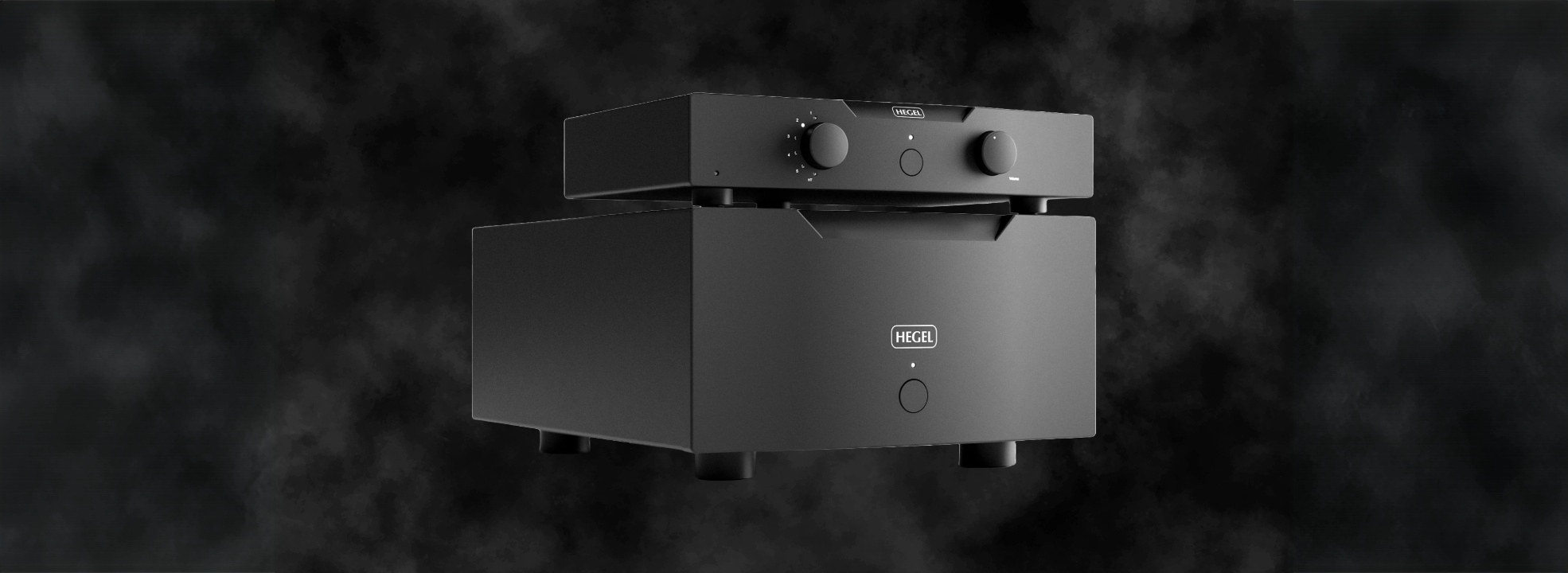
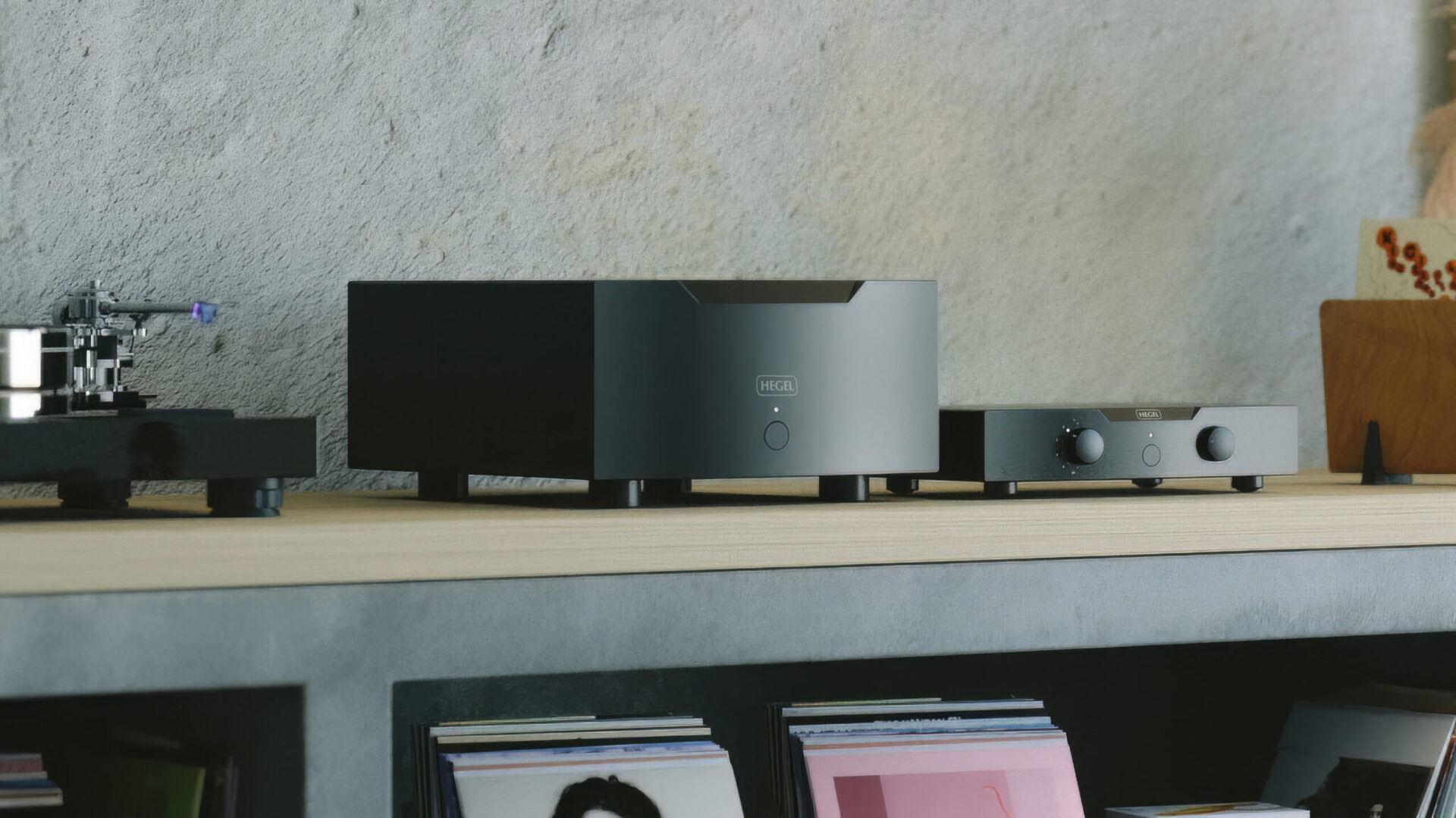
The Hegel H30A power amplifier and P30A preamplifier arrived in our listening room carrying that kind of reputation. Long before the courier rang the bell, we already knew the numbers, the design philosophy, the technology bullet points. We had heard the stories, we had seen them anchoring systems at shows, and we had our own prior experiences with Hegel electronics quietly raising the bar in other setups. This pairing promises the whole cliché checklist: bottomless power reserves, surgical control, low noise, vanishing distortion, and a “wire with gain” approach to preamplification.
You can imagine this was not a review sample to just pass through, but a potential reference point, something that could quietly rearrange our internal hierarchy of what is possible in a real-world system. We were curious whether the H30A and P30A would simply do the expected “big amp” tricks, crushing dynamics, iron-fisted bass, a gallery-sized soundstage, or whether they would go after the harder target: combining brute force with genuine finesse, subtlety, and long-term pleasant listenability, something we all search for.
Our past encounters with Hegel had already conditioned us to expect a very particular attitude: a stubborn refusal to sweeten the sound just for effect, and a clear preference for honesty over drama, built on carefully lowered noise and distortion. With this flagship pre/power duo, those expectations automatically moved a notch higher. The question became very simple, and maybe a bit unfair: is this the combo that merely confirms what we think we know about Hegel, or will it wow us with something never before seen?
It is with full desire to discover that we brought them into our system, wired them to our reference loudspeakers, the ones that we know almost too well, and started doing what we always do: playing the most revealing, difficult, and emotionally charged music we could find. What happened next tells you a lot about where Hegel stands today, and what this pairing really brings in a serious two-channel setup.
Core Design Concepts and Key Decisions
Hegel has always chosen a path that combines brute force with technical finesse. The H30A is a statement of control, both over the loudspeaker and over the smallest details of the signal.
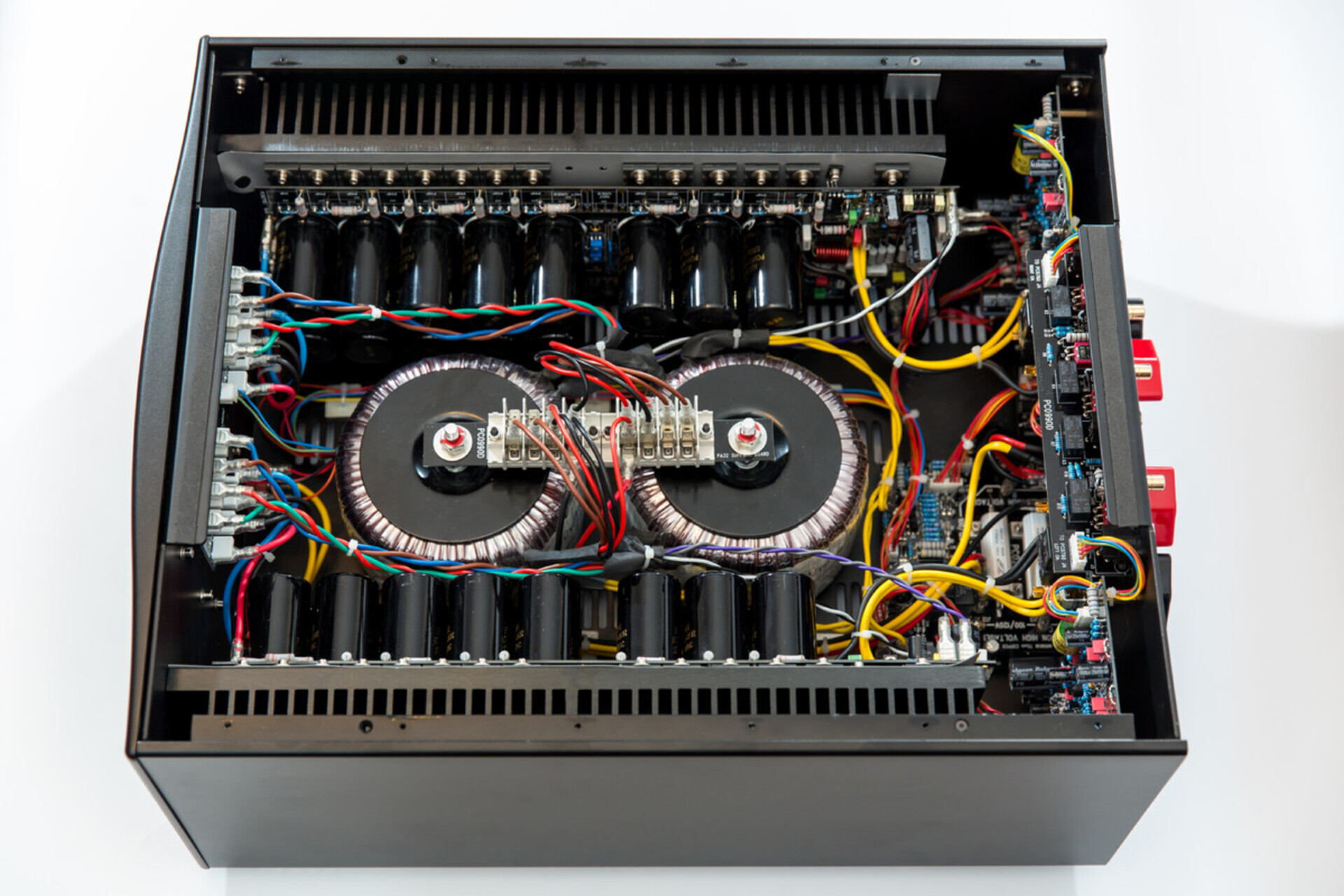
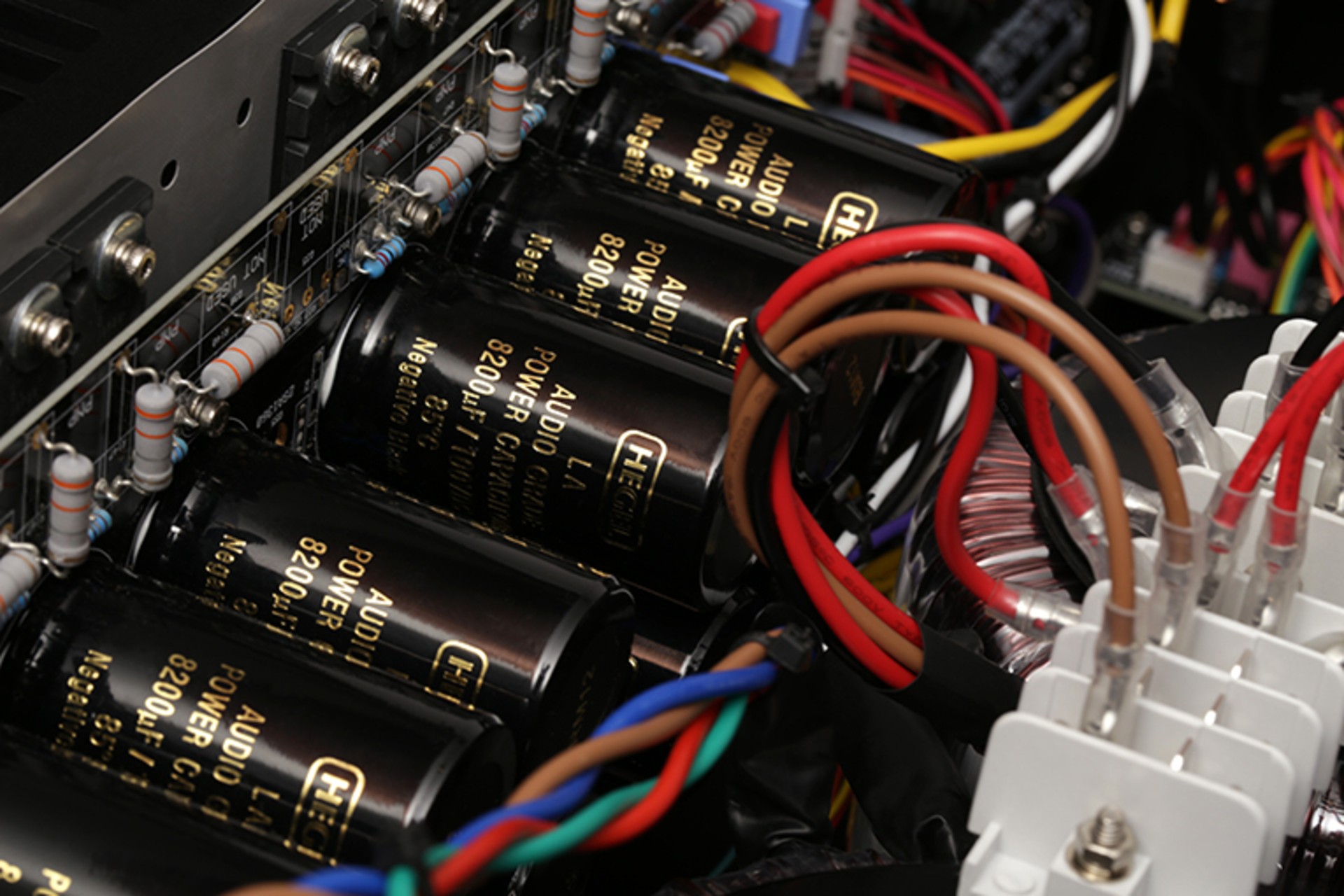
The amplifier uses a dual mono layout, with each channel given its own custom 1000 VA toroidal transformer. The power supply is dominated by 32 large capacitors, 16 for each channel. Each capacitor is rated at 8200 uF and 100 volts, creating a bank of energy storage that totals 131,200 uF per channel.
The output stage relies on 56 high-current, ultra-fast bipolar transistors per channel, each one rated at 15A and 200W.
The real heart of the H30A is its SoundEngine 2 technology, the result of decades of research by Hegel’s founder and chief engineer, Bent Holter.
In his words:
“It’s easiest to explain how the sound engine works by first explaining how normal amplifiers work.
A normal amplifier uses gain stages connected in series. Each amplifier block adds some gain and some distortion.
The amplifier blocks are connected in series, so the amplifier block will always amplify the distortion of the previous stage.
The sum of the distortions from all the different blocks will sum up and give a bigger distortion percentage. Negative feedback is used to reduce this specific distortion.
There are several problems with the normal global feedback approach. The speaker will have a kickback to the amplifier, and this kickback signal will go straight into the input stage.
Also, the speaker cables connected to the output of the amplifier will act as antennas and will feed the high-frequency noise to the input stage.
Another problem is the presence of a time delay in the different blocks in the amplifier. This means the global feedback will be delayed compared to the input signal. Another problem with feedback amplifiers is that they’re not good at reducing distortion at high frequencies. That’s why you often see that the distortion is low at low frequencies but rises at higher frequencies.
Sound engine technology works on an entirely different approach. Instead of feeding back the signal, we are using a feed-forward system. Here is how one sound engine block works:
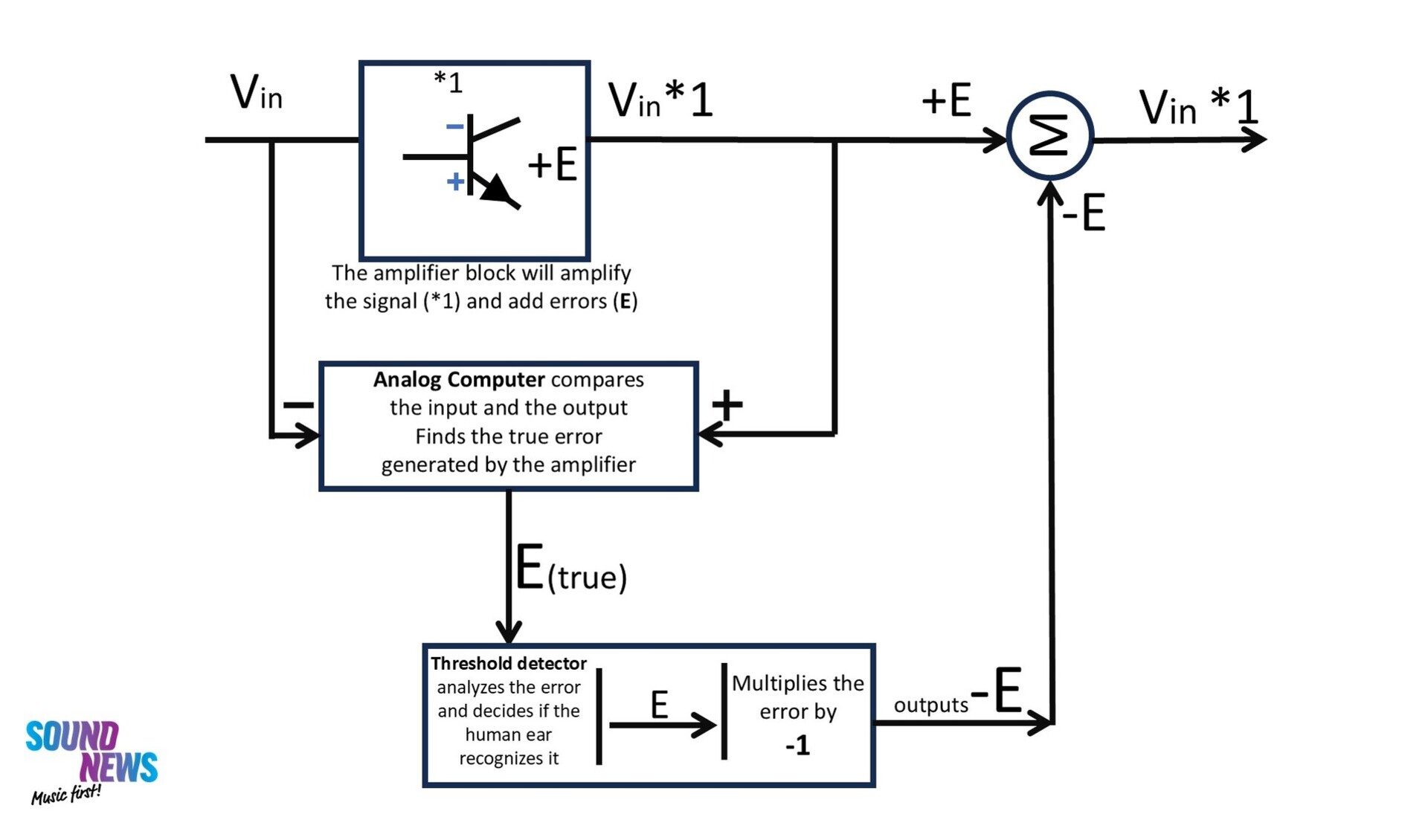
We are using an analog computer to compute the error (E) introduced in the signal block (Vin). The distortion signal is a dynamic distortion varying with the music.
A threshold detector will decide if the distortion is audible. If it’s audible, it inverts the distortion signal and adds it to the output of the amplifier block.
The result is that the distortion will be cancelled without time delay. This technology will also remove transistor crossover distortion.
What is very important is that the two computers work in parallel with the signal flowing through the system. It is different from a feedback system, where the amplifier creates a problem and then the system tries to fix it afterwards. This system corrects the errors in real time, thus reducing the distortion that a normal feedback system adds by about 20db.
This gives a higher dynamic range, very low distortion, a low noise floor, and will give you a much better musical experience.”
The result, as we’ve been able to hear it, is that you get an extremely low distortion, high damping factor, and very wide bandwidth sound, all while preserving the very important time domain characteristics of the initial, original signal. What does that mean? When you play music through the amplifier, the original signal goes out almost instantly, while any error that is created is caught and removed before it reaches the output. That is the essence of SoundEngine 2.
We found this to be the main reason why the H30A drives loudspeakers with a sense of ease and naturalness that is very difficult to achieve with classic feedback designs.
To put it in other words, we could say this technology acts as a silent observer, always comparing the output signal to the input and applying correction only when and where it is actually needed. Unlike conventional negative feedback, which acts as a broad blanket and can introduce time lag or remove texture, SoundEngine 2 operates with surgical precision, ensuring that music is delivered with both accuracy and a sense of immediacy. The result is an amplifier that, even on crowded, difficult sonic passages, is always clean, fast, precise, and musical, never sterile, even when called to deliver massive current into complex loads, which at times dip to below 3 ohms.
SoundEngine 2 constantly compares the output signal to the input, and only acts when it detects a real error. Instead of bathing the entire circuit in feedback, it applies precise corrections where they are needed, and only for as long as they are needed. This allows the amplifier to retain the grip and clarity of feedback, while preserving microdynamics and tonal richness. In daily use, this means that the amplifier maintains low distortion and composure at any output level, with no hint of artificiality or strain.
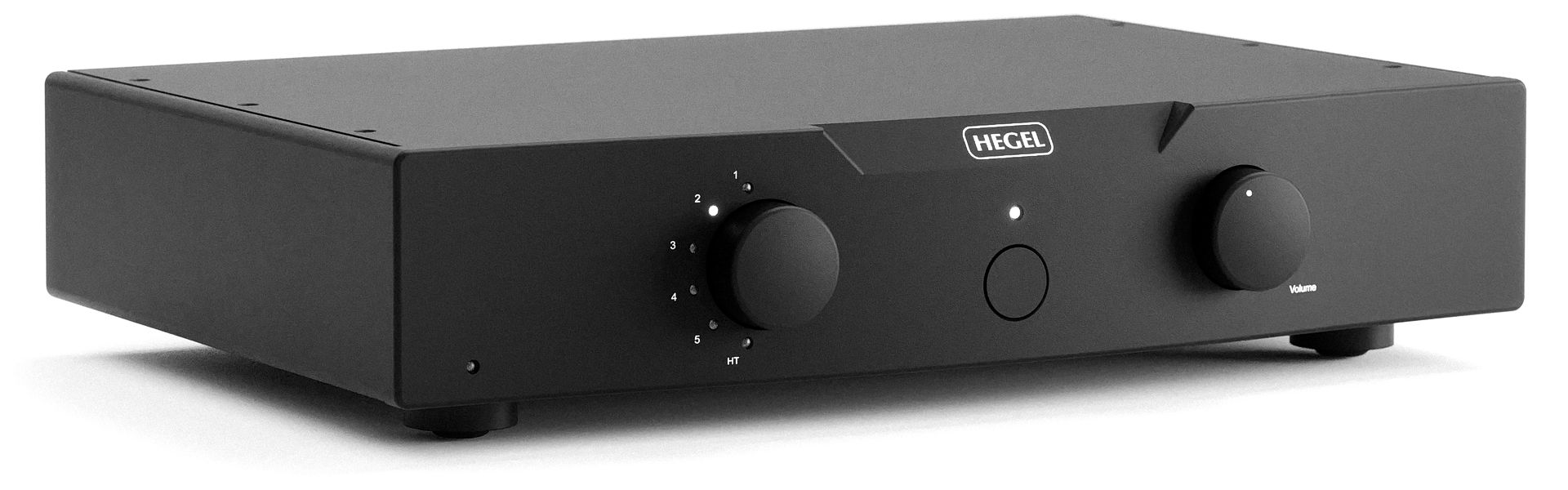
The P30A preamplifier is engineered as the purest link in the chain, with every design choice focused on eliminating distortion and preserving the original signal integrity. At the heart of the P30A, the music signal passes through only a single pair of meticulously matched FET transistors. Hegel’s engineering team explicitly selected these devices for their intrinsic lack of higher-order harmonic distortion, a key contributor to listening fatigue and unnatural timbre in other topologies. In the P30A, the music signal only passes through two transistors and an ultra-low noise volume attenuator.
Internally, the P30A is fully balanced from input to output, with separate amplifier circuits, volume attenuators, and Hegel’s proprietary SoundEngine modules for each channel. The SoundEngine circuit operates as an analog feed-forward error correction system, actively monitoring and eliminating intermodulation distortion in real time, before it can be amplified or passed downstream. This topology ensures that both common-mode and differential signals are treated symmetrically, reducing crosstalk to less -100 dB and keeping noise below the threshold of audibility.
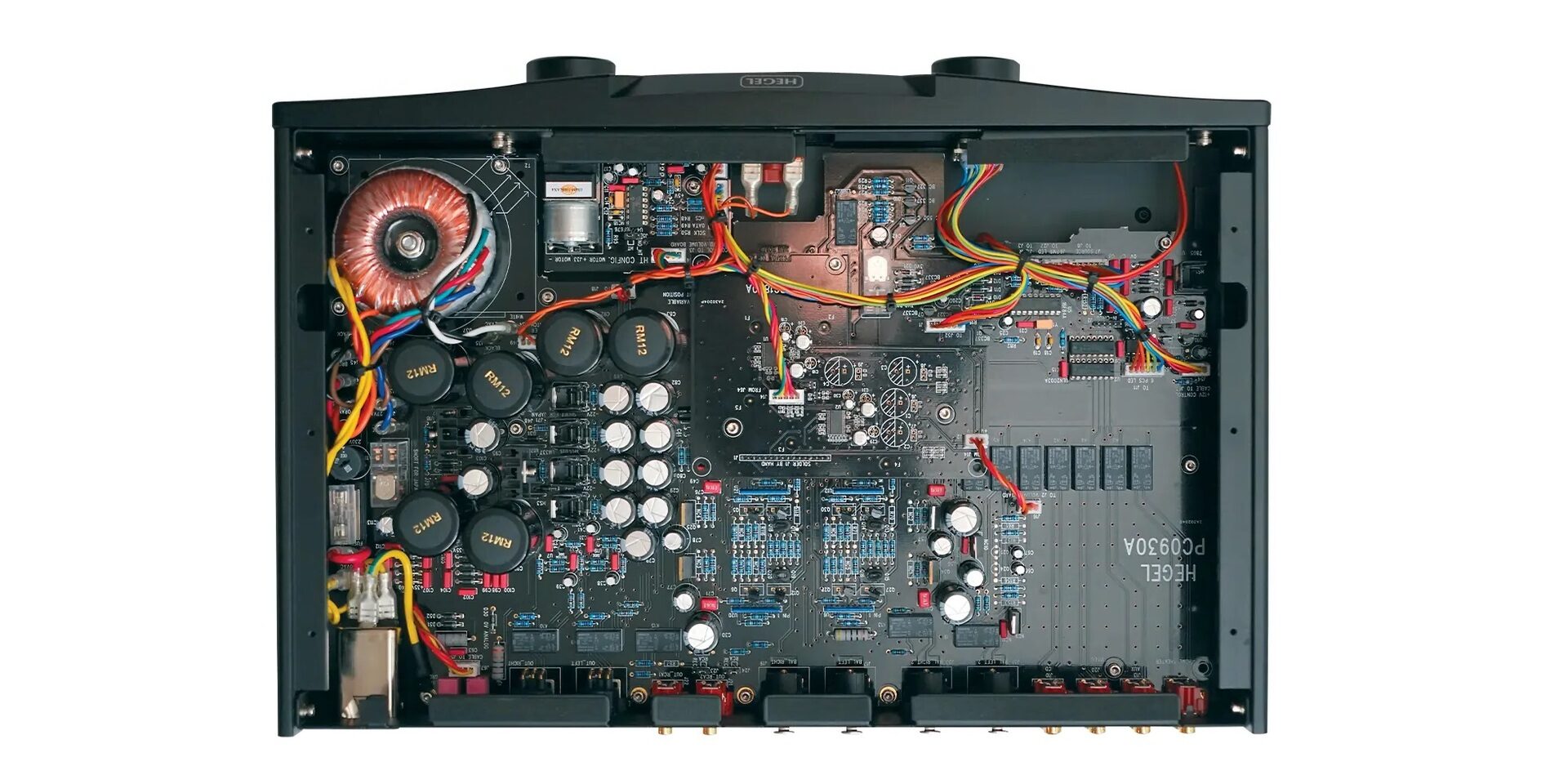
The P30A preamplifier is designed, as mentioned earlier, around a core principle: that of signal integrity. At its heart, the music signal in each channel passes through only a single pair of carefully matched FET transistors, selected specifically for their absence of higher-order harmonic distortion. This simplified design reduces the number of active components in the signal path and preserves the original waveform with extreme fidelity. The P30A is a fully balanced design, with completely independent left and right channels. Each channel has its own discrete amplifier stage, its own implementation of Hegel’s SoundEngine technology, and its own ultra-low noise volume attenuator.
Using one attenuator per channel allows Hegel to maintain perfect channel tracking across the entire volume range, even at extremely low listening levels. This eliminates the typical left-right imbalance found in many potentiometer-based designs, especially at very low listening volumes. The attenuator itself is specified as having exceptionally low noise and total channel symmetry, contributing to the unit’s vanishingly low distortion and inaudible noise floor.
Also, the SoundEngine modules, present in each channel, operate as an analog feedforward correction system for both left and right channels independently.
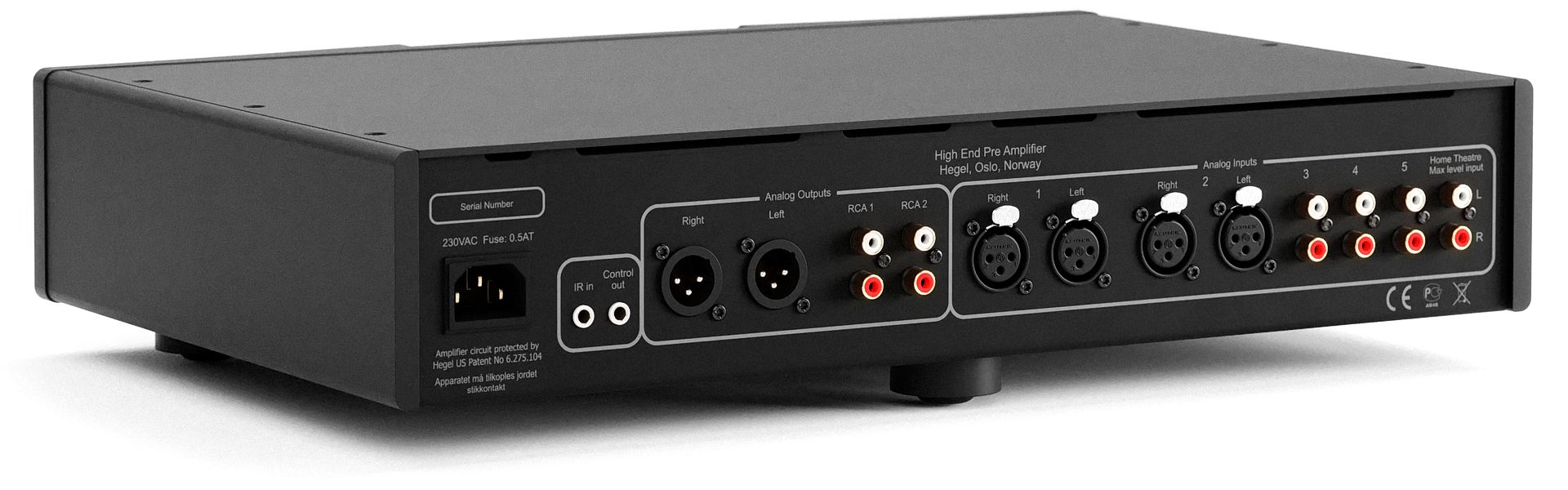
Inputs include two balanced XLR and three unbalanced RCA pairs, along with a configurable Home Theatre input that can operate as fixed or variable. Outputs consist of one balanced XLR and two unbalanced RCA pairs, one of which can be set to a fixed level for integration into recording or automation chains. SNR exceeds 130 dB in balanced mode. Total harmonic distortion is under 0.005 %. Intermodulation distortion is less than 0.01 percent at high frequencies, and crosstalk is lower than –100 dB. The chassis is machined from thick, vibration-resistant aluminum and internally laid out with strict attention to signal symmetry and grounding discipline.
Every technical element of the P30A exists to protect the signal from corruption, and every decision serves the single goal of passing music with zero compromise. There is no coloration, no overcorrection, and no channel imbalance.
Auditioning the Hegel
We began our listening sessions with one of the most unforgiving and revealing tracks in our arsenal: Time by Pink Floyd.
That iconic barrage of clocks at the beginning, when properly rendered, can say more about an amplifier’s timing, resolution, and control than entire albums. With the H30A and P30A in the chain, each clock struck with surgical precision. Every chime felt like it had a distinct space carved out for it, never blending into the next. The sensation was as if standing in the room where the clocks were being struck.
What was particularly striking was how the Hegel combo handled the transients. The leading edge of each sound was sharp and immediate, completely devoid of harshness. The trailing ends decayed naturally into a noise floor so low it almost felt artificial. It was as if silence itself was engineered.
Compared to the Chord Ultima 5 and Prima combo, we noted less punch, less of that bold contrast at the beginning and end of each note, but more stability, more composure, and a better grasp of spatial layering. Actually, we feel that this would be one of the many highlights of the Hegel P30A and H30A combo: the way it constructs a deeply holographic, three-dimensional soundstage that feels wide and tall, and very immersive. Instruments are no longer placed left and right, but they seem to appear suspended in space, with clearly defined depth and distance between them. It is the kind of presentation that makes you forget about gear and start visualizing, as if the walls of the room had silently dissolved.
The Burson Timekeeper Voyager, with its Class A character and warm harmonic overlay, brought its own flavour to the same track. The sound was rounder, sweeter, and more forgiving. But as the complexity of the composition ramped up, the Burson began to blur the lines between instruments. The H30A, in contrast, maintained clarity and separation with remarkable discipline, keeping every contour sharply defined even as the music became increasingly congested. What stood out even more was the sheer sense of ease it projected, whether delivering a whisper at 1 watt or commanding the full breadth of its rated output. This unshakeable control, independent of volume or musical density, became a recurring theme during our time spent with the Hegel combo. It instilled a feeling of limitless power, a sort of calm authority that we kept noticing again and again. If there is one defining trait that sets the Hegel apart, it is precisely this: the feeling of unlimited power and the cleanliness of the sound across its entire power band, even when approaching the edge of its maximum output.
We moved on to Explosions-Polka, op. 43 by Johann Strauss II, a piece built around sudden dynamic shifts, orchestral stabs, and microbursts of energy.
This is not an easy track. Lesser performing gear tends to smear the transients, soften the leading edges, or lose track of instrument placement as the musical complexity rises. None of that happened here. The Hegel P30A and H30A maintained full composure throughout, revealing each layer of the orchestra with precision and without congestion. Transients had sharp definition, with no overshoot or delay. What impressed us most, however, was the spatial integrity of the soundstage: the orchestra stayed perfectly locked in position, even during dense passages. It is this control and spatial stability, especially under pressure, that make the Hegel combo stand out. Once again, we noted the same effortless delivery and sense of headroom.
The Sound of Silence by Geoff Castellucci proved to be an ideal track for testing the low-end control and spatial capabilities of the Hegel pairing.
From the very first notes, there was an unmistakable sense of weight and precision. The deep baritone lines were sculpted with a level of articulation that gave each phrase a distinct physical presence. There was no smearing, no overhang, just clean, well-damped bass delivered with absolute authority. The low-end extended beautifully and was carried with a permanent sense of air, anchoring a soundstage that felt unusually vast. It was not just wide, it was tall and deep, with subharmonics adding a kind of invisible scaffolding to the performance. The cleanliness and transparency of transitions, the way the amplifier handled both weight and nuance simultaneously, even up to the point of its maximum power capability, was impressive and something that we rarely heard.
Yosi Horikawa’s “In the Wind” is a track that thrives on spatial cues, transient precision, and textural layering. On this one, the Hegel system again revealed its traits: that sense of effortless composure at any power level.
Even as we pushed it well into its upper output range, the presentation remained calm, unshaken, and utterly transparent. No trace of distortion crept in, no compression of space or dynamic nuance. This sense of limitless power, combined with the track’s exquisite dynamic range, gave the piece a scale that few amplifiers manage to convey with such poise.
When switching to the Chord combo, we noticed a different kind of brilliance. The Chord emphasized the attack and decay of each sound with surgical timing, enhancing the contrast between the moments of silence. It carved the transients out of a black background, lending them an almost visual clarity. But as we approached its rated limits, a slight loss of composure emerged, a mild glare in the upper registers, and a sense of congestion creeping in as the complexity increased. Unlike the Chord, which framed each sound with high contrast, the Hegel offered a more unified presentation, it revealed layers through clarity and transparency rather than emphasis. Where the Chord somewhat accentuated edges, the Hegel brought the entire image into sharper focus, letting every element settle naturally into its place without drawing attention to any single point. It is a case of reducing the fog around the notes entirely. The Burson Timekeeper delivered the track with its familiar Class A warmth, a presentation that immediately felt inviting and smooth. But when we switched back to the Hegel, the difference was unmistakable. The Hegel’s sound was more refined, the soundstage was deeper, and its grip on complex passages was absolute.
What we liked was that the Hegel’s accuracy and cleanliness did not strip away that class A emotion, that warmth we sometimes need in our stressful lives.
With I Can’t Outrun You by Trace Adkins, the Hegel pairing achieved a very good level of emotional realism.

The deep, textured voice of Adkins filled the room with striking realism, projected somewhat as a living presence standing in front of us. Every breath and vocal inflection carried weight, and every pause lingered naturally in the air. The articulation was flawless, the edges of each phrase very well defined yet never exaggerated. The piano unfolded with full harmonic depth that we could also feel, not just hear. The interplay between voice and instruments was rendered with good transparency, each element positioned precisely on the soundstage. What impressed us most was the palpable sense of physical presence, the feeling that the performance was taking place right there, inside the room.
Throughout our listening sessions, we set out to challenge the Hegel P30A and H30A with music that leaves no place to hide. Annette Askvik’s Liberty focused on delicacy, vocal inflection, and atmosphere, while The Race by Yello set a rapid-fire pace, layering electronic elements with pinpoint accuracy. Dead can Dance with the Anastasis album allowed us to examine the amplifier’s ability to render male vocals with full physical presence and textural realism.
To this foundation, we added a series of critical listening staples and even more reference tracks. Patricia Barber’s Company and Diana Krall’s A Case of You offered intimate, close-miked vocals and subtle phrasing. Dire Straits’ Telegraph Road expanded the scale, with shifting dynamics and complex interplay between instruments.

Marcus Miller’s Cousin John brought punchy, articulate bass and live energy. Trondheim Solistene’s Folketone from Sunnmøre and Eiji Oue with the Minnesota Orchestra’s The Firebird Suite pushed dynamic swings and orchestral depth. Hugh Masekela’s Stimela (The Coal Train) was a test for both realism and impact, while Jennifer Warnes’ Way Down Deep and Rebecca Pidgeon’s Spanish Harlem exposed detail, air, and natural decay. Daft Punk’s Giorgio by Moroder showcased electronic layering and spatial design, revealing how the Hegel could keep synthetic and acoustic elements precisely sorted in space.
Across every one of these recordings…and many more, regardless of style or complexity, the same sonic trait stood out again and again. The Hegel pair maintained a level of cleanliness and detail retrieval that was instantly recognizable.
There was always an underlying sense of tidiness, as if the noise floor had lowered considerably, leaving each musical element suspended in clarity. Detail was abundant, yet never fatiguing or forced, and the music felt open and uncompressed at all times. Notes emerged from silence, wholly free of haze or distortion, with no trace of masking or confusion even in the densest passages.
We also dedicated long sessions to electronic music from Smilk, Phaxe, and Morten Granau, E-Mantra, Astronaut Ape, Dreamstate Logic, Suduaya, genres where dense layering and relentless energy can easily turn into a wall of sound on lesser amplifiers.

The Hegel pair remained completely unphased, keeping every effect, trace, echo, and bass line distinct regardless of complexity or playback level. This trait was just as evident when we turned to the monumental arrangements of Thomas Bergersen, Two Steps From Hell, and Ivan Torrent, whose epic orchestral scores often involve hundreds of instruments and choral voices stacked in massive crescendos.
No matter how crowded or intense the mix became, the Hegel never allowed instruments to merge or become undefined. There was always a sense of order and space, with each element preserved in its own place.

Even at maximum power, the presentation stayed clean and uncompressed, with the same tidiness and composure that defined the amplifier on simpler material. Large symphonic climaxes, dense electronic layers, or modern pop productions with heavy compression did not cause the soundstage to collapse, did not harden the treble, and did not smear the leading edges of notes. Instruments and voices kept their outlines, dynamic swings remained controlled, and the sense of ease never left the room, even when the meters on the power conditioner suggested that we were already in “more than enough” territory.
Some albums are not meant to impress with their production quality, but rather with the memories and emotions they carry. Just Be by Tiësto falls into that category. Trance music, in general, is not known for its sonic purity as it tends to be dense, compressed, and often congested, especially by audiophile standards. It is dynamically flat, lacks any notable sense of depth or realism, and presents nothing particularly audiophile in its structure or layering. It is not the kind of material we would normally use for testing, as everything in it is artificial, from the instrumentation to the reverb tail shaping, to put it bluntly, as Trump would say: It’s fake “music”.

Despite all that, or maybe because of it, this album hit differently through the Hegel P30A and H30A. The very first track pulled us in with its familiar drive, and before we knew it, we had listened to the entire album, front to back. The nostalgia it evoked was embraced with joy that made each track feel like a personal time capsule. The cleanliness and composure of the Hegel combo stripped away the fog, revealing layers we had not noticed before, while never sacrificing the rhythmic pulse that makes trance so addictive for us. It was a reminder that musical pleasure is about connection. And in this case, the H30A and P30A combo helped us reconnect with an old favorite with childish joy.
This ability to maintain such firm separation and clarity, regardless of genre or demand, showcases the very low noise floor, the grip in the lowest notes, and the channel separation that allows subtle information to emerge from behind the obvious musical events. Background vocals stay intelligible behind a dominant lead singer, reverb tails remain audible behind crashing drums, and quiet ambience in the far corners of the recording space is still perceptible while the main musical line is at full stride. This composure under pressure stands out as one of the most impressive and consistent qualities of the Hegel P30A and H30A, and it is one of the reasons why long, loud listening sessions feel engaging and not at all fatiguing.
As the listening sessions unfolded, we found ourselves returning to this observation: the unique topology of the SoundEngine2, with its real-time error correction and local feedforward architecture, is responsible for this sense of effortless tidiness, clarity, and composure. It gives this pairing this very recognisable character. And even though you always feel the precision and control, what reaches your ears is still warm, engaging, and easy to live with.
Conclusion and what stood out
After spending more than a month with the H30A, listening to music every day became a pleasure, something to look forward to, mainly due to the qualities and impact that the H30A brought to the system and the way it made the Monitor Audio Platinum 300s come alive, turning them into an instrument of precision. There was a constant feeling that the loudspeakers had finally received the kind of amplifier they had been waiting for. Recordings that we knew well revealed new layers of space and nuance, room cues became easier to follow, and quiet background details that were previously hinted at now sat clearly and confidently in the mix. The system invited us back, day after day, with the same sense of ease and control that never once turned into fatigue.
As the days went by, this behavior became more obvious. Late night sessions at modest levels had the same sense of depth and clarity as daytime sessions at realistic volume. The Hegel pair never lost its grip on the Platinum 300s, and the speakers responded with a feeling of precision and speed that was hard to ignore. Bass notes started and stopped with authority, voices locked in place and stayed there, and the overall presentation had that rare quality where you no longer think about the speakers being present in the room. Instead, we started thinking about mic placement, hall size, and performance choices, etc.
The Hegel H30A and P30A pairing also revealed a somewhat remarkable depth that it brings to the soundstage, depth that we believe is closely tied to its exceptional handling of the subbass region. Low frequencies are powerful, disciplined, and well articulated, anchoring the entire image and allowing the stage to extend far beyond the plane of the loudspeakers. Front to back layering is excellent, with soloists, sections, and ambience clearly separated in the created soundstage. Dynamic swings, from the smallest inflection to the largest orchestral outburst, are reproduced with total composure, always supported by a sensation of unlimited power in reserve. You can push the system to serious levels, and it reacts as if it is just idling, with no change in tonal balance, no hardening of the treble, and no collapse of the soundstage and 3D, no smearing of layers.
Even when we deliberately chose the most dense, heavily loaded, and congested tracks in our library, the system preserved microdynamics delivery and kept every detail in focus. Complex electronic arrangements, crowded mixes, and modern epic orchestral scores never turned into a flat wall of sound. The Hegel pair managed to keep instruments and layers separate, each with its own attack, body, and decay, so that the structure of the music remained readable at all times. This ability to combine very large scale macro dynamics with precise, low level microdynamics, while maintaining order and tidiness, is one of the key strengths of the H30A and P30A combo.
In terms of timbre and coherence, the presentation remains perfectly neutral. There is no sense that the H30A – P30A combo favors any part of the frequency range. Bass is firm and not rumbly, midrange is open but not projected or too “in your face”, and treble is extended without becoming etched, sibilant, or thin. This also means that poorly recorded material will be revealed for what it is, but without being punished or exaggerated. Good recordings, on the other hand, are rewarded with a level of insight and stability that fits comfortably in what we would call a reference system.
Taken as a whole, the soundstage depth, the firm control in the lowest octaves, the generous dynamic headroom, the careful handling of microdynamics, and the excellent tonal balance create a very clear image of what the H30A and P30A really are. This is not a combo that chases a particular flavor or tries to impress with a strong personality of its own. They behave like precise and stable instruments that offer a solid, transparent foundation on which the rest of the system can express itself.
We would like to thank AVstore for lending us the Hegel P30A and H30A combo for an extended audition period. Having enough time to live with the gear in our own system is essential for the type of review we want to offer.
If what you are looking for is a sensation of limitless power, a soundstage that reaches deep into the room, and a neutral, clean, tidy, precise presentation that does not lose its shape even under the hardest musical tests, this Hegel pairing answers that brief with ease.
With the Hegel P30A and H30A we heard raw power and strict control. We felt a type of sound that is defined by purity, tidiness, and a complete absence of strain, even at very high levels. In our view, this is the core highlight of the design and the way we felt about the Hegel sound signature.
Pros
- Impressive sound, cleanliness, and detail retrieval, revealing micro-information in complex recordings
- Sense of absolute, effortless power that delivers authority and scale at any volume
- Remains free of distortion and never loses composure, even when pushed to maximum rated output
- Instruments maintain full body, depth, and clarity regardless of power output
- Powerful sonic presence and expansive soundstage, imposing itself confidently in any system
- Striking, commanding aesthetics that reflect its engineering pedigree
Cons
- Sound signature is highly neutral and transparent; tube enthusiasts may miss the warmth and coloration they prefer
- Substantial weight and large physical dimensions may not suit all rooms or racks
- Output power in stereo mode, while formidable, is outclassed in mono configuration. Best results demand dual units
ASSOCIATED EQUIPMENT:
- Digital Transport / Roon Server: Rockna Wavelight Server
- DACs: Rockna Wavelight
- Preamplifier: Hegel P30A
- Power Amplifier: Hegel H30A, Burson Timekeeper Voyager (X2), Chord Electronics Ultima 3 (X2)
- Loudspeakers: Monitor Audio Platinum 300
- Interconnects: Roboli (A Charlin) XLR2000 2m
- Speaker cables: Roboli (A Charlin) HP8000 2.5m
- Power Cables: Cablu Roboli (A Charlin) Power5200 2m
Scoring
We would like to mention that these scores reflect the system exactly as we listened to it during the review process. In this particular case, the evaluation was performed using a single H30A amplifier, even though the H30A is fundamentally designed as a dual mono power amplifier and can also operate as a true monoblock. Readers should absolutely take this aspect into consideration, especially since a dual H30A configuration changes the presentation in meaningful ways, particularly in terms of effortless dynamics, bass authority, soundstage scale and overall ease during demanding passages. Then there is the rest of the system chain, which also plays an important role, including the most important link in the chain: the preamplifier. Then there is the source, loudspeakers, cabling and room interaction. As such, these scores should be viewed as a reflection of this exact setup and system synergy, not as an absolute fixed result independent of context.