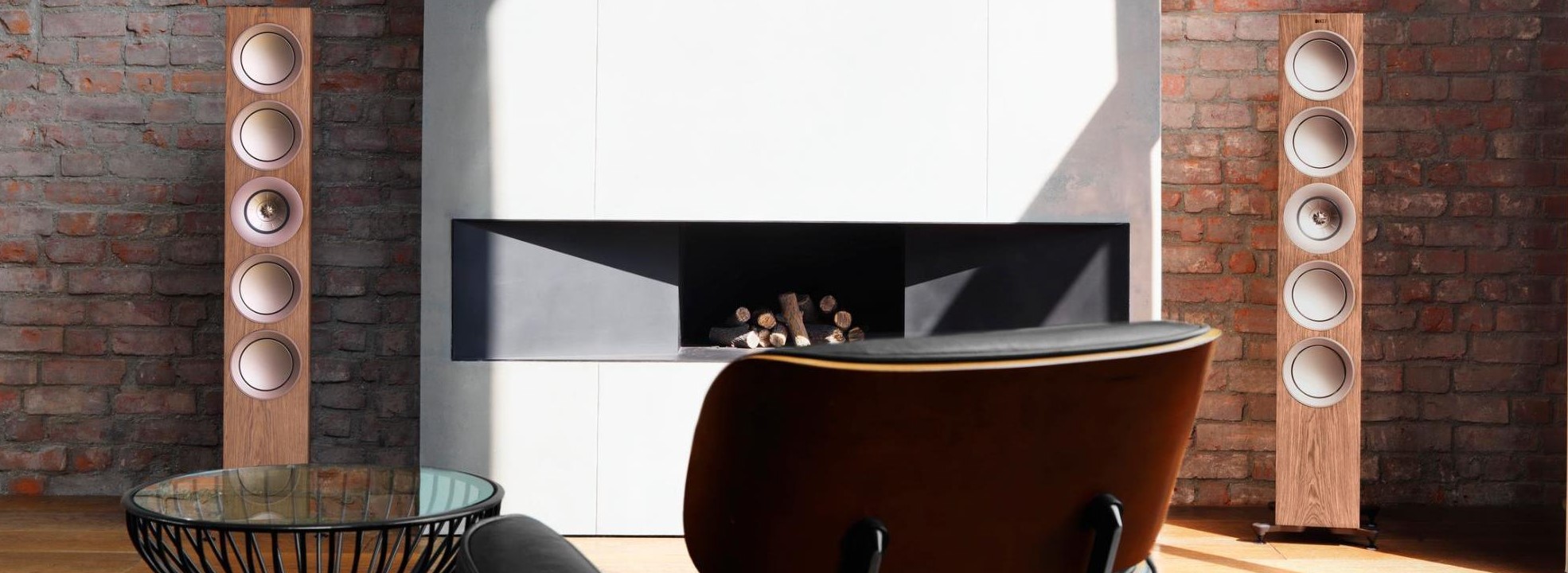
KEF launches the R Series Meta in early 2023, and the R11 Meta stands as the flagship model of the R Series floorstanders. Today, three years later, it floats in a very different landscape than the one it debuted into, and that is precisely where a revisitation becomes meaningful. We could say it is in a very interesting place where a model either matures into a modern classic or starts showing its age.
Since the model is already three years on the market, discounts often show up, and the R11 Meta slides into a very different value lane, closer to upper midrange money while still carrying high-end ambitions.
R11 Meta’s positioning also stays clear from a design standpoint. KEF builds this generation around its Uni Q array with MAT and frames the engineering goals around lower coloration, lower distortion, and controlled radiation into the room, aiming for a stable tonal picture beyond a single seat.
Build, drivers, cabinet, and technical highlights
Cabinet technologies
Let’s start with a little in-depth analysis of the build, drivers, and cabinet, and find the technical highlights that make this speaker stand out. Before reading this short resume that we did where we highlighted the most important and meaningful changes to the META generation, it is worth mentioning that the company goes much deeper in information within its own R Series Meta white paper.
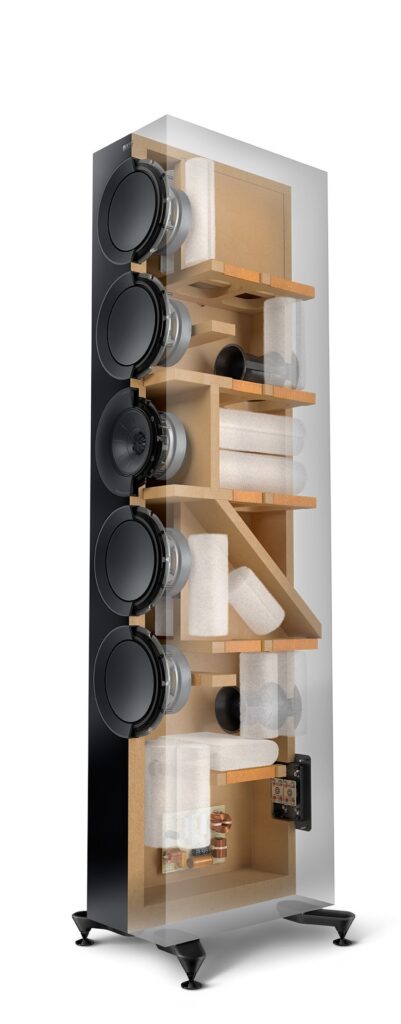
R11 Meta is a three-way bass reflex floorstander built around a coaxial Uni Q array, plus four dedicated bass drivers. It is a tall, slim cabinet, and that narrow front baffle plays a big role in how it integrates into normal rooms.
Every high-performance loudspeaker aims for a universal outcome: music must radiate from the drive units alone, while the cabinet and every supporting part should stay acoustically quiet. This way, the listener hears the signal and its spatial cues without any added coloration from the enclosure itself. With that information in mind, we can clearly say that the enclosure design carries the heavy lifting here, because the cabinet needs to stay inert while the drivers inject real mechanical energy into it.
At low frequencies, the whole structure wants to react against the motion of the bass diaphragms, so KEF decided to build the enclosure from thick panels, using 25 mm MDF, and increased that to 30 mm on the bottom face and the front baffle. As you can see from the cutout, the low-frequency drivers mount into the front baffle and receive an extra constraint at the rear via a transverse brace and a proprietary damping layer, effectively coupling the drivers to the mass of the enclosure.
At higher frequencies, cabinet panels behave less like static walls and more like resonant surfaces. Bracing helps by adding stiffness and mass, which reduces panel motion and shifts resonance modes higher in frequency.
Adding mechanical damping to a resonant system lowers how fast it can move at resonance frequency, much like a shock absorber controls how quickly a car suspension settles after a bump. To drain the energy out of cabinet panel resonances and reduce their amplitude, KEF used a viscoelastic damping layer. This is a well-known approach called a constrained layer damping: a second stiff layer constrains the viscoelastic layer, forces it to shear under vibration, and turns more of that motion into heat, increasing the damping effect.
KEF’s research found a more material-efficient implementation. Instead of lining the entire inside of the panels, the cabinet braces act as the constraining layer, while the viscoelastic damping material is applied only at the interface between panels and braces. This concentrates the damping where the energy transfer is strongest and delivers better results with less material.
Taken as a whole, the cabinet engineering in R11 Meta shows real scientific knowledge at work. Thick panels, a reinforced baffle and base, and a tightly integrated bracing network work together to keep stored energy under control. The clever part is how KEF combines stiffness with true energy dissipation, using constrained-layer ideas at the brace interfaces so resonances are not only shifted in frequency, but also reduced in strength. The enclosure then behaves like a calm, stable foundation that lets the drivers do their job with greater clarity and composure.
This is the kind of engineering discipline that makes revisiting the R11 Meta feel rewarding, even after three years on the market.
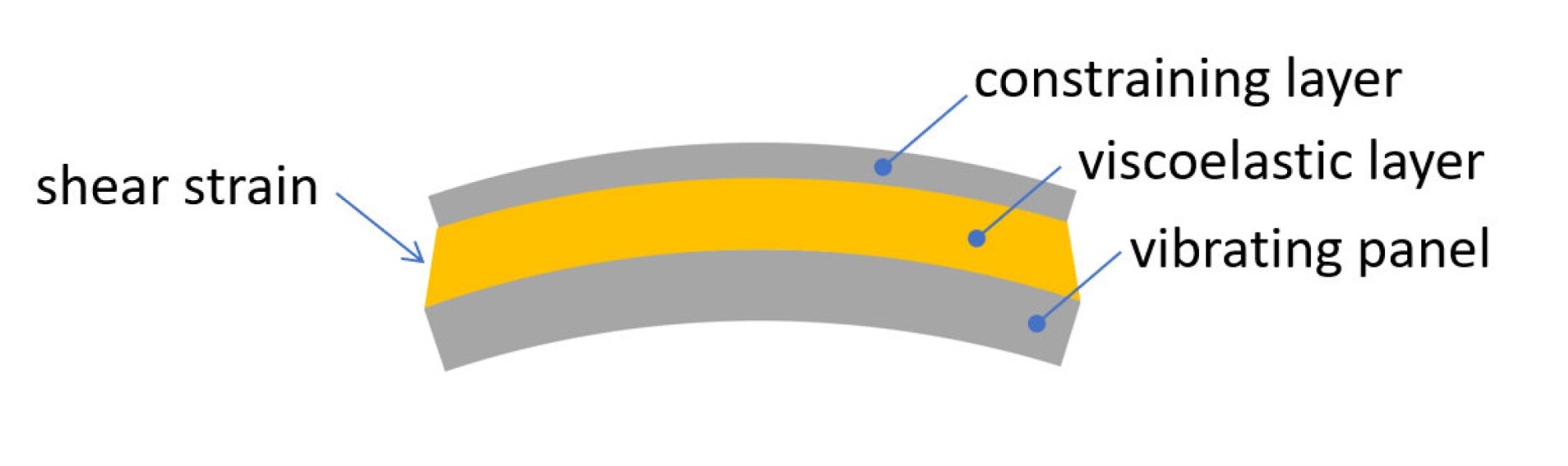
Diagram of a constrained-layer damping arrangement
This short enclosure overview only scratches the surface of the scientific breakthroughs KEF made with the launch. Cabinet structure, bracing strategy, constrained layer damping, damping of standing wave resonances, bass-reflex ports, all these are explained in a far more technical, research-driven way, with the kind of detail that becomes genuinely satisfying if you enjoy the science behind why a loudspeaker behaves the way it does. Give it a read if you have the time and curiosity.
New driver technologies
Let’s continue with a similar, shorter presentation on what makes the drivers special and unique, compared to the last iteration of the R series.
The story starts with a new Uni-Q® driver array that benefits directly from research done for Blade and Reference Meta, and KEF treats it as the platform that drives the rest of the redesign, including crossover work. Inside this Uni-Q® driver array, KEF highlights a new tweeter and tweeter motor with MAT, a completely new midrange motor with a low-distortion split top plate design, a flexible decoupling chassis, an ultra-low distortion midrange motor system, and a smaller, higher excursion midrange suspension. We will talk here in short about the MAT used behind the tweeter, and highlight the biggest change for the midrange portion of the driver.
For KEF, the breakthrough that defines this generation happens in a place most people never think about: behind the tweeter. The problem is simple: a tweeter dome launches sound forward into the room, but it also launches sound backward into its own cavity. That rear wave bounces around, meets hard boundaries, and part of it returns toward the dome. Once that happens, the tweeter is no longer working only with the electrical signal and the forward radiation, it is also dealing with a small, chaotic acoustic environment behind it.
KEF’s answer is to turn that cavity into an absorber. Right behind the dome, they place an 11 mm deep disc, a compact structure built from 30 channels of different lengths. KEF chose to name this generation of speakers after it, that’s how important it is. Each channel acts like a tuned absorber over a narrow band, and KEF tunes them so their absorption overlaps, reaching near complete absorption above 620 Hz. These channels “progressively swallow” all the frequencies. You can see a graphical representation of the technology in the video below.
The elegant part is how much absorption they squeeze into how little space. KEF describes the MAT disc as only 11 mm deep, yet comparable to the performance of a much longer tapered tube absorber that would be difficult to fit inside a speaker.
The new tweeter brings a clear step forward over the previous generation. The older R11 tends to spotlight the aluminium dome character, with a touch of metallic sheen that can sound sharp, edgy, and cold, and on certain recordings and systems, push sibilance forward.
The new R11 Meta tweeter presents treble in a smoother way. With MAT controlling the rear wave behind the dome, the top end flows with a more natural tone. Cymbals and upper harmonics feel less etched, and that recognizable metallic coloration becomes far less apparent.
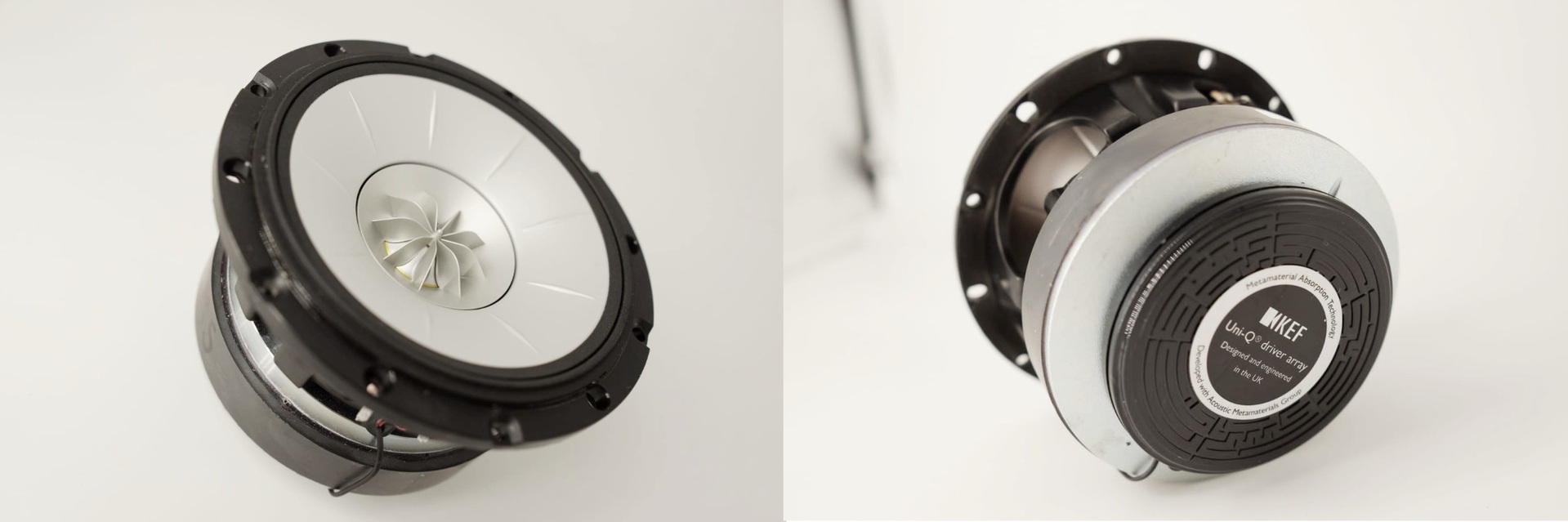
KEF Uni-Q® driver array
Now for the midrange, KEF treats it as the heart of the speaker, so it borrows the motor concept straight from Blade and Reference Meta and adapts it for the R Series. The goal is very specific: keep the driving force stable as the cone moves, and keep the voice coil inductance both low and steady across that movement. Those two things matter because once the force factor and inductance start changing with excursion, the midrange begins to generate harmonic and intermodulation distortion. This type of distortion reshapes voices and instruments and makes complex passages feel bloated, less clean.
The same basic physics that makes MAT so valuable behind a tweeter also applies here. A midrange cone radiates forward into the room and backward into its own cavity, and that rear energy can interact with the cone and motor structure on its way back. KEF focuses its midrange effort on motor linearity and vibration control, yet an absorption solution for the midrange rear wave is not part of this redesigned story. A tapered tube absorber remains an inspiring reference point, since it can be implemented behind midrange drivers too, not only tweeters.
That is a future-facing thought rather than a complaint. If KEF ever manages to adapt the same metamaterial idea to fit the space and airflow needs of a midrange, it could become a substantial next step, because cleaning up the rear wave environment in the midband can pay dividends in transparency and ease. We are genuinely curious to see if that is where the next generation goes.
Now to return to the effort spent on improving the midrange motor wich is substantial, to say the least. The top plate uses an unconventional split design, formed from two sections separated by an air gap. A short voice coil moves within that structure in an underhung arrangement, a geometry that keeps the motor behavior more consistent through the stroke.
Inside that gap sits a copper ring aligned with the centre of the voice coil. This is a purposeful choice, aimed at keeping inductance and its modulation under tighter control, which directly supports lower THD and IMD in the midrange. The fact that KEF goes for a copper ring instead of a cheaper alternative also signals a design built around care and refinement, with little cost savings in mind.
We would like to explain what the ring is doing in the first place and the important differences between the materials used. A conductive ring in the gap or around the pole piece acts like a shorted turn. When the voice coil current changes, it creates a changing magnetic field. That changing field also induces currents in the ring. Those induced currents generate an opposing field that counters the change.
Copper’s resistivity sits around 1.68 × 10⁻⁸ Ω·m, while aluminium is closer to 2.82 × 10⁻⁸ Ω·m, so with the same ring geometry, aluminium ends up at roughly 1.7 times the resistance. In practical terms, that means a copper ring can support roughly 1.7 times stronger induced currents for the same motor event, giving it more authority in stabilising voice coil inductance and its modulation with cone movement. Higher conductivity lets stronger induced currents flow in the ring for a given changing field, so the ring can counter inductance variation more effectively.
The result is a motor whose inductance behaves more predictably, with less variation versus frequency and versus cone position. That is one of the direct routes to lower THD and IMD, especially in the areas where the ear is most sensitive.
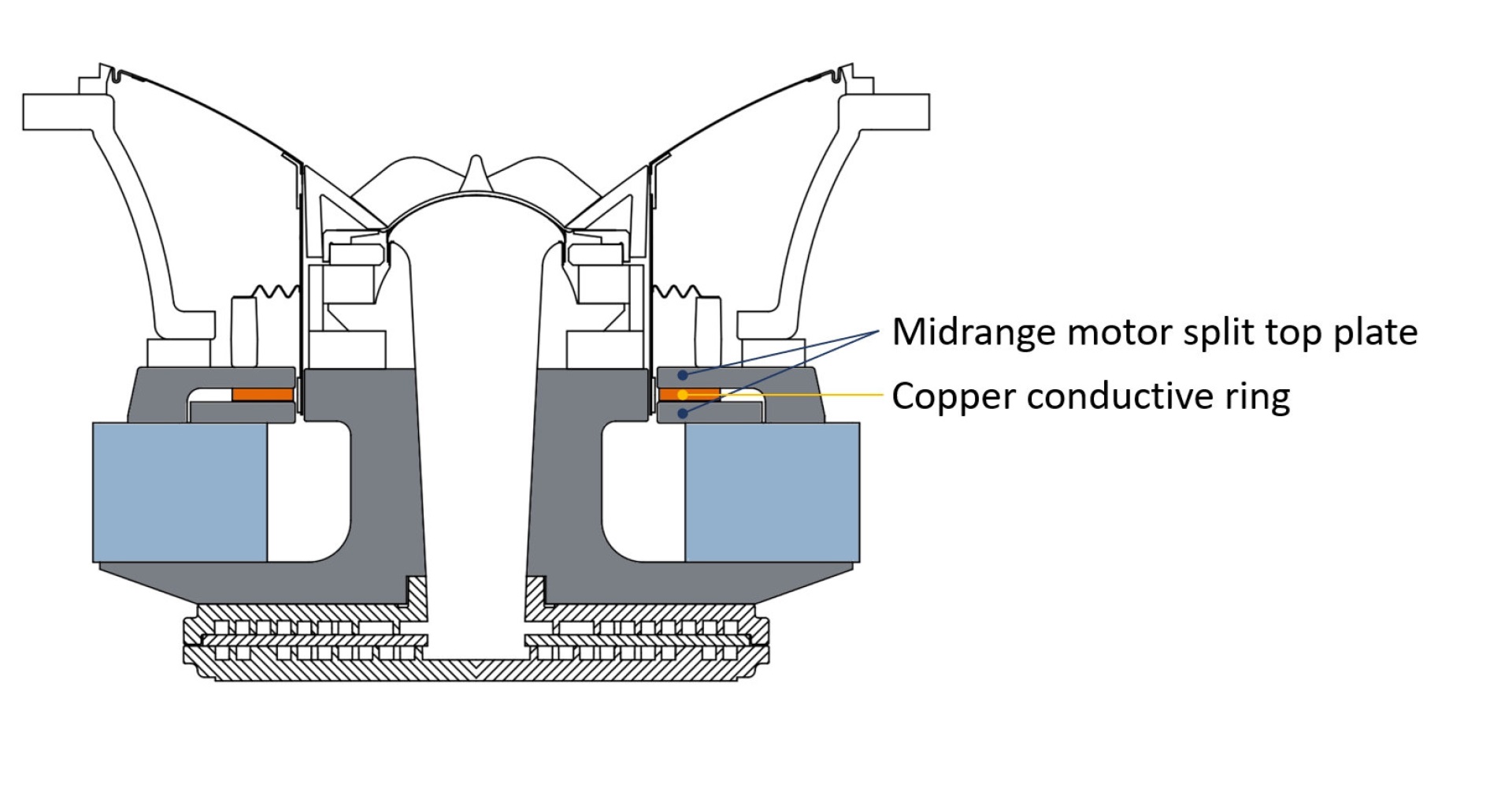
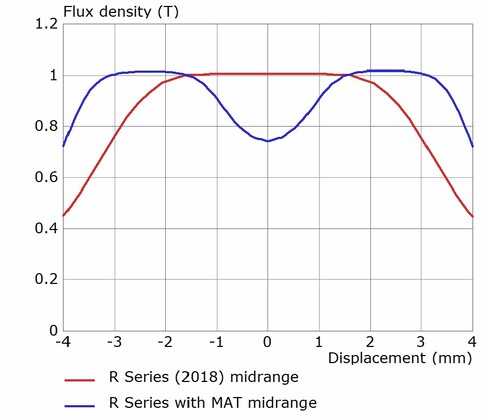
This new split top plate design reshapes how the ferrite magnet’s flux is distributed in the gap. Instead of concentrating the strongest field at the centre of the voice coil, it shifts more of that flux toward the coil’s ends. KEF describes the result as an M-shaped flux density profile, B(x), with a dip around the voice coil’s rest position. This reshaped flux profile translates into a flatter BL(x) across the voice coil’s working travel of plus minus 2 mm compared to the previous motor. A flatter BL(x) means the motor applies a more consistent force as the coil moves, so the driver’s motion tracks the input signal more faithfully instead of subtly changing character with excursion. KEF illustrates this directly in the BL(x), where the new motor holds a more even curve through the usable stroke.
We chose to capture only a small slice of what KEF changes in the midrange portion of the R Series Meta. The motor geometry, the split top plate flux shaping, the copper ring used for inductance control, and the way BL(x) is kept flatter through the usable stroke are the kinds of details that show KEF has treated the midband as a true centre of the loudspeaker, where realism is won or lost. It also explains how the company builds improvements as a chain of small, measurable decisions.
If you enjoy this level of engineering detail, KEF’s own R Series Meta white paper goes much deeper. It expands the reasoning, shows the supporting measurements, and connects the mechanical choices to the distortion mechanisms they target. It is a deeply technical read, and it rewards anyone who wants the full story behind how this Uni Q midrange evolves in the Meta generation.
The midrange is where we heard the most meaningful step forward versus the previous generation. The new R11 Meta midrange comes across more alive and present, with a cleaner, more intelligible core that makes voices and instruments feel closer and more resolved. The older version sat a touch further back by comparison, with a slightly more reserved midband perspective. On complex passages, the previous generation midband bloated, lost grip, and blurred separation, making instruments bleed into each other. It struggled with complexity and lost articulation. It really was the Achilles heel of the old platform, and KEF clearly put serious engineering effort into fixing it in the Meta generation.
The low-frequency section feels like the least progressed part of the R11 Meta package. Compared to the major work done around the Uni-Q® driver, the bass system reads as the area that receives the smallest step forward, and it shows in how the speaker handles impact and definition. Extension is there, and it is usable, but the bass character leans more toward weight and fullness than outright grip, articulation, and stop-start control, which makes the low end the most vulnerable part of the overall performance.
Even though KEF describes the woofer motor as a highly saturated undercut pole design, our impression is that the low-frequency section still feels like the area where the engineering ambition stopped earlier than it did elsewhere in the speaker. A simple conductive ring in the motor, even an aluminium one, is a well-known and widely used tool for lowering inductance and its modulation, which can help reduce distortion and tighten subjective control. The fact that this kind of straightforward motor linearization does not appear as a feature in the bass driver portion of the white paper supports the feeling that KEF’s main focus lay on the Uni-Q® driver array, while the bass section played a more conservative role in the overall design narrative.
If KEF had pushed the woofer motor linearisation further, even with a straightforward approach that targets inductance behavior and its modulation, the whole speaker would likely feel more balanced. Not necessarily louder, but more controlled, with cleaner bass textures and a more confident sense of timing.
At the same time, we understand how product lines are built. Price gaps between ranges need to remain meaningful, and that differentiation has to show up somewhere in hardware and performance. KEF seemed to draw that line at the bass section. The Uni-Q® driver array and its supporting technologies receive the spotlight and the deeper engineering push, while the low-frequency system feels like the area where compromises stay more visible. In that context, the R11 Meta reads like a speaker that protects the core of the music first, and accepts a more conservative approach in the woofers to keep the model in its intended place within the lineup.
This design approach also puts more responsibility on the amplifier. To extract real tightness and articulation from the bass section, the partnering power amp needs strong control and composure, especially when the music gets dynamic, and the room starts to saturate the low-end frequencies. Keep that in mind throughout the review as R11 Meta’s low frequency performance becomes far more dependent on amplifier authority, current delivery, and overall grip than the midrange and treble portions.
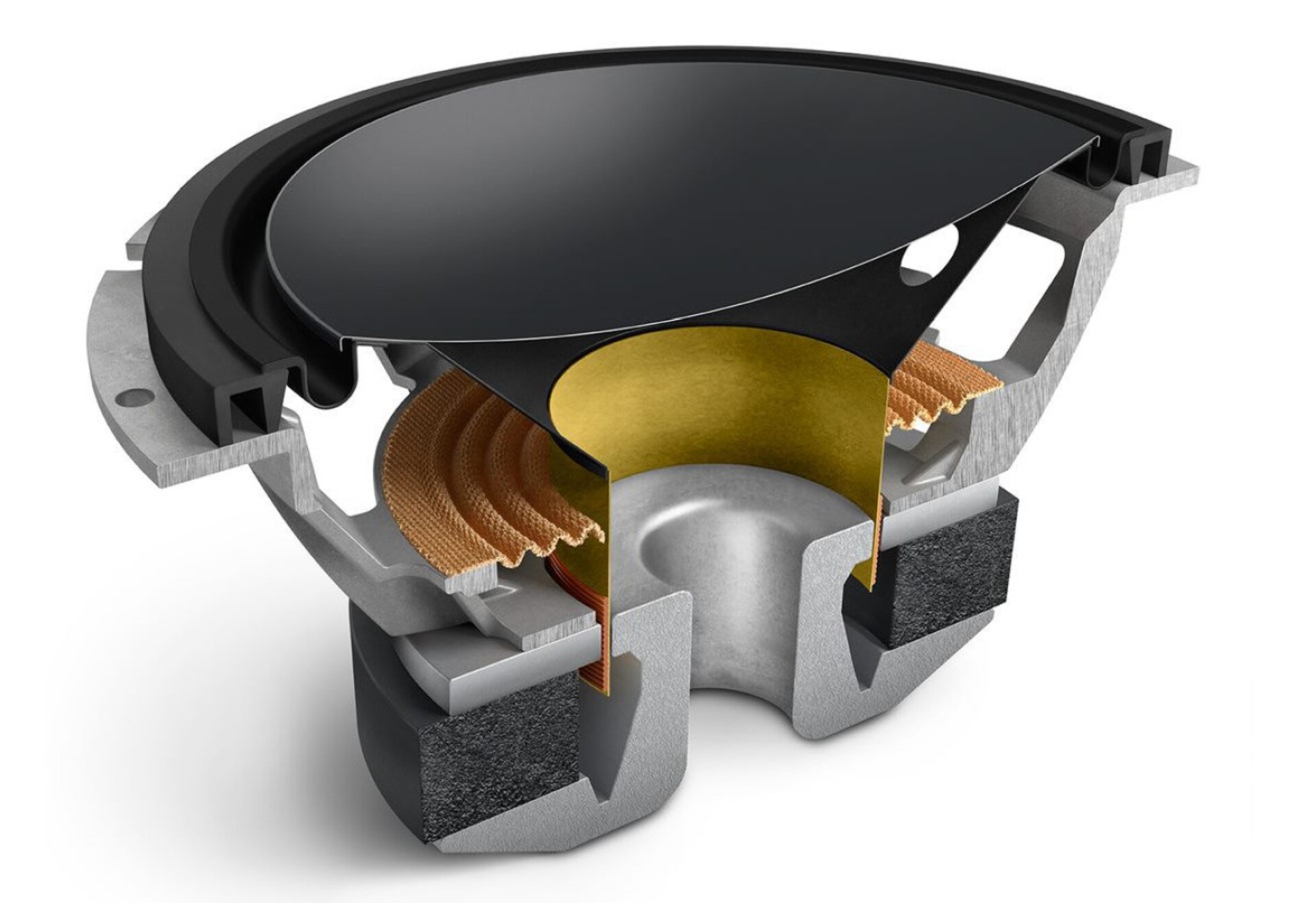
R Series low-frequency driver
Measurements
No loudspeaker review feels complete without a frequency response graph. Manufacturers measure in an anechoic environment and tune the design toward the most linear response possible, because that is the cleanest way to judge the speaker itself, without the room adding its own fingerprint.
Real-life listening happens in real rooms, though, and rooms vary as much as people do. Dimensions, construction, furniture, placement, and listening distance dramatically shape the final tonal balance, which means the same speaker can sound meaningfully different from one room to another, even in the same home.
That is also why we still include our measurement. It reflects a real-life scenario. The speakers used in an actual room, at an actual listening position, with realistic placement. It gives a practical reference that can be extrapolated to normal usage, even if your exact curve will differ, especially in the lower frequencies.
And we come to a very important note before reading the graph. The bass region, roughly 0 to 200 Hz, is heavily dominated by room modes and boundary loading, so it deserves the least attention when judging the speaker itself. The more valuable part is what happens above that region, where the room influence becomes more manageable, and it is where, in this case, we see something genuinely impressive: the overall linearity and smoothness of the R11 Meta through the midrange and treble in our setup.
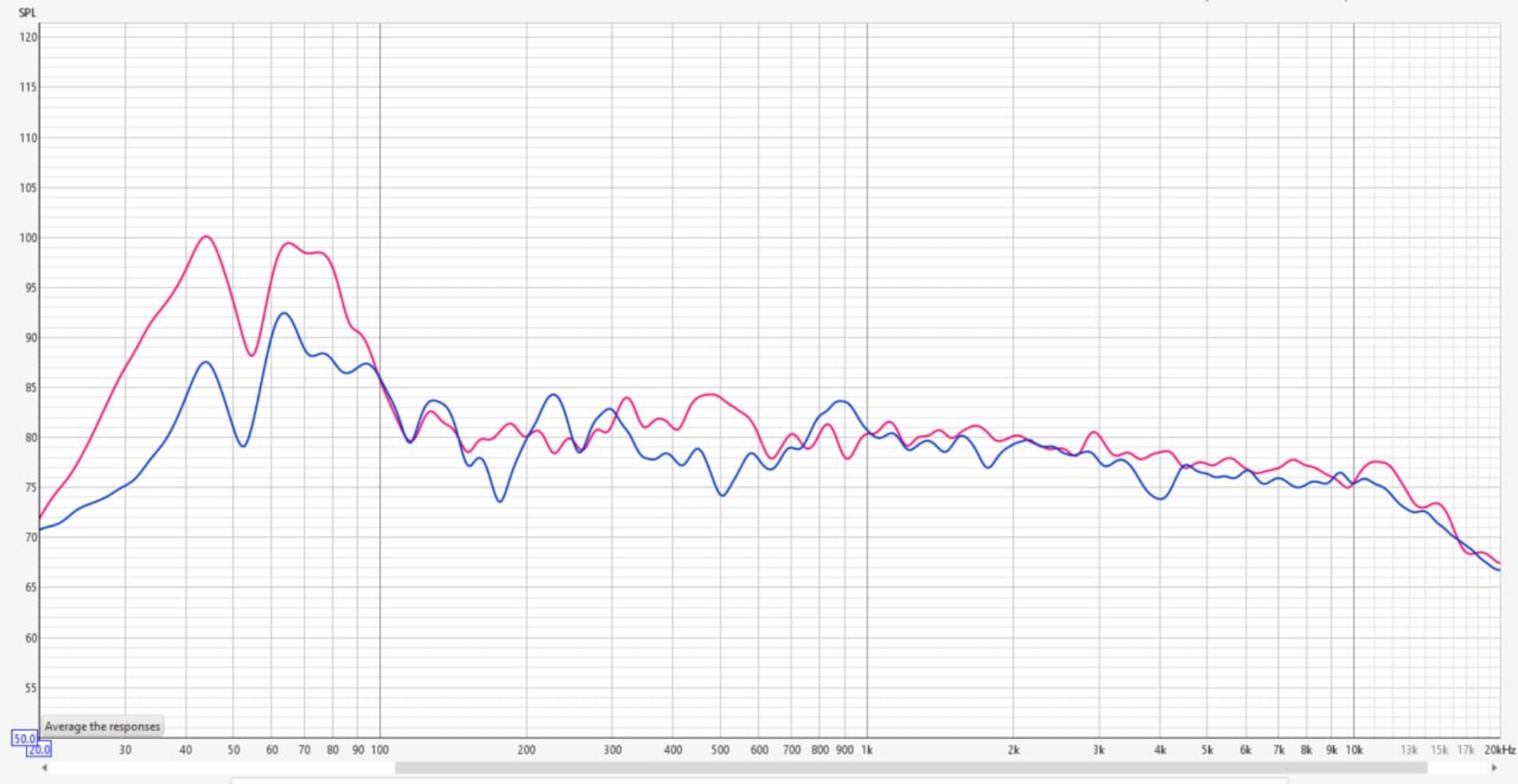
Kef R11 META off-axis in-room frequency response (red – 50 cm off wall; blue – 150 cm off wall)
The graph shows two in-room measurements taken at the same listening position, with the speakers off-axis, with one major change: distance from the rear wall.
The red trace is the measurement done with the speaker about 50 cm from the wall. It shows a clear rise in bass energy, especially from roughly 30 to 90 Hz. Ignore the big tip that is caused by a room node. You can clearly see more output and more pronounced peaks, compared to the blue trace. This is exactly what boundary gain and room loading tend to do when a floorstander moves closer to a wall. In listening terms, this usually translates into more weight and a bigger foundation, but with a higher chance of boominess, note thickening, and lagging on certain bass lines.
The blue trace is the measurement done with the speaker at about 1.5 m from the wall. It looks noticeably more restrained in the low end. Bass amplitude is lower, and the peaks are less dominant, making the bottom end easier to keep in control and easier to integrate. Many rooms reward this placement with cleaner bass texture, even if the first impression is less physical slam.
The most important takeaway sits above roughly 200 Hz. From there upward, the two traces track each other surprisingly closely. That tells us two things. First, the rear wall distance mainly reshapes the low-frequency region, as expected. Second, the speaker remains impressively consistent through the midrange and treble in our setup, with relatively small deviations and a very predictable overall balance. That supports the idea that the Uni Q based mid and high frequency driver is very well implemented.
In practical terms, the good news is that the rear wall distance becomes a bass tuning tool rather than a full-range tonal change. At 50 cm you gain weight and room pressurisation, although with a higher risk of boominess. At 1.5 m you trade some mass for cleaner definition, while the rest of the spectrum remains stable in both placements.
Setup, room, placement, amplification, and sources used
Our evaluation chain sits well above the price bracket of the KEF R11 Meta, and we mention that from the start because it frames everything you will read ahead. The source and amplification used here aim to remove limitations from the electronics side, so we can see the maximum ceiling of these speakers.
- Amplifiers: Moon 861, Tsakiridis Devices Aeolos Ultra, Burson Timekeeper Voyager
- Digital Source: Moon 891
- Power Cables: Roboli Power5200
- Interconnects: Roboli XLR 2100
- Speaker Cables: Roboli HP8000
Before we begin talking about the sound itself, as delivered by these speakers, we would like to show you the frequency response of the KEF R11 Meta as it behaves in our room, measured at the listening position after we settle on the final placement, toe in, and listening distance. We include this graph as a reference point for everything that follows, because the speaker you hear is always the speaker plus the room, and even small changes in distance to the rear wall, side wall spacing, and toe in can reshape the tonal balance more than most people expect.
The measurement also helps anchor subjective impressions in something repeatable. It shows where the room adds energy, where it takes some away, and how smooth or uneven the transition looks through the bass, midrange, and treble in our specific setup. It does not replace listening, and it does not attempt to tell the whole story about dynamics, texture, timing, or imaging, but it does explain why certain parts of the spectrum feel more pronounced, why some notes carry more weight, and why some recordings sound a touch brighter or a touch calmer than expected.
In short, this graph is our context map. It keeps the review honest, it makes our room influence visible, and it gives you a clearer idea of what the KEF R11 Meta is doing here, before we move into the listening chapters.
Bass performance, extension, articulation, dynamics, impact, SPL Limits
KEF rates the R11 Meta at 46 Hz to 28 kHz within ±3 dB, and that already hints at the voicing priorities of the model. In our room, the speakers reach about 35 Hz in a usable way. Bass character leaned toward size and presence, with speed and impact taking a step back, even when music asks for snap. The speaker fills the room, moves air, and creates a physical low end that you can feel in your clothes, yet the leading edge of bass notes arrives with a softer outline.
Room interaction also plays a big role here. At times, the low end swelled and thickened, taking on a slightly bloated, boomy quality that required careful placement of the speakers. After many repositionings and trying different amplifiers, we reached the same conclusion every time: only a strong amplifier brought the control needed to keep the bass section in check. These speakers thrive under an amplifier that can grip the woofers firmly.
Articulation exists, and it is a quality you notice once you start listening for it. The R11 Meta can convey layers in the low end with a decent sense of structure, but it does so subtly. It does not underline bass detail or push it forward in the mix.

Dynamics are another part of the story. These speakers play powerfully, and they reach their satisfying zone at higher drive levels. They come alive when fed proper current and voltage, with the bass gaining shape, confidence, and a faint impact as the volume rises. At low listening levels, the bottom end feels less convincing, almost like the speaker is waiting for the system to wake it up. Once pushed, they held together well, and distortion stayed low until we reached their practical limits, where output remained strong, but headroom stopped feeling endless.
Let’s start the listening session with emphasis on the foundation of a speaker. We used Yello’s Till Tomorrow specifically because Boris Blank’s low-frequency arrangements are deep, layered, and demand both extension and control in equal measure. The R11 Meta delivered the weight and physical presence the track calls for, the room was pressurized well, and the low-frequencies gave the music its intended scale and authority. The bass lines carried good physical body, and the overall low-end picture felt satisfying and complete at moderate to higher listening levels.
Where the track also revealed the character we described earlier was in the precision and speed of the bass lines themselves. The low frequency information arrived with a slightly rounded leading edge, the kind of presentation that prioritizes fullness and mass over the tight, snappy articulation that makes every bass note feel carved and instant. On a track like Till Tomorrow, where the bass is both rhythmic with an addition of textural elements, the difference between weight and grip becomes noticeable. The bass was always present, always musical, and always enjoyable, yet it stopped short of the kind of locked-in, percussive authority that would make it better at this level.
Midrange, timbre, and coherence vs the older generation
If the bass section is where the R11 Meta reveals its compromises, the midrange is where it reveals its soul. From the very first serious listening session, we understood why KEF placed its deepest engineering effort here. The midrange arrives with a presence and conviction that the older generation could only hint at, and the difference lands immediately, on the first track, and keeps landing week after week.
We opened with Nils Lofgren’s Keith Don’t Go, the famous live acoustic guitar performance that has earned its place as a reference staple in listening rooms for decades. The guitar body came through with good enough texture and natural warmth, the strings had bite and clean, satisfying decay, and Lofgren’s voice sat centered in the room with good presence and an immediacy that felt live. The midrange stayed composed throughout the song, never hardening, never pulling back. It just delivered, cleanly and with full conviction.

Moving to something far more demanding, we put on Patricia Barber’s Company, a track whose vocal presence exposes any midrange coloration almost instantly. Barber’s voice, intimate and slightly dark, sat in front of the stage with remarkable clarity. Consonants and vowels arrived clean, sounded natural, and the space around her felt 3-dimensional. A composed, present, and tonally faithful midrange portrait.
Massive Attack’s Teardrop, featuring Elizabeth Fraser on vocals, pushed the midrange into more complex territory. Fraser’s voice floats above a detailed arrangement of electronic pulses, plucked bass notes, and layered percussion, and the R11 Meta kept everything reasonably separated and weighted throughout. Fraser’s vocal arrived with that ethereal quality the recording intends, while the instrumental bed stayed organized beneath it. On the busiest passages, however, where the arrangement thickens and the bass pulses push harder, the midrange gave up a small degree of that crisp separation, the layers staying intelligible but losing some of their individual definition and air.

Salvatore Licitra’s Je crois entendre encore brought a completely different demand, a sustained operatic tenor voice with real power and harmonic complexity. Licitra’s voice carried both the gentleness and the authority the piece requires, with upper harmonics that stayed clean and natural through most of the performance. Where the voice rose to its most powerful passages, we noticed the midrange staying composed but pulling slightly inward dynamically, delivering the notes with accuracy while stopping just short of that last degree of physical presence and chest resonance that truly great midrange performers manage to convey. Still, the emotional weight of the performance came through with conviction, and we found ourselves absorbed from start to finish.
Treble, air, sparkle, and long-term listening comfort

We always begin treble evaluation with Govi’s Euphrates, and the R11 Meta made its character clear from the opening notes. The guitar’s upper harmonics were smooth and had a natural quality, every plucked note had a clean and defined edge, and the decay trailed into silence without any form of glare. Timbral accuracy here was good, the instruments sounded like wood and steel, warm and organic, with no metallic tint imposed over the top. Sibilance was absent, and extended listening on this track never once suggested fatigue was coming. Where we leaned forward slightly was in the very last layer of air around the instrument, that fine, almost luminous halo that the best tweeters cast around acoustic guitars in a well-recorded space. The R11 Meta reached close, but that final gossamer quality remained just outside its grasp. To be fair, the speakers that fully deliver that sensation sit in a very different price and engineering conversation, so we have to note the observation without turning it into a criticism.

Diana Krall’s Temptation confirmed what Govi started. The brush strokes on the had the appropriate texture, the ride shimmer stayed natural and proportioned within the mix, and Krall’s vocals presented characteristic warm intimacy entirely free of sibilance, even on her most forward consonants. The treble served the recording faithfully and stayed in its lane throughout. Again, the sense of air around Krall’s voice and the upper decay of the piano notes felt slightly contained compared to the most open, extended tweeters we have heard at higher price points, but the trade-off arrived in the form of a presentation that remained genuinely pleasant and fatigue-free across a full evening of listening.
With Soen – Huntress, from their newest studio album Reliance, we quickly understood what the R11 Meta does best, and where it asks for a stronger chain. The track started with that tension Soen does so well, and the speaker immediately built a wide, stable canvas. The guitars sat firmly in place, the vocal line stayed centered and carved, and the room around the performance felt organized and believable. We heard the midrange step forward with that alive, present character that defines this Meta generation, making the voice feel more tangible and forward, much better than the held back characteristic we remembered from the older R series voicing.
As the arrangement thickened, the R11 Meta kept the layers readable. The Uni Q coherence helped a lot here, because the transition from vocals to guitars to cymbals stayed locked together, so the song never turned into a blurred wall of sound. The soundstage also had that pinpoint quality we already associate with this platform, with images staying tight even when the track became more dynamic.
However, the low end told the other half of the story. Huntress relies on drive and momentum, and the R11 Meta delivered weight and scale, yet the kick and bass line felt rounder than we wanted. It moved air, it filled the room, it gave the song body, but the fastest punch and the most athletic stop-and-start control depended heavily on the amplifier. With a strong amp behind it, the bass line gained more discipline and the groove tightened up, yet the speaker still leaned toward mass over snap.
Up top, cymbal work and the sheen of the mix came through in a smoother, more relaxed way. We heard plenty of information, yet the treble stayed composed and natural, which helped the track remain listenable at higher levels. The song grew in intensity without turning sharp, and that made long sessions with progressive rock feel effortless.
Huntress ended up highlighting the personality of the R11 Meta in one go. It excelled at coherence, layering, and vocal presence, it painted a holographic picture, and it carried real power when pushed. At the same time, it reminded us that the bass section asks for authority and grip from the amplifier if we want the tightest, most percussive version of this track.
Soundstage, imaging, disappearing act, dynamics
The soundstage and imaging performance of the R11 Meta is where this speaker makes its most immediate and lasting impression. The coaxial Uni-Q driver places the tweeter at the acoustic center of the midrange cone, creating a true point source that radiates sound from a single, coherent origin. The result is a holographic, three-dimensional image that somehow locks instruments and voices into precise positions with a confidence and stability that actually becomes the defining sound signature of the speaker, immediately felt, immediately recognizable, and impossible to ignore.

Trace Adkins’ I Can’t Outrun You opened our dedicated soundstage session. Adkins’ baritone voice materialized tall, well-defined at the center of the stage, surrounded by the acoustic space of the recording with nice depth. The backing arrangement spread naturally to the sides, each element sitting in its own well defined position. The speakers managed to almost disappear from the room, leaving only the performance hanging in the space between and beyond the cabinets.
James Malikey’s Solar Eclipse pushed the spatial capabilities into even more revealing territory. The layered electronic textures and carefully positioned ambient elements opened up into a wide, deep field extending beyond the physical boundaries of the cabinets, which we really enjoyed and appreciated, since this is one of the traits we want and look for when analyzing the soundstage prowess of speakers. The image was clearly defined and holographic even as the arrangement grew denser, each layer holding its position with precision and ease, something we pay close attention to. The capability to hold the 3 dimensionality and space coherent even when layering becomes really dense is something we often test and the R11 Meta managed to pass this test, convincingly.
Terje Isungset’s Fading Sun offered one of the most demanding spatial tests of our entire session. Isungset’s use of natural ice instruments and unconventional percussion creates a recording where the acoustic space is as much a part of the performance as the music itself. The R11 Meta rose to the occasion beautifully, spreading the soundstage wide and deep, with individual sounds placed at clearly distinct distances from the listening position. The three-dimensional quality that defined our earlier sessions remained fully intact here, the holographic presentation holding its shape and coherence. The low frequency elements, subtle and textural, never felt bloated, carried good body and physicality, dare we say weight and integrating naturally into the spatial picture. The track is also known for a particularly hard to render low-bass passage, and the R11 Meta handled it with more composure than we honestly expected. We heard the low part clearly and with good definition, a genuine and pleasant surprise given everything we noted about the bass section earlier. We would have loved a touch more kick and a cleaner separation between the chest thump and the deeper rumble beneath it, but the fact that the speaker managed to actually deliver that passage as convincingly as it did stayed was a highlight in our book

O’Death’s Bobby Bass, with Greg Jamie’s raw, driven vocal delivery and the band’s dense folk arrangement, brought both a soundstage and a bass challenge in equal measure. The ensemble spread across the stage in a believable and organized way, each instrument occupying its own clearly defined position within a coherent picture, the holographic quality of the Uni-Q holding firm even as the arrangement pushed harder and the energy of the performance rose. Greg Jamie’s voice sat tall and present at the center, the surrounding instrumentation fanning out naturally to the sides with good width and depth.
The upright bass that gives the track its name carried a nice, somewhat physical presence, the low frequency foundation staying pretty articulate. That slightly rounded, full character we noted throughout our bass sessions appeared here again, prioritizing warmth and weight. At the track’s most intense moments, where the performance surged and demanded the last reserve of dynamic headroom and bass grip, we felt that familiar pull of wanting just a touch more authority and definition. A pleasant and engaging listen from start to finish regardless.

Three more tracks reinforced this Uni-Q sound signature in a way that left a clear and lasting impression. Jesse Cook’s Cancion Trieste placed the guitar in a strikingly real and physical space, the instrument hanging in the room with a presence and precision that felt almost tangible. Kiran Murti’s Magical India opened the stage wide and deep, the layered arrangement spreading across the soundstage with a clarity and separation that highlighted just how coherent and stable the point source presentation remains even on complex, richly textured material. Angus Stone’s Bella brought the most intimate of the three portraits, Stone’s voice and guitar sitting in a small, close, beautifully defined space that the R11 Meta rendered with a realism and dimensionality that stayed with us long after the track ended. Across all three, the same quality emerged consistently, that pinpoint holographic precision that the coaxial driver delivers as a natural consequence of its design, and that by this point in our sessions had become the most immediately recognizable and defining characteristic of these speakers.
Conclusions
If you have read this far, you already formed a pretty clear picture of what the KEF R11 Meta sounds like, what it does with conviction, where it holds back, and what kind of listener it was built for. The sound signature is consistent and coherent from top to bottom, a speaker that prioritizes spatial realism, midrange realism, and long-term listening comfort more than outright excitement and immediate drama. That consistency is both its greatest strength and its clearest personality statement.
The Uni-Q driver defines the experience more than any other single element. The holographic, pinpoint imaging, and the almost perfect disappearing act it enables are qualities that stay with you, the kind that make other speakers feel less focused and less real once you have lived with them for a few weeks. The midrange has significantly improved over the previous generation. It delivers voices and instruments with a presence and coherence that merits praise. The treble, smooth and well timbred, serves the music well across long sessions without ever becoming a source of fatigue.
The overall voicing of the speaker sits on the neutral side with a subtle tilt toward the brighter spectrum, away from a dark or warm tuning. That brings clarity and air, and it also puts a spotlight on partnering electronics. Keep in mind that a lean, forward, analytical DAC and amplifier combo steered the result toward a cooler, more clinical presentation. As the R11 Meta style was closer to a neutral one, we found that electronics with richer timbre and a fuller midrange kept the sound open yet closer to our hearts, gaining naturalness.
The bass section remains the area where the speaker asks for the most patience and careful system matching, and especially positioning within the room. It demands a strong amplifier, rewards good placement, and time spent meddling with them. It will never be the highlight of the presentation, but in the right system, it stays out of the way well enough to let everything above it shine.
For the final part, we would like to thank AVstore for providing the KEF R11 Meta for this review and for the smooth, professional support throughout the process. Since this model has been on the market for three years now, availability and pricing can be more flexible than at launch, so it is worth asking directly about current discounts and package deals, because meaningful savings can be on the table depending on finish, stock, and timing. This precious detail adds additional value to an already strong package offered by KEF with this model.
Pros
- Holographic, pinpoint imaging is one of the best in this category
- Midrange is the most significant generational leap, alive, present, clean, and coherent
- Treble is smooth, well-timbred, and completely free of sibilance, fatigue-free across long listening sessions
- Disappearing act is convincing and consistent, the speakers vanish from the room and leaves only the music
Cons
- Bass performance requires patience and careful system matching, offering more with a strong amplifier and thoughtful placement than it gives away freely
- Performs best at moderate listening levels, where the soundstage, dynamics, and overall presentation open up fully and reveal the speaker’s true character
Technical specifications:
- Design: Three-way speaker system in a bass reflex enclosure
- Speakers: Uni-Q driver:
- Tweeter: 1 x 25 mm vented with aluminum dome diffuser
- Midrange: 1 x 125 mm with aluminum diffuser
- Woofer: 4 x 165 mm with aluminum cone
- Reproducible frequency range (- 6 dB): 30Hz – 50kHz
- Frequency response (±3 dB): 46Hz – 28kHz
- Crossover frequencies: 400Hz, 2.9kHz
- Recommended amplifier power: 15 – 300 W
- Sensitivity (2.83 V/1 m): 88 dB
- Harmonic distortion 2nd and 3rd harmonics (90 dB, 1 m): <0.4% 120Hz-20 kHz
- Maximum sound pressure: 113 dB
- Resistance: 8Ω (min. 3.2Ω)
- Weight: 37.7 kg
- Overall dimensions (HxWxD): (with decorative grille and terminals) 1249 x 200 x 383 mm
- Overall dimensions (HxWxD): (with decorative grille, terminals and base) 1295 x 310 x 383 mm