The Graphic Artist
Almost all great audio companies have been founded by an engineer; it is so true that we never think about it, and it accounts for much of the equipment we have to deal with. The engineer begins by working out the circuit and only then puts it into a box; the box is merely a container, a result, the final decision rather than the first one. That is the reason our hobby takes the form it does. We have black rectangles with heat sinks. We have come to interpret the fascia’s simplicity as a guarantee of the sound within. We tell ourselves that we like it that way. In fact, we have merely agreed not to mention it.
Saul Bernard Marantz was not an engineer; he was a freelance graphic artist.
I have always been familiar with the name (Marantz), like everyone else, and yet I had never realized that before. For a long moment I was brought to a standstill when I came across it, and then my entire understanding of the brand was rearranged. He was a commercial artist, a man whose livelihood was based on drawing, one who thought in terms of typefaces, proportions, and the precise weight of a line, and who worked from his house in Kew Gardens, New York, because he was so deeply dissatisfied with the equipment available to him that he decided to build his own.
I would like to mention a possible “conflict of interest”. Throughout my professional career, I have done the same kind of work Saul Marantz did before he ever picked up a soldering iron—namely, graphic and interface design, the everyday, unglamorous sort of job involving deciding where things should be and why. So when I found out this fact, I didn’t regard it as merely an interesting piece of information; rather, I saw it as validation, and soon afterward as a challenge. For if a designer had founded the company, then a Marantz product has a duty which most audio equipment does not carry; it cannot be beautiful at the expense of being good, and it must be both, or else the entire seventy-four-year foundation of the company collapses.
This leads me to the huge, very heavy box, colored dark petrol blue with orange lettering, which I had on my floor for two days before I opened it.
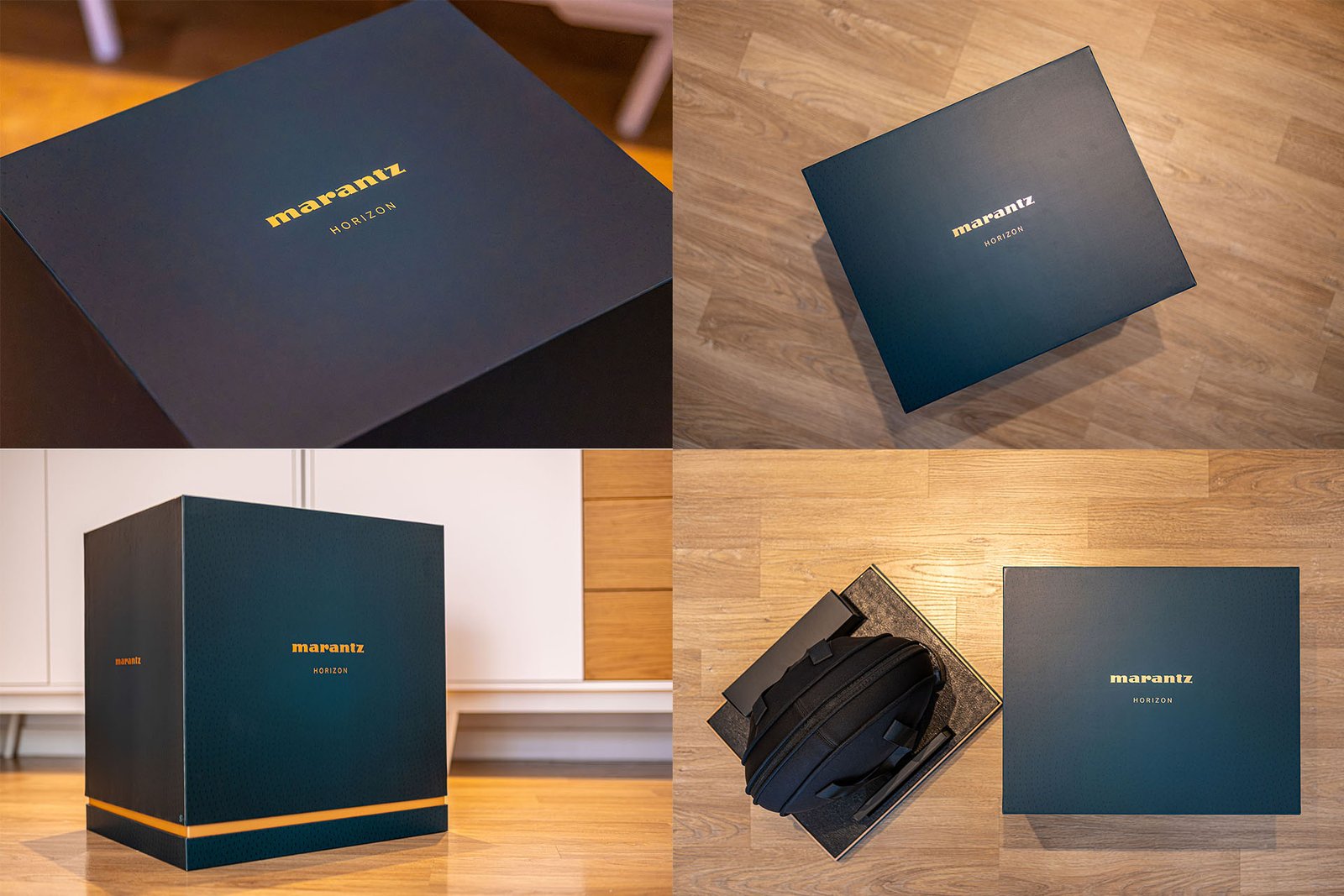
After looking at enough lifestyle speakers to understand the compromises they involve, I was prepared for what to expect. They have a beautiful appearance, but the sound is rather like an apology. The design team comes out on top while the acoustics team ends up in a quiet loss, and the reviewer then writes four thousand polite words describing how well it looks on a sideboard. I must admit that I had already formed some of those sentences in my mind. I took it out of the box and at once my back gave a formal complaint, so I had to begin once more.
Let us then go back and carry this out properly, since the story is better than the fact.
The problem he faced was very real and typical of its time. Long-playing records had arrived, along with a minor dispute over equalization curves: each label had adopted its own standards, meaning that to play a record correctly, you had to know which company had pressed it and make the appropriate adjustments. No commercial preamplifier could handle this properly. That is why Saul constructed one for himself; he named it the Marantz Audio Consolette. It had seven inputs, enabling you to connect all the equipment for your whole life around it, and it included the equalization curves, as well as being built using components which no one was using in consumer products because no one thought consumers would notice—such as the low-noise carbon resistors and the capacitors which the collectors now refer to as “bumblebees”.
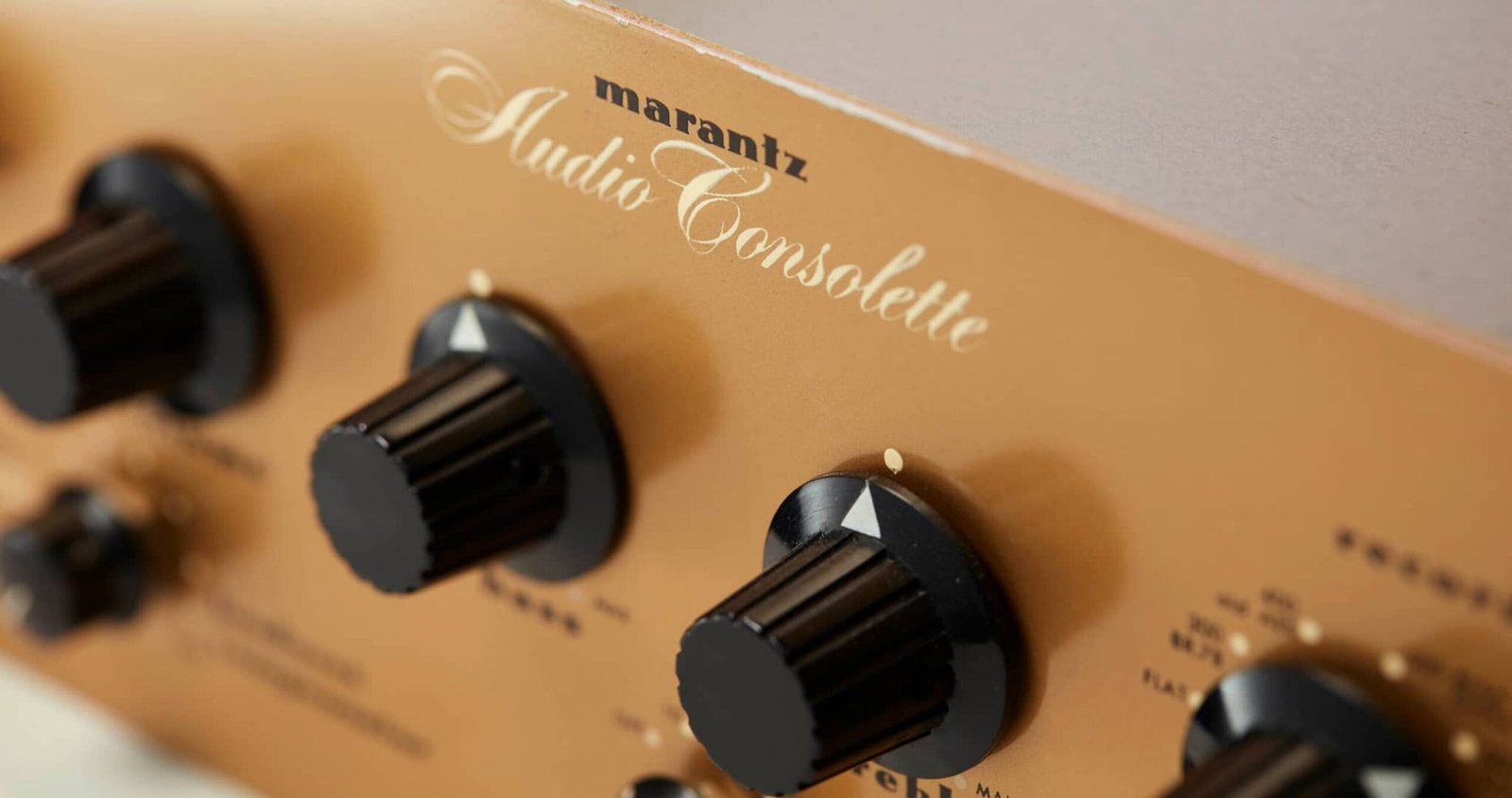
People noticed. When the first Consolettes were put on sale in the autumn of 1952, they were bought by those who cared most, which is generally how such products begin. In 1953, engineer Sid Smith joined him, and together they developed the Consolette into the Model 1, the first preamplifier built around the new RIAA standard, which we still use today.
This is exactly what the training has shown. Saul Marantz designed the front panels himself; he selected the typeface, the spacing of the knobs, the proportions of the meters, and the precise champagne gold of the anodizing, doing so at the start of the process, not at the end. Rather than decorating the engineering after it had been completed, he was designing an object with engineering incorporated into it, and that is a totally different kind of intellectual exercise, one I am familiar with from each day of my own work.
1958 – 1964
The race that established the name’s immortality deserves mentioning since the descendants of those individuals are discussed throughout this review.
The preamplifier known as the Model 7, made in 1958, remains one of the most copied circuits in the field of audio to this day and still commands a good price when in good condition. The Model 9 monoblock power amplifiers, introduced in 1960, featured meters and had a slow, steady authority. In 1964, Marantz, Smith, and a young engineer named Richard Sequerra developed the Model 10 B FM tuner, with an oscilloscope incorporated into the front panel so you could seethe multipath distortion you were tuning away from.
The 10B is the most important model in this story, and that is not for any pleasant reason. Its ambition was great, and the cost of developing and constructing it was ruinously high, which caused the company to go bankrupt. During the same period when the tuner was launched, Saul Marantz sold to Superscope for three million dollars. The finest product they had ever produced was also the one which brought about the end of the independent Marantz.
I consider it to be a truly touching example of industrial history as well as a useful warning; it is in fact the original form of the argument which I have been discussing in my living room, an attempt to pursue the last one percent even though this is beyond any sense of reason, until eventually something fails. Every audiophile understands this instinct perfectly well. Marantz had this attitude within the company and, as a result, lost the business.
What remained was the name, and, more permanently, the appearance. Throughout its history under Superscope, then Philips, during the long period of Japanese engineering, through Ken Ishiwata‘s many years in Europe and his much-loved KI Signature series, via D&M and Sound United and now Harman, one visual feature has always stayed: the porthole. This is the round, softly lit window situated in the center of the fascia. On the large tuners and receivers, it served as the tuning display, showing a glowing amber color in a dark room, and it became the single most identifiable feature in the field of consumer audio. Indeed, you are able to recognize a Marantz in a crowded room at night, even when you are behind a sofa, simply on the basis of that circle of light.
Hold that thought.
2025
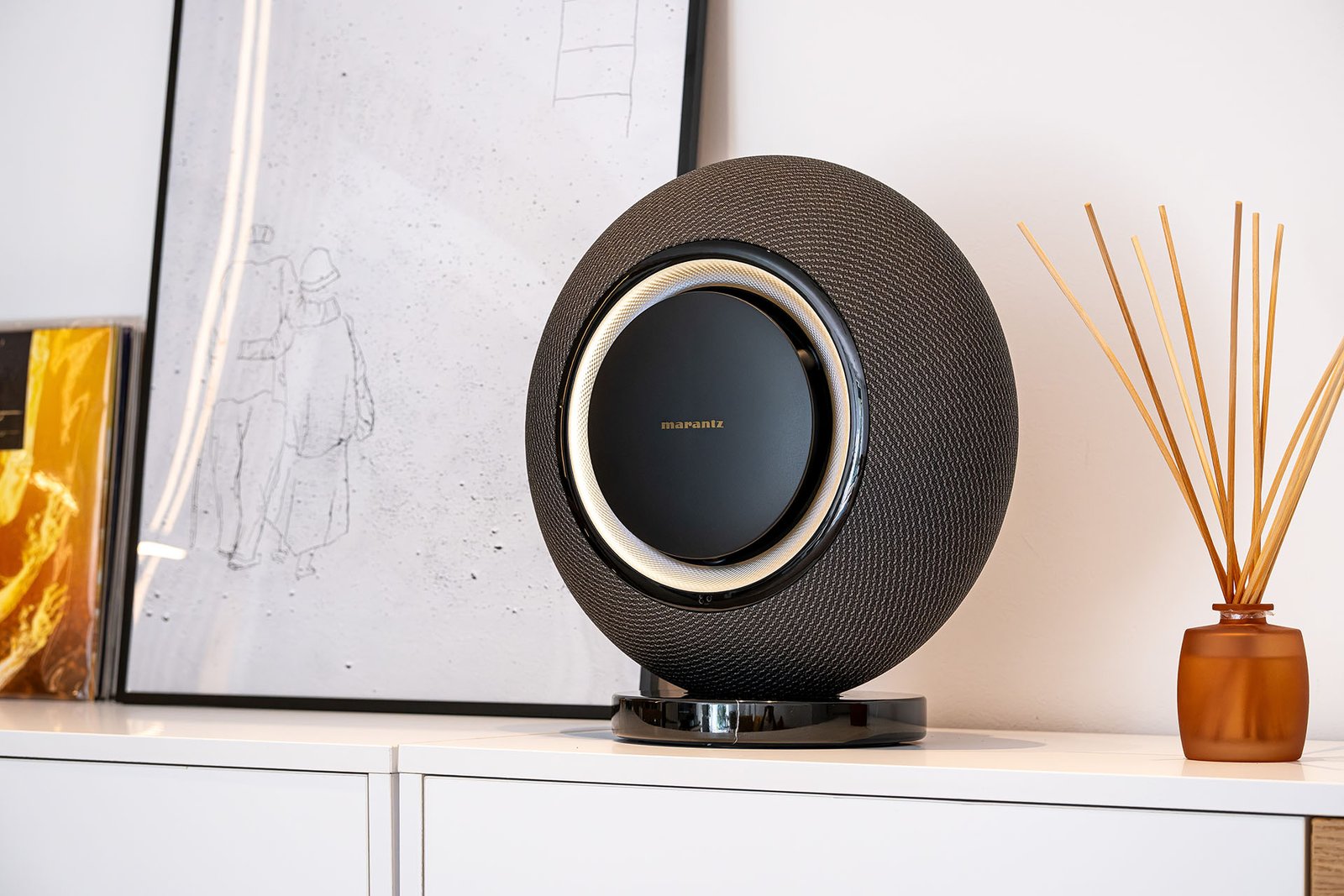
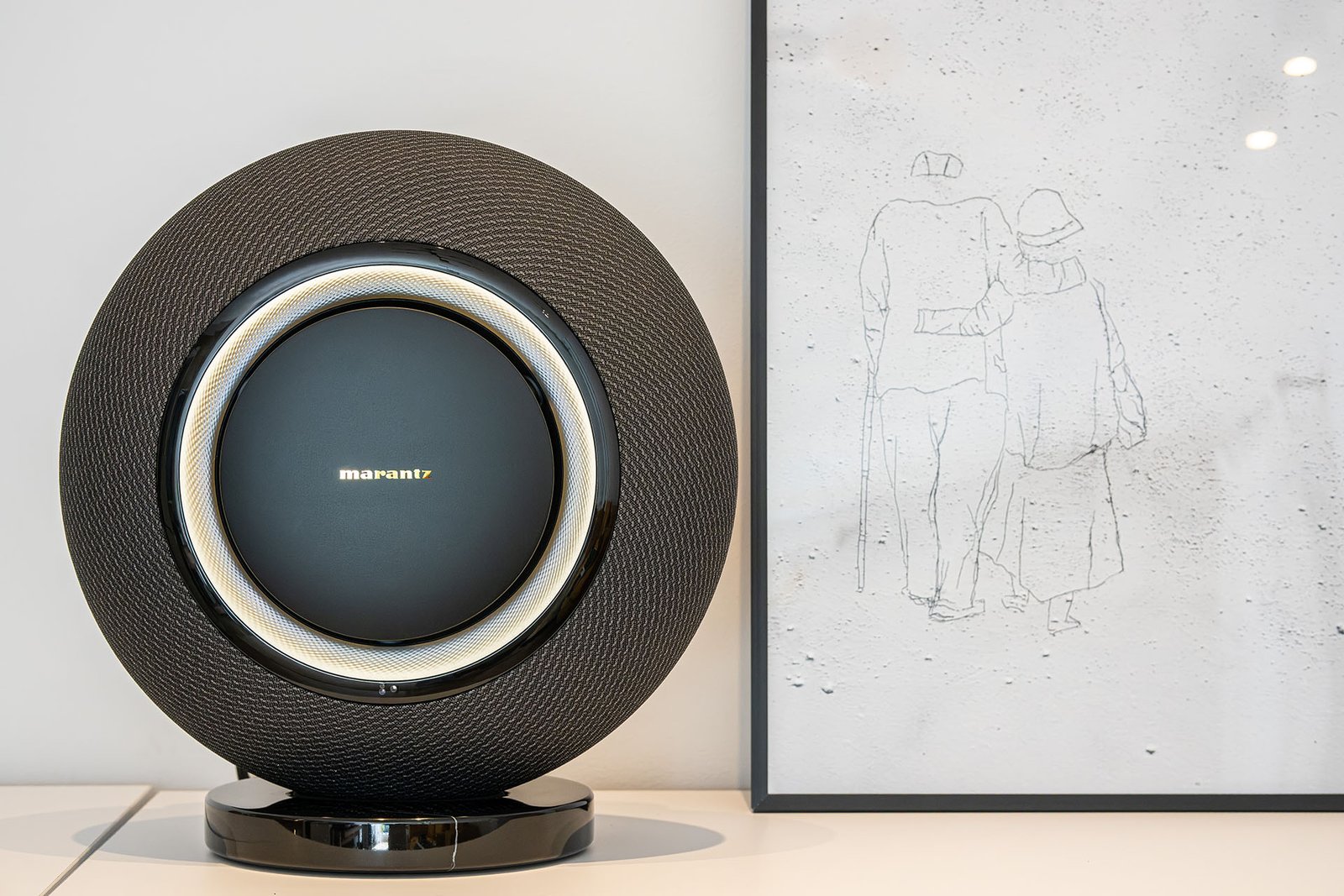
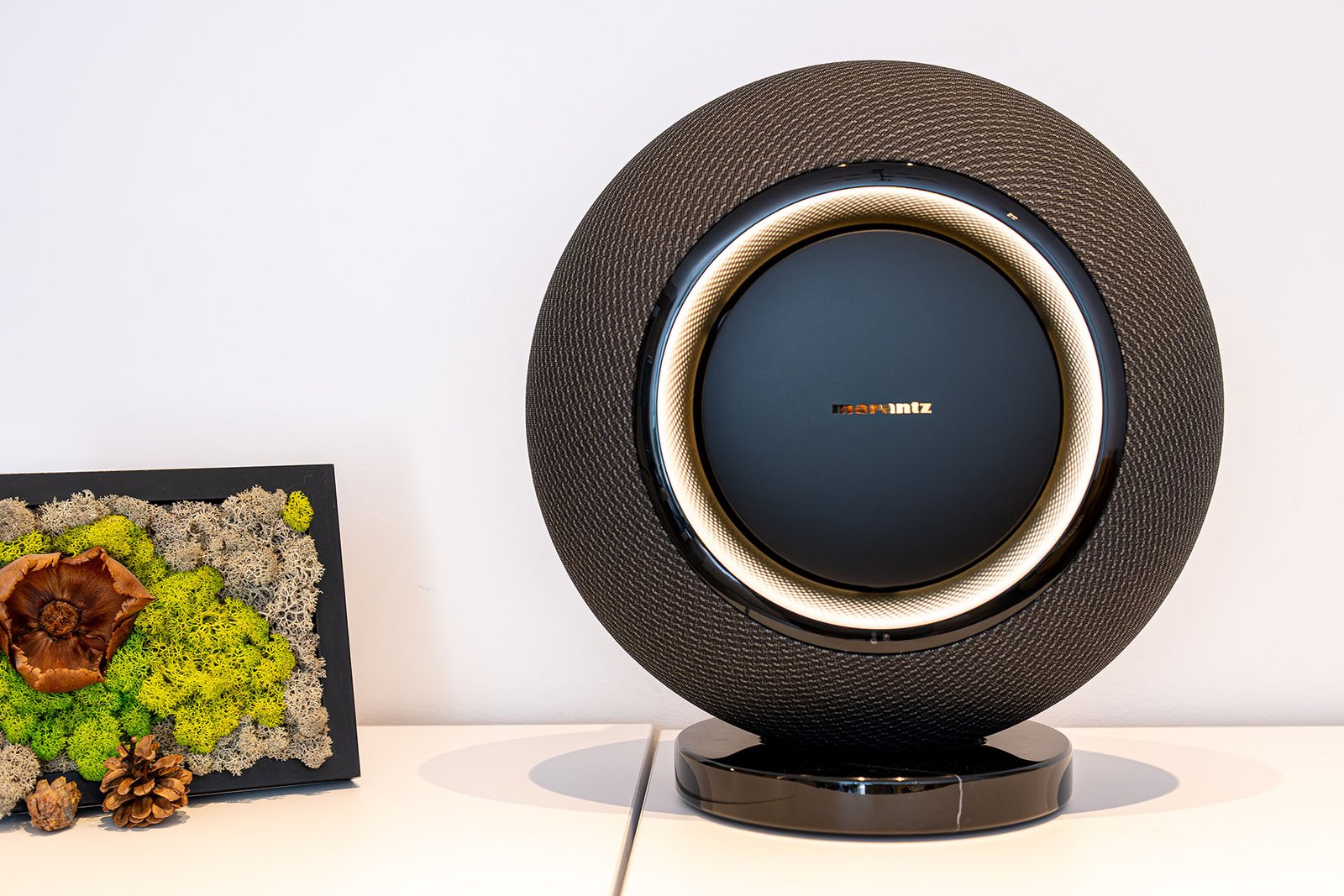
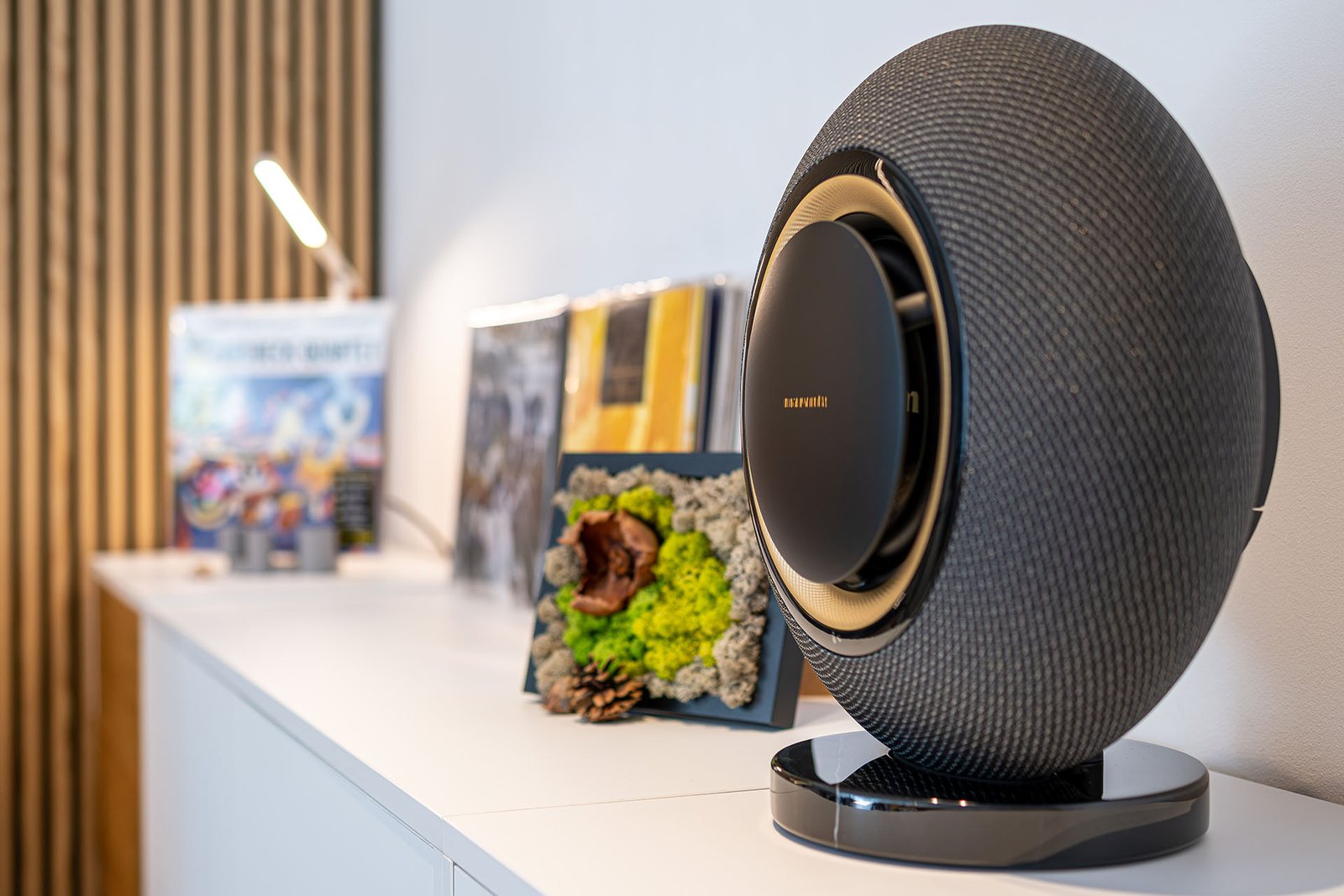
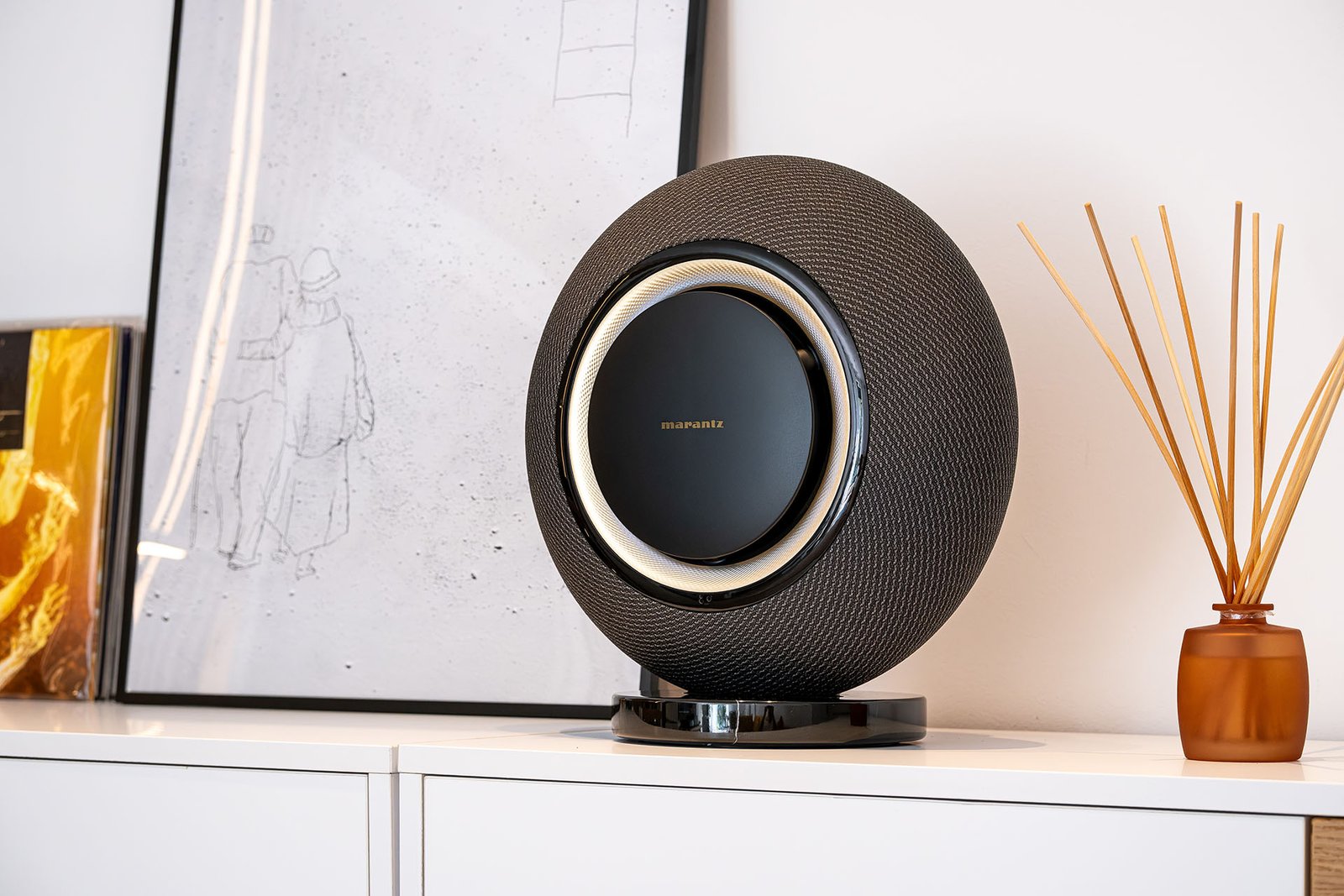
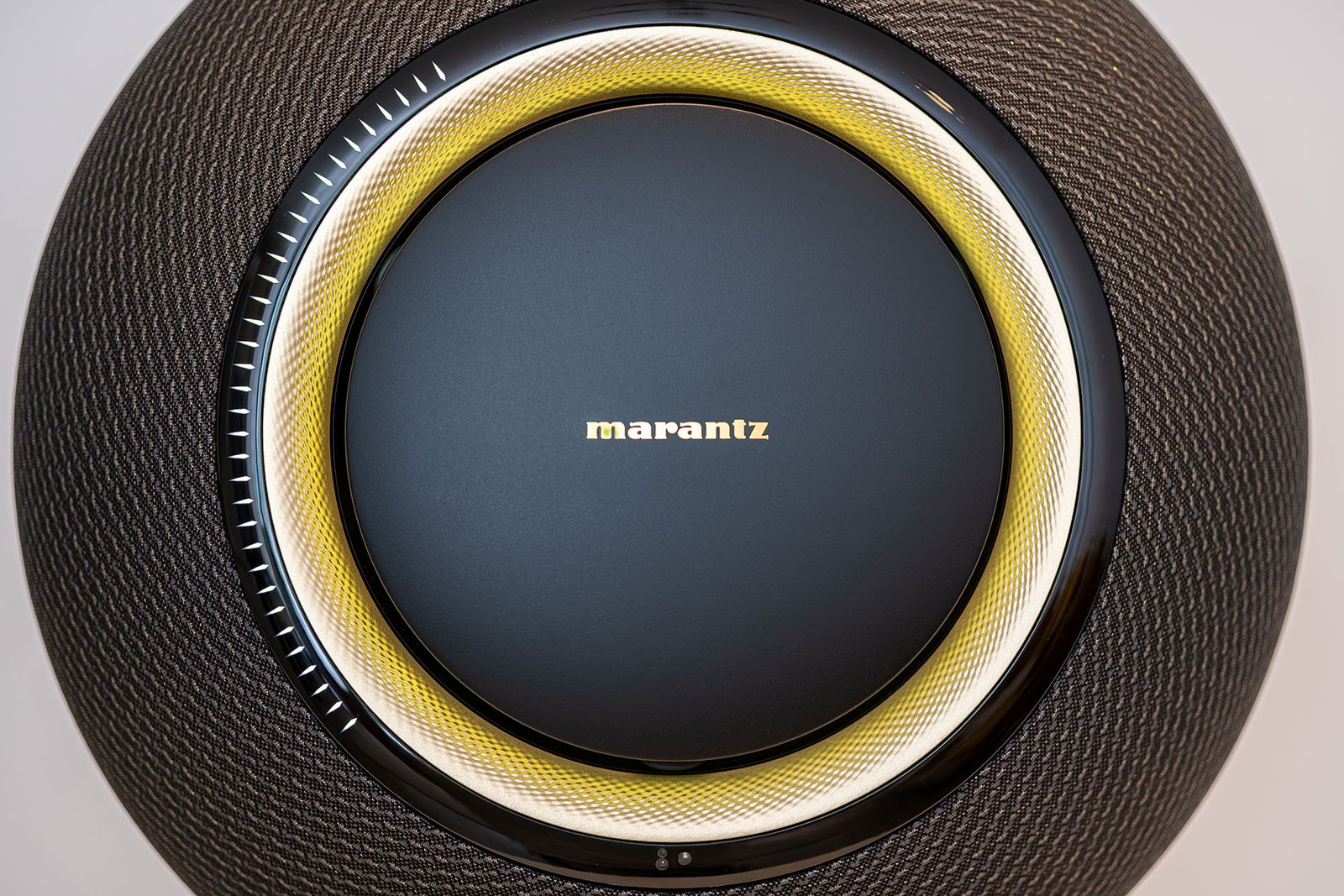
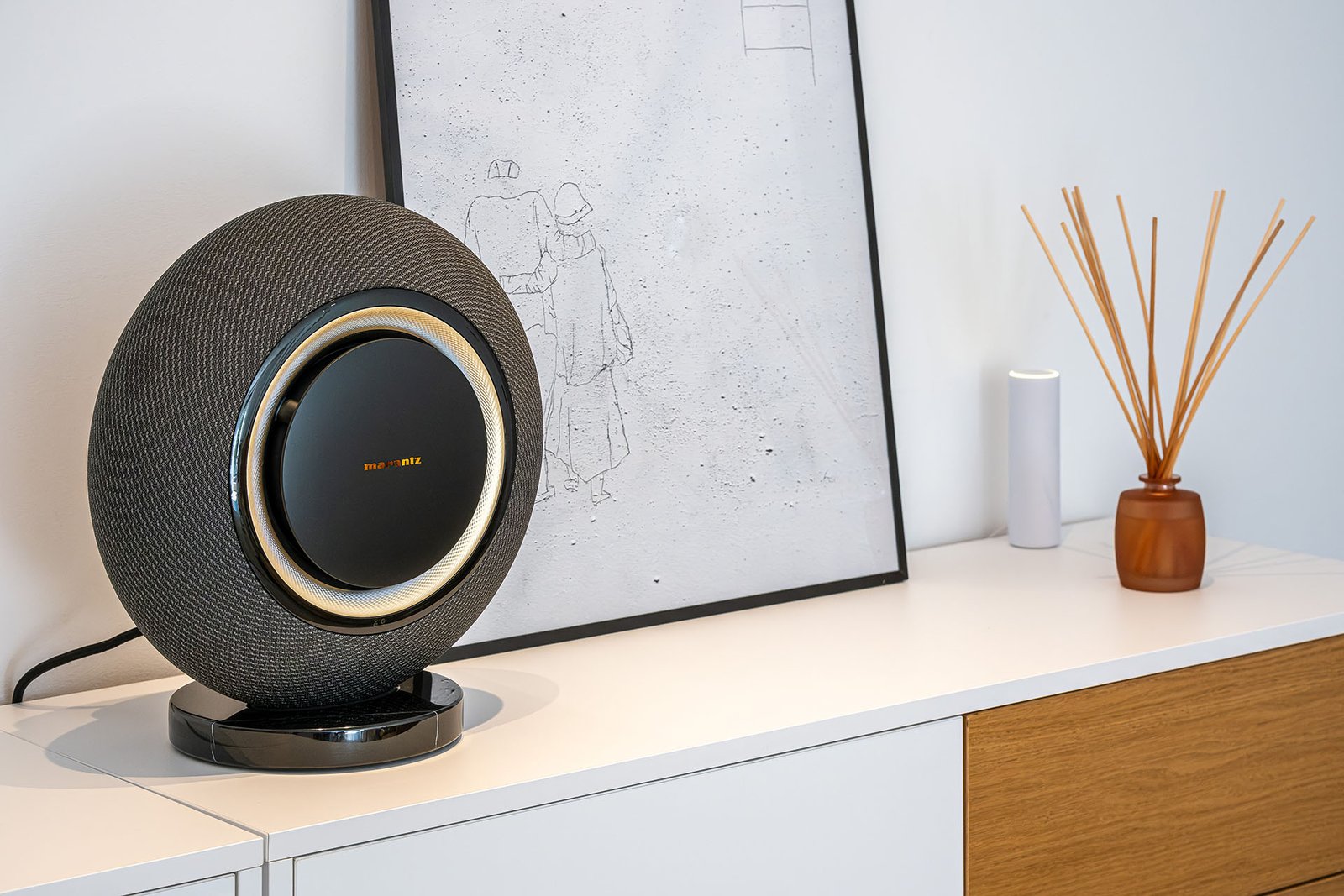
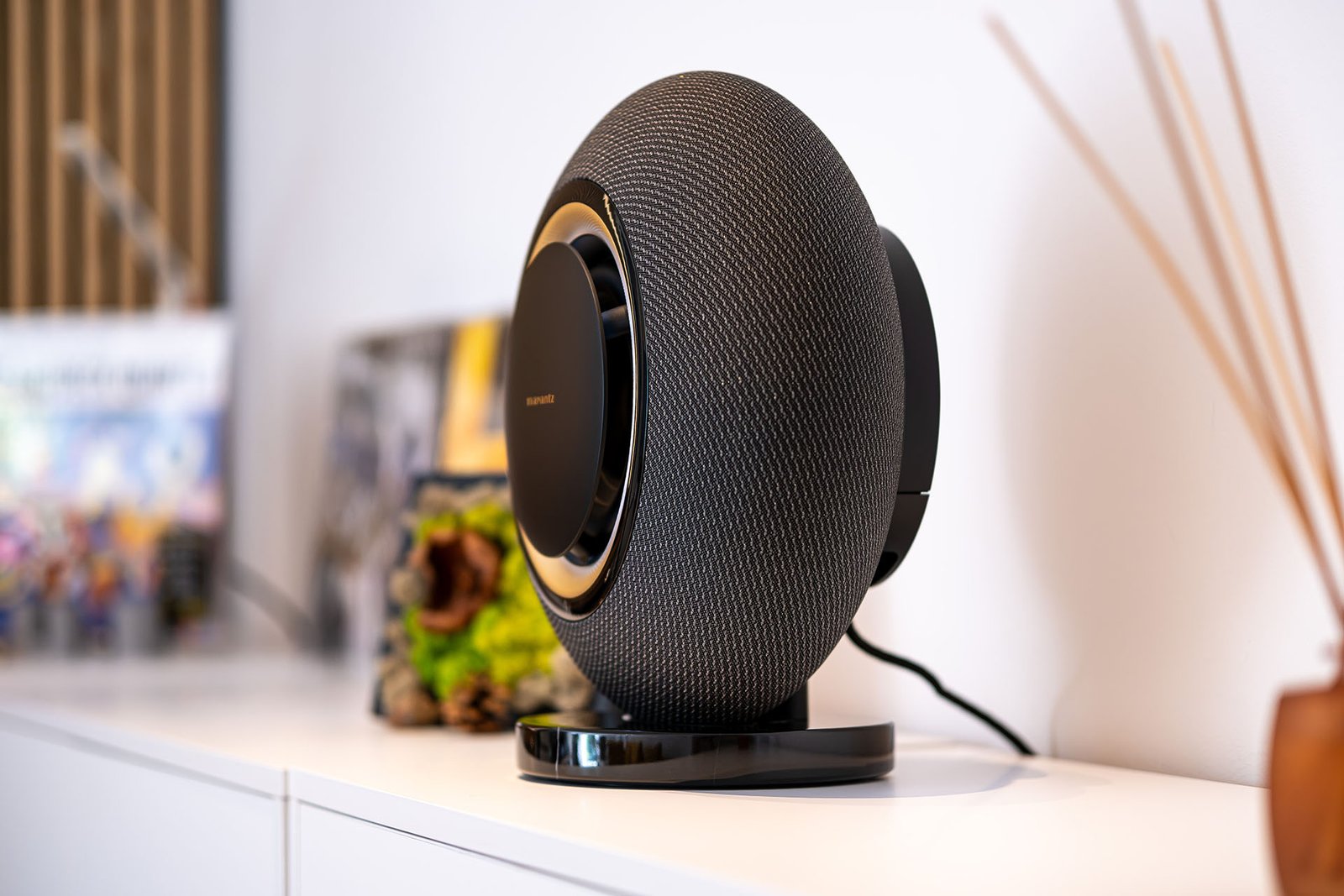
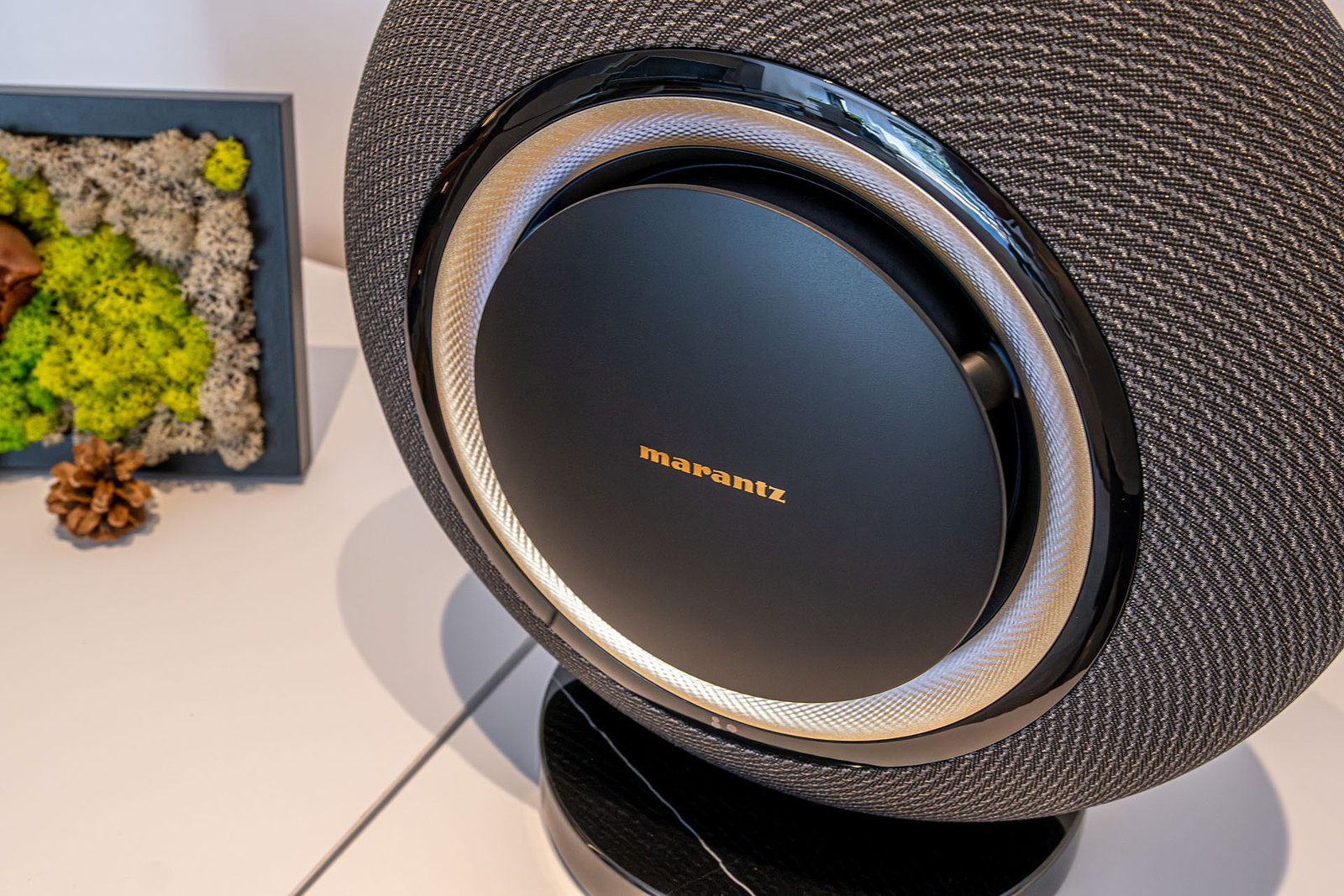
The Horizon and its larger counterpart, the Grand Horizon, were introduced in January 2025, and they differ from anything that Marantz has ever produced in living memory. They are not boxes or fascias but spheres, more accurately described as flattened orbs, shaped like a lens, and smoothly encased in fabric with a large illuminated ring at the center.
It’s the porthole; that, in fact, sums up the entire design idea, and it’s excellent. They took the most identifiable feature of a seventy-year-old visual language, stripped away everything around it, and made that feature the whole product. No faceplate remains, since the object itself is the faceplate. Whenever it lights up on a sideboard in a dark room, anyone over forty experiences a slight, involuntary shock of recognition even if they can’t explain why.
Marantz doesn’t refer to this as a wireless speaker; they call it a Luxury Wireless Speaker, and in their own literature they go on to say that the Horizon and Grand Horizon are the most luxurious wireless speakers in the world. That is a huge claim to make, and one which professionally obliges a reviewer to search for flaws. I spent several weeks doing so. I will return to what I discovered.
At the same time, the industry spotted this right away. In 2025, the Horizon won both the iF Design Award and the Red Dot Design Award, and I am sure those awards are not merely participation prizes. I will say more about this later since it turned out to be the most interesting aspect of the product.
Let us do the numbers, because there are a lot of them and they are not decorative.
- Amplification: Marantz Rise, a GaN FET switching topology, 310 W FTC rated, 745 W peak, 1160 W raw
- Drivers: six in total. One 6.5″ Gravity woofer at the center, three 2″ wideband and two 1″ silk-dome tweeters arrayed around it
- Frequency response: 30 Hz – 20 kHz (±3 dB), reaching 22 Hz at −10 dB
- Maximum SPL: 104 dB at 1 m, peaking at 114.5 dB
- Inputs: HDMI eARC/ARC, TOSLINK optical, one pair of analog RCA, USB-C
- Network: Ethernet, plus dual-band Wi-Fi (802.11 a/b/g/n/ac/ax)
- Streaming: HEOS built-in, AirPlay 2, Spotify Connect, Bluetooth 5.4
- Decoding: Dolby Atmos, Dolby TrueHD, Dolby Digital+, DSD up to 5.6 MHz, PCM to 24/192
- Base: natural marble
- Dimensions and weight: 364 × 210 × 387.5 mm, 12.5 kg
- Finishes: Midnight Sky, Moon Ray, Marantz Champagne
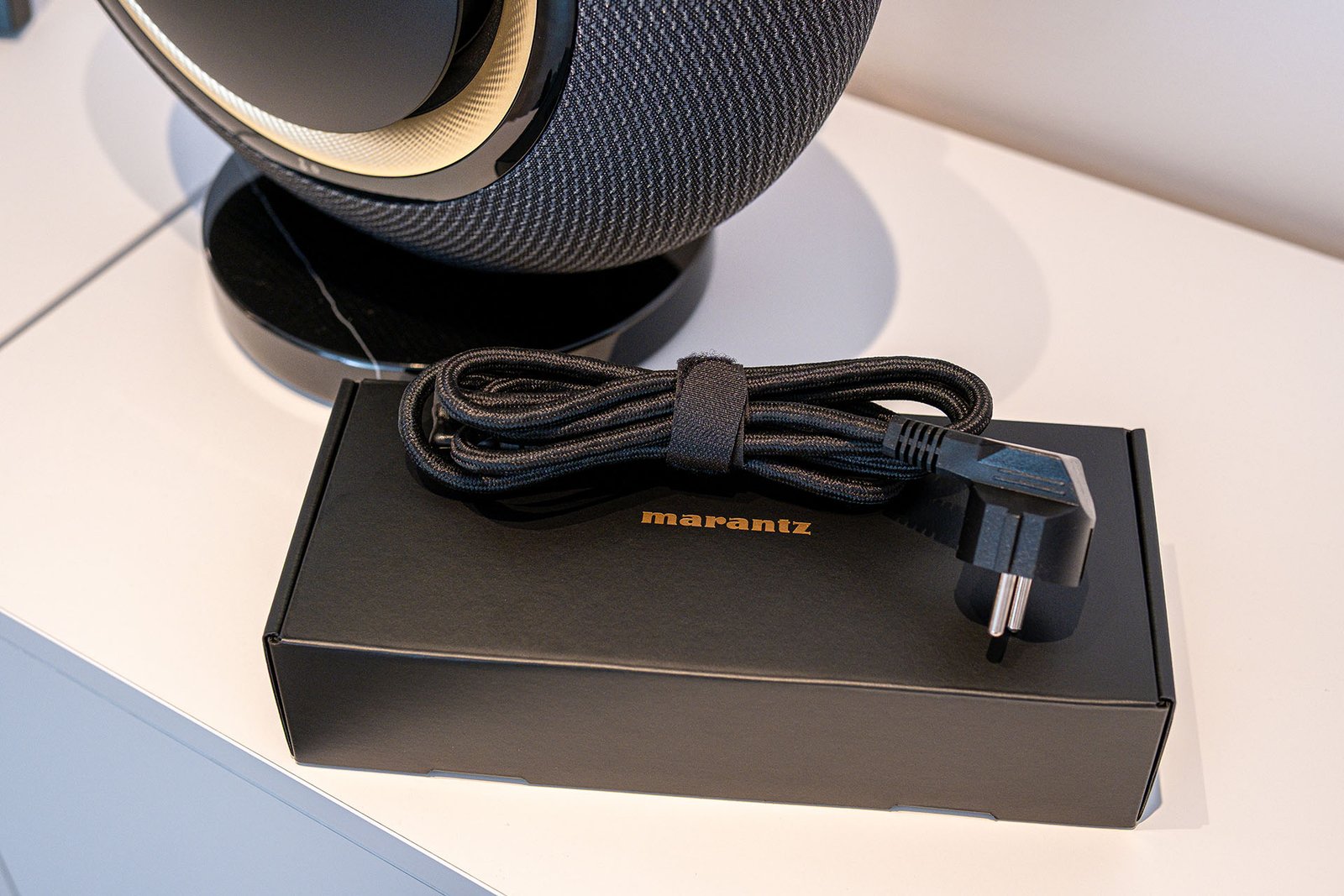
In the box: power cable, HDMI cable, quick start guide and a Certificate of Authenticity.
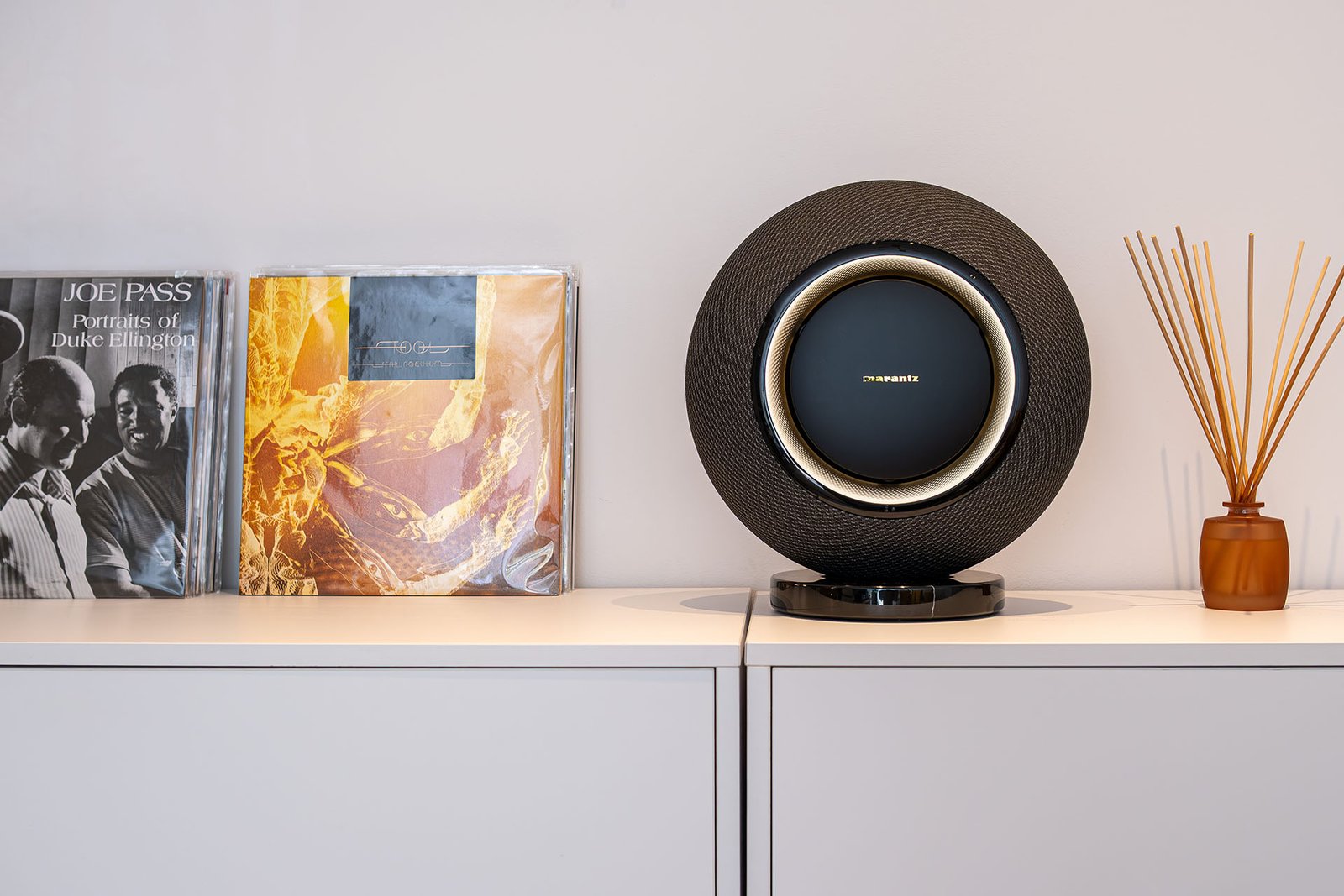
Take the weight figure once more—twelve and a half kilos, for an item you can hold in two hands and that takes up about the same space as a large hardback book standing on its end. I shall return to this point since it was the first thing the Horizon mentioned about itself before it produced any sound.
And look at that final point: a Certificate of Authenticity is not an audio component; it is instead a feature of the jewelry industry or watch industry, something that comes with an item rather than being contained within it. By doing this, Marantz is clearly indicating to you the category in which they believe they are competing, even before you open the case.
The Unboxing, and a Small Shock
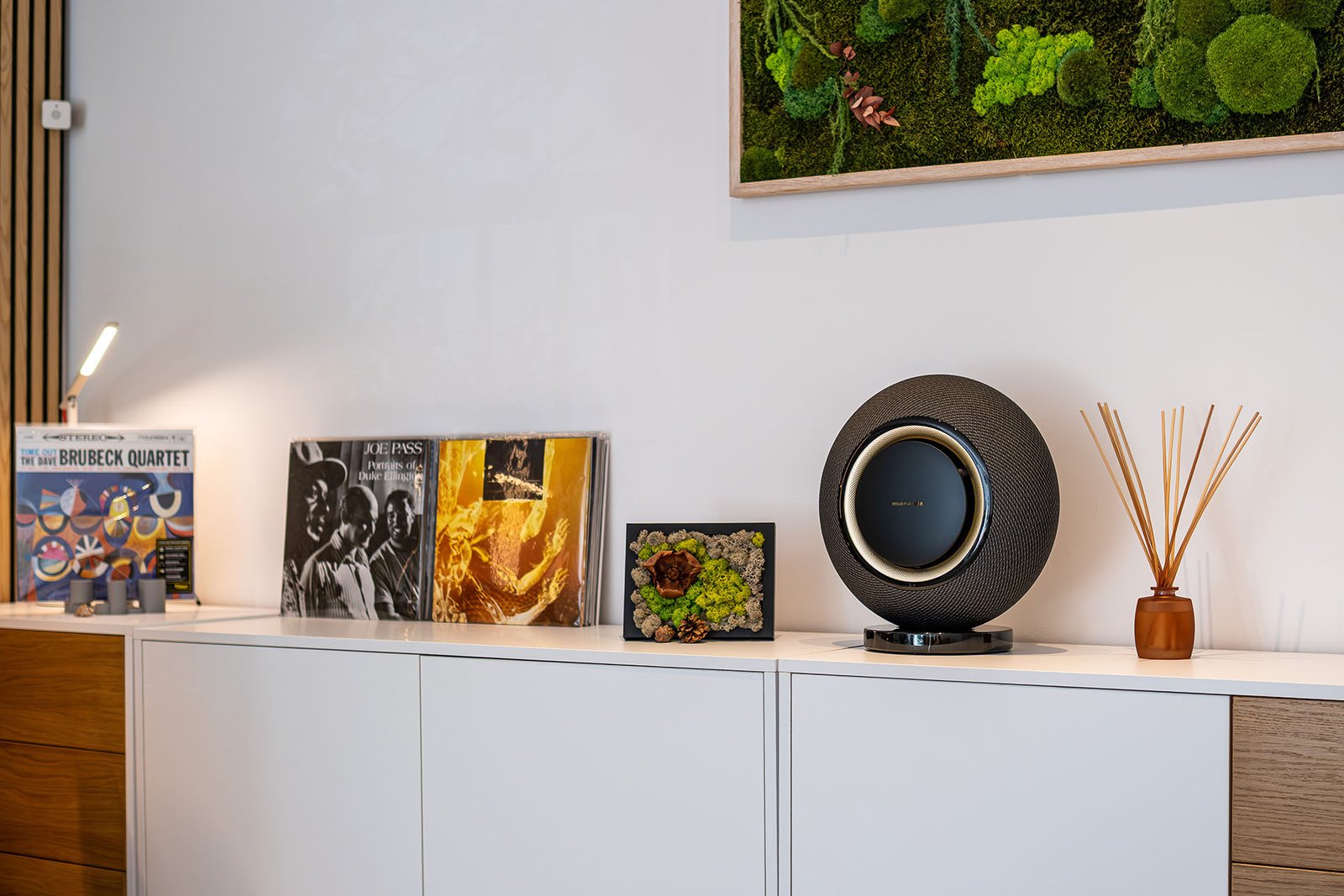
Of course I had lifted it the wrong way; you pick up a lifestyle product just as you would a lamp, using one hand and without any ceremony, since you already know what it is. It takes about half a second for twelve and a half kilograms to teach you otherwise.
The fact that it weighs twelve and a half kilograms in this size doesn’t just happen—it’s a clear indication of the manufacturer’s intention. Inside, it has a 6.5-inch woofer with a genuine magnet, a powerful amplifier, and, most important of all, a cabinet stiff enough to let all of this happen without the box itself interfering. If you tap the Horizon with the knuckle anywhere over its surface, you’ll get nothing in return, essentially: no ring, no boom, and no sound like hollow plastic. In the hand, it has the feel of something that has been machined rather than molded.
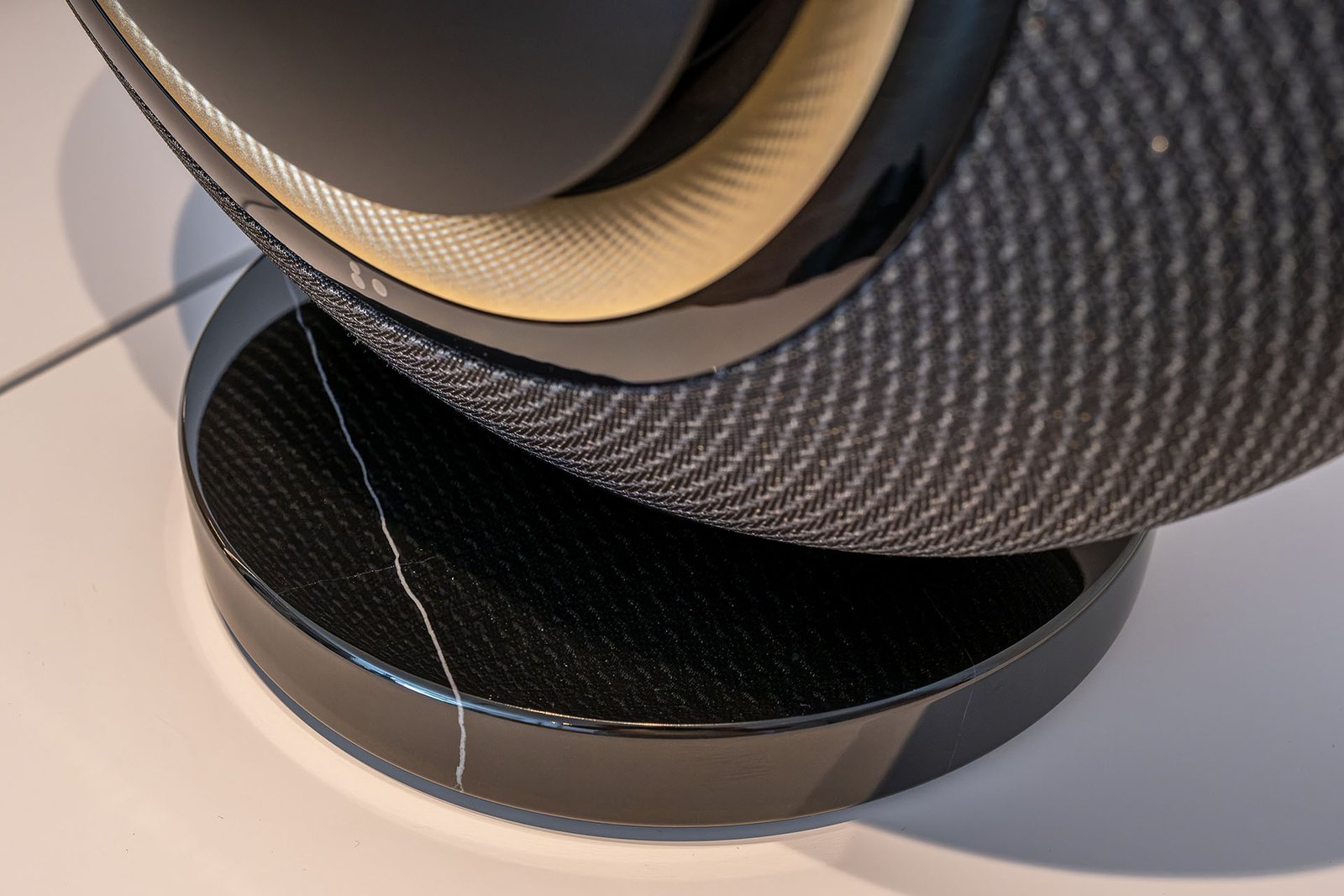
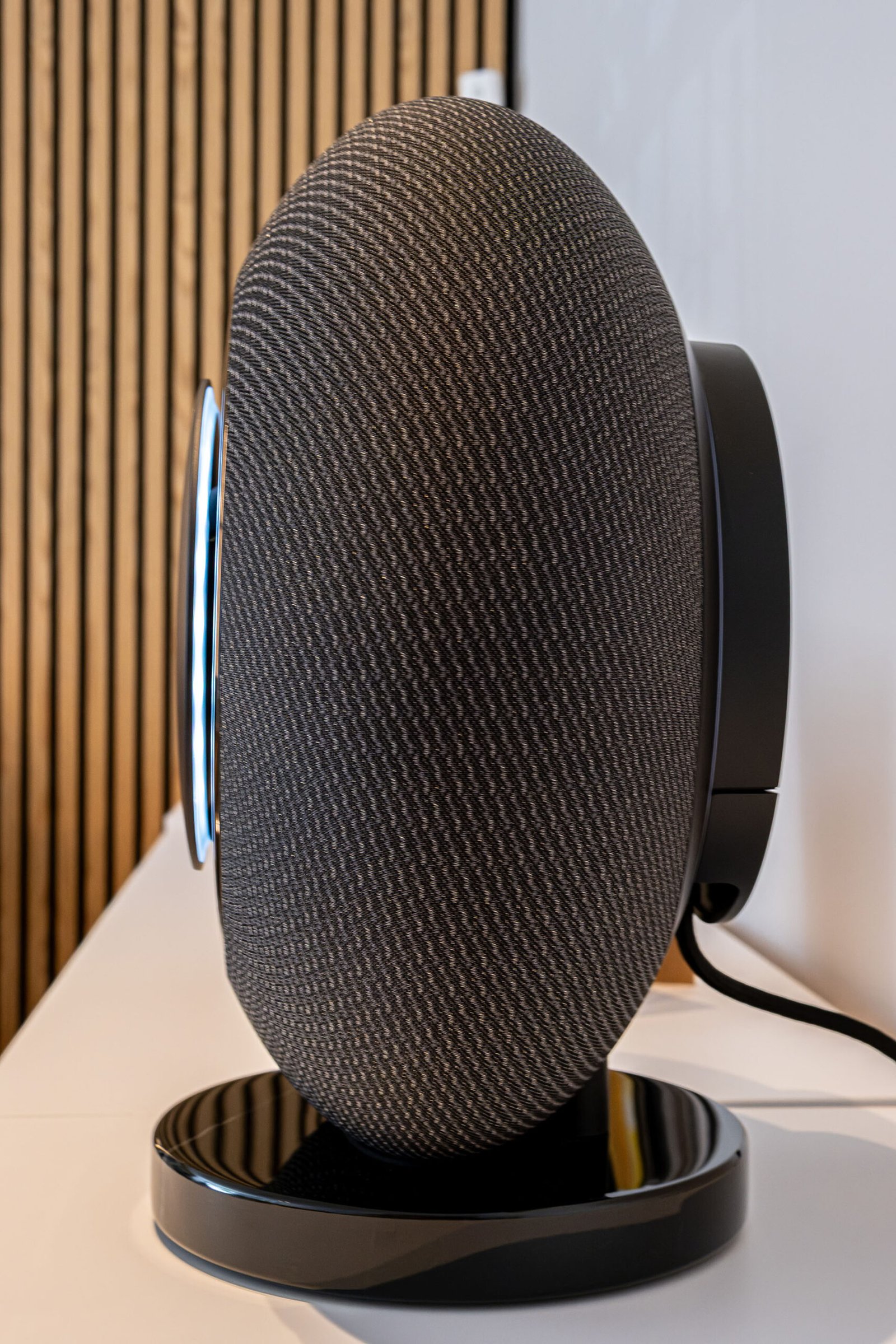
The base turns out to be a real surprise, since at first I had the wrong idea. I thought it was a gloss-finished composite because that is the kind everybody uses. It is actually natural marble—not marble-effect or marble-look—but a stone plinth which has been cut and polished, and once you realize this, the way the weight is distributed becomes completely understandable. It lowers the center of gravity so much that the entire thing seems firmly in place, allowing the sphere to rest slightly tilted toward the listener without any feeling of instability.
The point I keep returning to is this one: the very reason that has settled the issue of whether this is a luxury item or simply an expensive one. Each one is different. Since marble is a natural stone, mined and then cut, the pattern in the piece known as my Horizon occurs nowhere else. It isn’t a design that has been printed, or a texture molded, or a finish applied to ten thousand identical components on an assembly line. It came from the ground with that appearance.
I believe that most people won’t be aware of this consciously, and that is in fact the whole point. It therefore follows that the item in my living room is, in a small and entirely literal sense, the only one of its type, and it comes from a tradition of manufacturing which the industrial audio sector gave up on decades ago. Marble has carried with it about four thousand years of history as a material symbolizing permanence, and the people at Marantz must not have selected it by chance. It is impossible to mass-produce a unique object; one can only decide that it is important enough to warrant the cost, the waste, and the inconsistency, and then set up the supply chain to enable this.
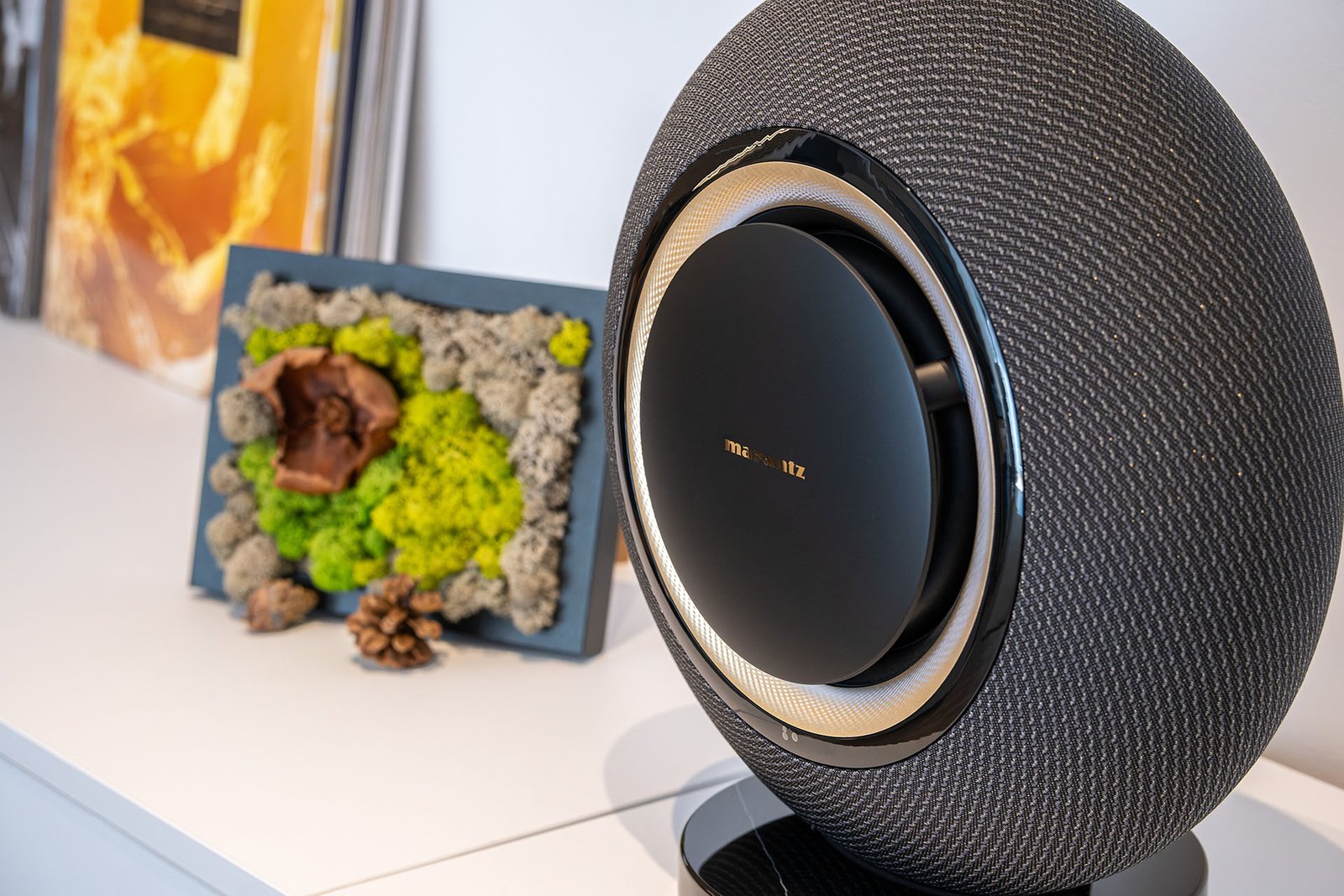
There’s also the fabric, and that’s where the story becomes genuinely interesting. Marantz has named it Radiance 360° Seamless Fabric, a name which causes me to roll my eyes in a professional way, until I read about how it was made, at which point I stop doing so. The fabric is made from recycled ocean plastics and is truly seamless, consisting of a continuous wrap with no join visible anywhere on the body and a fine texture that appears tailored rather than grille cloth. To develop it, Marantz did not turn to a speaker supplier; instead, they went to the fashion industry, where expertise in wrapping complex three-dimensional shapes in cloth exists.
Consider what this decision shows. It is a very difficult manufacturing problem to get a textile to follow compound curvature without a seam and, at the same time, remain acoustically transparent and durable enough to withstand a home with both children and cats. The inexpensive solution is a molded plastic grille with a fabric sleeve in front. Marantz chose to study couture instead. There’s a difference between a product that looks expensive and one that is actually expensive, and you can tell this just within about two seconds of touching it.
Two features of the packaging are worth noting, since they establish the atmosphere before you even meet the speaker. The Horizon is not supplied in a polythene bag enclosed in a foam clamshell; instead, it comes in a fitted neoprene drawstring cover, the type of case usually used for a camera lens or studio equipment, and one that you will retain. The power cable is made of braided fabric, coiled and secured with a Velcro tie, and is provided in its own printed box. Nobody actually needs a braided power cable, yet someone has decided that you should have one anyway.
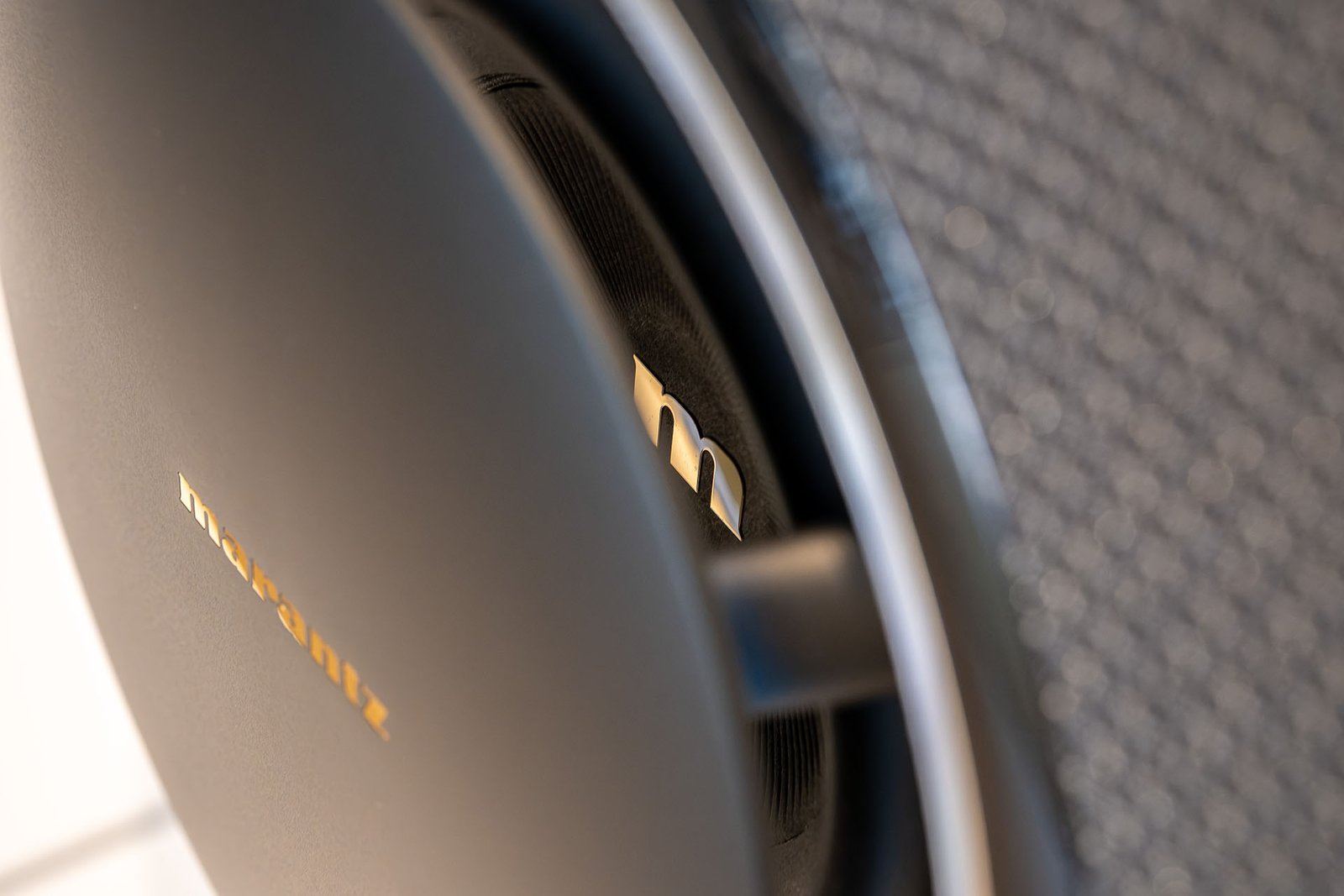
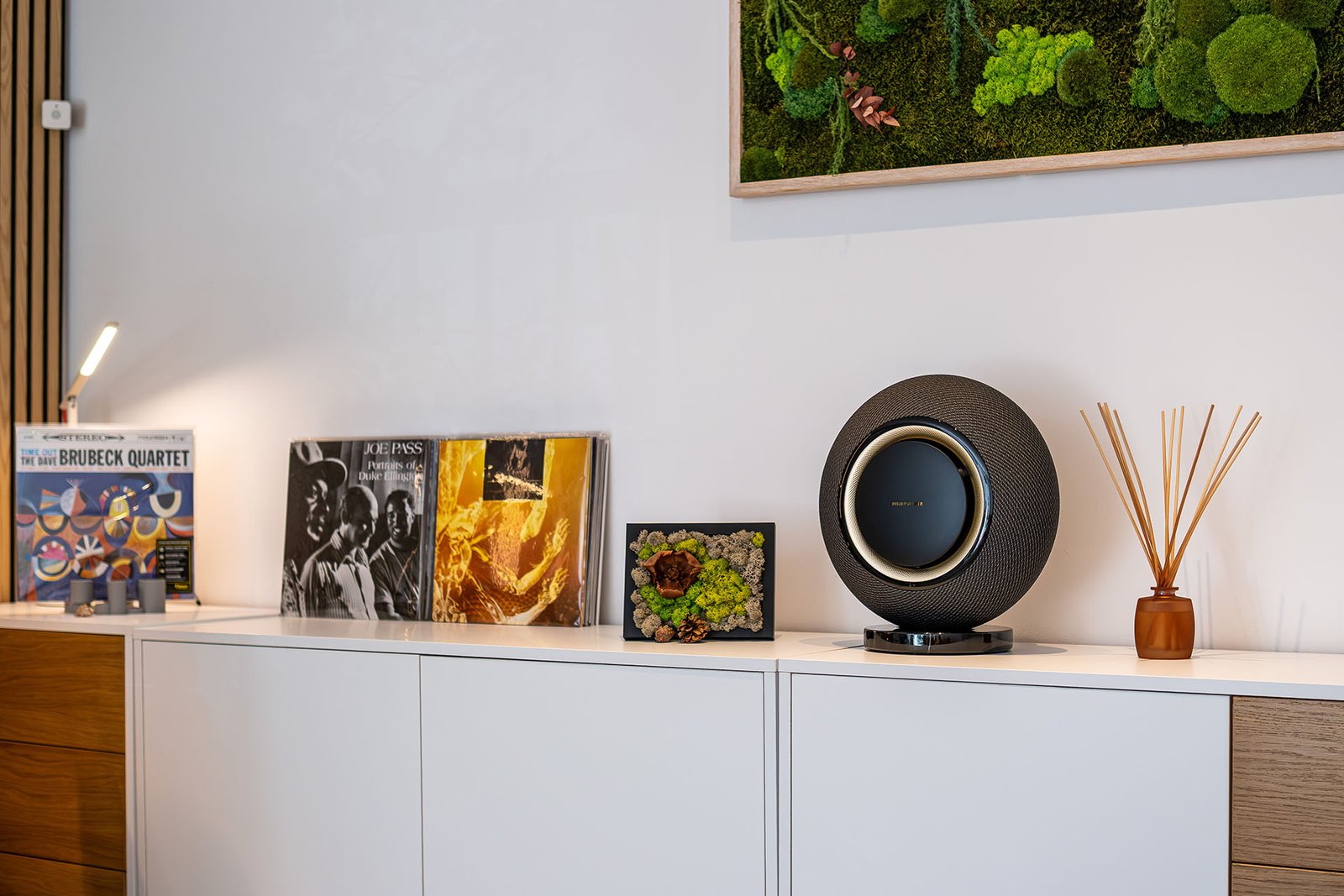
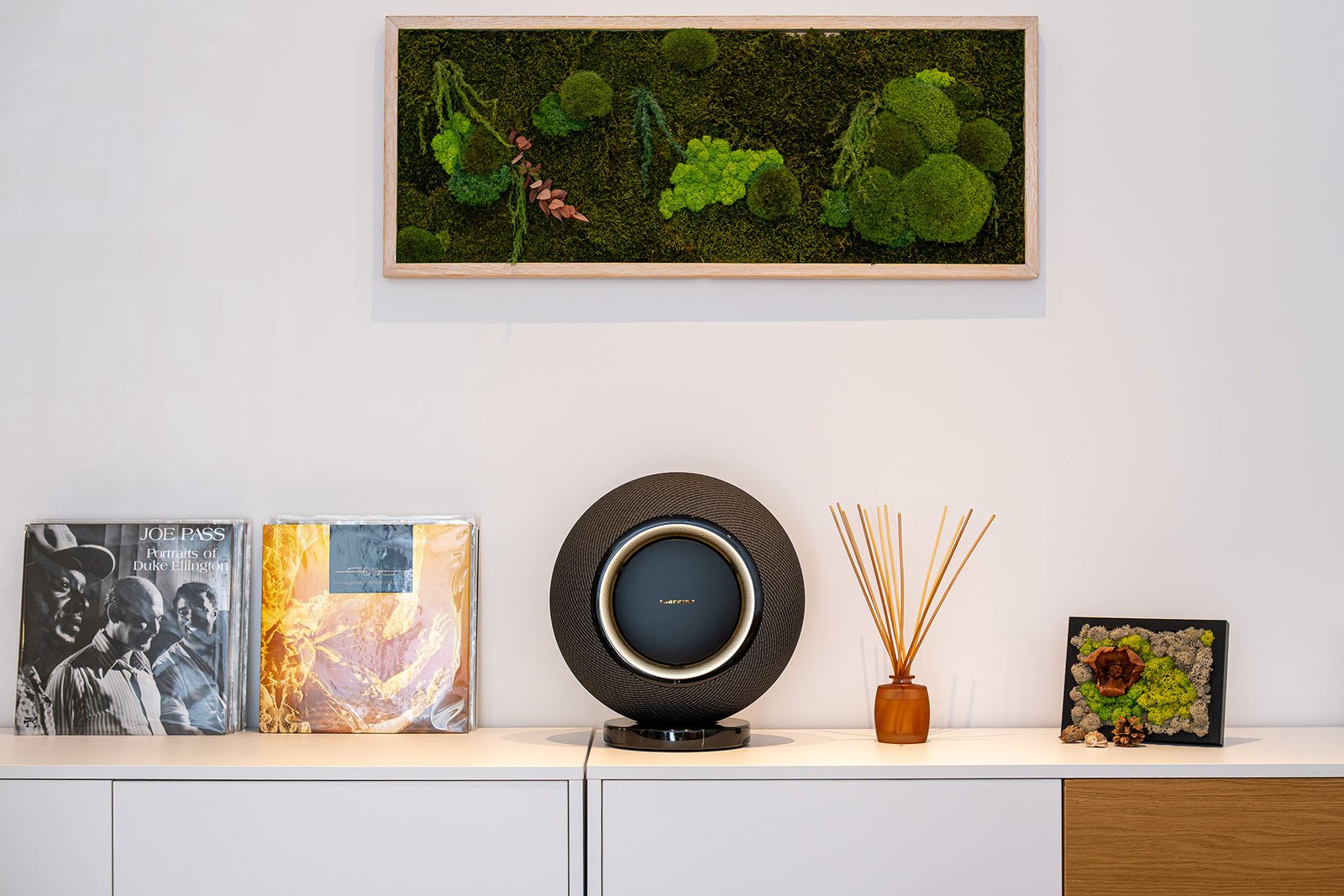
As for the details, there is a small gold m set in the ring, the wordmark on the central disc in that distinctive Marantz orange-gold, the polished bezel reflecting light around the lit ring, and a small row of LEDs situated at the lower left of the ring which can be read at a glance but disappear when you’re not looking for them.
Having made a living as a designer for twenty-five years has made me extremely difficult to please when it comes to such matters. I always look for the point where the money stopped, the plastic piece behind the metal one, the misaligned seam, and the badge, which is just a sticker. I didn’t find any of these things. Moreover, even the cap cover of the back connection area is solid metal, and be prepared… it is attached by magnets that snap it into place rather than plasticky clips. It is a well-finished article, one that reaches the standard I would normally expect from more expensive furniture, and it is the first speaker in a long time that my wife has looked at and simply said, without being asked, that it can stay there.
I have been striving to get that sentence for fifteen years, dear reader.
Three Finishes, and Why That Matters
A luxury item has to be designed to suit a room which has already been designed, and Marantz has given this consideration. There are three finishes, not just black, white, and beige with marketing names attached.
The book I have is Midnight Sky, which is the more sophisticated option. It has a deep, nearly black color that appears as charcoal in daylight and, in a dark room, fades so that only the glowing ring remains in the air. It serves as a suitable finish for a modern-style interior that features dark woodwork, walnut, brass inlays, and low lighting.
Moon Ray is the pale one, a gentle, luminous shade of light suitable for a bright, minimalist room with Scandinavian oak, white walls, and a lot of daylight; it is the least visually assertive of the three and is the one that an interior designer would choose if the client wished for the sound to disappear into the architecture. That Moon Ray would have blend into my place like it was grown there 🙂
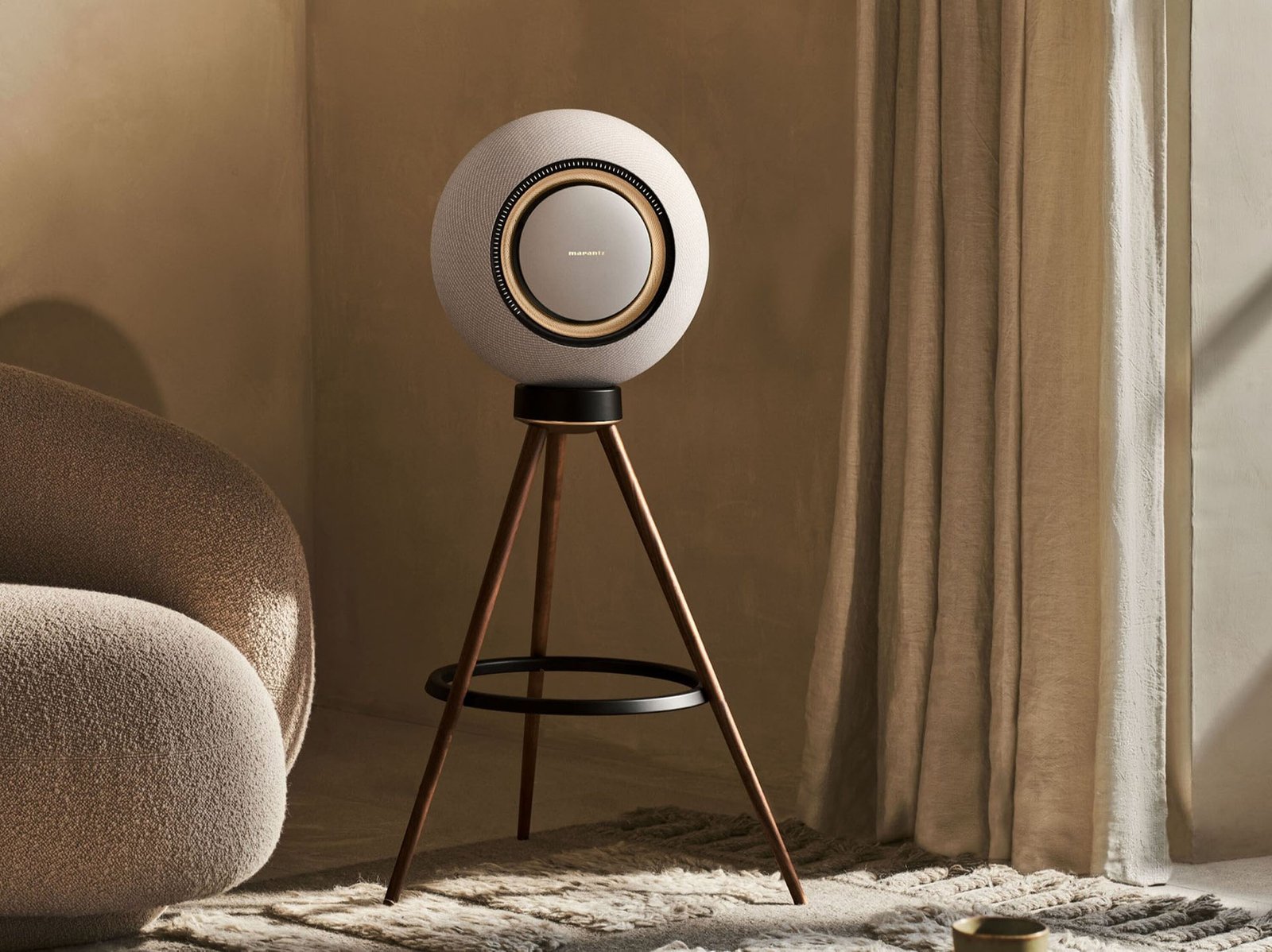
Marantz Champagne is the model that carries the brand’s heritage, and for those who grew up with this brand, it holds emotional significance. The color Champagne gold is that of the large faceplates of the Model 7 and the 10B, and choosing to apply it to a sphere in 2025 is a conscious act of evoking memory. The result is also, in a room that contains warm metals and natural materials, rather beautiful.
It by no means concerns a minor issue and has a direct bearing on the price. A speaker priced at €500 is available in black or white since it is intended to be placed anywhere next to a socket. A product of this sort has to be specified and selected together with the sofa, the rug, and the lighting, and for that a range of finishes is needed rather than a single standard option. When a company offers three truly different finishes, each with a marble base to match, it is because it assumes its product will be chosen by someone who cares about how the room looks.
What Is Actually Inside
Marantz has bestowed a trademarked name on every item, which is generally a cause for concern. However, in this instance the names do in fact relate to actual engineering, so let us consider them one by one.
Six drivers, and the Gravity array
There are six drive units, and the geometry is the key issue. At the center is a single 6.5-inch Marantz Gravity woofer, and the other five—three 2-inch wideband drivers and two 1-inch silk-dome tweeters—are placed around it. The bass is at the center, and the music takes place in a ring around it; this is a purposefully designed arrangement and not just a convenient way of packaging.
The Gravity woofer has been specially designed and uses neodymium magnets, which are the more expensive option. Neodymium produces a much stronger magnetic field from a smaller and lighter motor, and this means better control of the cone and, most important of all in a speaker cabinet of this size, leaves more space for all the other components. The diaphragm is made of paper, a choice that will satisfy traditionalists, but it has radial ridges pressed into it, a geometric arrangement that increases rigidity without adding weight. That combination of lightness and stiffness is exactly how the entire engineering challenge of a bass driver can be put down in six words.
The silk-dome tweeters are also worth mentioning since silk has a certain sound quality; metal domes are more analytical and, if poorly executed, can be harder on the ears during the course of the evening. Silk is the more civilized choice and matches the Marantz home sound exactly.
The five outer drivers don’t just produce a louder sound; instead, they work in conjunction with the Mirage DSP to create the soundstage, which is why a cabinet only 21 centimeters wide can sound much wider than it actually is.
The Rise amplifier, and why gallium nitride
The Marantz Rise is a switching amplifier using GaN FET technology, and it deserves a closer look because it represents the most important technical choice in the product.
GaN stands for gallium nitride, and it is used in place of silicon in the transistors that handle the switching. The name Rise is a clear reference to rise time, that is, the speed at which the device can transition from off to on state. That speed is the key point.
Compared to a conventional silicon transistor, gallium nitride has much lower on-resistance, so less power is lost as heat during switching. It switches much faster, giving the amplifier finer control of the audio signal and reducing distortion. It also operates at a lower temperature, something that is very important since the whole amplifier has to be enclosed in a fabric-wrapped sphere with no ventilation grilles at all. Moreover, it is smaller, which frees up internal space for acoustic components rather than electronics.
The final point is the one that people overlook. In a conventional design, the amplifier and the cabinet compete for space, with the cabinet generally ending up with less. With GaN, Marantz can achieve 310 watts of continuous power, with peaks exceeding that figure, and still have room for a proper 6.5-inch woofer and a sealed enclosure with useful volume. The reason for the technology is not to make the specifications look modern. It is because, without it, the device could not have been built in this form.

Setup, and the HEOS Question
This is where these products usually fail, and this one doesn’t.
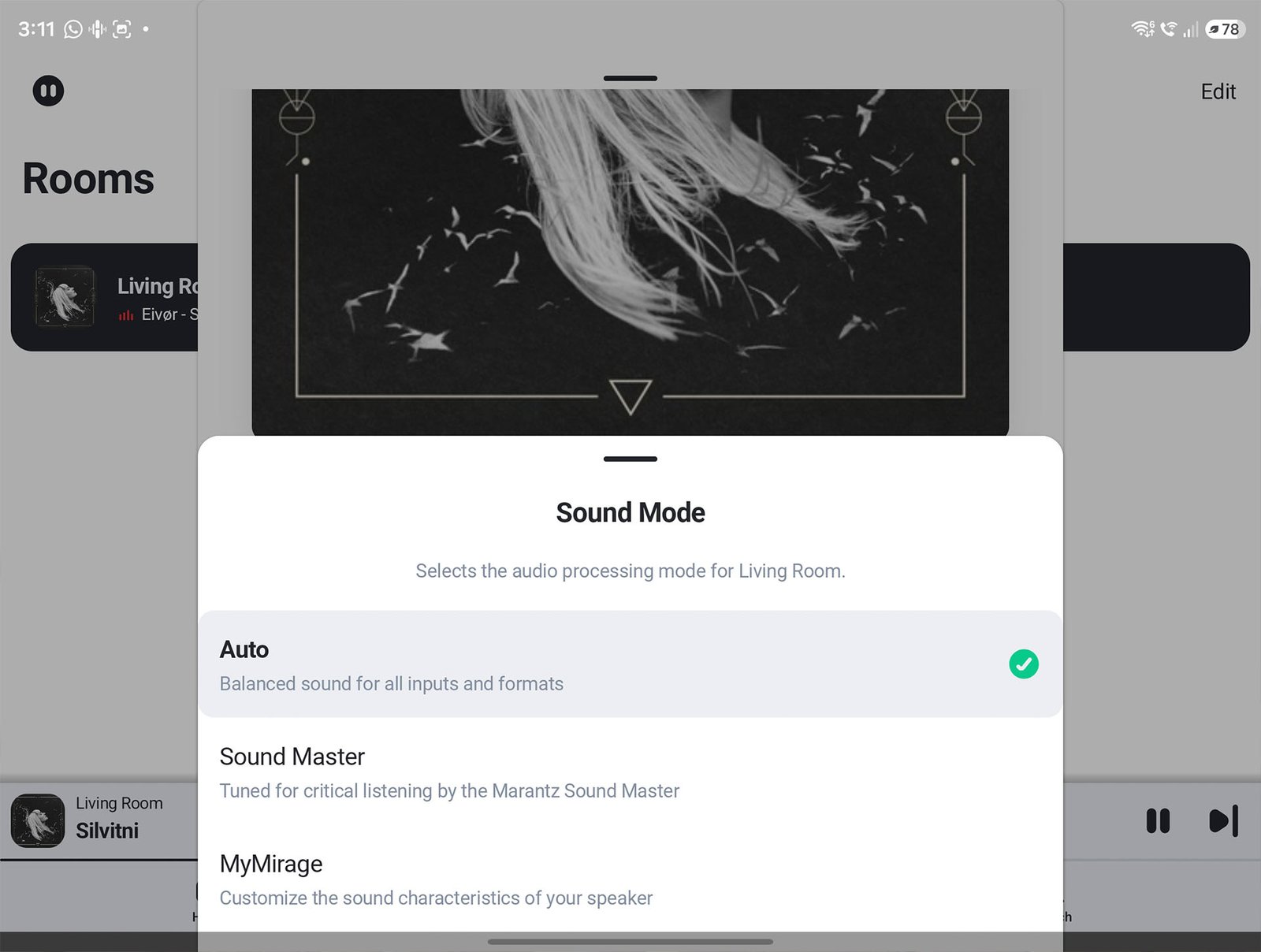
Turn the power on, and the ring comes to life. When you open the HEOS app on your phone, the Horizon appears right away—there’s no need to look for a hidden access point and no need to type in your WPA key using a mobile keyboard while wearing your reading glasses. The app detects it, requests your Wi-Fi credentials, supplies them, names the room, and then you can start playing music. The time it took me, from the moment I plugged it in until the first note was played, was under four minutes, most of that time being spent by me taking screenshots of each screen for this review.
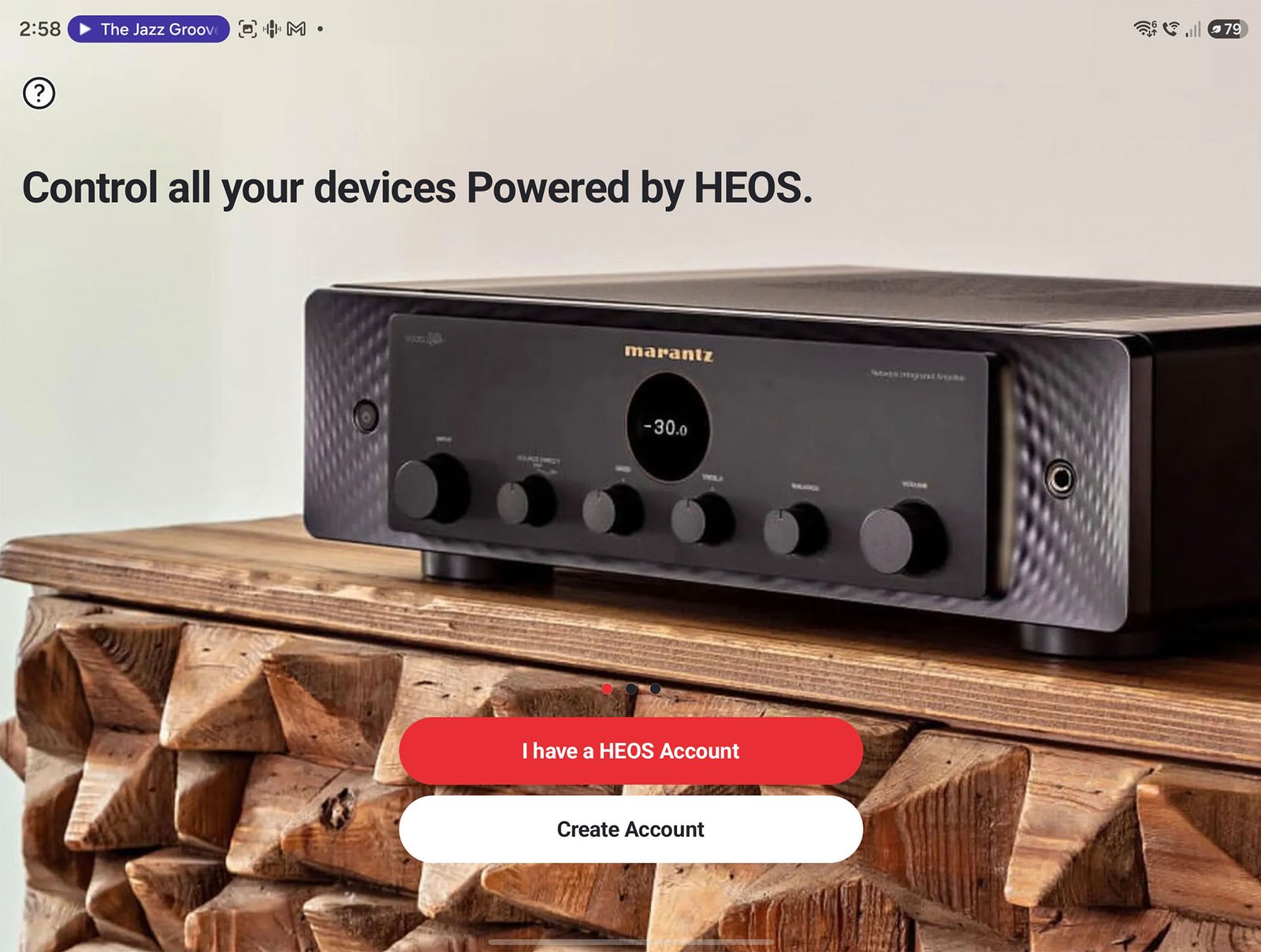
HEOS deserves its own paragraph, since it is one of the product’s lesser-known strengths and receives less recognition than it merits. It is the multiroom system developed by Sound United and now owned by Harman, and it has been on the market long enough for its bugs to have been discovered and sorted out by other people, which is by far the most overlooked feature of a streaming platform.
What you get:
- Cross-platform search. One search field that queries across the services you have connected, rather than making you remember which one has the album. This sounds trivial until you have lived without it.
- The services. TIDAL, Qobuz, Amazon Music, Deezer, Spotify, SoundCloud, TuneIn, SiriusXM, iHeartRadio and more, with hi-res where the service supports it.
- Local sources. UPnP and network shares, so a NAS just appears. USB mass storage on the USB-C port. FLAC, ALAC and WAV to 24/192, DSD to 5.6 MHz.
- Multiroom. Group any HEOS devices, in any combination, from the same app. This is where the platform earns its keep.
- The escape hatches. AirPlay 2, Spotify Connect and Bluetooth 5.4 all work independently of HEOS, so guests can play something without an account, an app or a negotiation.
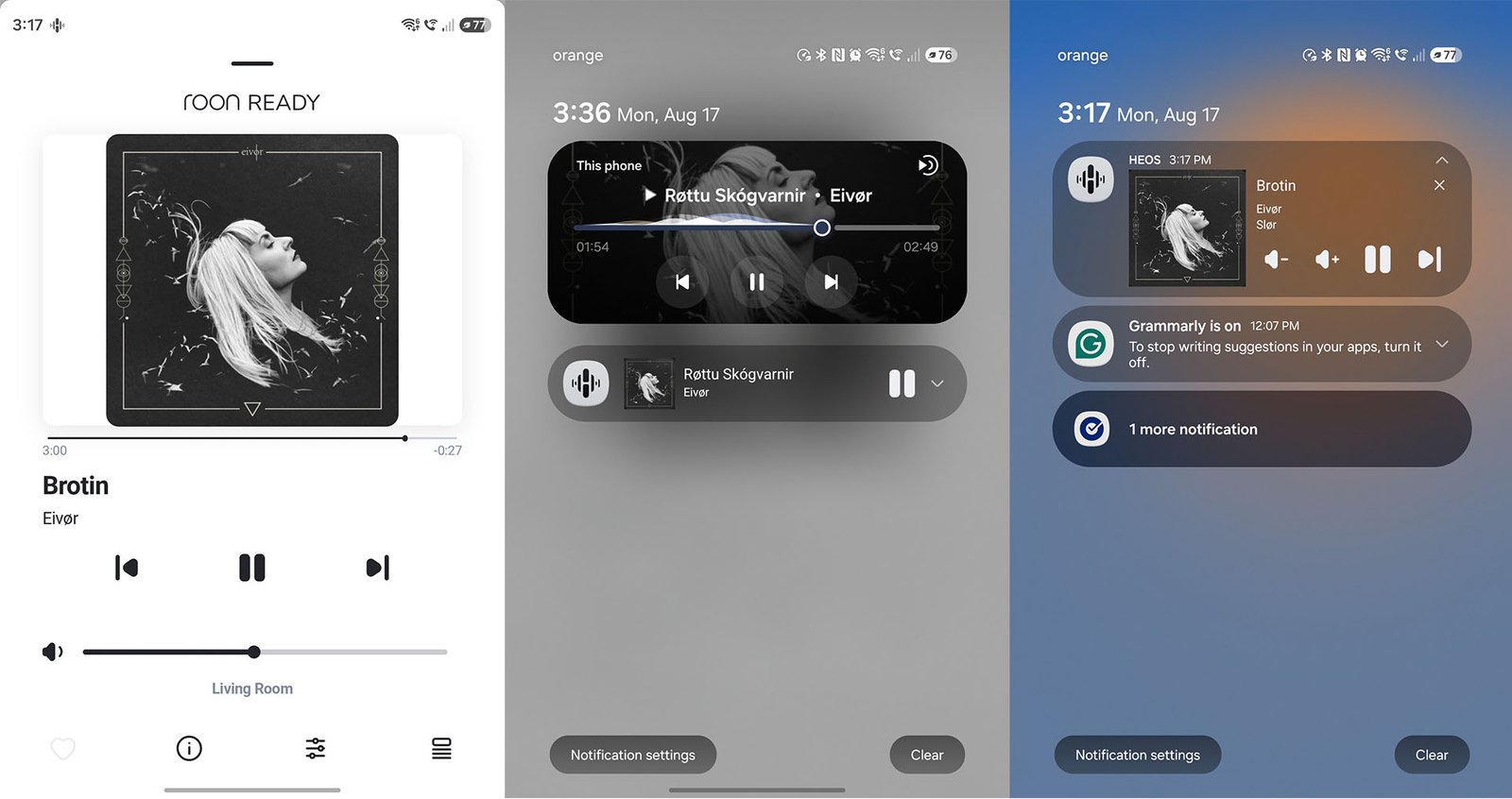
I set it up as a Roon endpoint, used it directly with Roon via Qobuz and TIDAL, connected a NAS share to it, and then plugged the TV in through eARC. All of this worked properly, with no drops. The eARC implementation, in particular, is carried out correctly: the TV remote can control the volume, the handshake works, and there are no lip-sync issues.
What I valued more than I expected was that there is no obligation to use Wi-Fi; a wired network connection is available. For individuals who have taken the trouble to optically isolate their network and supply it with a good switch, this option matters. The dual-band wireless genuinely performs well, with no dropouts after weeks of use, even at 24/192, but the choice shows the product is designed for both serious users and those who just want something convenient.
AuraControl and Mirage — the tricks up its sleeve
Two more proprietary names, and both earn their keep.
Marantz AuraControl serves as the tone and room-adaptation feature, and it is considerably more capable than the two-band treble-and-bass adjustment usually included with lifestyle speakers. You can make a meaningful adjustment to the response, and above all, you can tell it where it is. A speaker of this type may be placed against a wall, in a corner, or on a sideboard with a wall behind it and a ceiling above it, and the difference between telling it the truth about the situation and not telling it the truth is far from subtle.
The Marantz Mirage DSP handles spatial processing, enabling a single cabinet that is 21 cm wide to produce a soundstage considerably wider than its own width. I will explain exactly what effect it has on the music later, since that’s where interesting listening takes place.Both features are included in the app, both can be reversed, and neither is concealed behind three menus. The app is simple, fast, easy to read, and doesn’t oppose the user. Since I earn a living designing interfaces, I can say the best thing about a control app is that I stop noticing it, and with this one I stopped noticing it around day two.
Only the Music
I stayed with the Horizon for several weeks in three different positions: on the sideboard, where it was destined to end up anyway, on a low console since that gave it more air, and for a short time on a stand in the main listening room, even though it had no business being there, because that is what my job entails.
Let me start off by mentioning the main point: this is not a type of loudspeaker that sounds good ‘in the way that it is’. It is a loudspeaker that has been properly engineered and is placed in an unusual enclosure, and the descriptive qualifications can generally be left in the drawer.
1. First impressions — the weight of it
Massive Attack — “Angel” (Mezzanine, 1998)
I always begin by looking at any speaker that is said to have low-end extension, since “Angel” is particularly severe in this regard. The opening bass note is slow, very loud, and entirely vulnerable; a small cabinet has no possibility of hiding it, and the ways in which it can fail are clear. The result is either a single-note thud in the place where the pitch information should be, or a gentle indication of bass that appears two octaves above where it should be.
The Horizon didn’t do either of those things, and as a result I leaned forward in my chair. That note actually had a distinct pitch; you can trace the line, hear it move, feel where it hits, and it arrives with a weight which seems physically impossible for something that could be carried under one arm. The 6.5″ Gravity driver, together with that GaN amplifier, is indeed working hard. The 30 Hz figure is not merely promotional; there is genuine, controlled, tuneful energy at that frequency, and when Horace Andy‘s voice comes in above it, the bass doesn’t blur it or absorb it.
I turned the volume higher, and it continued playing. Then I increased it even more, beyond any level I’d use in social situations, and what struck me most was that the character remained the same—there was no compression, no hardening, no sign of DSP malfunction. It simply got louder, a feature that doesn’t seem all that impressive until you recall how many small speakers fail when pushed to eighty percent.
2. Soundstage and the Mirage question
Röyksopp — “What Else Is There?” (The Understanding, 2005)
The reason for this imaging torture test is that Karin Dreijer‘s voice is positioned right at the center and a little forward; the synthetic background then expands outwards in carefully layered sections. The recording has a real three-dimensionality when heard through a good stereo system, whereas with a single-box speaker it should, according to right, produce a flat wall of sound having the voice fixed in the middle.
That was not the case. When Mirage was in operation, the Horizon produced an image that stretched well beyond the physical limits of the device, considerably wider than the sideboard it stood on, with a real distinction between the layers and a steady, believable center. Dreijer’s voice remained in front of the speaker rather than inside it, while the synthetic sounds moved out and around.
Here’s the honest truth: this is a psychoacoustic trick, and like all tricks of this kind, it has certain conditions. If you sit within a reasonable arc in front of the speakers, the illusion works. But if you go to the far side of the room, the illusion simply disappears and goes back into the speaker cabinet. It doesn’t give you the holographic depth that you get with two well-placed speakers surrounded by air; nothing in a single cabinet can, and anyone who says otherwise is selling a product.
Yet within the specifications, it is truly impressive and is considerably better than any soundbar I have come across, regardless of how much it cost; it has a proper front-to-back dimension, not just width, and you do not just feel as though the event is coming from the speaker but that it is actually taking place in front of you.
3. Midrange and voices
The The — “Zen & the Art of Dating” (Ensoulment, 2024)
Since I first wrote about the Crystal Cable Art Series Monet, I have been listening to Ensoulment. Matt Johnson‘s baritone has become one of my standard test recordings, since it falls in that uncomfortable lower-midrange area where cheap audio systems tend to sound chesty and thin ones sound hollow, and it is surrounded by twangy guitar and piano with a lot of texture in the recording.
It dealt with him superbly; the voice had both body and chest without being boomy, and it occupied its own space with the instruments neatly arranged around it. The typical Marantz midrange—yes, after all these years there actually is such a thing—is there and properly rendered: slightly warm, always well-behaved, and never analytical just for the sake of being so. There’s texture but no harsh edges.
Here, the brand’s DNA is most evident. A person employed at Marantz has listened to this speaker in a room over an extended period, and as a result, it exhibits the same characteristics as speakers that are not based on measurement alone.
4. Dynamics and drums
Peter Gabriel — “Red Rain” (So, 1986)
Manu Katché‘s drumming on “Red Rain” is a particular test (live version not from the studio album) I have used for years (Manu Katché became Peter Gabriel’s primary touring drummer starting with the This Way Up tour in 1986 and famously performed “Red Rain” on subsequent concert tours and live albums). The drum kit is recorded in a large, dry way; the toms have genuine skin and air, and the piece develops from restraint into something very large. The thing I am listening for is whether the initial part of each hit reaches the ear intact, that is, the crack before the main body, or whether it becomes rounded.
The headroom of the Rise amplifier can be evident in this example. The transients reach their destination at the right speed, and the track’s large dynamic swings are retained; the build-up feels like a build-up, not a slow rise in level. The GaN topology is known for exhibiting this kind of control, and whether or not it is marketed as such, the behavior is genuine.
If I am being exacting, and that is what one would expect of me, then the most subtle micro-dynamic gradations, the tiniest variations in pressure, are simplified when compared to those produced by my reference chain. That indeed represents the true limit of a single-cabinet system controlled by a DSP, and it costs about twenty times as much to go beyond it.
5. Pop production and long-session comfort
Daft Punk — “Instant Crush” (Random Access Memories, 2013)
The production of modern pop music presents a particular challenge, one that is different in character: it involves thick layers, heavy compression, and a treated vocal placed on top of all the other elements. In this case, the problem when things go wrong is that the result becomes congested and collapses into a featureless wall during the chorus.
The Horizon not only kept the different elements separate but also made the music enjoyable. Julian Casablancas‘s vocoded voice remained clearly distinguishable from the guitars, the bass line stayed clear despite the mixing, and the track maintained its lively character. During that evening I listened to most of RAM as well as a lot of other recordings, and after three hours of playing the one thing I noticed was that I had never once felt the need to turn the music down; there was no fatigue, no harshness, and no unpleasant sharpness in the upper midrange where more inexpensive DSP designs are noticeable.
The final point mentioned might in fact be the most valuable of all those made in this review. A speaker situated in your living room is one that you will end up listening to for hours without having to make any intention to do so; whatever the Sound Masters have done to the voicing, they have achieved the kind of long-session comfort required, and that aspect is more important in this case than any single audiophile quality.
A Word About the Tripod
I didn’t get the optional tripod stand with the review sample, and therefore can’t say how it sounds. However, I can explain why I would order one.
It is constructed from American walnut and cast iron, is finished in satin black, and Marantz clearly states its purpose: achieving the correct listening height. The fact that that sentence is carrying more weight than it at first seems.
During this period all the sounds I heard were picked up using the Horizon on a sideboard, since that is the position in which it will usually be found in people’s homes, and a sideboard represents a compromise: it positions the drivers about at chest height for a seated listener so that the tweeters project past rather than directly into your ears, and it also places a large flat reflective surface right below the speaker and generally a wall right behind it. If you take the same speaker and place it on a proper stand, raise the driver array to eye level for a seated person, and move the speaker away from the walls, two things occur, which I have come to expect after having reviewed every other speaker. The tonal balance becomes more open since you are no longer hearing the high frequencies at an angle. And the bass improves in tightness because the sideboard is no longer acting as a resonating shelf, and there is less boundary reinforcement, so that the rear wall doesn’t add bass response that you didn’t want.
There is another advantage which is of particular relevance in this case. The soundstage of the Mirage is created psychoacoustically, and psychoacoustic effects work much better when the speaker is in free space, surrounded by air, and the listener is situated on the correct axis. Compared to the sound I obtained when the speaker was on furniture, I should expect the imaging to become considerably more definite if the speaker is placed on its stand in an open area and aimed properly.
The materials indicate that Marantz has also considered the mechanical aspects involved. Cast iron is a traditional material for a stand since it is dense and self-damping, and combining it with walnut is a choice that relates both to acoustics and to appearance. Since there is already a marble base beneath the sphere, the result is a structure that extends from the floor to the driver and is made up of stone, iron, and hardwood, which is as inert a pathway as could reasonably be expected.
If you intend to buy the Horizon as the principal music system for a room rather than as a decorative item, then you should plan to purchase the stand at the same time; that is my honest view of the matter, namely that the stand is not an accessory but, in fact the other half of the product.
Market Value
Let us be straightforward on the subject of money, as we are when dealing with it here.
The price of the Horizon is about $3,600 or €3,600, depending on the market and local taxes; the larger Grand Horizon is roughly $5,500. However, check with your dealer for current pricing, since this category is subject to change.
Can that be a great deal for a single speaker? Yes, it obviously is. As for this speaker, however, it depends completely on what you are comparing it to, and I should think that most people compare it to the wrong thing.
You could compare the setup to a pair of passive bookshelves together with an integrated amplifier, a streamer, and some cables, in which case you could put together a system at that price that had better sound quality. Of course you could; you would also end up with five boxes, a rack, a cable run, an afternoon spent setting it up, and a continuous need to discuss it with all the people you live with.
The right point of comparison is at the other end of the category, and there the Horizon comes across as solid. When measured against a high-end soundbar, it is not a close match. The Horizon is competing in a completely different category. Against the obvious single-cabinet models, it holds its own in build quality and finish in a way that I believe is truly leading the market; there is simply more value per euro. Compared with the two-box active systems I have reviewed, such as the Cabasse RIALTO (reviewed here) at €2,990, it gives up a bit of stereo separation in return for a significant improvement in industrial design, and it includes a five-year warranty and a mature streaming platform.
There is indeed an even more honest comparison, and it has nothing to do with audio equipment. It’s a marble base that does not exist anywhere else in the world, a stand made from American walnut, constructed from cast iron, and featuring a seamless technical textile that has been developed in collaboration with the fashion industry using recycled ocean plastics. The box includes a Certificate of Authenticity and offers three different finishes so that it can be specified to match a particular interior. It has won two international design awards. If you take out the part about it having drivers, the description sounds like that of some designer furniture, and furniture of this kind — for example, a good lounge chair, a decent floor lamp from a well-known brand, or a small sculptural side table — costs precisely the same amount and doesn’t play music.
That is the reason given for the price, and I believe it is valid. You aren’t paying just for a loudspeaker; you’re paying that amount for an item that has the material specifications, the finish quality, and the design background of luxury furniture, even though it includes 310 watts, six drivers, and a fully mature streaming platform, and will still look and sound up to date in ten years.
The case in question is not really all about the amount of sound per euro; it’s about the other things you receive alongwith the sound—a thing that you will be happy to look at every single day for a decade, a platform that will still be supported in five years’ time, one power cable rather than nine, and finally the end of an argument you have been gradually losing since you moved in together.That is a significant premium to many people, and to me, based on what I’ve seen over this period, it is worth nearly all of it.
In Conclusion
I started off with a graphic artist at his kitchen table in Kew Gardens, and now I want to end at the same place, since the circle then comes to a very neat conclusion.
Saul Marantz created the Marantz Audio Consolette because he couldn’t buy the product he wanted, and he gave it a beautiful design because, through both his training and his nature, he never regarded how something looked and how it functioned as two separate issues. Seventy-four years on, his company has produced a sphere enclosed in seamless fabric with a glowing ring in the center, and what is remarkable about it is not that it is beautiful. Many things are in fact beautiful. What is remarkable is that no one seems to have had to make any compromise in order to achieve it.
The Horizon is heavier than it has any justification for being, having been built to a standard that I couldn’t criticize after having spent weeks searching for the corner where it met the wall, being set up in less than four minutes, and then delivering music with real bass extension, a truly convincing soundstage, a midrange that could only have come from this brand, and absolutely no fatigue even after long sessions. It can be properly connected—either by wire or wirelessly—to any equipment you already have, and it manages all of this from a single cabinet that you can carry under one arm, something that I wouldn’t have believed just a few years ago.
At the beginning, I stated that a designer’s company has an obligation that most audio companies do not possess: it cannot choose to be beautiful rather than good. Based on what has happened over these weeks, the obligation has been fulfilled, and it has been fulfilled by people who clearly realized that they were being expected to meet it.
The reference system is still in the listening room since I am not cured and there never will be a cure, but there could be a Marantz on the sideboard in the living room, emitting a gentle glow and playing whatever anyone in the house chooses to request, and no one has proposed moving it. A graphic artist from Queens began all of this by refusing to accept the idea that the thing which sounds right and the thing which looks right are two different things.
Thank You — AVstore
Each experience of this kind starts with someone who is willing to place trust and to share, and in this instance it is once again the team from AVstore (avstore.ro), our local dealer and one of the most genuine, knowledgeable, and enthusiastic high-end partners I have had the pleasure of working with over the years.
They provided us with a copy of the Marantz Horizon for evaluation just as openly and patiently as they have done each time before, a willingness that is something only people who truly listen to music, who care about it, and who believe in what they are promoting can have. If you are in Romania and would like to hear the Horizon, you should go and listen to it in their showroom; that is the purpose of a showroom, and this is a good one.
The Marantz Horizon is available at marantz.com, which also has a dealer located near you.
Red Dot 2025, and Why I Am Not Giving an Award
I normally conclude my review of this sort by presenting one of our own awards. This time, however, I am going to do things differently, since the Horizon already has two awards more important than mine, and pretending otherwise would be a bit of vanity.
In 2025, the Marantz Horizon received both the Red Dot Design Award and the iF Design Award. Those awards are not given in the field of audio. They are among the most rigorous industrial design awards and are judged by designers, not listeners, alongside a wide variety of products such as furniture, medical equipment, and consumer electronics, since there are thousands of entries in the category. The jury members were entirely unconcerned about its sound; they focused on the product itself.
To me, that is the most interesting acknowledgment that this product could have received, since it confirms the very point I made at the start of this review. A company run by a graphic artist has created an item which professional designers (maybe none of whom have any interest in hi-fi) have judged to be one of the best-designed products of that year. The porthole is considered a complete object, made from marble, hardwood, iron, and a seamless recycled textile developed in collaboration with the fashion industry, with three finishes available so that it can be specified into a room that has already been designed.
The part of the question that I was responsible for was the one which the Red Dot jury did not need to deal with. Does it seem as if the object merits the place it occupies? After a number of weeks I have concluded that the answer is yes, and in fact I have become much more certain about it than I had been when that box was on my floor.
The design world has already spoken, and it has done so better than I could. All I’ll add is the aspect they hadn’t been assessing: this is truly luxurious and a truly good loudspeaker, and those two statements don’t usually go together.
Thanks, everyone, and as always, please don’t hesitate to leave a comment in the section below. Until we meet again, I hope you’ll only hear the best!