KEF Coda W and KEF Kube 12 MIE Subwoofer Review: Hi-Fi Sound at a Price That Surprises

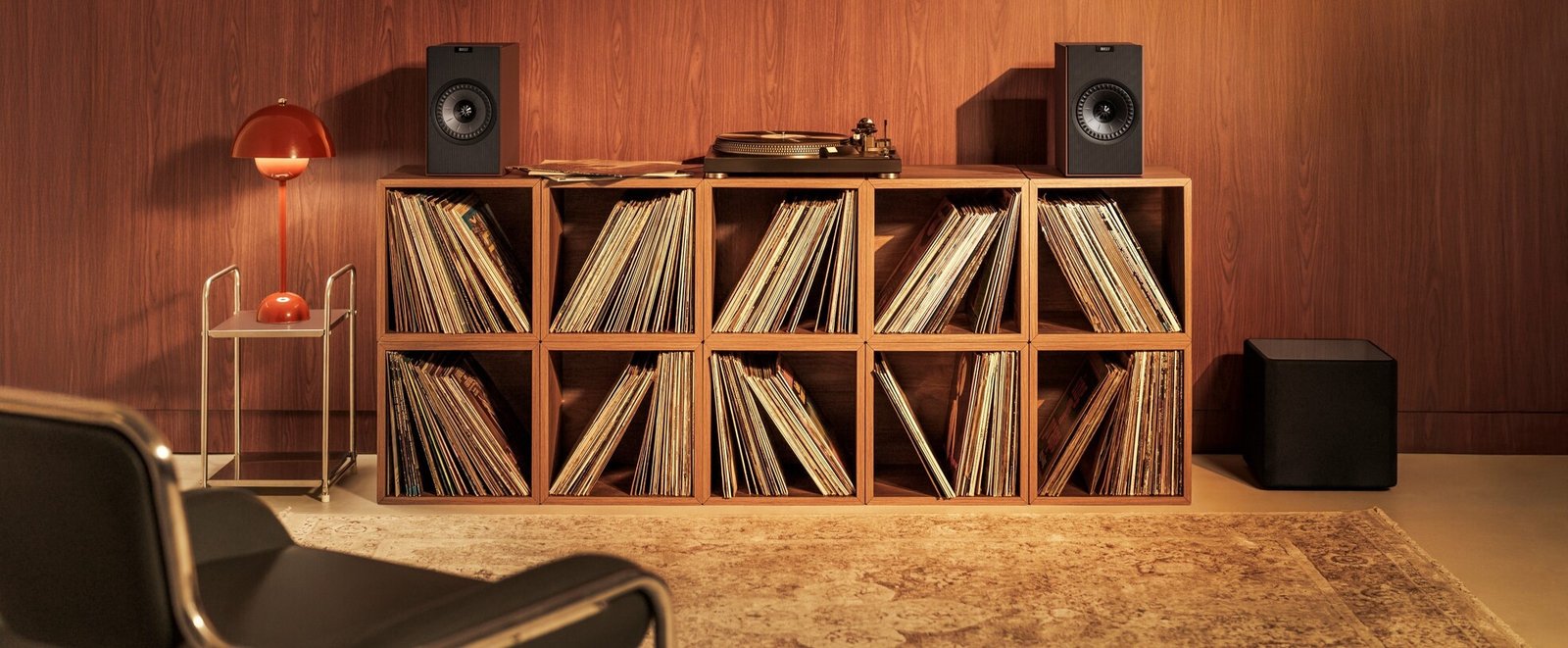
TLDR:
The Coda W is the entry point into KEF’s wireless range of speakers. This is an active stereo pair with built-in amplification, DAC, and a bonus RCA Phono input. KEF specifies 200 W of total Class D power for the pair. This power is split as 70 W for the woofer and 30 W for the tweeter in each cabinet, all built around the 12th generation Uni-Q driver array, with a 25 mm aluminium dome tweeter mounted at the acoustic centre of a 130 mm magnesium and aluminium alloy cone.
We ran the pair in combination with one Kube 12 MIE subwoofer, a sealed 12-inch design rated at 300 W that reaches down to a specified 22 Hz. The subwoofer was positioned in the middle of the front wall between the two speakers.
Three takeaways from the time spent with this system:
1. The system offers a hi-fi sound signature at a very affordable cost: the tonal presentation, the cleanliness, and the resolution belong to a beginning-of-the-road hi-fi system, but come at a cost that puts them within reach of people who have never assembled a rack of separate devices. This is their main achievement.
2. A three-dimensional soundstage with pinpoint imaging: depth and front-to-back layering are very good, with instruments placed at distinct places from the listening position, managing to hold the position accurately and clearly as the music flows. Separation between sound sources is obvious to anyone sitting down for a listen. This is the point-source presentation KEF has built its reputation on, and it is very well defined here.
3. Ease of use. Setup ran fast and problem-free. Source switching between hdmi/optical/usb/rca is quick and clean. The remote control is useful and also a pleasure to use.
As a bonus, we would like to mention that the bass extension is deeper than cabinets of this size would have anyone believe.
The dynamics, composure, timbre, and the sound signature stay identical from zero to full volume, with no compression applied anywhere in the range.
The speakers do come with a few quirks.
Maximum output is limited. We measured it at 97.2 dB (C) at our listening position, 4 metres from the speakers. There is no high-pass filter and no crossover options in the app, which begs the question: why give an option for a subwoofer-out if it is not completed by the correct functionality? We believe this is a mistake from KEF, but we hope it can be corrected with an updated app in the near future.
There is no network streaming platform on board.
And a very important note before you read any further. Past roughly 70 to 80% on the volume scale, air chuffing between the tweeter and the midrange driver becomes obvious from the front of the cabinets. It fires straight at the listener. So if you plan on using the Coda W in a nearfield or desktop setup, at anything past moderate levels, everything positive we say in this review becomes far less relevant, because that noise will hit you right in the face. Keep it in mind if you plan on buying!
Introduction
We have reviewed a wide range of active speakers, from the Cambridge Audio L/R X, the Denon Home 600, the Devialet Phantom Ultimate, and a powered subwoofer study built around the SVS SB-3000. Four very different answers to the same question: how much of a hi-fi system can you fit inside the speakers themselves, and what do you give up to get it there?
The Coda W is interesting because KEF cut a corner nobody else in this price range dares to. There is no streaming platform inside it. Almost all competitors at this price range have Wi-Fi, an app, and a list of services. KEF took all of that out and spent the savings on the drivers and amplification. The LSX II LT costs the same and offers streaming. The Coda W does not, but it uses a bigger Uni-Q array in a bigger cabinet.
So the question we are asking across this review is a narrow one. Was that a good trade? Does the money KEF saved on the network board show up in the sound?
We would like to point out that we have more than one system as our reference, formed from separate specialised devices. The systems are built the traditional way, one component at a time, matched by ear over months. We like that process, and we are not about to pretend otherwise. What makes an active system worth our time is that it removes every one of those decisions from the owner and makes them once, in a factory, on their behalf. When that works, it works for people who would never assemble a rack. When it fails, there is no workaround, especially if the active speaker has no built-in DSP function, and the owner has no way to fix it. You could go away with it, with the source making small adjustments to the sound from it.
I. KEF and the Coda Name
KEF was founded in 1961 by Raymond Cooke, a BBC-trained engineer who had spent five years under Gilbert Briggs at Wharfedale. The company took its name from the site it started on, Kent Engineering and Foundry in Tovil, near Maidstone. The first offices were in a Nissen hut on that land. KEF still designs and builds its signature models in Maidstone today.
Cooke left Wharfedale over materials. He wanted to work with the plastics and synthetics becoming available at the time, and paper cones were the standard everywhere. The first KEF speaker, the K1 of 1962, used an aluminium-skinned polystyrene bass diaphragm and a Melinex dome tweeter. That approach has held ever since in the philosophy of KEF’s engineering: take the newest material, understand it properly, and build the design around what it can do.
The BBC connection continued. KEF’s bextrene B110 and its T27 tweeter became the drive units inside the LS3/5A, the compact monitor designed at the BBC and built under licence by several British companies. More than fifty thousand pairs reached listeners worldwide, and it remains one of the most studied small loudspeakers ever made.
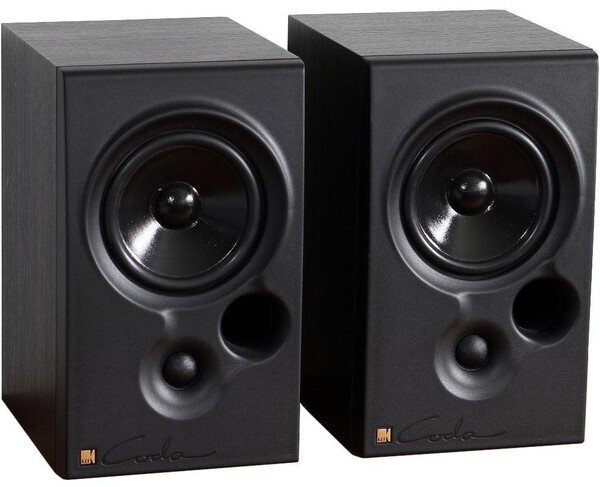
The original Coda. The Coda was sold from 1971 to 1977. KEF’s museum records place it beside the Cadenza, the Chorale and the Cantor, in a catalogue that used the letter C for the affordable models. The Coda was the entry point. A Coda II followed in the 1980s and became one of the company’s best sellers of the decade. Coda 7 appeared in the 1990s alongside the Q Series. Across three decades, the name meant the same thing every time.
Total System Design. In 1973 KEF became the first loudspeaker manufacturer to use computers in design and measurement. The method that came out of it treats the drivers, the cabinet and the crossover as one system to be optimised together. The Coda W is a direct descendant, with a digital processor coordinating every element.
KUBE, the original. During the 1980s KEF sold the KEF Universal Bass Equaliser, or KUBE, an outboard unit that let compact cabinets reach lower than their internal volume should allow. The Kube subwoofers carry the name forward. Same problem, forty more years of knowledge and a great deal more amplifier power.
Uni-Q. In 1988 KEF patented the first coincident-source driver, putting a tweeter at the exact acoustic centre of a mid-woofer so both radiate from one point in space. The listening area widens considerably, and people sitting in different spots hear the same tonal balance. Uni-Q is now in its twelfth generation, and that twelfth generation array is what the Coda W is built on.
Gold Peak bought KEF in 1992, and GP Acoustics has owned it since. Raymond Cooke died in 1995.
The original Coda existed to put KEF engineering within reach of people who could not afford the rest of the range. The Coda W does the same job, with an amplifier, a processor and a set of digital inputs added.
II. Build Quality and Technical Overview
The cabinets. The Coda W comes as a matched pair: a primary cabinet with all the electronics and inputs, and a secondary cabinet with its own amplification, fed over a wired link. Each measures 285 x 168 x 268 mm and the pair weighs 11.3 kg. Knuckle taps across the panels come back short and dense with no ringing behind them. Once the driver, the amplification and the electronics take their share, very little internal volume is left, and that density works in the design’s favour.
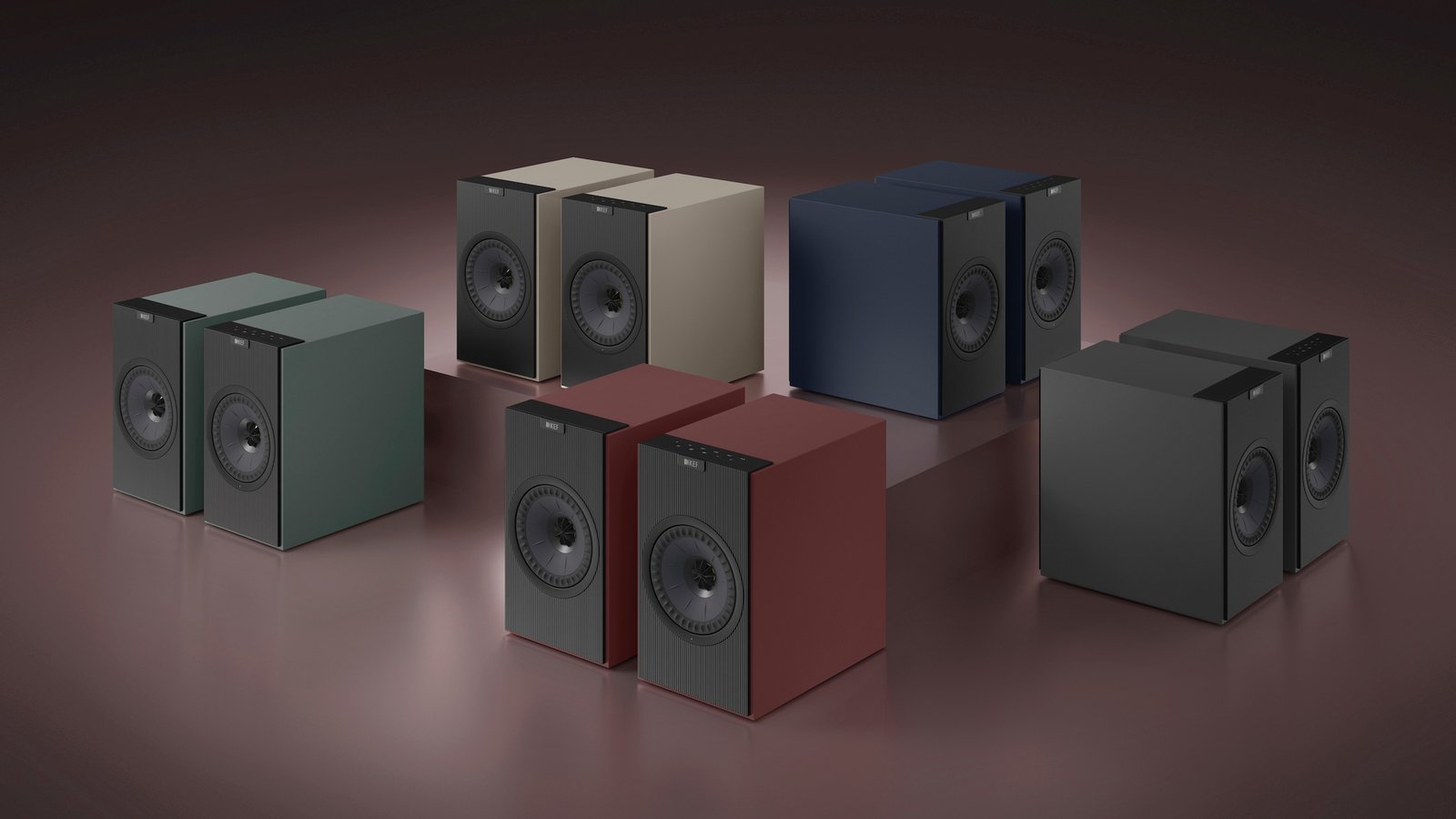
Five finishes: Vintage Burgundy, Nickel Grey, Moss Green, Midnight Blue and Dark Titanium. The proportions reference the original Coda, and the finishes are chosen for a living room more than a listening room.
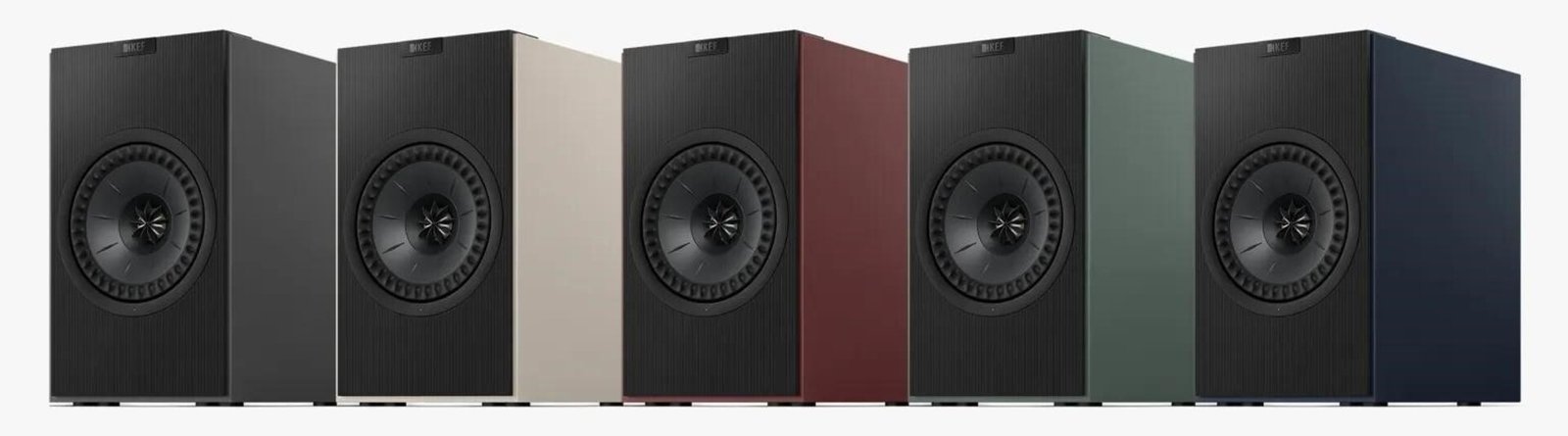
The 12th generation Uni-Q driver array. This is where the soundstage comes from. A 25 mm aluminium dome tweeter is mounted at the acoustic centre of a 130 mm magnesium and aluminium alloy mid-woofer cone. Both radiate from the same point in space.
The engineering explains a lot of what we heard. In a conventional two-way speaker the tweeter and the woofer occupy different positions on the baffle, so sound from each reaches your ears at slightly different times, and that difference changes depending on where you sit. A coincident-source array removes the variable. The two drivers share one acoustic origin, so the timing relationship stays constant across the room. You get a wide listening window, an image that survives you moving around, and a tonal balance that barely changes between the sweet spot and the seat next to it.
Twelve generations of work show up in the details: the tangerine waveguide over the tweeter dome, the profile of the surround, the cone shaped to work as an extension of the tweeter’s radiation pattern.
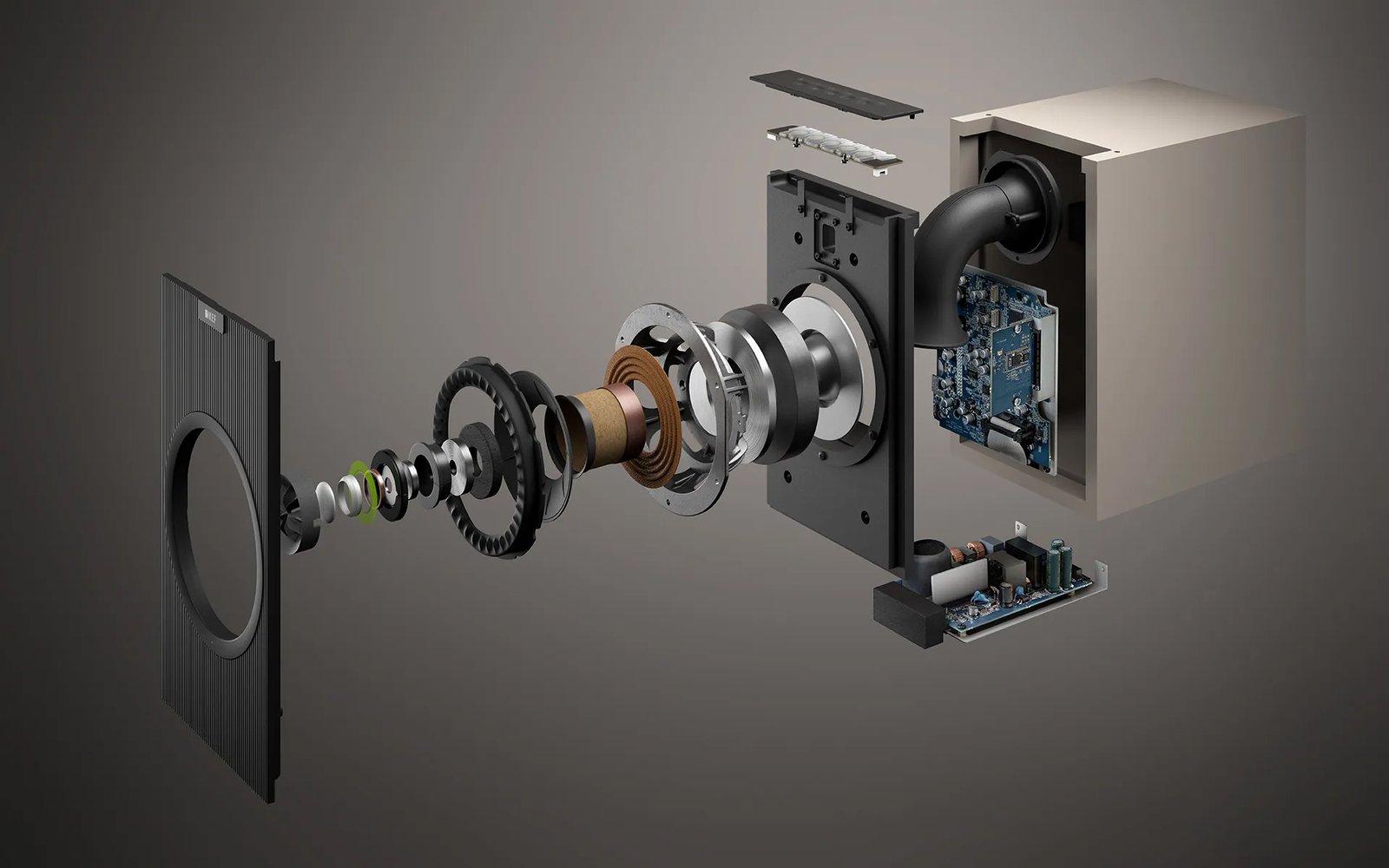
Amplification. 200 W of total system power. Each cabinet has two Class D amplifiers, 70 W for the low-frequency section and 30 W for the high-frequency section. One amplifier per driver removes the passive crossover from the signal path and lets the processor engineers play with the crossover frequencies from the digital domain, with complex slopes and corrections that would be much harder and more expensive to accomplish with a passive network. Active studio designs have worked this way for decades.
KEF quotes maximum SPL at 102 dB at one metre. Our own measurement at the listening position is a little lower.
Music Integrity Engine. KEF’s DSP suite handles the crossover, the driver protection and the corrections applied across the volume range. Each model gets its own implementation. In the Coda W, it runs a two-way active crossover mode. In the Kube, it manages bass extension through iBX.
Frequency response. KEF specifies 41 Hz to 20 kHz at ±3 dB, measured at 85 dB at one metre, with a minus 6 dB point at 38 Hz. Both figures depend on the EQ settings in use. A 5.25-inch woofer reaching the low forties in a cabinet this size is a good result.
Connectivity. Everything goes into the primary cabinet. HDMI ARC for a television over one cable. A moving-magnet phono input for a turntable, with no external phono stage needed. USB-C up to 24-bit/192 kHz. Optical up to 24-bit/96 kHz. RCA line-in for analogue sources. Bluetooth 5.4 with aptX Adaptive and aptX Lossless.
Outputs: an RCA subwoofer output, the USB-C interspeaker connection, and a USB-C 5 V DC socket for powering an accessory.
No streaming, and what that means for you. The Coda W has no Wi-Fi and no Ethernet. No Roon Ready, no TIDAL Connect, no Spotify Connect, no AirPlay 2, no Google Cast. You cannot open an app and send music to these speakers over your network, because there is no network connection to send it to.
So how do you play music? Two ways. Bluetooth from a phone or a laptop, at CD resolution over aptX Lossless. Or a cable from a device that streams for you: a computer over USB-C, a streamer over optical or RCA, a television over HDMI. That is the whole list.
If you already play everything from a laptop, a phone, or a TV, none of this will bother you. If you want to press play in an app and have the speakers do the rest, buy the LSX II LT or the LS50 Wireless II. The Coda W costs what it costs precisely because KEF took the streaming board out.
The interspeaker link. A three-metre cable ships in the packaging and carries the signal from the primary cabinet to the secondary, with every source resampled to 24-bit/96 kHz PCM. A wired link between the two halves of a stereo pair removes a whole category of variable from the listening, and we are glad KEF went this way. The cable length sets your maximum spacing between the cabinets, so check the geometry before you buy. KEF sells a longer C-Link cable separately.
Remote and daily use. Setup ran fast and problem-free. The pairing between the two cabinets was instant, and we had music playing within minutes of opening the packaging. Source switching between HDMI, optical, USB, and RCA is quick and clean, with no long pauses and no dropouts.
The remote was always on the sideboard for the whole review period. Volume and source selection are available without a phone involved. In a living room, used by people who have no interest in apps, a remote that works properly is very useful and practical.
III. The Kube 12 MIE Subwoofer
We ran one Kube 12 MIE, centred on the front wall between the two speakers.
The design. A single 300 mm front-firing long-throw driver in a sealed cabinet, driven by a 300 W RMS Class D amplifier. 410 x 393 x 410 mm, 18.6 kg. KEF specifies 22 Hz to 140 Hz at ±3 dB and a maximum output of 114 dB.
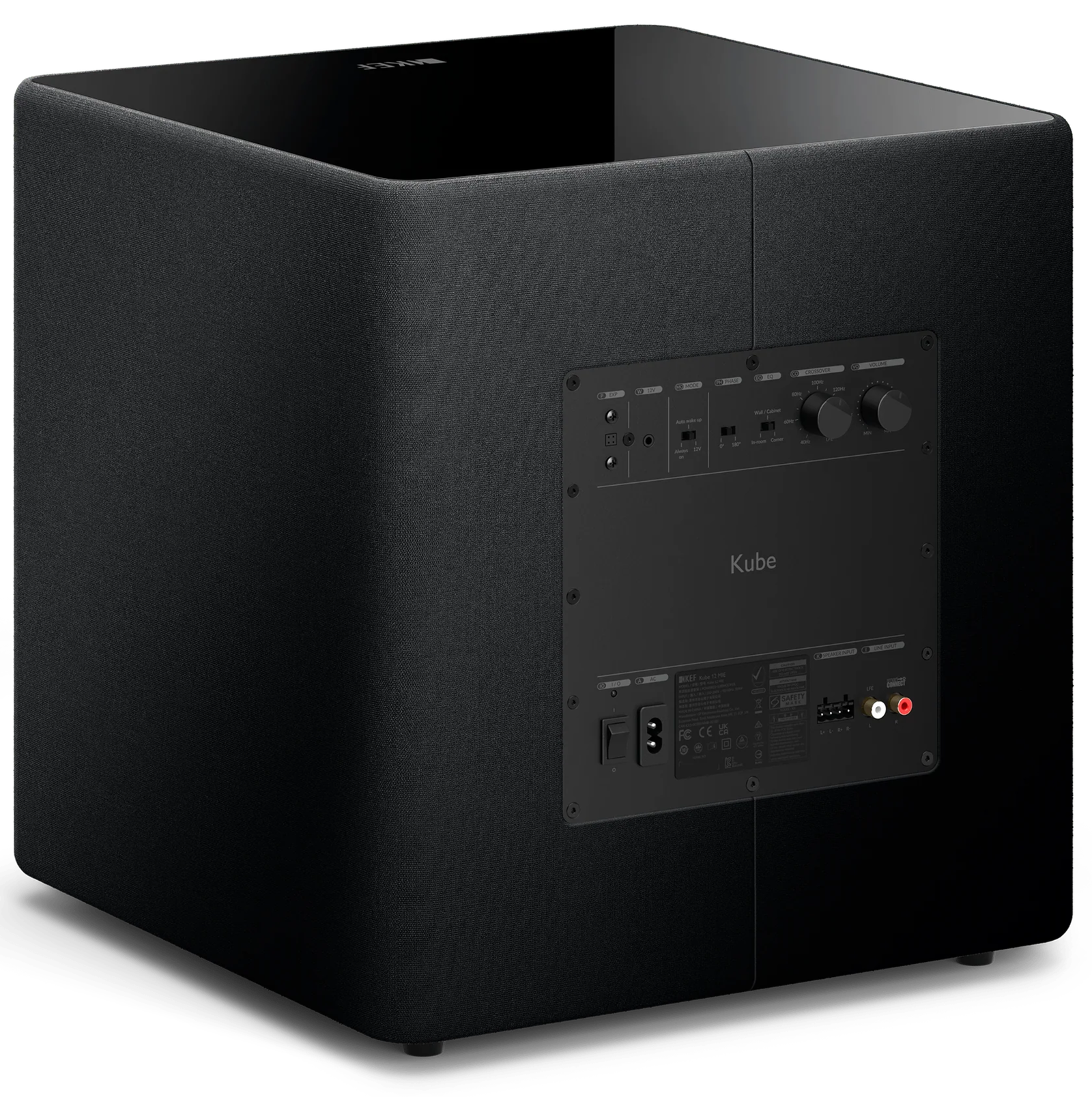
A sealed cabinet loads the driver against a fixed volume of air that behaves like a spring. The roll-off below the tuning point is gentler than a ported design gives you, and the time-domain behaviour is tidier, with less energy stored in the cabinet and released after the note has finished. The trade is efficiency, and 300 W of amplification covers it. What you get is a subwoofer that starts and stops with the music and blends into a small speaker without announcing itself. Sealed cabinets also sit more forgivingly in a room, which is why KEF points to placement flexibility as a benefit. This is the theory and if practice makes perfect, then we should have a very nice thing going here…
iBX Intelligent Bass Extension. Part of the Music Integrity Engine. It extends the depth available from the driver by managing excursion against level, and KEF describes it as delivering deeper and more precise bass at any listening level. That is the maker’s claim. We report what it produced below.
Room position EQ. Three presets: freestanding, wall or in-cabinet, and corner. Each applies a correction for the boundary reinforcement that position creates. Sensible engineering, and it takes a lot of guesswork out of setup.
Connections and control. RCA inputs, speaker-level inputs, and KEF SmartConnect, which detects a mono or stereo feed and adjusts level accordingly. A variable low-pass filter from 40 Hz to 140 Hz with an LFE bypass. An expansion port takes the KW1 wireless adapter if a cable run is difficult in your room. Power modes cover auto wake-up, always on, and 12 V trigger.
The missing option that limits everything: no high-pass filter
This is a very important aspect of the system as a whole.
The subwoofer output on the Coda W does not change the behaviour of the speakers in any way, shape, or form. No high-pass filter is applied to the speakers. There is no crossover point to set, in the app or anywhere else. The Coda W keeps reproducing its entire frequency range at all times, with the subwoofer working or not beside it.
In a typical subwoofer integration, a high-pass filter removes the lowest frequencies from the main speakers and sends that workload to the subwoofer instead. This greatly reduces the power and excursion demands on the main speakers, since deep bass requires both substantial amplifier power and large woofer movement.
With the subwoofer handling the bottom end, the main woofers no longer have to reproduce frequencies they are poorly suited for. Their cone travel is reduced, leaving them more headroom to reproduce the midrange cleanly and with lower distortion. The result is higher overall system output, because the main speakers and their amplifiers are no longer wasting valuable headroom on bass frequencies that the subwoofer is already handling.
You get none of that here. The 130 mm cones keep working across the whole range at every volume level. Maybe the subwoofer output was added to bring more presence below roughly 40 Hz, filling in the octave the Coda W cannot reach. It adds nothing to the available output or the dynamics. Maximum SPL stays exactly where it was, set by the excursion limit of those small drivers.
A Kube 12 MIE added to a Coda W extends the bottom end, and it does that job well, but if you are hoping for the system to play louder or hit harder, the current architecture clearly rules that out.
And this is our one complaint about how KEF has put this system together. There is a subwoofer output on the back but no crossover options in the app to go with it. Why give an option for a subwoofer output if it is not completed by the correct functionality? A high-pass filter is a few lines of DSP code on a processor that is already running a crossover between the tweeter and the woofer. The hardware is there. The output is there. The function is missing. We believe this is a mistake from KEF, and we hope an app update corrects it. The Coda W would gain output, dynamics and midrange clarity overnight, at no cost in parts.
A single subwoofer centred on the front wall between the speakers is a sound choice in a room of our shape. The central position keeps the arrival time of the low-frequency content symmetrical with respect to both speakers and both side walls, and it keeps the subwoofer out of the corner loading that exaggerates specific frequencies. Below 40 Hz, where wavelengths run longer than the room itself, the ear cannot localise the source, and the Kube disappears into the picture as it should.
Specifications
KEF Coda W
| Configuration | Two-way active stereo pair |
| Driver array | 12th generation Uni-Q, one per cabinet |
| Tweeter | 25 mm aluminium dome |
| Mid-woofer | 130 mm magnesium and aluminium alloy cone |
| Amplifier power per cabinet | LF 70 W, HF 30 W |
| Total system power | 200 W |
| Amplifier class | Class D |
| Processing | Music Integrity Engine |
| Frequency response | 41 Hz to 20 kHz ±3 dB, measured at 85 dB at 1 m |
| Frequency range | 38 Hz to 20 kHz at minus 6 dB |
| Maximum SPL | 102 dB at 1 m |
| Wireless | Bluetooth 5.4, aptX Adaptive, aptX Lossless |
| Source resolution | USB-C up to 192 kHz/24-bit, optical up to 96 kHz/24-bit, HDMI up to 1.411 Mbps PCM |
| Interspeaker connection | Wired, all sources resampled to 96 kHz/24-bit PCM |
| Inputs | HDMI, optical, USB-C, RCA line, RCA phono MM, Bluetooth |
| Outputs | RCA subwoofer, USB-C interspeaker, USB-C 5 V DC |
| Dimensions per cabinet | 285 x 168 x 268 mm |
| Weight per pair | 11.3 kg |
| Power consumption | 200 W operating, under 0.5 W standby |
| Finishes | Five |
KEF Kube 12 MIE
| Design | Powered subwoofer, sealed |
| Drive unit | 1 x 300 mm |
| Frequency response | 22 Hz to 140 Hz ±3 dB |
| Maximum output | 114 dB |
| Amplifier type | Class D |
| Amplifier power | 300 W RMS |
| Variable low pass filter | 40 Hz to 140 Hz, LFE |
| Inputs | RCA phono, speaker level, expansion port for KW1 |
| Room position EQ | Freestanding, wall or in-cabinet, corner |
| Power modes | Auto wake-up, always on, 12 V trigger |
| Dimensions | 410 x 393 x 410 mm |
| Weight | 18.6 kg |
| Power consumption | 300 VA |
All specifications above are as published by KEF.
A Note on Measurements
We measured in our small living room, roughly 4 m x 5.3 m with a 2.7 m ceiling, modest treatment, a normal couch, nothing resembling an anechoic chamber. It is the smaller of our two rooms, and we chose it because this is a smaller system that outputs a lower 97.2 dB (C). To put it in a bigger room makes no sense.
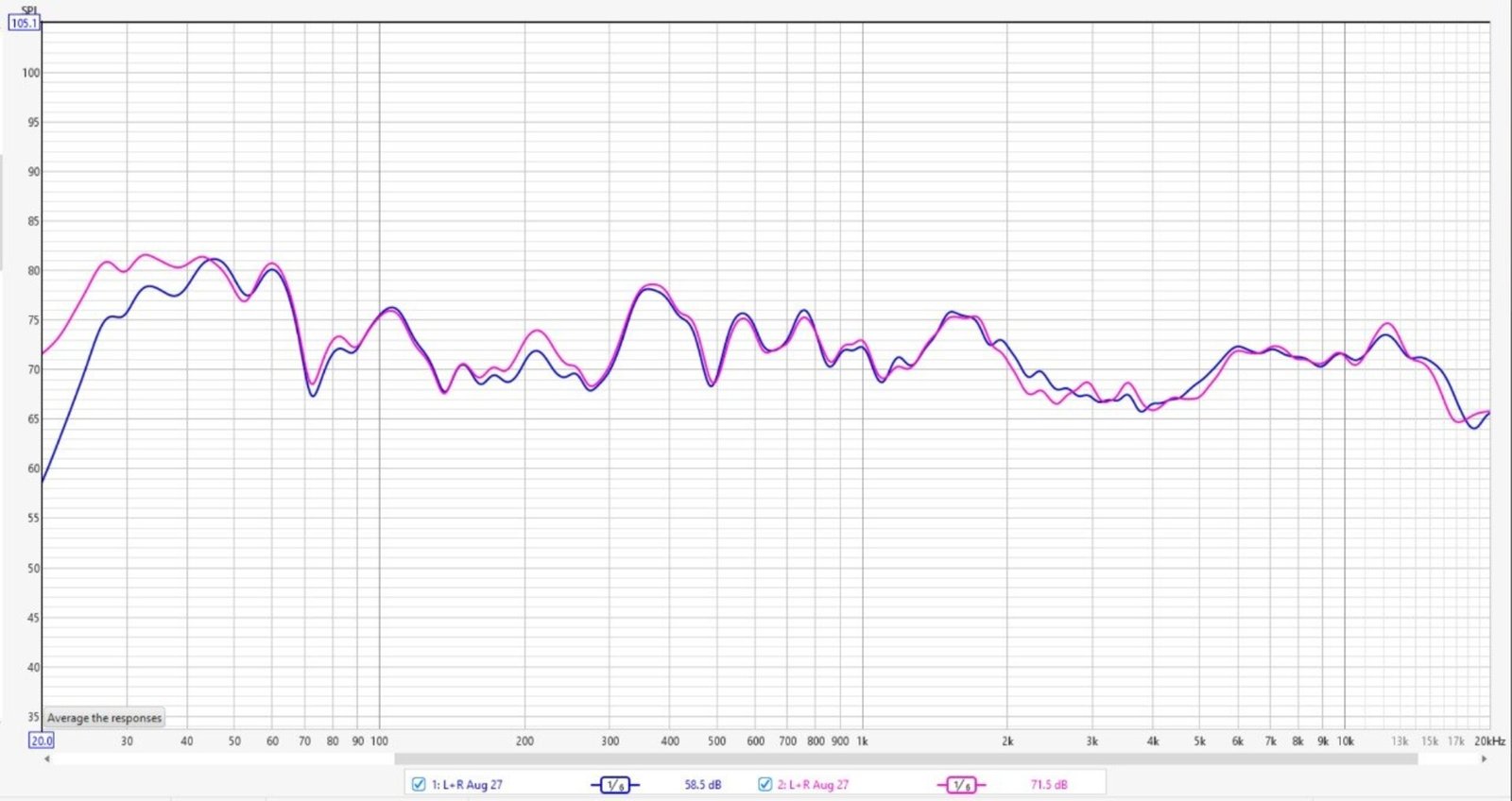
Coda W stereo pair alone (blue trace), and Coda W with the Kube 12 MIE (violet trace) measured at the listening position
Same sweep, same settings, same listening position, two configurations. The difference between the traces shows exactly what the Kube adds and where it takes over.
Active loudspeakers often rely on DSP limiters and protection circuits that can progressively reduce bass output as the drivers and amplifiers approach their limits. Below, you can see how the CODA W behaves as the volume is progressively increased from 50% all the way to 100%.
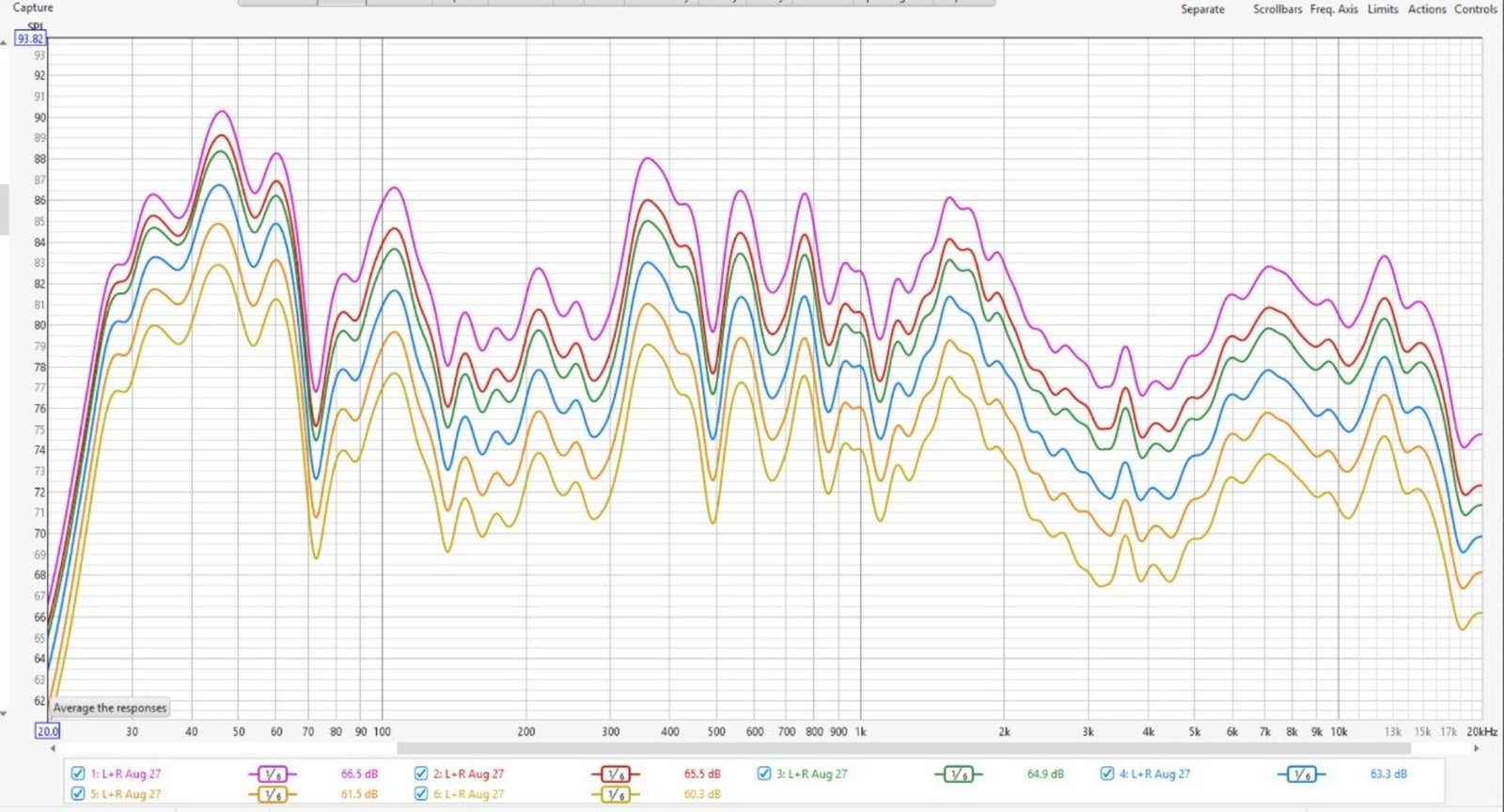
Sweeps at increasingly higher volume levels
Things get even more interesting when we start pushing the volume. We measured the speakers at 50, 60, 70, 80, 90, and finally 100% volume, looking specifically for signs of dynamic compression or DSP intervention.
As you can see from the measurements, the curves remain remarkably consistent and almost perfectly parallel as the volume increases. More importantly, the bass response continues to scale together with the rest of the frequency range, with no obvious low-frequency compression even at maximum volume. There is no sudden bass roll-off, no meaningful change in tonal balance, and no indication that the DSP is aggressively pulling back the woofers as things get louder.
This is an excellent result for an active loudspeaker. From 50% all the way to 100%, the system simply gets louder while largely preserving the same frequency response. In practice, this translates into a speaker that maintains its tonal character and sense of impact even when pushed hard, rather than becoming progressively thinner or more midrange-forward as it approaches its limits.
Whatever protection and limiting are happening behind the scenes, they are implemented remarkably well. At least from these measurements, there is very little evidence of dynamic compression, even with the volume control pushed all the way to 100%.
IV. Setup and Room
The Coda W pair sits on a sideboard along the wall, with our listening position four metres away. The Kube 12 MIE is centred on the front wall between the two speakers.
We put them on a sideboard on purpose. Somebody buying an 899 euro active pair is not building a dedicated listening room around it. The speakers are going on a piece of furniture against a wall, in a room that also has a sofa and a television in it. A cabinet surface loads the bass differently and brings boundary effects that stands would keep out of the way. Testing this speaker on 800 euro stands in a treated room would produce a nicer measurement and a less useful review.
Three inputs across the review period. A MacBook Pro with the M5 Max processor over USB-C carried most of the critical listening at up to 24-bit/192 kHz. A phone over Bluetooth with aptX Lossless covered casual playback. We also ran material over optical and HDMI.
We spent deliberate time with the pair working alone, so we could tell exactly what the Kube was contributing.
V. Listening Impressions
Treble and Air
The treble is open, airy, and extended, and it offers a level of detail that puts fine information in front of the listener without much effort required to hear it. The presentation is tilted forward. The Uni-Q tweeter makes its contribution audible, and the top end feels precise across the whole range. Cleanliness is the word we will often use in this review. There is no grain, no harshness, and no smear laid over the music.

Jesse Cook, Canción Triste. This recording demands a tweeter that resolves the fine texture of string plucks while keeping the energy of the performance intact. The Coda W gave us the physicality of each note and a convincing snap to the guitar, with the sense of fingers moving across strings coming through clearly. Air surrounded the instrument. Decay tails extended cleanly and stayed audible enough to tell us a very important thing: the sound signature, the feeling we had throughout, was that of true hi-fi gear. The presentation was precise and articulate, pleasant and delicate, with amazing soundstage and 3D. We liked it a lot!

Idrissa Soumaoro, Chérie. A recording that reaches high into the top octave, and one we have used before to find where a tweeter runs out of composure. The highs stayed open and clean, with the extension holding to the top of the range. The tweeter has enough air and sparkle, dare we say a bit too nice for the price.
Lizz Wright, Barley. Her voice arrived clean and articulate, with the higher frequency zone totally free of sibilance. This is a recording that punishes any system carrying even a little harshness in the high-frequency region, and we can successfully say the Coda W kept its composure. Lizz was sitting clearly in front of us, with the detail of her phrasing intact from the lowest volume all the way to the maximum the Coda could deliver.

Diana Krall, Temptation. An unforgiving test, with closely miked percussion and a voice that turns harsh very fast on a wrongly matched system. Diana’s voice carried detail and stayed intelligible throughout. Brushed cymbals and the shimmer of the ride were airy and open. The tonal presentation here told us a good deal about the character of this system: the treble sits forward in the balance, with the warmth that usually softens this recording on other systems coming through in a smaller measure. The result is a Diana Krall that sounds closer to the microphone and further from the room.

The tonal balance across the top of the range tilts towards the extremes. Detail, air, and cleanliness are present in good measure. Warmth in the timbre is modest. Listeners coming from a warmer system will notice this fast.
Midrange, Timbre and Body
The midrange is neutral and even, clarity being the guiding principle here. Voices and instruments have great detail, and their positions are clearly defined, with a presentation that leans toward the lean side of the scale.
Danit, Naturaleza. The guitar had its harmonic structure clearly laid out, and the relationship between the strings and Danit’s voice above them was easy to follow. Her vocal sat cleanly in front of us with good articulation. The whole picture held together from the bottom of the range to the top, which speaks well of the coherence a coincident-source array achieves. Body underneath the presentation is modest, this is where the Coda W shows its small, friendly size.

Chris Stapleton, Death Row. Here we tested the system for physicality and punch. Chris’s voice showed immediacy and presence, with the texture in his delivery clearly audible. Weight underneath that voice is modest. The transition from bass into midrange and onward into the treble was seamless, which is exactly what a properly implemented active crossover should deliver. The soundstage that grew out of it was deep and well organised, and this is the second time in two tracks that we caught ourselves paying more attention to the space around the performer and less attention to timbre, weight and physical impact.
Leonard Cohen, You Want It Darker. Leonard’s deep, resonant voice was well positioned inside a three-dimensional soundstage, with the separation between the vocal, bass, and background harmonies clearly carved out. Each element occupied its own well-defined space in the soundstage. This recording reveals a system’s tonal presentation through the lower midrange, and we would say the Coda W presented it with clarity and a certain degree of transparency that we enjoyed, transparency taking priority over weight and impact.

Timbre is where any system shows its inherent character. The presentation here is even and neutral, with a leaning toward clarity, transparency and a tonal balance tilted toward the frequency extremes. Compared with the Cambridge Audio L/R X, the Coda W plays leaner, less obvious through the midrange and flatter in its colour. Two systems, similar starting points, very different destinations. The choice between them comes down to what a listener wants from the middle of the range.
Bass and Extension, Coda W Alone
Before the subwoofer entered the picture, we spent time with the pair working on its own.
Nils Frahm, All Melody. We used this one to hear how the pair handled a slow build from delicate beginnings up to full weight. The Coda W followed the climb with excellent composure and filled the room without losing its footing. The move from near silence to full scale was well made, with the piano and the surrounding textures holding their relationships throughout. Nothing hardened, nothing thickened, nothing shifted position, and nothing changed in the timbre department, which is something we highly appreciate and praise. Even if the SPL levels are low, the fact that there is no dynamic compression and no change in sound signature from 0 to 100% level is a very, very good thing!

Dead Can Dance, Opium. A reference for us on both subtlety and depth. Differences in bass texture were audible, layers in the arrangement separated cleanly, and Brendan’s voice showed the tonal accuracy this recording demands. The low end kept its shape as the arrangement thickened. We paid deliberate attention to intermodulation distortion here, the effect that makes a voice wobble when the sustained low-frequency content is shared with the same driver. This often happens with speakers that are built in a 2 way desing, like almost all bookshelves are, and it is especially bad in a 2.5-way speaker design. The Uni-Q array plays both the voice and bass frequencies on the same moving cone, so this test is more important here than it is on a three-way designed speaker. We heard no wobble in Brendan’s voice at any of the levels we ran, and that is a compliment to the entire work KEF has done for the Coda.
Geoff Castellucci, The Sound of Silence. Here we tested the physical presence and articulation of the lowest male vocals. Every note stayed audible and dynamic, and the ones at the bottom of Geoff’s range remained identifiable as pitches. The subsonic weight underneath those notes is reduced with the pair working alone, which is why, with this track, we felt the need for a subwoofer
Boris Blank, Electrified. A trial by subbass, with passages that challenge full-size tower speakers. The Coda W handled the upper bass and midbass with success and kept each note distinct and articulated. The lowest frequency content is reduced, since the pair rolls off well before what this track requires in order to be fully represented.
Bass from the Coda W alone reaches deeper than cabinets of this size have you believe. This is one of the qualities that impressed across the whole review period, and we kept going back to check that we had heard it correctly. For a great deal of music, this is sufficient. For anything with deep electronic content, the subwoofer is there to be used.
What the Subwoofer Adds

Adding the Kube 12 MIE extends the system’s low-frequency response, and it does that job cleanly.
Going back to Boris Blank, Electrified with the subwoofer running, the material that had been reduced was now complete. The deep synthesiser content that defines this track carried its full weight, with pressure in the room underneath the notes. Each note stayed distinct as the arrangement moved. We paid attention to bass overhang, the effect that leaves a note ringing on after it should have stopped and turns a fast passage into a smear. The sealed cabinet did its job here. The notes started and stopped with the music, which is what we hoped for when we described the theory further up.

Geoff Castellucci, The Sound of Silence gained the dimension it had been missing. The subsonic weight underneath Geoff’s lowest notes was there, and the chest resonance that carries the physical sense of a voice this deep came through with the pressure the recording contains. This track separates systems that reproduce the pitch from systems that reproduce the body underneath it.
Dead Can Dance, Opium kept its composure with the Kube filling in beneath the arrangement, and the bottom of the mix acquired a foundation that a 130 mm driver cannot supply on its own.
The soundstage also gained scale with the subwoofer running. Low-frequency content carries a great deal of the information that tells the ear how large a space is, and reproducing it completely lets the recorded acoustic reach the listener intact.
What the subwoofer contributes is extension. Below roughly 40 Hz, where the Coda W runs out, the Kube takes over and finishes the job. Everything above that point stays exactly as it was, with the main speakers working across their full range at all times. Maximum output stays the same, as does dynamic capability. Anyone adding a subwoofer here should expect the bottom octave and nothing beyond it.
Soundstage and Imaging
This is what the Coda W does best.
Tonebloom, Violin. The string had excellent separation, sitting clearly between the two cabinets with the space around it defined. The instrument occupied a specific position independent of the SPL rising. Very good spatial positioning, a compliment to the Uni-Q design.
James Blake, Retrograde. A track that turns muddy and congested on a system that struggles with layering. The Coda W kept each texture and vocal layer distinct, with the dense production holding its scale and structure throughout. Layers sat at different depths and stayed there. Nothing collapsed toward the middle as the arrangement built. Of course, the layering and depths, the articulation, textures, and harmonics will never match a dedicated hi-fi system with separate devices specialized in handling specific tasks 10 times the price. For its asking price, the Coda does the job very well.
Pink Floyd, Time. The opening sequence of clocks is one of the most demanding imaging tests in recorded music. Each clock occupied its own position with pinpoint precision, the separation between them clean enough to be acceptable, the space around each one clearly defined. As the track opened into the main arrangement, the soundstage kept its organisation and the layering held, nothing becoming congested or muddied. We have heard this passage on systems costing many times what the Coda W asks, and the KEF holds its own.

Mahler, Symphony No. 2. Large-scale orchestral material tests a system’s ability to hold a complex picture together at scale, to avoid congestion once the plot thickens. The Coda W laid out the orchestra with the sections placed at distinct distances from us. Depth was the standout quality. The rear of the ensemble sat behind the front, and the hall came through with its size in a believable way. The scale of the crescendos is limited by the SPL ceiling, we knew that going in, so everything about the way that soundstage is presented stays impressive at the levels the system does reach, and nothing more.
Depth and front-to-back layering are the defining strengths here. Instruments occupy positions in three dimensions, with the Coda managing to keep them intact with no smearing or congestion even when the volume is close to maximum. Imaging is pinpoint, the space between sound sources clearly defined. Separation is obvious enough that a listener with no experience of hi-fi hears it in the first minute.
The Uni-Q array is doing its job, with four decades of refinement, audible in the first minute. This is the KEF sound, and it is fully present here even at this cost, which we appreciate. It is a difficult thing to do, manage, and trickle down all the way from the Blade, such an amazing sound signature.
Dynamics and Composure at Volume
We ran the Coda W across the whole volume scale, from quiet evening levels up to the point where the system runs out of power.
We are happy to say there is no dynamic compression. The dynamics, the composure, the timbre, and the sound signature stay identical from zero to full volume. The tonal balance we described in the sections above is what the system delivers at every level we played. It reaches its limit and stops there. That is the whole story, and we like it a great deal.
A great many active designs protect their drivers by reducing bass output as the volume rises. The reasoning is sound from an engineering standpoint, the woofer runs out of excursion long before the tweeter runs out of anything, and pulling back the low end buys headroom, SPL. The consequence for the listener is a system that changes character as it gets louder. Bass thins out, the mids and highs come forward, and the music that sounded warm at moderate volume turns bright and hollow at “party levels”.
The Coda W does not do this. We ran the same tracks at low, moderate, and maximum levels and listened specifically for the balance shifting. The bass kept its level and its weight relative to everything above it. Voices kept their timbre correct in the tonal picture, and the relationship between the frequency bands was constant across the entire scale. Compliments to KEF on this one, it is the kind of engineering discipline that costs a lot of money to get right.
The limit comes earlier than we would like. We measured 97.2 dB (C) at our listening position, four metres from the speakers. In a small room, in an apartment, at the levels most people listen at in the evening, you will never reach it. In a large room, or with orchestral material at concert levels, or if you like your music loud, you will hit that wall, and you will hit it fast. Adding a Kube or any other subwoofer, unfortunately, does nothing to raise it, for the reasons we set out in the subwoofer section.
VI. On Listening Pleasure
Something happened over the review period that we did not expect from a system at this price. We kept sitting down for one track and getting up an hour later.
The reason is the soundstage. When a system disappears from the room, places performers at distinct positions and holds them there, listening turns into looking around the recording. You find things you had not noticed on records you know well. That pulls you into the next track, and the next one.
The Coda W does this at a level we associate with equipment costing a great deal more. That combination is why we enjoyed it.
VII. Versatility and Everyday Use
We ran this system as a dedicated stereo music setup, the role we know best.
We connected the TV over HDMI ARC with one cable, and the subwoofer gave film material a nice foundation. We also connected a laptop over USB-C at up to 24-bit/192 kHz for high-resolution music and critical listening sessions. We used the phone to connect over Bluetooth 5.4 with aptX Lossless. For a system this size, that is a lot of ground covered.
Music has to come from a device you own and operate. If a laptop, a phone, and a television already have the capability to play the music, nothing about this arrangement will get in your way.
One important thing to mention, and we flagged it at the very top of this review as well. Past roughly 70 to 80% on the volume scale, air chuffing between the tweeter and the midrange driver becomes obvious from the front of the cabinets. It plays alongside the music and, unfortunately, it is audible enough that we dislike it a great deal. Because it fires forward, a listener sitting close is placed directly in front of it. Be wary of this if you plan to turn it up and use them for a desk or for nearfield listening. It is a shortcoming, and we say so plainly in a system we otherwise admire.
Conclusions
Back to the question we opened with. KEF took the streaming board out of an 899 euro active speaker and spent the money on the drivers and the amplification. Was that a good trade?
Yes. The Coda W sounds like a true hi-fi gear. Clean across the whole range, transparent, with resolution that puts fine detail in front of you, and a three-dimensional soundstage with pinpoint imaging that we would associate with equipment costing several times as much. Depth and front-to-back layering place instruments at precise distances and keep them there, with no smearing and no congestion as the volume rises. That is the twelfth-generation Uni-Q doing its job, and the point-source presentation KEF built its name on is here in full.
The bass reaches deeper than cabinets this size would have you believe. The dynamics, composure, timbre, and the overall sound signature stay identical from zero to full volume. Most systems in this category pull the low end back as the level rises, which changes the character of the music at exactly the moment you want more of it. The Coda W keeps its character all the way to the end, and we praise KEF for that decision.
Now for the other side of the coin. It does not play loud. 97.2 dB (C) at four metres is where it stops, fine for a small or medium room and short of what a large one needs. There is no high-pass filter and no crossover options in the app, so a subwoofer here fills in below 40 Hz and does nothing else. It will not make the system play louder, and it will not make it hit harder, because the excursion limit of those 130 mm drivers sets the ceiling with a subwoofer connected or without one. If you were planning to buy a Kube to get more out of the Coda W, save your money. We believe the missing crossover is a mistake from KEF, and we hope an app update corrects it. And the worst part is that past 70 to 80% volume you get air chuffing from between the tweeter and the midrange driver, firing out of the front of the cabinets, which means no nearfield and no desktop use at those levels.
The layering, the textures, the harmonic detail, and the dynamic freedom of a system built from separate specialised devices costing many times the price clearly stays out of reach, and we expected that going in. For 899 euros, the Coda W lands well above the line we drew before the first track played.
Buy it if you listen in a small or medium room, at sensible levels, and you already have a laptop or a phone or a television to play music from.
We extend our deepest gratitude to AVstore for making the KEF Coda W and the Kube 12 MIE subwoofer available for this review.
Pros
- A hi-fi sound signature at a very affordable cost. Cleanliness and transparency across the whole frequency range, with no grain, no harshness, and no smear laid over the music.
- A three-dimensional soundstage with pinpoint imaging. Depth and front-to-back layering place instruments at distinct distances and keep them there. The point-source presentation KEF has built its name on trickled down from the range above.
- Dynamics, composure, timbre, and sound signature are identical from zero to full volume. No compression applied to the bass as the level rises, no smearing and no congestion as the volume approaches maximum.
- Bass that reaches deeper than cabinets of this size have you believe. No audible intermodulation distortion either, with a single cone carrying voice and bass together.
- Plug-and-play ease of use. Setup is fast and problem-free, source switching is quick and clean, the remote earns its place in daily use, and the wired connectivity covers HDMI ARC, moving magnet phono, USB-C at 24-bit/192 kHz, optical and RCA line.
Cons
- Air chuffing past roughly 70 to 80% volume, coming forward from between the tweeter and the midrange driver, which rules out nearfield and desktop use at anything past moderate levels.
- Limited maximum output, measured at 97.2 dB (C) at four metres, capped by the excursion of the small drivers in the main cabinets.
- No high-pass filter and no crossover options in the app, which leaves a subwoofer working as an addition below 40 Hz with no contribution to available output or dynamics.
Equipment Used
- KEF Coda W active loudspeakers, stereo pair
- KEF Kube 12 MIE subwoofer, centred on the front wall between the speakers
- Supplied interspeaker cable between the primary and secondary cabinets
- MacBook Pro with M5 Max processor, over USB-C at up to 24-bit/192 kHz
- Phone over Bluetooth 5.4 with aptX Lossless
- Optical and HDMI inputs
- Supplied remote control
- Sideboard placement along the wall, listening position at four metres
- Our small living room, roughly 4 m by 5.3 m with a 2.7 m ceiling, modest acoustic treatment