Raidho X2T Loudspeaker Review – Precious Things Come in Small Packages

Raidho. The name alone is enough to divide a room. Mention it in any serious audiophile gathering and the reactions will arrive quickly and with conviction: bright, analytical, thin in the midrange, spectacular tweeter, but nothing below it, speakers for people who care about air and detail and very little else. We had heard this enough times, from enough people whose opinions we respect, that when we asked for a pair of X2Ts to review, our expectations were already shaped by that reputation. We were prepared for a spectacular tweeter. We were prepared for a challenging low end. Is this review a confirmation of what everyone already believes?
No, not even close. It was a real journey of discovery, but we managed to unlock their potential. You see, we had heard the X2T on more than one occasion before the pair arrived in our room. We experienced the breathless superlatives in the very showroom from whence they came. We knew about the holographic soundstage and physics-defying low end, because these are aggressively tuned this way. But we wanted to hear them in our big room, which puts serious demand on low-end engagement. We were wondering whether a speaker this slim and elegant could repeat what was demonstrated by professionals in an acoustically treated showroom.
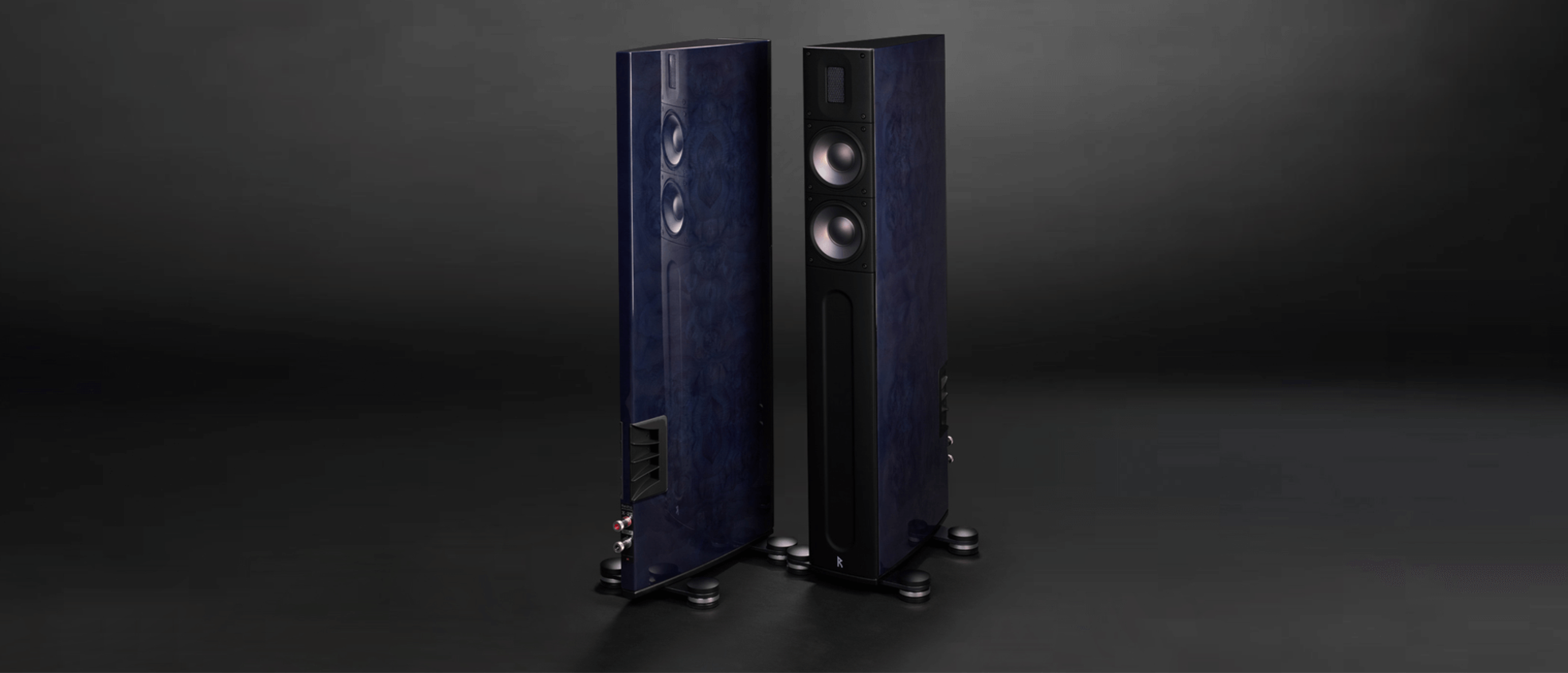
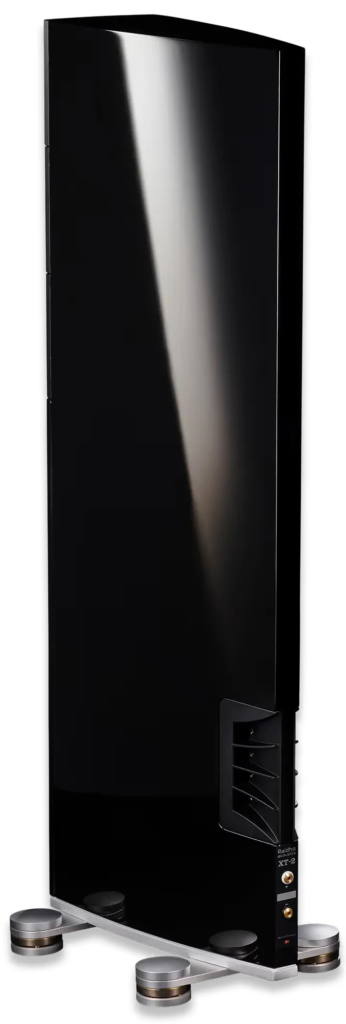
The X2T is a very compact floorstander from the Danish manufacturer Raidho Acoustics, a brand operating under the Dantax Radio group based in Pandrup, Denmark. At 1065 mm tall and only 143 mm wide, these speakers have a visual presence defined by elegance. They disappear as effortlessly as high-end modern furniture. The cabinet tapers backward to a point, reducing internal standing waves, and the whole structure rests on proprietary decoupling feet with ceramic ball bearings, a carefully considered engineering detail.
The price positions the X2T as Raidho’s entry point into the world of high-end audio. We feel that this market positioning, while technically accurate, is also somewhat misleading. The word “entry” implies a degree of compromise and a lower price, but we found very little compromise with this speaker, and, with the matching we eventually discovered, the price became justified as well. Raidho built these with a highly specific set of priorities, had a clearly defined character in mind, and executed with remarkable precision.
With their tuning and our careful matching, every listening session and every track became an act of discovery.
Raidho Acoustics – A Philosophy of Zero Compromise
Understanding the philosophy behind the construction of the “mighty” X2T requires a deep dive into its origins. Raidho Acoustics builds everything in-house in Denmark: drivers, crossovers, tweeters, and even the feet on which the speakers rest. This level of vertical integration is exceptionally rare in the loudspeaker industry, and it gives the company a degree of control over the final sound that other manufacturers cannot match. When Raidho says a design decision was made for sonic reasons, there is no supply chain compromise standing behind that claim. The decision was made, executed, and heard in their own facility.
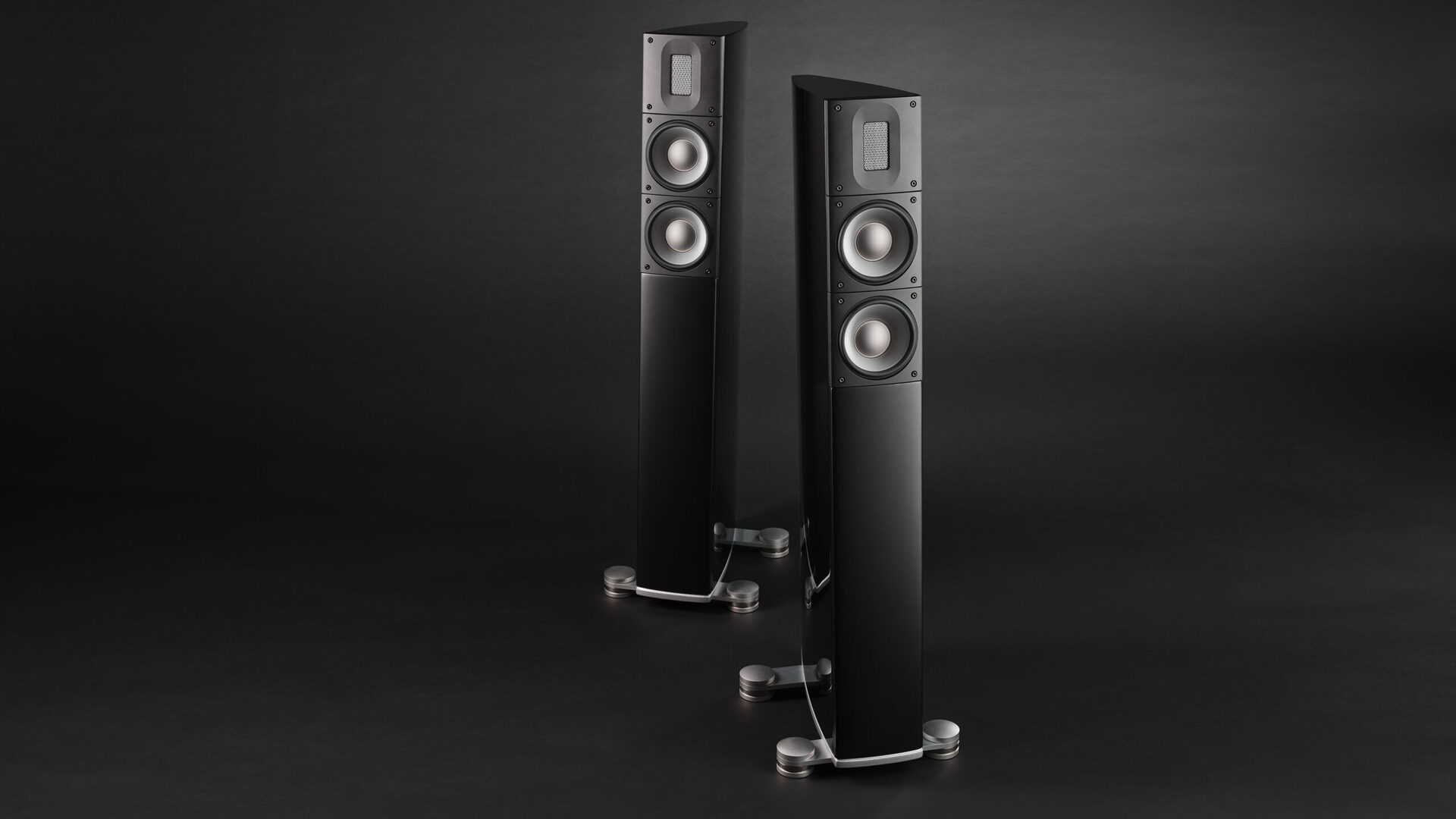
The X Series sits below the flagship TD Series in the Raidho lineup, but the technology sharing between the ranges goes well above what “entry-level” usually implies. The X2T carries a planar magnetic ribbon tweeter that shares its fundamental design philosophy and core architecture with the tweeter found in their flagship TD Series. The TD Series carries an evolved and further refined version of this tweeter technology, but the engineering DNA is the same, and the X2T benefits directly from the research and development that produced it. When a company filters its most advanced tweeter research down into a 15,000-euro speaker, it is making a clear statement about what matters most in the listening experience.
The X2T represents the second generation of the X2 platform. The upgrade from X2 to X2T brought the same Tantalum coating seen on the TD series for the woofer cones, a completely new crossover with superior components, Nordost internal cabling throughout, and a full re-tune of the entire speaker from scratch. Raidho is direct about the ambition here: the only thing that stayed the same was the visual appearance. The sonic performance, they claim, is on a different plane of existence altogether. After living with this speaker for an extended period of time, with the matching we carefully discovered, we feel that the claim is well within the bounds of honesty.
Build Quality, Cabinet Design, and the Art of Disappearing
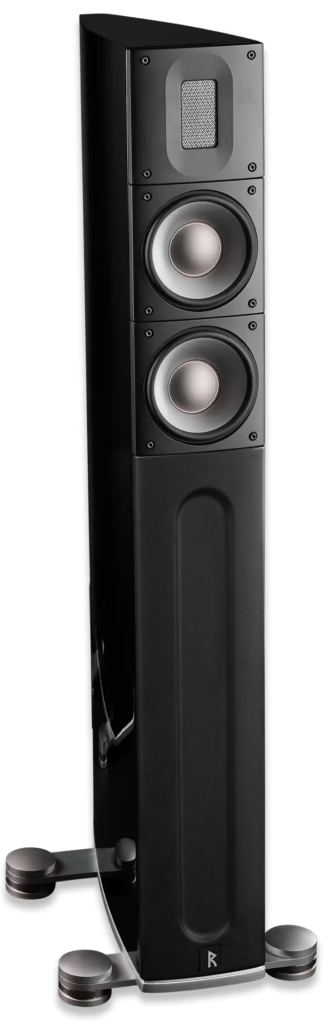
The first physical encounter with the X2T emanates delicacy, long before any music plays. The cabinet can be finished in Piano Black or Piano White lacquer, with a surface quality that would be entirely at home in a luxury furniture catalogue. The enclosure itself is MDF, but the front baffle is cast aluminium, a material choice that eliminates resonances at the driver mounting interface. The aluminium outrigger feet, which extend the visual footprint to 300 mm while keeping the cabinet itself at 143 mm, carry the speaker on three ceramic ball bearings for each foot, at their base. This decoupling system requires no spikes and leaves no marks on floors. It is a detail that shows the manufacturer’s attention regarding real home conditions.
The cabinet’s characteristic tapered profile, narrowing toward the rear, is not only aesthetically intentional, of course. The geometry is chosen to eliminate parallel internal wall faces, preventing the formation of standing waves inside the enclosure that would otherwise color the bass and lower midrange frequencies. This is the same principle applied in the finest transmission line and asymmetric cabinet designs, realized here in a form factor slim enough to feel like a design object. This rear placement is deliberate because proximity to the rear wall provides boundary reinforcement, and that adds low-frequency energy in a controlled and predictable way, a feature that becomes highly relevant in real rooms. We will discuss its implications in the measurement section.
The overall fit and finish of the X2T we would say communicates seriousness without ostentation. There are no unnecessary design flourishes, no chrome accents or visual distractions. The speaker is what it is: a precision instrument built to get out of the way and let music through. We believe the ability of the X2T to disappear visually prepares the listener, almost unconsciously, for its acoustic ability to do exactly the same.
The tweeter is the core of the X2T’s identity.
The Raidho ribbon tweeter is one of the defining technologies in the X2T. Describing it accurately requires stepping back from the usual superlatives and explaining precisely what makes a planar magnetic tweeter different from the dome designs that dominate the industry.
A conventional dome tweeter generates sound by vibrating a dome-shaped membrane attached to a voice coil suspended in a magnetic gap. The voice coil adds mass and introduces a mechanical interface between the electrical drive signal and the acoustic output. Resonances in the dome and voice coil assembly place a practical upper limit on the frequency range the tweeter can handle without distortion, and those resonances can color the sound in the range the tweeter is supposed to reproduce.
Raidho’s planar magnetic tweeter eliminates the voice coil. The diaphragm is an 11-micron aluminium foil, 50 times thinner and lighter than a conventional dome tweeter membrane, weighing only 20 milligrams in total. Conductive traces are etched directly into this foil, and the foil is suspended between two opposing magnetic fields generated by permanent magnets on either side. When current flows through the traces, the entire foil surface is driven simultaneously and uniformly, with no mechanical interface, no voice coil, no cone. The result is a radiating surface that responds to the electrical signal with essentially no lag, no resonance, and no mechanical coloration.
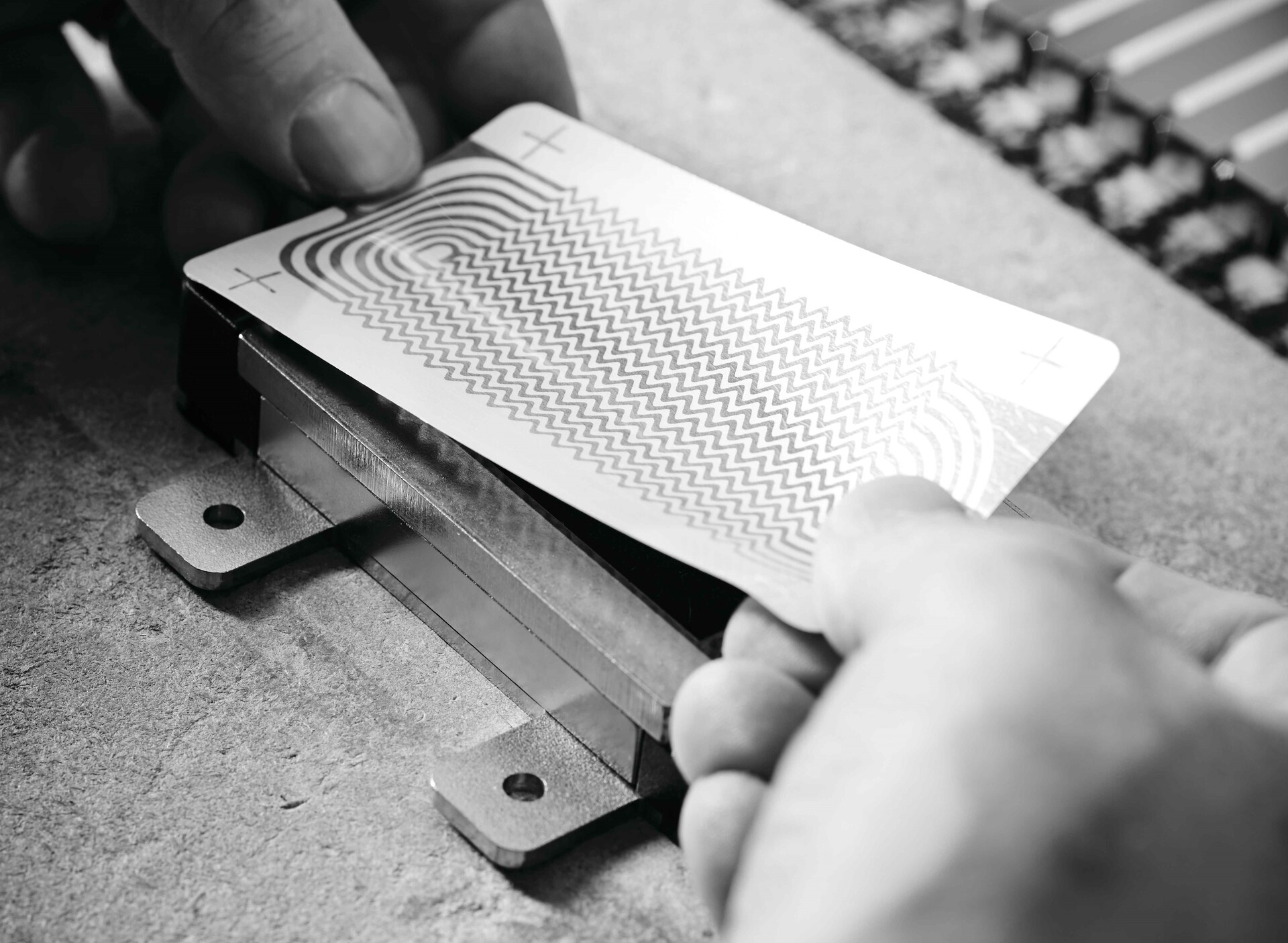
The breakup mode of this tweeter, the frequency at which the diaphragm begins to behave in a non-linear and distorted way, sits at 82 kHz. While this frequency range carries no musical information on its own, it has a major influence on the tweeter’s behavior within the audible band. A tweeter whose breakup point is at 82 kHz operates at 20 kHz with enormous headroom, well below any point where its mechanical behavior becomes compromised. The subjective result is a treble that arrives clean, natural, and completely free from the metallic hardness or sibilance that even very good dome tweeters can exhibit under demanding conditions.
Raidho assembles every one of these tweeters by hand, in-house, in Denmark. The manufacturing process is time-consuming and demands precision at very low tolerances. We believe this commitment to in-house production is one of the reasons the X2T sounds the way it does: the tweeter’s performance is a specification achieved under ideal conditions and approximated in production, consistently, by the same hands, in the same facility, in every unit that leaves the factory.
You can see a tour of the Raidho factory on YouTube, and observe how the drivers and tweeters are hand-assembled and how the driver’s cones are handled without a care in the world.
The older X2 version used the same size 5.25-inch drivers built around Raidho’s Ceramix technology. The driver cone begins as a thin aluminium substrate. Then, a liquid plasma process at extremely high voltage is applied to transform the outer skin of the metal into an aluminium-oxide ceramic layer. The finished cone is a natural sandwich: ceramic skins on either side of an aluminium core. Ceramic is substantially stiffer than plain aluminium without adding significant mass, and this combination of high stiffness and controlled self-damping pushes the cone’s first breakup resonance to an extraordinary 12.5 kHz.
The upgraded X2T generation added Tantalum coating over this already advanced Ceramix structure. Tantalum belongs to a class of metals known as refractory metals, defined by their exceptional resistance to heat and wear, with a melting point of 2,996 degrees Celsius. Applied to the cone surface, it raises the breakup point further still, to a specified 15 kHz. This means that both woofers operate through their entire working range, from the lowest bass notes to the crossover point at 3.5 kHz, with no significant structural resonance whatsoever. The distortion figures that result from this are unusually low. The drivers operate in a regime of near-perfect linearity throughout their useful band.
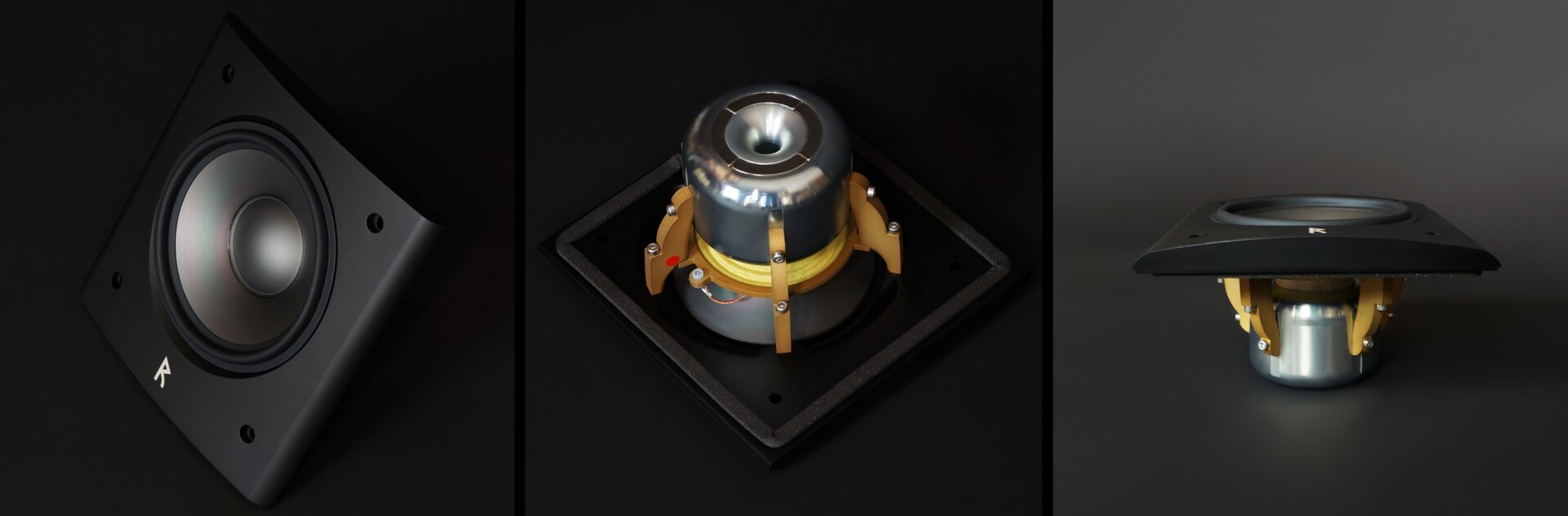
The motor system behind each driver uses strong neodymium magnets arranged around a very open, well-ventilated frame, with titanium voice coils. Titanium is selected because it is entirely unaffected by magnetic induction, eliminating a source of distortion present in aluminium or copper voice coil formers. The open frame design allows both cooling airflow and the controlled release of rear-cone energy, preventing back wave buildup that would otherwise compromise transient response.
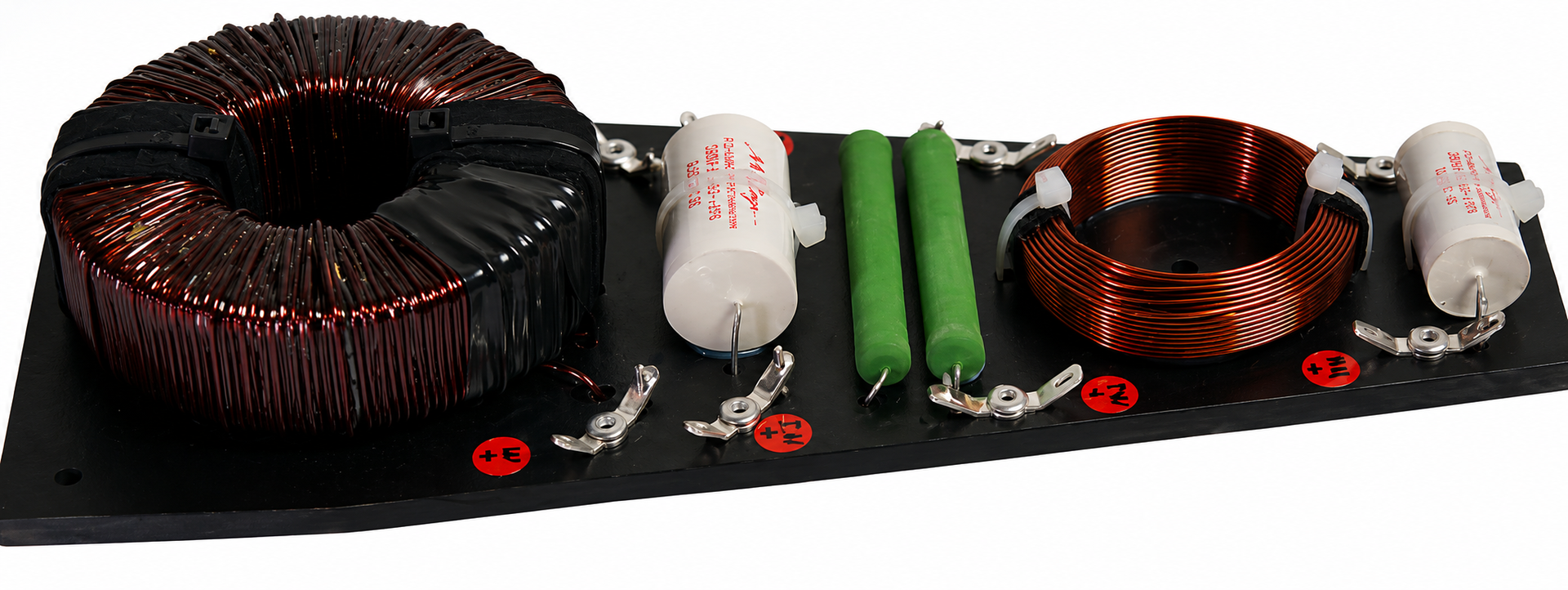
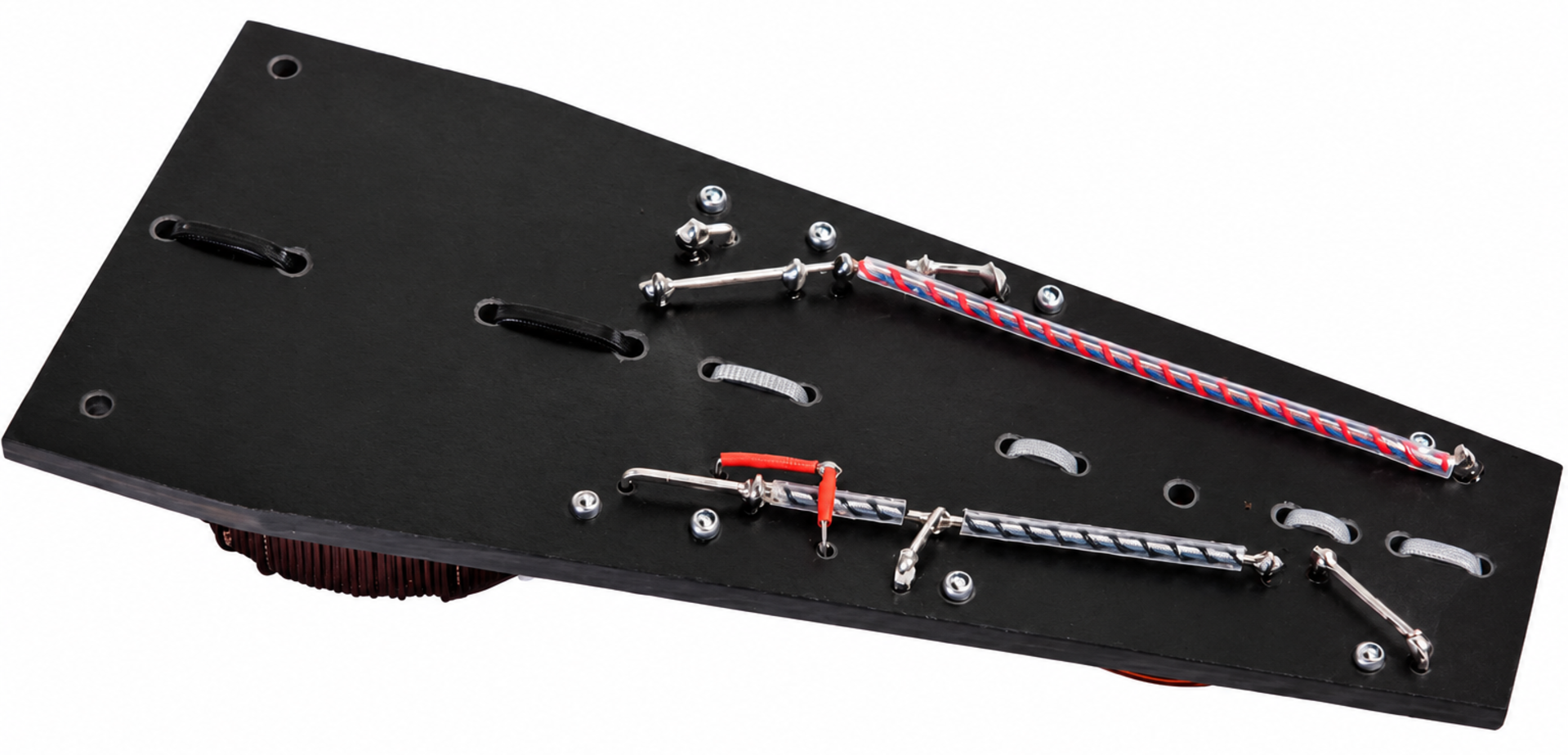
The 2.5-way architecture assigns both drivers to bass reproduction, while only the upper driver also handles the midrange. This arrangement provides the bass output and scale of a dual-woofer design without the comb filtering and off-axis response complications that would result from a true two-woofer midrange configuration. The crossover between the two bass drivers is set at 140 Hz, and the crossover to the tweeter is set at 3.5 kHz, with second-order slopes throughout. The crossover itself uses hand-selected and matched components, with point-to-point wiring done entirely by hand, and internal Nordost Norse technology cabling, the same technology found in Nordost’s Valhalla reference cable range. The terminals are Raidho’s own proprietary design, single-wire, and machined to a standard that matches the rest of the construction.
Measurements: What the Numbers Reveal About the Raidho Voicing
The measurement graph shown below tells a story about the X2T that we feel is important to read carefully, because it explains both the speaker’s remarkable strengths and the acoustic demands it places on the room and the listener’s setup choices.
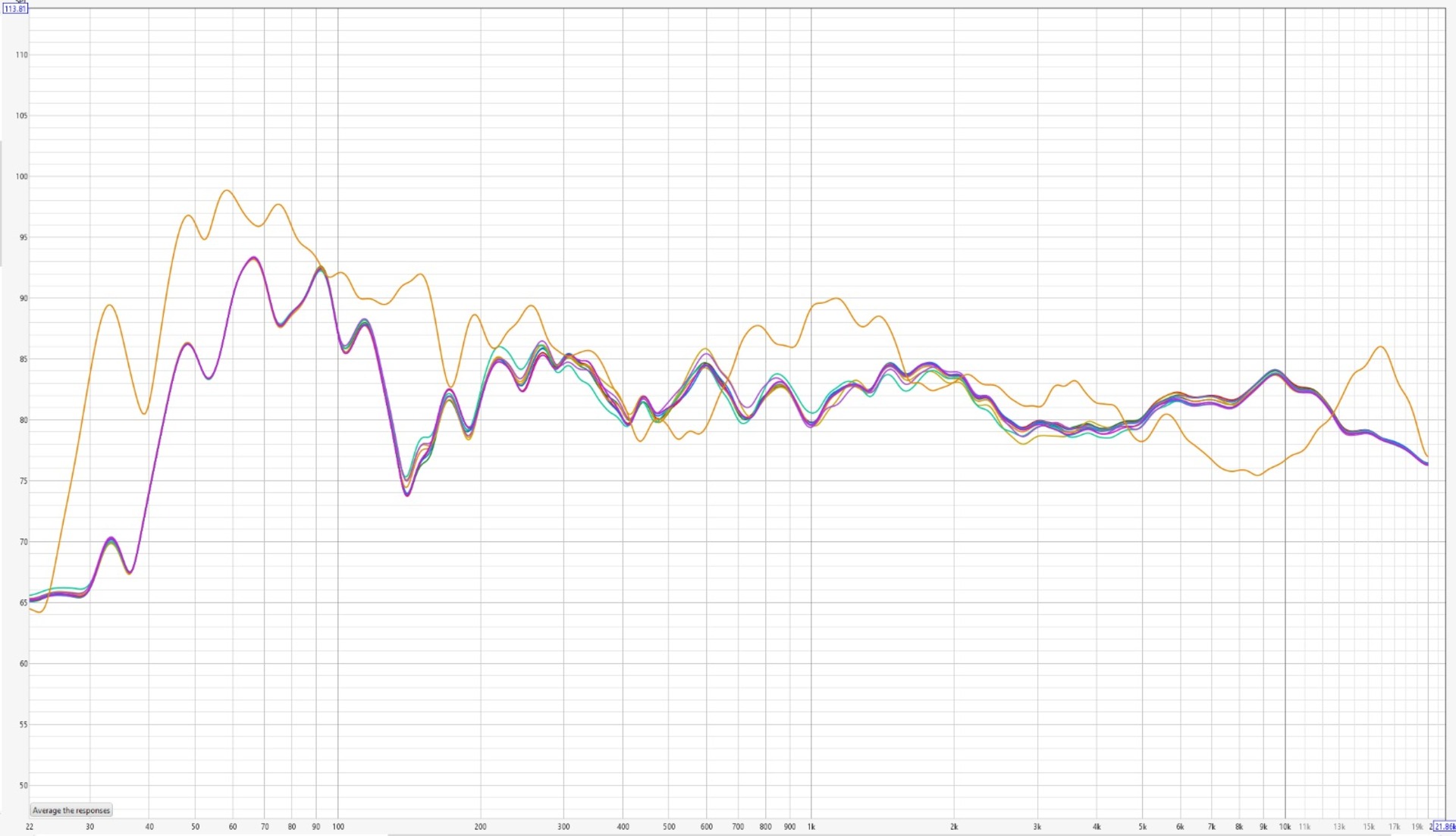
Orange: listening position in the room. Grouped lines: 10 near-field measurements at 1m, on tweeter axis, free air.
The grouped set of curves represents the measurements taken with the microphone at 1 metre on the tweeter axis in free-space conditions. Above 300 Hz, these curves track each other with extraordinary consistency across all ten measurement captures, demonstrating the exceptional repeatability and spatial evenness of both the midrange driver and the ribbon tweeter. The midrange region shows a clean, well-controlled response with no obvious colorations or resonance peaks. You can see that the tweeter’s integration is seamless, with the handoff from the upper Ceramix driver (at 3.5khz) occurring without any detectable irregularity. From the 1 kHz region through 10 kHz and well beyond, the near-field curves converge into a tight, coherent band, and that speaks directly to the quality of the crossover design and the inherent low-distortion character of the drivers.
The bass region is where the X2T’s voicing philosophy becomes unmistakably clear. Looking at the near-field measurements between 40 and 100 Hz, there is a prominent and deliberate elevation, a broad, sustained presence peak that sits well above a nominally flat reference line. Be mindful that this is not a measurement artifact. It is intentional, aggressive bass tuning, and it is the character fingerprint that defines everything the X2T does in the low-frequency area. One way to give physically small 5.25-inch drivers the kind of authority that speakers with larger cone areas achieve through sheer displacement is through aggressive tuning.
The single orange curve represents the measurement taken from the listening position in our listening room, with the speakers pointed directly at the microphone. The distance from the back wall is ~1 meter, the side wall ~1 meter, and they are set 3 meters apart. The distance to the listening position is 3.7 meters from the front plate of the speakers. The measurement taken from the listening position shows significantly higher SPL in the bass region. You can see the combination of the speaker’s own elevated low-frequency output and the room’s modal reinforcement compound into a presentation that is rich, weighty, and physical. The gap between the orange curve and the near-field bundle is particularly visible below 100 Hz, where room modes and boundary loading add their energy to the speaker’s own elevated output. This is by design, and when the room is appropriately sized, as we shall discuss in the listening section, the result is a scale and foundation that seems physically impossible given the speaker and driver size.
Above 1 kHz, the listening position curve joins the near-field bundle and tracks it with good consistency through the midrange and into the lower treble. The convergence of all eleven curves in this region is a remarkable evidence of the X2T’s coherence and spatial consistency. We feel that this measurement confirms what our ears picked up: the X2T’s midrange and treble are as pure and consistent as the drivers and tweeter technology promise.
The Pairing Challenge: Not Every Amplifier Will Do, and Neither Will Every Source
Raidhos are notoriously difficult to pair, and we’re sharing this with full transparency based on direct, repeated experience, including some painful lessons. These are speakers that require a vast amount of experience and careful judgment in matching, and the cost of a poor match is unfortunately not just a reduction in performance. The cost of a poor match is a sound character that can become difficult to listen to, sometimes immediately and dramatically so.
We began our exploration with two very appreciated DACs for their price/performance, the Gustard R30 and the Eversolo Z10, which we know well and appreciate for their organic, tonally rich character. The music source we used was the 3DLab Nano Network Transport Platinum V5.
We were expecting each combination to work with the X2T’s presentation. We were wrong. The result was musical in a few places, but not fully right. The bass accumulated in a way that felt bloated and uncontrolled, and the midrange, which, with the source and amplifier, is one of the sweetest and most flowery things these speakers offer, became absent, robbed of its natural bloom.
The Chord Electronics Ultima integrated amplifier, with its characteristic precision, speed, and contrast, cuts through and provides the grip and definition that the exaggerated bass tuning demands. The result, with both the R30 and the Z10 DAC, is, regrettably, the opposite of what we hoped. The screeching that came from the ribbon tweeter was overwhelming, a sharp, fatiguing brightness that made extended listening not just unpleasant, but utterly distressing. Chord’s treble character, which works beautifully with speakers tuned for a softer top end, met the X2T’s already revealing and extended ribbon tweeter, and the combination became unlistenable within minutes. This didn’t work.
We also tried them with the Tsakiridis Aeolos Ultra, a Greek tube amplifier that brings a beautifully liquid and harmonically saturated character to the systems it drives. The romantic character that makes tube amplifiers so seductive, with many speaker types, produced a bass character that, besides being bloated and texturally undefined, also came with “bonus” harmonic distortions, especially at higher volumes. All this, combined with the treble that lacked sparkle and any sort of definition, made us stop it after not even 10 minutes into the listening session. Of course, this was after letting the amplifier warm up for ~3 hours. So this too didn’t work.
These two DACs have a precise, analytical character, and when that meets the X2T’s revealing ribbon tweeter, it produces a presentation that is clean and technically impressive but devoid of any emotion. The midrange, which, on the right source, as we will soon find out, opens with warmth and harmonic richness, remained controlled and direct, communicating information without any musical ease or sweetness. The bass, already challenging to manage, arrived with definition and speed but lacked the tonal body and weight that the low-frequency tuning of these speakers needs from its source to sound harmonious.
As we said, the Z10 and the R30 share this quality: both are detailed and precise, adding just a touch of musicality. On the X2T, that is too much precision in the wrong direction and too little musicality. What the X2T asks of its source is a different kind of presentation, one that accentuates sweetness, midrange harmonic density, and a musical flow that complements the speaker’s revealing character. Both the R30 and the Z10, while excellent as they may be in many systems, were simply the wrong match here.
We knew this about Raidhos. See, they have a reputation for being sterile, bright, and lacking midrange. And that is precisely why we came prepared with another DAC, this time from the same guys who created the streamer. 3DLab’s DAC is renowned for its warmth and harmonic richness, especially in the midrange area. The exchange of digital electronics was a natural first step, as it was impossible to think that these couldn’t sound great. If that didn’t work, then the next step would have been to change the amplification.
Fortunately, it did, and the pairing that finally, decisively, and beautifully unlocked everything these speakers offer was the 3D Labs Nano Network Player Platinum V5, the same streamer but with an integrated DAC. The 3D Labs source brings a midrange with exceptional sweetness and harmonic richness, a presentation that leans toward the warmer side of music. It is very musical, with a tonal density that complements the X2T’s own midrange, which is a little recessed, creating a sweet presentation without pushing it into excessive gibberish. The cables in the chain are also on the warmer side of neutral, and we would like to emphasize that these speakers benefit greatly from this. A warm cable pairing adds just enough tonal body to the presentation to let the X2T’s treble breathe with its natural sweetness without any tendency toward brightness. We would never pair these with entry-level silver cables.
Another amplification that we tried was the Burson Timekeeper Voyagers, but ultimately chose the Chord because it brought a tad more detail up top. We would like to say that both the Chord and the Burson amplification provided the grip, control, and bass definition that the aggressively tuned low end of this speaker demands, and the result, through both, was a system of remarkable coherence, beauty, and authority.
We feel that this experience, which manifested throughout weeks of testing, frustrating and time-consuming as it was, carries a lesson that applies to every loudspeaker on the planet. Matching is everything. It is the discipline that separates a system that performs from a system that transcends. You require patience, humility, and a willingness to be wrong many times before being right just once. This matching dance requires your full attention and seriousness, especially with this brand.
Every loudspeaker ever built is operating below its potential in most of the systems it ends up in. We believe this with complete conviction. The speaker sitting in your room right now, the one you have lived with for years and know intimately, has more to give. There are combinations of sources, amplification, and cabling that would make it sound like a different instrument entirely, one that would make you question every opinion you formed about it. Unfortunately, the X2T’s expose this truth more than others, because its character is so clearly defined and its sensitivity to the chain upstream so extremely pronounced. A poor match punishes you openly, but the right match rewards you beyond what its specifications or price would ever suggest.
This is precisely what dealers exist for, and we want to say this loudly and without reservation. A good dealer listens, asks the right questions, and guides the process of matching with the accumulated experience of having heard what works and what fails across hundreds of combinations. They carry the institutional memory of every failed pairing and every transcendental one, and that knowledge is worth more than any review, including this one. The trial and error that took us weeks in our own room can take a good dealer an afternoon, because they have already made the mistakes and learned the lessons. Walk into a serious dealer with an open mind, sit down, and let them show you what the speakers are actually capable of. The potential is always there. It simply takes someone patient enough to find it. Shout-out to all the dealers out there doing awesome work for all of us.
Setup, Room, and Reference System
Our listening room measures approximately 5 metres by 6 metres with a 4-metre ceiling height. This is a large domestic space, and we want to note this because the X2T’s specific bass tuning, which produces substantial low-frequency energy by design, requires a room of significant volume to breathe in correctly. In a smaller room, the bass energy would accumulate to levels that no amount of port plugging could adequately manage. In our large room, the speakers were placed approximately 1 meter from the rear wall, 1 meter from the side wall, and 3 meters apart. The listening position was at 3.7 meters from the face plate, and this is where the X2T’s found their equilibrium. The room was pressurized in the most satisfying way, and we could say the scale of the music matched the speaker’s extravagant engineering.
For all listening sessions, the source was the 3D Labs Nano Network Player Platinum V5, feeding the amplification directly. Interconnects were on the warmer side of neutral, as already noted, and speaker cables were selected with a similar intent. Streaming was conducted at full resolution via Tidal and Qobuz.
- Digital Transport / Roon Server / DAC: Gustard R30, Eversolo Z10, 3DLab Nano Network Transport Platinum V5, 3DLab Nano Network Player Platinum v5.
- Amplifiers: Chord Ultima Integrated
- Interconnects: Roboli XLR 2100
- Speaker cables: Roboli HP8000 2.5m
- Power Cables: Roboli Power5200
Listening Sessions

Jean-Michel Jarre’s Oxygène Part 8, from the Oxygène Trilogy album, is a wonderful track we would normally reach for to test for air and the relaxing qualities of a tweeter, if there are any. It is an underestimated track, atmospheric, built largely on synthesizer textures that inhabit the upper sound registers. The high-frequency content of this recording is airy, slightly shimmering, and layered in a way that stresses a tweeter for exceptional transparency. The X2T rendered it with a quality that we believe is without equal at any price point. The layering was resolved to a depth that allowed individual synthesizer elements to occupy their own spatial address simultaneously. And the whole presentation had an ease, a sweetness, an absence of effort that made the music feel very easy and pleasant to listen to. We believe the ribbon tweeter in this speaker is the finest high-frequency transducer we have heard, regardless of price, and this track was the first of many that made us understand why.
As the track unfolded into its second and third minute, we where pleasently discovering how the X2T managed sustained high-frequency content over time. Many tweeters, even very capable ones, begin to assert themselves during prolonged passages, introducing a subtle fatigue that accumulates gradually and only becomes obvious when the music pauses and the listener relaxes. With the X2T, that accumulation never arrived. The synthesizer textures kept floating, kept shimmering, kept singing in the room with the same ease as the opening seconds, and we found ourselves drawn deeper into the music with each passing minute. The soundstage also deserves mention here specifically: the X2T threw a three-dimensional soundstage around this recording that extended well past the physical boundaries of the speakers, placing each layer at a distinct depth and height.
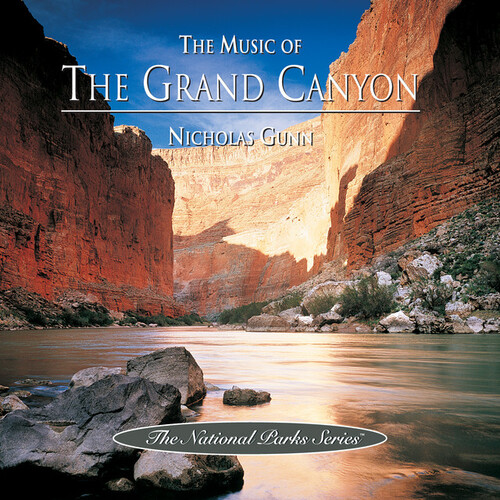
Entering Twin Falls is track two on The Music of the Grand Canyon album, released in 1995 on Real Music as part of their National Park Series. Nicholas Gunn was born in the UK and trained at the Royal Academy of Music, building his career around a fusion of Native American flute, ambient textures, guitar, piano, and sacred percussion. The album sold over one million copies in its first year and spent fourteen weeks on the Billboard New Age charts, reaching the top ten. The concept behind The Music of the Grand Canyon is straightforward and deeply felt throughout its tracks. Gunn spent time in the canyon, absorbing its scale, its silence, and the way water moves through it, then translated that experience into music.
Twin Falls is a real location, a series of cascading waterfalls deep in the canyon’s inner gorge, and this particular track, we feel, really carries a combination of intimacy and grandeur. We weren’t thinking about the bass performance as the track started. Still, after raising the volume, we were surprised by the performance of the X2T, as the delight of an unexpected weighty foundation surrounded us, from the vibrating couch all the way around to the chest impact. The X2T delivers something really special and somewhat different: the bass reproduction has a grounding feeling, weight in the most physical and satisfying sense of the word, giving us a sense of deeply implanted roots, of connection to the place itself, all the while maintaining the important intimacy and sweetness in the rest of the frequency range. The low end was not overwhelming in any way, shape, or form.
The scale of the bass is extraordinary for drivers of this size, and the room pressurization that the X2T achieves in a space like ours gave the track a cinematic quality that invited us to close our eyes and be transported somewhere else entirely.
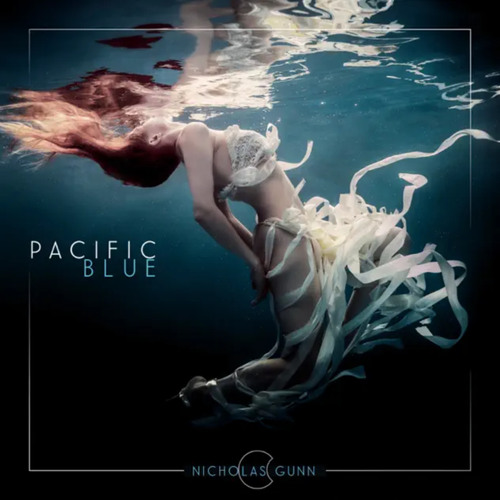
Into the Vastness is the opening track of Pacific Blue, Nicholas Gunn’s twentieth album, released on 24 April 2020 on Blue Dot Studios. The album was conceived as a metaphor for the human journey, with the ocean as its central image, its emotions as deep, wide, and vast as open water. Gunn, by this point in his career, had moved toward a more electronic, ambient-trance sound, closer in spirit to Schiller or Oceanlab, and Into the Vastness reflects that evolution fully. Reviewers talk about its opening as world-class sound design: a lonely synth, described as almost sonar-like, pulling the listener into the deep before dance-trance sequencer patterns build beneath cinematic swells evoking waves on an open shore.
Through the X2T, Into the Vastness took us into an eerie, weightless journey. We feel only a ribbon tweeter of this precision can communicate it like this. The opening droning pad settled into the room with a width and depth. The sonar-like synth that punctuates the opening sat suspended in the air, above the listening position, with a precise spatial address that moved as the production intended, never anchored to the speakers, always floating somewhere in space.
As the sequencer patterns built and the cinematic swells expanded, the high-frequency sparkle that defines this track’s upper frequency layers flew through the room with freedom, intimacy, and delicacy. Fast, sweet, and airy, each sparkly element landed in its own position in the space and dissolved naturally, tracking all the way into silence.
The bass foundation beneath all of this arrived with the same feeling of weight we had heard on Entering Twin Falls, grounding the vastness above it with a steady, deep pulse, amplifying the track’s sense of scale. The two layers, deep and grounded below, free and floating above, coexisted in complete harmony.
After the first track ended, we didn’t stop until we finished the entire album, top to bottom.

Italia, from Chris Botti’s album of the same name, featuring Andrea Bocelli, is a recording we had been saving deliberately for a moment when the system felt fully settled and ready. Andrea’s voice surprised us with a weight and presence that we rarely heard on a Raidho. This company has a reputation, a persistent perception in the audiophile world that their speakers are bright and dry, all tweeter and very little body below. We felt that perception dissolve entirely during our time with them. The sweetness of the 3D Labs source, paired with the warmer cables in the chain, clearly showed why matching matters so much with these speakers. We didn’t expect such a juicy presentation from the Chord. When the matching works, it works, so get it right, and simply become amazed every time you hear music.
The voice had force, chest resonance, and physical authority that made a great baritone almost feel present in the room. The guitar accompanying the opening phrases blended seamlessly with Andrea’s voice, each element remaining naturally connected to everything around it. The tonal coherence between voice and acoustic instrument was beautiful, natural, and sweet, easy to follow. When the trumpet enters, something remarkable happens. We often wondered about how a ribbon tweeter of this precision would handle a live brass instrument, and we were lifted. The trumpet rose through the mix with an ethereal quality that was sweet and juicy, present and physical, full of body and very important, without ever tipping into brightness, hardness, or harshness. We could feel the trumpet as well as hear it, a sensation that accompanies real brass in a real room, and the X2T communicated it with a completeness that we enjoyed…a lot!

Vangelis – Moxica and the Horse, from the 1492: Conquest of Paradise soundtrack, is a contrasting track. The bass, the low frequency foundation, arrives first, deep, driving, and ceremonial, with the weight necessary to fill the room and make the atmosphere feel heavier. This is precisely what we look for when listening to this track. The X2T handled it with a groundedness that once again confirmed what we had been learning throughout our time with these speakers: when bass tuning and room size are in harmony, the result is something wonderful. The low end was physical, present, and controlled, giving the track its sense of ritual and inevitability without ever becoming oppressive. When the male voice enters the soundstage, it just seems to float above the established foundation. The contrast between the two is what makes this recording so powerful, and the X2T rendered it perfectly. The voice had the same feeling of floatiness we heard in the Jarre and the Gunn tracks, while the low frequency beneath it kept everything anchored three-dimensional and lifelike. The two elements coexisted without either pulling the other out of its natural place and without muddying anything.
At around the 4:30 mark, the high-frequency elements in the production begin to multiply and scatter across the room. Sparkly, fast, suspended in the air above and around the listening position, they flew through the space with freedom and localisation precision. Spectacular is the word we would use for it. The ribbon tweeter placed every one of them in their place, the room felt alive with the recording.
We were thinking about whether a speaker this revealing would expose the slight digital sheen in this recording, and it did, gently, but the musical experience was so complete and involving that it passed without concern.

Chö Lineage Prayer by Margot Reisinger and Lama Tenzin Sangpo comes from the album Buddha Within Yourself, released in 2011. Lama Tenzin Sangpo was born in 1967 in the Tingri region of southern Tibet, trained at the Ka-Nying Shedrub Ling Monastery in Kathmandu, and is among the most respected chanters of his tradition. The recording pairs his voice with Margot Reisinger’s production, weaving traditional Tibetan chant with ambient instrumentation and natural environmental sounds captured in what feels like an outdoor ceremonial setting.
The opening section is anchored entirely by Lama Tenzin’s voice. The X2T speakers in the current matching (with the 3dlab transport and DAC paired with the Chord Ultima Integrated) gave a sense of thick, physical, and deeply present voice, with a weight in the chest register that made us feel the chant with our entire body. The dynamism of the delivery was striking: the natural breath and intention of a live performance, and the sense of a real person occupying real space in the room was complete. We were thinking about how rarely a loudspeaker communicates this quality with such directness, and the X2T, if matched accordingly, can do it without effort.
At around the 3:30 mark, the energy of the recording shifts entirely. Birds appeared, chirping and calling with enough presence and distance that they seemed to be outside the house. The ceremonial percussion then enters, a hand drum struck with a wooden knock, and the first time it landed, we stopped to look at the other room because we were convinced the kids had found something to bang on. The realism of that transient, its weight, its spatial placement, and its decay into the ambient space of the recording wonderfully surprised us.
Then Margot’s voice enters over everything. It envelops, it hugs, it carries that same sweetness and warmth we heard from the X2T throughout the entire session, wrapping us in something soft and entirely beautiful. At 4:50, the drums continue to make their presence known, and they sound truly realistic.

I Believe In You is a song written by Roger Cook and Sam Hogin, recorded by Don Williams for his 1980 MCA album of the same name, produced alongside Garth Fundis. The production is deliberately sparse: acoustic guitar, a swaying bass line played by Joe Allen, Kenny Malone’s steady drumbeat, and Lloyd Green’s Dobro floating in the background. Interestingly, Williams kept the arrangement so close to the original demo that the Irish guitarist Phil Donnelly, who played on the demo, was brought in to replicate his own guitar parts exactly.
We had become accustomed to the speakers’ weight, thanks in part to the careful matching, and this comfort gave us the freedom to explore without boundaries. We arrived now in the countryside of America, where Don Williams made a simple love song feel eternal. The track opened with such weight… Don Williams’ baritone is one of the great voices in country music, warm, dark, and unhurried, and the X2T placed it in the dead centre of the stage with a perfectly locked solidity and focus. The voice was thick and physical, with real chest resonance that made it feel like a real man, in a real room, meaning every word. The tonal accuracy of the midrange driver gave the voice its full body without any coloration, and the ribbon tweeter resolved every subtle overtone above it with its characteristic ease.
Joe Allen’s bass line hits with a chest-pounding, physical force that seems entirely impossible from two 5.25-inch drivers. We felt it before we consciously heard it, a clean, deep thump that arrived with extreme speed and definition, tight and controlled, and completely realistic. The X2T’s aggressive bass tuning found its ideal home in our big room, and with this recording. The kick and weight were there in full measure, the room was pressurized on every downbeat, and the scale of the presentation made the bare-bones arrangement feel vast.
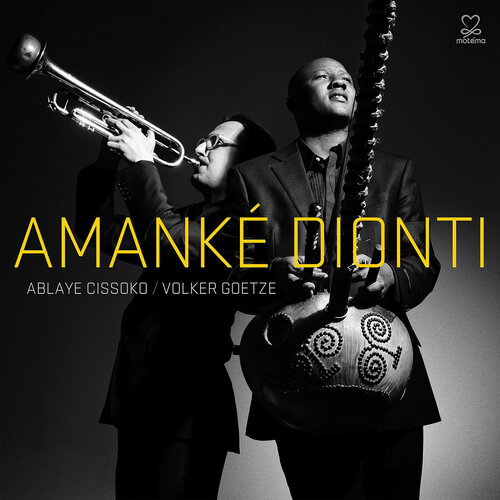
Amanké Dionti is the title track from the 2012 album of the same name, a collaboration between Senegalese kora player and vocalist Ablaye Cissoko and German-American trumpeter Volker Goetze, recorded on the Motema Music label. Cissoko is a griot, a son of a griot, born in Kolda and living in Saint-Louis in Senegal, carrying the living oral tradition of West Africa in his voice and hands. The album was recorded at the Bon Secours church in Paris, a historic all-wooden building from the mid-nineteenth century, chosen deliberately for its natural reverb. Goetze explained the decision simply: rooms with a natural reverb are perfect for the kora, voice, and trumpet. The spiritual nature of the space served the spirit of the music.
Africa is a continent we wish to visit some day. A place whose musical richness is as vast and deep as any on earth, carrying traditions that predate every genre we grew up with, built on instruments and voices of ancient times. This track carried that feeling into our room.
Amanké Dionti was an intimate listening experience. Cissoko’s voice feels light and ancient simultaneously, carrying the soft ritual quality of a griot’s invocation, and the speakers managed to render every shade of it with delicacy, softness, and sweetness. Goetze’s muted trumpet enters softly above it all, warm and unhurried, and the X2T placed it in the air, above the kora with a separation and sweetness that made the two instruments feel like they had a conversation across time and space. The kora, a 21-string bridge harp whose plucked notes dissolve into shimmering overtone trails, was an
ideal companion. Each string was perfectly plucked in time. Its decay tracked all the way into silence, as if the instrument was alive, accompanying the artist through the journey of sorrow and hope with patience and tenderness.
We felt, for a few minutes, a long way from home. In the best possible way.
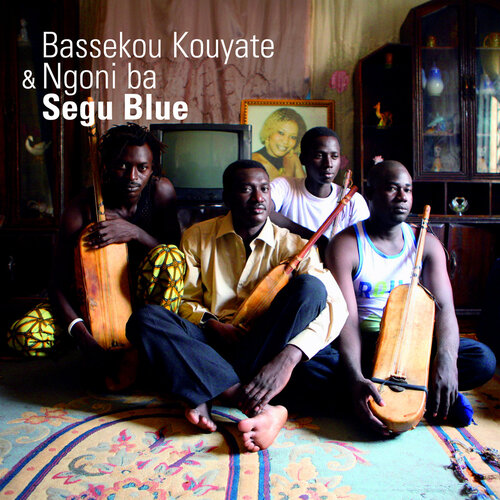
Segu Blue is the debut album by Malian ngoni player Bassekou Kouyaté and his band Ngoni Ba, released in 2007 on Out Here Records. Produced by British broadcaster and Mande music scholar Lucy Duran at Bogolan Studios in Bamako and mixed in London by Jerry Boys, the engineer behind the Buena Vista Social Club recordings, the album tells the story of the ancient Bambara empire of Ségou through a band built entirely around ngonis of different sizes, Mali’s first ever ngoni quartet. The ngoni is a West African stringed instrument (an ancient lute). The personnel is: Bassekou on lead ngoni and ngoni ba, Oumar Barou Kouyaté on ngoni, Moussa Bah on ngoni ba, Andra Kouyaté on bass ngoni, Alou Coulibaly on calabasse, Moussa Sissoko on percussion, and Bassekou’s wife Ami Sacko, some sources even describing her as “the Tina Turner of Mali”, on vocals. Bassekou was born in Garana, 60 kilometres from Ségou on the banks of the Niger river, raised in a household of musicians, his mother a praise singer, his father and brothers ngoni players. He moved to Bamako at 19, met Toumani Diabaté, and spent decades collaborating with the finest musicians Mali has produced before finally stepping forward as a leader with this record.
Tabali Te opens the album, and Qobuz describes it simply as dramatic. That is the right word. The interlocking ngoni lines, four instruments weaving around each other with a percussive urgency, gave the X2T something fast, dense, and rhythmically complex to resolve, and the speakers did so with perfect separation and attack. Made every individual string voice audible within the ensemble, distinct, clear. The calabasse and percussion locked in beneath it, and the X2T’s bass tuning gave the rhythm section a physical weight that made the track feel grounded and alive in the room.
Ami Sacko’s voice sat above the ensemble with the presence her reputation demands. The warmth and power of her delivery arrived completely and convincingly. We felt, as we do with all the African music we explored during this session, that we were sitting somewhere we had never been, listening to something completely alien.
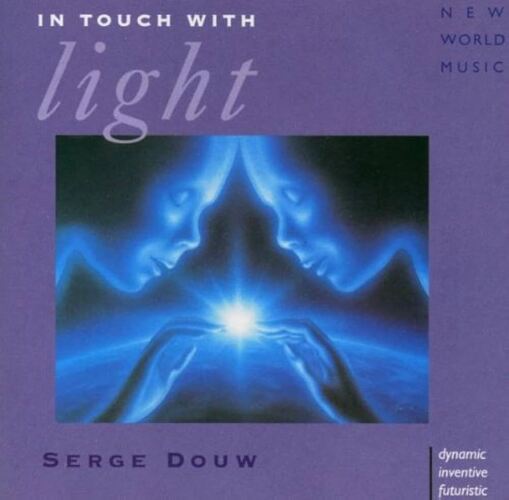
Before we talk about the album and how it shaped our upbringing, we want to give you some insights about the creator. Serge Douw was born in Port Douglas in tropical Australia and moved to West Germany with his family, where he completed his education and found himself drawn, with an almost inevitable logic, toward two disciplines that shared a common obsession with precision and light: lasers and electronic music. He founded his own laser company in 1984 and returned to Australia in 1990 to concentrate entirely on his music. The parallel between his two pursuits is one we find deeply appropriate. Laser technology and electronic music are both about the controlled emission of energy in a precise and focused form. Both require an understanding of physics that most people will never need, and both, in the right hands, produce something that feels supernatural to those who encounter it. In Touch With Light was recorded and released in 1990, produced, composed, arranged, and performed entirely by Douw himself, and released on the New World label in 1992. Reviewers at the time placed it firmly in the tradition of Jean-Michel Jarre, a comparison that is accurate in spirit, though Douw’s approach to the low end carries a specific character and ambition that sets it apart.
The album runs ten tracks across just under fifty minutes. Every note was composed, arranged, and performed by Douw alone, with cover artwork by Richard G. McKenna. The result is the work of a single musical mind with a clear and consistent vision, a sustained meditation on light, movement, and the space between sounds.
This album is very close to our hearts, and we chose to talk about it because of what it represents and how we came to experience it. In Touch With Light by Serge Douw came into our lives through our father. We were at the ripe age of 2 years old when he discovered it for its meditative and calming nature, and he brought it into the house the way he brought all the music that shaped us: quietly, simply by playing it, late-night listening, the lights low, the house settled, and Douw’s slow, deep synthesizer landscapes filling the room with a stillness and calmness that encompassed us and invited us to go to sleep. So we can definitely say that we grew up with Serge Douw’s album.
When we were 13 years old, and the hi-fi drug began to carry over from our father, our speakers could not reproduce what was truly at the bottom of these recordings. The bass was present in the way that a suggestion is present, implied, hinted at, not even felt as a faint warmth in the lower registers, never truly arriving with its full physical weight. We accepted this as the complete picture because we had nothing to compare it to. We had only heard the low-end bass through headphones but never through a speaker. Later that year, we decided to build our first subwoofer and traded in the gaming sessions for time with WinISD, learning how it works and trying all sorts of drivers in it to find the right one that would go down to 20 Hz with a relatively small box.
And so, after trial and error, we were 14 years old when we designed, calculated, and built our first subwoofer with a 15-inch Ground Zero Hydrogen car audio driver in it. In Touch With Light had the honour of being the first album to play through it, and it was then that we heard and felt it. The moment, hearing and feeling those bass notes arrive with their full physical presence, is one we carry with us still. Truly exquisite music, from a truly visionary artist, who deserved far more recognition than he received.
The technology has evolved in ways that continue to astonish us, and this album, of all the albums we could have chosen, made that evolution viscerally clear. Two 5.25-inch drivers, in a cabinet so slim it disappears against a wall, reproduced the low-frequency content of this recording with a refinement, control, and physical authority that, 20 years ago, only a subwoofer could have, and a 15-inch one at that. The bass from the X2T is deep, disciplined, and present in the body, exactly as Douw intended it to be heard and felt. It arrives with an unbelievable naturalness, smoothness, and coherence when you look at the cabinet and driver size. We often hear people say that loudspeakers have not changed, that the technology is essentially the same as it was thirty or forty years ago, that the fundamentals of a cone in a box have been solved, and what remains is refinement at the margins. We feel that claim could not be further from the truth. What Raidho has achieved with the Ceramix and Tantalum-coated drivers in the X2T is a demonstration of how profoundly speaker technology has advanced. The materials science, the motor geometry, the crossover precision, the cabinet engineering, all of it has moved forward in ways that produce results that would have seemed implausible 22 years ago.
This section, and everything it carries, is dedicated to Serge Douw. An amazing artist, a solitary musical visionary who built something extraordinary, in his own time, on his own terms, and left it in the world for a father to discover one quiet evening and share it with his children. Thank you, Serge.
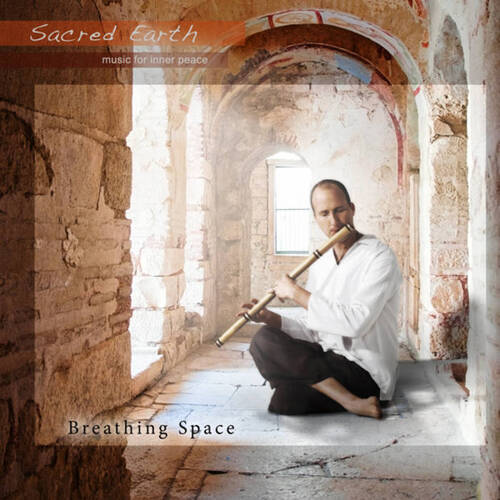
Grounded by Sacred Earth is the opening track of the 2012 album Breathing Space. Sacred Earth is the creation of Australian duo Jethro and Prem Williams. Jethro is a multi-instrumentalist whose palette spans the Japanese Shakuhachi, Indian Bansuri flute, Irish tin and low whistles, and acoustic guitar. Prem carries the vocal and devotional heart of the project, singing mantras and songs of the earth sometimes as a prayer, other times as a lullaby. Grounded runs for nine and a half minutes, building slowly from a single flute pulse chant and a low drone into a full, layered, warm sonic landscape.
The track opens with the bansuri flute. The opening note arrived delicately, with intimacy. The Bansuri character of the flute is breathy, warm, and almost human in its tonality. It was delivered with a feeling of completeness, a sweetness that is hard to describe in words. All of its beautiful overtones fully intact and floating naturally above the fundamental. The speakers managed to communicate the breath inside the note, the slight impurity that makes a flute sound alive. And it did this so easily and pleasantly that it felt natural.
Nine and a half minutes passed without us once checking the time.
The entire Breathing Space album as a whole was a pure pleasure to listen to from start to finish. We kept returning to it across several evenings, and each time it gave us something we had not fully absorbed the time before. The X2T’s midrange, with its completely uncoloured rendition of acoustic music, allowed every line, every harmonic texture, every subtle shift in the instruments to arrive with finesse and delicacy, nothing added and nothing taken away. This album is a testament to how good, how sweet and wonderful, how deeply musical the X2T can sound. We have said it before, but here it goes again. This happens only when the matching is done correctly, and everything is working in harmony. Change the DAC with a brighter one, a more analytical one, a faster one, and the emotion is gone. We changed the XLR cables from the Roboli to Van Den Hul, and everything stopped being so nice, polite, and delicate. These speakers need care if one is to reach Nirvana guided by their sonic performance.

Mirage is track fourteen on Le Dernier Vol, the 2009 film soundtrack album recorded by Le Trio Joubran in collaboration with the string ensemble Chkrrr. The trio are three Palestinian brothers from Nazareth, Samir, born in 1973, Wissam, and Adnan, his younger siblings, descended from four generations of oud makers. Their father, Hatem, is among the most celebrated instrument builders in the Arab world, and Wissam himself is now a master luthier who builds all of the band’s instruments by hand. Formed in 2004, they are the world’s first and only oud trio, building original compositions on the ancient maqam modal tradition of Arabic classical music, their ouds doing the singing in place of a voice.
Mirage opens with a breath. The blow into a flute, placed in our room with such intimacy as if it were whispered to our ears. The ribbon tweeter communicated the full acoustic signature of the moment: the turbulence of air across the embouchure, the soft attack before the pitch fully forms. Then the pitch emerges, and the oud enters, engulfing it. Warm, dark, and immediate, the string’s pluck landed with the characteristic toughness that separates the oud from the softer kora, a more percussive edge that the X2T’s Ceramix drivers communicated with full attack and natural decay.
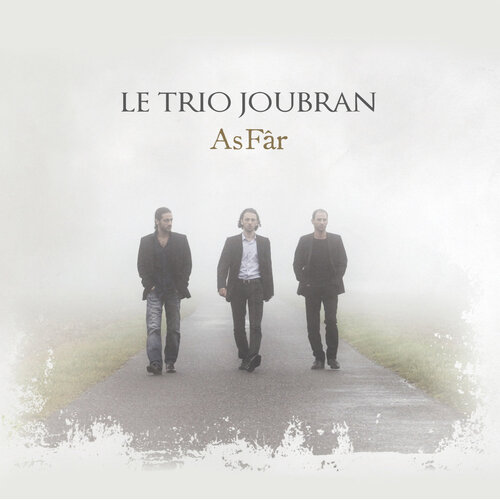
From the same brothers, we moved on to AsFâr, the fifth album, released in 2011 on the Randana label. The personnel on the album is: Samir, Wissam, and Adnan Joubran on oud, Youssef Hbeisch on percussion, and as a special guest, Dhafer Youssef on voice. Dhafer Youssef is a Tunisian vocalist and oud player born in 1967 in Teboulba, one of the most distinctive voices in contemporary Arabic music, known for a falsetto range and an improvisational approach that blurs the line between human voice and instrument. AsFâr itself plays on a bilingual meaning: in Arabic it means journeys or travels, and in English it reads as “as far”, a deliberate double meaning that reflects the trio’s musical ambition to carry Palestinian musical identity as far into the world as possible. Douja is track four, running six and a half minutes, and it is the album’s most physically charged composition.
The track opens with percussion, Youssef Hbeisch laying down a driving, insistent rhythm that the X2T planted in the room with immediate physical presence. The bass energy here is extraordinary. The low-frequency content of the percussion hits arrived with a chest-thumping directness that reminded us, once again, of what the X2T’s aggressive tuning delivers when the room and the matching are working together. We were not simply hearing the drums. We were feeling them.
The three ouds entered above that foundation, interlocking with the density and urgency that defines the Joubran brothers at their most driven. The X2T resolved each string within the ensemble with full precision, the percussive attack of each pluck was sharp and immediate. The decay trailed naturally, unbothered by the high dynamics of the notes.
When Dhafer Youssef’s voice arrived, the speakers gave it everything it deserved. His upper register, wide and searching, floated in front of the instruments, far from the rhythmic and dynamic energy, preserving the ever-so-sweet character of the presentation that the speakers had accustomed us to. The contrast between the driving low end and the floating vocal was so nicely observed, especially at the end of the track when only his voice remains. The speaker communicated both worlds exceptionally!

Loreena McKennitt’s voice is one of the great tests of a loudspeaker’s ability to render a specific kind of emotional intimacy. Dante’s Prayer, probably her most intimate and devastating recorded performance, arrived with such an emotional charge that it brought tears to our eyes. We are not embarrassed to say this. It is the intended response, and the X2T delivered it. The careful matching brought everything into harmony, the source with its sweetness, the amplification with its grip and dynamic capabilities, the cables with their warmth, each element contributing its part to the whole. But the prize of being the cherry on top, unequivocally, goes to the Raidhos.
What the ribbon tweeter does to a voice like McKennitt’s is something we struggle to fully detail. It reveals overtones and resonances in the upper registers of a human voice that dome tweeters simply do not. Everything is delivered with harmonic completeness, a sense that you are hearing the full acoustic signature of a real voice in a real space, that no other tweeter design has consistently delivered. The voice was rendered sweet, intimate, filled with emotion. Every inflection was communicated as it was supposed to.
Loreena McKennitt’s voice was hauntingly beautiful, no matter which track played. The midrange and ribbon tweeter combination and their ability to track the decay of a voice into near-silence, following the last traces of reverb into the noise floor without losing the thread, is extraordinary. The voice echoed in our large room as it echoes in the recording, and the boundary between the acoustic space on the disc and the acoustic space we were sitting in became ambiguous. We were fully immersed in the experience.
There is something we feel compelled to say before discussing this track, because May It Be cannot be separated from the films that gave it its reason to exist.
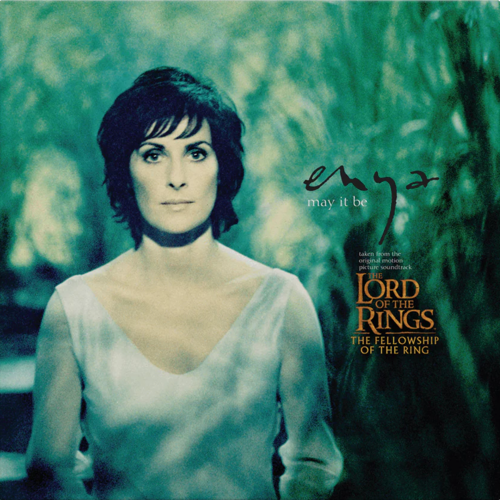
The Lord of the Rings trilogy, directed by Peter Jackson and released between 2001 and 2003, is perhaps the greatest achievement in the history of cinema. We say this without hesitation and with full awareness of how large that claim is. Jackson took J.R.R. Tolkien’s foundational work, a story that had been considered unfilmable for decades, and realized it with a completeness and emotional fidelity that has never been matched in the adaptation of a literary epic. The three films tell the hero’s journey from every conceivable angle simultaneously. Frodo carries the weight of the world in the form of a single object, a burden that corrodes his soul with every step. Aragorn walks the longer road from self-doubt and exile to the acceptance of his birthright and the full weight of kingship. Samwise Gamgee, perhaps the most quietly heroic figure in all of storytelling, carries his friend, and in doing so carries everything. Gandalf descends into darkness to find the light inside him. Boromir fails, understands his failure, and redeems it with the same breath. Each arc is its own complete hero’s journey, and they all unfold simultaneously, interwoven with a craft and emotional intelligence that leaves the viewer changed forever by the experience, exactly as we were, growing up with these masterpieces. Howard Shore’s score, performed by the London Philharmonic Orchestra, the London Voices, and the New Zealand Symphony Orchestra, is itself among the greatest pieces of music ever written for film, a living, breathing thematic architecture that carries the emotional weight of three films across nine hours without once losing its power.
It was Howard Shore who suggested approaching Enya. He knew what he needed: a voice that could close the first chapter of this journey with the same quality of ancient, timeless sadness and hope that the story itself carries. Enya traveled to New Zealand to see the preliminary edits of the film, and what she and Roma Ryan wrote in response was May It Be. The vocals were recorded at Aigle Studio in Dublin, the orchestration directed by Shore and performed by the London Voices and London Philharmonic. The lyrics are written partly in Quenya, the Elvish language Tolkien created, and Shore himself described the result: her singing grows right out of the choral music and the orchestra. It is a seamless sound. That is exactly how we felt May It Be through the X2T’s, with a completeness and a complete coherence between her voice and the orchestra. Enya’s layered voice, built from dozens of individual passes without sampling, floated above Shore’s orchestration with the same characteristic sweetness and air that the ribbon tweeter communicates so purely. The choir of her own voices opened wide in our large room, each layer sitting in its own space in the presentation, the full depth of the production resolved without compression or confusion. The strings beneath her carried warmth and sadness in equal measure.
We enjoyed the track at low listening volumes, in intimacy, with her voice close to our hearts.

The Four Seasons by Janine Jansen, in the Amsterdam Sinfonietta recording, gave the speakers a test of their ability to handle complex acoustic content across the full frequency range simultaneously. The violins are what concern most people first, and here the ribbon tweeter’s advantage was again immediately apparent. String overtones had presence and naturalness that avoided both the steeliness of lesser tweeters and the softness of dome designs trying to conceal their limitations. The violins simply sounded like violins, real ones, present in the room.
The bass from the cello came across with the weight necessary to blend perfectly into the harmonic foundation of the ensemble, just enough low-frequency presence to anchor the music and faintly vibrate the couch on the deepest passages, a physical sensation that exemplifies scale. With these speakers, in this room, bass frequencies never became disproportionate, dominant, or boomy. Autumn, second movement, was particularly beautiful: the X2T conveyed the intimacy and the sense of coming winter that Vivaldi encoded in the falling phrases perfectly.
Listening to the Four Seasons at both low and higher volumes confirmed something we had begun to notice straight from the beginning: the X2T scales its performance with volume in a very satisfying way. At low levels, the ribbon tweeter’s detail retrieval means that nothing is lost when the room is quiet. The aggressive tuning of the bass response means that even at low volumes, there is plenty, just enough to feel. At higher levels, the bass authority grows, and the sense of orchestral scale expands without the presentation ever hardening or compressing.
We truly have to give credit to Raidho for creating such a “big” small speaker.

And to honor the greatness of it, what better track than Svanrand from Heilung
Svanrand is track six on Futha, Heilung’s second studio album, released on 28 June 2019 on Season of Mist. Heilung describes their music as amplified history from early medieval northern Europe, and the trio behind it are Kai Uwe Faust, a German tattoo artist specializing in Old Norse work, Maria Franz, a Norwegian vocalist, and Christopher Juul, a Danish producer. The name Heilung means healing in German, and the intent behind the music is precise: the listener is supposed to be left at ease and relaxed after a sometimes turbulent musical journey. Futha was conceived as a counterbalance to their debut Ofnir, which carried a masculine and battle-heavy character. Futha celebrates female energy, fertility, and feminine power, and Svanrand sits at the centre of that intention. The track was written entirely for female warriors. Its lyrics are a recitation of the names of the Valkyries and heroines of Norse mythology, a roll call of the women who chose those slain on the battlefield and carried them to Valhalla: Gunr, Hildur, Gudhur, Herdjoetur, and dozens more, each name a separate invocation.
These tracks sound best when unleashed with unlimited levels of SPL. The higher you go, the better. This is where the limitations of the X2T’s begin to show. Svanrand immediately placed us in the middle of something extreme, as it should. The beginning is an invitation to war. And it is there that we heard the first pop of the drivers, reaching their maximum excursion. We need more power! The percussion beneath the chant drove forward with physical presence and chest feeling. This track really appreciates the X2T’s bass tuning and the speakers delivered. In our room, the drum hits hard, landing with weight and definition, grounding the voices above in something earthy and fully physical. The production, which blends ancient Germanic instruments with subtle electronic processing, was rendered with full transparency, every textural element sitting in its own space without blurring the voices or instruments.
We felt the hair on our arms. That is all we want to say. Keep in mind that Heilung has many more ultra epic tracks, one especially called Anoana…
Conclusion
We have never heard Raidho’s with such warmth, intimacy, and engagement. We have proof that they can be exactly that when care is taken with the matching process. It’s not always a good idea to throw money at the system in hopes of making it play. This can be done with so much less, you just have to be patient and search, ask, and research.
As we became more and more accustomed to the speaker’s sound, thanks in part to the careful matching that made it so sweet and velvety, it gave us the comfort, the freedom, should we say, to explore without boundaries. That freedom is what the listening sessions became: a journey across multiple cultures, continents, centuries, and states of the human soul.
We began in France, with Jean-Michel Jarre’s synthesizer textures floating and shimmering in our large room. Flying, we found ourselves all the way up, in North America, with Nicholas Gunn’s cinematic bass and ethereal overtones, and then sat quietly in the American countryside while Don Williams made a love song feel eternal. We traveled to Italy with Andrea Bocelli and Chris Botti’s trumpet lifting us toward something transcendental. We stood at the edge of the ancient Norse world with Heilung’s Svanrand and its roll call of Valkyries, and let Enya close the greatest cinematic trilogy ever made with a voice that seemed to carry the weight of all mythology behind it. Vivaldi’s Four Seasons arrived through Janine Jansen’s bow with the full intimacy of a live string ensemble in the room. Vangelis painted the conquest of a new world with ceremonial bass and a male voice suspended above it like steam. We climbed the great Tibetan mountains with Lama Tenzin Sangpo, felt his voice in our body, and heard the birds outside our house. We crossed into West Africa and found the soul of Mali in Bassekou Kouyaté’s ngoni, and the griot tradition of Senegal in Ablaye Cissoko’s kora conversation with a muted trumpet inside a wooden church in Paris. The Moroccan oud of Driss El Maloumi carried the ancient Arabic and Berber traditions of North Africa through the ribbon tweeters with a delicacy and sweetness that left us silent. The Palestinian brothers of Le Trio Joubran opened a track with a single breath and closed it with Dhafer Youssef’s voice suspended alone in our room. Craig Pruess and Ananda brought Sanskrit devotion and angelic female voices into our living room. Sacred Earth carried us through Earth’s wilderness with Breathing Space, Jethro’s flutes painting a landscape of calm that settled into the room like the last light of a long, peaceful day. And so, late in the night, with the lights low and the house settled, we returned to Australia, to the solitary musical world of Serge Douw, and In Touch With Light filled the room the way it had filled our childhood home thirty years before, deep, slow, meditative, and completely at peace with the silence surrounding it, reminding us how we started this hobby.
The X2T carried us on a journey. Every culture, tradition, and every emotional register reveals defining traits: sweet, airy, and precise, a speaker that adapts its presentation to the music with completeness.
The ribbon tweeter is the finest high-frequency transducer we have heard. We say this having heard a great deal. The way high frequencies arrive, sweet, airy, sparkly, and entirely free from fatigue, coloration, or metallic edge, sets a standard that we believe is the best in the world at any price. The midrange is equally clean, harmonically rich, and deeply musical. The bass, given the right room, delivers weight, slam, and physical authority that drivers of this size have no business producing. But all this is only possible through correct matching.
The X2T also taught us something about ourselves as listeners. We naturally gravitated toward female voices, toward music that asked for delicacy and sweetness, because that is where this speaker’s most extraordinary gift expresses itself most completely. Angelic is the word we kept returning to. It is the right one.
Getting the X2T to sound right is tough work. It’s an unforgiving speaker. Careful matching is mandatory: the right source, the right amplification, cables that complement its character, etc. Walk in unprepared, and it will tell you so. Loudly. Walk in prepared, and these speakers will give you something very special.
We want to thank AVStore for their endless generosity and goodwill. It is because of them that we had the opportunity to live with these wonderful speakers for an entire month.
Every word in this review reflects our honest experience, shaped by our room, our matching, and our ears. It is, by its very nature, subjective. We have done our best to be measured and fair, but the only truth that matters is the one you discover for yourself. Book a demo. Listen. Your ears are the only judge that counts. Bring your own tracks and try more than one amplifier, different sources, and ask to experience them with different cables. Listen at low volumes and at moderate ones. Give them time to speak. If the treble finesse, the coherence, and the midrange sweetness connect with you the way they connected with us, you will know. And if that connection turns into something more serious, ask about available offers.
These speakers respond beautifully to a warmer chain of electronics and cables, and keeping that principle in mind is what ultimately led us to the correct matching decision. What you see in the pros/cons reflects that decision.
Pros
- The ribbon tweeter is the finest high-frequency transducer we have heard, at any price.
- Amazing soundstage that exceeds the speaker’s physical boundaries in every direction.
- Ability to create a solid, stable, realistic phantom center channel.
- Midrange is exceptionally clean, detailed, and rich in harmonics.
- Bass performance, given the right room and amplification, is extraordinary for the driver and enclosure size.
- Drivers blend smoothly and deliver excellent, coherent sound.
- Cabinets have a flawless fit/finish and are a pleasure to look at.
- They have a small footprint, are light, and very easy to move around.
Cons
- The speaker can become harsh and fatiguing if paired with the wrong electronics and cables.
- SPL ceiling is limited, in part due to the physical dimensions of the drivers and enclosure.
- The combination of aggressive bass tuning and modest driver size creates an unusual room-size requirement for their size.
- They require a large room for the bass to become pleasant and listenable.
- They require a large space between them (at least 3 meters) to create a true phantom center and an expanded soundstage.
Equipment used:
- Digital Transport / Roon Server / DAC: Gustard R30, Eversolo Z10, 3DLab Nano Network Transport Platinum V5, 3DLab Nano Network Player Platinum v5.
- Amplifiers: Chord Ultima Integrated
- Interconnects: Roboli XLR 2100
- Speaker cables: Roboli HP8000 2.5m
- Power Cables: Roboli Power5200