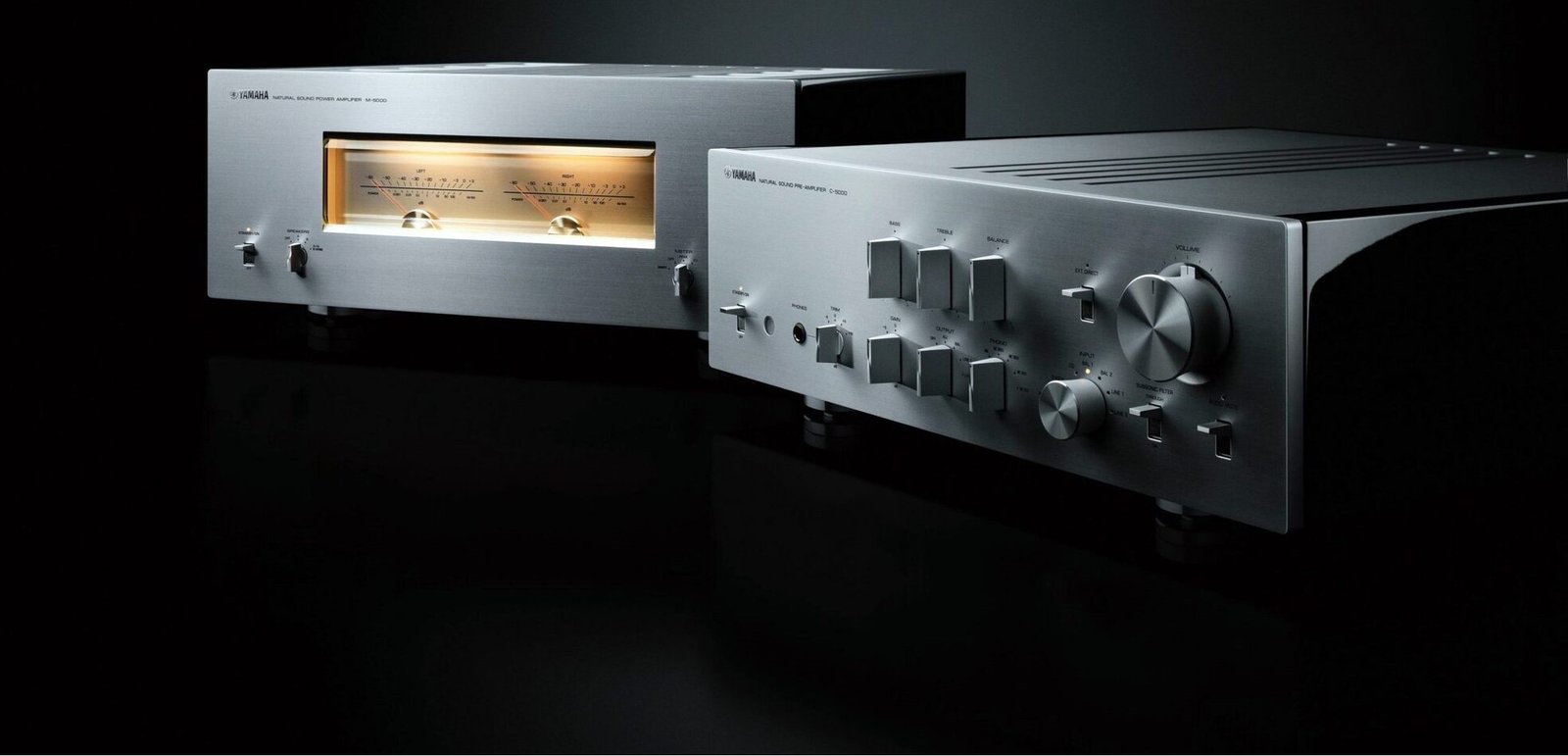
Yamaha C5000 Preamplifier and M5000 Power Amplifier Review: Harmony Above All

Listening rooms: the small living room, 4 m by 5.3 m with a 2.7 m ceiling and modest treatment, and the bigger room, 5 m by 6 m with a 4 m ceiling, treated • Loudspeakers used: Monitor Audio Platinum 300 3G, Dynaudio Contour 60i
Sources and preamplification: MOON 491, Luxman DA 07X DAC • Cabling: ZenSati Zorro Power Cable, ZenSati Zorro XLR, ZenSati Zorro Speaker Cable
Measured from the wall: around 290 W maximum, around 60 W at idle • Loaned by: HifiExpert
TLDR:
The Yamaha C5000 preamplifier and M5000 stereo power amplifier together form a flagship amplification system built around something we have come to value more and more throughout time: harmonic balance. The presentation tends to be on the warmer side. It also comes with a rich harmonic density, physicality, speed, detail, a deep 3D soundstage, and excellent dynamics, all coming together with a smooth and relaxed character that made every listening session incredibly pleasant. Some flagship electronics push individual qualities further, but few combine so many of them this harmoniously.
Three qualities define this combination for us:
- Balance. This could be the defining quality of the C5000 and M5000 combo. Speed and harmonic richness converge somewhere in the middle, with enough resolution, physicality, tonal density, and dynamic expression to make the system feel complete across every genre we played.
- Harmonic richness. Voices and instruments are warm, have great body and very nice tonal density, with the C5000 adding a mellow character that reminds us of good tube electronics. The M5000 also contributes substantially to the same character, making the complete pairing rich and smooth while preserving very good transparency and accuracy.
- Low and normal volume listening pleasure. One of the highlights of this system. Perfect tonal balance, soundstage that keeps its dimensions, bass with weight and articulation, and dynamic expression which survives beautifully even when the power drops to very low levels (lower than 1 watt).
The main limitation is power reserve. We would have loved considerably more headroom from a flagship power amplifier, especially considering how highly we value scale and unrestricted dynamics. Treble air and sparkle, absolute transient speed and articulation are also slightly below the most open flagship systems we have heard. These qualities, although in short measure, have rarely distracted us during normal listening, where the overall balance remained the strongest argument of the Yamaha M5000 and C5000 pair.
Introduction
The Yamaha C5000 preamplifier and M5000 stereo power amplifier sit at the very top of Yamaha’s amplification portfolio. Yamaha has an enormous history in audio and an equally impressive catalogue, but the 5000 Series represents something different. These are statement products, designed without the usual constraints found in the lower range. They were designed with the responsibility of showing what Yamaha can achieve when cost and complexity are not limited by the financial department constraints.
We have reviewed several Yamaha components over the years and have become familiar with many of the ideas that continue to appear throughout the company’s amplifier designs. The C5000 and M5000 take those ideas considerably further, both mechanically and electrically, while sitting in a completely different price category. At around €8,000 per component in Europe, the complete amplification system is worth €16,000, putting it directly into a territory where expectations become pretty high.
We tested the pair for more than a month and used them primarily with the Monitor Audio Platinum 300 3G, while the Dynaudio Contour 60i helped us explore power delivery and dynamics with a more demanding loudspeaker. The Moon 491 served as our main source, and the Luxman DA 07X DAC also spent substantial time in the system. Zensati Zorro cables were used throughout for power, balanced analogue connections (XLR) and speaker cabling.
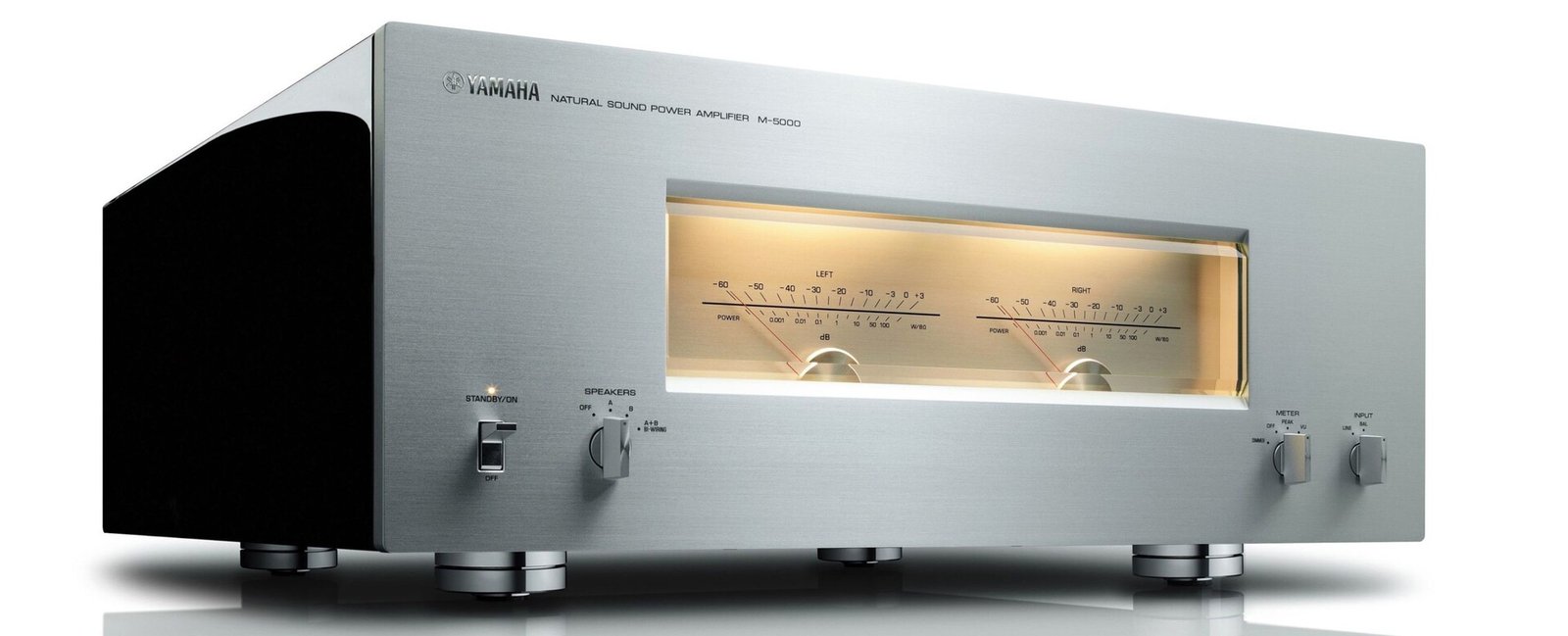
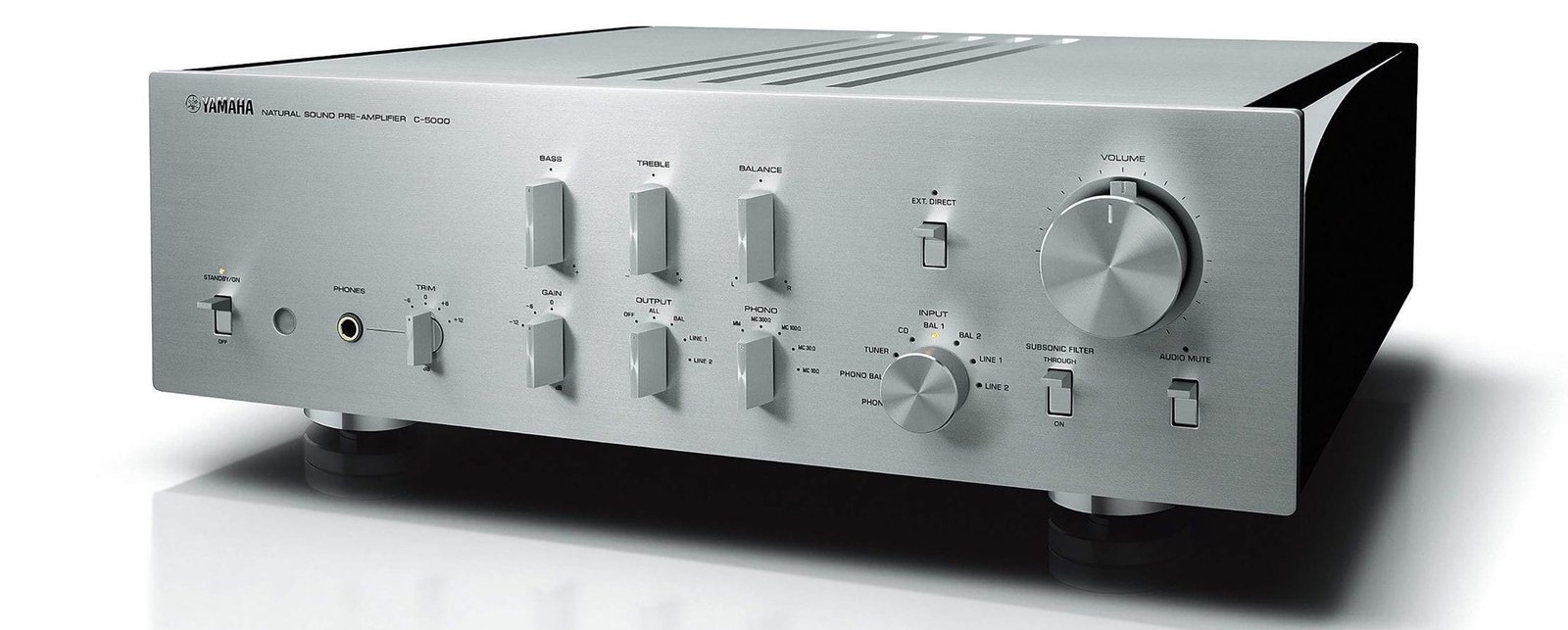
The review units are silver. Both machines are large, heavy and beautifully finished. The M5000 in particular has the sort of presence that makes you stop and look at it every time you enter the room. We liked the C5000 as well, although visually the power amplifier was our clear favourite.
There is also something refreshing about seeing Yamaha build products at this level while keeping such a strong connection with its own identity. The meters, proportions, control layout and the overall unique design make them immediately recognisable as Yamaha products.
A Brief Look at the 5000 Series
The C5000 and M5000 were launched in 2018 as Yamaha’s flagship separate amplification system and form part of the wider 5000 Series, alongside the NS5000 loudspeakers and GT5000 turntable. The series represents Yamaha’s modern statement in two-channel audio and continues a lineage that reaches back through some of the company’s most ambitious hi-fi products.
What we find interesting is how closely the individual components are connected. The M5000 was developed with the NS5000 in mind, with Yamaha specifically aiming to create an amplifier capable of extracting the full performance of its flagship loudspeaker. The C5000 completes that concept on the control side and extends Yamaha’s Floating and Balanced philosophy through the preamplifier stage.
This makes the 5000 Series feel much more like a complete project, not just a collection of unrelated flagship products. The loudspeaker, turntable, preamplifier and power amplifier all follow the same general approach, with mechanical construction, electrical symmetry and signal purity receiving a great deal of attention.
Yamaha also makes a direct connection between the 5000 Series and its historic 1000 and 2000 lines. These products are designed to represent the highest level of the company’s accumulated experience in analogue audio.
We will keep the history concise, as we did a deeper dive into it in our Yamaha AS-3200 review earlier this year. These amplifiers were created as part of Yamaha’s most ambitious modern hi-fi platform, and many of the engineering decisions inside them make more sense once they are viewed from that perspective.
As we touched on the A S3200 during our previous Yamaha experience, there are some familiar ideas shared between these devices. The 5000 Series takes those ideas much further. Construction becomes more elaborate, the circuit architecture more ambitious, and the separation between functions gives Yamaha far more freedom in how each component is designed, the result being a preamplifier and power amplifier combination that is clearly positioned above Yamaha’s integrated amplifier range in both purpose and execution.
Design and Build
The C5000 weighs 19.1 kg and measures 435 mm wide, 142 mm high and 451 mm deep. The M5000 is the heavier of the two at 26.9 kg, measuring 435 mm wide, 180 mm high and 464 mm deep. Both components use extremely rigid chassis construction, substantial aluminium panels and heavy brass feet that can be configured as spikes or used with protective bases.
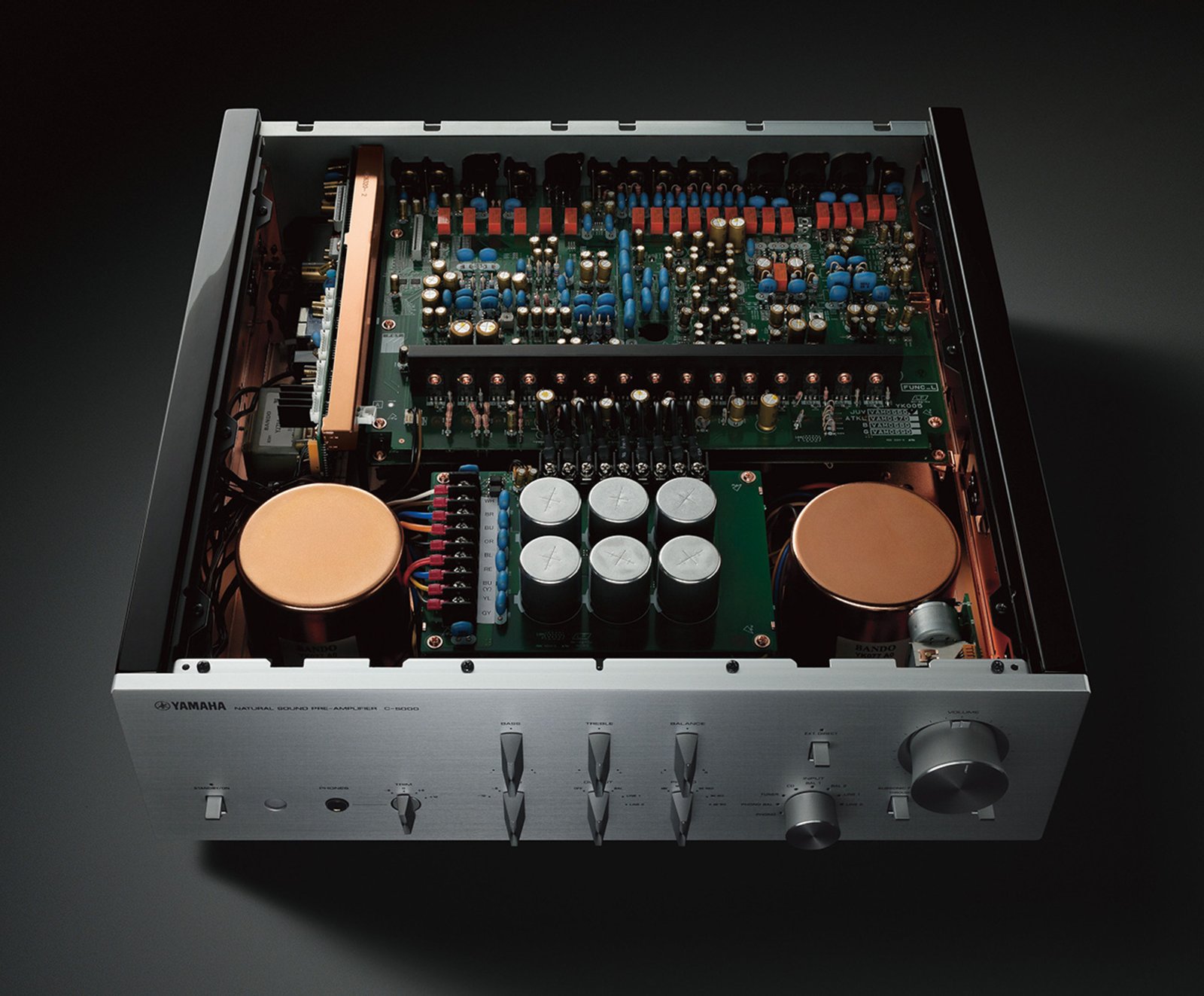
The preamplifier uses Yamaha’s Floating and Balanced preamplifier architecture and is fully balanced and discrete through the signal path when Tone Defeat is engaged. Yamaha applies the same principle through the phono equaliser, input amplifier and line amplifier sections, with the circuits electrically separated from ground influence.
One of the more interesting solutions is the internal layout. Each channel has its own main circuit board, with the left and right boards positioned as mirrored versions of each other in what Yamaha calls a book-matched construction. Signal paths, ground paths, and power supply routes are kept as short and symmetrical as possible, with the entire layout built around keeping both channels electrically equal.
The power supply follows the same idea. The C5000 uses two independent toroidal transformers, one for each channel, each enclosed in its own copper-plated case. Yamaha also uses substantial power supply wiring and very short connections throughout the unit. It is a complicated way of achieving something quite simple in principle: keeping the left and right channels as independent, symmetrical, and clean as possible.
Build quality is exceptional!
The M5000 power amplifier immediately attracted more attention in our room. The large analogue meters dominate the front panel in the best possible way, and their illumination also gives the amplifier a beautiful presence during evening listening. The proportions are equally successful. It looks substantial and powerful without becoming visually excessive.
The amplifier uses the same Yamaha Floating and Balanced architecture. MOSFET output devices are used in a circuit where the complete amplification section is electrically floated from ground. The left and right amplifier sections are arranged symmetrically around the central power supply, with short signal and power paths throughout.
Power is rated at 100 W per channel into 8 ohms and 200 W per channel into 4 ohms, with both channels driven from 20 Hz to 20 kHz at 0.07 percent THD. Yamaha also specifies 400 W into 8 ohms when the amplifier is used in monaural operation. We did not get the opportunity to add one more amplifier and test the M5000 in monaural mode, although maybe this will happen in the foreseeable future.
Those numbers look quite conservative for a flagship power amplifier in 2026, especially for us, considering how much importance we place on power and available headroom. The power supply itself is substantial, with a 1200 VA toroidal transformer mounted on a 3 mm brass base. Yamaha uses thick wiring, brass lugs, and screw connections through the main current paths in an effort to keep impedance as low as possible and automatically increase the damping factor.
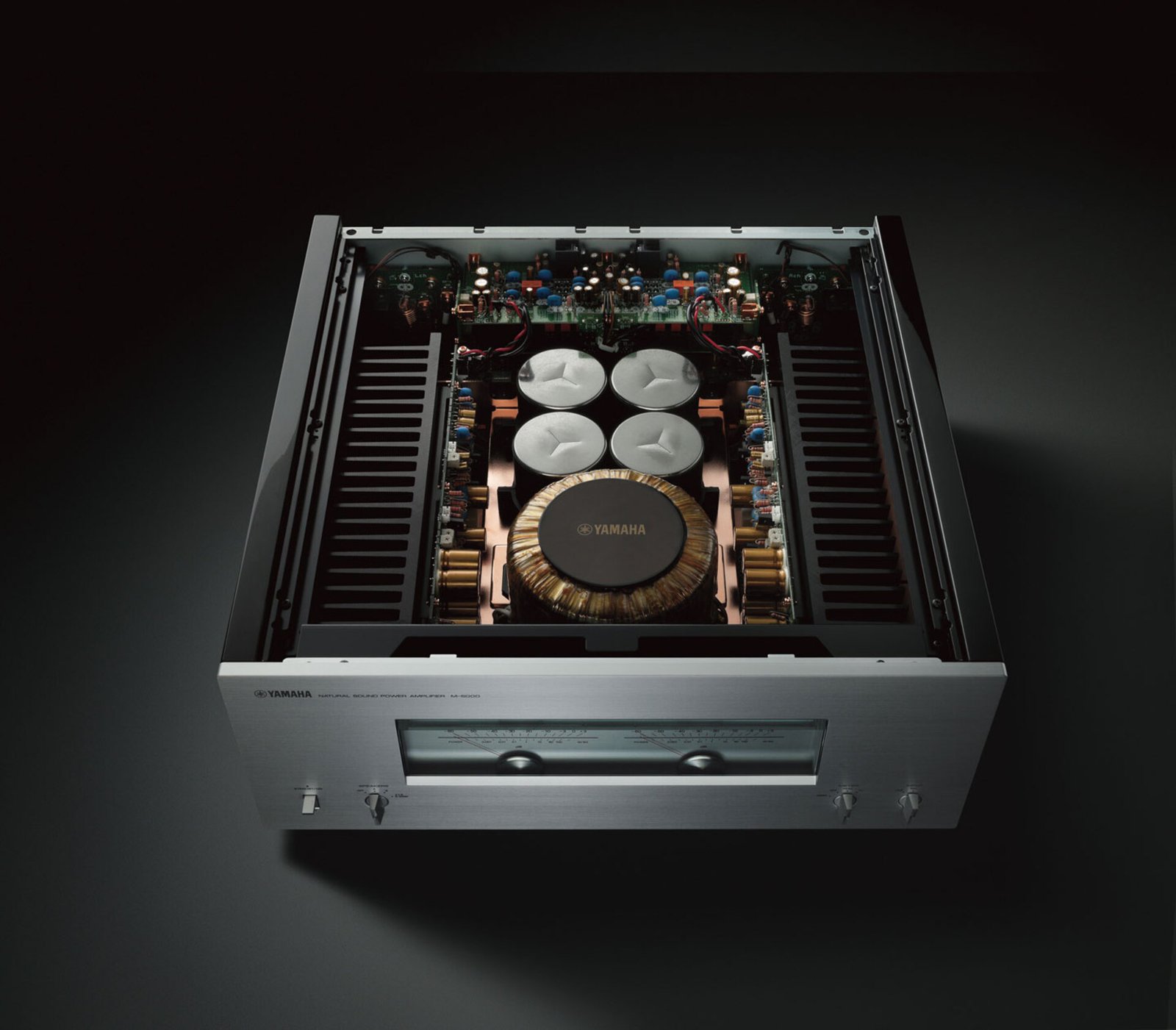
Mechanical grounding is also taken seriously. The transformer, block capacitors and heat sinks are fixed directly to the rigid internal structure, with Yamaha trying to control the vibration generated by the heaviest components inside the amplifier. The internal chassis is separated into dedicated sections for the left amplifier, right amplifier, and power supply, while the wiring runs through the space below them to keep the paths short.
There is a lot of engineering inside both machines, but the general philosophy is easy to understand. Yamaha focuses heavily on symmetry, short signal paths, low impedance, mechanical rigidity, and keeping both channels as electrically equal as possible.
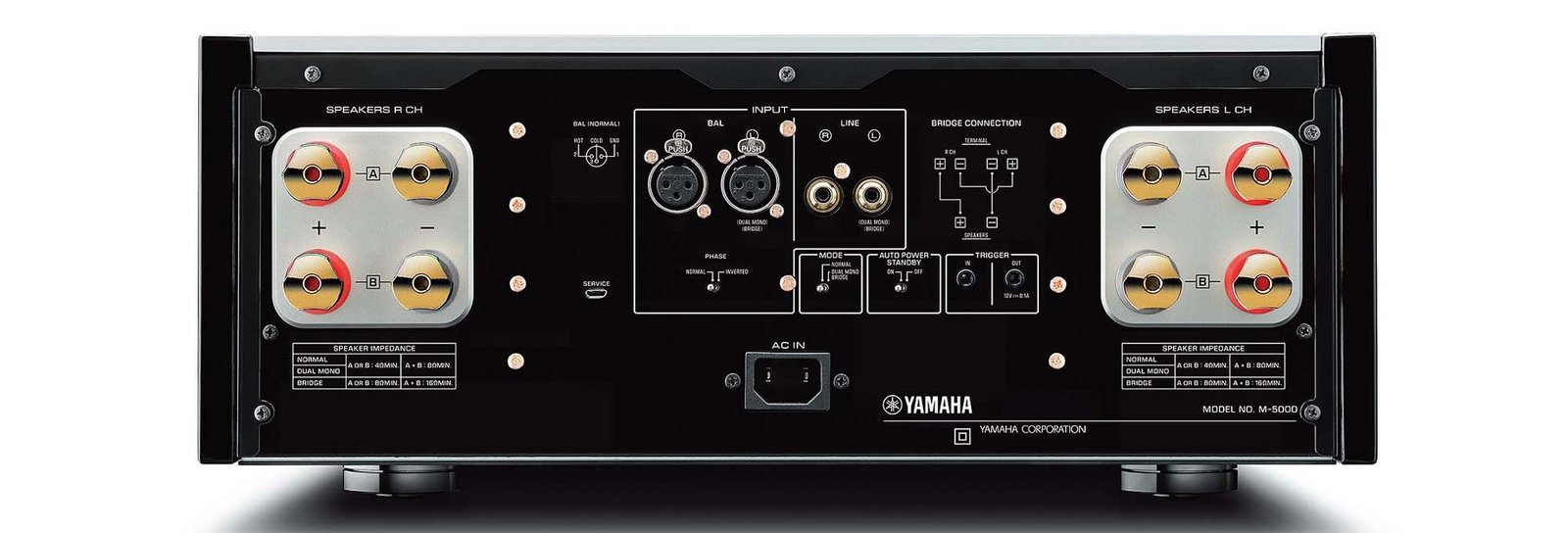
We will see later how all of this translates into actual power delivery, because the M5000 behaves in a particularly interesting way once it approaches the end of its usable power range.
The C5000 preamplifier is more conservative in appearance, with a design that leans slightly toward the vintage side. Some will appreciate that traditional look, while others may find it a little dated. Unlike the M5000, which makes a strong visual impression almost immediately, the C5000 is less of an instant win and depends more on personal taste. Its front panel is cleaner and more functional, with the large volume control becoming the main visual element.
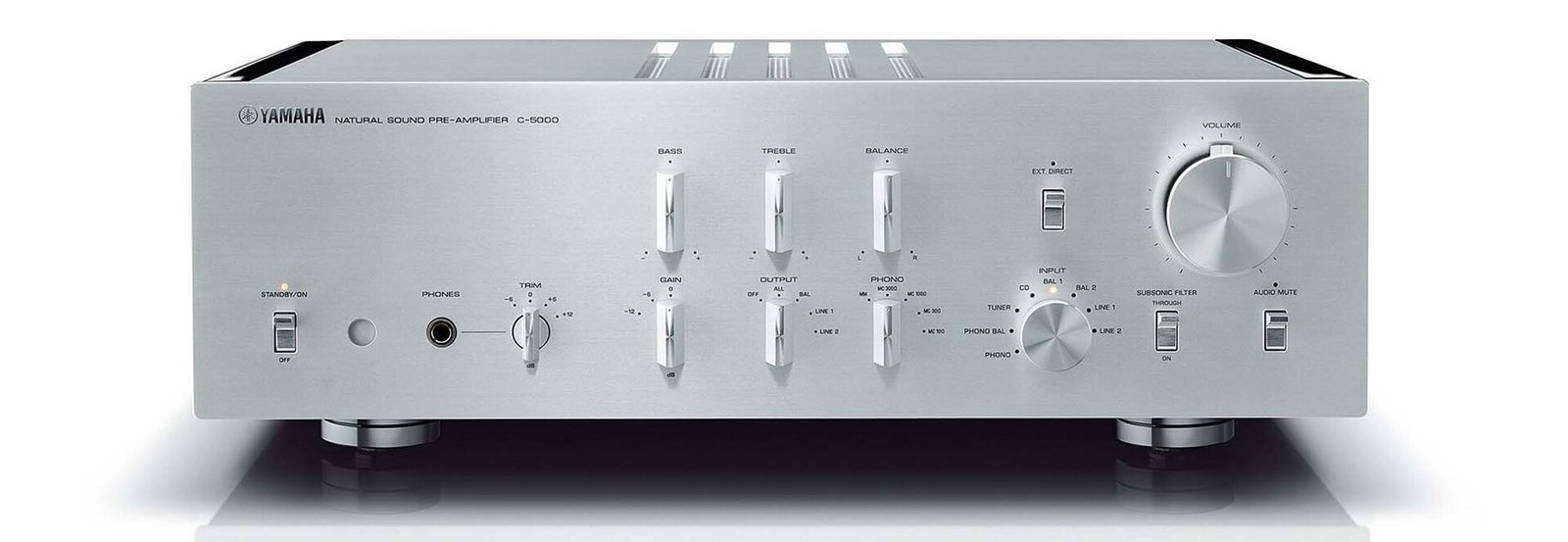
The tactile quality is every bit as convincing as the appearance. Controls feel precise and substantial, switches operate with real mechanical feel, and the volume control on the C5000 has a very smooth resistance that we liked. Yamaha uses a precision-cut aluminium volume knob supported by ball bearings.
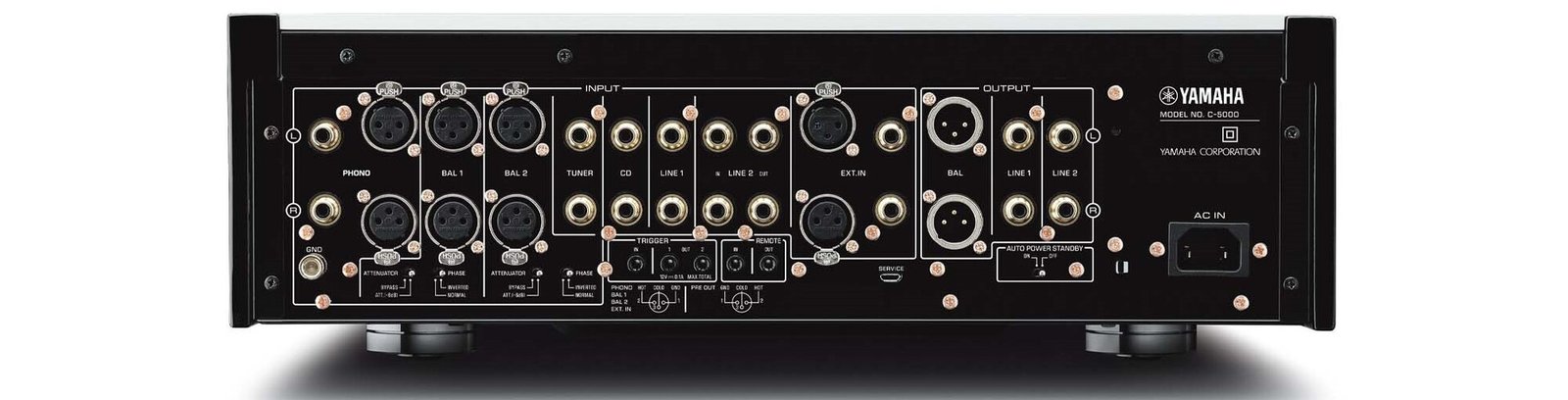
The remote follows the same approach and feels appropriate for a flagship preamplifier. Volume adjustment is precise even at very low levels, which we paid close attention to, since there are some other competing brands out there that missed this part. Channel balance was perfectly stable in any position.
We also found the combination easy to live with throughout the review period. Warm-up differences were small in our system, so we never felt the need to leave the electronics running for long periods before listening. They reached their familiar character quickly and behaved consistently the entire time we got them.
System Setup
The Monitor Audio Platinum 300 3G are our main loudspeakers throughout this review and are used for almost all critical listening. We know them extremely well by now, which makes them a very useful reference when changing electronics. Their resolution, openness, and ability to show differences upstream also make them particularly suitable for evaluating a combination like the C5000 and M5000.
The Dynaudio Contour 60i also has a very important role. We can see what happens when pushing the M5000 harder and can explore power delivery, physical impact and dynamics with a more demanding loudspeaker. The amplifier drives them very well throughout its usable power range and gives them strong physical presence, which becomes important later when we discuss the available power reserve.
The Moon 491 is our main digital source, working as both streamer and DAC and feeding the C5000 through balanced Zensati Zorro XLR cables. We know its detailed, open and more analytical character very well, and it fits this system nicely. We still keep the focus of this review on the Yamaha electronics, because changing sources never removed the main character we heard from the C5000 and M5000.
The Luxman DA 07X also spent substantial time in the system, fed from our Apple MacBook Pro 16” with the latest M5 Max processor, through USB and connected to the C5000 with the same balanced Zensati Zorro cabling.
Zensati Zorro is used for speaker and power cables, keeping the cabling consistent throughout the evaluation. Everything is installed in our usual reference room, with the system remaining unchanged whenever we move between sources or loudspeakers.
We also connect several other preamplifiers to the M5000 during the review. More analytical preamplifiers bring additional openness, sharper image outlines, faster transitions, and more treble energy. Warmer designs move the presentation further toward tonal density and harmonic richness.
This tells us that the M5000 is a very transparent power amplifier when it comes to system matching. At the same time, part of the warmth and harmonic density we hear with the complete Yamaha pairing clearly comes from the M5000 itself. Our impression is that the contribution is pretty even, with the M5000 and C5000 each bringing their half of that character to the table.
The C5000 then pushes the complete combination further towards warmth, tonal density and smoothness. This is useful information for anyone considering the M5000 separately, because the final balance can be moved in either direction depending on the preamplifier used. With the C5000 in front of it, the two machines feel extremely well matched.
Bass, Physicality and Dynamics
Bass makes the M5000’s character particularly easy to identify. There is plenty of weight, very good physical impact, and a rich tonal structure that gives low frequencies a good feel of substance, think of it like a power-audio style presentation. Articulation is also good, although the M5000 does not have the fastest decay, which keeps the presentation from sounding dry or thin.
We like this balance a lot. Bass notes have enough speed to remain clearly separated, but are presented with enough decay and harmonic information to feel complete and weighty. There is body, is pressure, and enough control to keep things organised even when the recording becomes more demanding and congested.

Yello’s The Race was a very good example. The synthesised bass had excellent weight and filled the room with convincing energy. Individual pulses remained easy to follow. The amplifier kept very good control when the arrangement became more congested, so the sound character never seemed bloated. The Platinum 300 3G also responded beautifully here, giving us enough pressure in the room to make the electronic foundation the impact it needed.
The dynamic changes and swings were also greatly rendered. The M5000 kept everything organised as the energy increased. What impressed us most when testing this track was the balance between weight and speed, but with enough articulation to keep the bass lines clean, while the richer character of the Yamaha added more substance and physicality to each event.

Pink Floyd’s Money brought a more familiar type of bass. The kick drum had very good weight and definition, all while keeping the bass guitar easy to follow throughout the track. Texture was pretty clear, individual notes kept their identity, and the dynamics were very nice with nothing being tiresome at any point at any power level.
The slightly longer decay of the Yamaha becomes easy to hear here. Notes carry a little more body and remain present for a touch longer, which adds some substance to the presentation. Percussion feels physical, bass guitar has more tone, the lower frequencies are more developed and fuller. Overall, the presentation feels more musical, and there is a certain pleasure that appears as you listen more and more.
Dire Straits’ Ride Across the River followed the same direction. Bass articulation was very good, and pitch differences remained easy to hear. The lower frequencies had excellent body, percussion had convincing weight. Decays had the right length, with everything sounding properly high-end.
This is one of the M5000’s strengths. It finds a very comfortable balance between articulation and harmonic richness. The bass stays controlled and easy to track, while also keeping enough body and decay to sound natural.

Infected Mushroom’s Deeply Disturbed pushed the amplifier considerably harder. The amount of low-frequency information here is very demanding, especially once the volume goes up. The Yamaha kept the bass well organised, physical and energetic, with dense passages remaining articulate and detailed enough that the end feeling was a very pleasant one with absolutely no fatigue.
The Platinum 300 3G handled the energy beautifully, and the M5000 kept enough speed for the electronic sequences to stay clear, detailed, and never bloated or fatiguing. At the same time, the richer tonal character added physical substance and made the track feel bigger and more weighty.
This track also showed how relaxed the amplifier can sound while still having very good dynamics. Large changes in level had enough force, and smaller dynamic events remained easy to hear inside the bigger picture.

Aurora’s Through the Eyes of a Child was especially useful during the passage where the “machine gun” bass starts. There is a lot happening in the lower frequencies, so it becomes easy for bass notes to start blending together. The M5000 kept very good articulation throughout this passage. Individual events remained separated, impact was strong, and the kick kept its distinct shape throughout the entirety of the song.

Johann Strauss II’s Explosions Polka, Op. 43 moved the discussion towards large-scale dynamics. Sudden changes in level had a convincing impact, the orchestra expanded naturally, and the M5000 remained composed as the arrangement became more demanding. Brass and strings retained body, and the larger dynamic accents were presented with very good force.
When testing using the Dynaudio Contour 60i, physical impact remained strong, the amplifier drove them confidently throughout its usable power range.
This is also where we reach the main limitation.
We would have loved considerably more power.
We place a lot of importance on power reserve because large dynamic peaks need headroom if we want to preserve scale and freedom when the recording becomes true to life. The M5000 gives us excellent quality from the power it has available, while the available reserve remains a bit too limited for a flagship power amplifier.
We also observed a very interesting behaviour when pushing it towards its maximum output.
Using a power meter at the wall, idle consumption stayed around 70 W continuously. During high-level listening, we saw approximately 300 W while the amplifier remained clean.
The M5000 maintained essentially the same sonic character from very low output through normal listening levels and all the way towards the end of its clean operating range. Weight, tonal density, dynamics and articulation remained consistent. Once the available reserve was exhausted, distortion appeared clearly and quickly.
We liked this behaviour a lot because every usable watt sounded consistent until the very last rated one. There was no sense that the amplifier slowly changed character as the level increased. The same balance remained present until the available reserve was gone.
Physicality follows the same pattern. The rich harmonics contribute greatly to the final result and give bass extra substance. Drums and electronic bass have body, pressure, and enough density to feel physical, while articulation remains very good throughout.
Midrange, Harmonics and Voices
The midrange is where the C5000 becomes even more important for the final character of the system. This combo provides plenty of warmth and density, and voices are presented with enough body to feel natural and complete. At the same time, articulation stays very good, so the presentation never becomes overly soft or veiled.
What we appreciated most was the way texture and smoothness coexist. Voices had enough detail to expose small changes in phrasing, breath, and articulation, with the overall presentation also remaining relaxed and easy to listen to. We never felt that extra harmonic richness was masking any information.

Diana Krall’s Temptation was especially useful here. Her voice was presented with excellent body and a very natural sense of intimacy. Fine textures were easy to hear, articulation was clear, and the tonal density added substance without making the voice sound oversized.
This is also one of the tracks where the C5000 contribution becomes very obvious. The presentation had a mellow character that reminded us of good tube electronics, with a warmth that made the voice fuller and more expressive. At the same time, clarity was very good, so small details in the recording were still easy to follow.
The overall result was very pleasant and harmonious.
There was enough transparency to hear the recording clearly, while the richer tonal balance gave the voice and instruments more body. Maybe this is one of the reasons long listening sessions were so easy and delightful with this combination.
The overall presentation also remained very cohesive, so individual elements were clearly separated, but still belonging to the same musical picture. We could follow each instrument without feeling that the system was trying to dissect the recording.
This balance was also emphasized on Dire Straits’ Your Latest Trick. The saxophone was reproduced with excellent tonal colour and very good body. Harmonic information was rich, texture was where it should be, and the instrument had a clear, identifiable position inside the soundstage. There was also a very convincing sense of depth around the saxophone.
Some highly analytical systems can present extremely sharp image borders and impressive separation, but the final result can become a little too clinical and tiresome for our taste. The Yamaha keeps very good focus while giving voices and instruments enough substance to sound natural.
The saxophone also showed how well the combination handles tonal variation. Small changes in texture and intensity were obvious, while the richer harmonic structure made the instrument sound more complete, more weighty. The presentation was smooth, but still accurate enough to preserve the differences between individual notes and phrases.
Across other acoustic material, we heard the same behaviour repeatedly. Strings had good body and tonal colour, piano had proper weight, and wind instruments benefited greatly from the extra harmonic density. Everything was presented with enough texture to remain interesting, without pushing the system towards an overly analytical character.
Midrange separation was also good when recordings became more complex. Voices and instruments remained easy to distinguish, while the overall presentation stayed cohesive even when the track was a bit crowded. There was no feeling that the richer character was blending information together or bloating the sound in any way, shape, or form.
We also liked how naturally the system reproduced vocal distance. Voices had presence, intimacy, and their size remained believable. Nothing was pushed unnaturally forward, and nothing seemed recessed.
This helped greatly with long listening sessions because the midrange never screamed for attention through excessive sharpness or exaggerated detail.
The smaller changes in intensity inside a phrase were also naturally presented. We could follow the flow of a voice or instrument easily, and even if the very most analytical systems can show slightly finer gradations and more information, we felt the harmony presented by the M5000 and C5000 combo was spot on.
To conclude this chapter, the Yamaha combination presents enough information to make voices and instruments feel developed, textured, and expressive. More importantly, all of this is delivered with a very natural sense of flow.
Low Volume Listening, Balance, Tradeoffs and Emotional Connection
Low and normal volume listening pleasure is one of the strongest qualities of this combination. We paid a lot of attention to this during the review because many amplifiers can sound impressive once enough power is flowing, while considerably fewer can preserve the same involvement when the level drops below the 1 Watt mark.
The C5000 and M5000 perform exceptionally well here. Small changes in level remained obvious and the music kept its feel even when listening very quietly. Bass retained its weight, articulation, and its dynamic envelope very convincingly.
Tonal balance was also remarkably consistent. We could move from our usual listening levels to very quiet playback without feeling that one frequency range suddenly became more dominant than another. Voices kept their physicality, bass remained articulate, and the upper frequencies preserved enough energy to keep the overall sound harmonious and balanced.
Yosi Horikawa’s In the Wind was probably the easiest track to use when checking what happened to the soundstage at very low SPL. We had already used it extensively at normal levels, so reducing the volume made the comparison straightforward. The result was impressive. Soundstage dimensions remained almost unchanged, depth was still excellent, individual elements kept their positions, and the smaller spatial cues were still clearly identifiable. Decays remained easy to follow, and the 3D picture retained the same basic proportions we heard at normal listening levels.
This is a quality we value greatly because the soundstage can flatten quite quickly when volume is reduced. Here, the C5000 and M5000 kept the spatial presentation intact to a surprising degree.

Vivaldi’s The Four Seasons with Janine Jansen focused our attention on dynamics. Even at low SPL, bowing intensity and smaller shifts in dynamics remained obvious. The orchestra kept its layering and scale, and tonal colour stayed beautifully preserved.
This was an excellent result..
The absolute dynamic range naturally becomes smaller as SPL drops, while the relationships inside that range remain clear.

E-Mantra’s Last Symphony of the Stars, in the Reasonandu version, brought all of these qualities together.
We played this track from the lowest levels we normally use all the way towards the upper end of the M5000’s clean operating range. The sense of immersion was excellent throughout.
At low SPL, the 3D presentation was already very satisfying. Depth extended clearly behind the loudspeakers, lateral information expanded around them, and height added another layer to the complete picture. Foreground, middle distance, and background were all easy to identify.
As we increased the volume, the scale grew, and the spatial proportions remained harmonious. The electronic atmosphere surrounded the listening position beautifully. Listening to this track was extremely satisfying on any level.
We also never had the impression that we needed to turn the system louder in order to make it interesting. The C5000 and M5000 already sounded complete at moderate levels, with enough dynamics, physicality and tonal information to keep us engaged.
This is why balance is more than a word used to describe tonal behaviour. During the review, we compared individual characteristics with several electronics we know very well. The Hegel H30A is a bit more articulate in the bass. The Moon 871 and 891 combination presents faster high-frequency transitions with considerably more air. The Marantz Model 10 is faster on bass stops and has a sharper, more laboratory precision-like transient character.
Yamaha gives more weight, physicality, and harmonic substance.
Each of these devices can push a particular quality further than the other.
The C5000 and M5000 gave us a harmonious mix of all those qualities in one system.
The Yamaha did not need to win every individual category for the complete result to work. We could hear where another amplifier was faster, maybe another one was more articulate, or another presented more air, and then return to the C5000 and M5000 without feeling that the complete experience had lost something important. The individual tradeoffs are easy to identify when we search for them, but the complete result is much harder to criticise.
The matching also gives the owner some freedom here. We already heard how changing the preamplifier can move the M5000 towards a more analytical or warmer presentation, and the Moon 491 and Luxman DA 07X showed how clearly the spatial balance can move between depth and width depending on the source.
This means the final character can be adjusted without losing the qualities that make the M5000 interesting in the first place.
Also, the C5000 pairing was very harmonious. It added enough warmth, tonal density, and smoothness to make listening sessions easy and delightful, while the M5000 kept enough speed and transparency to prevent the complete system from feeling overly soft.
There was also a very strong emotional connection with the combination, although this came from the complete sonic result and not from one particular quality. We simply wanted to continue listening.
That happened across very different genres and at very different volume levels.
To conclude this chapter, the C5000 and M5000 are among the most pleasant amplification systems to listen to that we have experienced for low and normal volume listening.
Conclusion
After more than a month with the Yamaha C5000 and M5000, what remains with us is how harmonious the complete result feels.
There are electronics that are faster, more articulate, more transparent, or more powerful. We have heard systems with more treble air and sharper transient precision. The Yamaha does not try to dominate through one particular quality, and maybe that’s why we enjoyed it so much.
The C5000 adds warmth, tonal density, and a mellow character that reminds us of good tube electronics, while the M5000 keeps enough speed, transparency, and control to maintain a very good balance. Together they create a presentation that feels complete on every genre we played.
Low and normal volume listening sessions are especially impressive. The sound remains engaging below the 1 Watt mark, tonal balance is consistent, the soundstage keeps its proportions and dynamics remain expressive enough to preserve the feel of the recording.
Our biggest criticism remains the power reserve. We would have loved considerably more of it, especially considering how highly we value scale and unrestricted dynamics.
Treble air and sparkle can also be improved through careful matching, as we clearly heard when changing sources and other components around the Yamaha pair.
For us, the C5000 and M5000 are among the most pleasant amplification combinations we have experienced. Their strongest quality is shown in the way everything comes together, with enough speed, richness, detail, physicality and a level of harmony that is difficult to criticise.
Highly Recommended.
Acknowledgment
We would like to extend our thanks to HifiExpert for lending us the precious pair of Yamaha M5000 – C5000 and for giving us the time to listen and enjoy them properly across two rooms and three systems. Having the components in the house for a month, in our own space, with our own loudspeakers and our own cables, is how we learn what it does over time. Shout-out to all the dealers out there doing awesome work for all of us.
Pros
• Exceptional overall balance between speed, harmonic richness, physicality, detail and smoothness
• Rich, dense and natural midrange with excellent vocal presence and instrumental body
• Outstanding low volume performance with dynamics, tonal balance and soundstage remaining remarkably complete
• Deep and immersive soundstage with excellent layering and stable image placement
• Smooth and refined treble that remains easy to listen to across very long sessions
• Beautiful construction, flagship-level tactile quality and one of the most attractive power amplifiers we have reviewed
Cons
• Power reserve is the clearest limitation, and we would have loved substantially more headroom from the M5000
• Treble air and sparkle are a little less pronounced than with the most open and illuminated flagship electronics we have heard.
• Absolute transient speed and bass articulation are behind the fastest and most analytical flagship designs.
Score
The scoring is the absolute truth and the way we best quantify how the devices sound. Interpreting this score is the best thing you can do if you want to “read” into the device’s sound signature.