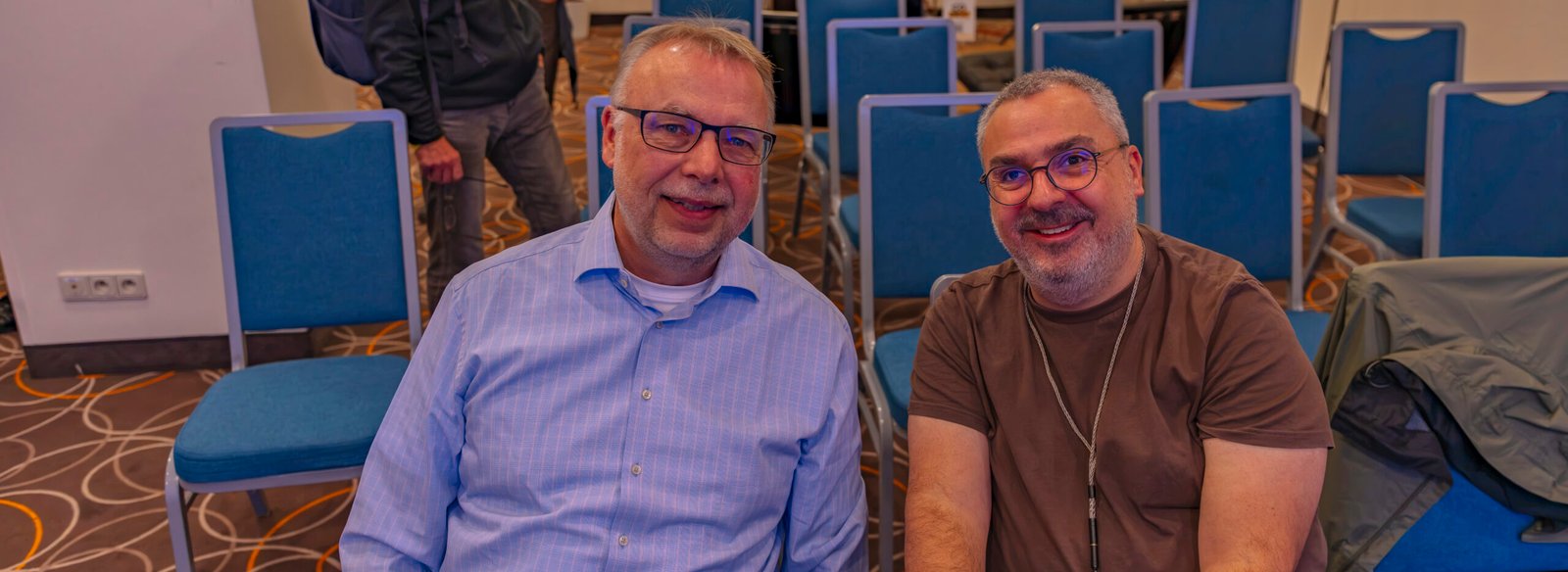
An interview with Dr. Stefan Schwehr, the owner and CEO of Audionet
Introduction
The perfect amp sounds like nothing. That’s what Dr. Schwehr told me the first time we spoke, and that sentence has stayed with me ever since, forming the basis of my review of the Audionet AMP Signature Line monoblock earlier this year. I referred to that review as ‘The discipline of silence’ because that’s exactly what the AMPs did for me. They taught me what silence in a recording actually is, what silence really sounds like. They taught me about bass with pitch and character rather than any sort of borrowed warmth, and about music that is simply transmitted rather than processed. They won us the Soundnews Highly Impressive award and left me with a whole host of questions for the man behind them.
Warsaw was the place to go to ask them. I’d already heard the AMPs in two very different systems indeed: in the Raidho TD 2.2 in my reference system for the review and then in my Wilsons where the effect was immediate. It was a lower noise floor, more dynamics, more cleanliness, and a pair of very demanding speakers suddenly showing what they could do. The thing I still didn’t really understand was the story behind the machines. Where does that silence come from? How is it achieved? How far up the Audionet range does it go?
That one starts in Bochum in 1994, when Audionet is set up as a spin-off of Ruhr University by engineers from the medical electronics department. The same spirit is very much alive in the company today, encapsulated in the mantra that Dr. Stefan is quite proud to repeat: scientific magic. Over 30 years on, that’s still the company’s basis.
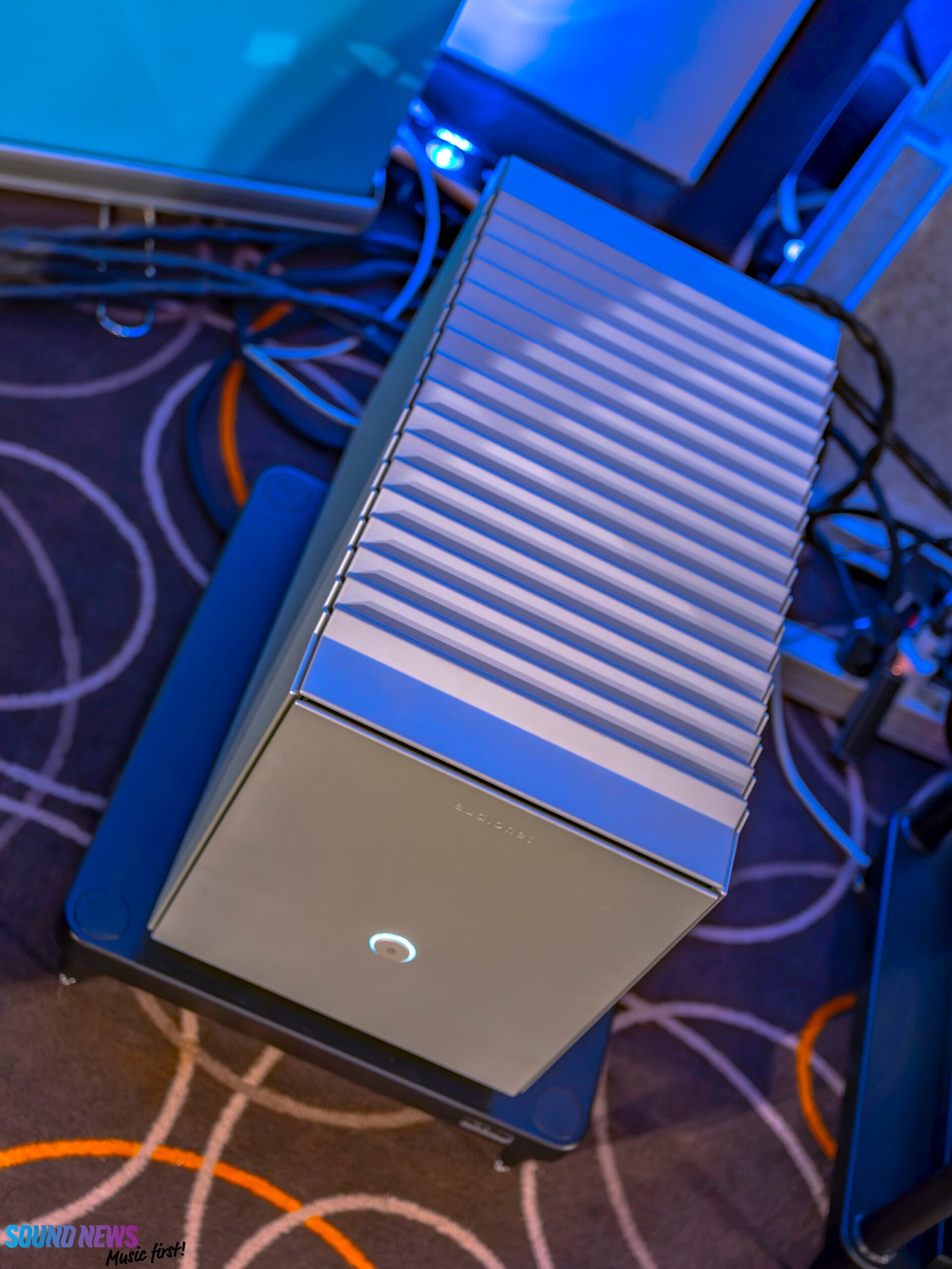
Dr. Ing. Stefan Schwehr is an electrical and microelectronics engineer who spent a significant part of his career at Daimler before taking over Audionet in 2019 (following the insolvency of the previous operating company). He is both the manager and head of development and talks about transistors, propagation times, and transformer magnetization in the same way that other CEOs would talk about market share. Under his ownership, the company has become much leaner, has started to machine its own casework, and has extended the Scientist Series with the Mach preamp and the Schrödinger monoblocks, which is a more accessible route into the top end.
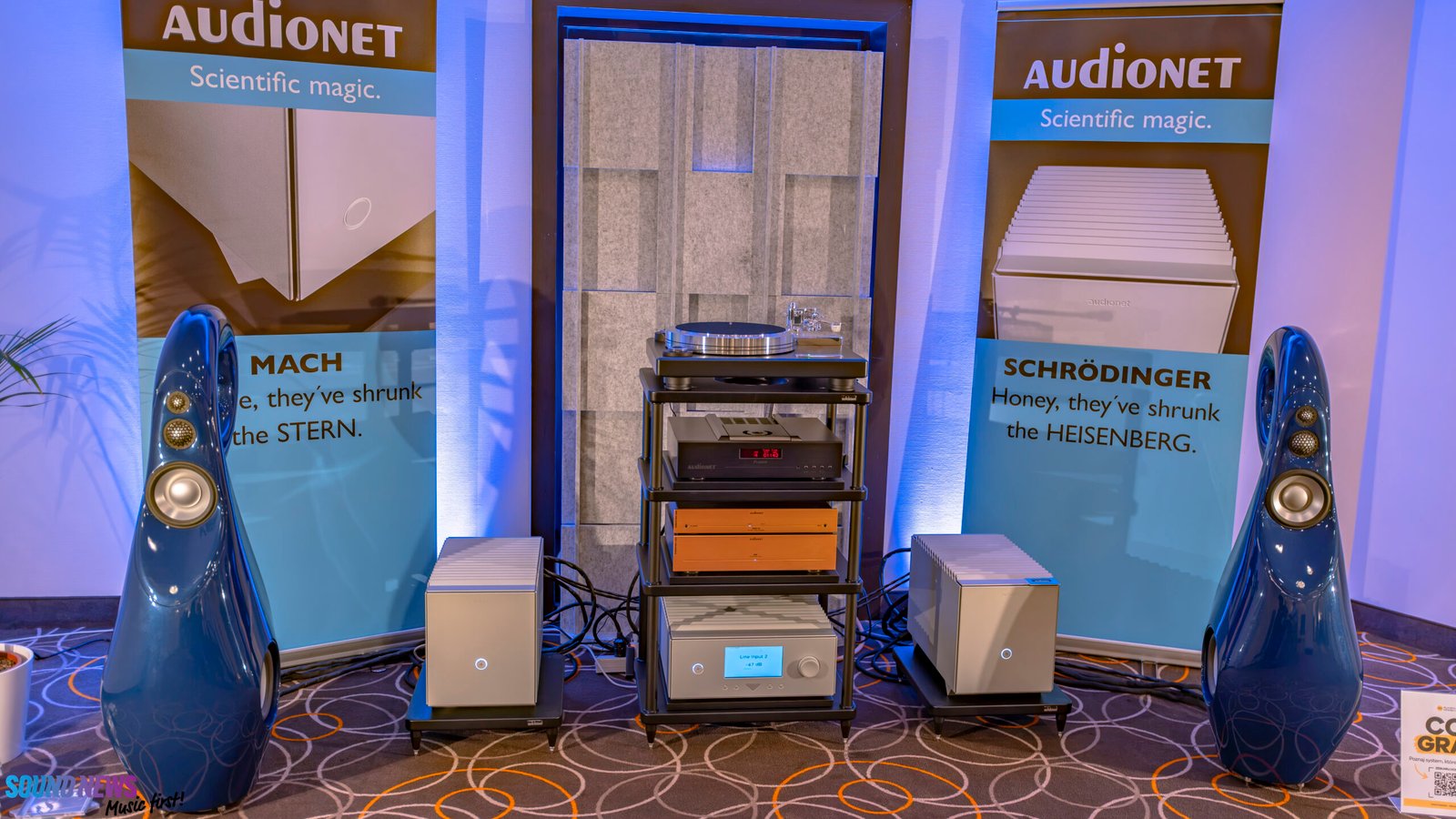
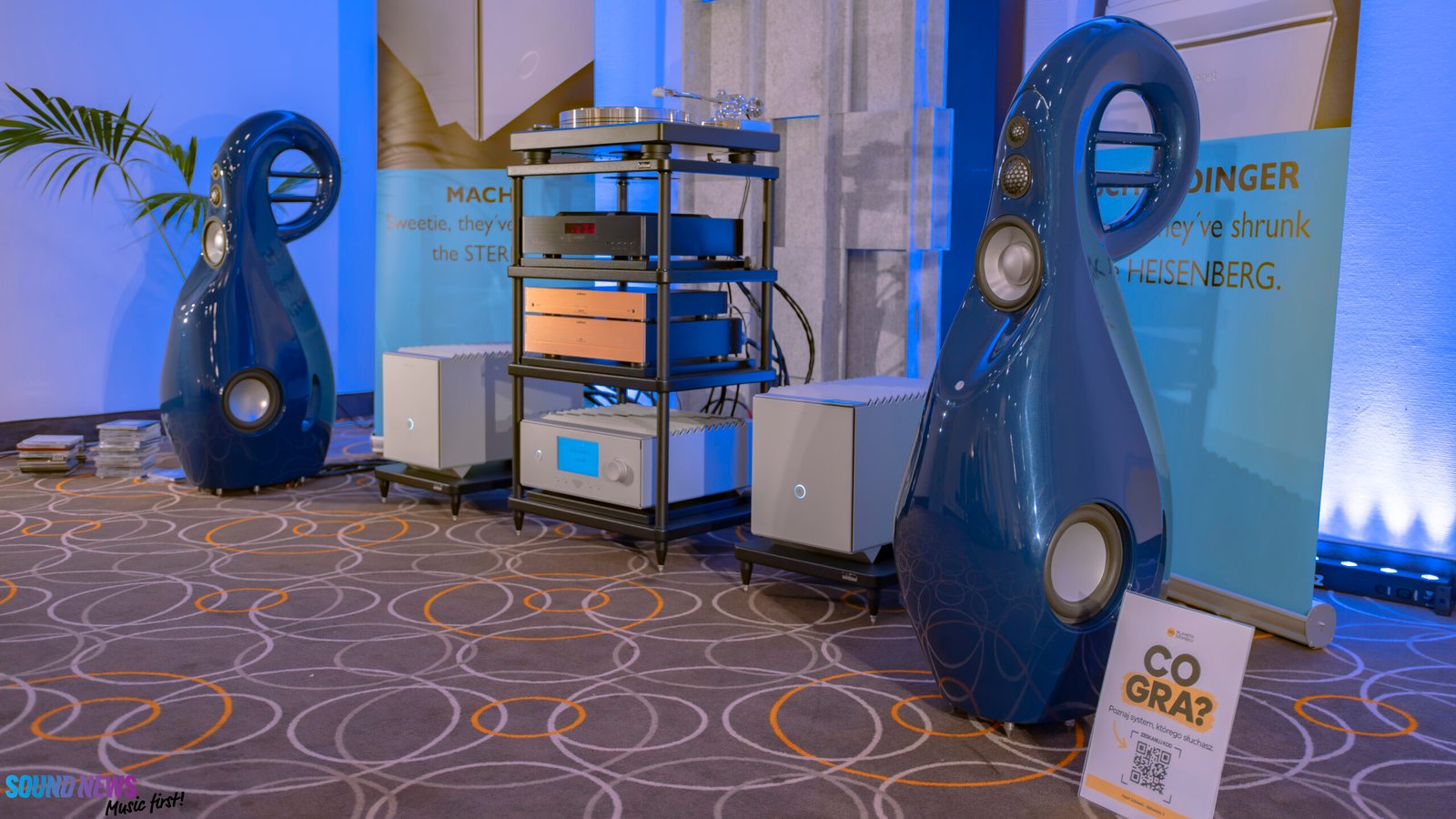
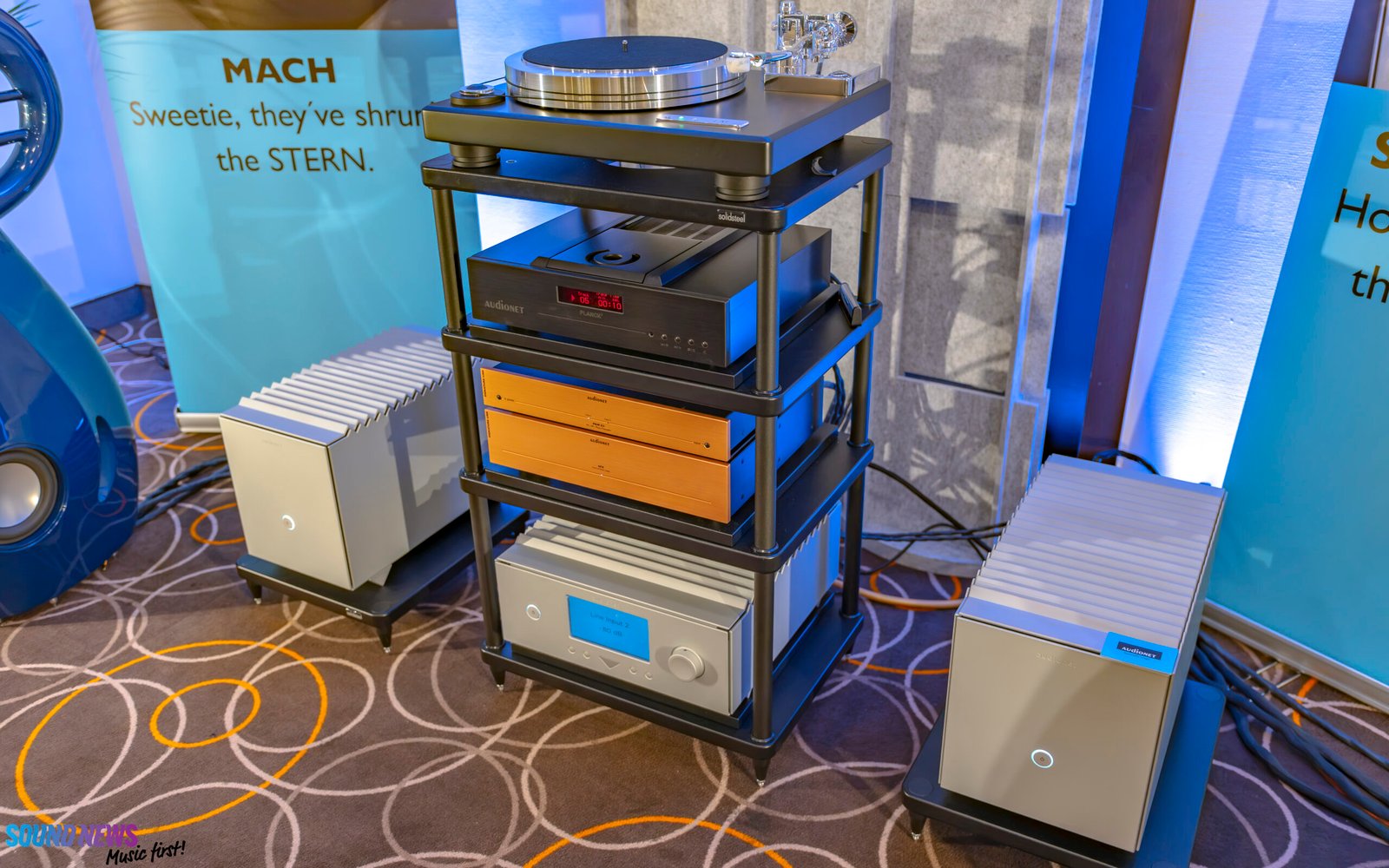
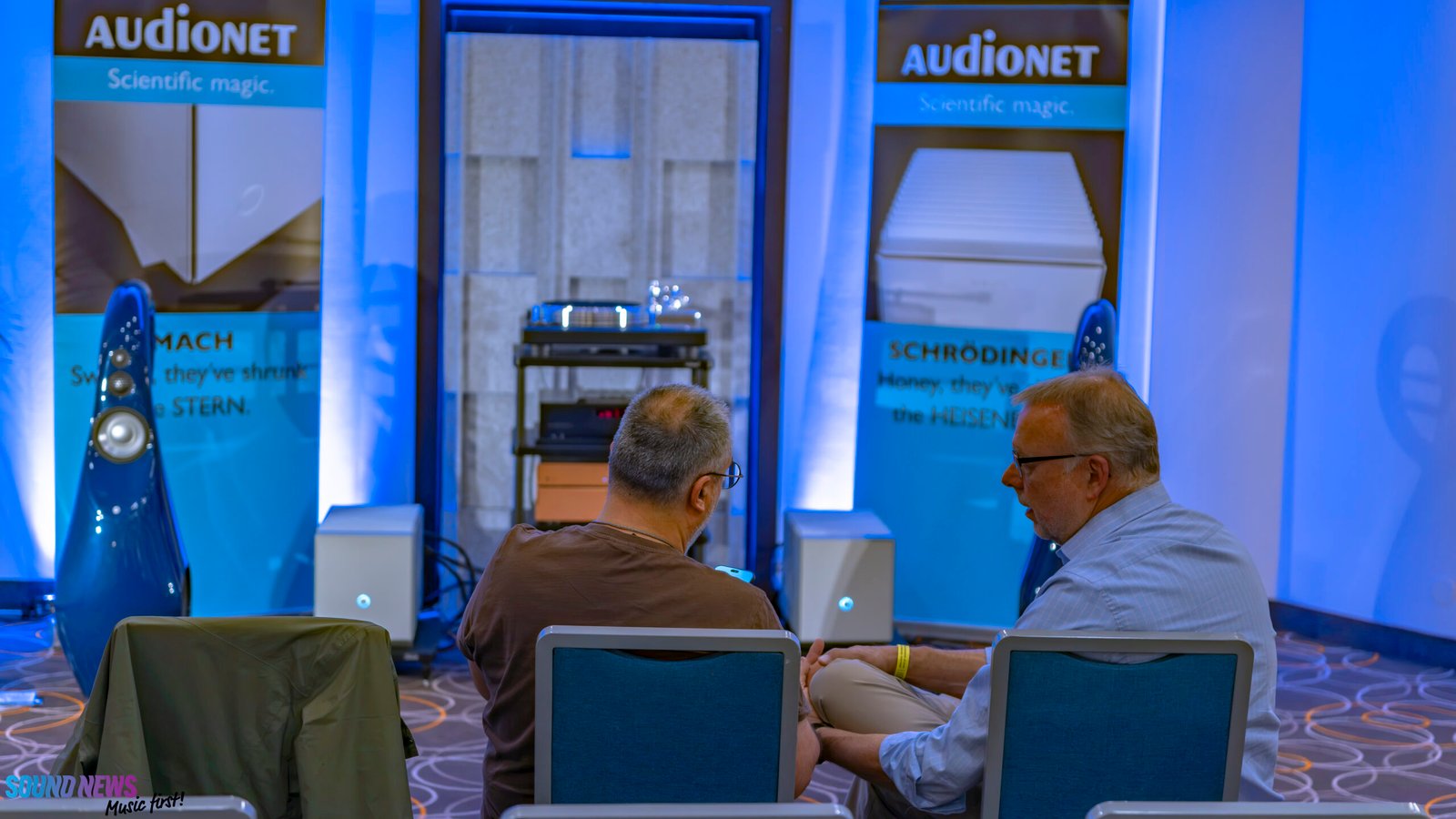
Our last conversation had been in Munich. This time we met at the Audio Video Show 2026 in Warsaw (in the Audionet room), where a Mach and a pair of Schrödingers were playing with a fairly substantial novelty in there. More on that later. I came with a list of questions, and Dr. Stefan answered every one of them, going far deeper than I had anticipated. His answers were just edited for the flow of spoken language and were all approved by him.
Before we get into the interview, I just want to say a big thank you to Dr. Stefan Schwehr for his time, his patience with a very technical discussion, and his willingness to go into the company’s recent history as well.
The Interview
1 · Born in a university laboratory
Soundnews: Let’s go back to the origins, really. I have to be upfront with you: even after looking at the AMPs, I didn’t know much about where Audionet actually came from. The products are obviously very technically accomplished, and you can see that there’s a great deal of very sophisticated technology in there. I discovered that Audionet actually started out in a university setting, building amplifiers for very, very weak sensor signals. How much of that DNA, that very much ingrained obsession with noise and resolution, do you think still underpins the company today, having moved from precision medical electronics into audio electronics?
Stefan Schwehr: Do you really want me talking about this for half an hour (laughing)?
Soundnews: Not half an hour, let’s try.
Stefan Schwehr: Right, let’s go to Bochum, over 30 years ago. The company was set up in 1994 as a spin-off of the University of Bochum, and the people who set it up were very much from the medical electronics background: high precision, very low noise, very small signals.
As an electrical engineer, I can look at the schematics we have and get a pretty good idea of what they must have had at the time. It’s the sort of electronics that was being worked on in the 1990s. When I was at uni in the 1990s, we did a lot of work on op-amps, and those op-amps are still here in our gear. They’re still very accurate.
And that’s one of the secrets, one of the keys to this electronics, actually: we build it discreetly. A lot of other companies use fully integrated op amps.
Soundnews: Chips.
Stefan Schwehr: Yes, simple analog chips. As a microelectronics engineer, I can tell you what the tolerances are from chip to chip, and you can’t get (completely) around them. If you do it discretely, though (which is the way we do it), you go down to a small board and build your op-amp from discrete transistors. You can then make it vastly more accurate, and one op-amp is pretty much identical to the next with virtually no tolerances between them. That’s one of the key success factors in our electronics.
Soundnews: And it’s very technical-looking.
Stefan Schwehr: It’s very technical, and it is, because our mantra is ‘scientific magic’. It sounds like magic, but it’s all scientific (scientifically based, scientifically proven, measured, etc.). It’s been that way for over 30 years.
2 · A lean company and a CNC machine
Soundnews: As I found out, you’re from Daimler, and in 2019 you took over Audionet. What did you see in the company that led you to take it on, and what did you feel needed fixing?
Stefan Schwehr: In 2018, the prior company was insolvent, and I took over after that. As for the number of staff, the company was simply too big, and therefore the fixed costs were too high. It was never a question of the product at all. The amps were excellent. The product was always excellent. The transition from the Classic range to the Ultimate range probably took too long; that was the one thing.
So I restructured the company and made it very lean in terms of headcount. I’m an engineer, so I can serve as both the manager and the head of development. I can also help the team do new things, which we’ve recently done. We now have, for instance, a CNC machine. We’re an electronics company, but I thought we’d buy a CNC machine to make the panels, the housings, and the casework ourselves.
Soundnews: That’s very clever, really, in that it reduces your reliance on suppliers in China and all over the world. It’s a real shame that today in Europe you can’t actually find the precision that Germany was always renowned for at a competitive price.
Stefan Schwehr: The precision is absolutely there. The companies that do this sort of work have many aerospace customers and know how to deliver it to a very high degree of precision. Their aerospace customers have the cash to pay for that precision. Ours is a very expensive product, I’ll admit. The casework from the suppliers was by far the most expensive, compared with China, which, of course, took over that business. That was the reason I decided to do it in-house.
Soundnews: I really do appreciate that. A lot of companies across Europe should be doing the same in order to get back on track and become competitive again.
Stefan Schwehr: It cuts my lead time, and it cuts my costs. I can now build one piece at a time. I don’t have to go to my supplier and place an order for five or ten pieces, which is not easy to finance in advance. If I need one, I make one.
3 · The amplifier that sounds like nothing
Soundnews: The very first time we spoke, you told me that the perfect amp sounds like nothing. That stayed with me, and it ended up at the heart of my AMP review. Many brands chase measurements and end up with something sterile. I’ve seen that myself with some Chinese manufacturers. They’re all over the place with their claims about their clocks and precision, and the end result is that it doesn’t actually sound like music. Yours does. How?
Stefan Schwehr: It’s just reproducing what’s on the CD. That’s the object of it, really: to reproduce almost 100% of the original, exactly what the producer heard in his studio.
Soundnews: But many do this and end up with something very dry…
Stefan Schwehr: We can do it because of the knowledge. The knowledge of every component, every transistor, how the transistor works, and how the signal propagates through the whole system.
The amp has to be absolutely, utterly fast. Our amps use negative feedback just like an op-amp does (you feed the output signal back to the input to correct for offset and to correct for noise as well). That only works perfectly if the transit time through the amp is effectively zero. You also have to know the propagation time through the electronics. Otherwise, it’s not perfect, and you can hear it.
That’s why people generally say negative feedback isn’t so pleasant in terms of music reproduction; you quite literally hear it.
Soundnews: It kills the music.
Stefan Schwehr: That’s the point. Yes, it kills the music.
Soundnews: And yours sounds particularly good.
4 · Physicists on the front panel
Soundnews: You’ve got some really interesting product names. As a geek, I quite like them: Mach, Heisenberg, Schrödinger. For a power amp that, in theory, is supposed to sound like nothing at all, Schrödinger is probably the most appropriate. It’s a bit of a pain to say if you’re not German.
Stefan Schwehr: I know.
Soundnews: It’s absolutely brilliant. Anyone with any knowledge of modern physics, any knowledge of quantum physics, really, is going to be struck by the fact that those are such well-known names.
Stefan Schwehr: The idea of ‘scientific magic’ was to put more emphasis on the scientific aspect. That’s why we name our devices after the most famous scientists.
5 · Why 2.2 MHz?
Soundnews: Audionet electronics are typically flat from DC right through into the hundreds of kHz, and the Mach goes all the way up to 2.2 MHz bandwidth. You’re not the only high-tech brand going well beyond the audio band, are you? Why do you need so much bandwidth, so many times beyond the limit of human hearing?
Stefan Schwehr: Now I need to be a bit scientific.
Soundnews: Please.
Stefan Schwehr: It’s a pleasure. As we all know, we only hear music up to 20 kHz. If you’ve got an amp that only goes up to 20 kHz, it looks like that’s quite sufficient at first glance. You just mustn’t forget about the phase shift.
If you look at a graph of the bandwidth (level vs. frequency), it’s flat right up to 20 kHz, and then it drops. You also have to consider the system’s phase shift. At the −3 dB point, you typically have a 90-degree phase shift. (Every operational amplifier is an active, oscillatory second-order roll-off component, and our amplifiers are of such a nature.) That means a 20 kHz frequency is 90 degrees behind the lower frequencies. The sum of the frequencies at the output of the amp is therefore quite different from the sum at the input. If you shift the bandwidth out to much higher frequencies, you don’t actually see any phase shift at all, as the 90-degree point is well outside the audio range. In that case, it’s at 2.2 MHz.
If you want to make a perfect amplifier, you need that wide bandwidth. That’s the small-signal bandwidth; that’s the technical term. A wide bandwidth in that sense also implies high speed for large transitions. If you have a very fast transition from low to high level (a drum, a plucked guitar string, etc.), then those amplifiers can follow it completely. An amplifier that only gets to 20 kHz cannot follow a fast guitar strum or a drum due to its impulse response.
6 · A little brother for the Scientist Series
Soundnews: When did you decide the Scientist Series needed a little brother? I’m absolutely thrilled you did, as the top of the range is a statement in itself, but a lot of people can’t afford that and need something in a smaller package.
Stefan Schwehr: That’s what we did. It’s still in the five figures, not the six. Our biggest system (Heisenberg with Stern) is at around 132k, and this one (Mach with the Schrödingers) is only at around 85k. Still high numbers, of course, but to a degree it is a reasonable price when you consider the loudspeakers it will be used with.
Soundnews: So when you were scaling down a statement product, what were the non-negotiables, the things you absolutely wouldn’t touch in order for the smaller system to still be recognizable as a Scientist Series machine?
Stefan Schwehr: In the Schrödinger, we’ve kept the same concept as in our highest model, i.e., two transformers, one for each half-wave. The benefit is that you have no transition losses. With a single transformer, you always have to go through the zero point between the positive and the negative half-wave, which means you have to switch the magnetization of the transformer. With each transformer handling just one half-wave, you have no losses due to the magnetization switching. That’s one of the key things we’ve carried over from the Heisenberg.
And we’ve retained what we’ve always had in pretty much all of our amplifiers: the discrete op amps (built from transistors) with high precision. That’s the case here in the Mach as well as in the Stern.

7 · Where the Stern still leads
Soundnews: Where would you say the Stern still does better than the Mach?
Stefan Schwehr: Undoubtedly the Stern, down to its size. There are still more caps in the power supply, which always helps with transients and transparency. The analog stages are quite another thing altogether in comparison to the Mach.
8 · A volume control without a potentiometer
Soundnews: The volume control is electronic; it’s based on a precision resistor network. What does that actually mean in practice?
Stefan Schwehr: In practice, the volume knob just steps in increments. Those steps are read by the microprocessor, and the same thing occurs when you use the remote. The microprocessor reads the volume you want and puts a binary word on the bus (256 steps from 00 to FF in hex). That word is then passed down a chain of transistor switches, which in turn switch the resistors.
Soundnews: A resistor ladder.
Stefan Schwehr: Yes, that’s what it does. For an electronics-type person, it would be far easier to explain with a schematic, so let me try to explain it another way. The odd thing is that for different volume levels, you don’t get different voltage drops across the whole chain. The chain swings between the supply voltage and zero and always gives the same exact voltage for each volume setting.
9 · Smaller, yet quieter
Soundnews: On paper, at least, the Schrödinger is better than its bigger brother, the Heisenberg, in signal-to-noise (128 dB vs 125 dB). We know 3 dB at that level isn’t a huge difference, so how did you manage to do better in a smaller package?
Stefan Schwehr: We’re looking at a very high level of electronics, an extremely low noise floor, at the very limit of what you can detect. The amplification module in the Schrödinger is a bit different from that in the Heisenberg. In the end, I’d say they’re pretty much the same, despite the documentation suggesting otherwise.
10 · No ferromagnetic materials
Soundnews: You avoid all ferromagnetic materials throughout the circuit and chassis. What difference does that actually make to the sound?
Stefan Schwehr: Ferromagnetic materials are going to be susceptible to radiation in any case, and there is EM radiation all over the place. Ferromagnetic materials are going to behave far more like an antenna than something like aluminum would, and that radiation is going to get into the signal path. That’s why you want to use non-ferromagnetic materials.
11 · Floating panels
Soundnews: What about the Floating Panel design (your patent)? What problem does it actually solve, and why is it so important?
Stefan Schwehr: It’s about the housings, the metal housings. There’s the thing that if you have a completely compact housing, a single big rigid metal block, it can transmit the micro-vibrations from one component to another, from one part of the cage to the other. The vibrations from outside the system, the vibrations from the EM world, the vibrations from the sound itself, can be fed into the whole package. If you build it so that the panels are all mounted on an inner skeleton and don’t actually touch each other, then that helps to mitigate that.
12 · Light instead of copper
Soundnews: Why do you use the optical Audionet Link to connect your gear rather than the 12 V triggers that everybody else uses?
Stefan Schwehr: It makes perfect sense, really, as you don’t want to introduce any electrical connection between the units, you know, one that could introduce a very small amount of noise. You don’t want any metal-to-metal connection between the units, really. The optical link is the only thing that decouples them.
13 · Ten centimeters of special metal
Soundnews: In the end, what do you listen for? On paper, it’s all perfect; in the measurements and the technology, you know precisely what you’ve got to do to get the best (lowest noise floor, etc.). Are you still doing listening tests?
Stefan Schwehr: We do. And here I think we need to stress what we did for the three machines in our system at this show. We introduced new wiring from the PCBs (the boards) to the output terminals (the loudspeaker binding posts). Those ten centimeters are no longer silver or copper. They’re a special metal that we’ve actually worked on in close cooperation with the young cables and wiring company Voodoo Labs in Hamburg from a quantum physics point of view.
Soundnews: Wow.
Stefan Schwehr: Yes, Voodoo Labs did the majority of the research on a very deep atomic level of the metal lattice, in terms of how the various materials behave in their ability to deliver electrons to the conductor. If you look at it on that level rather than the ohmic level, you get quite different results, and they tell you which material is the best. Audionet, in turn, provided the practical proof of all the new outcomes.
Soundnews: So it’s a special material?
Stefan Schwehr: A special metal. A special metal connection, only from the board to the output. And we are currently carrying out further tests in order to find the best metal. So Warsaw was the official starting point.
Soundnews: And when you listened to it, it proved itself?
Stefan Schwehr: It was definitely better than it had been before.
14 · From AMP to MAX to Schrödinger
Soundnews: Would you say an AMP owner like me should go up to the MAX or go straight to the Schrödinger? I have to be honest. When I put the AMPs on my Wilsons, the effect was immediate. I was blown away by the noise floor, dynamics, and cleanliness. They really brought out what the speakers could do. Wilsons are very demanding, though, so I’m now thinking about more power.
Stefan Schwehr: Honestly, the AMP is already very good; the MAX has even more (more bass power, more transparency), and going from the MAX to the Schrödinger, you get even more bass control. The Mach gives you spaciousness, and with the female voices in the midrange, you’ll hear a massive difference.
I did that exact comparison with a customer in Germany last year. He went from the MAX to the Schrödingers, and we went through it step by step. The first comparison was the MAXs against the Schrödingers, and that was already different, with even more precise bass control. Then we replaced his PRE G2 with the Mach, and we had even more spaciousness and, in the mids, still a touch more clarity in the voices, especially the female voices.
And now, with the new internal wiring, the whole thing is even better. I was quite impressed and surprised when I heard it three days ago. You get even more out of the sound picture. If you like, the scene is really a sound picture in the sense that it’s something you receive and have to listen to.
15 · An entry point, and what comes next
Soundnews: Now for the younger audience who are after integration… could we see a Scientist-level integrated amp with streaming, based on the Mach and the Schrödinger?
Stefan Schwehr: Maybe people don’t know enough about this. We have integrated amplifiers in the Classic line, where your AMPs also come from, such as the SAM 20 SE. The SAM 20 SE with streaming on board is our DNA. We have had this DNA for 15 years. From a schematic and circuit standpoint, these amplifiers inherit everything from the rest of the Audionet range. They don’t have a dual-mono power supply design because of the small box. Those are the limitations, of course. But it is a very good entry point for someone who wants to start and keep it simple. And in the future, we will have more to offer here.
Soundnews: Did you give more thought to the streaming side we talked about in Munich?
Stefan Schwehr: We are working on that.
Soundnews: I am glad that you do!
16 · Switch everything else off
Soundnews: My last question is not really a question. It’s about simply listening to the product.
Stefan Schwehr: Then we should switch everything else off here, and listen.
Soundnews: Is there anything you would like to add?
Stefan Schwehr: No, I think it was a nice interview in the end. Many good questions.
Soundnews: I hope so. Thank you very much!
Closing
At some point in our conversation, I realized that “scientific magic” is less a slogan than a working method. Stefan doesn’t separate the two halves of the phrase. The magic is simply what science sounds like when nothing is left to chance: not the tolerance of a single transistor, not the phase of a 20 kHz tone, not even ten centimeters of metal between a circuit board and a binding post. And when my last question turned out not to be a question at all but an invitation to listen, his answer was the most Audionet answer I could have imagined: switch everything else off and listen. The perfect amplifier, after all, should sound like nothing. What remains is the music.
Interview recorded at Audio Video Show 2026, Warsaw, Poland.
Audionet: en.audionet.de