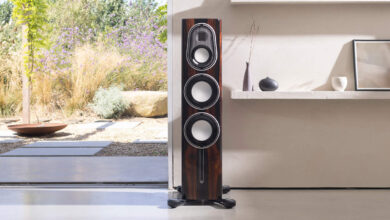
Listening room: the small living room, 4 m by 5.3 m with a 2.7 m ceiling and modest treatment • Placement: 1m to the front wall and to the side walls, listening distance: 4m, firing straight ahead, no toe in, spikes on the supplied spike seats
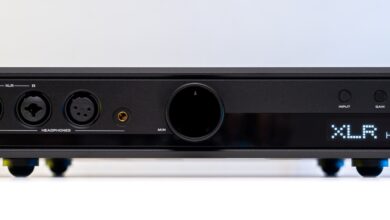
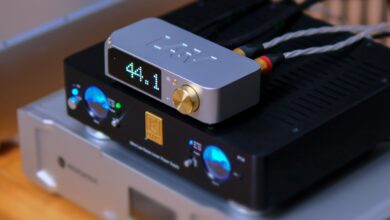
Source: Hegel H200 network streaming, TIDAL Connect and Qobuz Connect; MOON 491 for the Burson Timekeepers • Amplification: Hegel H200 integrated amplifier; Burson Timekeeper Voyager Max monoblocks • Cabling: Roboli HP8000 speaker cables (single wired combined with the supplied bi-wire links), Roboli XLR 2100 interconnects, Roboli Power5200 power cable
Loaned by: AVstore
TLDR
We recommend the Elysian 4R to the listener who seeks a gentle, fatigue-free sound, with a gorgeous top end, in a small to medium room. These speakers are made for long, relaxed listening sessions. For bass lovers, detail hunters and fans of rock and electronic music, other floorstanders at this price are a better match.
Three qualities define the Wharfedale Elysian 4R:
- A sparkly, transparent and fast treble. The Air Motion Transformer tweeter is our favourite part of these speakers. Cymbals, hi-hats, strings and the air around voices had a lot of sparkle and very good transparency, with fast, crisp transients. The S sounds were clean and smooth on every recording we played, our sibilance tests included.
- Listening pleasure. The tonal balance is neutral, and the presentation is mellow, smooth, and relaxed. Long sessions were fatigue-free, and poor recordings were easy enough to enjoy. Low volume listening was good too. Music on the Elysian 4R is very pleasant to listen to.
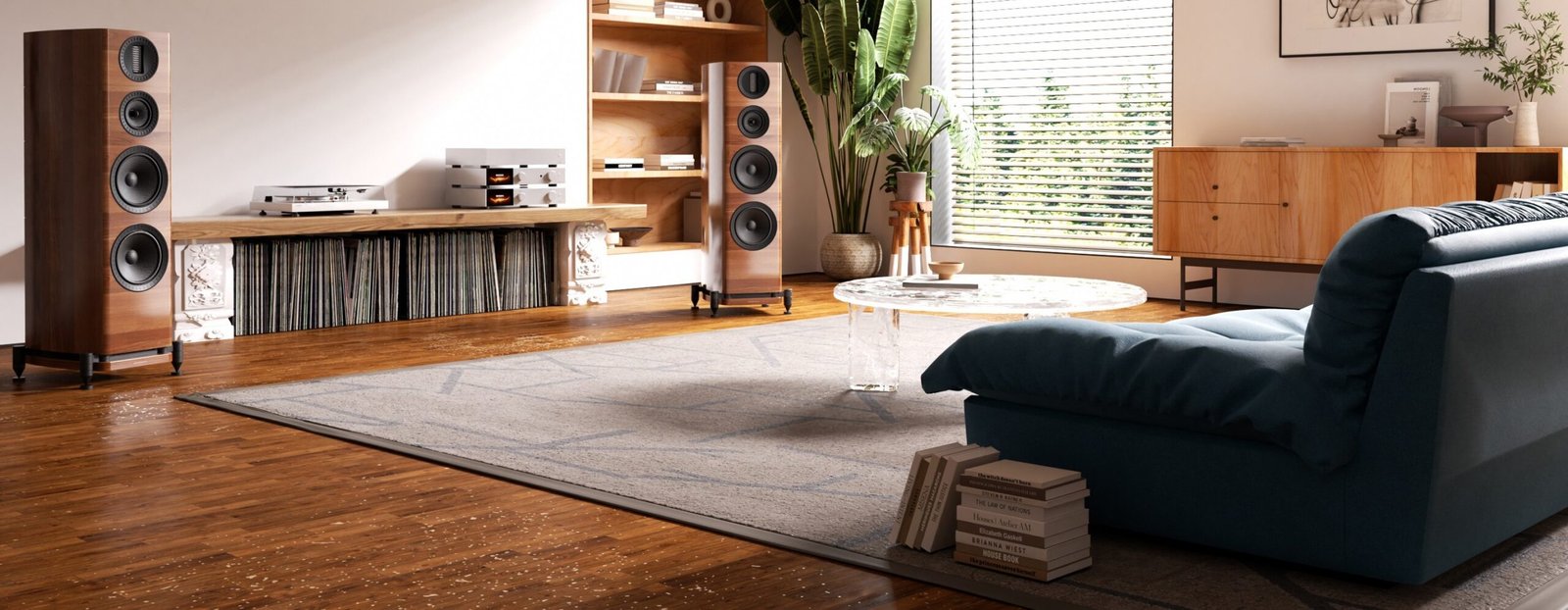
- A beautiful design. Our pair, in Walnut High Gloss, looks like a fine piece of furniture in a living room. The WAF factor is over 9000 with this one!
The main limitation is the bass. For a floorstander with two 220 mm woofers per speaker, weight, power, and impact are rather modest, with a slightly soft and relaxed character. In our small living room, audible bass stopped at around 33 Hz. In our bigger room, there was even less of it, so these speakers are also quite sensitive to room placement. Microdetail in the midrange and bass is a step behind more resolving designs. The midrange itself is neutral, without drawing much attention to itself.
The AMT tweeter, however, operates at a noticeably higher level than the drivers handling the midrange and bass, offering greater resolution, speed, and refinement. There is a sense that the tweeter is a couple of steps ahead of the rest of the speaker, and we would have liked to hear the same level of performance from the other drivers.
Played loud, well above normal listening levels, the bass and midrange lost some coherence and articulation. Pay attention to the size of your room.
Introduction
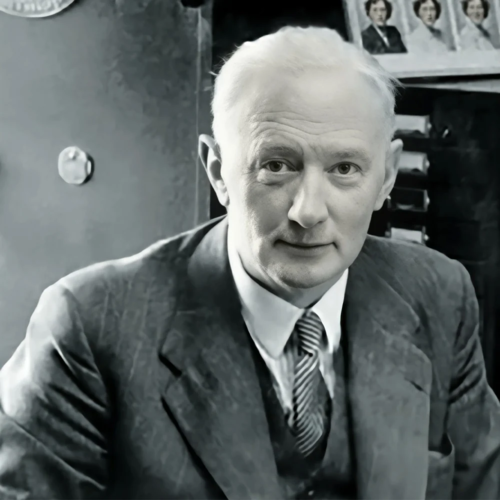
Wharfedale started in 1932, in Ilkley, Yorkshire. Gilbert Briggs, a music enthusiast and amateur engineer, built his first loudspeaker in the cellar of his home there. Ilkley is in the valley of the River Wharfe, an area known as Wharfedale, which is where the name of the brand comes from.
A year later, Briggs moved into a small factory near Bradford to make drive units. His wife, Doris, assembled the first components by hand. That same year, he took both first and second place in the Bradford Radio Society’s competition, which led to Wharfedale’s first large order. In 1945, Wharfedale built one of the first two-way loudspeakers, with a dedicated tweeter, a mid/bass driver and a crossover between them. In 1948, Briggs published his first book, Loudspeakers: The Why and How of Good Reproduction.
Then, in the 1950s, Wharfedale and QUAD organised a series of live versus recorded concerts. Musicians played live, then the recording of the same performance was played back through QUAD amplifiers and Wharfedale loudspeakers, with everything hidden behind a curtain. What a brilliant idea!
In late 1997, Wharfedale became part of IAG, the International Audio Group. Today, the group is also home to QUAD, Leak, Mission, Audiolab and Luxman. Wharfedale’s research and development is in Huntingdon, Cambridgeshire, where Peter Comeau is Director of Acoustic Design.
The Elysian series launched in 2019 as Wharfedale’s flagship range, built around Air Motion Transformer tweeters. The R generation is a refinement of that original series. It has five models: the Elysian 1R, a two-way standmount; the Elysian 2R, a three-way standmount; the Elysian 3R and the Elysian 4R, both three-way floorstanders; and the Elysian CR, a centre channel. The Elysian 4R we have here is the larger of the two floorstanders.
We have heard Wharfedale loudspeakers at audio shows and owned several of their designs over the years. This time, we had the Elysian 4R at home, in our own rooms, with our electronics and the music we know.
Keep in mind that every listener hears music in a different way, with different ears, rooms, and expectations. Our impressions are from two rooms, one main amplifier, and our own playlist. So trust your own ears, in your own room, above any review.
Design, Build and Technology
Each Elysian 4R is 1,188 mm tall on its plinth, 402 mm wide and 462 mm deep with the terminals, and weighs 49.5 kg. With this weight, unpacking and positioning are a job for two people. Wharfedale also recommends assistance for lifting and moving them.
Our pair was finished in Walnut High Gloss, which Wharfedale describes as a handcrafted walnut veneer under a piano gloss, polished to six levels of depth. The other two finishes are Matte Black and Lunar Grey. The cabinet is a tall, elegant column on a plinth. Up close, the finish is very beautiful.
We care a lot about looks at home, since a pair of floorstanders this size is part of the room every day, music or no music. It’s our feeling that a lot of buyers at this price choose with their eyes as much as with their ears. These speakers are easy to love on sight.
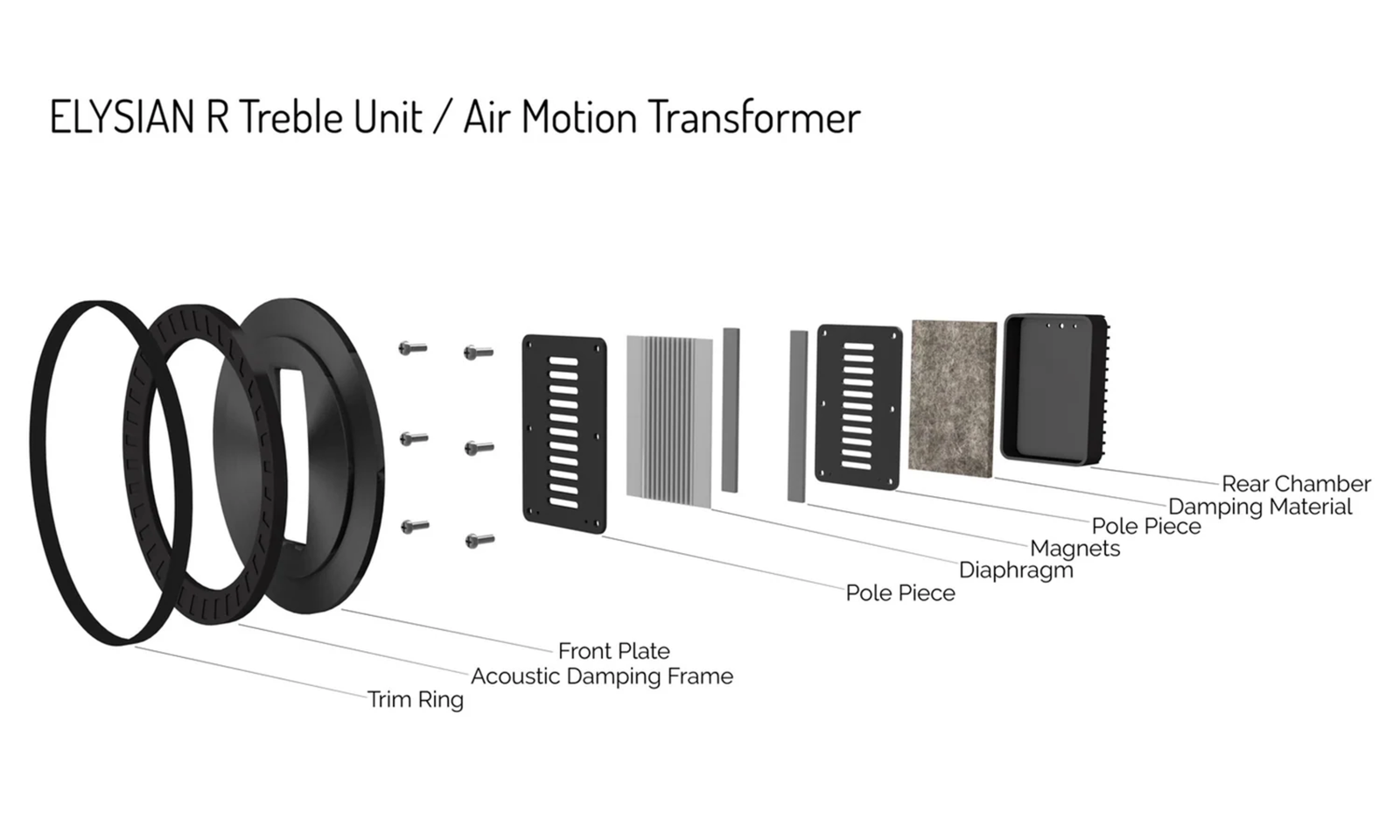
Air Motion Transformer. The tweeter is a 27 x 90 mm AMT, with a pleated diaphragm made of PET, an ultra lightweight material. Rows of metal strips in a strong magnetic field drive the diaphragm across its surface. As the pleats open and close with the signal, they squeeze the air between them. An acoustically damped rear chamber behind the diaphragm absorbs the back wave. Wharfedale says this AMT is larger and of a higher specification than the one in the EVO 5 series.
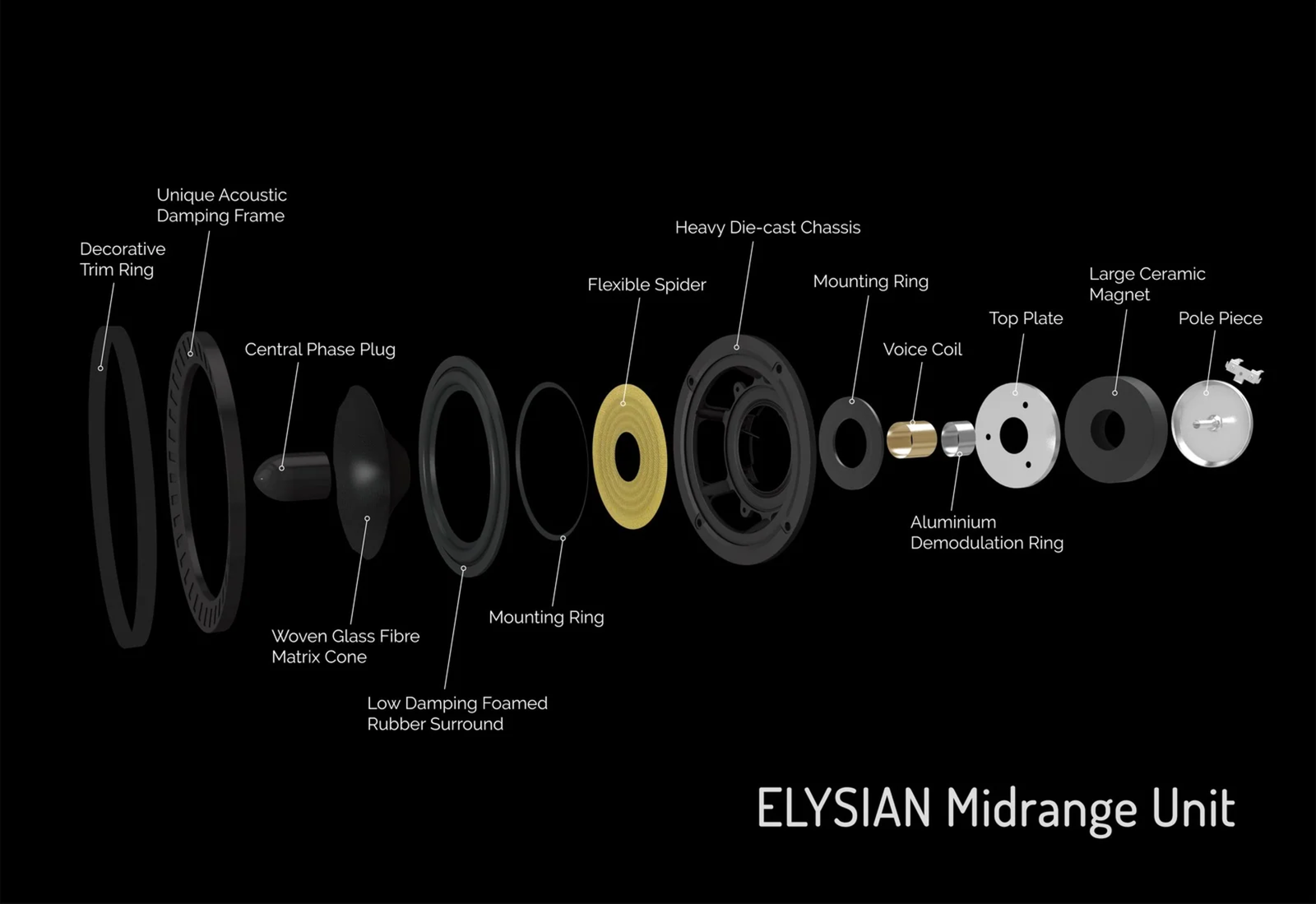
Midrange. The 150 mm midrange cone is a woven glass fibre matrix, with a high plasticity coating to control its acoustic behaviour, on a foamed, rubber like surround. Its 25 mm, two layer voice coil is mounted in a magnetic gap fitted with an aluminium ring, one that controls eddy currents. The die cast aluminium basket has large ventilation windows below the spider. According to Wharfedale, the central phase plug linearises the output over a wide bandwidth, off axis too.
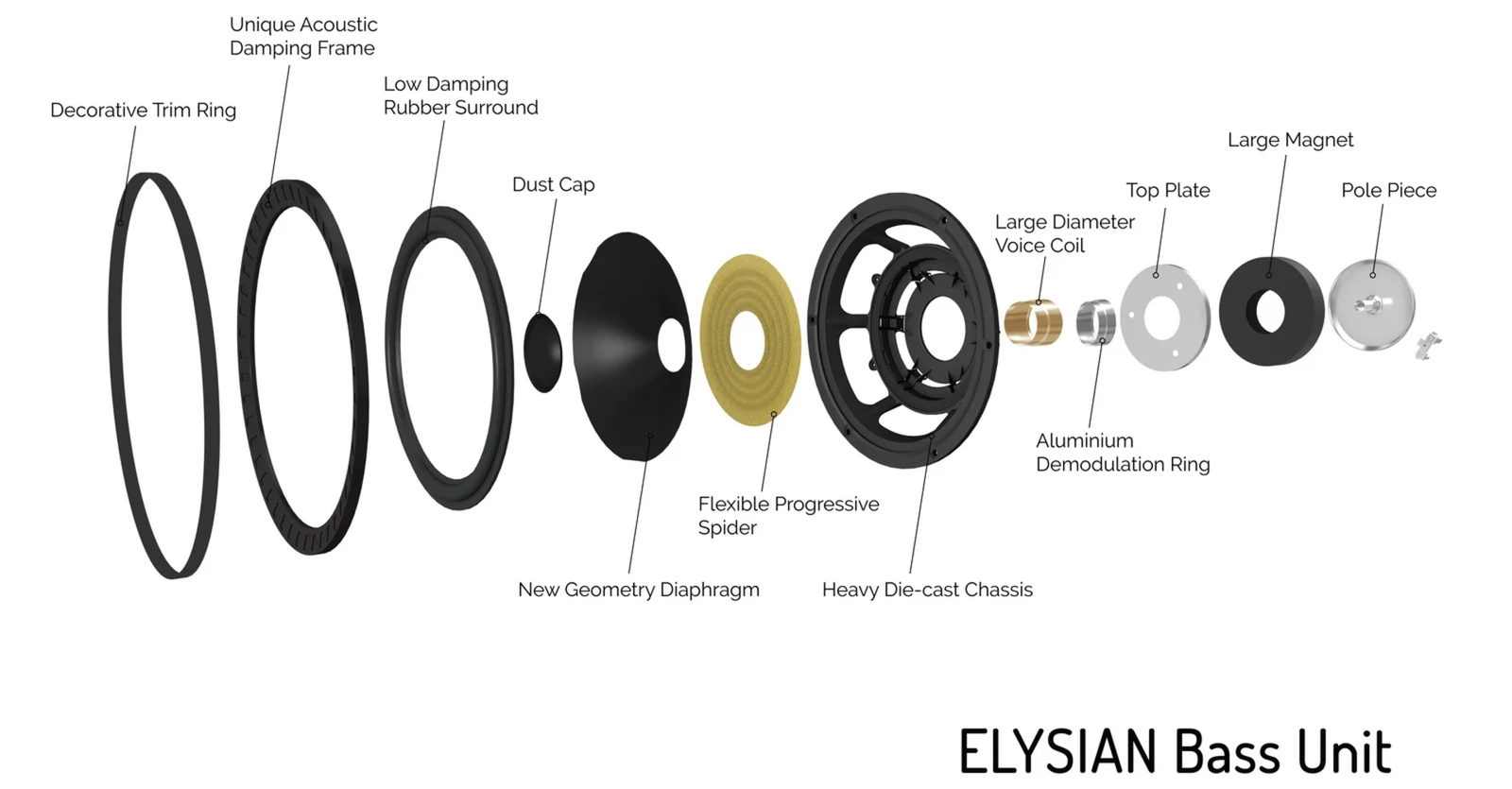
Bass units. Each speaker has two 220 mm woofers in the same glass fibre matrix, on a flexible rubber surround. The voice coil is 38 mm in diameter and 17.5 mm long, with 12 mm of linear excursion, in a magnet system with its own aluminium ring. The chassis is die-cast aluminium.
SLPP. All Elysian models have the woofers loaded by what Wharfedale calls the Slot Loaded Profiled Port. The port vents air into a slot at the base of the cabinet, profiled to equalise the high pressure inside with the lower pressure in the room. Wharfedale says this lowers the distortion typical of a bass reflex system, increases the efficiency of the port and makes the speakers less fussy about placement.
PROS cabinet. Under the veneer is a sandwich of different woods, which Wharfedale calls PROS, the Panel Resonance Optimization System. It is designed to lower panel resonances and to limit the leakage of sound energy from inside the cabinet.
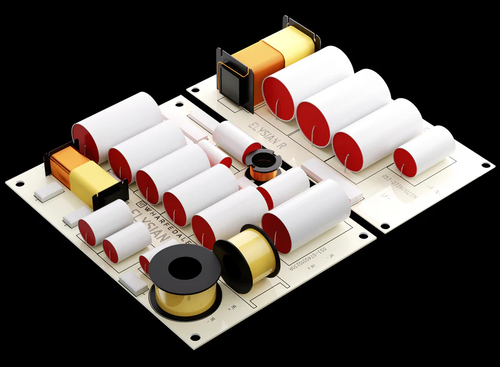
Crossover. The crossover points are 340 Hz and 3.1 kHz, with acoustic slopes matched to Linkwitz-Riley characteristics. The bass section uses silicon iron-cored coils with a low DC resistance, and the midrange and the tweeter use air core coils. The signal path has polypropylene capacitors throughout, on what Wharfedale calls a direct path PCB. Internal wiring is made of LC OFC copper strands in PET insulation. The newer revised crossover design also benefits from the use of bypass capacitors.
Sensitivity, impedance and power. Sensitivity is 92 dB at 2.83 V and 1 m. Nominal impedance is 4 ohms, with a 3.2 ohm minimum. Wharfedale recommends 15 to 250 W and specifies a peak SPL of 110 dB. The frequency response is 30 Hz to 22 kHz within ±3 dB, with the 6 dB down point at 24 Hz.
Terminals and accessories. The terminals accept bi-wiring, with link cables supplied for single wiring. The terminals are big, have an excellent finish, and are very nice to use. One of the best designs we’ve ever seen on any loudspeaker.
The accessories include spikes with locknuts, spike seats for wood or stone floors, and the grilles.
Setup, Room and Placement
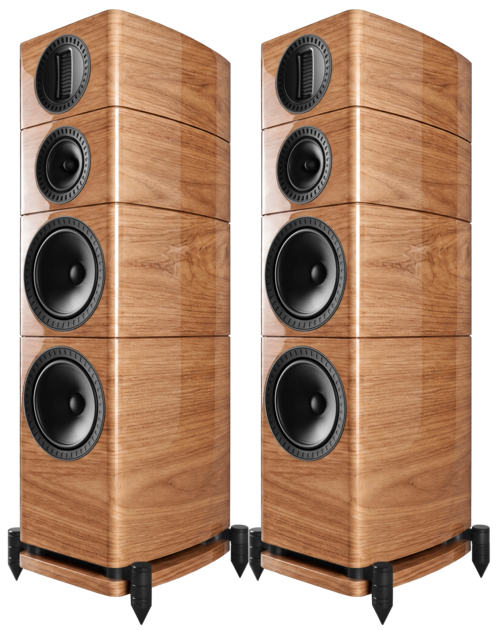
We used the Elysian 4R in our small living room, 4 m by 5.3 m with a 2.7 m ceiling and modest treatment. They fired straight ahead, with no toe-in, on their spikes and the supplied spike seats.
Break-in took more than 100 hours of playing time before the critical listening and the notes.
Wharfedale recommends removing the grilles for critical listening. We tried both. The difference was very small, so keep them on if you like the look.
The distance to the wall behind the speakers has a big effect on the low end. Closer to the wall, the bass gained weight, with some boom in the room, as Wharfedale’s manual says, so take your time to find a good balance between the two.
We also listened in our bigger room, 5 m by 6 m with a 4 m ceiling, treated, with both amplifiers. There, the bass was present but very modest. Moving the speakers closer to the walls helped only a little.
Overall, bass response depends a lot on the room with these speakers. In-room, the bass we hear is the result of the speakers and the room together. A smaller room adds more reinforcement to the lowest frequencies, which helps the Elysian 4R a lot, so measure your room before you fall for the looks!
System Matching
The Hegel H200 was our main amplifier, streaming TIDAL Connect and Qobuz Connect through its own network input. Roboli HP8000 speaker cables, single-wired complemented with the supplied bi-wire links, were connected to the Elysian 4R, with a Roboli Power5200 power cable for the H200.
On paper, the Elysian 4R is easy to drive to high levels. Into a 4-ohm load, the 2.83 V of the sensitivity figure means 2 W, so the sensitivity per watt is closer to 89 dB, a high figure regardless. With an impedance minimum this low, choose an amplifier with solid current delivery.
Hegel specifies a damping factor above 4000 for the H200. In our review of it, the bass on our Monitor Audio Platinum 300 3G was fast and tight. With the same amplifier, the bass of the Elysian 4R was soft and slow.
We also tried the Burson Timekeeper Voyager Max, a pair of Class AB monoblocks rated, Burson says, at 100 W into 8 ohms and 200 W into 4 ohms, each with a Fusion Core 32 V, 15 A power supply. The MOON 491 fed them, over Roboli XLR 2100 interconnects. The Burson has a more mellow, almost tube-like character. With it, the Elysian 4R had a warmer, fuller midrange, a sweeter, softer treble, and a more relaxed presentation overall. Very enjoyable!
The bass was very similar on both amplifiers, soft, slow, and modest in weight. This tells us that the bass character belongs to the Elysian 4R itself. These speakers also sound good on more mellow, tube-like amplification, a nice option for listeners who want an even gentler presentation. Taste decides in the end, of course.
Listening Sessions
Relaxed, neutral in tonal balance, sparkly and fast at the top, soft in the bass and very easy to listen to. That’s the Elysian 4R, in a few words.
All the tracks below were played with the Hegel H200 as the main amplifier. We value listening pleasure above analysis, especially in the evening. Some evenings, we simply want the music. The Elysian 4R is very good at exactly that.
Treble, Sparkle and Sibilance
The treble is the highlight of the Elysian 4R.
With the H200, the AMT was quick and clean on every transient. The top end is open and extended, with a lot of air throughout all the instruments.
A great treble is one of the hardest things to get right in a loudspeaker, so it is a quality we prize a lot. An edgy or sibilant tweeter ruins a long evening of music for us very quickly. On the Elysian 4R, this part of the sound is excellent.

Sophie Zelmani’s All I See Is You and My Soul Remembers are two of our sibilance tests, with her soft voice recorded very close to the microphone. Her S sounds were absolutely clean, small and discreet, a natural part of her voice. The breath around her words had that fine, delicate texture. The guitar strings also had a lovely, sparkly presentation. Her voice itself was neutral, but a bit plain in its texture.

Affection, by Cigarettes After Sex, is sung almost in a whisper, with a lot of reverb and guitars rich in high-frequency content. As we’ve spoken about, and been adamant about, on Sophie’s tracks, the consonants were clean here too, at every level we tried. Greg Gonzalez’s voice was airy and open. The guitars had a fast, crisp shimmer, smooth at the top.
Janine Jansen’s recording of Vivaldi’s The Four Seasons, with a small chamber ensemble, is one of our tests for strings in the upper registers. Her violin had a sweet tone, with a bright, silky sheen on the top notes. The rosin and the bow were easy to hear. In the fast passages of Summer, the violin was also quick and smooth. The cellos under her were a bit light in body. A top end we found was overall very pleasant over long sessions.

Jump is the Van Halen song, in Mike Dawes’s arrangement for solo acoustic guitar, full of slaps, tapping, and harmonics. The harmonics were bright and sparkling, with a quick, precise attack. The tapping was also crisp and detailed. The small differences in how hard each string was plucked were a bit less obvious than on faster, more detailed loudspeakers. The slaps on the body of the guitar also had a little less snap than we would have liked. Very enjoyable regardless!

Los Angeles, by The Midnight, is full of retro synths, drums, and saxophone. The hi-hats and the cymbals had a bright, crisp sparkle, and the synth textures at the top were shiny and pure. The saxophone was also really smooth and pleasant. The drums were gentle in punch, a bit lighter than this track should normally sound like.
Midrange, Voices and Coherence
The midrange is neutral, with a correct timbre on voices and instruments. Next to the treble, it represents the more relaxed, we could maybe say it is the quieter part of the sound characteristic, one which we rarely thought about during the sessions.
The handover between the midrange cone and the AMT, at 3.1 kHz, is seamless. Voices sounded almost like one source, from the chest to the air on top, which tells us a great deal of good information about the crossover work that was done for the Elysian 4R.
Microdetail in the midrange is sadly moderate, to say the least. The smallest inflections in a voice and the finest textures of an instrument are present, but slightly softer in focus. We would have liked and expected a bit more detail, speed and agility here.
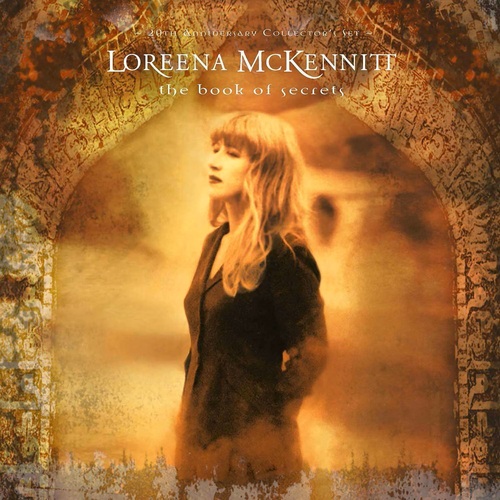
Loreena McKennitt’s Dante’s Prayer closes The Book of Secrets, her 1997 album. Her voice had a correct, neutral timbre, with plenty of air in the upper area of the frequency range. The piano and the choir behind her each had their own place, inside an acoustic space of fair size. The small inflections in her phrasing were present, a little less defined than on the more resolving loudspeakers we have heard. Calm and gentle, with a timbre that sounded right to us.
Diana Krall’s Temptation, the Tom Waits song on The Girl in the Other Room, is close-miked and intimate. Her lower register had good body. The brushes on the snare had a fine, airy sparkle. The texture of her voice, the slight rasp and the breath between phrases, was audible enough, although a little less vivid than on more transparent speakers. The Elysian 4R sounded natural, with an uncoloured timbre.

Chris Stapleton’s Death Row is a slow, heavy blues, with a deep bass line under a rough, powerful voice. His voice had good body and a correct timbre, from his low register up to the rasp at the top. The grit in his phrasing was there, but smoothed over a bit. The bass line was rounded, a bit light for a song this heavy. Overall, the character was smooth and agreeable, even with a voice this rough.
On Aberdeen, Avi Kaplan, the former bass voice of Pentatonix, has a lot of chest in his low notes. The step from his lowest register to the higher notes was seamless. His deepest notes had less chest weight than the recording, with a slightly soft outline. Tonally, he sounded like himself. The lowest bass notes were totally lacking here, missing a great part of how this track should sound. The bass in this track also lacked physical presence and engagement.
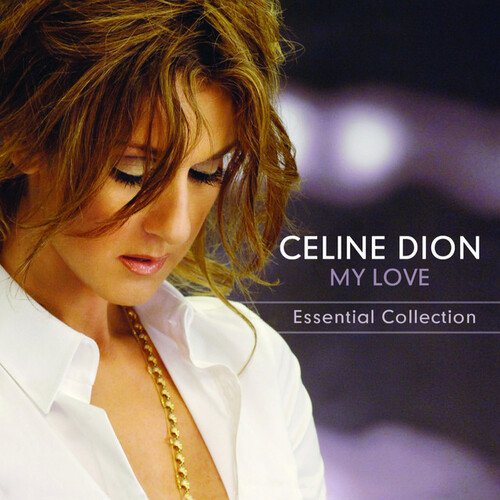
Céline Dion’s version of The Power of Love starts with soft verses and ends on long, powerful notes. Her timbre was correct and clear. The high notes were smooth, with a pleasant shine on top. The small breaths in the quiet verses were there, but were a bit vague in their detail. The drums in the climax were on the light side.
Bass, Weight and Room
We would have loved to hear a lot more weight from these woofers.
For a floorstander this size and weight, the bass is too light, short on power and impact. The lower part of the frequency response is soft and slow, with bass notes a little rounded in their attack. Kick drums also have modest punch.
Wharfedale speaks of bass reaching below 28 Hz in room. In our small living room, with music rich in low bass, the lowest notes we could hear were around 30-32 Hz. Anything lower was inaudible to us. Wharfedale also describes the low-frequency impact as “thunderous”. Our experience was more modest, with less punch and authority than that word suggests. We think many people shopping for such a large floorstander expect a bit more weight and power.

Heilung’s Traust is a track of deep ritual drums and layered voices. The drum strokes had good depth, with gentle attacks and a slightly slow decay. The physical impact in the body was there, but it was a step below what we look for from cabinets this big. The voices in front of the drums were clear and well separated and the soundstage was ok, so this part was good.
Yello’s Till Tomorrow has deep, layered electronic bass lines. Most layers were audible, with decent extension in our room. The faster notes had a somewhat blurred outline. The layers blended a bit into each other, so articulation was also mild. As on Heilung’s track, the weight was light for two cabinets with a total of four 220 mm woofers.

On AURORA’s A Different Kind of Human, the rapid bass sequence that starts around 1:38 is a great test for speed and bass articulation. The pulses were round and blunt, a bit slow to start and stop, so the sequence lost some of its drive. Her voice was clear, detailed, and transparent enough, with a fine, open top. Her timbre sounded just right.
Feet on the Ground, by Danish singer Pernille Rosendahl, has a deep, driving low end. The bass was round and warm, relaxed in its contour. The kick was a little light in the chest, with limited punch and weight. Pernille’s voice was full and natural but a bit too polite for music this energetic.
Overall, this is a gentle, rounded bass, easy to like with voices and acoustic music. For big drums and synth bass, it is a step behind what we want and expect especially for their size.
Soundstage, Imaging and Detail
Width, depth and height are moderate. Imaging is precise enough, with each instrument in its own place. Off-axis, the sound changes somewhat, so sit in the centre if you can.
The detail picture has two sides. In the treble, details are fast, clear and sparkling. In the midrange and the bass, the finest details are present at a moderate level, a step behind faster, more agile designs.
Yosi Horikawa built In the Wind from small percussive sounds and field recordings, placed all around the listening position. The high, metallic sounds were crisp and very precise, with a beautiful shine. The lower, woody sounds were softer in outline and a bit less defined in their position. Depth was of medium size, with the quieter sounds placed only slightly behind the speakers. We could clearly differentiate both sides of the Elysian 4R in one track.
Jean-Michel Jarre released the sequel to Oxygène in 1997, two decades after the original. Part 7, its opening track, is full of synthesizer layers panned across the room. The high synth textures had a fine, glittering sparkle, quick and precise. The movement from one speaker to the other was really easy to follow. The layers further back also had a fair amount of depth. The synth bass underneath was warm and round. A very enjoyable track, with the treble as the star.
Nils Frahm recorded All Melody, his 2018 album, in his studio at the Funkhaus, in Berlin. The piano tone was neutral and sounded realistic, with a crisp start on the higher notes. The hammers, the pedals, and the small noises of the instrument were audible, albeit slightly blurred. The soft, light bass we’ve spoken about previously was rendered beautifully. Calm and pleasant, with the acoustic space around the piano being clearly present in the background.
Dynamics and High SPL
Sensitivity is high, so very little amplifier power was needed for high levels in our room, which is a very good thing. The SPL we reached was good (max of 118 db), with a clean sound up to loud levels. Macrodynamics were lively at normal levels.
The limit is in the speakers themselves. On the H200, the Elysian 4R ran out of headroom before the amplifier did.

Stravinsky’s The Firebird Suite, with Eiji Oue and the Minnesota Orchestra on Reference Recordings, is a test of both ends of the dynamic range. In the quiet passages, the woodwinds and the harp were delicate and airy. At everyday levels, the big crescendos had good speed and a bright, sparkling top. As we turned the volume up, well past our usual levels, the bass drum and the lower strings lost some coherence and articulation, so keep the volume inside the clean range, where these speakers are a pleasure.
Low Volume Listening and Listening Pleasure
At low volume, the Elysian 4R is good. The tonal balance remains neutral, the treble has the same sparkle, and microdynamics are present at low levels. Late in the evening, the music was relaxed and enjoyable.
Allan Taylor recorded Colour to the Moon for Stockfisch, the German audiophile label. Played quietly, his voice was natural and close. The guitar strings had a bright, quick attack. The sound of his fingers moving along the strings was there, quiet and slightly in the background. A very relaxing and pleasant presentation that seems to draw you in and keep you hooked.
Govi’s Euphrates centres on a nylon string guitar. At whisper levels, each plucked note had a clean attack and a pleasant decay. The finer shadings between the notes were subtle, a bit too subtle for our taste. The bass had great presence and was very well rendered. Dynamics were also very good. The overall presentation was excellent on this track.
So who is the Elysian 4R for? We believe a lot of listeners will value how easy these speakers are to live with. After long sessions, our ears felt rested. Bad recordings with hot treble sounded very good without any trace of fatigue. Add the looks, and a pair of these make a lot of sense in a small to medium living room, for someone who wants music to be a pleasure first. It’s a calm, gentle kind of pleasure, the one we look for at the end of a long day. The high SPL is also a very good consideration since tube amplifiers will love them and they will play loud with very little power.
Final Thoughts
The Wharfedale Elysian 4R is a beautiful, mellow and very pleasant loudspeaker, with a sparkly, transparent treble we fell in love with. Choose them for a small to medium room, for relaxed evenings filled with music, and, of course, for their looks. Despite their imposing size and presence, the bass section comes with clear limitations. Before buying, make sure to audition them in a room similar in size to your own, as room acoustics and placement can significantly affect their performance.
We want to thank AVstore for their trust, and for the time we spent with the Elysian 4R in our small living room and in our bigger room, with the Hegel H200 and the Burson Timekeeper Voyager Max. Shout-out to all the dealers out there doing awesome work for all of us.
Pros
- Sparkling, airy, and fast treble from the AMT, free of sibilance
- Relaxed, fatigue-free presentation, with a neutral tonal balance
- Seamless integration between the AMT and the midrange
- Forgiving with poor recordings, and very good at low volume
- High sensitivity, with high SPL from modest amplifier power
- Beautiful finish and a very high WAF
Cons
- Soft, slow bass, with modest weight, impact, power, and extension for their size
- Limited bass output in larger rooms; highly sensitive to room size and placement.
- Modest microdetail in the midrange and the bass
- A neutral, unremarkable midrange