Listening room: the small living room, 4 m by 5.3 m with a 2.7 m ceiling and modest treatment • Placement: 1 m to the front wall and to the side walls, listening distance: 4 m, firing straight ahead, no toe in, grilles off
Source: MOON 491 network streaming, TIDAL Connect and Qobuz Connect, with the 491 volume control • Amplification: Michi M8 monoblocks • Cabling: Roboli HP8000 speaker cables, Roboli XLR 2100 interconnects, Roboli Power5200 power cables
Loaned by: AVstore
TLDR
The 801 D5 is the flagship of the fifth generation of the Bowers & Wilkins 800 Series Diamond. In our small living room, driven by the MOON 491 and a pair of Michi M8 monoblocks, these speakers played with a scale, depth, and ease we associate with very few loudspeakers. We recommend the 801 D5 to listeners who love voices, acoustic and instrumental music, and orchestral works, and of course to owners of larger rooms. People who value transparency and detail first would not be disappointed with these.
Four qualities define the 801 D5 for us:
- Dynamics. Midrange dynamics are very impressive. The swells in a voice, from soft to loud, were reproduced with a lot of ease, and so were the small inflections inside a phrase. At high volume, these speakers play effortlessly, with no audible compression.
- Midrange and voices. The midrange is natural, transparent, warm, and rich. Very, very good! Voices had body, breath, and texture, with a very natural timbre for male and female singers alike.
- Soundstage reproduction. The soundstage was extraordinarily wide, extending well beyond the loudspeakers, very deep and tall, with a scale that suits the size of these cabinets. Imaging was pinpoint, with each voice and instrument occupying their own precise spot.
- Subbass performance. Bass and subbass are one of the strongest qualities of the 801 D5. The electric bass on Carolin No’s Crystal Ball was one of the best bass presentations we have ever heard, in any system, at any price point. In our room, the low end was clean, with no boom.
As with the older iterations, the main limitation remains with the treble. It has the articulation and the detail we expect at this level, and it is a very large step forward over the D4 generation, but still, with our matching, of course, it was somewhat harsher than we expected at this price point, with a bright edge present at every listening level. This makes cabling and amplification very, very important in matching.
Also, kick drums in fast electronic and retro music had a softer leading edge and a bit less speed than we would have liked, but again, regarding this aspect, our electronics may be part of the reason. Keep in mind that these are very large, very heavy loudspeakers weighing ~100 kg each.
Introduction
The 801 D5 is the top model of the 800 Series Diamond, the floorstanding loudspeaker at the head of the range Bowers & Wilkins builds in Worthing, on the south coast of England.
We have also published a separate factory tour that Bowers & Wilkins kindly offered us as part of the launch event. It was a wonderful opportunity to go behind the scenes, explore the manufacturing facilities, and witness firsthand the craftsmanship, engineering, and attention to detail that go into creating these remarkable loudspeakers. If you’re curious about what happens long before a finished speaker reaches a listening room, we highly recommend checking it out.

The company unveiled the fifth generation of the range at High End Vienna on 4 June 2026, sixty years after it was founded. The D5 models were available from 9 September. Much of what is new in this generation started on the 801 D4 Signature, a limited and more expensive edition of the previous flagship. In the D5 range, those parts are standard.
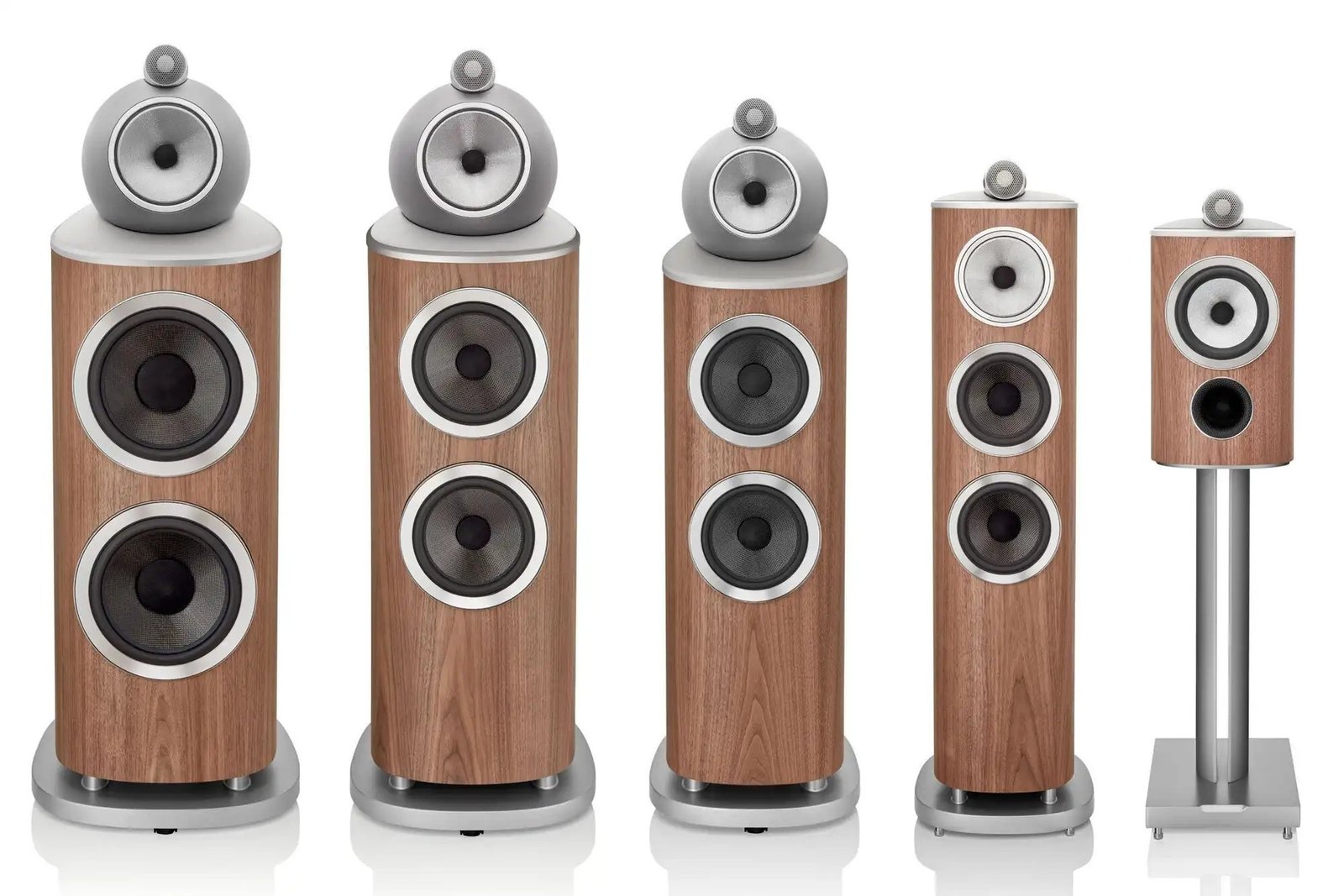
The range has the same structure as before:
- 805 is a two-way bookshelf with a 165 mm Continuum mid and bass driver
- 804 is the first stand-floor of the range and pairs a 130 mm midrange driver with two 165 mm bass drivers
- 803 uses the same midrange size with two 180 mm bass drivers
- 802 uses a 150 mm midrange, with two 200 mm bass drivers
- 801 uses a 150 mm midrange, with two 250 mm bass drivers
- Every model uses the 25 mm Diamond Dome tweeter. The HTM81 and HTM82 complete the range as centre channels.
In Europe, the 801 D5 costs approximately 50,000 EUR per pair. We spent around one month with a pair loaned by AVstore, already broken in, in our living room. The source is a MOON 491 connected directly to a pair of Michi M8 monoblocks, the electronics we use as our reference from now on.
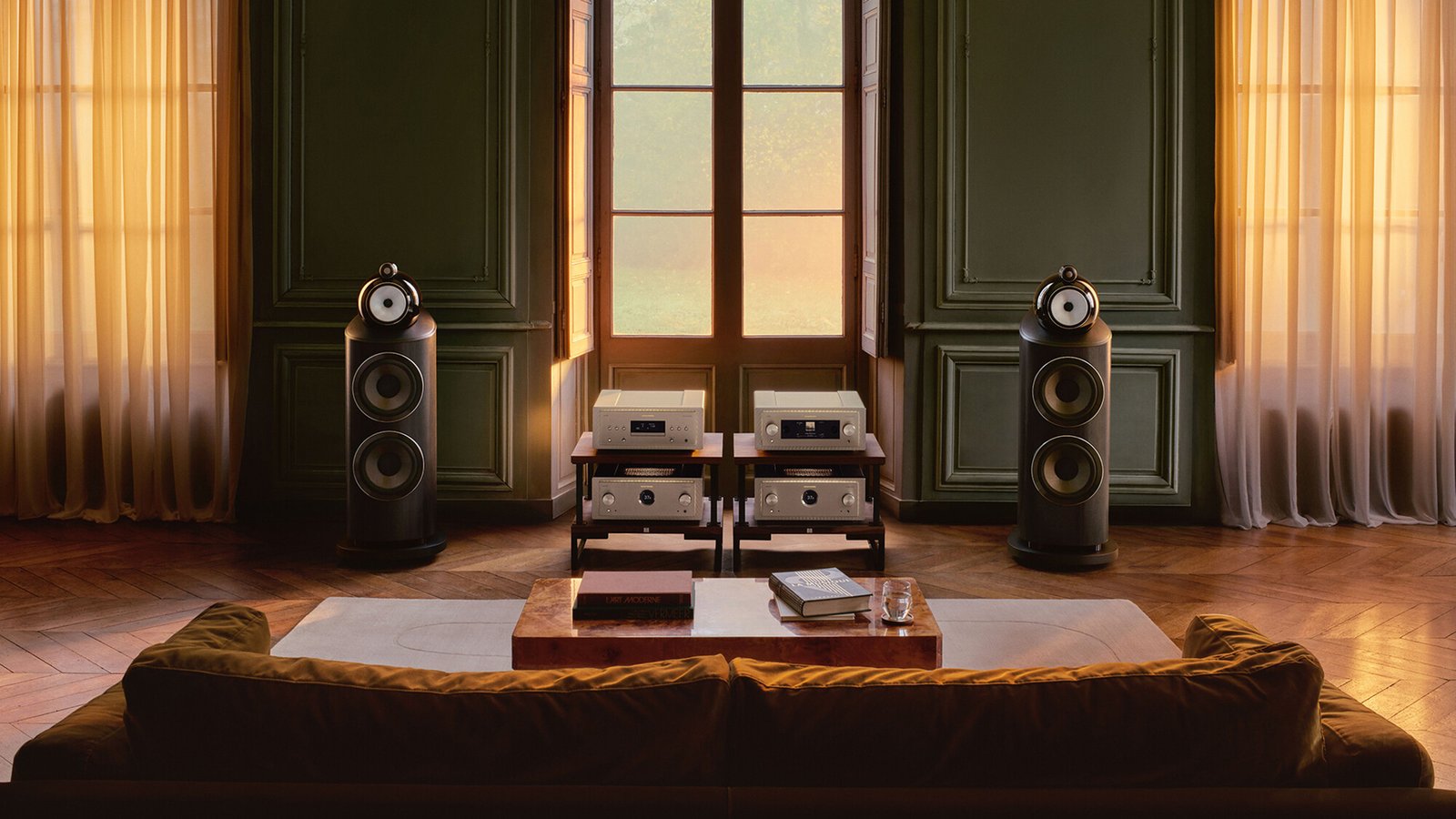
The review pair is finished in Dark Walnut, one of four new finishes for this generation, inspired by the 801 Abbey Road Limited Edition. Up close, the grain is deep and warm, with a very even gloss and tight panel gaps. In a room of 4 by 5.3 m, two of these are a very imposing sight, and they look the part!
Bowers & Wilkins calls its goal True Sound, a reproduction of the recording with nothing added and nothing taken away. Fidelity to the recording is something we value more and more with time, as long as the music remains pleasant to listen to over a long evening. That balance is what we went looking for with the 801 D5.
A Brief Look at Bowers & Wilkins
John Bowers and Roy Wilkins met during the Second World War, in the Royal Corps of Signals. After the war, they opened a radio and electronics shop in Worthing. John Bowers started building loudspeakers in the workshop behind it. In 1966, a customer and former opera singer, Miss Knight, left him 10,000 pounds in her will. That money helped him found B&W Loudspeakers Ltd, together with Peter Hayward, with one aim in mind: a loudspeaker that reproduces the original performance as faithfully as possible.

The first 801 launched in 1979 as a loudspeaker for recording studios. Abbey Road was one of the studios that adopted it. The name of the studio is linked to the 800 Series to this day. The Matrix 801 of 1987 used the Matrix, the interlocking internal bracing found in every 800 Series cabinet today. In 1993 the Nautilus launched, designed by Laurence Dickie, with its spiral of tapering tubes. The tapering tube behind every 800 Series Diamond tweeter uses the same principle. The diamond dome tweeter became part of the 800 Series in 2005, the Continuum cone in 2015 with the D3 generation, and Biomimetic Suspension, which replaces the conventional spider under the midrange cone, in 2021 with the D4. In 2023, Bowers & Wilkins refined the D4 further with the Signature models.
Today the 800 Series Diamond and the Nautilus are built in Worthing. Research and development is based at Southwater, a short drive inland.
Design, Build and Technology
The 801 D5 is 1221 mm tall including the tweeter and the plinth, 447 mm wide and 597 mm deep including the plinth. Each one weighs 106.4 kg. Bowers & Wilkins describes it as a three-way vented box system, with a 25 mm Diamond Dome tweeter, a 150 mm Continuum cone FST midrange and two 250 mm Aerofoil bass units. The midrange and the tweeter are the same as in the 802 D5. The bass units are larger, 250 mm against 200 mm, in a larger cabinet.
The silhouette is the one we know from decades of 800 Series loudspeakers: a curved, tapering cabinet, the Turbine Head above it and the tweeter housing at the very top. On the D5, the trim rings around the drivers are slimmer, and the back of the cabinet is a smooth, slightly curved plate with the fixings hidden. Panel gaps are smaller than on the D4. As far as our eyes can judge, the finish of our pair is perfect.
With its castors, moving a loudspeaker this heavy is surprisingly easy. We moved the pair into position with very little effort. Fine adjustments of a few centimetres took seconds. A very welcome detail on a pair of this size!
Many of the components described below are things we had in our hands, or watched being made, at Dale Road in September. The factory mixes hand work and automation in a sensible way, with presses, CNC cells and a painting robot for the repetitive steps, and trained hands for fitting, sanding, tweeter assembly and inspection.
The video below, courtesy of the Bowers & Wilkins website, offers a quicker overview of the key engineering innovations and improvements introduced with the new D5 generation, highlighting what has changed and how these developments take the 800 Series Diamond a step further.
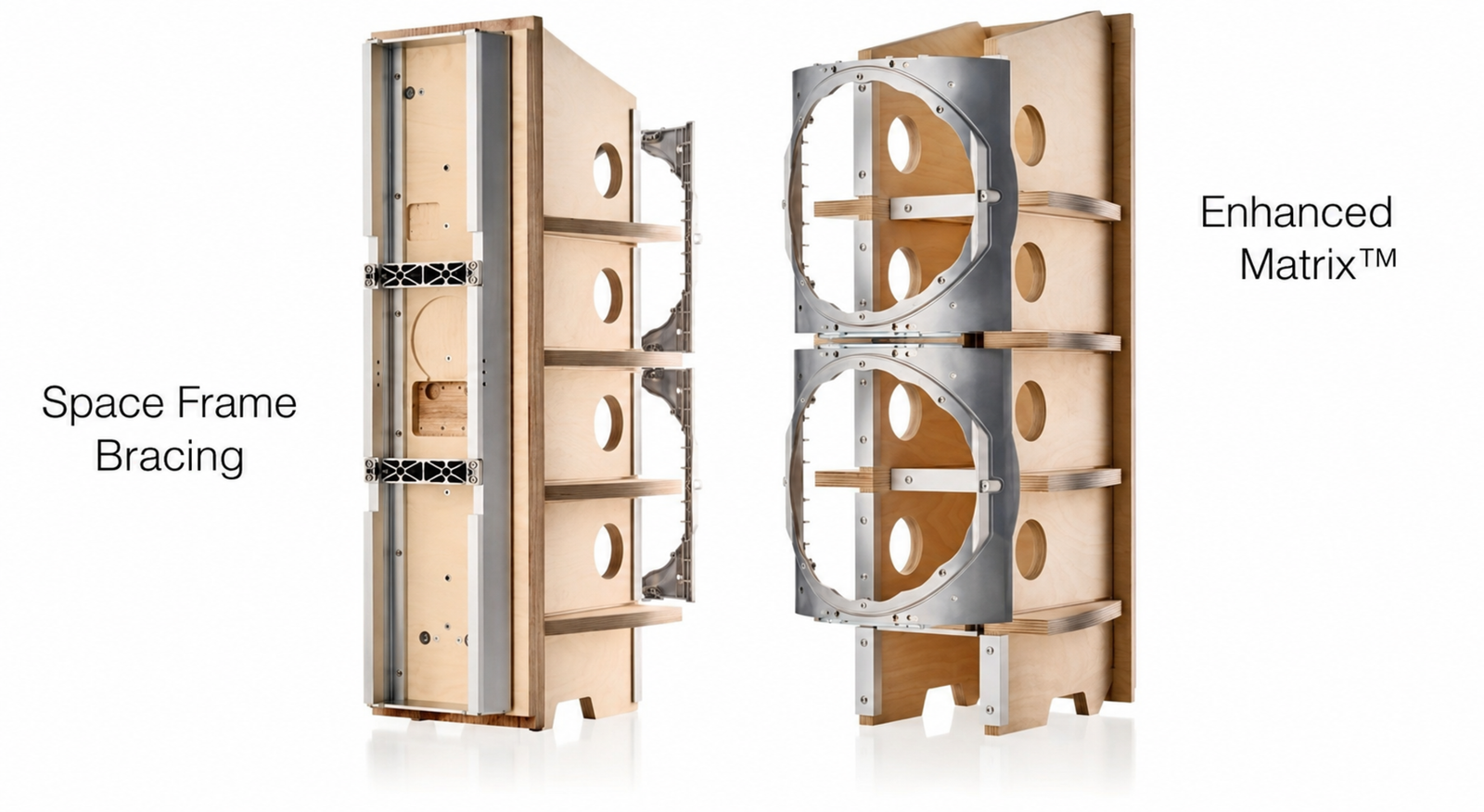
The cabinet. The curved walls of the cabinet are made from thin birch plies laid at alternating grain directions, with a sheet of dry glue film between each pair and a face veneer on the outside. The stack is wrapped around an aluminium former shaped like the horseshoe cross section of the cabinet. In the press, heat and pressure turn the layers into one stiff, curved wall. In the woodshop we saw the recipe for the 802 cabinet pinned next to the press, a controlled document listing all 41 sheets of its wall in the order they are laid, each with its size, grain direction and part number, together with the temperature and time needed to form the final shape. After pressing, the shells are trimmed and machined, then the Matrix grid of interlocking birch plywood panels is glued and screwed in place, with the cabinet clamped in an assembly jig. The Matrix ties the walls together, so their resonances are pushed higher in frequency and lower in level.
Enhanced Matrix and Space Frame Bracing. In the D5, the Matrix is reinforced with thick aluminium sections, profiled around each drive unit aperture and ribbed at the back, which Bowers & Wilkins calls the Enhanced Matrix. The Space Frame Bracing is a new addition for the D5. It is a pair of long, parallel aluminium rails joined by transverse members, bolted to the rear of the Matrix inside the cabinet.
Top plate and plinth. At the top of the cabinet there is a new aluminium plate, with thicker ribbing, more fixing points and revised decoupling mounts. It is finished with a collar trimmed in Leather by Connolly and damped with a material derived from the D4 Signature models. The plinth is aluminium too, profiled to the shape of the cabinet, with constrained layer damping and tuned mass dampers chosen for the resonances of each model. A tuned mass damper absorbs energy at one specific frequency, so each model has dampers matched to its own cabinet. The lower edge of the plinth covers the castors and the spikes. Bowers & Wilkins says the Space Frame, the Enhanced Matrix and the new top plate together make the D5 enclosure mechanically quieter than any it has built before.
Turbine Head and midrange. The 150 mm Continuum cone FST midrange is mounted in the Turbine Head, a cast aluminium housing on top of the main cabinet, separate from the bass enclosure. This way, the midrange is isolated from the vibrations of the two bass units. It also has an enclosure of its own, shaped and damped for it alone.
During our factory tour, we learned that the Continuum midrange driver has a metallic coating applied to its diaphragm, while a silicone-like damping material is added to its rear to help control unwanted resonances.
This was particularly interesting to us because, for decades, Bowers & Wilkins relied on their iconic yellow Kevlar cones for midrange reproduction, a technology that became almost synonymous with the brand’s sonic identity. When Kevlar was replaced by Continuum with the introduction of the 800 D3 series in 2015, we felt the midrange presentation slightly, very subtly changed. While the newer Continuum drivers brought greater articulation, speed, and precision to the midrange, we felt that a touch of the mellow, melodic, almost romantic character of the older Kevlar designs had been traded for a slightly more incisive presentation. There was also an extremely subtle hint of firmness in the tonal texture, reminiscent of what we sometimes hear from metal-cone drivers when compared directly to siblings with softer cones. It was never an obvious harshness, but a delicate shift in character that became apparent only through very careful listening and familiarity with the older designs.
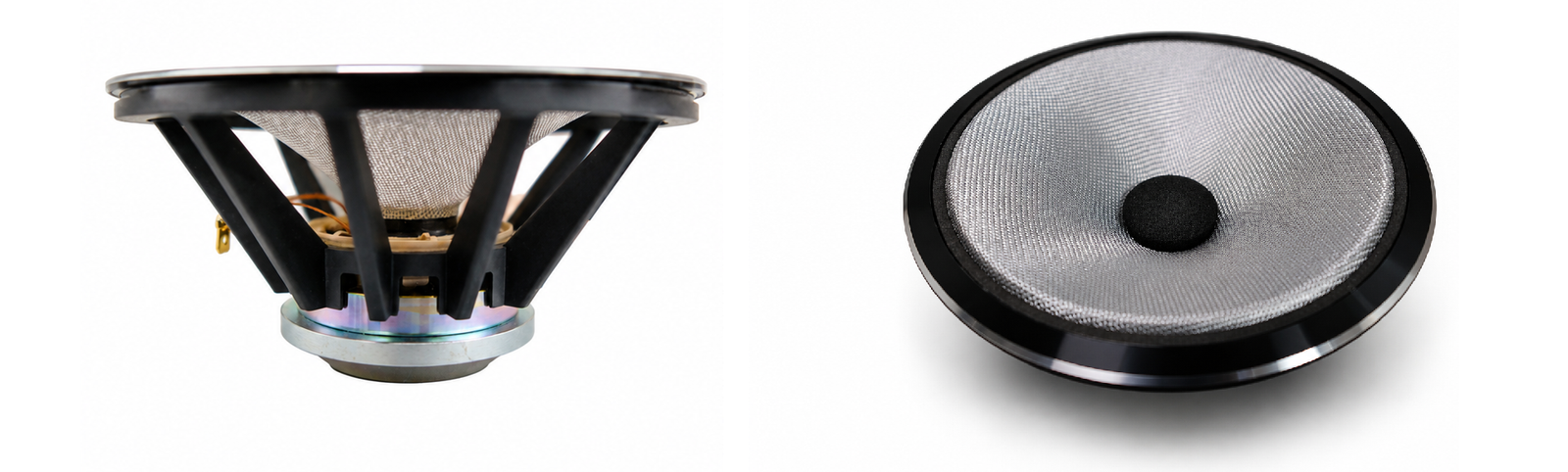
Discovering the metallic coating during our factory visit finally gave us a possible explanation for something our ears had been picking up on for years. Of course, cone materials and coatings are only part of what determines a driver’s sound, but this was one of those moments when seeing the engineering behind a product helped us better understand our listening impressions.
FST stands for Fixed Suspension Transducer, a design with a very narrow surround at the edge of the cone. The midrange uses Biomimetic Suspension in place of a conventional fabric spider, which Bowers & Wilkins says reduces the air disturbance a spider creates behind the cone. An Anti Resonance plug is fitted at the centre of the cone.
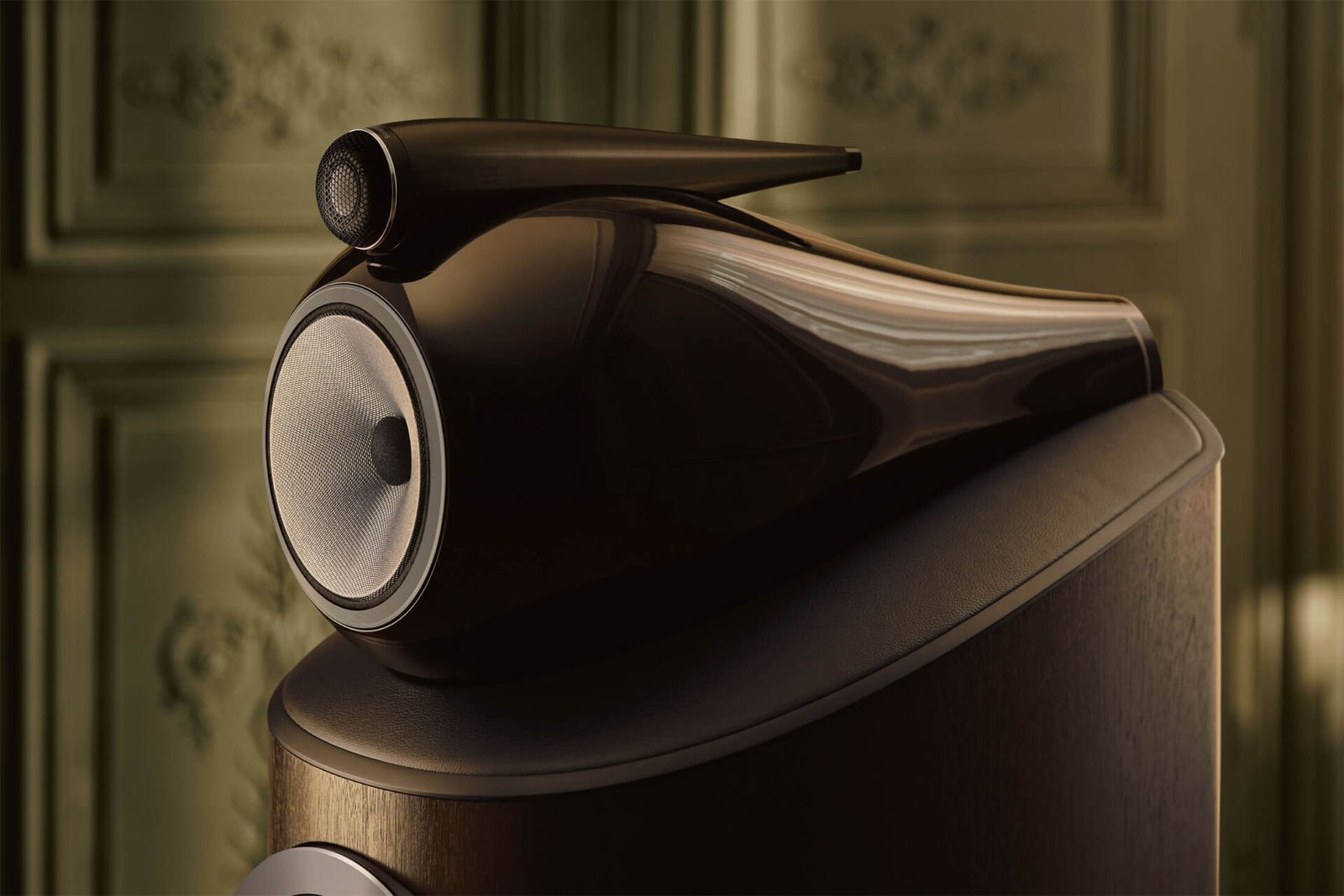
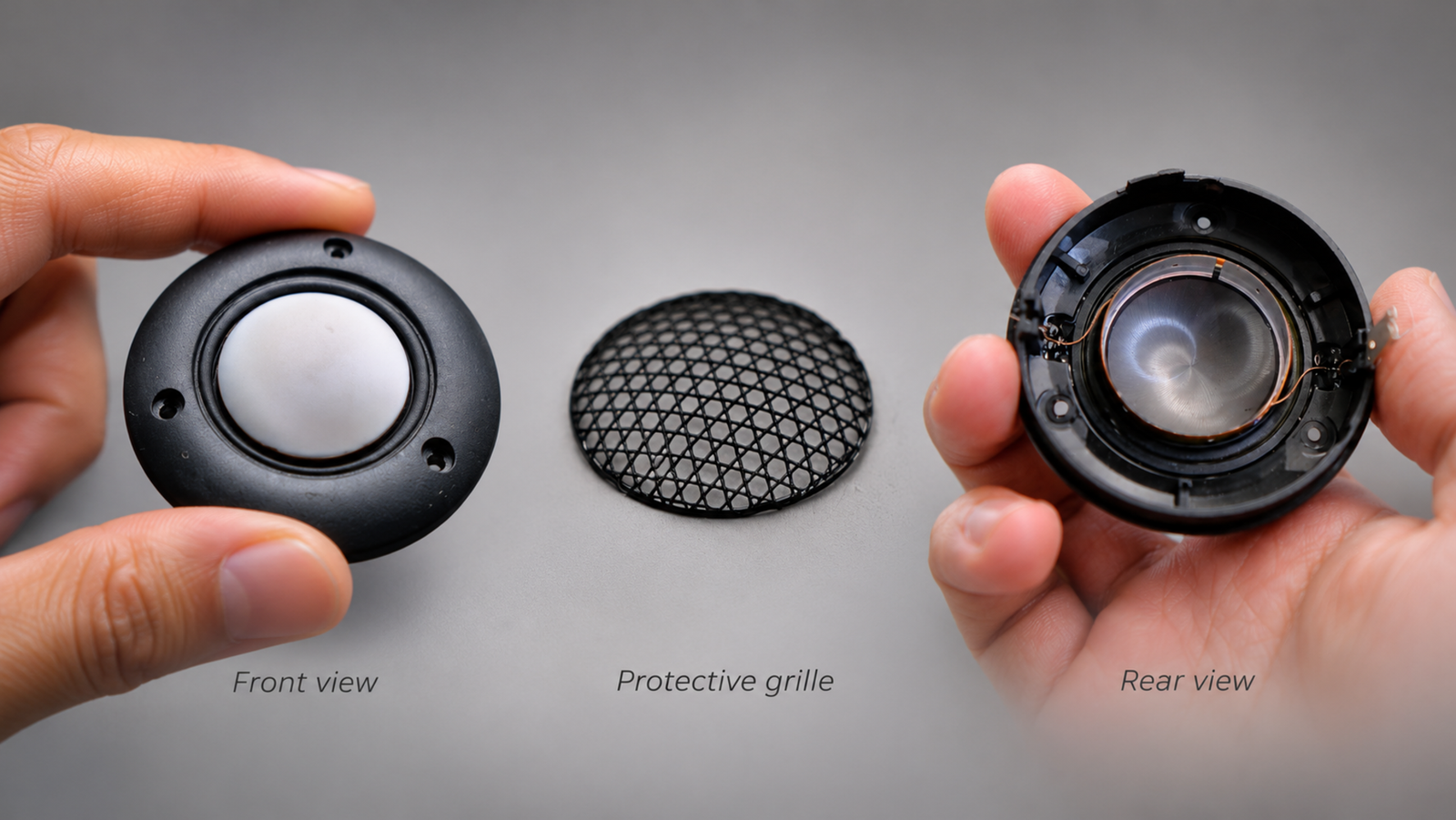
Diamond Dome tweeter. The 25 mm Diamond Dome tweeter is mounted in the Solid Body Tweeter on Top housing, with a long, tapering tube behind the dome. Diamond is extremely stiff for its weight. Bowers & Wilkins says the dome has its breakup at 70 kHz, far above the audible range. For the D5, the tweeter has a more open, airy grille first used on the 801 D4 Signature, a fine hexagonal mesh with a lot less metal in front of the dome. The tweeters are assembled by hand in the factory. The synthetic diamond domes are supplied in transparent clamshell cases, each with its own QR code label. Every finished tweeter is measured in a small foam-lined test station. We have detailed this process in our factory visit tour.
The photograph above reveals something particularly interesting about Bowers & Wilkins’ Diamond tweeters, something that would be almost impossible to appreciate simply by looking at a finished loudspeaker. On the left, we have the bare, uncoated carbon diaphragm, showing its natural dark grey, almost black appearance. On the right, we have the finished diaphragm, with its distinctive silvery, diamond-like surface achieved through the application of a fine platinum powder coating. The difference is quite striking, especially considering that the underlying diaphragm material is essentially the same.
During our factory visit, we learned that this platinum coating serves an entirely aesthetic purpose, with no meaningful influence on the tweeter’s acoustic performance. Its role is to give the diaphragm that unmistakable, almost jewel-like appearance we have come to associate with Bowers & Wilkins’ Diamond tweeters. After all, diamond itself is a form of carbon, but a dark grey dome would hardly convey the same visual impression as the shimmering silver surface featured in the company’s marketing brochures. The coating gives the tweeter an appearance that better matches its prestigious Diamond designation, without changing the acoustic properties of the underlying diaphragm.
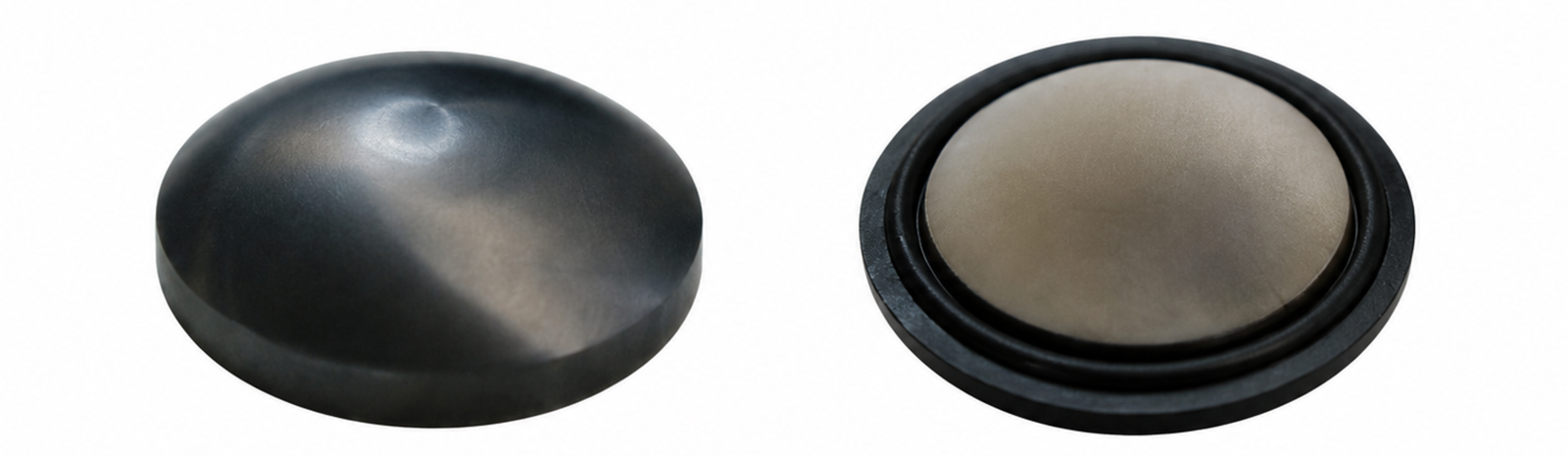
This platinum powder coating is extremely delicate. Since it is not secured to the diaphragm by an adhesive layer, even the lightest physical contact can disturb or remove portions of it, exposing the darker material underneath. Once that happens, the beautiful, uniform finish is compromised, leaving visible marks that can make the tweeter look rather unsightly. Interestingly, while this cosmetic damage does not necessarily translate into an audible difference, it certainly affects the appearance of what is otherwise an exquisite piece of engineering and art, dare we say.
This is why we strongly recommend exercising extreme caution when cleaning or dusting these tweeters. Even something as innocent as brushing away a few particles of dust with a soft brush or microfiber cloth can be enough to damage the delicate surface. Our advice is simple: never touch the diaphragm. If some dust accumulates on the dome, it is far better to leave it there than risk damaging a finish that cannot simply be wiped clean or restored at home.
And please, don’t be tempted to test this for yourself! During our factory visit, we experienced firsthand just how surprisingly fragile this coating really is. We can confidently say that even the gentlest touch is something you should avoid entirely. Take our word for it: this is one experiment you definitely don’t want to repeat on your own Diamond tweeters, especially considering the cost of replacing one. Sometimes, admiring something from a safe distance really is the best approach!
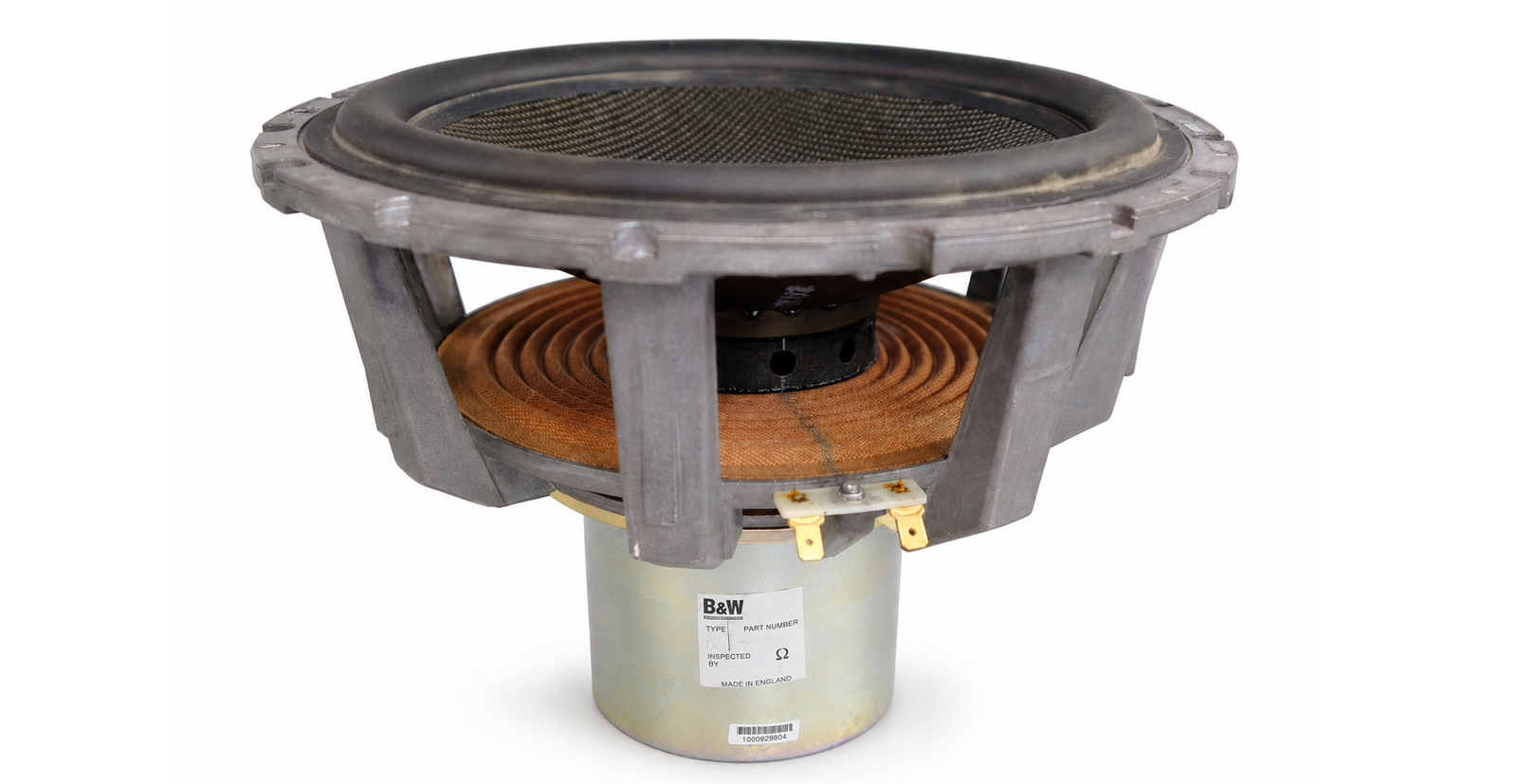
Bass units and port. The two 250 mm Aerofoil bass units have cones whose thickness varies across the profile, thicker where more stiffness is needed, Bowers & Wilkins says. The cabinet is vented through a Flowport, with a dimpled surface that reduces turbulence in the airflow, and with it the port noise at high levels. All the drive units of the D5 range have the upgraded motor systems developed for the Signature models.
Crossover. The crossover is mounted on an aluminium plate fixed to the back of the cabinet. In the D5, the plate is coupled to the cabinet and to the Space Frame with M8 and M4 fixings, so it adds stiffness to the enclosure and isolates the components from the air pressure inside. The crossover is split over three boards: the midrange and tweeter sections on the upper one, the bass section on the lower one, and between them a small board with one large air-core inductor on its own. Each board is mounted on a dark grey foam pad. The internal wiring is colour-coded, with XLPE insulation. The capacitors are Mundorf, from the MCap Supreme Aluminium Oil, MCap Supreme SilverGold Oil and MCap EVO ranges.
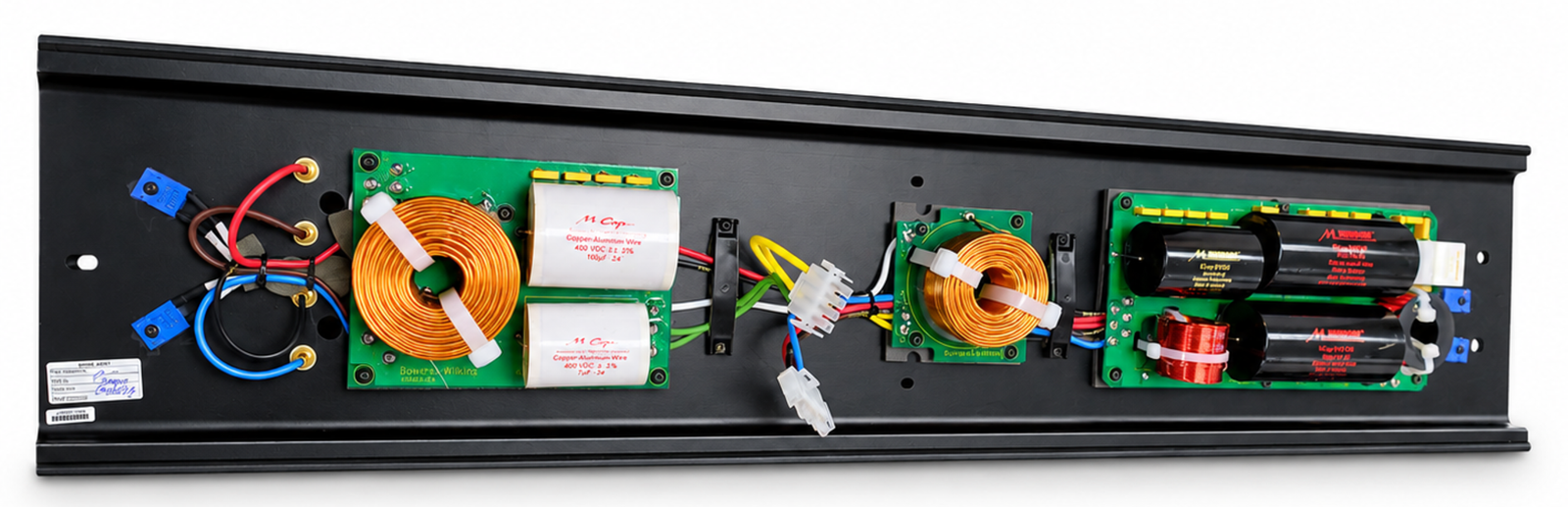
Every crossover built is measured and checked against its reference.
Finish. Before paint or lacquer, the cabinets are sealed and sanded. Veneered cabinets are sanded by hand. Bowers & Wilkins revised the paint process for the D5, with the new Stealth Black finish in mind. The four finishes are Stealth Black, Warm White, Light Walnut, and Dark Walnut. Dark Walnut replaces the Rosewood of the D4.
Specifications. Bowers & Wilkins specifies a frequency response of 15 Hz to 28 kHz within 3 dB, and a frequency range of 13 Hz to 35 kHz at minus 6 dB. Sensitivity is 90 dB at 2.83 V and 1 m. Nominal impedance is 8 ohms, with a minimum of 3.0 ohms. Second and third harmonic distortion is below 1% from 30 Hz to 20 kHz and below 0.3% from 100 Hz to 8 kHz, at 90 dB and 1 m. Recommended amplifier power is 50 W to 1000 W into 8 ohms on unclipped programme. The maximum recommended cable impedance is 0.1 ohm.
Measurements
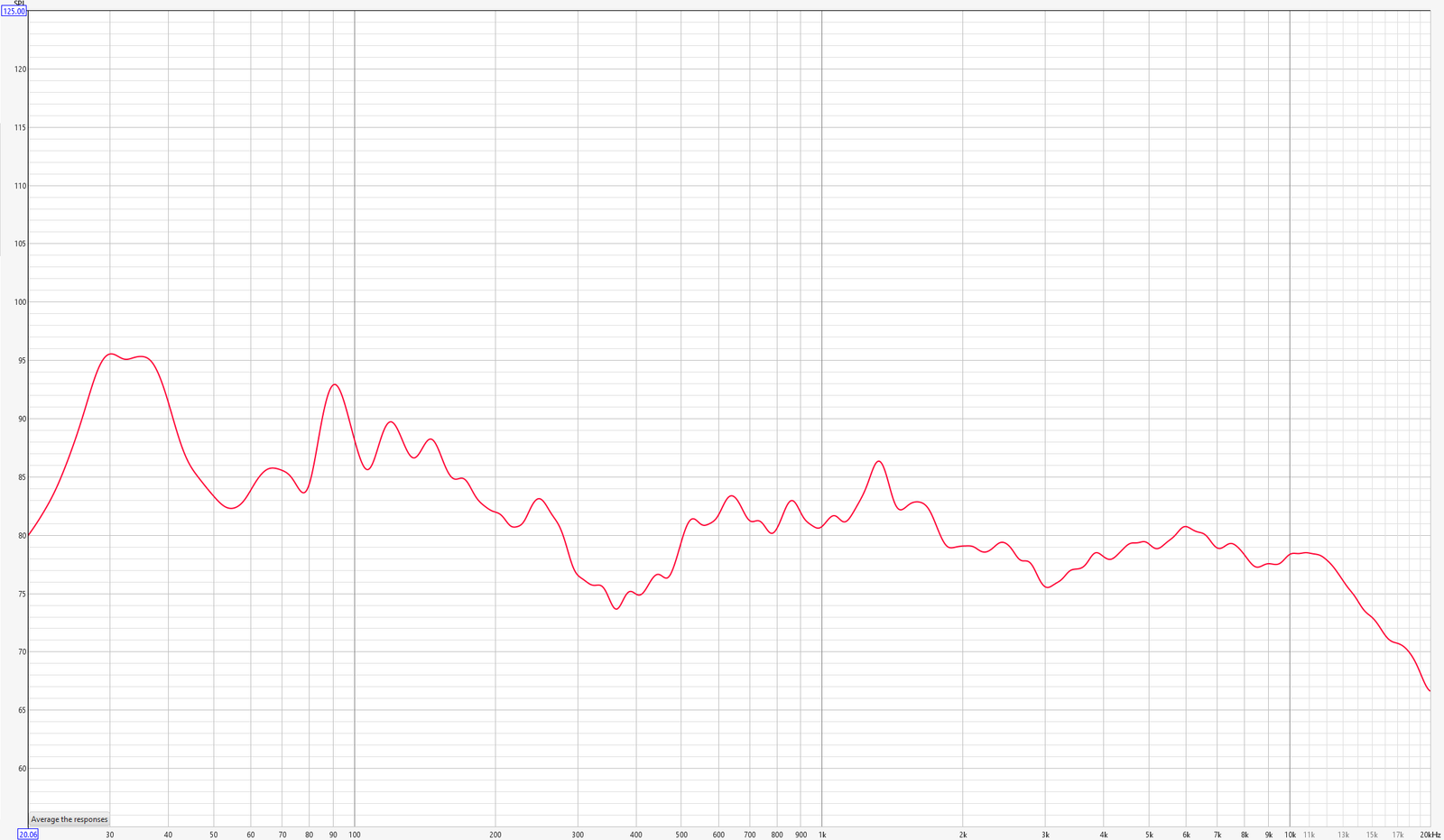
In-room measurements of the 801 D5
The graph shows the in-room frequency response of the 801 D5, measured at the listening position. For this measurement, the speakers are 1 m from the wall behind them and 0.5 m from the side walls, firing straight ahead with no toe-in, with the listening position situated at 4 m from the speakers. An in-room measurement shows the loudspeaker and the room together. Below approximately 200 Hz, the listening room has a particularly strong influence on the measured frequency response. However, it’s important to remember that reflections from the floor and surrounding walls also affect frequencies well above this region, shaping the overall response across a much broader part of the spectrum. Our room is slightly treated but not to the extreme.
The overall shape is a gentle downward tilt from the bass to the treble. It is a shape of in-room response we like to see from a neutral loudspeaker in a domestic room. Around 1 kHz, the level is about 81 dB, that is the reference for the figures below.
801 D5 has a broadly familiar crossover architecture. Bowers & Wilkins does not publish the crossover points in its official specifications. From our test, we believe them to be at around 350 Hz between the bass units and the midrange and 4 kHz between the midrange and the tweeter. Information presented at the Japanese launch of the D5 suggests that the crossover frequencies and filter slopes are unchanged from the D4 generation. The bass units roll off at about 18 dB per octave above 300 Hz, and the acoustic transition to the midrange is just above 400 Hz. The upper crossover uses a gentler, first-order electrical filter. So the important improvements of the D5 appear to be in the quality of the crossover components, with the Mundorf capacitors, the internal wiring, and the new mechanical mounting of the crossover plate described in the Design chapter. As far as we can tell, the frequency division between the drivers is the same as on the D4.
Below 40 Hz, the response rises strongly to a broad plateau of about 95 dB between 30 and 36 Hz. The first length mode of our room, which is 5.3 m long, is at about 32 Hz, and the listening position, near the back wall, is in a pressure maximum for that mode. So this plateau is the sum of two things: the very deep extension of two 250 mm bass units per speaker, and a room mode at the same frequency. At 20 Hz, the level is about 80 dB, on par with the midrange around 1 kHz. This is the physical subbass we felt in the body listening to tracks from Hedegaard, Carolin No, Dead Can Dance, Heilung, and many others. Very little music has high energy around 30 Hz, but on most recordings that do, this region is felt as well as heard.
Between 50 and 200 Hz, the response shows the usual pattern of a small room, with a peak of about 93 dB at 90 Hz, smaller peaks around 125 and 150 Hz, and dips around 55, 82 and 105 Hz. These peaks and dips belong to the room and to the positions of the speakers and the listener as much as to the 801 D5, and moving any of them by a few centimetres changes them. On the music we played, the bass sounded clean and well controlled, so these room effects remain in proportion.
Between 300 and 470 Hz there is a dip, with the lowest point at about 74 dB around 370 Hz, 7 dB below the level at 600 Hz. The dip is centred on the transition between the bass units and the midrange, between the nominal 350 Hz and the acoustic transition just above 400 Hz. At a 4 m listening distance, the reflection from the floor also cancels part of the direct sound in this region, at a frequency set by the height of the drivers and of our ears, so the dip is most likely a combination of the two. Our hearing is much less sensitive to dips caused by reflections than to peaks, and in listening, the lower midrange sounded full and warm.
From 500 Hz to 1.1 kHz, the response is even, between about 80 and 83.5 dB. Much of the fundamental range of voices and instruments is here, and this evenness is a good sign for the natural, transparent midrange of the 801 D5.
Above 1.1 kHz, the response rises to a peak roughly 5 dB above the level at 1 kHz, with a smaller bump at about 1.6 kHz. This is problematic as our hearing is very sensitive in this region, and a peak here adds presence and projection to voices, pianos, and violins. This boost in the 1.3 to 1.5 kHz area is responsible for a slight fatigue that appeared after long listening sessions. Pay attention to this during the demo, ideally with a session of a few hours.
The source of this peak, and of the harshness we heard, is primarily due to the midrange driver. With a gentle first-order filter at a nominal 4 kHz, the output of the midrange around 1.5 kHz is reduced by only about half a decibel. So the shape of the response here is the shape of the driver itself, in its Turbine Head.
Between 2 and 10 kHz the response is fairly even, with a dip to about 75.5 dB around 3 kHz and a gentle rise to about 81 dB around 6 kHz. With a nominal crossover at 4 kHz, the 150 mm midrange plays well into the upper midrange, and a cone of this size narrows its dispersion above about 2 kHz. The higher it plays, the less energy it radiates towards the side walls. With no toe-in, our listening position is slightly off-axis. The dip around 3 kHz, just below the crossover, is consistent with this. As a result, the 1.3 to 1.5 kHz region, where the midrange radiates more evenly, is even more prominent. The rise of about 5 dB from 3 to 6 kHz is consistent with the bright edge we heard on top, an emphasis in the region of the attack of cymbals and the upper harmonics of strings and voices.
First-order filters also mean a wide overlap between the midrange and the tweeter around the crossover frequencies, so listening height has an audible effect on this region.
We suspect the 4 kHz crossover point is a little too high for this 150 mm midrange. Across the recent generations of the 800 Series, this is an aspect that has improved slowly, mostly through better components, yet the same frequency division has been roughly the same. We believe it needs a lot more attention, and maybe we will see some changes in future revisions of the 801.
For the top octave, above 11 kHz, the response rolls off steadily to about 67 dB at 20 kHz. With the speakers firing straight ahead, the listening position is off-axis for the tweeters, and air absorption over 4 m reduces the highest frequencies a little more. This roll-off is normal for an in-room measurement at this distance. The on-axis extension of the Diamond Dome is a different matter, rated by Bowers & Wilkins at 28 kHz within 3 dB.
Overall, the graph exemplifies what we heard. The bass is very deep and physical, with a strong contribution from our room below 40 Hz. The midrange is even and natural, with the peak around 1.3 to 1.5 kHz being a product of the midrange driver, making long sessions slightly tiring, and the treble has a little extra energy between 4 and 7 kHz.
Keep in mind that this is one measurement, in one room, with one placement. In your room, the same loudspeakers will measure differently, especially below 500 Hz.
Setup, Room and Placement
The 801 D5 is set up in our small living room, 4 m by 5.3 m with a 2.7 m ceiling and modest treatment. The speakers are 1 m from the front wall and 0.5 m from the side walls, our usual placement in this room, with the listening position at 4 m. Grilles are off.
They fire straight ahead, with no toe-in. These speakers are a little bright, and with the tweeters pointed straight ahead, less of their treble energy is aimed at the listening position. For our ears, the tonal balance is better this way.
So, is a loudspeaker of this size too much for a room of about 21 m²? In our experience, the 801 D5 sounded very good here. A bigger room is even better. The soundstage has more space around it, and the listening position can be further from two very large cabinets, which helps the three drive units integrate better into one coherent sound. Despite that, we enjoyed them immensely even in the “small” room.
System Matching is extremely important
There are loudspeakers that are relatively easy to match with almost any decent amplifier, and there are others that can turn your life into an absolute nightmare until you find the right combination. With the latter, getting the matching wrong doesn’t simply mean losing a little refinement or leaving some performance on the table. They can sound genuinely disappointing, sometimes even remarkably bad, despite their impressive specifications and equally impressive price tags.
Some manufacturers are particularly demanding in this regard. Raidho and Marten immediately come to mind, and Bowers & Wilkins certainly belongs in the same category. These are loudspeakers that require careful attention to the partnering electronics, especially the amplifier, if you want to hear what they are truly capable of.
And we’re not talking exclusively about power. Having an amplifier that can deliver hundreds of watts doesn’t automatically guarantee a successful match. Current delivery, control, tonal balance, dynamic behaviour, and the amplifier’s interaction with the loudspeaker’s impedance all play important roles. Two amplifiers with similar power ratings can produce surprisingly different listening experiences with the same pair of speakers.
Cabling also made a large difference with these speakers. With the Roboli cabling, the tonal balance was warm enough. A little more refinement in the treble would have been welcome. With Van den Hul The Magnum speaker cables, the 801 D5 sounded too bright and harsh for our tastes. We tried other amplifiers as well. The treble character was the same with each of them. Cable matching changed it a lot more than the amplifiers did, and we advise you to try a large range of cables with them and pick whatever you prefer.
We strongly discourage judging loudspeakers of this calibre after hearing them with a single amplifier. A poor demonstration can leave you with an entirely wrong impression of their capabilities. Conversely, finding the right combination can transform the listening experience, revealing qualities that seemed completely absent just moments earlier.
With the 800 Series Diamond D5, system matching isn’t a minor consideration or something to think about after purchasing the speakers. It is an essential part of getting them to perform at their best.
Our reference electronics, from this review onwards, are the MOON 491 and two Michi M8 monoblocks. The 491 streams TIDAL Connect and Qobuz Connect and is connected directly to the M8 pair, with its own volume control and Roboli XLR 2100 interconnects. The speaker cables are Roboli HP8000, and the power cables are Roboli Power5200. Each M8 is a Class AB mono amplifier rated at 1,080 W into 8 ohms and 1,800 W into 4 ohms.
With a 3.0 ohm minimum, an amplifier with plenty of current in reserve is very important. The M8 pair has that reserve, with power to spare at every level.
We place a lot of importance on system matching, because a loudspeaker this transparent shows the character of every component in front of it. Audition the 801 D5 with your own cables, or with a few different sets, before you decide. Preferences differ, of course.
A First Listen at Southwater
Before our pair was set up in our room, we heard the 801 D5 once, at the Southwater Research Establishment, side by side with the 801 D4. It was a short comparison in one of the dedicated listening rooms, a quiet space with diffusers on the front wall, absorbing panels in the corners, and marks on the carpet for every loudspeaker position. Staff swapped the loudspeakers by hand between comparisons. Moving an 801 is heavy work, and they made it look easy. The 801 D5 in that room was finished in Dark Walnut, the same finish as our review pair. A nice coincidence!
The system was a Denon DP S1 CD transport, an MSB Diamond DAC, a Gryphon Commander preamplifier, and two Gryphon Apex monoblocks. The music was Harry Belafonte’s A Fool for You, Phoebe Bridgers’ Garden Song and DVD Menu, and Agnes Obel’s The Curse.
The change in the treble was very easy to hear. On the D5, the top end was smoother, with less of a harsh edge than the D4. The noise floor was lower, so small details and the air between instruments were easier to hear. The bass was tighter and reached a little deeper. The soundstage was bigger, wider, and deeper. Overall, the D5s sounded more open and more relaxed than their predecessor.

The first track was Phoebe Bridgers’ Garden Song, from Punisher, released in 2020. It is an intimate, quiet song with her voice close and soft. It is also a sibilant recording, which makes it a very good test for the upper midrange and the treble of any loudspeaker. On the 801 D4, her S sounds were very prominent, with a sharp edge that was distracting. On the 801 D5, the same S sounds were much softer and sounded a lot more natural. The D5 is more forgiving with a recording like this one, and her voice was easier to listen to at the same volume, from the first line to the last.
In the duet passage, the two voices on the D4 were somewhat intertwined, blending into each other. This was not so apparent until we listened to it on the D5, where they were easier to tell apart, each with its own, more contrasted outline and texture. The lower noise floor clearly helped with the better articulation in this newer generation.
Sibilance was the major benefit on this track. The D5 was miles better here! For anyone who found the D4 a bit too sharp with voices, this is very good news.

Agnes Obel’s The Curse, from Aventine of 2013, was another very good test. The Danish singer and pianist built the song on strings, piano and her own layered voices. On the 801 D5, the bass was more articulate. The lower frequencies were better defined and better separated from each other, so each low note had a clearer outline and a cleaner stop. Dynamics were a little better too, with slightly more contrast between the quiet and the loud passages. Here the change was subtler than in the tweeter, where the refinement of the D5 was much easier to hear. A smaller step on this track, and a welcome one.
Listening Sessions
In our room, with our matching electronics and cables, the 801 D5 sounded dynamic, deep, open and detailed, warm in the midrange and a little bright on top.
Bass, Subbass and Physicality
Let’s start with the low end of the 801 D5, which is outstanding! Two 250 mm Aerofoil bass units per speaker, in a cabinet so overengineered turned out to be a recipe for greatness. These reach very deep, but also maintain very good control. Bass has depth, texture and articulation. Subbass also has a physical presence we could feel in the body, on almost every track with low-frequency content. The size of the woofers helps with this, of course.
Carolin No’s Crystal Ball. Carolin No are the German duo of Carolin and Andreas Obieglo. On this track, the electric bass guitar was what we listened to first. We were surprised by its depth and extension, with the lowest notes clean and well-defined. Each note had texture and articulation, a clear outline and a full body. The pressure in the room was something we felt in the body as much as we heard it. What a track!
Dead Can Dance, the duo of Lisa Gerrard and Brendan Perry, released Into the Labyrinth on 4AD in 1993. The Wind That Shakes the Barley is an old Irish ballad, sung on that album by Lisa Gerrard. The breath and the plosives in her voice had a low-frequency weight we could feel in the room, a very unusual thing to experience from a voice. The subbass under the song was extremely well reproduced, deep and clean. The kick drums were very, very good, with a tight, well-defined outline.

Heilung is an experimental folk group with members from Denmark, Norway and Germany. Svanrand and Traust are two of our favourite tracks from the album, and we use them to test the low-end prowess of every speaker. Here it was extremely well reproduced. These tracks layer frame drums over long, sustained low tones. On the 801 D5, the difference between the two types of bass was so obvious that it was impossible to confuse them.
What made this so enjoyable wasn’t simply hearing another small detail, but how that detail changed our perception of the music. Suddenly, the track became more complex, more layered, and more interesting. What initially seemed like a relatively straightforward rhythmic passage revealed additional nuances, almost as if another chapter had been added to the story the music was trying to tell. This is precisely the kind of resolution we appreciate most, when technical performance translates into a more engaging and emotionally rewarding listening experience.
The bass performance of these speakers is truly exceptional in this regard. It’s not merely about extension, weight, or the ability to shake the room. It’s about articulation, texture, and the remarkable separation between individual low-frequency sounds. Each note seems to occupy its own clearly defined space, with its own attack, body, and decay, without bleeding into or masking the notes around it. Even when several low-frequency instruments play simultaneously, the 801 D5 maintains their individual identities.
Nils Frahm’s All Melody is the title track of the album he recorded at the Funkhaus in Berlin, released by Erased Tapes in 2018. It has a long, slow, hypnotic build. The organ and the synthesiser bass reached very deep. In our room, the sub-bass was even and full. The synth pulses were quick and precise. The layers were easy to separate over the whole length of the build, with generous space between them, something we found very pleasant to listen to from start to finish.
In what many would consider a small room, 21 m², for two 250 mm bass units per speaker, we were expecting trouble. Bass was clean and controlled on every track we played. That was a pleasant surprise.
With Windflower by Ayumi Tanaka, from her beautiful ECM recording alongside double bassist Thomas Morgan and drummer Thomas Strønen, we moved into an entirely different musical territory. This is a delicate, intimate recording where silence is almost as important as the notes themselves. There are no spectacular dynamics or thunderous bass passages to impress the listener. The music relies on subtle textures, gentle interactions between the musicians, and the space surrounding each instrument.

What immediately caught our attention was the wonderfully dark and almost mysterious atmosphere that the 801 D5 managed to create. There is a constant, low-frequency rumble running underneath the music, giving the entire recording a sense of mystery, depth, and underlying movement. The speakers reproduced this continuous low-frequency presence with tremendous authority, filling the room with an almost physical sense of atmosphere. Yet, despite this persistent rumble, absolutely nothing became muddy or congested. Every instrument remained beautifully separated, with even the smallest details emerging clearly above that dark foundation.
This is an impressive achievement because such continuous low-frequency energy can easily obscure the more delicate elements of a recording. Here, the rumble had its own texture and identity, occupying the lowest registers without bleeding into the piano, the double bass, or the percussion. The 801 D5 demonstrated remarkable control, allowing us to hear multiple layers of low-frequency information simultaneously, each with its own character, articulation, and decay. The darkness was present, but also the weight, while maintaining an extraordinary sense of clarity.
The piano had a wonderful sense of harmonic richness, with each note emerging effortlessly from the dark background. We could follow the initial strike of the hammer, the body of the note, and its delicate decay as it slowly disappeared into the recording space. Thomas Morgan’s double bass retained its woody character, with the resonance of the instrument clearly distinguishable from the articulation of the strings. Strønen’s delicate percussion added another layer of complexity, with subtle cymbal textures and gentle strikes appearing in their own clearly defined positions.
It was impressive to feel how the speakers preserved the intimacy and emotional character of the performance while at the same time revealing so much information. Nothing was lost in the background, or felt artificially pushed forward to grab our attention.
This is a demonstration of the 801 D5’s remarkable resolving ability and showed us that it goes well beyond exposing microscopic details. It can reproduce a complex musical atmosphere in its entirety, preserving the relationship between every sound, every resonance, and every moment of silence. Windflower became a deeply immersive experience, with an almost haunting sense of presence. It was a beautiful demonstration of how extraordinary bass control and articulation can influence its entire emotional character.

Moving on to Opium by Dead Can Dance, we arrived at what we consider one of the most demanding bass tests in our music library. This track is an absolute nightmare for both electronics and loudspeakers, with layers upon layers of low-frequency information intertwined in a way that can easily overwhelm a system that lacks proper control and articulation. And we’re not talking about a simple bass line or a few isolated drum strikes. The track has a continuous low-frequency rumble that moves through different registers, starting around 90 Hz, descending toward 80, 70, and 60 Hz, while another, much deeper layer reaching approximately 45, 40, 35, and even 30 Hz is intermodulated. On top of all this, a kick drum operating around 100 Hz adds a rhythmic element that must remain clearly distinguishable from everything happening below it.
Just imagine how much is going on simultaneously in the lowest octaves. You have multiple bass frequencies interacting, overlapping, and constantly changing in intensity, each contributing something different to the atmosphere of the recording. On lesser systems, all this information tends to merge into a single, thick mass of low-frequency energy. You can certainly feel the bass, sometimes in considerable quantities, but understanding exactly what is happening becomes an impossible task. The individual notes lose their identity, the rumble overwhelms the kick drum, and the entire lower register turns into an indistinct wall of sound.
And to top it all off, there’s Brendan Perry’s magnificent, deep voice, which adds yet another challenge. His vocals occupy a substantial part of the lower midrange, sharing some of their harmonic richness with the frequencies already being reproduced by the bass drivers. Keeping his voice natural, clean, and perfectly intelligible while all those low-frequency layers are unfolding underneath is no easy task. An amplifier struggling to control the woofers, or a loudspeaker with insufficient bass articulation, can easily make his voice sound thick, congested, or unnaturally heavy.
On the 801 D5s, we could clearly follow each individual bass layer effortlessly. The rumble around 90 Hz had its own character and texture, the descending notes through 70 and 60 Hz remained clearly identifiable, and the much deeper information extending toward 30 Hz unfolded underneath with remarkable authority and presence. Nothing seemed to interfere with anything else. Each frequency range maintained its own identity, its own articulation, and its own contribution to the musical landscape.
Even more impressive was the way the kick drum retained its distinct attack and impact. Despite the tremendous amount of low-frequency energy constantly moving beneath it, every strike remained tight, precisely defined, and easy to follow. The deeper rumble provided the foundation, the upper bass added texture and movement, and the kick drum punctuated the rhythm with tremendous precision. All these elements existed simultaneously, yet none seemed to mask or compromise the others.
Brendan Perry’s voice was the final piece of the puzzle. It remained beautifully centred, rich, and authoritative, with excellent intelligibility and a wonderfully natural tonal character. The 801 D5 managed to preserve the weight and darkness of his voice without allowing the massive bass foundation to cloud its articulation. We could hear the smallest changes in his delivery while the entire room was being energised by the deep, continuous rumble underneath.
What fascinated us most was how this extraordinary separation transformed the music itself. Suddenly, Opium revealed a far more intricate low-frequency arrangement than we had previously appreciated. The different bass layers weren’t simply providing weight or atmosphere; they were contributing to the rhythm, building tension, and shaping the emotional progression of the track. What was once hard to distinguish and unintelligible became considerably more complex, more immersive, and ultimately more rewarding.
We had heard Opium countless times before, on many different systems, but never quite like this. The 801 D5 combined enormous bass authority with exceptional articulation, allowing us to experience the recording’s deepest frequencies without sacrificing a single layer of information above them. This was one of those rare listening moments when a loudspeaker reveals something genuinely new in a track you thought you knew by heart. And for us, that is one of the greatest compliments we can give any loudspeaker.
Midrange, Voices and Timbre
The midrange of the 801 D5 has both transparency and warmth, two qualities that are rarely found together. Voices have body and density, but also add a slight, subtle colouration that is very specific to Bowers & Wilkins speakers. Acoustic instruments have rich harmonic details and a natural tonal density.

All Is Well is a beautiful duet between Avi Kaplan and Joy Williams, and the 801 D5s delivered another wonderful demonstration of their ability to reproduce the human voice with exceptional realism. Avi Kaplan’s extraordinarily deep vocals had tremendous weight and physical presence, with a chest resonance that we could almost feel in the room. Yet, despite this impressive depth, his voice remained beautifully textured, clean, and completely natural.
The contrast between his commanding baritone and Joy Williams’ delicate, expressive voice was particularly captivating. The 801 D5 reproduced both singers with remarkable separation, preserving their individual tonal characteristics while allowing their voices to blend effortlessly during the harmonies. Every subtle change in their delivery was clearly audible, from the gentlest humming to the powerful dynamic swells, without any sense of compression or strain.
What made this performance so special was its emotional impact. The result was a wonderfully believable duet, with a sense of scale, warmth, and naturalness that made it incredibly easy to forget about the loudspeakers and simply enjoy the music.

With Voice of Eternity by Jane Winther, we experienced something that very few loudspeakers have managed to reproduce convincingly in our listening room. Her voice had an extraordinary physical presence, with its resonance extending well beyond what we could simply hear. We could actually feel it in our chests and throughout our bodies, even at remarkably low listening volumes. And this was perhaps the most surprising part. We weren’t playing the music loud, yet the sensation of a real human voice energising the room was unmistakable.
What made this experience so fascinating was that the physical sensation came primarily from the midrange, not from powerful bass notes or spectacular dynamics. The 801 D5 reproduced the body of her voice with such density, richness, and natural resonance that it almost felt as if she were singing near us. Every subtle variation in her vocal delivery remained beautifully articulated, while the sustained notes had a wonderful sense of weight and presence.
This physicality of midrange reproduction is one of the rarest and most remarkable qualities of the 801 D5. We’ve listened to countless loudspeakers in this room, including some exceptionally capable designs, but none had managed to reproduce this particular sensation with such intensity at such low volumes. It’s a quality that is extremely difficult to find elsewhere, and one that makes the listening experience feel profoundly more realistic and emotionally involving. You don’t just hear the human voice through these speakers. You actually feel it.

With The Sea by HAEVN, the 801 D5 delivered a wonderfully intimate and emotionally engaging performance. The vocals were presented remarkably close to us, almost as if the singer were standing just a few steps away. Every breath, subtle inflection, and delicate change in expression was beautifully rendered, giving the performance a strong sense of realism and vulnerability. The timbre was particularly convincing, with just the right amount of warmth and body, allowing the voice to sound completely natural without becoming excessively thick or coloured.
The piano had a lovely richness, with each note carrying a satisfying sense of weight and harmonic complexity. The strings surrounding it were equally impressive, revealing their delicate textures while building a lush, atmospheric backdrop for the vocals. As the arrangement developed, the 801 D5 maintained excellent separation between these elements, allowing us to appreciate the individual instruments without losing the beautiful cohesion of the performance.
Underneath everything, the low frequencies provided a solid, perfectly integrated foundation, adding depth and substance without drawing unnecessary attention to themselves. What we particularly enjoyed was how effortlessly the speakers balanced intimacy with scale. The voice remained close and personal, while the piano and strings expanded naturally around it, creating a spacious yet wonderfully connected musical presentation. It was one of those performances where the extraordinary technical abilities of the 801 D5 served the emotion of the music beautifully.

Carol of the Bells, from the legendary Home Alone soundtrack, arranged by the brilliant John Williams. What is there more to say? There are certain pieces of music that can transport you back in time within seconds, and this is undoubtedly one of them. For many of us, Home Alone is much more than a Christmas movie. It’s a collection of childhood memories, family gatherings, winter evenings, and a wonderful anticipation of the special Christmas morning. Hearing those familiar choral harmonies immediately brought back all those feelings, reminding us just how powerful the connection between music and memory can be.
The performance was nothing short of magical. It was as if the choir appeared in our listening room with such convincing presence that, for a few moments, it genuinely felt as though we had a group of singers standing right in front of us. The individual voices were beautifully separated, yet they came together into a wonderfully cohesive whole. We could hear the different vocal registers, the subtle differences in their delivery, and the way their harmonies intertwined, creating an enormous sense of depth and space.
As the arrangement grew in intensity, the speakers reproduced the swelling voices with tremendous ease, allowing the choir to expand naturally without losing its clarity or becoming congested. The reverberation surrounding the singers was particularly beautiful, giving the impression of a much larger acoustic space extending beyond the walls of our listening room. There was a wonderful sense of air between the voices, yet the entire presentation retained the warmth and richness that make choral music so captivating.
The 801 D5 managed to recreate the grandeur of the performance and also that unmistakable feeling of childhood wonder associated with the film. For a few minutes, we weren’t analysing soundstage dimensions, vocal separation, or harmonic textures. We were simply enjoying the music, remembering Christmases long gone, and smiling at how beautifully this familiar piece had come to life in our room.
We could go on and on about how special human voices sound through the 801 D5, how naturally they reproduce vocal timbre, how much body and texture they bring to every performance, and how convincingly they recreate the physical presence of a singer in the room. But by now, you probably get the point. The midrange is simply one of the greatest strengths of these loudspeakers, standing proudly alongside their extraordinary bass performance. Now let’s move on to the controversial part.
High Frequencies, Detail and Sibilance
The treble is where the 801 D5 began to reveal some of its weaknesses. In our system, there was a mild but persistent brightness, giving the entire upper frequency range a slightly elevated character. This wasn’t something that appeared only at higher listening levels; the same tonal balance was noticeable whether we played music quietly or turned up the volume.
In terms of articulation, resolution, and detail retrieval, the 801 D5 performed exactly as we would expect from a loudspeaker at this price point. The finest nuances in the upper frequencies were clearly reproduced, with plenty of air and definition. However, it was the smoothness and refinement of the treble that we felt didn’t quite reach the exceptional standards set by the midrange and bass. There was a slight emphasis that made the top end sound a little less relaxed than we would have liked, preventing an otherwise outstanding presentation from achieving complete tonal coherence.

Two tracks we regularly use to evaluate sibilance are All I See Is You by Sophie Zelmani and Affection by Cigarettes After Sex. Both are particularly revealing because of their intimate vocal presentations. Sophie’s soft, delicate voice exposes even the slightest emphasis in the upper frequencies, while Greg Gonzalez’s characteristic whispered delivery is filled with consonants, breaths, and harsh vocal textures that can quickly reveal an overly enthusiastic treble response.
Through the 801 D5, both recordings were reproduced with excellent clarity and resolution. Every breath, whisper, and subtle inflection was easy to distinguish, and neither voice suffered from a lack of articulation or detail. However, the sibilants were slightly exaggerated, with the sharper consonants carrying a little more energy than we would have liked. The familiar s, sh, and t sounds occasionally stood out from the rest of the vocal performance, adding a mildly harsh edge that became noticeable during longer listening sessions.
What made this particularly interesting was that the brightness wasn’t confined to sibilant passages alone. We perceived a subtle but consistent emphasis spread across the upper frequencies, giving the entire treble region a slightly elevated character. The result was a presentation that remained highly detailed and transparent, but lacked some of the smoothness and effortless refinement we experienced through the midrange.

This was a question of tonal refinement. The 801 D5 had no difficulty extracting the finest upper-frequency details. In fact, the upper treble, from around 7–8 kHz onwards, was excellent, offering impressive clarity, air, and extension. The problem was concentrated lower down, in the 1.5 to 4 kHz region, where we noticed an emphasis that gave vocals a slightly sharp, occasionally harsh character and made sibilance more pronounced.
This wasn’t simply a subjective impression, either, as our measurements clearly revealed the same emphasis in this frequency range, confirming what we had been hearing throughout our listening sessions. While the very top end was beautifully resolved and refined, this lower-treble emphasis prevented the overall presentation from achieving the smoothness and naturalness we would have liked. We would have preferred those details to be presented with a slightly gentler, more polished character. Considering just how extraordinary the bass and midrange performance had been, this mild but persistent treble emphasis stood out as one of the few areas where we felt there was still room for improvement.
Interestingly, this is an area where the D5 generation has already improved upon the older D4 models, suggesting that Bowers & Wilkins is aware of this particular characteristic and has been working to refine it. The progress is certainly welcome, and we hope to see further improvements in future generations, bringing the same exceptional smoothness and naturalness to this frequency range that we already enjoy throughout the bass and midrange.
It’s also worth mentioning that this character can be softened through careful system matching. Choosing electronics with a slightly smoother tonal balance, along with appropriately matched cables, can help calm the upper-midrange emphasis and make the overall presentation more relaxed and forgiving. Still, we believe a loudspeaker of this calibre should achieve the best possible tonal balance on its own, without relying too heavily on the partnering equipment to compensate for its character.
Soundstage, Imaging and Detail
The soundstage was another area where the 801 D5 took us completely by surprise, and undoubtedly one of its greatest strengths. In fact, these loudspeakers created the largest soundstage we have ever experienced in our listening room, surpassing everything we had previously tested here. The sheer scale of the presentation was extraordinary, with music extending far beyond the physical boundaries of the speakers, creating an enormous sense of width, depth, and openness despite their huge size.
On The Wind That Shakes the Barley, the soundstage was one of the best we have ever heard. Lisa Gerrard’s voice was placed in a large, deep space, with the reverb extending far behind the loudspeakers and well to the sides.
Yosi Horikawa, the Japanese producer, builds his music from field recordings and small everyday sounds. On In the Wind, each sound was placed with pinpoint precision, many of them well outside the loudspeakers. Transients were quick and clean.

The Ubiquitous Mr. Lovegrove by Dead Can Dance was another spectacular demonstration of the 801 D5’s extraordinary soundstage capabilities. This is a fascinating recording, filled with exotic percussion, hypnotic rhythms, atmospheric drones, and haunting instrumental textures, all surrounding Brendan Perry’s unmistakable baritone. The arrangement has a wonderful sense of mystery, with sounds appearing from different directions and seemingly occupying their own spaces within an enormous acoustic landscape.
Through the 801 D5, the presentation was simply breathtaking. The percussion extended far beyond the physical boundaries of the loudspeakers, with individual rhythmic elements occupying clearly defined positions across an exceptionally wide stage. The atmospheric effects and instrumental textures seemed to emerge from deep within the recording, sometimes appearing remarkably distant, while others felt much closer to our listening position. The sense of depth was just as impressive as the width, giving the entire performance an almost three-dimensional quality.

Kothbiro by Ayub Ogada was another extraordinary demonstration of the 801 D5’s soundstage capabilities. His deep, hypnotic voice, accompanied by the delicate plucking of the nyatiti, created a wonderfully intimate atmosphere, with each sound occupying its own precisely defined position in an enormous acoustic space. The reverberations extended far beyond the loudspeakers, while the subtle echoes and decays gave the recording a remarkable sense of depth and realism.
At one point we actually got startled, thinking that someone was talking in the other room. A distant vocal sound appeared so convincingly outside the boundaries of our listening space that, for a brief moment, our brains interpreted it as a real person somewhere else in the house. It was only after a second or two that we realised the sound was coming from the recording.
Experiences like this are exceptionally rare, and they say more about the spatial abilities of a loudspeaker than any technical description ever could. The 801 D5s reproduced distance, positioning, and the acoustic environment with such remarkable realism that the illusion occasionally became indistinguishable from reality. When a recording makes you question whether a sound is coming from your loudspeakers or from somewhere inside your home, you know the imaging and soundstage reproduction are something truly special.
By now, it should be clear that the bass, midrange, and soundstage are some of the defining strengths of the 801 D5. The bass combines tremendous authority, depth, and articulation, while the midrange delivers a rare sense of physicality, tonal richness, and realism that makes human voices sound truly special. Add to this the largest and most expansive soundstage we have ever experienced in our listening room, with outstanding imaging precision and instrument separation, and you have a loudspeaker capable of creating an exceptionally immersive musical experience.
During the crossover assembly process, we noticed that individual capacitors were marked with their measured deviations, with values controlled to an exceptionally tight 1% tolerance. This level of attention to detail impressed us at the time, but after experiencing the 801 D5 in our listening room, its significance became even clearer. We believe this is one of the reasons behind this extraordinary spatial performance.
We strongly suspect that such precise component matching contributes to the exceptional consistency between the two loudspeakers, particularly in their frequency and phase behaviour. Maintaining tightly controlled crossover values helps minimise differences between the left and right channels, allowing stereo information to be reproduced with remarkable accuracy. And that is exactly what we experienced: a rock-solid centre image, instruments positioned with almost pinpoint precision, and an enormous soundstage extending far beyond the physical boundaries of the speakers.
Of course, crossover tolerances alone cannot explain everything. Cabinet construction, driver matching, dispersion characteristics, and the overall acoustic design all contribute to the final result. Nevertheless, we believe the extraordinary manufacturing precision we witnessed at the factory is an important part of what makes the 801 D5’s spatial presentation so special. It is a wonderful example of how meticulous engineering, down to the smallest crossover components, can translate into a listening experience of remarkable scale, coherence, and realism.
Dynamics and High SPL Listening
The dynamic capabilities of these speakers are another aspect we praise and one of the main reasons we would recommend them. Microdynamics, the small changes in level inside a phrase, are rendered very precisely. Macrodynamics have the scale of a large loudspeaker with plenty of power behind it.

A lot of the emotion in music is in the contrast between quiet and loud, so dynamics are high on our list of priorities.
Alison Krauss’s Let Me Touch You for Awhile is from New Favorite, released with Union Station by Rounder in 2001. This track is extremely dynamic. The soft-to-loud swells in her voice had a speed and a scale we rarely hear in a domestic room. The microdynamics inside each phrase, the small changes of pressure and breath, were all there, very precise. Her timbre was clear and very natural. On this track we forgot about the equipment and listened to the song. One of the most moving moments of our month with the 801 D5.

Kaz Hawkins Surviving, was another highly impressive track for dynamics. The power of her voice was reproduced in full, and the contrasts between quiet and loud passages were very large. The emotion in her voice was easy to feel. Timbre was very natural here too.
As we’ve been adamant about on the vocal tracks, the dynamics of the 801 D5 are very impressive. On Stravinsky’s The Firebird Suite, they had the full size of an orchestra. The sudden orchestral strike that opens the Infernal Dance had enormous impact. In the Berceuse, the bassoon solo was soft and delicate, with air around it, and the Finale, from its opening horn solo to the full orchestra at the end, had a very wide dynamic range. The separation between the sections was very good, with depth and height in the soundstage.
At high SPL, the tonal balance was the same as at normal levels, and the M8 pair had power to spare. With 90 dB sensitivity, the volume we could stand in a room of 21 m² was well below the limits of the system.
Kick, Speed and Electronic Music
The kick bass and speed is one of the weak spots of the 801 D5 in fast electronic music, with our electronics.
Jean-Michel Jarre released Oxygène 7 to 13 in 1997, as a sequel to the original Oxygène of 1976. On Oxygène Part 7 and Part 8, the attack of the kick drums was softer than we would have wished for. The pace of both tracks was a little slower overall. On Los Angeles, by The Midnight, the kick had the same softer attack, with a bit less speed, and the drive of the groove was somewhat smaller.

Perimeters by Aes Dana presented the 801 D5 with a very different kind of bass challenge. This electronic track features extremely fast, hard-hitting bass pulses around 90 Hz, intermodulated with equally rapid low-frequency information around 50 Hz. The result is an almost relentless succession of tightly spaced electronic beats, reminiscent of the powerful, aggressive bass you would experience through a PA system in a concert. It’s the kind of recording that demands exceptional speed, control, and the ability to stop and start the woofers almost instantaneously.
And here, for the first time, we felt that the 801 D5 was struggling to keep up. The bass was certainly powerful, deep, and impressively physical, but some of the rapid transitions between the two frequency regions lacked the sharpness and immediacy we were expecting. The individual pulses occasionally seemed to lose a little of their definition and rhythmic precision. It wasn’t a dramatic loss of control, but the slight softness in their attack and decay was noticeable, especially considering how exceptionally well these loudspeakers had handled complex low-frequency arrangements in our previous tests.
Interestingly, our Monitor Audio PL300 had no such difficulty reproducing these rapid bass passages when driven by the same electronics.
This was a relatively minor weakness in an otherwise extraordinary bass performance, but Perimeters, among other electronic tracks, demonstrated that even the mighty 801 D5 has its limits. While their ability to reproduce deep, layered, and complex bass information remains among the finest we’ve experienced, exceptionally fast electronic bass can occasionally expose a slight lack of agility.
Transients in general were quick, as Yosi Horikawa showed, so this is about the attack of a deep, fast kick. Maybe with other, faster amplifiers like the ones from Chord or Moon, the result could be different, so we see this more as a limitation from the electronics side of things.
If electronic music with fast kick drums is a large part of your listening, pay close attention and demand to hear your own tracks at the demo.
Low Volume Listening and Listening Pleasure
At low volume, the 801 D5 sounds very good and full, with bass and soundstage present even at quiet levels.
Over the month, the 801 D5 was a pleasure to live with. We believe that listeners who spend their evenings with voices, acoustic instruments and orchestras will find a lot to love in these speakers.
Final Thoughts
The 801 D5 is a refined flagship. Its bass and subbass, its midrange, and its dynamics are on a level very few loudspeakers reach in our room. Its soundstage was also exceptionally large-scale and very precise in focus.
With our matching, the treble was brighter than we would have liked for the cost, and the kick in fast electronic music was a little soft. Pay a lot of attention to cables, and audition these speakers with your own music to get a better sense of their character.
It’s our feeling that listeners used to judging recordings, in studios or at home, will appreciate the 801 D5 a lot.
Recommended.
Thanks
Many thanks to AVstore for the loan of the 801 D5. We had the pair for around one month, in our listening room, with the MOON 491 and the Michi M8 monoblocks.
Shout-out to all the dealers out there doing awesome work for all of us.
Pros and Cons
Pros
- Bass and subbass with outstanding depth, texture, and articulation, clean even in a small room
- A very large, deep, and tall soundstage with pinpoint focus
- A natural, transparent, warm and rich midrange, with very lifelike voices
- Very impressive micro and macrodynamics, effortless at high SPL
- Very good at low volume
- Extraordinary finish and build quality
- Despite weighing an imposing ~ 100 kg each, they are surprisingly easy to position thanks to their integrated wheels
Cons
- Treble is harsher than expected at this price point, with a bright edge at every level
- A softer, slower kick in fast electronic and retro music, with our electronics
- Very sensitive to cable and amplifier matching