KEF LS LUXE – A Loudspeaker That Listens To Itself and the First Touch of Ice

The First Audiophile in Literature
In the first pages of One Hundred Years of Solitude, a gypsy called Melquíades drags two metal bars through a village, and the whole of Macondo watches its pots and its pans and its nails come loose and follow him down the street. José Arcadio Buendía trades a mule and a pair of goats for the ingots on the spot. He has a plan. He is going to use them to pull gold out of the ground.
He does not find gold. He finds a suit of fifteenth-century armor with a skeleton inside it, and a wife who is running out of patience.
José Arcadio Buendía might be the first audiophile in literature, and I say that with affection, because I recognize him in the mirror. He buys the apparatus. He believes the man who brought it. He is certain, every single time, that this is the object that finally opens the door, and he is willing to be publicly wrong about it for the rest of his life.
But the thing everybody remembers from that book is not the magnets. It is the ice.
The gypsies bring it the following year, in a chest, and charge admission to touch it. And out of a century of war and love and repetition, García Márquez chooses that as the memory his colonel reaches for while standing in front of a firing squad: that distant afternoon when his father took him to discover ice. Not the battles. Not the women. The afternoon somebody put his hand on something he had no category for, and had to build one, standing up, in public, with his palm still on it.
Everybody in this hobby has an afternoon like that. If you don’t, you are in the wrong hobby, and you should take up cycling, where the equipment is cheaper, and the arguments are shorter.
Mine had three letters on the front. I am going to tell you about mine, because a pair of speakers arrived this summer that sent me all the way back to it, and then, rather annoyingly, made the memory look small.
TL; DR — The Short Conclusion
For those of you who go to the end first, and I know there are plenty of you, here it is without the scenery.
The KEF LS LUXE is a €4,000 pair of active wireless bookshelf speakers, and it is the most complete small system that has ever been in this house. Not the most impressive for the money. The most complete.
Each speaker carries 380 watts: 280 of Class D for the bass and midrange and 100 of Class AB for the tweeter, and both stages are current-driven rather than voltage-driven. Almost nobody attempts that, because it normally makes the bass uncontrollable. KEF solved it with VECO, a patented velocity sensor printed on a flexible circuit board inside the Uni-Q motor, which watches the voice coil move and corrects it as it moves.
The speaker listens to itself while you listen to the music. Measured against the LS50 Wireless II at matched levels, KEF’s own data shows 8 to 10 dB more output below 40 Hz and 6 to 14 dB less distortion across the bass and midrange. From a cabinet 336 mm tall.
Two things surprised me. The bass is the first bookshelf bass I’ve had that didn’t send me looking for a subwoofer instantly. And the tone, because that bright, faintly metallic KEF sparkle I have been describing politely for years is simply not here. What replaced it is smooth, dense, and grown up.
Ross Lovegrove designed the cabinet, and that is not a decorative footnote. The near-spherical, seamless, badge-free form is an argument about diffraction that happens to be beautiful. The honest ceiling: this is a two-way in a small box, so it will not move air like a floorstander, and the last layer of micro-dynamic shading belongs to my reference chain.
At €4,000 the pair, with the amplification, the DAC, the streamer, the room correction, a remote, a very good app, and all the cables already included in the price, it takes our Editors’ Choice Award without hesitation.
Seven Years With a Pair of Small KEF wireless speakers
I should tell you where I am standing, because it is not a neutral place.
In November 2023, I published a review of the KEF LSX II, and it opened with a dream. I was in a circle of folding chairs at a support group, under a yellowed banner reading Audiophilia can be cured. Seek help now, and the moderator asked me to confess the first piece of equipment that started it all. I woke up shouting, then laughed for most of the morning. The answer in the dream was also the answer awake. It was KEF. It was the LSX.
That review is still, by a margin I find slightly embarrassing, the most read thing I have ever written. I think the reason is simple. It is the only piece I have written that was entirely about the beginning of something rather than the end of it.
Here is that beginning. More than four years earlier, during a Black Friday week, I walked into AV Store and replaced a desktop system from a brand I still have never named in print for a pair of white KEF LSX. I wrote at the time that they began my strive for more, better, wider, deeper, punchier, and more beautiful. Everything since has been that sentence, repeated at steadily increasing cost.
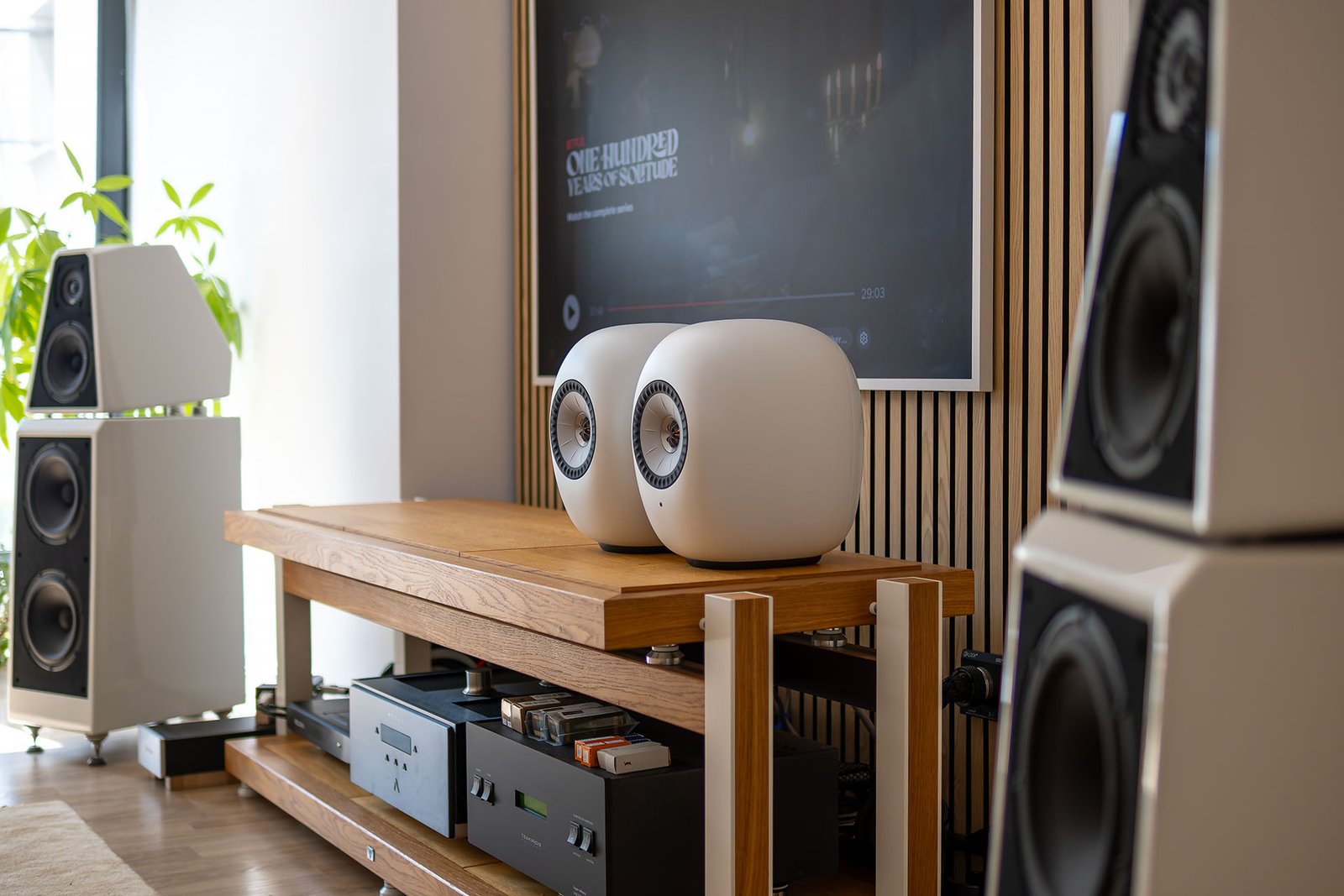
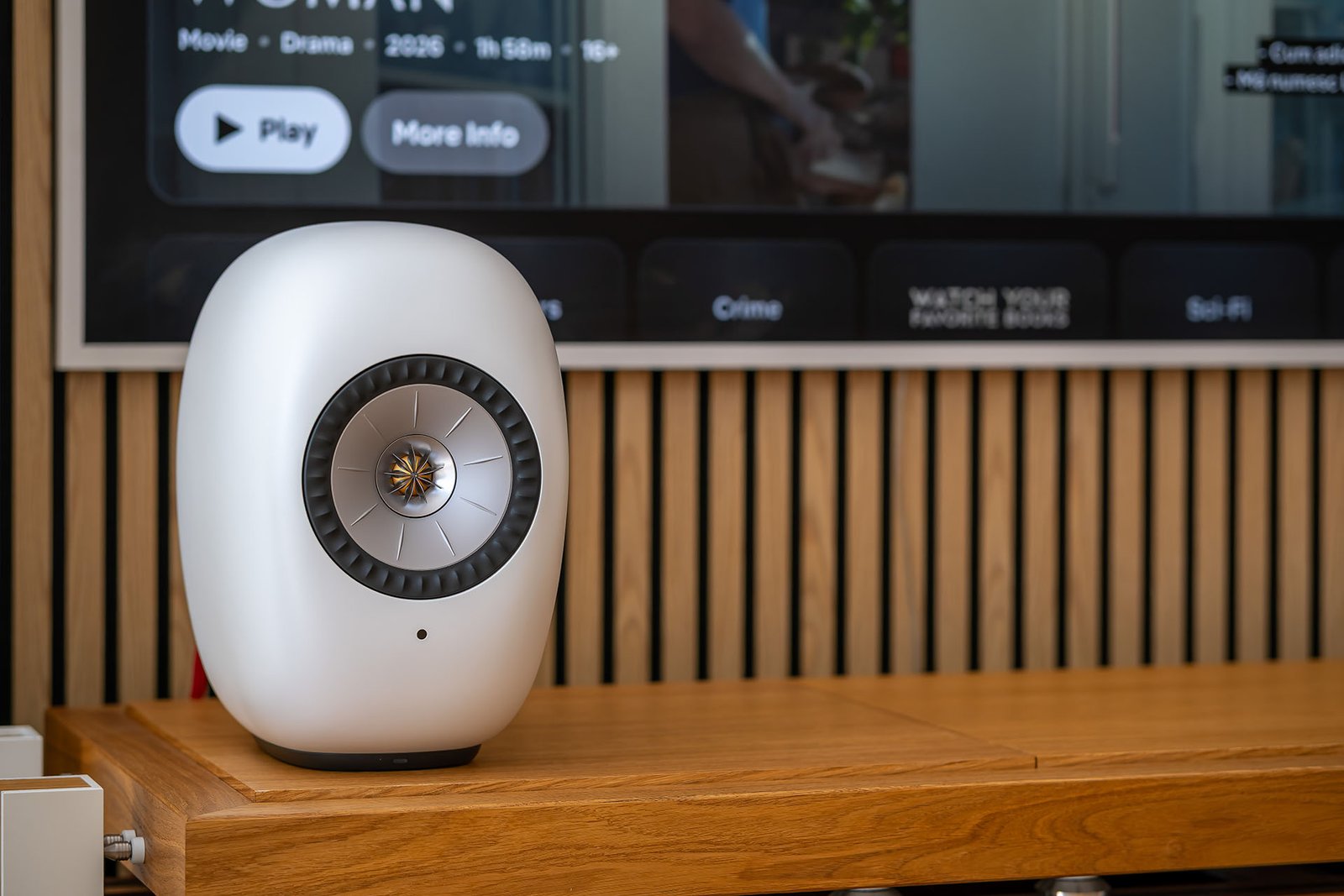
And they never left. It later became the LSX II, but it never really left. Equipment has passed through this house in quantities I would rather not total, much of it more expensive and far more serious, and a lot of it went back. The LSX II stayed. They moved off the desk into the office, where they replaced a soundbar from a well-regarded brand and embarrassed it so completely that I gave the episode its own chapter. They are still there tonight, under an OLED on which the news remains permanently forbidden, because I am not burning in another screen for anybody.
So when KEF announced a speaker on the thirtieth of July this year sharing the LS name, roughly the footprint and the entire philosophy of those small white ones, then calmly attached nearly three times the price, I did not have the usual question. I had a feeling it would be good. My question was: how far is it possible to travel in seven years, inside the same shape, under the same three letters?
Considerably further than I was prepared for.
Captain Organic
Ross Lovegrove was born in Cardiff in 1958, and the design world calls him Captain Organic, a nickname you only earn by refusing for forty years to draw anything with a corner in it.
He learned the trade at Frog Design in Germany, working on Sony Walkmans when the Walkman was the most desirable object on the planet. Then Paris, consulting for Knoll. Then his own studio, the Ty Nant water bottle, which looks like water that decided to stand up on its own, and the Go chair, a magnesium skeleton in the permanent collection of MoMA. His method never changes. Find where the loads travel, delete everything not carrying one, and what remains will look like nature, because nature solved the same problem first.
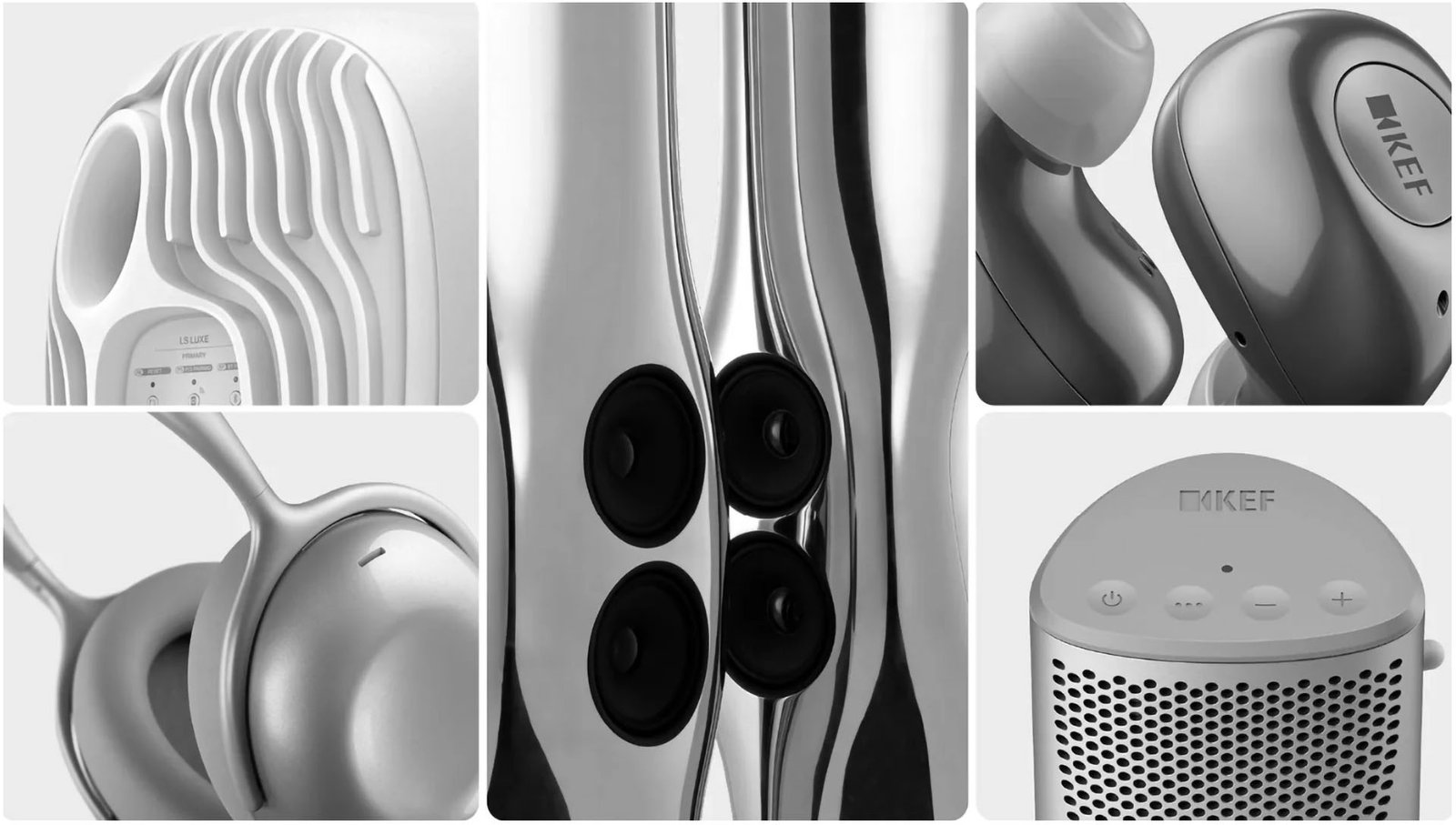
He has been in KEF’s orbit since 2007, when he drew the Muon. Two meters of superformed aluminum per channel, a hundred pairs in existence, listed on KEF’s own site today at €230,000. Then the Muo Bluetooth speaker and the Mu3 earphones. So the LS LUXE is not a celebrity signature dropped onto somebody else’s box. It is the fourth act of a nineteen-year conversation, and the most disciplined thing he has drawn for them.
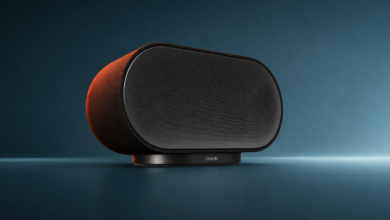
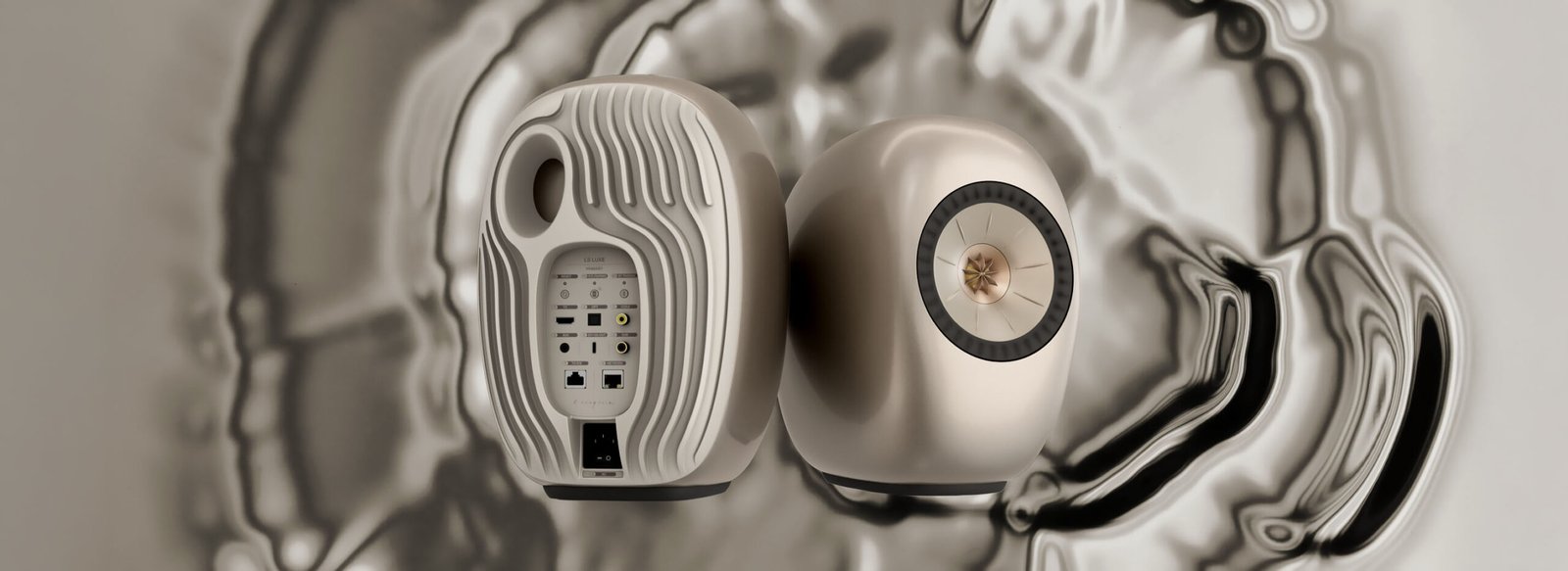
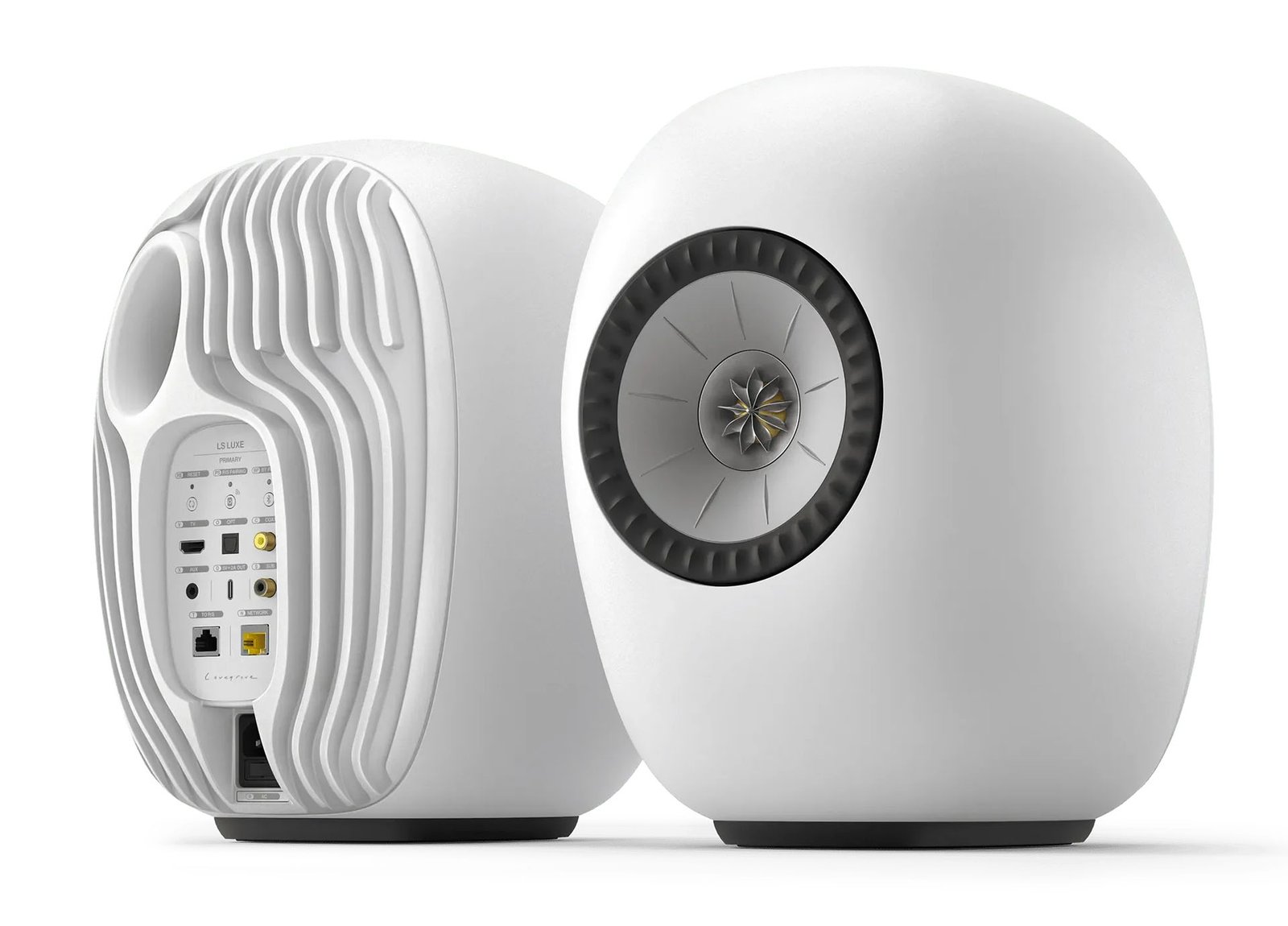
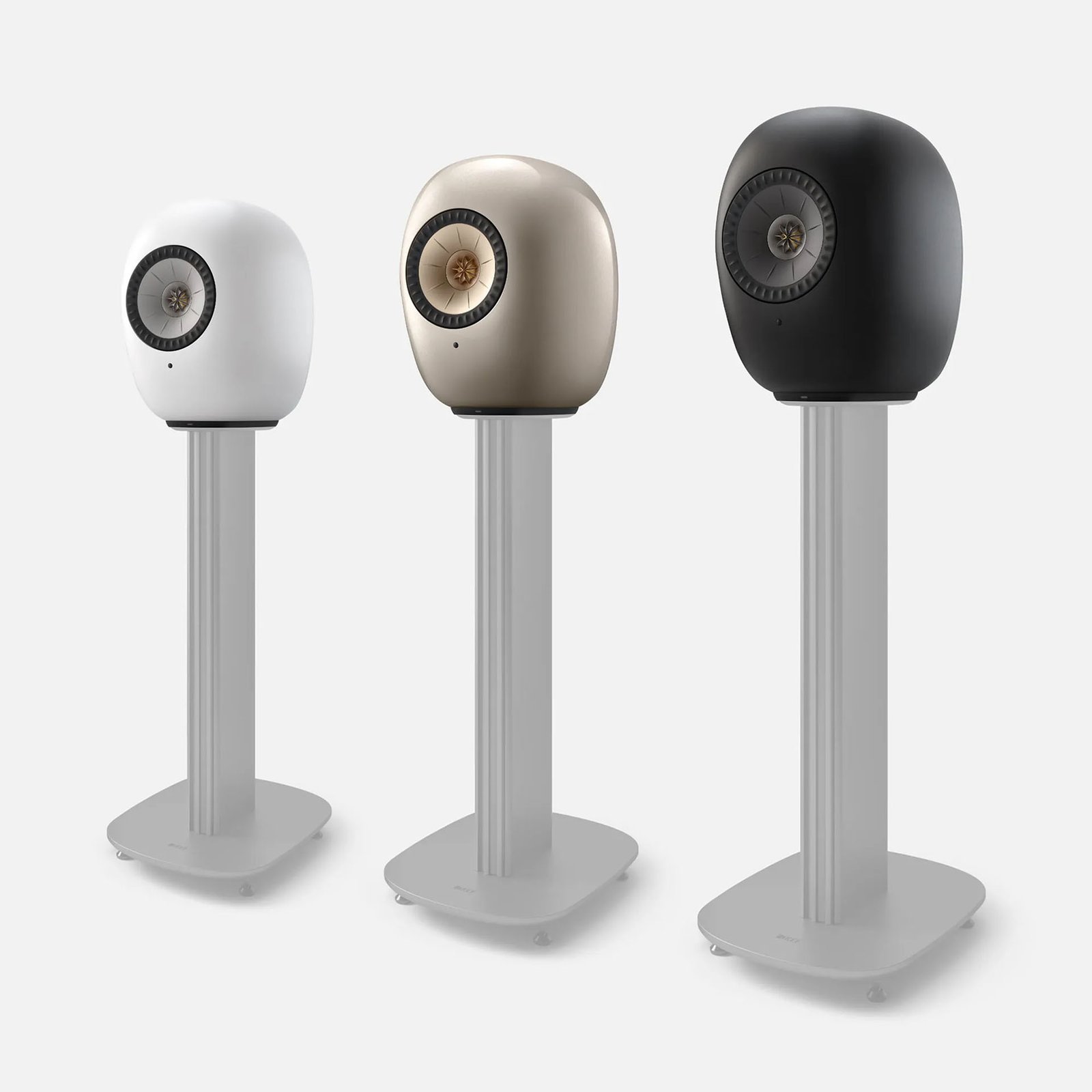
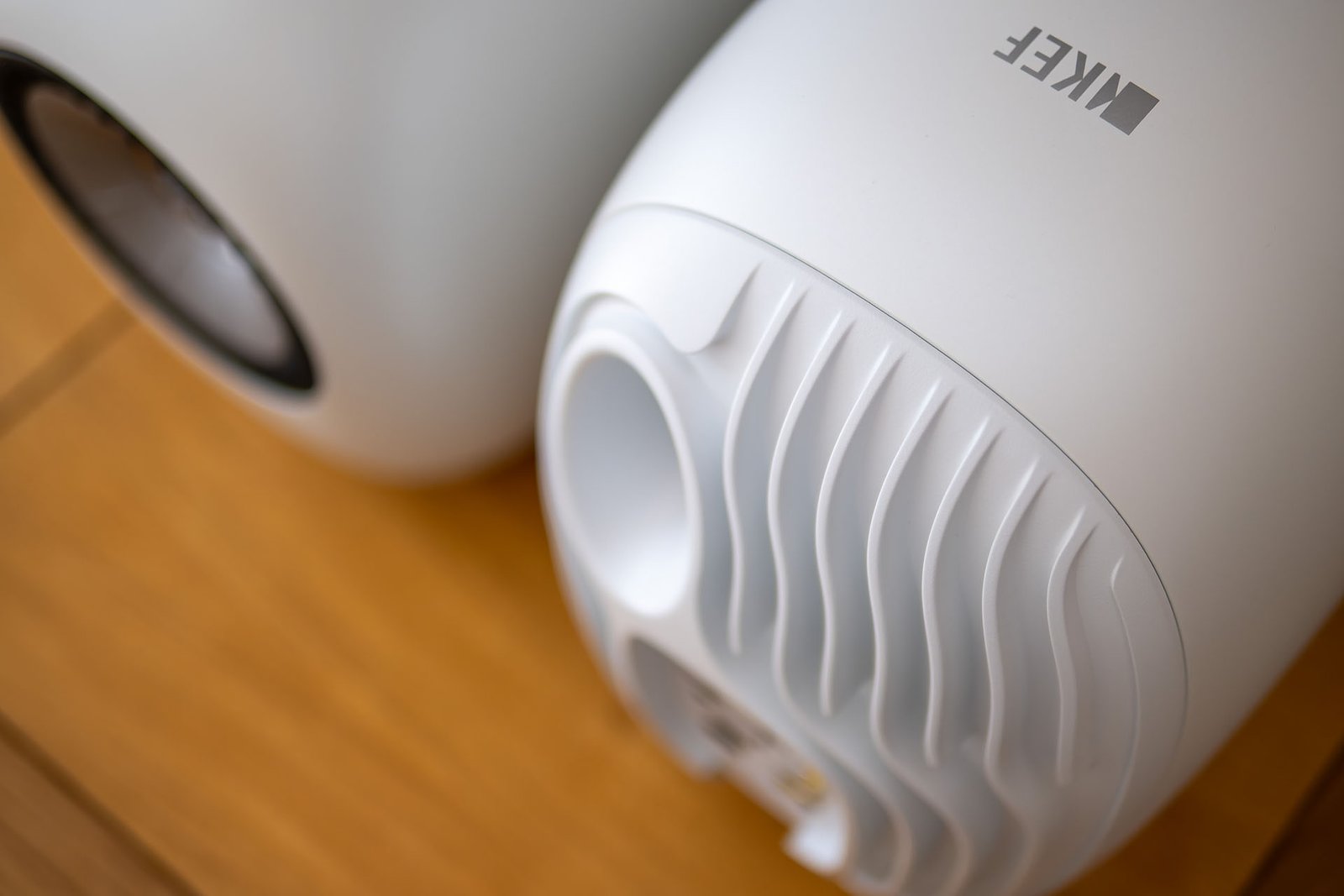
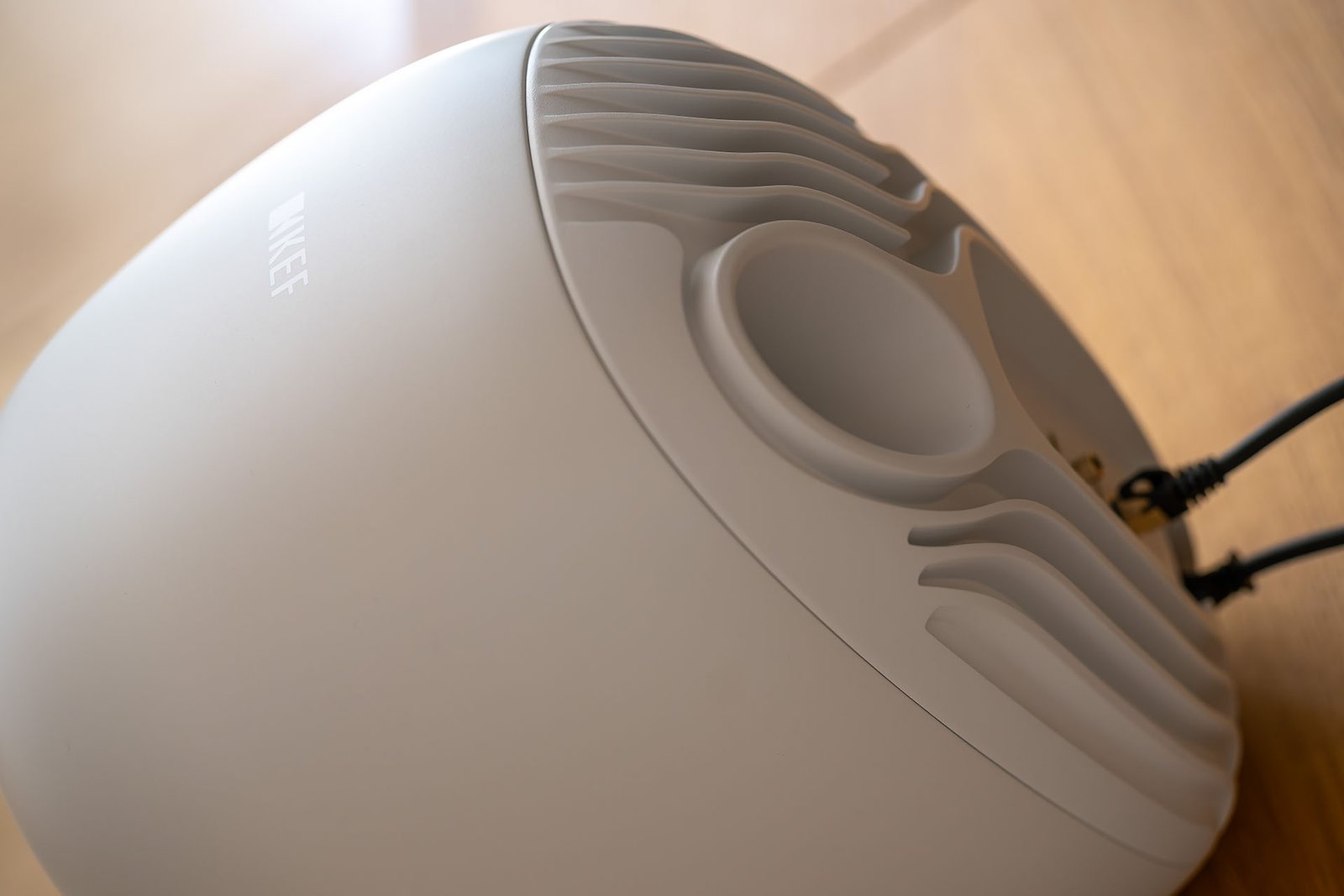
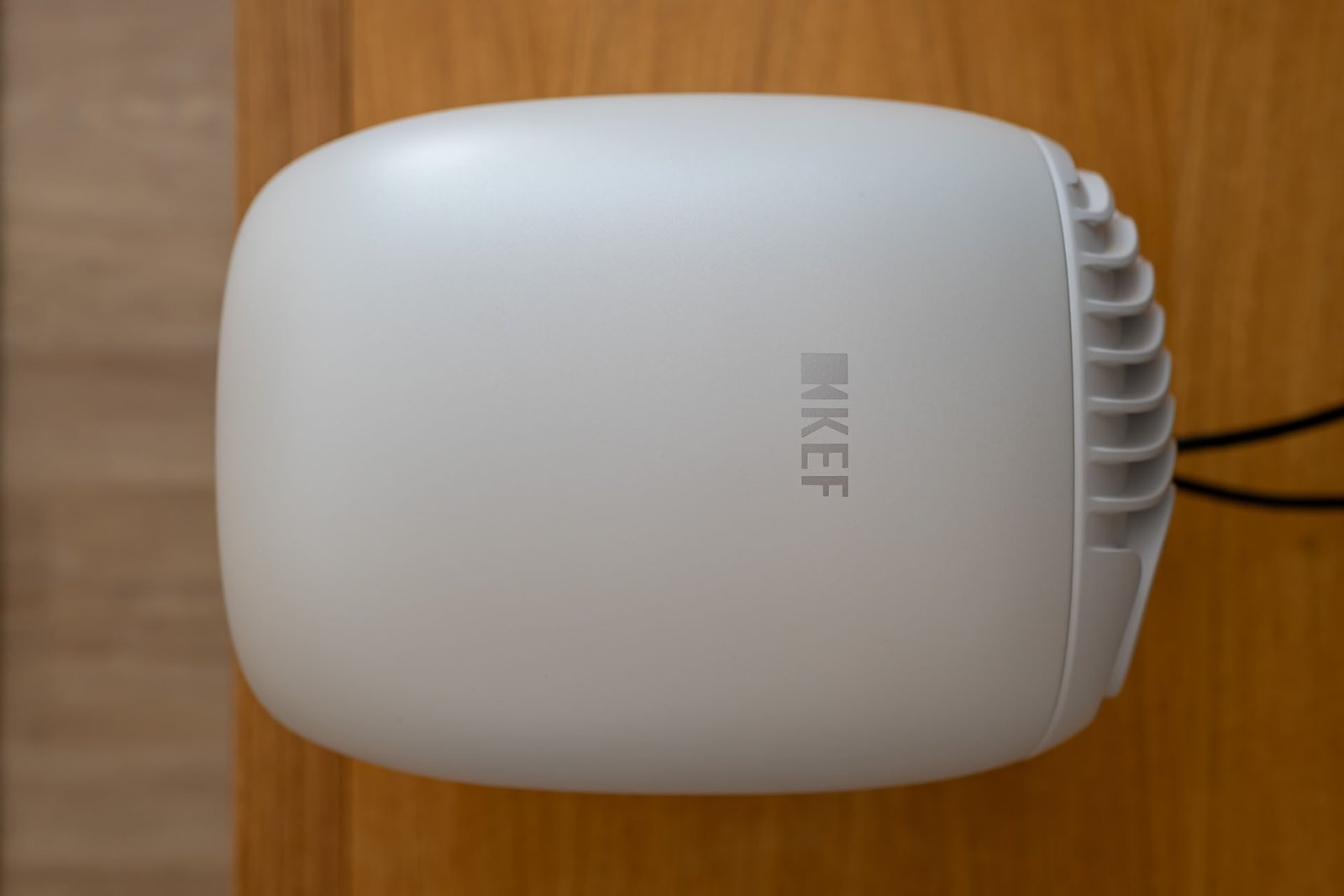
The cabinet is 336 mm tall, 223 wide, 298 deep, with not one straight line on it. The front gathers around the Uni-Q like a drum skin being pulled taut, the sides fall away in a single continuous curve, and from any angle the form reads as one gesture with nothing left over. And there are no fixings. No trim ring, no badge, no visible screw head, nothing at all. KEF’s engineers asked for that, and Lovegrove delivered it, and I will come back to why, because it has almost nothing to do with taste.
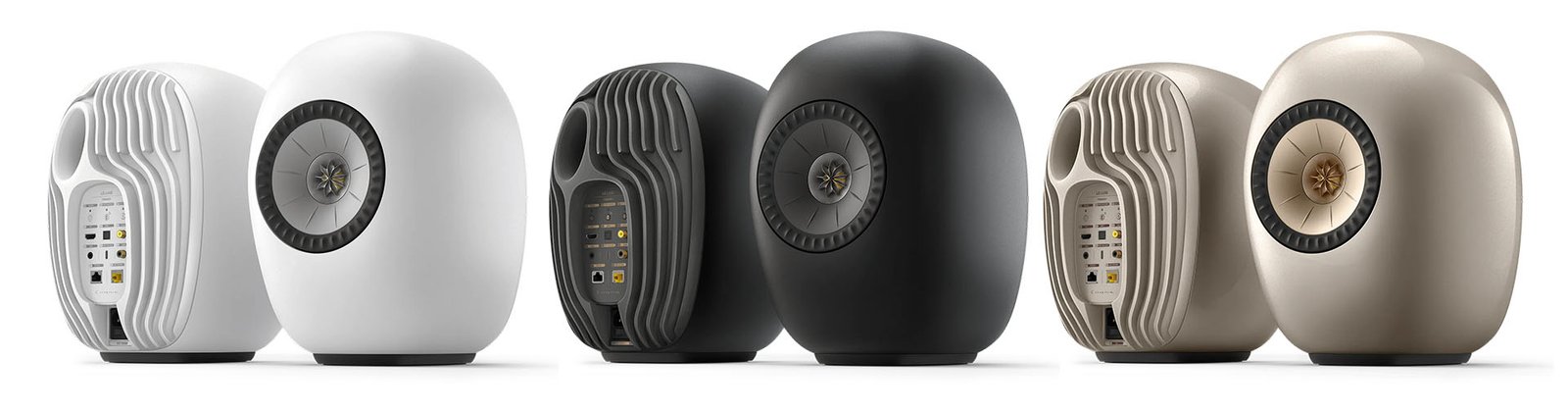
Three finishes, all at the same price, which I appreciate, because charging extra for white is one of the uglier habits in this business. Dusk Titanium, a deep warm grey that moves under changing light. Eclipse Black, matte and absorbing. Mineral White, luminous, the one that will sell itself to architects before anybody has heard it.
One detail I did not expect to find on a paint chart. KEF’s own description of the Dusk Titanium finish says it reveals cymatics, sound waves rippling across a surface into geometric and organic patterns. Sound made visible, in the skin of the thing making it. In a review that has already borrowed from a book where a trickle of blood crosses a town to find the right mother, and a woman ascends into the sky while folding the laundry, I am not going to pretend that is not slightly perfect.
The Box That Wants To Be a Sphere
Here is where the sculpture stops being sculpture. KEF’s white paper states the target without any poetry. The cabinet is designed to approach the acoustical ideal of a rigid sphere as closely as possible. Not inspired by a sphere. Approach one.
The reason is diffraction, and it explains a great deal about why expensive speakers sound expensive. As a wavefront travels across the front of a cabinet, every edge, trim ring, screw head, and proud little badge becomes a secondary source, re-radiating a smeared, delayed copy of the music into the room. You do not hear an echo. You hear a loss of focus, a faint fog around instruments, a soundstage sitting on the front panel instead of behind it. A sphere has no edges, so it has nothing to re-radiate from.
KEF published the comparison, and it is blunt. This cabinet sits far closer to a perfect sphere than to a conventional box. That is exactly why it has no single fixing. Every screw head would have been one more little re-radiator standing in the path of the wavefront. The unbroken surface is not Lovegrove being precious. It is the acoustic requirement and the aesthetic ambition arriving, for once in this industry, at the same answer.
Getting that shape with a finish that has to justify €4,000 took a material. KEF developed a custom blend of glass fiber-reinforced BMC, bulk-molded compound, from the family used for the front baffle of the LS50 Meta. It is far stiffer than the plastics you would normally mould, and a shell that stiff, combined with a decoupled driver chassis, meant no bulky internal bracing was needed to keep the cabinet quiet. Every cubic centimeter they did not spend on bracing went straight back into the bass. Internal volume here is roughly fifty percent larger than the LS50.
Read that again, because it is the whole trick. The sculpture is not costing this speaker its bass. The sculpture is buying the bass.
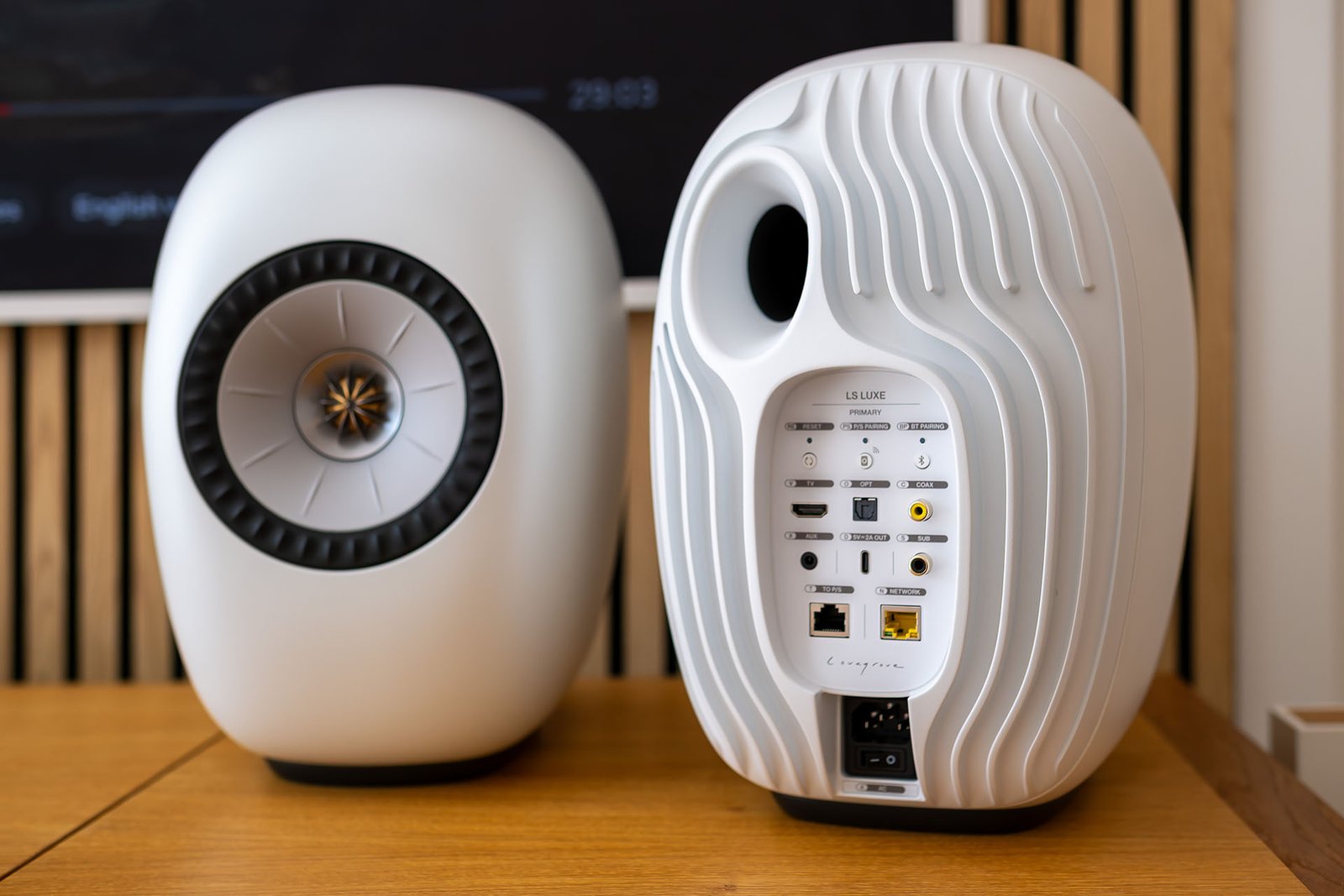
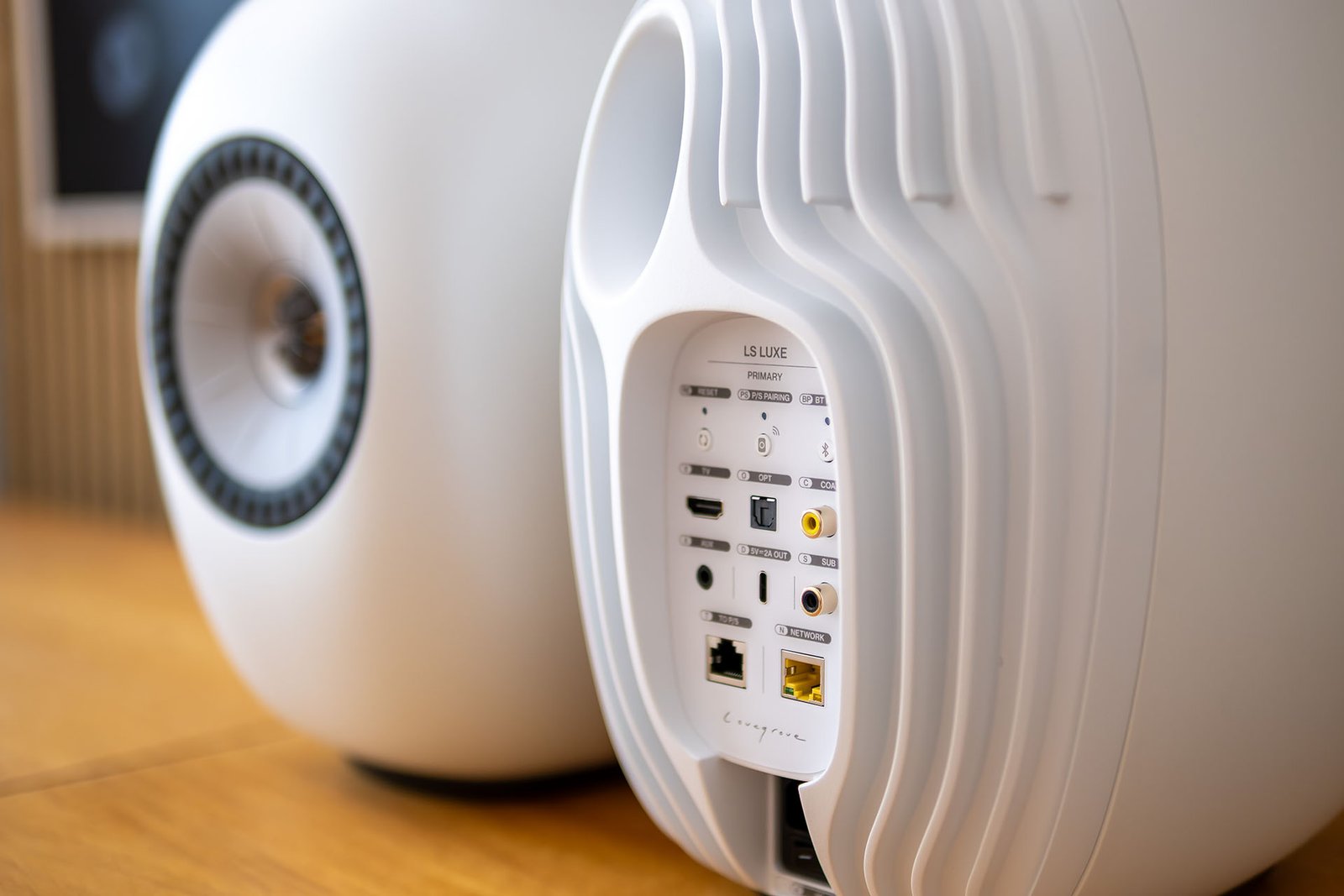
Then the back, my favorite piece of industrial design on the whole speaker. A large die-cast aluminum heatsink carries away heat from the amplification mounted directly behind it, and hidden inside the folds of those fins is the port. A flared opening shaped for laminar airflow, using KEF’s Flexible Port technology, where the walls deform locally to suppress internal resonances instead of letting them sing back out through the music. A heatsink that is also a port. Somebody in Maidstone had a very good week.
Twelve Generations of One Stubborn Idea
The Buendías spend a hundred years handing the same two names down the generations. Every Aureliano is a variation on the last Aureliano, every José Arcadio repeats a José Arcadio, and not one of them escapes the pattern. Repetition without progress is the engine of that novel and the tragedy of it.
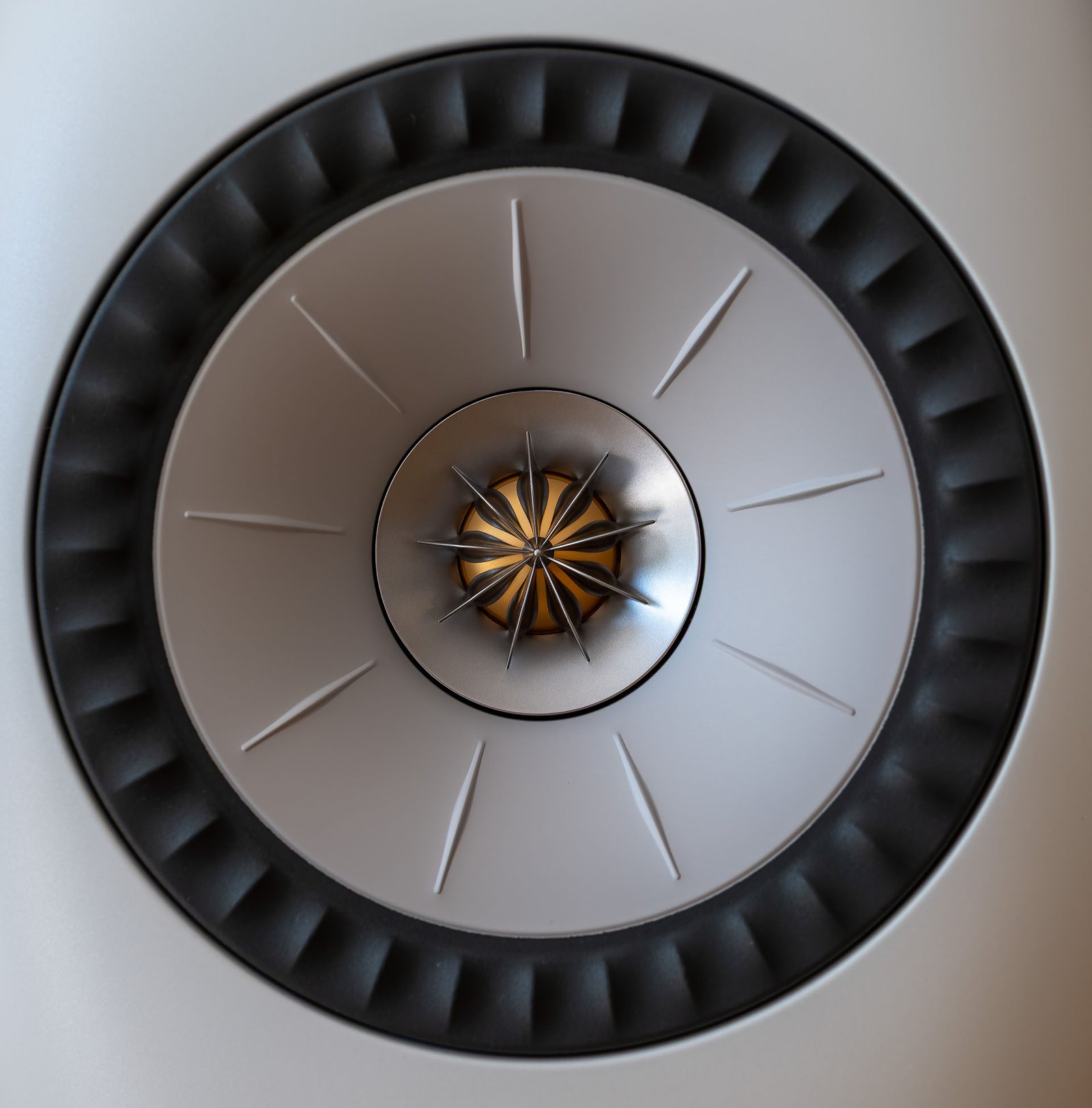
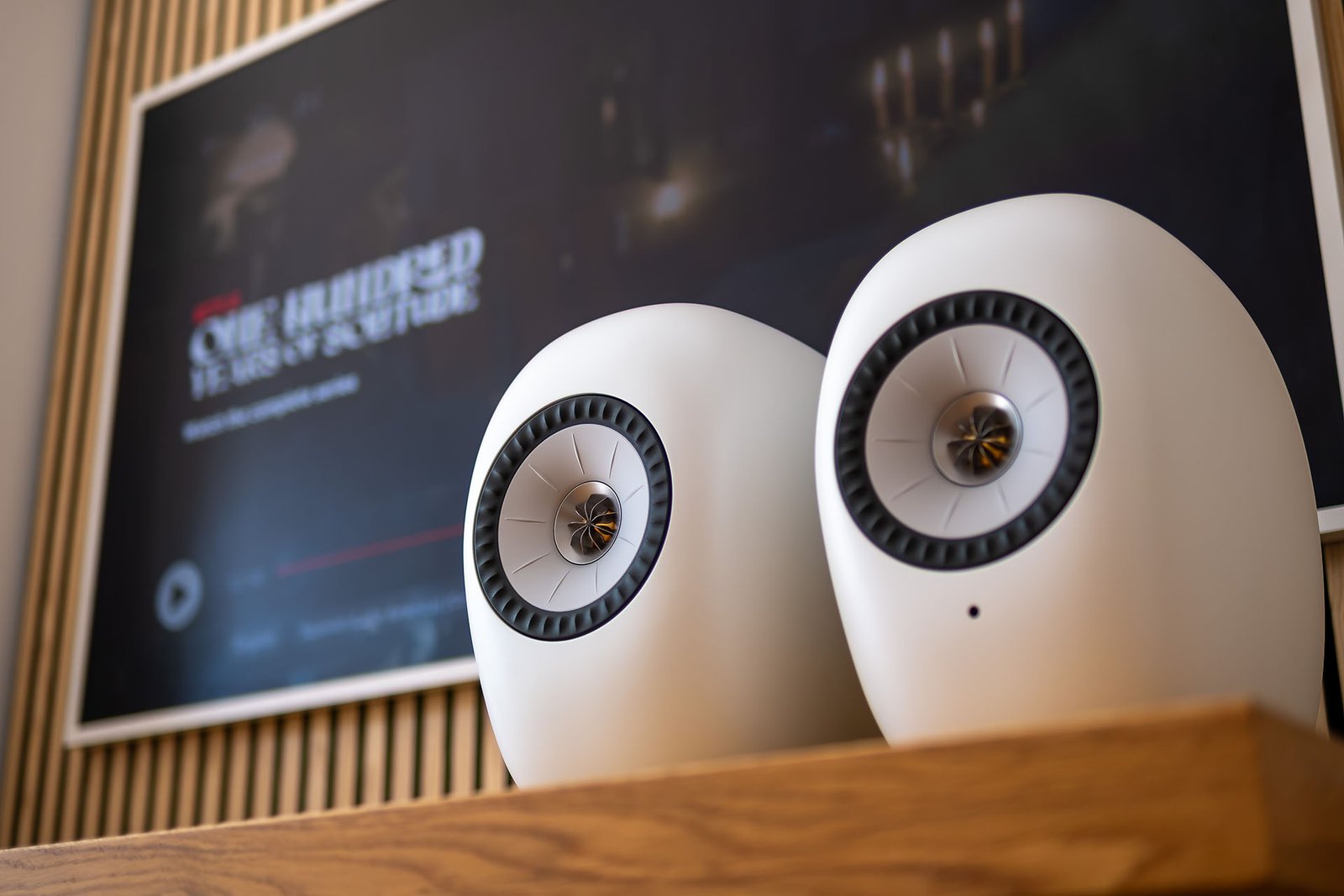
Uni-Q is on its twelfth generation, and the difference, which is the entire point, is that these repetitions get somewhere. KEF put the tweeter at the acoustic center of the mid-bass cone in 1988 and has spent thirty-eight years refining the same conviction: that the sound of a two-way loudspeaker should leave from one place, because that is how sound leaves a cello.
In a conventional speaker, the two drivers sit at different heights, so for every listener except one, they are slightly different distances from your ears. Their outputs arrive out of step; they interfere, and you get a narrow sweet spot and a presentation that changes when you lean forward for your glass. Put the tweeter in the middle of the cone, and the problem stops existing.
I wrote about the eleventh generation in the LSX II, with its 11.5 cm mid-bass and 1.9 cm tweeter. The twelfth is a different animal from the same family.
- LF/MF: 165 mm, 6.5 inch, aluminum cone
- HF: 25 mm, 1 inch, vented aluminum dome with MAT
- Tangerine Waveguide, Tweeter Gap Damper, and Cone Neck Decoupler, the refinements defining this generation
The jump from 115 mm to 165 mm is not an increment. That is more than double the radiating area, in a cabinet with half again the internal volume, driven by a motor with a velocity sensor living inside it.
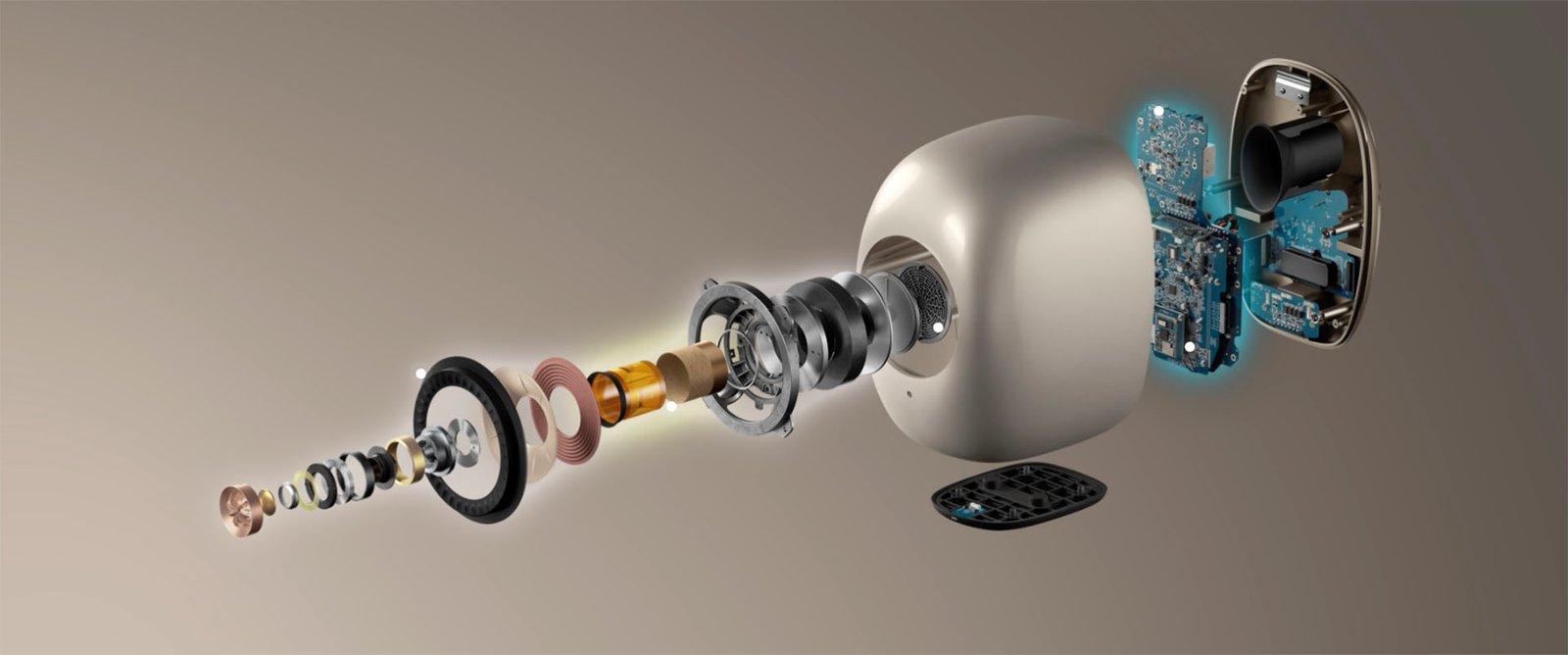
MAT deserves a paragraph, because it is the most elegant physics in KEF’s catalog. Metamaterial Absorption Technology, a joint development with the Acoustics Metamaterials Group, is a small disc behind the tweeter dome built as a labyrinth of narrow channels, each tuned to swallow one frequency. Between them, they absorb 99 percentof the sound radiating backward off the dome, energy that in a conventional tweeter returns through the diaphragm a fraction of a millisecond late and is heard as hardness.
And here it quietly does a second job. All that absorption damps the tweeter’s own resonance and flattens the peak in its electrical impedance, which is exactly what you need to run a tweeter from a current-drive amplifier without putting a velocity sensor in it as well. The metamaterial earns its keep twice, acoustically and electrically.
A Loudspeaker That Listens To Itself
This is the chapter the engineers at KEF would want you to read, so they even released a white paper with their new product.
Practically every loudspeaker you have owned is driven by voltage. The amplifier holds a voltage at the terminals and then, to put it unkindly, stops caring. Whatever current flows is whatever the driver’s impedance decides to draw. Harmless, until you remember that the force a driver produces is set by the current in the voice coil, not the voltage across it. The amplifier has spent a century controlling the wrong quantity and hoping for the best.
Meanwhile, the coil heats as it works and its resistance rises, so the speaker gets quieter as the evening goes on. Inductance changes with position, the magnetics are nonlinear, and each error corrupts the instantaneous current. Since current is force, everyone leaves the speaker as distortion.
Current drive fixes the category error at the root. The amplifier regulates current instead of voltage, presenting a deliberately high output impedance so the driver can no longer modulate the signal. Distortion falls. Thermal compression nearly disappears. KEF’s multitone measurements show midrange distortion products dropping 10 to 20 dB.
So why has nobody shipped it?
Because current drive breaks the bass. Spectacularly. With a voltage amplifier, the driver’s own motion generates a back ElectroMotive Force (EMF), and at resonance that back-EMF raises the impedance and pulls current away from the driver, damping it. Free electrical braking, and the only reason woofers behave themselves. A current amplifier refuses to be fooled. It sees the back-EMF, shrugs, and raises its output voltage to deliver exactly the current it intended. What you get instead is an enormous peak at the driver’s resonance, and in a ported box, two of them.
That brings us to VECO, Velocity Control Technology, and why this loudspeaker exists.
If the amplifier cannot feel the driver moving, give it a sense of touch. VECO is a patented electromagnetic sensor that measures the voice coil’s velocity in real time while music plays, feeding it back into the current-drive amplifier as a negative feedback loop. It replaces the braking that the back-EMF used to provide, and does it better by linearising the driver’s velocity directly. That is most valuable at low frequencies, where the cone moves fastest and behaves worst.
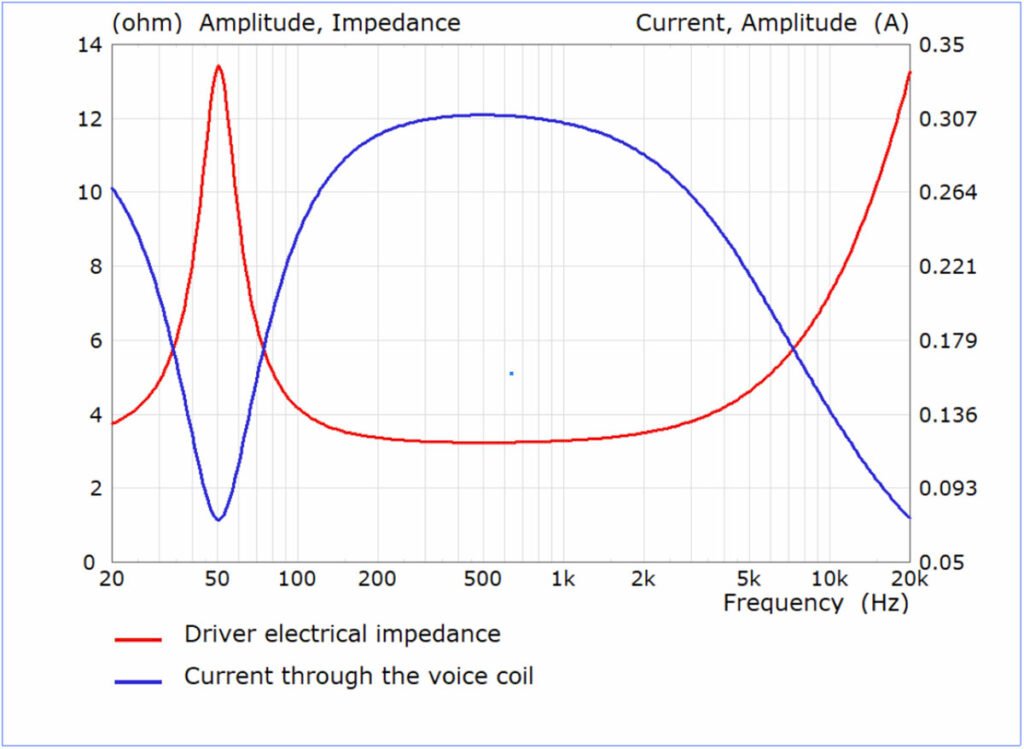
Relationship between driver electrical impedance and the current flowing through its voice coil under conventional voltage-drive operation (KEF LUXE white paper).
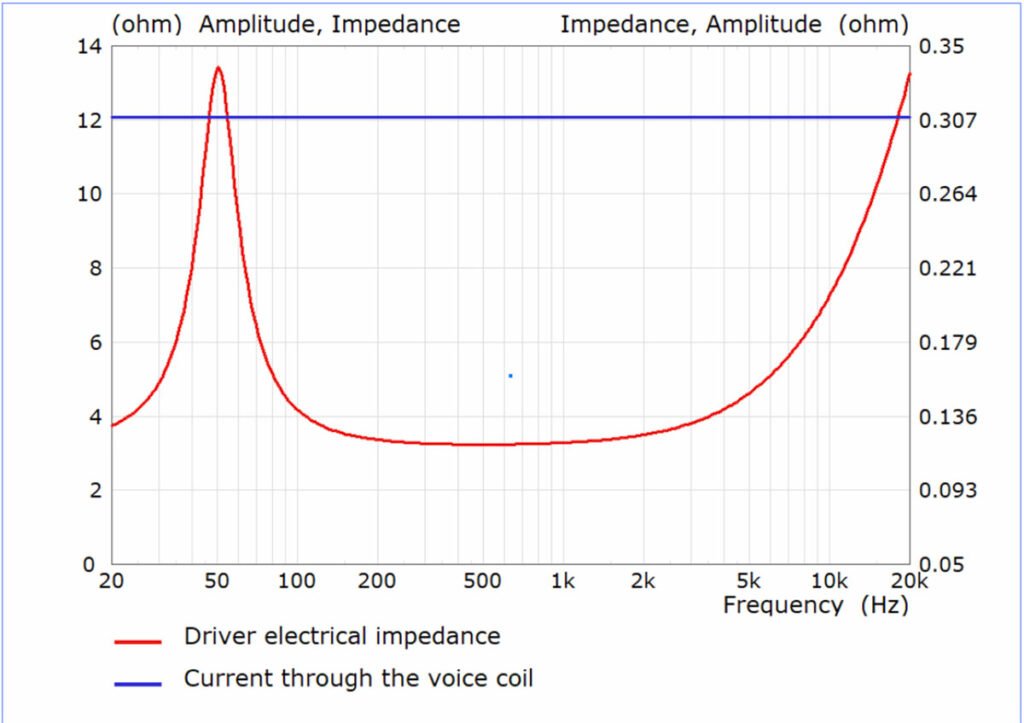
Relationship between driver electrical impedance and the current flowing through its voice coil under current-drive operation (KEF LUXE white paper).
The implementation is where I started grinning.
The sensor is a coil printed on a flexible circuit board, and rather than adding it to the motor, KEF used it to replace the former voice coil it was wound around. It occupies no extra space and needs no power, because induction works for nothing. And the obvious objection, that a sensing coil sitting on a voice coil is just a transformer that will pick up the drive signal and report it back as movement, is answered by a winding geometry I would cheerfully frame and hang on a wall. Four loops with alternating winding directions, each axis perpendicular to the voice coil’s. The coupling cancels. The sensor goes deaf to the drive signal while staying sensitive to motion.
Its own magnetic circuit is eight small neodymium magnets and two steel rings, focusing the field into exactly the four regions where the four loops are listening. Total track length across both faces of the board: fifty-five meters. Fifty-five meters of printed copper, inside the motor of a bass driver, so an amplifier can feel what a cone is doing. KEF checked it against a laser Doppler vibrometer, and the sensor tracks real cone velocity up to 400 Hz.
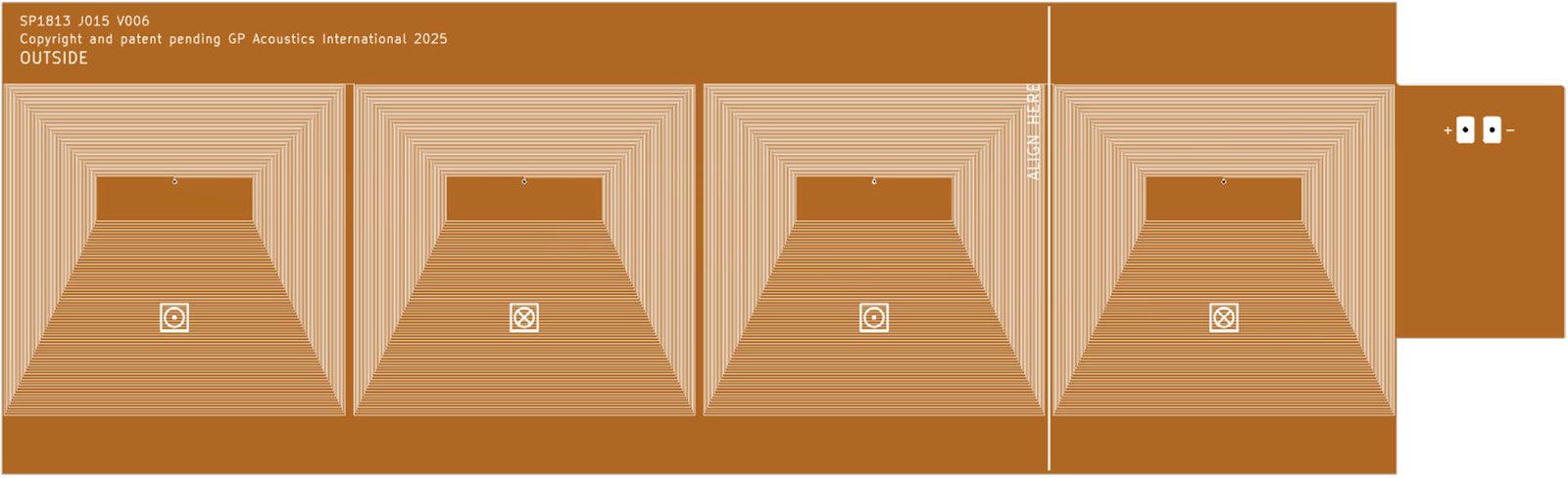
LS LUXE VECO sensing coil printed on a multi-layer flexible PCB (FPCB). Total track length across all four loops on both sides is approximately 55m.
José Arcadio Buendía traded a mule and two goats for two magnets and turned up a skeleton in a suit of armor. KEF used eight and found what they were actually looking for. I know that is a cheap joke, and I am keeping it because somebody in Maidstone spent six years earning it.
The idea is not new, and KEF are decent enough to say so in print. Philips shipped motional feedback with accelerometers in the 1970s, and Mills and Hawksford published on current drive with motional feedback in 1989. It fell out of fashion because nobody could make a sensor small, fast, and passive enough to live inside a real driver, let alone inside a Uni-Q. That is the barrier KEF has cleared.
Credit where it is due, this is not VECO’s first outing. It arrived earlier this year in the XIO soundbar, which is where the technology was proven in public. What is new here is the harder problem. The LS LUXE is the first product anywhere to apply velocity feedback to a ported system, giving engineers feedback gain and bandwidth as two extra tuning parameters for bass alignment, on top of the box’s physical design.
The scoreboard, all of it from KEF’s measurements against the LS50 Wireless II at matched output.
- 8 to 10 dB more acoustic output below 40 Hz
- 6 to 14 dB lower total harmonic distortion through bass and midrange
- 10 to 20 dB lower multitone distortion products in the midrange
- 280 W Class D on the LF/MF and 100 W Class AB on the HF, per speaker
- 110 dB maximum SPL at one meter
- 42 Hz – 28 kHz at ±3 dB, 35 Hz – 47 kHz at minus 6 dB, depending on EQ
Six years of development since the LS50 Wireless II, according to the people who did it. You can hear where it went. One detail for the romantics: KEF’s founder Raymond Cooke left a line about what this company is for, and the white paper still opens with it. Music returned to your ears, he wrote, without drama, without exaggeration, without artifice.Three decades after his death, they put fifty-five meters of copper into a circuit board to keep the promise.
Two things before you take my word for any of this. TechRadar found the LS LUXE unusually fussy about positioning, wanting only the smallest amount of toe-in, and toe-in changes how much treble energy actually reaches your chair. And KEF’s Treble Trim adjusts the broadband slope in either direction, so anyone reporting on this speaker’s tonal balance owes you their setting. Mine were barely toed in, and the Treble Trim stayed at zero for every session described here.
Everything In the House Plugs Into This
The LSX II review had one sentence that still holds up. I wrote that HDMI eARC was the most important thing the second generation brought, more important than the sonic improvements, and that it was a must-have for today’s connected devices. Three years later, I still believe it. On the Primary speaker:
- HDMI eARC, up to 192 kHz / 24 bit
- TOSLINK optical to 96 kHz / 24 bit, and digital coaxial to 192 kHz / 24 bit
- Analogue 3.5 mm auxiliary, for a turntable through a phono stage or anything with a headphone socket
- RJ45 Ethernet for the network, a second RJ45 for the wired interspeaker link
- RCA subwoofer output, plus USB Type-C charging at 5 V / 2 A
The Secondary takes the interspeaker link and provides its own subwoofer output, and that is worth underlining. Two dedicated wired subwoofer outputs, one per channel. Most active speakers give you a single mono sub feed and call it done. Two means two subwoofers, each fed its own channel, which is how you want to do it if you do it at all. If you would rather not run another cable, the KW1 wireless adapter handles it.
Network playback runs to 384 kHz / 24-bit, and the format list is the full buffet: DSD through FLAC, WAV, AIFF, ALAC, and the rest. One real decision, though. The link between the two speakers resamples everything at 192 kHz / 24-bitover the supplied cable and 96 kHz / 24-bit wirelessly. If you care about the last increment, run the cable. Three meters come in the box, which tells you what KEF would prefer.
Wireless covers AirPlay, Chromecast, UPnP, Bluetooth 5.3 and Audirvāna, with Roon Ready promised for 2027 as a free update. Native Connect support covers Spotify, Tidal, Qobuz, Amazon Music, and Deezer, and Wi-Fi is dual-band 802.11ax on a product whose predecessor shipped with a much older radio.
KEF Connect, and the Part Where the DSP Earns Its Money
I said in 2023 that KEF Connect was one of the most polished applications I had tested. Now it does far more than choose inputs.
- Bass extension, shown as Room size in normal mode, three settings, each a genuinely different low-frequency alignment rather than a tone control
- Wall mode for the bass lift you get near a large reflective surface, and Desk mode for a shelf underneath
- Treble Trim, redesigned here, adjusting the broadband spectral slope in either direction. KEF even suggest a reverberation time of 0.3 to 0.35 seconds, as the line either side of which you should reach for it
- Phase Correction, an FIR filter optimized for this speaker, which visibly reduces the overshoot after the main impulse peak
- Subwoofer presets for every current KEF subwoofer, wired or over KW1, with gain and latency compensated automatically
That subwoofer list is the feature I praised in the LSX II review, grown up. Choose your model from a menu, and the speaker sorts out the crossover, the gain, and the timing. Five minutes, against an afternoon and a measurement microphone.
Phase Correction deserves its own sentence, because people will leave it on without knowing why the speaker suddenly got better. It fixes the smear after a transient. Switch it on, and cymbals stop trailing, plucked strings stop blooming, and the whole presentation tightens in a way that has nothing to do with frequency response.
The same honest note on DSP I always make. None of this is magic. Desk mode cannot turn a shelf into a stand, and Wall mode cannot undo a corner. What it does is remove the penalty for living in a house with furniture in it.
The Setup, and a Rack That Was Never Designed For This
I did this in two stages on purpose, because the two stages describe two completely different customers and both deserve an answer.
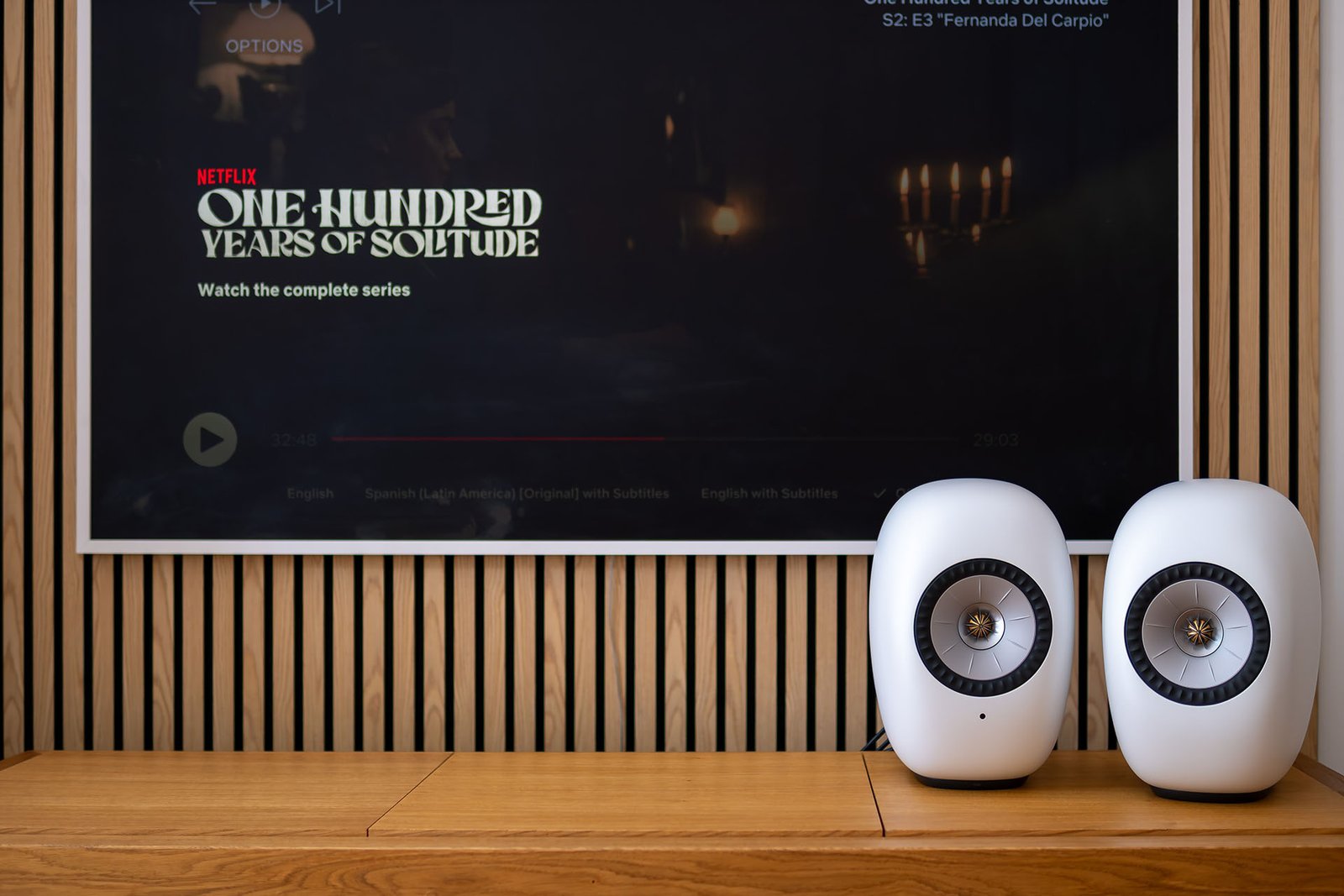
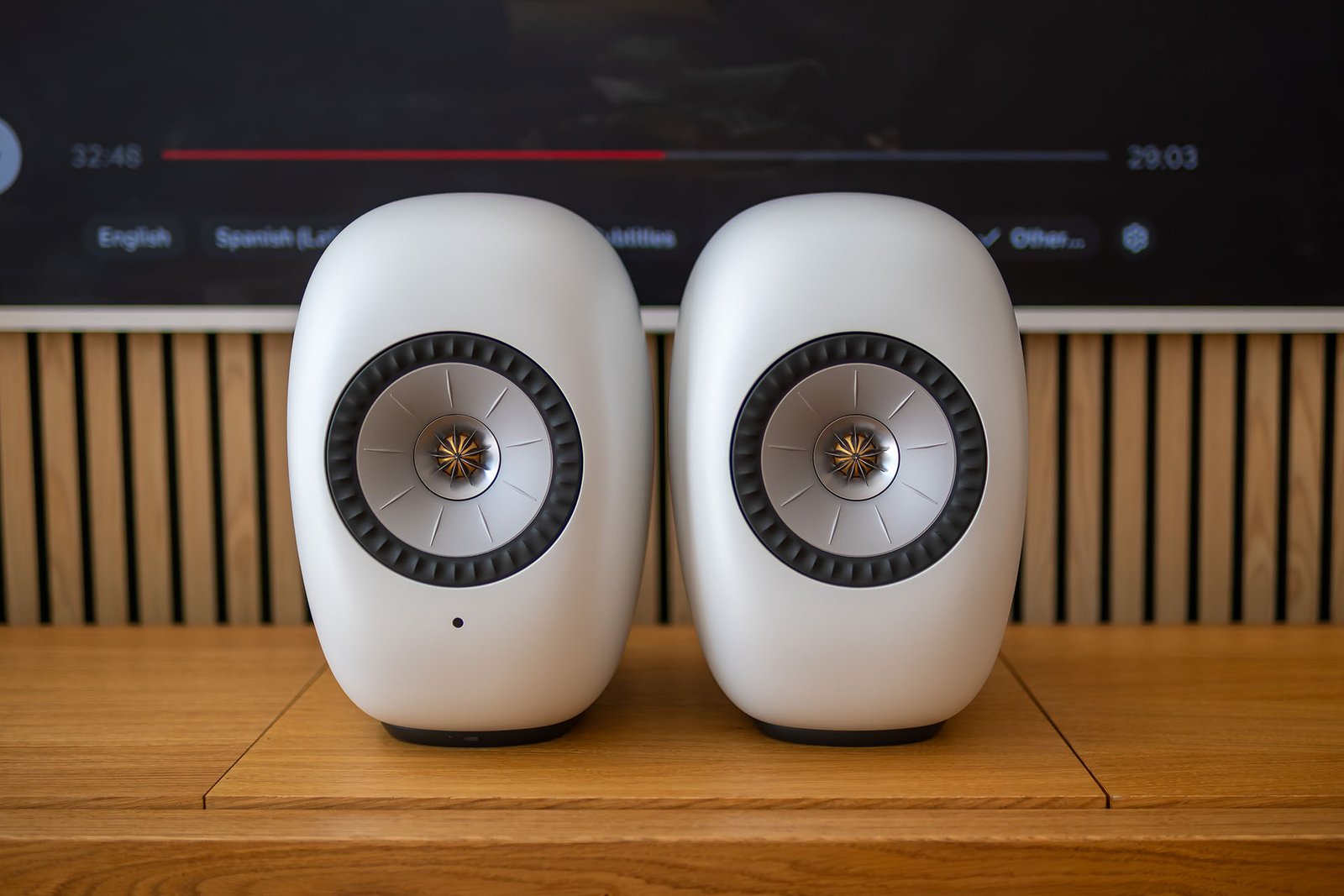
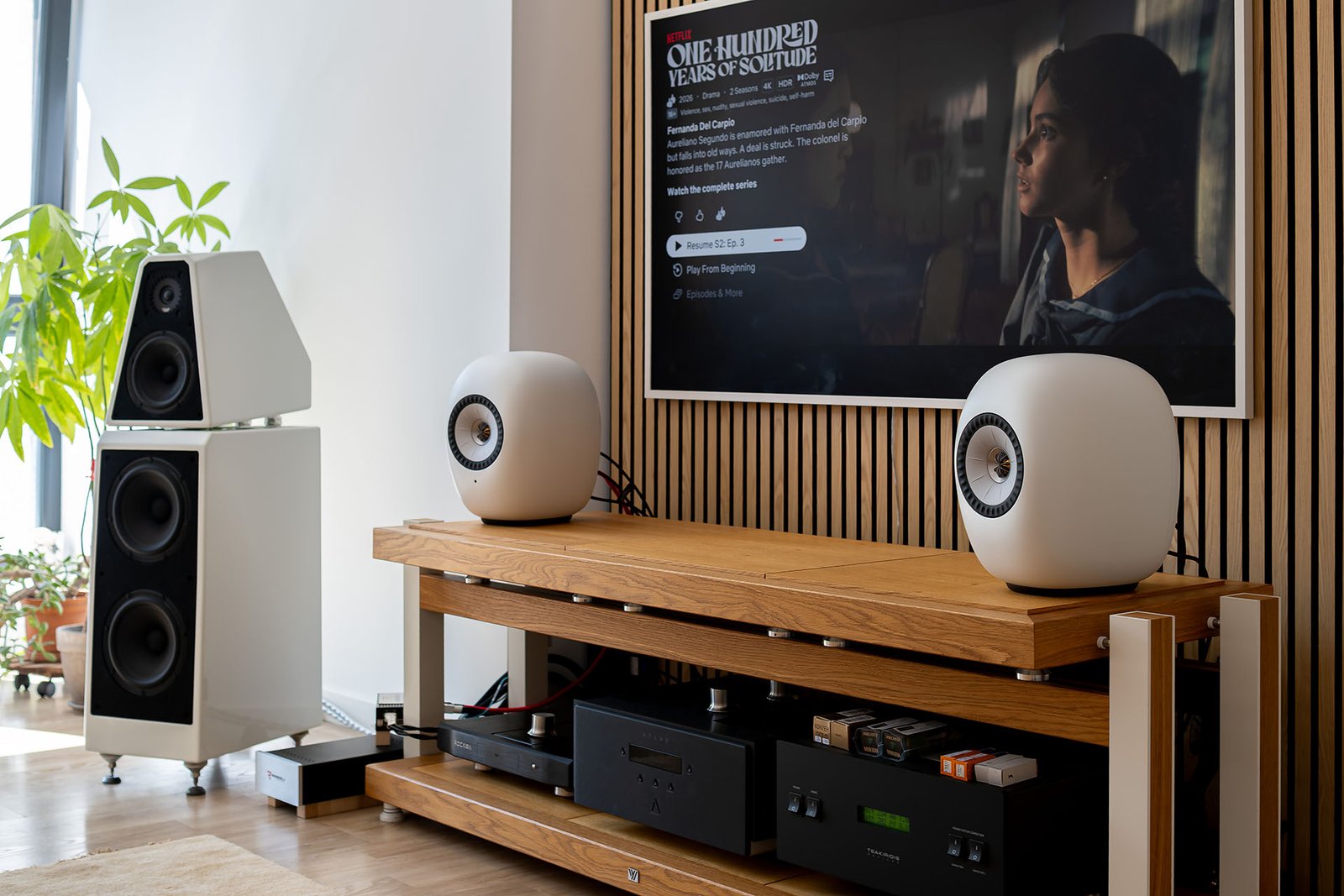
Stage one was the honest one. The LS LUXE went onto the open rack under the television, roughly where a soundbar would live, with as much separation as the furniture allowed and no more. HDMI eARC into the TV, interspeaker cable behind the rack, network over Ethernet. Desk mode at minus 3 dB, Wall mode at minus 3, bass extension on Normal. The rack has a huge advantage over a standard credenza, namely the vibration control it provides through decoupled shelves and high mass.
This is the configuration nobody writes about, and almost everybody lives in. And it is not a compromise I tolerated in order to be thorough. The whole argument of the LSX II review was that two small honest speakers in a bad position will still take a soundbar apart. I wanted to know what six years of engineering does to that argument.
Stage two came later and closed a circle that had been open for three years. In 2023, I wrote that I would love to put the LSX II on stands and couldn’t, for lack of space, and that I knew exactly what I was giving up. I finally got the stands.
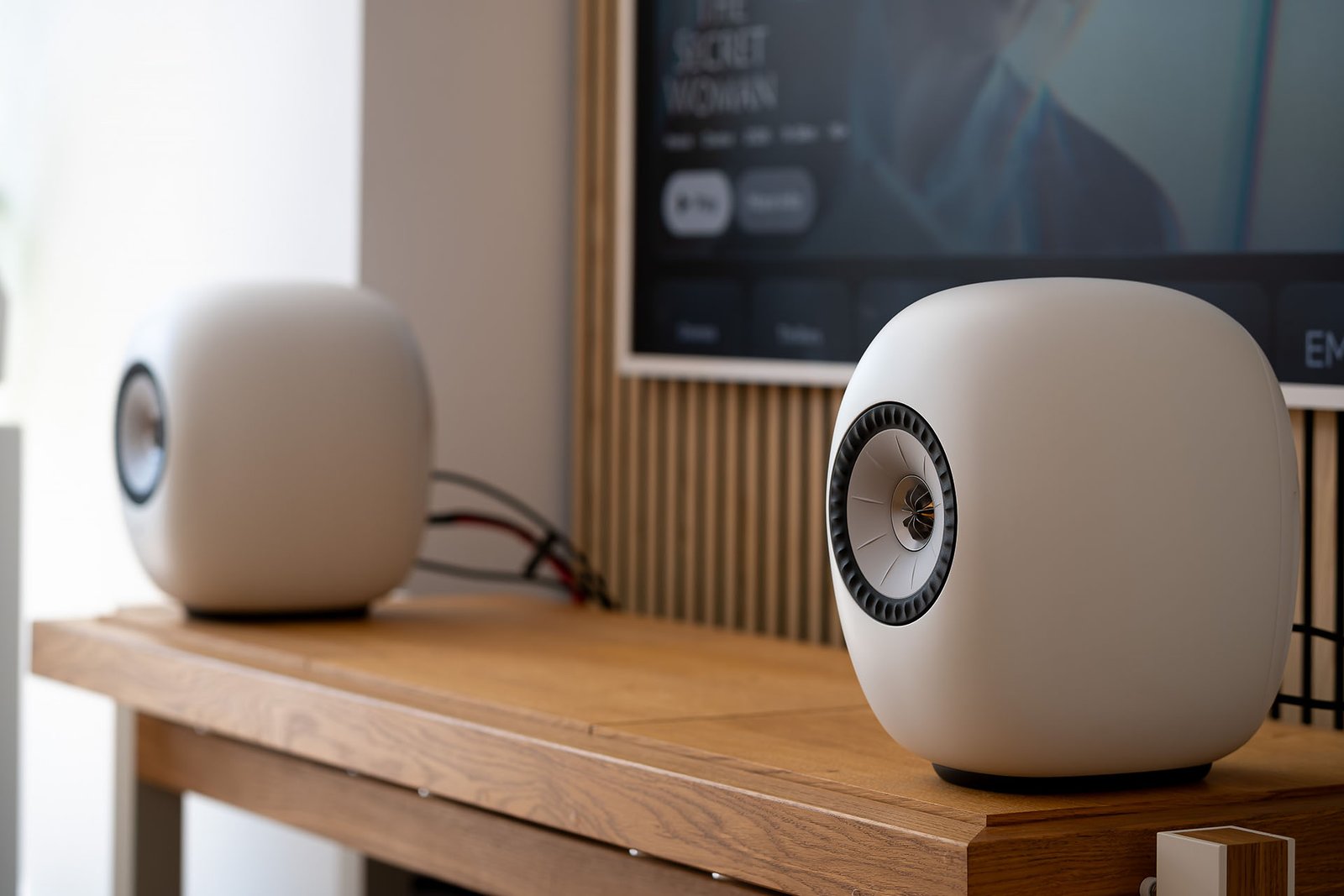
Audio, Part One — The Movies
This is how the speakers spent their first two weeks, and the result was immediate enough to reorganize my expectations for everything after. Short version: this is the best thing I have ever had a television plugged into, and it is not close.
Now I owe you an explanation for the opening of this review.
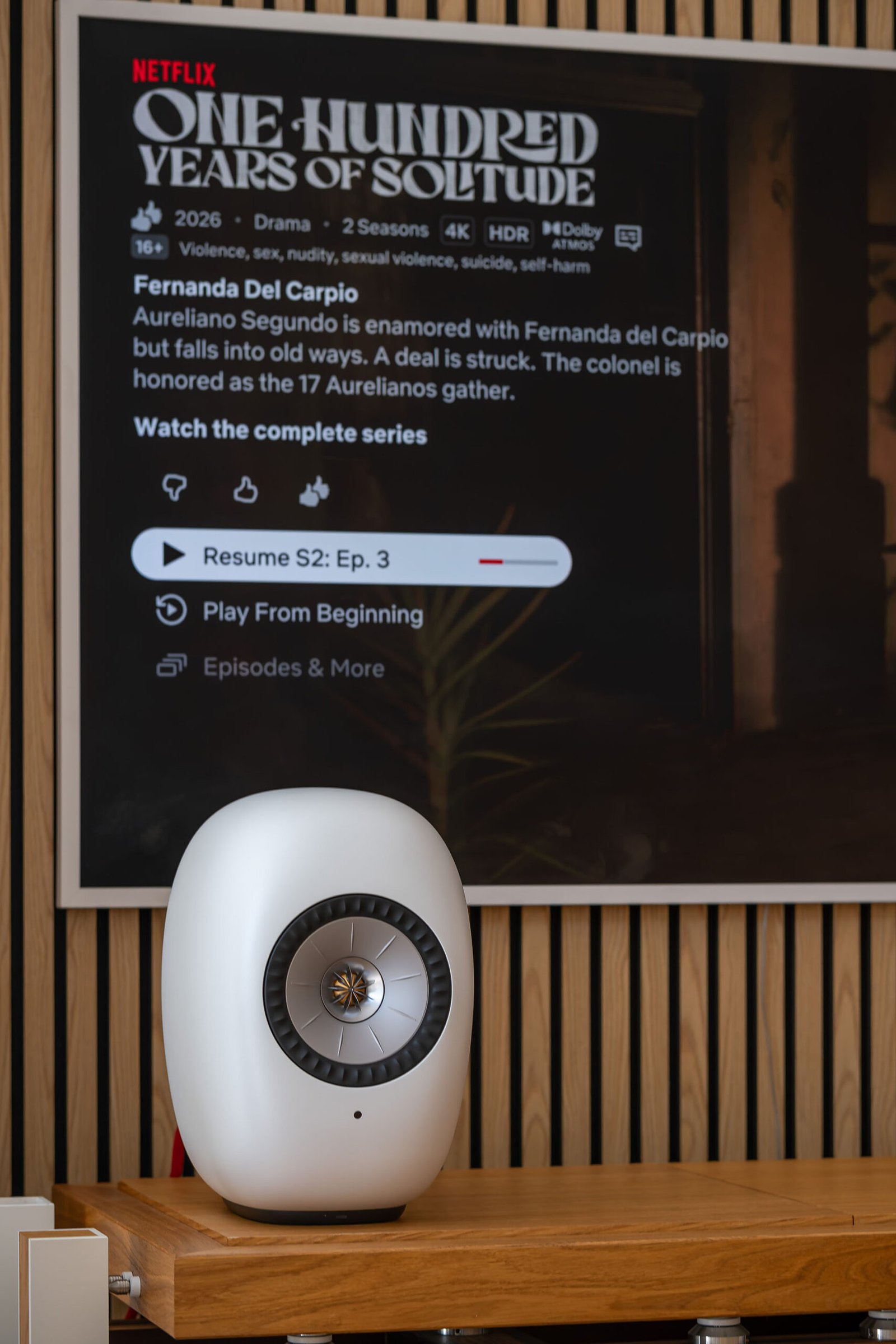
I did not go looking for García Márquez. He was on the television. Netflix released the second part of One Hundred Years of Solitude on the fifth of August this year, seven episodes, with a feature-length finale three weeks later that Colombia put into cinemas, and it landed in precisely the fortnight the LS LUXE was sitting on my rack. By the time I reached the end of it, I could not think about these speakers in any other language. A reviewer does not deserve that kind of timing, but I am so lucky 🙂
Getting that series made took half a century of refusal. Márquez would not let anybody film the book while he was alive, and not out of vanity. He thought it wouldn’t survive translation. Put a face on Aureliano Buendía, and you take that face away from every reader who had already built one; and do it in English, and you lose the language the magic is made of. He held the line until he died in 2014. His sons released it to Netflix on conditions their father would have recognized: in Spanish, shot in Colombia, with enough hours to tell it properly. The first eight episodes arrived at the end of 2024.
Here is why it belongs in a loudspeaker review. Macondo is built out of sound. Rain that falls for four years. Insects. Birds. Wind moving through a house with nothing in the windows. Thunder arriving from somewhere behind the town, before anybody on screen reacts to it. And over all of it, a narrator speaking Spanish, unhurried, in the register of a man reading aloud from a book he loves.
On the LS LUXE, the room went first. The insects were not a texture laid across the picture; they were in specific places at specific distances, some of them clearly outside the house. The rain had a ceiling above it and a ground beneath it. When the thunder came, it arrived with weight and then decayed into a space, which is the part small speakers almost never get, because they can make the bang but not the room the bang happened in.
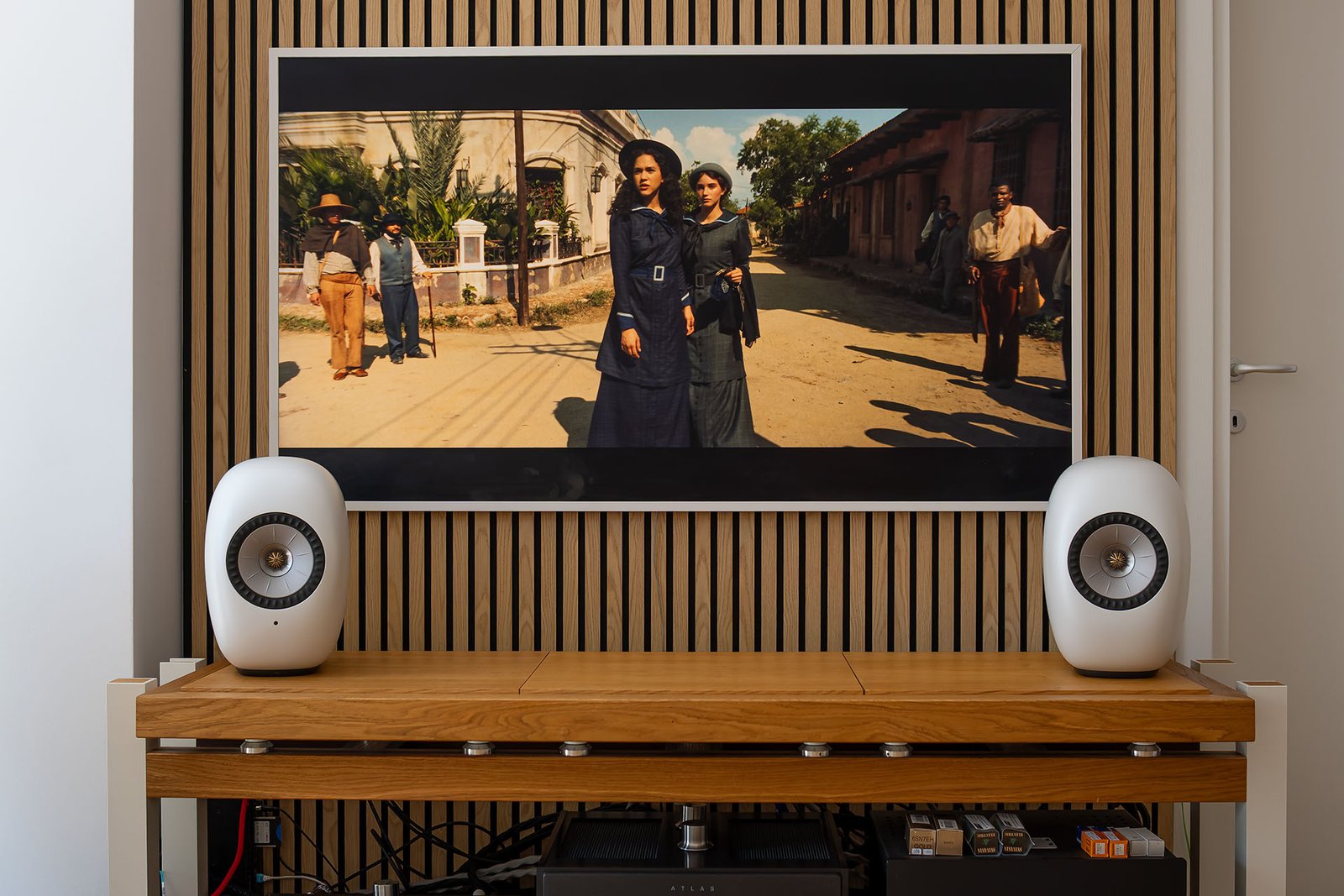
And the narrator sat dead center, dry, solid, and completely separate from everything behind him. That is Uni-Q doing what Uni-Q does. One apparent source, a voice leaving from a single place rather than being assembled in the air from two drivers at different heights. On the phantom center channel, which is what a stereo pair watching television actually is, that coherence is the whole game. A soundbar spreads a voice across a bar of drivers and hopes. This puts it in a chair.
Dialogue under pressure. Then Oppenheimer, deliberately, because its mix is notoriously difficult and has generated more complaints than any major film of the last decade. Whispering over rumbling score, overlapping voices in rooms, the kind of thing that makes a soundbar throw up its hands. Nothing was lost. Not a syllable. Halfway through, I realized I had not once nudged the volume up during a quiet exchange and back down when the music returned, something I do so automatically on that film that I had stopped noticing I was doing it. That, rather than any adjective I can offer you, is the measurement.
Bass and impact. Dune next, which was not subtle at all. The ornithopters and the sandworm both test whether a system can produce pressure without producing mud, and the LS LUXE produced pressure. The kind you feel in the furniture. Out of a 336 mm box on a shelf, with no port noise anywhere.
There is no height channel here, and no processing pretending your ceiling is a speaker. The stereo image is so stable that your brain, helped by the picture, builds the rest of the room for free. I wrote in 2023 that bouncing sound off your walls is a gimmick if you cannot place real speakers properly, and four years of Macondo rain have not changed my mind.
One warning, kindly meant. Once you have watched something like this on these, going back is not really possible. The LSX II ruined soundbars for me in 2023. The LS LUXE has now ruined the LSX II for television, and I say that as somebody who loves those little speakers and intends to die owning them.
Then the Stands Arrived
The S-LUXE floor stand costs €900 for the pair in Slate Grey, and I know what you are thinking, because I thought it too. That is almost a quarter of the price of the speakers. It is also the going rate for a serious dedicated stand, and these are designed as part of the speaker rather than bought in to fit it. Not to mention the only color availability, which is black…
But let me be honest about the order of operations, because this is where reviewers go soft. If the LS LUXE is going under a television to replace a soundbar, you don’t need the stands, and you shouldn’t feel bad about it. The speaker is extraordinary in that position. Spend the €900 on records. If you are buying it as your actual stereo system, the stands are not an accessory. They are the rest of the product.
Here is what changed. The bass tightened and lost a layer of thickness I had not identified as thickness until it went away. Desk mode came off, Wall mode came off, bass extension went from Normal to More, and the low end arrived drier, faster, and somehow larger at the same time.
The soundstage left the furniture. On the rack, the image was excellent, but attached to the television, as all television sound is. On stands it detached completely. Instruments acquired height, the center filled with real density rather than implied density, and depth went from good to genuinely surprising.
And the midrange opened, which was the biggest single improvement and the hardest to describe. Less of the speaker, more of the recording. The sense that the DSP had stopped fixing my furniture and started working on the music.
I wrote in 2023 that putting the LSX II on stands would not be a subwoofer-magnitude improvement, but that it was the second-best step available. I was wrong, and I am pleased to correct myself. On a speaker this capable, the stands come first, and the subwoofer is the one you may not need at all.
Audio, Part Two — High Resolution, and the End of My Subwoofer Argument
The KEF House Sound Is Not Here Any More
Let me quote myself from 2023 and then tear it up. Of the LSX II I wrote: Some will accuse KEF’s high response of some metallic timbre. Truth be told, the highs are not rounded and subdued, but I would not classify the upper frequencies as harsh or metallic either. Sparkly and vivid would be the proper characterization.
That was an honest description of an honest trait, and it was also a reviewer being diplomatic. Sometimes, there is a bit of metallic timbre in the KEF signature that many people love, though a smaller group, me included, eventually finds it tiring on long evenings.
The LS LUXE does not have it.
I listened for it specifically for three evenings because I didn’t believe the first one. No glare. No metallic edge on cymbals, no hardness on massed strings, no wince on a close-miked trumpet, no point in the volume range where the top end stiffens and tells you to stop. Instead, it has a treble that is extended, airy, and completely unemphatic.
And it is not a voicing choice, which is the part I find genuinely interesting. Go into the white paper, and you will find that the tweeter is essentially carried over. It is closely derived from the dome in the LS50 Meta and the LS50 Wireless II. The same 25 mm aluminum. Whatever changed here, it was not the driver.
Three other things changed. MAT does more than absorb rear radiation, because all that absorption also damps the tweeter’s own resonance and lowers its Q, and KEF publish the impedance curve against a conventional vented-pole tweeter to show it. A lower-Q resonance is less ringing, measured rather than described. Then the tweeter is driven by current instead of voltage, and the high-frequency multitone measurements show those distortion products falling. And the cabinet removes the third cause, because diffraction off baffle edges and trim rings lands squarely in the presence region and is heard as etch, and there is no edge and no trim ring anywhere near this driver.
So KEF did not revoice the treble. They removed three separate causes of hardness and left the dome alone. Which is why the most technically ambitious KEF in the LS line is also the smoothest one I have heard.
Instrument Mass, or Why Small Speakers Usually Lie
Here is the failure mode of almost every good bookshelf speaker. It gets the shape of an instrument right and the weight of it wrong. The notes are in the right place with the right tone and the right decay, and the thing producing them is somehow smaller than it should be. A cello the size of a viola. A piano the size of a spinet. The LS LUXE gets the weight right, and it is the most grown-up thing about it.
Isao Suzuki Trio / Quartet — Blow Up (Three Blind Mice, 1973), “Aqua Marine”
This recording exists to humiliate loudspeakers. Suzuki’s cello is close, enormous and physical, and the bass underneath it has a woody, breathing quality that cheap systems turn into a hum. Here it was an instrument. The body had size, the bow had friction, and when Suzuki leans into a note, you hear the wood taking the load. That texture in the attack only arrives when distortion is genuinely low.
Nils Frahm — All Melody (Erased Tapes, 2018), “Sunson” and “#2”
Recorded in Frahm’s own hall at Funkhaus in Berlin, so the room is part of the instrument. The pipe organ in the low registers is where I first understood what the velocity feedback buys. Sustained, deep, utterly steady tones held without wobble, without port noise, without that slight loosening you hear when a small driver works hard near the bottom of its range. The cone is being told what to do and then checked on, and you can hear the supervision.
The Bass, and the Subwoofer I Did Not Connect
I am about to say something I have spent years telling readers not to believe. I have never reviewed a pair of bookshelf speakers and concluded a subwoofer was optional. Not once. A small cone in a small box displaces a maximum volume of air, and no cleverness changes that arithmetic.
Forty-two hertz at ±3 dB, thirty-five at minus six, which on paper is good rather than startling. Paper is not the story. The story is that whatever is down there is clean, and clean bass at 40 Hz is worth far more than dirty bass at 30. It is fast, dry, and tightly coupled to the music, with pitch definition all the way down rather than a general warm pressure. And because the bass is controlled, the midrange above it stays clean. Most of what people call congestion in small speakers is bass distortion climbing up into the midrange and smearing it.
Massive Attack — Mezzanine (Virgin, 1998), “Angel”
The bass line I have used to frighten loudspeakers. It exposes control, because any system can make it loud, and almost none can make it move. This one made it move. Each note arrived, stopped when it was supposed to stop, and left a silence behind it. And no port chuffing. I listened for it with my ear next to the heatsink, which is undignified, and I would do it again.
Patricia Barber — Modern Cool (Premonition, 1998), “Company”
For the bass drum, which on a loose system becomes a soft thud and on a good one becomes a skin with a stick hitting it. Skin and stick.
So, with the appropriate caution. If your listening is mostly electronic, or you want cinema at serious levels, or your room is large, add a subwoofer. The outputs are there, and the app will integrate a KEF sub in five minutes. For everything else, in a normal room at normal volumes, this is the first bookshelf speaker I have lived with that does not feel incomplete without one.
Soundstage, and the Thing the Cabinet Was For
Jazz at the Pawnshop (Proprius, 1977)
Recorded across two nights in a Stockholm jazz club in December 1976, and still the most useful soundstage test ever committed to tape, because the room is full of people and glasses and a ceiling. Here the club had dimensions. Not a wash of ambiance, dimensions: a back wall, a height, individual people in individual places. The speakers were not producing that space; they were getting out of its way.
This is the clearest audible consequence of the cabinet. No edges to re-radiate from, a shape approaching a sphere, and the result is images that are small, dense, precisely located, and absolutely stable. Instruments have edges. You can point at them. And because it is a Uni-Q with matched directivity inside a cabinet with almost no diffraction signature, the image does not collapse when you move. I walked around the room repeatedly, which is behavior that makes visitors uncomfortable, and the stage stayed where it was.
Arvo Pärt — Tabula Rasa (ECM New Series, 1984)
For the silence, which is the hardest thing a loudspeaker reproduces. An active speaker with two amplifiers and a DSP engine inside a sealed box has no right to be this quiet, and the string decay went all the way down into nothing without a step in it.
One limit rather than a fault. The image scale is honest. This is a small speaker, and it draws a life-sized chamber ensemble and a slightly less-than-life-sized orchestra. It does not pretend to be a floorstander by inflating everything, which I respect, and it means large-scale orchestral material arrives with precision and coherence rather than overwhelming physical scale.
Dynamics, Voices, and Two Last Records
Rickie Lee Jones — Pop Pop (Geffen, 1991), “Up From the Skies”
Voice, upright bass, guitar, almost nothing else, recorded close enough that you hear her deciding what to do next. A midrange purity test with nowhere to hide, and the LS LUXE passed it by doing nothing at all. No chestiness, no sibilance, no added sweetness, no subtraction. This was the session where I stopped evaluating.
Daft Punk — Random Access Memories (Columbia, 2013), “Giorgio by Moroder”
Nine minutes build from one man talking in a chair to a full orchestra, a drum kit, and a synthesizer arpeggio underneath it all, and the test is whether the speaker can keep adding without compressing. It kept adding. The arpeggio stayed separate when the strings came in, the kick stayed distinct under the bass line, and the whole thing got louder without getting denser.
That is current drive refusing to let thermal compression happen. A conventional active speaker, an hour into a loud session, quietly loses output as the voice coils heat, and you don’t notice because it happens gradually. Subjectively, it shows up as a speaker that sounds the same at the end of the evening as it did at the beginning.
And burn-in: yes, some. The bass took about a week to settle into the dryness I have been describing. Thirty to fifty hours, nothing dramatic, but do not make up your mind on day one.
Comparisons, Including One That Hurt
Against the KEF LSX II, Which Is Still in the Next Room
The LSX II costs €1,499, and the LS LUXE costs €4,000, so any sane reader already knows which wins. What I did not expect was the character of the difference. I assumed more of the same: more bass, more detail, the usual linear upgrade. What I heard was a different kind of speaker wearing the same badge.
The LSX II is vivid. Quick, clear, energetic, slightly forward, and it sells itself in thirty seconds in a shop. The LS LUXE is calm. It has more of everything the LSX II has and is in far less of a hurry to tell you. Denser and warmer through the midrange, dramatically smoother at the top, and the bass is not in the same discussion. Imaging is where the gap is widest, and it is the cabinet. On the LSX II, the imaging is excellent in front of a small rectangular box. The LS LUXE has no box.
Now the part that hurt. I have owned those small KEFs since 2019. They started everything. I wrote the most-read piece about them. And after three weeks with the LS LUXE, going back to the LSX II for the television felt like going back to a good photograph of a room I had been standing in.
They are not going anywhere, and I want to say that clearly. They will sit where they sit until one of them dies. But the honest answer is that the LS LUXE has made them historical, and seven years is a shockingly short time for that to happen. That is why I opened where I opened. Technology does not move smoothly. It sits still for years and then takes an entire step in one go.
Against the LS50 Wireless II
I did not have one here, so I will not pretend to do a side-by-side. What I can do is repeat what KEF publish, because they published more than most manufacturers would dare. Below 40 Hz, 8 to 10 dB more output. Distortion 6 to 14 dB lower. Lower mean cabinet panel vibration. A bigger Uni-Q, 165 mm against 130, in a cabinet with fifty percent more internal volume.
And here is the detail I find most revealing. On paper, the amplification is identical: 280 watts of Class D and 100 of Class AB per speaker, exactly as the LS50 Wireless II has had since 2020. The numbers did not change. What changed is that those watts are now delivered as regulated current with a velocity sensor watching the cone, instead of regulated voltage with the amplifier hoping. Everything in that list comes from the topology rather than the wattage, and the maximum SPL still went up, from 108 dB to 110.
Against the One-Box Luxury Speakers
Regular readers will know I spent some time this summer with the Marantz Horizon, and before that with the Cabasse RIALTO (long ago). This sits beside them like a pair of shoes beside a single shoe. Those are single-chassis products built around a different promise, and both do it remarkably well. But no acoustic trick replaces two real sources separated by two real meters. If you want one gorgeous thing on a sideboard, buy one gorgeous thing. If you want a stereo system that happens to be gorgeous, this is the one.
Against the Reference, Which Still Wins
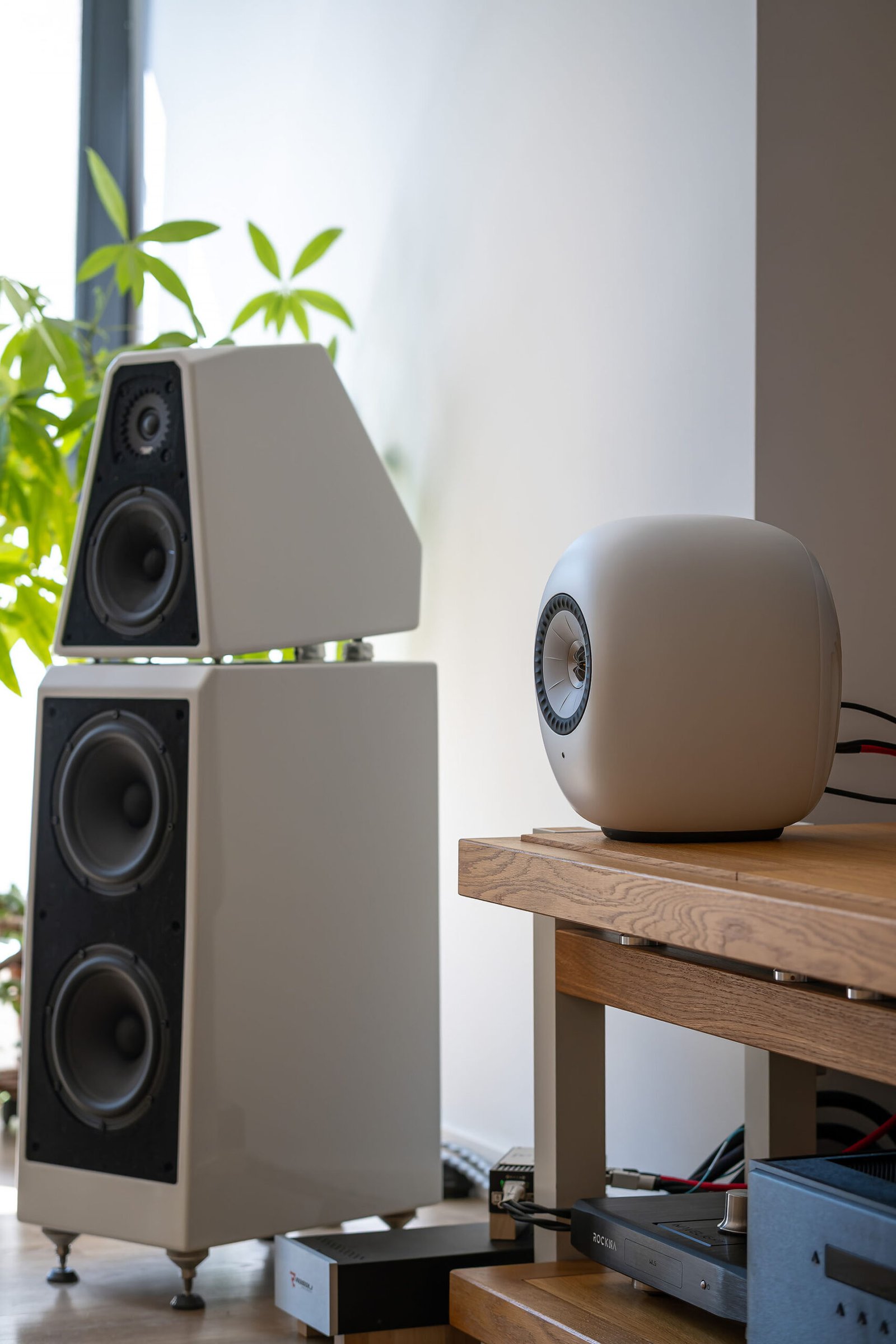
And now the paragraph that keeps me honest, because you know what lives in the main room. The Wilson WATT/Puppy 50th Anniversary, driven by the Aesthetix Eclipse trio with the LampizatOr Pacific in front of it, costs a sum I prefer to express as a percentage of a house. It is better, obviously. The interesting but totally unfair question is where.
Not tone: the LS LUXE is tonally convincing in a way that would have cost five figures not long ago. Not clarity, and certainly not noise floor. Where the reference pulls away is in scale and the last layer of micro-dynamic shading, the sense of unlimited headroom underneath everything, the way a large system makes a room feel pressurized rather than filled. Those are functions of moving air and of cost.
But here is what happened, and it is the only thing this month that genuinely unsettled me. On the weekend, I moved the LS LUXE into the main room on the stands, roughly near the Wilsons’ position, and listened for an afternoon. Not to compare exactly. To see how much of a difference there would be. They were not embarrassed. On voice and piano, small jazz, chamber strings, the difference was there, of course, but mostly in resolution, depth, and soundstage, and there were two or three minutes when I couldn’t construct the full argument in my head. Then I put on something large, and the argument reassembled itself immediately.
Which is the correct outcome, and a rather astonishing one for €4,000 with the amplifier included.
Market Value
The KEF LS LUXE launched on the thirtieth of July 2026 at €4,000 the pair, £3,500 in the United Kingdom, $4,000 in the United States and $5,499.99 in Canada. The S-LUXE floor stands are €900, £800, or $800.
€4,000 for a pair of bookshelf speakers is a lot of money, and let us not be coy about it. It is also not what you are buying. To assemble the equivalent of what arrives in those two cartons, you would need:
- A pair of high-quality passive bookshelf speakers, realistically €1,500 to €2,500 at this level
- An integrated or power amplifier with genuine grip, €1,500 and upwards
- A DAC and a streamer, or a streaming DAC, another €1,000 to €2,000
- Speaker cable, an interconnect, a power cord, a rack for the electronics. Call it €500 and be grateful
- Room correction, which in the separate world means a measurement microphone and an afternoon, or a DSP box you will resent
That is €4,500 to €7,000, four boxes, six cables, and a weekend, to arrive at approximately the same place. But not the exact spot for sure. Yes, KEF LS LUXE are far better than this exercise can provide. You still won’t get current-drive amplification with velocity feedback, because nobody sells it. Not as a separate component, not at any price.
This is the real argument for active speakers, and it has never been easier to make. VECO could not be retrofitted to a passive speaker. It exists only because the measurement, the correction, and the amplification live in the same cabinet. Against the handful of genuinely high-end active speakers in the €2,000 to €6,000 window, this is the one with a technology nobody else has, a cabinet nobody else could afford to tool, and HDMI eARC, the input that turns a hi-fi into something a household actually uses. Against separates, at €4,000, it is frankly a more than fair value.
One caveat I give every time, and I mean every single time. Talk to your dealer. Prices move, packages exist, and the person who will set these up and take your call in two years is worth paying for. In Romania, the LS LUXE is at AV Store, which also sold me the LSX that started all of this, which I find quite funny.
Conclusion — The Afternoon You Discover Ice
Back to the ice, because I have been circling it for nine thousand words and it is time to land.
Here is what Márquez understood, and why that scene outlives the rest of the book. Ice is not rare. Ice is water that got cold. What made it the great invention of our time was not the substance. It was a man standing in front of something his existing categories could not hold, building a new one on the spot, with his hand still on it, in front of his son.
That is the whole business we are in. Not the equipment. The occasional afternoon where the categories have to be rebuilt.
And unlike poor José Arcadio Buendía, who was promised gold and turned up a skeleton in a suit of armor, this time the promise is kept. The cabinet is round because round wants it that way. There are no screws in the front because every screw is a second source of distortion. The amplifier controls current instead of voltage because current makes force, and a sensor printed on a circuit board inside the motor, fifty-five meters of copper in four alternating loops, because that was the only honest way to keep a current amplifier under control. Every one of those decisions was forced by physics, and the object they add up to is the most beautiful loudspeaker of its size I have seen.
Ross Lovegrove has said for forty years that if you follow nature’s logic you arrive at beauty without aiming at it. I have always half believed him. I believe him now.
And there is the other circle, the personal one, which I did not plan and cannot avoid. Seven years ago, I bought a pair of small white KEFs on a Black Friday discount because I wanted something better than a standard desktop system, and they became the thing that opened the door to all of this. They showed me that a room could hold music, that speakers could do something headphones never quite manage. They walked me a very long way, and they are still walking, quietly, in the next room. That was my ice. This summer the same company sent me the far end of the same idea, and I had to build the category again.
The LS LUXE goes back, and I am already unhappy about it. That is not a flourish; it is logistics: they go back, the room gets quieter and worse, and I will spend a week moving the LSX II around trying to recreate something I know perfectly well cannot be recreated.
So if you have €4,000, a room, a television and an interest in music, stop reading and go and listen to them. Ask for the stands. Ask to hear something with a voice in it. And if the room is right and the record is right, you may get one of those afternoons, the kind you are still reaching for years later when something important is happening and your mind goes somewhere else entirely.
Thank You — AV Store
This review exists because of AV Store, and this time the thank you has some history. They sold me a pair of white KEF LSX during Black Friday week more than seven years ago, which is where this whole story begins. They have been the most frequent partner in my work since, and they loaned me the LS LUXE and the S-LUXE stands for as long as I needed them, with no conditions and no questions about what I might conclude.
If you are in Romania and any of this has made you curious, go and hear them properly rather than taking my word for it.
AV Store – avstore.ro | Thank you, as always, for the trust.
The Award — Editors’ Choice
There are moments in this work when hesitation would simply be dishonest. This is one of them.
Based on everything documented in the pages above: a loudspeaker that brings current-drive amplification and real-time velocity feedback into a product a normal person can buy and install in an afternoon. Distortion 6 to 14 dB lower than the model it supersedes, with 8 to 10 dB more output below 40 Hz. A cabinet chasing the acoustical ideal of a sphere and getting close enough to change what you hear, drawn by one of the most important industrial designers alive. The smoothest, most tonally adult KEF I have heard. The first bookshelf speaker I have lived with that did not send me looking for a subwoofer. And all of it, amplification included, at €4,000.
The KEF LS LUXE receives the Soundnews Editors’ Choice Award, our highest honor, with the kind of certainty that does not come along often.
It also receives something I cannot put on a badge. It is the first product in years that made me want to write about the beginning of things again.

Associated Equipment
Under review
- KEF LS LUXE, Dusk Titanium, €4,000 the pair · KEF S-LUXE floor stands, Slate Grey, €900 the pair
Sources and network
- Gustard S26 as Roon Server · Rockna Wavelight Server as streamer and Roon endpoint
- Roboli Switch S80 ExpertLine, with optical network separation · Tidal and Qobuz
- OLED television over HDMI eARC
Reference system used for comparison
- Loudspeakers: Wilson Audio WATT/Puppy 50th Anniversary
- Amplification: Aesthetix Atlas Eclipse power amplifier, Aesthetix Calypso Eclipse line preamplifier
- DAC: LampizatOr Pacific, KR Audio 300B and 5U4G, Amperex 7119
- Analogue: Acoustic Signature Montana NEO with TA-5000 NEO, Ortofon MC A95 and Hana Umami Red, Aesthetix Rhea Eclipse
- Cabling: Albedo Monolith Reference MKIII and XLR, AudioQuest Dragon, Pink Faun USB and network · Power: Tsakiridis Super Athena
Also referenced
- KEF LSX II, owned since 2023, and the original KEF LSX, owned since 2019
- Marantz Horizon and Cabasse RIALTO, both previously reviewed here
Until next time, I wish you to hear only the best!
And as always, the comment section below is the best part of this website. Tell me what you are listening to.