Sonus faber Lumina V Amator Loudspeaker Review: Relaxed, Warm and Beautifully Italian!

TLDR:
We recommend the Lumina V Amator to the listener who loves full bass, a warm midrange, and a relaxed sound, and who wants music that is simply pleasant to listen to. The lower part of the frequency response is full and generous, with a bloom that adds to the pleasure of listening, especially classical music. After break-in, with the HMS Gran Finale 50 speaker cables, we heard no trace of sibilance whatsoever.
Three qualities define the Sonus faber Lumina V Amator:
- A relaxed sound. The character is somewhat mellow and smooth. Voices, trumpets, and violins were easy on the ear, both at normal levels and with the volume turned up. These speakers are made for long listening sessions.
- Full, warm, and natural midrange. Voices were clear, full-bodied, and slightly warm. Male and female voices alike had a natural timbre. Guitars, pianos, and strings had good harmonic density.
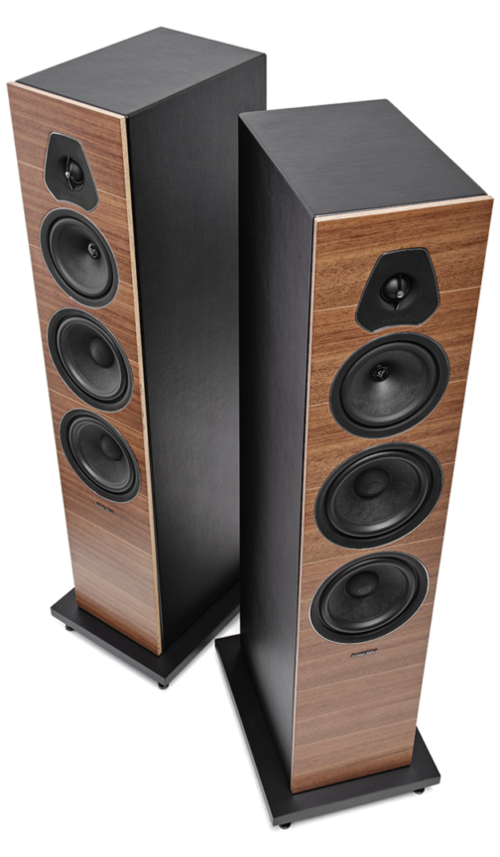
- Italian build and finish. The front baffle is multilayer lacquered wood with an angled grain. The speaker’s sides are wrapped with black leather. The pair is made in Vicenza, Italy. They were an absolute pleasure to look at.
The main limitation is speed, especially in the bass and detail. The kick is a bit soft, and the bass is sometimes bloomy and slow. With psy, goa, trance, and other electronic music, where speed matters most, these speakers feel less at home. Fine textures, like the breathing on a close-miked voice, are a bit softer than on more analytical designs. They also lack some of the SPL you would want at party levels. Given their size, we could say they perform admirably. Their power handling is very impressive. Sparkle and air are modest. Soundstage width and depth are moderate. The bass also thins out at low volume. For listening at home with classical music, jazz, and voices, these limits weigh very little against the warmth and the ease of the presentation.
Introduction
The first Sonus faber workshop opened in 1983, in the hills of Vicenza. Parva was the first product. Minima, Electa and the Electa Amator were part of the same first decade, all of them built from solid walnut and leather. Since then, Sonus faber has reserved the Amator name for its special models.
In the next decade, Sonus faber studied the work of the Italian violin makers. Guarneri Homage, named after Giuseppe Guarneri, was what the company describes as the first hi-fi loudspeaker with a cabinet structure inspired by the lute. From then on, the lute has been one of the signature shapes of Sonus faber. At the end of that decade, the company moved to Arcugnano, into a headquarters building shaped like a violin. And since 2014, Sonus faber has designed every part of its own drivers, the membranes, the baskets, even the magnets.
The Lumina collection launched in September 2020 with three models: the Lumina I, a two-way bookshelf, the Lumina III, a three-way floorstander, and the Lumina CI, a centre channel.
The name is made of three words, LUxury, MInimalist and NAtural. A year later, Sonus faber added the Lumina II and the Lumina V, with the V as the flagship of the collection. Later, the company created Amator versions of both, the Lumina II Amator and the Lumina V Amator we have here, with a new crossover and new front panels.
Keep in mind that every audiophile has different music, different electronics, and a different room. We heard the Lumina V Amator in one of our rooms, on our chain. We loved some of their qualities more than others. The final word belongs to your ears, in your own space, so book a demo.
Design, Build and Technology
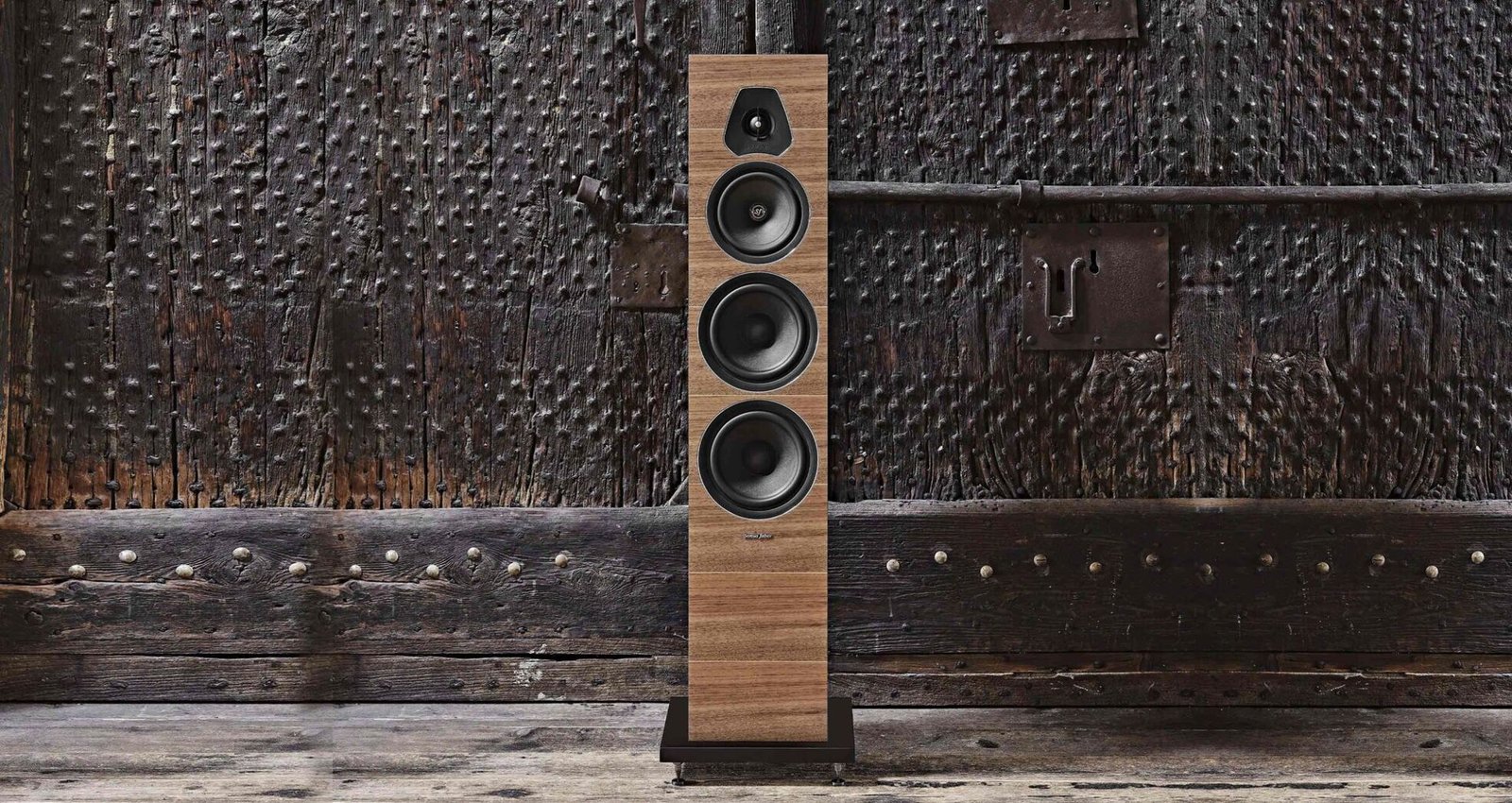
The Lumina V Amator is a three-way, four-driver floorstander. Each speaker measures 1049 mm in height, 280 mm in width and 372.6 mm in depth, and weighs 22.5 kg.
The cabinet has the simple, squared shape of the whole Lumina collection. The front is what sets the Amator apart. The front panels are multilayer wood in a high-gloss lacquer, with the grain of the veneer cut at a 45 degree angle, combined with black leather. Chrome rings surround each driver on the baffle. Three finishes are available, Red, Wenge and Walnut, all of them in high gloss.
Build quality and finish are excellent!
Lute-shaped chamber. Like the Lumina V, the Amator has its own internal chamber for the midrange and the tweeter, built in the shape of a lute, the classic shape of Sonus faber cabinets since the 1990s. Sonus faber says this raises the structural rigidity of the cabinet and reduces the standing waves inside the volume behind the midrange.
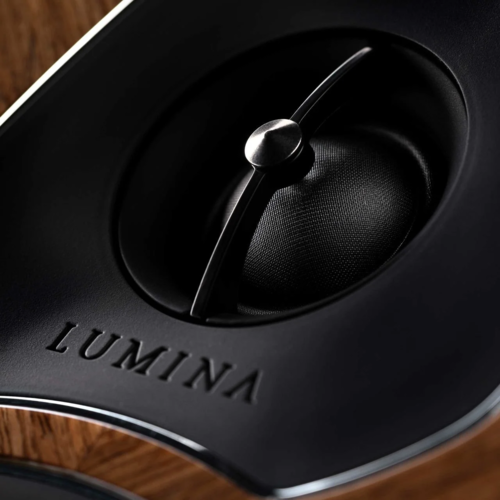
DAD tweeter. The tweeter is the 29 mm DAD, short for Damped Apex Dome, the same unit Sonus faber uses in the Sonetto series. Its soft silk diaphragm is hand coated by Kurtmueller. The motor uses a ferrite magnet. The whole tweeter is visco elastically decoupled from the baffle.
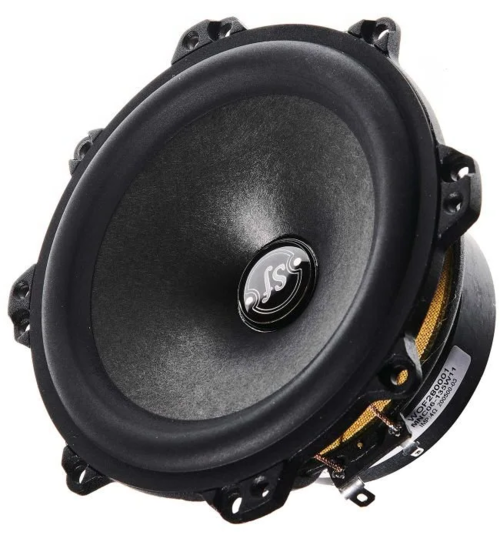
Midrange. The 150 mm midrange is shared with the Sonetto collection. Its cone is a Sonus faber blend of natural fibres and paper, air-dried.
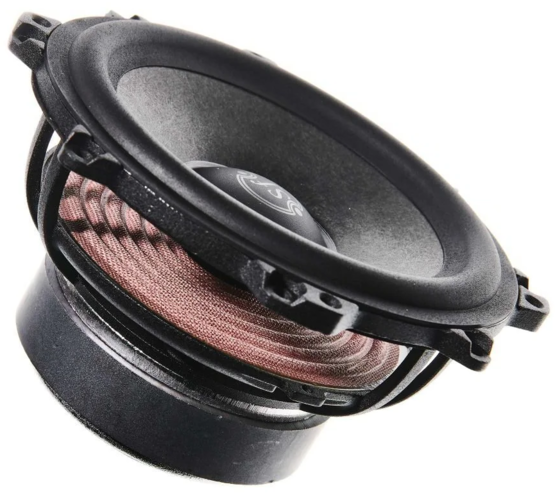
Woofers. Two 165 mm woofers reproduce the bass. They were designed from scratch for the Lumina range, with a sandwich diaphragm made from cellulose pulp blended with other natural fibres. Both the woofers and the midrange use what Sonus faber calls an ultra free compression basket.
Crossover. The crossover points are 260 Hz and 2850 Hz. Compared to the Lumina V, the upper point is 250 Hz higher, so the midrange plays almost three and a half octaves before the handover to the tweeter. The new network, Sonus faber says, is derived from the development work on the latest Homage collection, with many solutions taken from the Amati G5 and the Guarneri G5.
Sonus faber calls the topology Hybrid IFF Paracross. IFF stands for Interactive Fusion Filtering, first used on the Maxima Amator in December 2020. In Paracross, the capacitors and the inductors are placed on the negative rail of the circuit. The reasoning, they say, is a lower back EMF from the drivers and a lower sensitivity of the crossover to radio frequencies, with a phase coherent design for a three dimensional soundstage.
Port and spikes. The Lumina V Amator is a bass reflex design, with the port firing down, towards the floor. Iron spikes are supplied, with under spikes and locks.
Sensitivity, impedance and power. Sensitivity is 90 dB (2.83 V/1 m) and the nominal impedance is 4 ohm. The specified frequency response is 38 Hz to 24 kHz. Sonus faber suggests an amplifier of 50 to 300 W. The company also advises amplifiers with a high output current, together with low resistance cables. With a 4 ohm nominal load, choose an amplifier with good current delivery.
Terminals. At the back are four binding posts, Mid Hi and Low, connected by jumpers, for bi wiring and bi amping.
In the box. Each pair ships with the owner’s manual, two jumpers, two grilles and two fabric dust covers, together with the spikes. According to the manual, the sound improves over time, as the membranes and the suspensions of the drivers break in.
Measurements
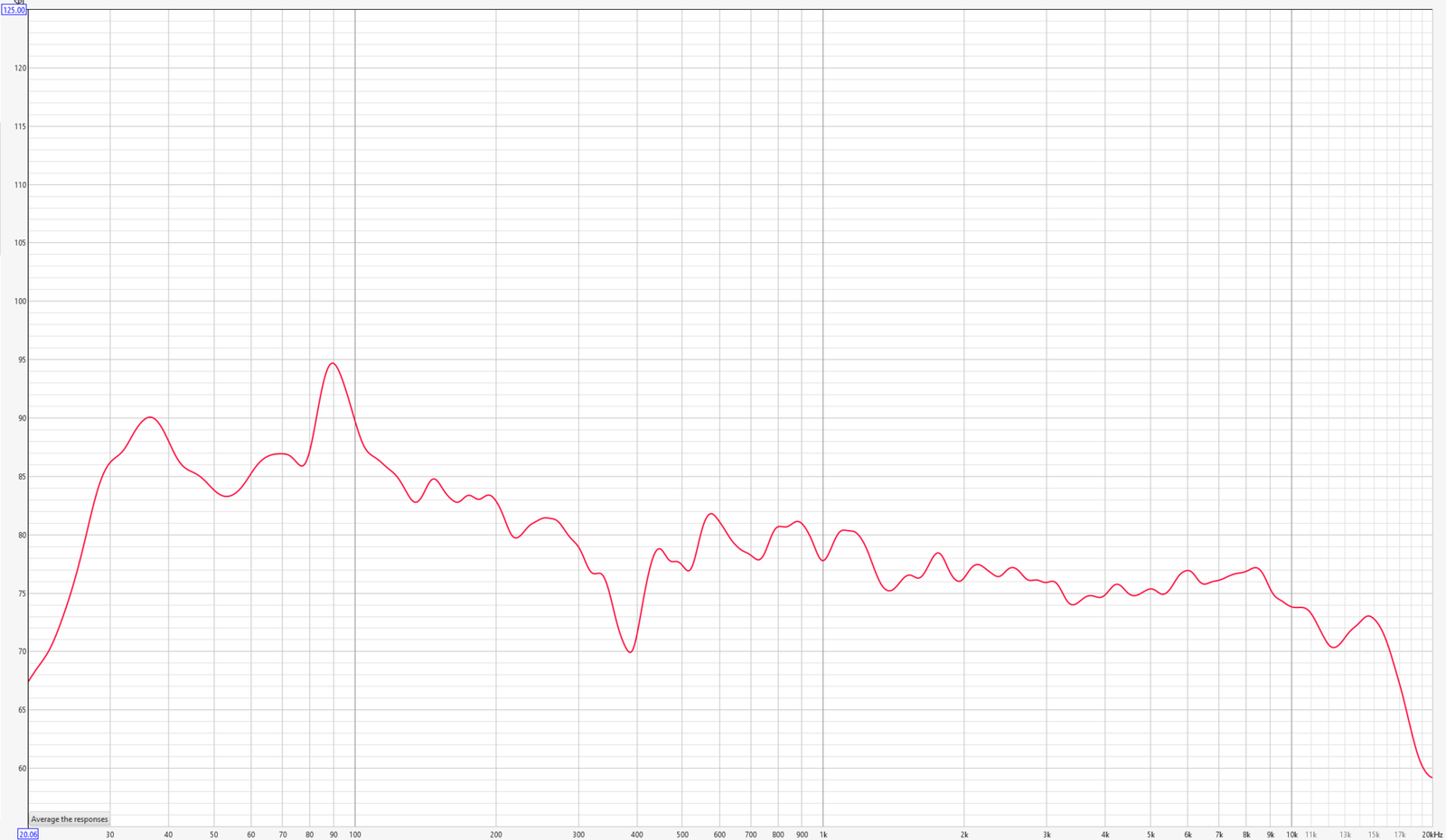
Measured in our small living room, at the listening position, 3.5 m from the speakers. Both speakers, firing straight ahead with no toe-in, grilles on.
The bass on this graph is the Lumina V Amator and our room together, as we explain in the setup chapter. In-room response reaches deep, with about 86 dB at 30 Hz and a peak of about 90 dB around 37 Hz. Below 30 Hz, the level drops quickly to about 67 dB at 20 Hz.
The biggest feature of the graph is a peak around 90 Hz, about 8 dB above average. It is our feeling that our room is behind most of it. Lower down, a dip around 53 Hz is about 4 dB below the regions on each side. This part of the graph explains a lot of what we heard. A room mode this strong decays more slowly than the frequencies around it, so fast bass lines lose some of their definition. We believe this is the bloom, the slow and generous bass we spoke about in the bass chapter. The weight of many kick drums is between 50 and 100 Hz. The dip at 53 Hz, next to the peak at 90 Hz, fits the soft kick on psy, goa, trance, and EDM in general. On classical music, the same peak adds to the warmth and the scale we enjoyed so much.
From 450 Hz to 1.2 kHz, the midrange is between about 77 and 82 dB, a few dB above the presence region. It matches the warm, full-bodied midrange we loved with voices. Around 390 Hz, a narrow dip of about 8 dB is visible. Narrow dips like this one are usually cancellations in the room, linked to the position of the microphone. The ear is much less sensitive to them than to peaks of the same size.
Between 2 and 9 kHz, the response is very even, within roughly 3.5 dB, around 76 dB. The region between 3.3 and 4.5 kHz is a dB or two lower. We believe it plays a part in the relaxed character of the presentation. Between 5 and 9 kHz, where sibilance makes its presence known, there is a gentle rise of about 2 dB, up to around 77 dB at 8.4 kHz. It is small and smooth, with no sharp peak, in line with the clean top end of our listening sessions.
Above 9 kHz, the level falls to about 74 dB at 10 kHz and 70 dB around 12 kHz, with a small bump around 14.5 kHz and a steep roll-off above 16 kHz. With the speakers firing straight ahead, the microphone is off-axis to the tweeters, which explains part of this roll-off. The modest sparkle and air we described are visible here.
Overall, the graph tilts down from the bass to the treble, by about 9 dB between 200 Hz and 10 kHz. A downward tilt is normal in a room. This one is a little steeper than the gentle slope of a neutral speaker, a good picture of how warm and mellow the Lumina V Amator sounds.
It is a special joy for us when a graph and our ears tell the same story. Here, they do, from the bloom of the low end to the calm, smooth treble.
Setup, Room and Placement
We listened to the Lumina V Amator in our small living room, 4 m by 5.3 m with a 2.7 m ceiling and modest acoustic treatment. That is about 21 m² of floor.
In the owner’s manual, Sonus Faber suggests at least 1 m from the rear wall, at least 1.8 m between the speakers, and a toe-in that aims both speakers at the listening position. We fired them straight ahead from the start.
With the grilles on, the Lumina V Amator sounded better to us, so we left them on for the whole review. All of our impressions describe the pair after the break-in period.
Below roughly 200 Hz, what we hear at the listening position is the speakers and the room together. So the bass impressions in this review describe these speakers in this room, at our listening position.
System Matching
Our source was the MOON 491, used as DAC and streamer, connected over XLR to a McIntosh MA9500 integrated amplifier. Cabling was HMS Gran Finale 50, with 1.5 m XLR interconnects and 3 m speaker cables, single-wired with the jumpers in place.
The MA9500 is rated at 300 W per channel into 2, 4 or 8 ohm, through McIntosh’s Autoformers, with a separate output tap for each impedance. The 8-ohm tap sounded best to us with the Lumina V Amator, so we used it for all of our listening.
The MA9500 has a mellow, almost tube-like character. It is our feeling that the Autoformers, the output transformers McIntosh uses on its solid-state amplifiers, have something to do with it. Together, the MA9500 and the Lumina V Amator made a warm, easygoing pairing, very easy to enjoy.
Cables made a difference too. With the MOON 491 in the chain, the HMS Gran Finale 50 set sounded better than the Roboli cables we usually use. The tweeter was tonally better.
We also listened with a MacBook Pro connected over USB to the DA2, the Digital Audio Module inside the MA9500. McIntosh describes it as a Quad Balanced, 8-channel, 32 bit DAC. The DA2 is a good match for the MA9500.
Pay attention to the character of your amplifier before anything else. In the end, it all depends on taste.
Listening Sessions
Mellow, relaxed, full in the bass, warm in the midrange, and smooth on top. That is the Lumina V Amator in a few words.
Bass, Kick and Speed
With our matching, the bass was full and warm, at times a bit bloomy and slow to stop. The kick is the weak point, a bit soft at the start of each beat, with less impact than we hoped for. On slower music, bass lines are reasonably articulate.
Physical impact is a big part of why we listen to electronic music and big drums at home, so this is a quality we value a lot.
Heilung’s Traust is built on deep ritual drums, with chanting voices layered above them. Every drum strike had a lot of weight, with a long decay after each one. The start of the strikes was a bit soft, with a modest snap. The voices above the drums were clear and full. Primal and enveloping, in a gentler way than we expected.

Chris Stapleton’s Death Row is a slow, heavy blues, with a deep bass line under a rough, powerful voice. The kick was light on impact and the bass guitar full and warm, with a slightly long decay. On a slow blues like this one, the bloom suited the groove. He sang with a big voice, full of body and grain. Even on the loudest phrases, the rasp was full, with no edge at all.

On AURORA’s A Different Kind of Human, the fast bass sequence around 1:38 is a test we use for speed. The pulses had solid weight, but they were not separated clearly, the sound had a little overhang between them at this speed. Her voice above the bass was clear and comfortable, even when she climbed to her top notes. Articulation overall was good enough for their size and price, but it did not stand out.
Marcus Miller’s Cousin John is all slaps and pops on the bass guitar. The body behind each note was full, with a nice snap on the slaps. In the fastest passages, the notes were a little less distinct and harder to read one by one. Groovy and enjoyable.
Yello’s Till Tomorrow has layered electronic bass lines over a steady, driving kick. Each layer had plenty of body, with a kick that lacked some impact on every beat, less physical than we are used to on this track. The lowest synth notes had some weight in the room, but not as much as we would have liked. At the volume this track is made for, it was enjoyable, with less drive than we wanted. Turned down, the same bass lines were noticeably lighter. We will explain why in the Low Volume chapter.
So this is a generous, warm bass, and its bloom suits classical music and slower songs very well. For psy, goa, and trance, where speed is everything, the Lumina V Amator struggles a bit.
If fast electronic music fills most of your evenings, a faster speaker will suit you better.
Midrange, Voices and Harmonics
The midrange is one of the most beautiful qualities of these speakers. It is full-bodied and warm, with a bit of detail there too, but not as analytical as ceramic-based drivers. Instruments in this region have rich harmonic details, from the wood of a guitar to the lower strings of a piano.

Allan Taylor recorded Colour to the Moon for the German label Stockfisch, with his voice and an acoustic guitar close to the microphones. His voice was warm and full, with a rich chest tone and a natural texture. The guitar strings had a clean attack and a warm decay, with the body of the instrument easy to hear behind each note. His timbre was very natural, with the right amount of weight and warmth, but microdetails such as breathing and plosives were a bit of a miss. Not to say they were not present, just that they were not that emphasised or sharp enough to stand out.

Loreena McKennitt’s 1997 album The Book of Secrets ends with Dante’s Prayer, a piano, a choir and her voice in a large acoustic. Her voice was pure, with good body in the lower notes. The choir behind her was well separated from the piano. The hall around them was a little smaller than the recording suggests. A beautiful, very human voice on these speakers, true in timbre, with a little extra warmth on the lower notes.
Diana Krall’s version of Temptation, the Tom Waits song, is on The Girl in the Other Room album. The recording is close-miked, with her voice very near to us. Her lower register was full and rich, with the smoky texture of her voice clearly audible. The piano and the double bass were well separated from her. Her timbre was warm and lifelike.

Avi Kaplan sang bass in Pentatonix before his solo career. On Aberdeen, his low register was weighty, with a pleasant grain and plenty of warmth. His lowest notes and his higher phrases sounded like one voice, with no change in character across the lower crossover point, which says a lot about the integration between bass and midrange. Very moving. His timbre was rich and true. This track also has a subbass note that is inaudible on many speakers. The same happened here.
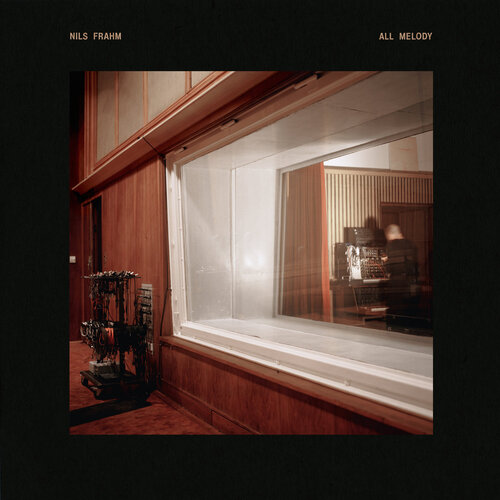
All Melody is the 2018 album Nils Frahm made in his studio at the Funkhaus, the old radio building in Berlin. The piano had a full, warm tone, with rich harmonic details in the lower strings and a clean attack on every note. The hammers and the pedal were also audible in the quieter moments. The room around the piano was presented at a moderate size, a bit less obvious than on the most open loudspeakers we have heard. Overall, a very relaxing and pleasant presentation.
The voices we played, low or high, all had this warm, full character. For us, voices are a big reason to listen to the Lumina V Amator. Take note that we had this feeling using the HMS cabling. When using the VDH Magnum, a much more modestly priced cable, a very big part of the presentation was missing. Matching is a very real and definitive aspect of this crazy hobby.
High Frequencies, Sibilance and Air
The top end is smooth and gentle. With the HMS Gran Finale 50, sibilance was completely absent. Higher up, sparkle is modest, and so is the air.
We are very sensitive to sibilance. It is one of the first qualities we check on any loudspeaker.

Sophie Zelmani’s All I See Is You is a favourite sibilance test of ours, with her soft voice recorded very close to the microphone. Her S sounds were smooth and natural, in proportion with the rest of her voice. Her voice itself was delicate, with the breath around her words clearly audible. Lovely.
Affection, by Cigarettes After Sex, is sung almost in a whisper, surrounded by reverb and by guitars with plenty of high-frequency content. A hard test for any tweeter. Greg Gonzalez’s consonants were soft and clean at every level we tried. The guitars were present, with a modest shimmer on top. The reverb around his voice was wide enough.

Janine Jansen’s recording of Vivaldi’s The Four Seasons, with a small chamber ensemble, is a demanding test for violin tone. Her violin had a lively tone, gentle on the high notes, with the bow and the rosin present. The cellos and the basses under her had a warm, solid body. The finest bow textures were a bit less vivid than on a more detailed speaker.
Italia is the title track of Chris Botti’s 2007 album, written by Botti and David Foster, with Andrea Bocelli on vocals. Botti’s trumpet had everything, and it sounded so natural. At 0:57, Andrea Bocelli joins in, and the moment sounds exactly like a grand entrance. In some parts of his voice, the high-frequency details were clearly audible, like the plosive C in the word “musica” at 1:57, a pleasure to hear. A joy from beginning to end.

Oliver Shanti’s Licht Prakash Light is full of bells, chimes, and soft high-frequency textures, a track we use for air and extension. The bells had a clear attack. Their shimmer and decay were somewhat short, with the space around them on the small side. A little more air is what we missed on this one.
So the treble is clean, with modest sparkle and air. If air is high on your wish-list, bring your own recordings for it to the demo.
Soundstage and Imaging
With our placement, the music was presented mostly between the speakers, with some layering from front to back. A bit more width and depth would have been nice here.

Yosi Horikawa built In the Wind from field recordings and small percussive sounds, placed all around the listener. On the Lumina V Amator, each sound had its own position, with a moderate spread to the sides. Depth was moderate too, with the quieter sounds placed a little behind the speakers. We would have loved more space around each sound, to hear the field recordings in a bigger acoustic space.
Oxygène Part 7, from Jean-Michel Jarre’s 1997 sequel to the original Oxygène, has synthesizer layers panned from one side of the room to the other. The movement from left to right was clear, within a good width. The layers further back also had a somewhat moderate depth. The bass layers under the synths had good body, a little slow on the quicker pulses.
Armand Amar wrote the music for HOME, the 2009 documentary by Yann Arthus-Bertrand. The duduk and the flutes were presented in front of us, with a full, woody body. The space around the players was ok in size, a bit smaller than the scale of the recording. The tone of the instruments was beautiful.
The soundstage is a more modest aspect of the Lumina V Amator. Their strengths are elsewhere, in the bass and the midrange.
Dynamics, Power and High SPL Listening
The power handling impressed us. With the MA9500 behind them, the Lumina V Amator played with no strain at every level the amplifier reached in our room. They are even sufficient for a party in a normal-sized house. For bigger venues, more than 100 square meters, a bit more SPL would be welcome. For a floorstander of this size, the result is very good. Large swings in level are presented with good weight, and the sound remains clean at high levels.
We place a lot of importance on clean, high SPL, because big orchestral works and electronic music sound the way they were recorded only at a realistic volume.

Stravinsky’s The Firebird Suite is a test of both ends of the dynamic range. In the quiet passages, the woodwinds and the harp were delicate and clear. In the Infernal Dance, the big orchestral hits were heavy and powerful, with a deep, generous bass drum that suited the size of the orchestra. As we pushed the level higher, the orchestra remained clean and uncongested. With our matching, the brass had almost no extra brightness, even at the loudest moments. A thrilling listen!
Mike Dawes arranged Van Halen’s Jump for one acoustic guitar, with slaps, tapping and harmonics in the same performance. The slaps on the body of the guitar were punchy. The small differences in how hard each string was plucked were easy to hear, a good sign for microdynamics. The harmonics had a clear ring. A lot of fun to listen to!
Hugh Masekela’s Stimela is about the migrant workers on the coal train to the South African mines. The rasp and the breath in his voice were vivid, with a rough, very human texture. The big swells of the band were powerful and clean, and although the percussion lacked a little bit of snap and speed, it felt crisp. The trumpet was bright and forward at the loudest moment, but not fatiguing at all. Very moving.
Caterpillar is a 2017 single by Mountains of the Moon, a band from Stockholm. The voice was very pleasant, warm, and close. The dynamics of the song felt natural, from the quiet lines to the fuller passages. Every element was in its place, in a balance that sounded just right.

Feet on the Ground is a song by the Danish singer Pernille Rosendahl, with her strong voice over a heavy, driving low end. At high volume, the low end had strong physical pressure in the room, warm and full. The kick, which we spoke about in the bass chapter, was on the soft side here too. Powerful and physical. At our usual high volume, a little more level in reserve would have been welcome.
No matter how you like to listen to your music, we would suggest auditioning these speakers at the level you like, with the recordings you know best. This way you can make up your own mind about their character.
Low Volume Listening

Turned down low, the bass is much lighter and thinner than at normal levels. Part of this is our hearing, since the ear is less sensitive to low frequencies at low levels. This applies to any loudspeaker, to some degree. Here, the effect is pretty noticeable, more than we would have liked.
On Oxygène Part 8, from the same Jean-Michel Jarre album, the pulsing bass sequence under the synthesizers was light and thin at low volume, with the synths above it clear and pleasant. At a normal level, the bass gained its weight and its punch again.
Norah Jones’s Don’t Know Why is a track we often play quietly. Her voice was close and warm, with the piano clean around it. The double bass under them was much lighter than in a normal listening session. The emotion of the song was intact.
So what if you mostly listen quietly, late in the evening? A speaker that is fuller when played quietly is a better fit for you. With an amplifier that has tone controls, like the eight-band equaliser of the MA9500, adding a little bass for late evening listening is one simple and elegant solution.
Final Thoughts
The Lumina V Amator is a slender, beautifully finished Italian floorstander with a full bass, generous power handling, and a warm, natural midrange, in a mellow, relaxed character that is very likeable. We believe listeners who prefer warmth and ease to the last bit of speed and resolution will find a lot to enjoy here, so book a demo with your own music.
Recommended.
We want to thank HifiExpert for their trust, and for the time we spent with these speakers in our small living room, with the MOON 491 and the McIntosh MA9500. Shout-out to all the dealers out there doing awesome work for all of us.
Pros
- A relaxed, pleasant sound, free of any sibilance
- A generous bass, with a bloom that suits classical music
- A full, warm midrange, with a harmonious presentation of voices
- Very impressive power handling for their size
- Excellent Italian build and finish, with the angled veneer, the leather and the chrome rings
Cons
- A soft kick and a sometimes bloomy, slow bass, a limit with fast electronic music
- Detail is a step behind more analytical designs
- A moderate soundstage, together with lighter bass at low volume